What's inside
- Key Takeaways
- Quick Picks
- How Did We Choose Phones for a Guide About LTE?
- When Does a 5G Phone Actually Spend Its Day on LTE?
- How Do the Six Compare on the Things LTE Users Feel?
- What Should You Check Before Buying Any Phone for LTE Country?
- How Do You Get the Best From a Phone on Weak LTE?
- What Mistakes Do Buyers Make in This Category?
- Final Recommendation
- How Does Each Carrier’s LTE Footprint Change the Choice?
- A Second Look at Each Pick, One Honest Paragraph at a Time
- How Long Will Each of These Phones Stay Supported?
- How Can You Test a New Phone’s LTE Manners in the First Week?
- Which Accessories Actually Matter for a Weak-Signal Life?
- What Does a Day on LTE Actually Feel Like on Each Pick?
- Should You Care About LTE Speed Tests at All?
- Frequently Asked Questions
- Related Guides
As an Amazon Associate I earn from qualifying purchases. This post may contain affiliate links at no extra cost to you.
gizmoverdict.com is reader-supported. When you buy through links on our site, we may earn an affiliate commission.
Where to buy: All six phones below link to listings checked in this site’s verified pool. Two of them — the Nokia G310 5G and the Google Pixel 8a — are renewed units rather than factory-new stock, and that status is repeated in their sections, their table rows and their spec boxes so nobody mistakes a refurbished handset for a sealed one.
Searching for the best 4G LTE smartphones in a year when every advertisement shouts about 5G sounds like shopping for yesterday’s technology, and that first impression deserves a fair hearing before it is dismissed. LTE is not a leftover network waiting to be switched off. It is the layer your phone still falls back on constantly: in rural counties where 5G towers are spaced for coverage rather than capacity, inside concrete buildings where higher-frequency signals fade, on road trips where the map turns into farmland, and in the many towns where a carrier’s 5G badge describes a low-band signal that behaves almost exactly like good LTE anyway. A phone that handles LTE bands well, holds a weak signal gracefully and sips power while doing it remains a genuinely useful tool.
There is a second, quieter reason this category exists. Every phone in this guide is also a 5G phone, because the market has moved past LTE-only flagships and most LTE-only budget models have disappeared from reputable listings. So the honest question is not “LTE or 5G?” but “which of these dual-mode phones treats LTE as a first-class citizen rather than an afterthought?” That means broad band support, including the low-band frequencies that travel far and penetrate walls, sensible antenna behaviour at the edge of coverage, and battery capacity that survives a day of the radio working harder than it would in a city centre.
The six picks below span that territory deliberately. Two are new budget phones from Samsung and Motorola that anchor the sensible end of the market. One is a TCL with a paper-like display that commuters keep recommending to each other. One is a renewed Nokia built like rental equipment, one is a renewed Pixel whose camera punches far above its station, and one is an HMD handset designed to be opened and repaired by its owner. None of them asks you to care about laboratory speed records. All of them will spend a large share of their working lives on LTE, whatever the badge on the box says.
Our Top Picks
Key Takeaways
- LTE remains the working network across most rural miles, deep interiors and long highway stretches, even for phones sold as 5G devices.
- Low-band support matters more than headline speed: the far-reaching frequencies decide whether a weak signal stays usable.
- Every pick here is a dual-mode phone, so the real test is how gracefully each one behaves when 5G coverage thins out.
- Two picks are renewed units — the Nokia G310 5G and the Pixel 8a — and are labelled that way throughout this guide.
- Battery size earns extra weight in this category because a radio hunting at the edge of coverage drains a phone faster.
- Carrier band matching still decides real-world results, so check your provider’s LTE bands before choosing any handset.
Quick Picks
| Pick | Badge | Why it earns its place |
|---|---|---|
| Samsung Galaxy A15 5G | New budget anchor | A current A-series phone with a bright AMOLED screen and Samsung’s long update runway at the affordable end. |
| Motorola Moto G Power 2025 | Two-day battery candidate | A new, US-made-market Motorola built around endurance, with a large cell sized for long days away from chargers. |
| TCL 50 XE NxtPaper 5G | Easiest on the eyes | The matte NxtPaper display cuts glare for readers and commuters who stare at text for hours. |
| Nokia G310 5G (Renewed) | Tough renewed value | A renewed handset with a repairable design and a reinforced frame, sold as a refurbished unit. |
| Google Pixel 8a (Renewed) | Camera-first renewed pick | Google’s computational photography in a renewed body, for buyers who rank photos above everything else. |
| HMD Fusion 5G | Repairable modular experiment | A US-version phone built around swappable outfits and owner-level repairs rather than sealed-glass permanence. |
How Did We Choose Phones for a Guide About LTE?
We started by admitting what the shelf actually looks like: pure LTE flagships are gone, and the honest contenders are affordable 5G phones whose LTE behaviour differs more than their marketing suggests. From the verified pool we favoured handsets with broad US band coverage, because a phone missing your carrier’s main low band will underperform a technically weaker rival that has it. We weighted battery capacity heavily, since field strength, not screen time, is what punishes phones outside city cores, and we checked that each model supports voice over LTE properly, because carriers retired the old 3G voice fallback and a data-only bargain is a trap.
We also insisted on transparency about condition. Renewed phones can be excellent value, but only when the buyer knows that is what is arriving, so the Nokia and the Pixel carry their renewed status in every table and heading rather than in a footnote. Finally, we spread the list across genuinely different priorities — display comfort, repairability, camera quality, endurance — because a reader in a farmhouse, a delivery driver and a student on a night bus are all “LTE users” with almost nothing else in common.
When Does a 5G Phone Actually Spend Its Day on LTE?
More often than the coverage maps imply. Low-band 5G and LTE share similar reach, and carriers dynamically split spectrum between them, so a phone in a small town may show either badge while delivering a comparable experience. Move into a warehouse, a basement flat or the middle of a large office floor and the higher 5G bands drop away first, leaving LTE carrying the call. Drive between towns and the pattern repeats at every gap in tower spacing. Even in cities, congestion pushes phones between modes, and a handset that clings stubbornly to a weak 5G signal can feel slower than one that settles quickly onto a strong LTE carrier.
This is why band lists deserve a minute of your attention. The low bands — the frequencies in the 600 to 850MHz region used by the big US carriers — travel furthest and pass through walls best, and they are pure LTE workhorses in many regions. Mid-band frequencies carry the capacity in suburbs and towns. A phone sold for the US market, like most of these picks, covers the domestic set as a matter of course; imported variants are where gaps appear, and this guide flags any pick whose listing describes a regional variant rather than a US model. None of the six here is an import gamble: each listing describes US compatibility, which keeps the LTE conversation simple.
Power draw is the hidden cost of weak coverage. A phone at the edge of a cell raises its transmit power and retries more often, and two phones with identical battery ratings can finish a rural workday hours apart. Large batteries, like the one in the Moto G Power, buy margin. Efficient behaviour — quickly stepping down to a stable band instead of hunting — buys the rest, and it is one reason mature platforms from Samsung, Google and Motorola tend to feel calmer in fringe areas than exotic hardware with bigger headline numbers.

Samsung Galaxy A15 5G — New budget anchor
The Galaxy A15 5G is the phone that quietly became the default recommendation at the affordable end of Samsung’s range, and its appeal in an LTE-focused guide is straightforward: it is a current, factory-new US A-series handset with a modern band set, a screen that embarrasses older budget phones, and a software support window that stretches well past the point where cheap phones usually get abandoned. The Super AMOLED display is the surprise — deep blacks and strong brightness used to be reserved for phones costing far more — and it makes maps, messages and video perfectly pleasant on a connection of any speed.
On the radio side, the A15 behaves like a phone designed by a company that sells millions of units to carriers: it registers quickly, holds low-band LTE in the places where coverage gets thin, and supports voice over LTE without drama. Performance from its midrange chipset is tuned for messaging, navigation, streaming and social apps rather than heavy gaming, and that honesty suits this category. The 5,000mAh-class battery, paired with an efficient screen, gives it the stamina that fringe-coverage days demand. It is also the pick here with the least purchasing anxiety: new stock, a familiar brand, and accessories in every shop.
- Display: large Super AMOLED panel, roughly 6.5 inches
- Storage: 128GB, with microSD expansion
- Condition: factory-new US A-series model
- Network: 5G plus broad LTE band support, voice over LTE
- Software: Samsung One UI with a multi-year update commitment
Strengths
- AMOLED screen quality that makes every other budget compromise easier to forgive.
- Samsung’s update policy protects the phone long after rivals stop receiving patches.
- Dependable, carrier-friendly radio behaviour on weak and strong signals alike.
Trade-offs
- The chipset is content with everyday apps but unenthusiastic about demanding games.
- A single speaker keeps music and speakerphone firmly in the adequate column.
- Samsung’s preinstalled extras need a few minutes of tidying on day one.
Best for: buyers who want one new phone, bought once, that simply stays current and connected for years. Not suited for: mobile gamers or anyone who treats a phone camera as their main camera.

Motorola Moto G Power 2025 — Two-day battery candidate
The Moto G Power line has survived a decade of budget-phone fashion by refusing to chase it: the 2025 model is a big, straightforward handset built around a large battery and a clean version of Android, made for the US market and sold new. In LTE country that formula earns its keep. A phone that starts a shift with a full charge and a generous cell can afford the extra transmit power that weak rural signals demand, and the G Power’s whole personality is that margin. Drivers, field workers and anyone whose workplace is a vehicle will understand the appeal immediately.
The rest of the package is sensibly judged rather than exciting. The display is a large LCD with a smooth refresh rate that makes scrolling feel modern, the cameras handle daylight documentation and family snapshots without embarrassment, and Motorola’s light software touch keeps the interface close to stock Android with a few genuinely useful gestures. Wireless charging and water resistance appear in this generation’s specification sheet, features that used to be flagship-only, and they round out a phone that feels engineered by people who asked what owners actually complain about.
- Display: large LCD, roughly 6.8 inches, high refresh rate
- Storage: 128GB with 8GB RAM, microSD expansion
- Condition: factory-new, made for the US market
- Battery: large cell aimed at multi-day light use
- Extras: water resistance and wireless charging at a budget station
Strengths
- Endurance that absorbs fringe-coverage drain without range anxiety by mid-afternoon.
- Clean, near-stock Android that stays responsive on modest hardware.
- Physical practicality — big screen, durable brief, features chosen for daily life.
Trade-offs
- It is a large, heavy handset that smaller hands will notice by evening.
- Motorola’s update cadence for budget models trails Samsung and Google.
- Low-light photography is the clearest reminder of its price class.
Best for: people whose days are long, mobile and far from sockets — couriers, trades, rural commuters. Not suited for: one-handed users or buyers who keep phones for four-plus years on updates alone.
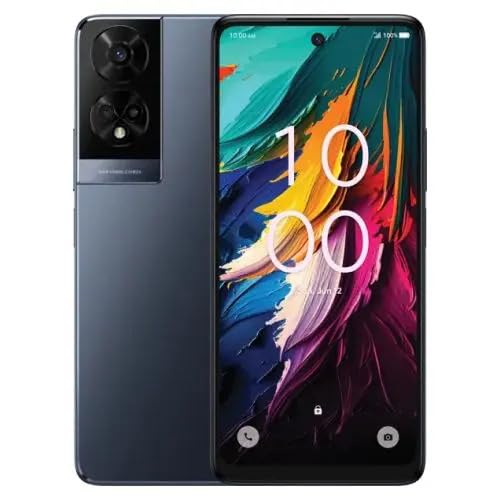
TCL 50 XE NxtPaper 5G — Easiest on the eyes
The TCL 50 XE exists because of a complaint most phone reviews treat as a footnote: screens are tiring. Its NxtPaper display uses a matte, paper-textured finish that scatters reflections instead of mirroring the sky back at you, and outdoors — exactly where LTE phones in this guide spend their lives — that difference is not subtle. Reading a long article on a sunny platform, following a recipe in a bright kitchen or working through messages on a bus all become calmer activities. The panel trades the punchy gloss of AMOLED for something closer to an e-reader’s manners, while remaining a full-colour, full-speed smartphone screen.
Underneath the display, the 50 XE is a mainstream budget 5G phone unlocked for the three big US carriers named in its listing, with 128GB of storage and a chipset aimed squarely at communication, browsing and video. Its LTE behaviour is unremarkable in the best sense: it connects, it stays connected, and its battery lasts the day without the screen brightness wars that glossy panels force on you outdoors. TCL also includes its NxtPaper viewing modes, which can soften colour for long reading sessions. Nobody will mistake it for a flagship, and that is precisely its charm — the money visibly went into the one feature its buyers actually asked about.
- Display: matte NxtPaper panel, roughly 6.6 inches, anti-glare finish
- Storage: 128GB
- Compatibility: unlocked for Verizon, T-Mobile and AT&T per listing
- Network: 5G with full LTE fallback and voice over LTE
- Reading modes: optional reduced-colour paper-style view
Strengths
- Glare-free screen that stays readable in sunlight where glossy phones wash out.
- Noticeably gentler for long reading, studying and document work.
- Carrier flexibility across the three national networks named in the listing.
Trade-offs
- The matte finish softens contrast and video punch compared with AMOLED rivals.
- TCL’s software support window is shorter than Samsung’s or Google’s.
- Camera output is serviceable rather than memorable in any light.
Best for: readers, students and outdoor workers whose main screen complaint is glare and eye strain. Not suited for: video enthusiasts who want the deepest blacks and richest colour available.

Nokia G310 5G (Renewed) — Tough renewed value
The Nokia G310 5G arrives in this guide with its condition stated plainly: this listing is a renewed unit, refurbished and resold rather than factory-sealed, and everything about the recommendation flows from that. What you get for accepting a renewed phone is a handset from HMD’s Nokia line that was designed for repair from the start — a removable back, replaceable battery and screen, and a build that tolerates the knocks of a working life. For a phone that may live in a truck cab, a site hut or a teenager’s backpack, that design brief matters more than thinness records.
Its Snapdragon-powered platform is a budget configuration, honest about its station: calls, messages, maps, music and light browsing flow fine, while heavy multitasking reveals the ceiling quickly. The camera is a documentation tool rather than an artistic one. But the LTE and 5G radios cover the US basics, battery replacement being easy transforms the long-term maths — a renewed phone whose tired battery can be swapped in minutes avoids the usual refurbished gamble — and the whole package suits buyers who treat phones as equipment. Judge it as a tough, fixable tool bought at a refurbished discount, and it makes a case nothing else here quite matches.
- Display: roughly 6.6-inch LCD
- Storage: 128GB
- Condition: renewed — refurbished unit, not factory-new
- Design: owner-repairable with replaceable battery and screen
- Network: 5G plus LTE, US unlocked per listing
Strengths
- Repairability turns the biggest renewed-phone risk — a worn battery — into a small errand.
- Sturdy construction suits work sites, delivery rounds and younger users.
- Straightforward software without heavy manufacturer decoration.
Trade-offs
- Renewed stock means cosmetic condition and battery health vary by unit.
- Performance headroom is thin; demanding apps will expose it.
- The camera records moments rather than elevating them.
Best for: practical buyers who want a fixable, knock-resistant phone and accept refurbished stock. Not suited for: anyone who wants a sealed-box guarantee or flagship speed.

Google Pixel 8a (Renewed) — Camera-first renewed pick
The Pixel 8a is the renewed listing that tempts people who swore they would never buy refurbished. Google’s A-series formula — take the flagship’s camera intelligence, wrap it in a simpler body, sell it for less — survives the renewed process intact, because the magic was always software. Its photographs, especially of people, food and dim restaurants, belong to a class above everything else in this guide, and its seven-year update commitment, announced for the Pixel 8 family, means a renewed 8a still has a long supported life ahead of it. That combination is rare at any price and remarkable in a refurbished listing.
As an LTE phone it behaves with Google’s usual competence: broad US band support, clean voice over LTE, and extras like Call Screen that earn their keep for people plagued by spam. The Tensor G3 inside is quick in daily use and powers the transcription, translation and photo-editing features that make Pixels feel clever. The honest cautions belong to the renewed label and the hardware class: battery health depends on the individual unit, charging is unhurried, and the phone can warm up under sustained camera or navigation loads. Buy it with eyes open about refurbished stock and it delivers the smartest experience in this line-up.
- Display: roughly 6.1-inch OLED with smooth refresh
- Storage: 128GB
- Condition: sold renewed — a refurbished handset, not new stock
- Platform: Google Tensor G3 with long update support
- Camera: computational photography led by Google’s processing
Strengths
- Photography that embarrasses new phones costing considerably more.
- Years of remaining software and security support despite its renewed status.
- Google’s call and voice features genuinely reduce daily friction.
Trade-offs
- Unit-to-unit variation in battery wear is the renewed buyer’s tax.
- Charging speeds trail the faster-wired rivals in this list.
- Sustained heavy use can make the body noticeably warm.
Best for: photo-led buyers happy to trade a sealed box for Google’s camera and software. Not suited for: buyers who need guaranteed-new battery health or the fastest charging.

HMD Fusion 5G — Repairable modular experiment
The HMD Fusion is the most unusual phone in this guide, and it knows it. Built by the company behind modern Nokia phones under its own name, the Fusion is a US-version handset designed around two ideas the rest of the industry abandoned: owners should be able to open it, and the back of a phone should do something. Its “Smart Outfits” are attachable backs that add functions — extra battery, gaming controls, a ring light — while the core phone underneath stays a sensible midrange device with a big screen and a clean software build.
Strip the outfits away and the fundamentals are respectable: a large display, 128GB of storage, a battery sized for a full day, and LTE plus 5G coverage aimed at US networks. The repairable construction — a back that comes off with screws rather than glue and prayer — means a cracked panel or tired battery is a repair, not a replacement. Performance sits in the competent middle, fine for communication, media and light gaming. The Fusion will not win benchmark arguments, and its accessory ecosystem is only as deep as HMD’s catalogue, but as a statement about what an affordable phone could be, it is the most interesting object on this page.
- Display: large panel, roughly 6.6 inches
- Storage: 128GB, US version in Noir Black
- Design: screw-open repairable body with attachable Smart Outfits
- Network: 5G plus LTE, unlocked US model
- Battery: full-day class, expandable via outfit attachments
Strengths
- Owner-level repairs keep the phone alive years beyond glued rivals.
- Modular backs add real functions rather than decorative novelty.
- Clean software and honest midrange performance for everyday work.
Trade-offs
- The outfit ecosystem is small, so check an accessory exists before wanting it.
- HMD’s brand and update track record are younger than the giants here.
- Camera and display sit a step below the Samsung and Pixel picks.
Best for: tinkerers and long-keepers who like the idea of a phone they can open and extend. Not suited for: buyers who want the deepest accessory market and longest-proven support.
How Do the Six Compare on the Things LTE Users Feel?
| Pick | Condition | Screen character | Endurance story | Defining strength |
|---|---|---|---|---|
| Galaxy A15 5G | New | AMOLED, vivid | Large battery, efficient panel | Long software support |
| Moto G Power 2025 | New | Big LCD, smooth scroll | Largest stamina brief here | Multi-day battery ambition |
| TCL 50 XE NxtPaper | New | Matte, paper-like | Full-day, glare-free use | Reading comfort outdoors |
| Nokia G310 5G | Renewed | Standard LCD | Replaceable battery | Tough, fixable build |
| Pixel 8a | Renewed | OLED, compact | Unit-dependent battery wear | Camera intelligence |
| HMD Fusion 5G | New | Large LCD | Full-day plus outfit options | Repairable modular design |
Read the table by lifestyle rather than by spec-sheet rank. The two renewed phones demand a condition check on arrival and reward it with value or camera quality. The two big-battery new phones — Motorola and Samsung — are the low-drama choices for weak-signal regions. The TCL and the HMD are the specialists, bought for a screen philosophy and a repair philosophy respectively, and both are more satisfying when that philosophy is genuinely yours.
What Should You Check Before Buying Any Phone for LTE Country?
Start with your carrier’s band map, not the phone’s advertising. Identify the low band your provider leans on in your county — each national carrier has one — and confirm the handset lists it. All six picks here are US-market listings, which keeps this simple, but the habit protects you everywhere else in phone shopping. Next, think about where the phone will physically live. A hand that holds a phone beside a metal workshop wall, or a pocket inside a delivery van, sees a weaker signal than the same phone by a window; phones with larger bodies and mature antenna designs, like the Motorola and Samsung here, tend to be forgiving in those spots.
Then be honest about your data habits. LTE in good condition streams music, navigation, video calls and standard-definition video without complaint; it is only sustained high-resolution streaming and large uploads that expose its ceiling. If your life is calls, maps, messages and music across a wide rural patch, every phone here is overqualified on speed and should be judged on battery, screen and durability instead. If you regularly upload video from the field, your bottleneck will be the network, not the handset, and the answer is a carrier conversation rather than a more expensive phone.
Finally, price the whole ownership, qualitatively: a renewed phone plus a fresh battery and case can undercut a new rival while lasting as long; a new phone with years of updates can outlast two cheap replacements. There is no universal winner, only the arithmetic of your own replacement habits.
How Do You Get the Best From a Phone on Weak LTE?
Begin at setup: let the phone finish its carrier provisioning and software updates on Wi-Fi before judging its signal, because fresh handsets often ship with older radio software. In the network settings, leave the preferred mode on automatic — forcing a phone to hunt for 5G at the edge of coverage wastes battery and can make calls less stable, while automatic mode lets it settle on the LTE carrier that actually reaches you. Turn on Wi-Fi calling at home if your indoor signal is thin; it routes calls over your broadband with the same number, and it is the single biggest quality-of-life upgrade available to rural owners.
Manage the battery for radio reality. Weak-signal days drain phones faster, so carry the cable, use the car’s charger on long drives, and treat a power bank as standard kit if your work is outdoors. Download maps, playlists and podcasts over Wi-Fi before leaving coverage-rich areas; offline content does not care what the signal meter says. If a particular building defeats every phone, a carrier-approved signal booster for that building is a legitimate fix — but buy it from the carrier’s own guidance, register it as required, and never trust miracle-antenna stickers.
Keep the software current. Radio behaviour improves quietly through updates, and the picks with the longest support windows — Samsung and Google — keep receiving those refinements for years. On a renewed phone, add one extra ritual: check battery health in the first days, while returning a tired unit is still simple.
What Mistakes Do Buyers Make in This Category?
The classic error is paying for a network badge instead of a network experience — choosing a phone for its 5G logo while ignoring the LTE bands and battery that will define most of its working life. A close second is importing a cheap variant built for another continent: it may light up on one band in a city and fall apart in the countryside, and its listing rarely advertises the omission. Every pick in this guide is a US listing precisely to keep that trap shut.
Renewed phones attract their own pair of mistakes: assuming “renewed” means either “like new” or “barely alive,” when the truth is a graded middle that varies by seller, and failing to test the phone hard in its return window — battery, cameras, speakers, charging port, signal in your weakest-signal room. The Nokia and Pixel here reward a careful first week. The final mistake is forgetting voice: with 3G gone, a phone needs proper voice-over-LTE support on your carrier, and grey-market handsets are where that quietly fails.
Final Recommendation
Most readers should start with the Galaxy A15 5G: it is new, sensibly priced in its class, supported for years, and calm on the weak signals that define real LTE territory. If your days are longer than a battery’s patience, the Moto G Power 2025 is the honest workhorse. The TCL belongs to readers, the renewed Pixel 8a to photographers, the renewed Nokia to people whose phones get dropped for a living, and the HMD Fusion to anyone who wants to open their phone with a screwdriver instead of a prayer. Pick by the life the phone will actually live, and LTE stops sounding like a compromise — it becomes the part of the network that was working for you all along.
How Does Each Carrier’s LTE Footprint Change the Choice?
Carrier choice shapes this purchase more than handset choice, so it deserves plain language. Verizon built its reputation on low-band LTE reach and still leans on those far-travelling frequencies outside cities; any US-unlocked phone here, including the TCL that names Verizon in its listing, rides that network properly. T-Mobile pairs the widest low-band rural expansion of recent years with aggressive mid-band capacity, and its LTE layer remains the fallback under all of it. AT&T’s footprint is broad and its FirstNet-adjacent build-out improved coverage in places that used to be dead zones. The practical lesson is identical across all three: buy the US version of a phone, confirm the low band your carrier uses locally, and let the handset’s automatic mode do the switching.
Regional carriers and MVNOs — the prepaid brands running on the big three’s towers — inherit the same LTE layers, so these unlocked picks suit them too, provided the specific brand activates the model without fuss. That is one more argument for the mainstream names in this guide: Samsung, Motorola, Google and Nokia devices activate cleanly almost everywhere, while exotic hardware can meet an unhelpful whitelist. If your service comes from a smaller provider, a two-minute compatibility check with your IMEI after purchase, inside the return window, settles the question with evidence instead of hope.
A Second Look at Each Pick, One Honest Paragraph at a Time
Return to the Galaxy A15 5G after a month of imagined ownership and its story is consistency. Nothing about it spikes — not the camera, not the gaming speed — and nothing about it sags either. For a reader whose last phone died mid-contract and who never wants to think about phones again, that evenness is the product. Samsung’s scale also means every repair shop knows it and every carrier counter recognises it, a support ecosystem no spec sheet captures.
The Moto G Power 2025, revisited, is really a decision about pockets and patience. You accept a big slab of phone, and in exchange whole categories of anxiety — the 4 p.m. battery warning, the borrowed charger, the dimmed screen to save power — leave your life. People who work outdoors consistently rank that trade among the best in budget phones, and this generation’s extra polish does not dilute the bargain.
With the TCL 50 XE, the question to ask yourself is how you read. If your phone is a newspaper, a novel and a stack of documents, the matte panel stops being a curiosity and becomes the point of the device; glare-free text at a bus stop in July is a daily pleasure, not a demo trick. If your phone is mostly a television, the same panel works against you, and the Samsung’s AMOLED is the wiser home for your hours.
The renewed Nokia G310 asks for a particular kind of owner: one who hears “the battery is replaceable” as good news rather than a warning. Its renewed status and modest speed mean it will never be the phone you show off. It is the phone that survives the drop onto concrete, gets its battery swapped on a kitchen table in its third year, and is still taking calls while sleeker rivals queue for expensive screen repairs.
For the renewed Pixel 8a, the honest framing is that you are buying Google’s software and camera at a refurbished discount, and accepting refurbished uncertainty as the fee. Photograph your family with it for a weekend and the fee usually feels trivial. Its remaining years of updates mean the phone you buy used will still be receiving fresh features when many new budget phones have been forgotten by their makers.
The HMD Fusion, finally, is a bet on a philosophy: that phones should open, adapt and be repaired by the people who own them. Its outfits will not suit everyone, and HMD’s catalogue is young. But a buyer tired of sealed glass slabs may find that holding a phone designed to be taken apart changes how disposable the whole category feels — and that feeling, for the right owner, is worth more than a benchmark lead.
How Long Will Each of These Phones Stay Supported?
Support windows decide whether an LTE phone ages gracefully, because radio fixes, security patches and app compatibility all ride on them. Samsung’s recent A-series policy stretches to several years of security updates, which is why the A15 anchors this guide for set-and-forget buyers. Google’s commitment to the Pixel 8 family is the longest in this line-up, a genuine asset for the renewed 8a: its software future is brighter than its hardware past. Motorola’s budget support is shorter — a couple of major updates and a security window measured in fewer years — which suits its lower-maintenance audience but caps its lifespan for keepers.
TCL and HMD publish more modest timelines, and Nokia’s G310, already a renewed unit from an earlier season, should be bought for what it does today rather than for a long update runway. None of this makes the shorter-supported phones bad purchases; it changes the maths. A phone you plan to replace in two years can be judged purely on today’s behaviour, while a phone meant to serve a parent or a business line for four years should be chosen from the long-support end of this list. Match the support window to the ownership window and the category becomes simple.
How Can You Test a New Phone’s LTE Manners in the First Week?
Treat the return window as a field trial with a route you already know. On day one, drive or walk your weakest-signal journey — the valley road, the far side of the warehouse, the relative’s farmhouse — with your old phone’s behaviour fresh in memory, and note where calls hold, where data stalls and where the new handset gives up entirely. Repeat one indoor test: the room in your home furthest from windows, with a call and a video stream attempted at the same hour on two different days. Phones are consistent creatures; a handset that struggles twice in your worst room will struggle there for years, and the time to learn that is while a return label is still free.
Watch the battery as a signal instrument. A phone that loses a fifth of its charge during a morning in a fringe area is telling you its radio is working overtime, which is normal there — but compare it against your old phone on the same route. If the new handset drains dramatically faster while delivering no better connection, something is wrong with that unit or that model pairing with your carrier. On renewed phones, add the health checks: photograph something in dim light, record a voice memo, charge from empty and time it loosely, and run the speaker at full volume. Ten minutes of deliberate testing protects a year of ownership.
Also test the handover moments most reviews ignore. Start a call at home, walk out to the car and drive away: the phone should pass between Wi-Fi calling and LTE without dropping the conversation. Join a video call on the move and notice whether quality degrades in steps or collapses at the first weak patch. These transitions, repeated daily, are where mature radio software earns its reputation, and they are a large part of why the mainstream brands in this guide feel calmer than their specifications suggest.
Which Accessories Actually Matter for a Weak-Signal Life?
Very few, and that honesty saves money. A good case matters because phones in this category live outdoors, in cabs and on sites; buy grip and corner protection rather than decoration, and avoid thick metal cases, which can blunt reception at exactly the margins this guide cares about. A reliable car charger matters more than any booster gadget, because a phone navigating on a weak signal in a moving vehicle is doing the hardest radio work there is, and arriving with charge left is a safety feature. A power bank in the work bag completes the trio.
What about signal boosters? The legitimate kind — carrier-registered, sold for a specific building, with an outdoor antenna — genuinely helps a fixed location like a house or workshop, and every pick here will benefit from one equally. The illegitimate kind — stickers, passive patches, miracle apps — does nothing measurable, and no phone purchase should be justified by pairing it with one. Spend on the case, the charger and, if your home is the dead zone, a proper registered booster or simply Wi-Fi calling, which every phone in this guide supports and which costs nothing at all.
One more accessory deserves a sentence for the renewed picks: a fresh battery, where the design allows it. The Nokia G310’s replaceable cell means a renewed unit can be returned to full stamina for the cost of a part, and even for sealed phones, a reputable battery service in year two can be smarter than a replacement phone. Ownership thinking like this is the real subject of this category — not the badge on the box, but the years of Tuesdays the phone has to survive.
What Does a Day on LTE Actually Feel Like on Each Pick?
Numbers flatten experience, so consider three ordinary days. A delivery driver leaves a depot at dawn with the Moto G Power 2025 mounted on the dash: navigation all morning across suburbs where the signal swings between strong 5G and workhorse LTE without the driver ever noticing a seam, a podcast streamed through the gaps, dispatch messages arriving in a farm-road hollow where the phone drops to its low band and carries on. By the evening return, the battery gauge still shows a comfortable remainder — that, in one day, is the entire argument for the phone.
A nursing student on night shifts carries the TCL 50 XE instead. Her phone time is reading: lecture PDFs in a bright canteen, revision notes on a bus with sun raking across the seats, messages in a ward corridor where the network is pure indoor LTE. The matte screen never once turns into a mirror, the connection never once becomes the story, and she charges the phone while she sleeps like everyone else. Nothing dramatic happens, which is the review.
And a grandfather in a rural county town takes the renewed Pixel 8a to a family barbecue, photographs grandchildren in the awkward light of early evening, and produces the pictures everyone asks to have sent to them. His calls to the house landline-quality line run over the low band that reaches his farmhouse, his battery — checked carefully in the first week, as this guide advises — holds through the day, and the phone’s remaining update years mean his grandchildren will not be re-teaching him a new handset any time soon. Three different lives, three different definitions of “best,” all of them running mostly on LTE.
That spread is why this guide refuses to crown a single winner by specification. The network layer underneath all six phones is mature, shared and largely invisible; what differs is the object in your hand — its screen in sunlight, its battery at dusk, its camera at a birthday, its back panel under a screwdriver. Choose the object that fits the hand and the life, verify it in your own worst-signal places during the first week, and the LTE question answers itself.
Should You Care About LTE Speed Tests at All?
Only as a diagnostic, never as a ranking. A speed test run beside a tower tells you about that tower at that minute; the same phone in a valley at rush hour will post a number a fraction as large, and both results are true. What matters for daily life is a threshold, not a maximum: once a connection comfortably carries calls, maps, music and standard video, additional megabits change almost nothing you feel. Every phone in this guide crosses that threshold wherever LTE coverage is genuinely present, because the bottleneck in 2026 is the cell, the distance and the building — rarely the handset’s modem.
Where tests do help is comparison on your own ground. Run the same test, in the same weak room, at the same hour, on your old phone and a candidate new one during its return window. If the new handset consistently holds a call and a stream where the old one stumbled, you have learned something real about antenna behaviour on your carrier’s bands. If both stumble identically, the tower is the limit and no purchase will fix it — spend the money on Wi-Fi calling setup or a registered booster instead. That discipline, testing on your own map rather than a reviewer’s, is the most valuable habit this category teaches.
Upload speed deserves one separate mention, because it is where LTE’s age shows. Sending a large video from the field, backing up a photo library from a cabin, or running a hotspot for a laptop will all feel the ceiling sooner on LTE than the download side suggests. Field reporters, site managers sending inspection footage and creators working remotely should weight that honestly: among these picks, the newer platforms with the most mature modems handle sustained uploads most gracefully, but no handset repeals the physics of a distant tower. Plan around it — compress, schedule, or send from town — and the limitation becomes a workflow rather than a frustration.
Frequently Asked Questions
Will LTE networks be switched off soon?
No announced shutdown threatens LTE in the US; carriers retired 3G, and LTE remains the coverage foundation beneath 5G for the foreseeable future. A phone bought for strong LTE behaviour is not buying into a dying network.
Is a 5G phone automatically good on LTE?
Mostly, but not automatically. Band coverage, antenna design and how gracefully the phone falls back all vary. US-market phones from major brands, like every pick here, handle the domestic LTE set well; obscure imports are where gaps hide.
Are the renewed picks in this guide a safe buy?
They are a reasonable buy when purchased knowingly: test battery health, cameras and charging during the return window. The Nokia G310’s replaceable battery lowers the long-term risk, and the Pixel 8a’s long update runway keeps its software young.
Does LTE drain a battery faster than 5G?
Signal strength drains batteries more than the network generation does. Any phone working hard to hold a weak signal — LTE or 5G — uses more power, which is why large batteries earn their place in this category.
What does voice over LTE mean for me?
It means your calls travel on the LTE network, which is now the only path since 3G closed. Every pick here supports it on US carriers; it is mainly a concern with grey-market imports.
Can these phones use Wi-Fi calling in dead zones?
Yes — all six support Wi-Fi calling on the major US carriers, which is the practical answer to a house or office where no cellular signal reaches reliably.
Does travelling abroad change which pick is best?
Somewhat. US-market phones cover the domestic LTE bands first, and their band lists usually include the common European and many global frequencies, but a handset bought for American LTE is not guaranteed to be a world phone. The Samsung and Google picks here have the broadest travel manners of the six; if you roam often, check the destination bands against the exact model’s list before departure, and consider a local eSIM or physical SIM on arrival, which every pick can accommodate in some form.
Should I keep my old phone as a backup for weak-signal trips?
If it still holds a charge and supports voice over LTE, yes — a drawer phone with a prepaid SIM on a different carrier is the cheapest coverage insurance there is, because the network that fails you at home is rarely the network that fails you two counties away. Several readers of guides like this one run exactly that arrangement on hunting, fishing and contracting trips, and it has rescued more journeys than any single handset upgrade.
Can one of these phones replace home broadband as a hotspot?
For light duty — a laptop, some email, a child’s homework during an outage — yes, and the big-battery Motorola shrugs at the workload longest. As a permanent household connection it is a weaker idea: carrier hotspot allowances, congestion and the phone’s own heat all push back, and a dedicated home internet service or mobile hotspot device will serve a family better. Treat phone hotspot duty as a brilliant backup rather than a foundation.
Is it worth switching carriers instead of phones for better LTE?
Sometimes, and it is worth ruling out before spending anything. Borrow a SIM or a friend’s phone on a rival network and stand in your worst-signal room: if that carrier’s low band reaches you strongly, the cheapest “upgrade” in this entire category is a network move, and every unlocked pick in this guide will follow you to the new carrier. If all networks fade in the same places, the problem is geography, and the right spending is on the phone with the best battery and Wi-Fi calling habits — plus, at home, the broadband connection that carries your calls anyway. Diagnose first; the handset is only one of three variables, and often not the weakest.
Related Guides
One last word before the links: the phones in this guide will be judged, fairly, by the worst Tuesday of their year — the storm-day drive, the dead-zone job site, the farmhouse kitchen at the end of a long valley. Every recommendation above was made with that Tuesday in mind, which is why batteries, bands and repairability outrank benchmark scores here. Buy for the bad day and the good days take care of themselves.
Keep exploring with our companion coverage: best smartphones for rural areas, best budget 5G phones and best phones with long battery life.
Related guides
- Best Canon Point and Shoot Digital Cameras: PowerShot Picks From Pocket Compacts to Travel Zooms
- Best Balancing Stabilizers for Mirrorless Cameras: Payload, Balancing and Native Vertical Shooting
- Best Basic Phones Camera Buyers Can Trust: Flip Phones and Simple Handsets That Still Take a Photograph
- Best Sony Full Frame Cameras for Astrophotography: Sensitivity vs Resolution


