What's inside
- Key Takeaways
- Quick Picks
- How We Chose These Picks
- Adapter or Converter: What Is the Difference That Matters?
- Which Sockets Will You Actually Meet?
- How Should You Pack and Use a Travel Adapter on the Road?
- What Changes on Trains, Boats and Long Stays?
- How Should Families Charge Abroad Without the Nightly Argument?
- What Safety Details Separate a Good Adapter From a Risky One?
- How Do You Choose Between the Two EPICKA Adapters?
- What Should a Working Traveller’s Hotel-Desk Setup Look Like?
- How Much Charging Power Does a Holiday Actually Need?
- What Should You Check the Week Before Departure?
- How Do You Handle the Destinations Universal Adapters Miss?
- Why Do Travellers End Up Owning Two Adapters?
- What About Charging on the Journey Itself?
- Which Adapter Belongs in a Second Home or a Student Flat Abroad?
- One Adapter, Six Temperaments: The Travel Line-Up Compared
- What Mistakes Do Travellers Make With Adapters and Chargers?
- Final Recommendation
- Frequently Asked Questions
- Related Guides
As an Amazon Associate I earn from qualifying purchases. This post may contain affiliate links at no extra cost to you.
gizmoverdict.com is reader-supported. When you buy through links on our site, we may earn an affiliate commission.
Where to buy: Order through the Amazon link in the Quick Picks table or in each review heading, and check price on Amazon there. Before a trip, confirm on the listing that the adapter covers your destination’s plug type — coverage lists differ between models that look alike.
The best chargers for international travel do two jobs that are often confused: they physically fit foreign sockets, and they feed your devices once fitted. A universal travel adapter handles the first job with sliding pins for the EU, US, UK and Australia; the chargers gathered here add USB ports — increasingly GaN-powered and fast — so the same block that adapts the socket also charges the phone, tablet and laptop gathered around it. One object in the bag, every socket in the world, no drawer of country-specific bricks.
This guide treats the adapter as the centre of the travel kit rather than an afterthought bought at the airport, because that is how it behaves in practice: every device you own passes through it nightly, and its failure is the one failure that cannot be worked around with a borrowed cable. A borrowed cable still needs a socket it can use. Spend the ten minutes this guide asks for, and the subject never needs your attention again.
Choose by itinerary. A single traveller with a phone and earbuds needs far less than a working traveller whose laptop must charge nightly in Lisbon, London and Sydney on the same trip. The six picks below run from a featherweight 20W two-pin specialist to 70W GaN adapters that can run a small office from a hotel desk, with honest notes on what each leaves behind.
Key Takeaways
- Adapters change shape, not voltage — your modern USB devices handle voltage themselves, but a hair dryer is a different story.
- EPICKA’s standard universal adapter is the coverage anchor: one AC outlet plus five USB ports across EU, US, UK and AUS sockets.
- The 70W EPICKA and 65W TESSAN add GaN fast charging, enough for a laptop at a hotel desk.
- Anker’s Nano adapter is the minimalist’s pick — two USB-C ports and 20W in a two-pin design for light packers.
- SAUNORCH is the budget veteran: older, slower ports, very forgiving price.
- Ceptics’ 45W model sits in the middle, with five USB ports and universal input.
Quick Picks
| Pick | Badge | Why it earns its place |
|---|---|---|
| EPICKA Universal Travel Adapter | Coverage anchor | One AC outlet, five USB ports split between the C and A generations, and pins for the EU, US, UK and Australia. |
| EPICKA 70W GaN Universal Travel Adapter | GaN step-up | Seventy watts of GaN PD charging across a five-port USB mix for laptop travellers. |
| TESSAN Universal Travel Adapter 65W GaN | Extra outlet | GaN charging plus an extra two-prong AC outlet and five USB ports for shared rooms. |
| Anker Nano Travel Adapter (2 USB-C, 20W) | Minimalist | A compact two-pin adapter with two USB-C ports and temperature monitoring for light kits. |
| SAUNORCH Universal Travel Adapter | Budget veteran | Worldwide coverage with three USB-A ports and a Type-C port at a forgiving price. |
| Ceptics 45W Universal Travel Adapter | Middle path | Forty-five watts across three USB-A and two USB-C ports with universal input. |
How We Chose These Picks
Coverage came first: every pick adapts to the major socket families a leisure or business traveller actually meets — European, American, British and Australian at minimum — in a single unit with sliding or interchangeable pins, because a bag of separate country plugs is a bag waiting to lose the one piece you need. We then separated the field by charging ambition, from simple USB convenience ports to GaN models that fast-charge a laptop.
We also weighed the morning-after test: how an adapter behaves at checkout time, tired, in a hurry. Sliding pins that retract cleanly, a body that pulls from a stiff socket without a fight, and a size that drops into a pouch without snagging are worth real money on the twentieth morning of a trip, and the picks here were chosen partly on that unglamorous evidence.
Safety and honesty shaped the shortlist. Travel adapters are passive devices carrying mains power, so established accessory brands and clear listings mattered more here than in almost any other category we cover. We also read the port arithmetic carefully: an adapter whose USB ports share a modest pool suits phones and earbuds, while the GaN picks were chosen for travellers who genuinely charge a computer abroad. Finally, we included one deliberate minimalist and one deliberate budget veteran, because not every trip justifies the flagship.
Adapter or Converter: What Is the Difference That Matters?
An adapter changes the shape of the plug. A converter changes the voltage of the power. Modern phone, tablet and laptop chargers — including every USB port on every pick in this guide — are built for the world’s voltage ranges, so they need only the adapter’s shape. The danger zone is single-voltage appliances from home, above all hair dryers, straighteners and kettles, which can cook themselves on foreign voltage even through a perfectly fitting adapter.
The rule for packing is simple: if it charges over USB or its label lists a wide input range, bring it with any pick here. If it heats, spins or was bought cheaply for one country’s voltage, leave it home and use the hotel’s, or buy a local one at the destination. Every adapter below includes an AC pass-through outlet for a charger or similar load; treat that outlet as a home for your laptop brick, not for a hair dryer, and your trip will stay drama-free.
Which Sockets Will You Actually Meet?
Continental Europe runs on round two-pin sockets, Britain on three rectangular pins, Australia and China on angled flat pins, and North America and Japan on flat parallel pins. The universal adapters here cover those families with sliding pins, which handles the overwhelming majority of itineraries. A few destinations sit outside the universal umbrella — parts of South Asia, South Africa and some older installations elsewhere use their own shapes — so travellers headed off the standard circuit should check a plug chart for their exact stops before relying on any single adapter.
Socket shape is only half the encounter; socket behaviour is the other half. Hotel rooms hide outlets behind beds, ration them to one per room, or place them at ankle height where a bulky adapter sags. Cruise ships and older European trains add their own scarcity. The adapters with several USB ports earn their space in these rooms precisely because one occupied socket must serve the whole device pile — the adapter becomes the room’s charging station, not merely a shape-shifter.

EPICKA Universal Travel Adapter — Coverage anchor
EPICKA’s standard universal adapter is the reference design of this category: sliding pins for EU, US, UK and Australian sockets, one AC outlet on the face, and five USB ports — three USB-C and two USB-A — wrapped around the body. It is the adapter that lives permanently in thousands of suitcases, and its popularity is earned the unglamorous way: it fits, it works in the next country too, and it charges the whole phone-and-earbuds pile from the room’s one reachable socket.
The port mix reflects how people actually travel now. USB-C ports serve the phone, tablet and earbuds case; the USB-A pair keeps older cables, a partner’s watch puck lead and the occasional camera battery charger in business. The AC outlet takes your laptop’s own brick, which is the honest division of labour for this class: the adapter adapts and distributes, the laptop keeps its dedicated power supply. Expect phone-class speeds from the USB ports rather than laptop fast charging — that is the 70W sibling’s department.
For a first universal adapter, or the household spare that lives in the family suitcase, this is the default recommendation. It is not the fastest or the smallest pick here, but it is the one whose absence on a trip would be felt most, and the one whose coverage list matches the destinations most travellers actually visit.
One practical note from long use of this design: learn the pin sliders at home, on your kitchen table, before the trip. Each region’s pins deploy with a particular slide and click, and discovering the British set for the first time in a dark hotel room at midnight is a rite of passage best skipped. Thirty seconds of practice per region turns the adapter into muscle memory, and the same practice run is the moment to confirm every slider still locks firmly — a loose pin set is the one fault worth catching before departure.
- Socket coverage: EU, US, UK and AUS pin sets in one body
- AC provision: one pass-through outlet
- USB line-up: three USB-C and two USB-A ports
- Charging class: phone-and-accessory speeds from the USB ports
- Role: the all-rounder most suitcases should contain
Strengths
- Five USB ports end the one-socket hotel problem.
- Proven universal design across the major socket families.
- AC outlet keeps a laptop brick in play abroad.
Trade-offs
- USB output is for phones and small gear, not laptop fast charging.
- Bulkier than the minimalist Anker below.
- One AC outlet means the laptop brick still travels with you.
Best for: leisure travellers and families who want one adapter to cover the standard world tour. Not suited for: a working traveller hoping to leave the laptop brick at home.
EPICKA 70W GaN Universal Travel Adapter — GaN step-up
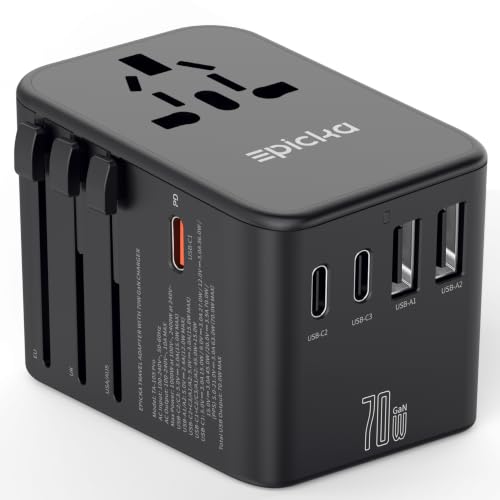
Take the anchor above and rebuild it around a 70W GaN charging engine: that is this EPICKA. Three USB-C and two USB-A ports now draw from a pool deep enough for PD fast charging a laptop, which changes the packing list fundamentally — the laptop’s own brick can stay home, and the adapter alone runs the hotel desk. For the working traveller, that is the difference between a charging accessory and a charging system.
Seventy watts shared is still shared, so set expectations by scenario. Laptop alone: full pace. Laptop plus a phone: both content. Laptop, phone, tablet and earbuds at once: the laptop’s slice thins, and an overnight window hides it entirely. GaN keeps the body travel-sized despite the output, and the universal pins cover the same EU, US, UK and Australian ground as its sibling.
Choose this over the standard EPICKA when the laptop genuinely travels and works abroad; choose the standard one when the laptop stays home or keeps its brick. The price gap buys exactly one thing — laptop-class charging — and travellers who need it will feel the value every single night of a working trip.
Working travellers should also appreciate what this adapter does to the desk footprint abroad. A hotel desk usually offers a lamp, a phone and one socket; the GaN EPICKA turns that socket into laptop power, phone charging and accessory top-ups without a power strip snaking across the workspace. Video calls from hotel rooms — now a standard part of business travel — stop being a battery negotiation, because the laptop simply lives plugged in, and the evening’s charging and the day’s working draw from the same small object.
- Charging engine: 70W GaN with PD fast charging
- Ports on board: a trio of USB-C sockets flanked by two USB-A
- Socket coverage: EU, US, UK and AU families
- Packing consequence: the laptop brick can stay home
- Maker line: EPICKA’s step-up from its standard universal adapter
Strengths
- Laptop-class GaN charging inside a universal adapter.
- Five USB ports cover the full travel pile.
- Removes a separate brick from the bag entirely.
Trade-offs
- The 70W pool divides when several devices charge together.
- Pricier than the standard adapter it resembles.
- Still an adapter for voltage — heating appliances stay home.
Best for: business travellers and remote workers whose laptop charges nightly in foreign hotels. Not suited for: a phone-only holiday kit, where the standard EPICKA or the Anker Nano suffices.

TESSAN Universal Travel Adapter 65W GaN — Extra outlet
TESSAN’s entry competes on a feature the others underplay: an extra two-prong AC outlet alongside its GaN charging, plus five USB ports. Two travellers sharing one hotel socket understand the value instantly — the adapter feeds the USB pile while the spare outlet takes a partner’s charger, a camera battery unit or a CPAP-adjacent small load that cannot sip from USB. In socket-poor rooms, an extra outlet is not a luxury; it is the whole negotiation.
The charging side is serious: 65W of GaN output runs a laptop at a hotel desk and keeps phones moving, sitting a small step below the EPICKA 70W in ceiling while offering the friendlier socket arrangement. TESSAN has built a steady reputation in travel power specifically, and this model feels designed by people who have shared a room with one working outlet — which, on the evidence of hotel design worldwide, is most rooms.
Pick it for shared travel: couples, colleagues in a twin room, a parent charging a family’s devices from the one socket the children have not claimed. Solo laptop travellers may prefer the EPICKA’s extra watts; everyone else should weigh the outlet heavily, because on the road, sockets — not watts — are the currency that runs out first.
TESSAN’s extra outlet also rescues a specific traveller: the one whose companion device refuses USB charging. Travel kettles are out of bounds for voltage reasons, but a partner’s older laptop brick, a camera charger with its own plug, or a medical device’s dedicated supply all need a real socket, and in a one-socket room the TESSAN is the difference between taking turns and charging together. That unglamorous generosity is why this adapter, rather than a marginally stronger rival, gets the shared-room recommendation.
- Charging engine: 65W GaN output
- Socket bonus: an extra two-prong AC outlet
- USB line-up: five USB ports in total
- Socket coverage: international pin sets for the major regions
- Natural setting: shared hotel rooms with scarce outlets
Strengths
- The spare AC outlet solves the shared-room problem directly.
- 65W GaN charging covers a working laptop plus phones.
- Five USB ports swallow a family’s small devices.
Trade-offs
- A shade less total wattage than the EPICKA 70W.
- The extra outlet serves two-prong plugs; three-prong gear still needs the main face.
- Size grows with the feature list — not a minimalist’s pick.
Best for: couples and colleagues sharing hotel rooms and their single usable socket. Not suited for: an ultralight solo packer counting every gram and cubic centimetre.

Anker Nano Travel Adapter (2 USB-C, 20W) — Minimalist
Anker’s Nano adapter rejects the Swiss-army approach entirely. It is a compact two-pin adapter — the European-style format — with two USB-C ports delivering up to 20W and smart temperature monitoring watching over them. No sliding pin zoo, no AC face crowded with ports: just the smallest respectable way to charge a phone and one companion in the many countries where two round pins rule.
Honesty about wattage is essential here. Twenty watts fast-charges a phone respectably and keeps a tablet or earbuds fed, but it will not run a laptop beyond a desperate trickle, and Anker does not pretend otherwise. What you get for that restraint is a genuinely pocketable object with Anker’s temperature-monitoring safety habits, from the line that made small chargers a category. For a city-break kit — phone, watch, earbuds, nothing else — it is arguably the most elegant pick in this guide.
Its limits are geographic as well as electrical: a two-pin specialist serves Europe and other two-pin regions, not Britain’s three-pin sockets. Travellers whose map is mostly European weekends will find it perfect; travellers crossing to the UK need one of the universal models instead. Buy it as a specialist and it delights; buy it as a universal adapter and it will strand you in London.
There is a packing philosophy embodied in this little adapter worth stealing even if you buy a different pick: carry the smallest thing that covers the trip you are actually taking. The Nano’s owner packs for a Lisbon weekend with a phone and a watch, and the kit fits a jacket pocket; the universal adapters’ owners pack for uncertainty, and their kits fit a suitcase corner. Neither is wrong — but matching the object’s ambition to the itinerary’s ambition is the skill that separates travellers who glide from travellers who haul.
- Format: compact two-pin travel adapter
- USB line-up: two USB-C ports
- Output ceiling: 20W — phone-class charging
- Safety habit: smart temperature monitoring
- Coverage: two-pin regions such as continental Europe
Strengths
- Genuinely pocket-sized for light travel kits.
- Two USB-C ports match a phone-plus-one routine.
- Anker’s temperature monitoring adds peace of mind.
Trade-offs
- 20W cannot charge a laptop meaningfully.
- Two-pin only — no UK or universal coverage.
- No AC pass-through outlet for a separate brick.
Best for: light packers touring two-pin countries with a phone and one small companion device. Not suited for: a UK itinerary or any trip where a laptop must charge.

SAUNORCH Universal Travel Adapter — Budget veteran
SAUNORCH’s adapter has been riding in budget travellers’ bags for years, and its formula is unfashionable but sound: worldwide pin coverage, three USB-A ports rated at 2.4A and a Type-C port at 3.0A, all at a price that makes losing it a shrug rather than a claim on the travel insurance. Backpackers, gap-year travellers and anyone outfitting several family suitcases at once are its natural constituency.
Set expectations in period terms. USB-A at 2.4A charges phones and tablets at yesterday’s comfortable pace, not today’s fast-charge sprint, and the Type-C port’s 3.0A is a current figure, not a PD laptop supply. Overnight, none of that matters — everything is full by morning. During a ninety-minute airport layover with a hungry phone, it matters a great deal, and the GaN picks above will leave this one behind.
Its virtues are coverage and price, and for slow travel — hostels, long stays, unhurried mornings — those virtues are the right ones. Buy two for less than one flagship, keep one in each bag, and forgive the speeds. Buy it for a working trip with a laptop and tight turnarounds, and you have saved money in the wrong place.
Students heading out on a year abroad are this adapter’s quiet success story. It covers the home-leaving present, the semester’s side trips and the summer’s backpacking in one purchase a student budget survives, and its standard-speed ports match the pace of a life where the hostel bunk, not the layover, is the charging station. If it dies in month nine, its replacement costs less than the taxi to the airport — a resilience strategy the premium picks cannot match at their prices.
- Socket coverage: worldwide universal pin sets
- USB line-up: three USB-A ports plus one Type-C port
- Port ratings: 2.4A on USB-A, 3.0A on Type-C, per the listing
- Charging class: standard speeds, overnight-friendly
- Buying logic: inexpensive enough to outfit several bags
Strengths
- Full universal coverage at a backpacker price.
- Four USB ports handle phones, tablets and accessories.
- Cheap enough to duplicate across family luggage.
Trade-offs
- No PD fast charging and no laptop-class output.
- USB-A-heavy layout feels dated beside USB-C kits.
- Build and finish reflect the budget brief.
Best for: budget travellers, backpackers and families equipping several suitcases at once. Not suited for: a professional trip where charging speed between meetings matters.

Ceptics 45W Universal Travel Adapter — Middle path
Ceptics splits the difference in this guide: 45W of charging — more than convenience ports, less than the GaN flagships — across three USB-A and two USB-C ports, with universal input and the pin coverage for international work. Forty-five watts is a considered figure. It fast-charges phones properly, keeps tablets happy, and can sustain a modest laptop or rescue a bigger one slowly overnight, which covers a large share of real itineraries.
Ceptics is a travel-adapter specialist rather than a general accessories brand, and the range shows it: the company sells into the details of world travel, and this model’s universal input framing is aimed at travellers crossing several regions on one trip. The port balance — USB-A still in the majority — suits travellers whose cables and devices span generations, a common reality on family trips where a parent’s new phone shares the adapter with a child’s older tablet.
Choose the Ceptics when the EPICKA 70W feels like overkill but the standard adapters feel underpowered, or when your device pile is genuinely mixed old and new. It is the compromise pick in the honourable sense: nothing about it leads the guide, and nothing about it will embarrass you in a hotel room on any continent it covers.
Ceptics also suits the traveller who rents cars and works from cafés across a region: the adapter’s universal input means the same object serves the Lisbon flat, the London hotel and the Sydney motel on one long itinerary, while its mid-level power keeps a tablet-based workflow — maps, documents, video calls — fed without the flagship adapters’ bulk or cost. It is the pick of the pragmatist who changes countries more often than devices.
- Charging ceiling: 45W across the USB ports
- USB line-up: three USB-A and two USB-C ports
- Input: universal input for international use
- Maker angle: travel-adapter specialist brand
- Device fit: phones fast, tablets well, laptops modestly
Strengths
- 45W is a well-judged middle for mixed device piles.
- Five ports with both USB generations represented.
- Specialist maker with a travel-first catalogue.
Trade-offs
- Cannot match the GaN picks for laptop charging pace.
- USB-A majority will age as kits go all-USB-C.
- Less distinctive than the picks above and below it.
Best for: travellers with mixed old-and-new devices who want one mid-powered universal adapter. Not suited for: a power user running a hungry laptop plus two phones at full speed nightly.
How Should You Pack and Use a Travel Adapter on the Road?
Keep the adapter in your hand luggage, always. Checked bags get lost on exactly the trips where charging matters most, and a phone arriving at a foreign airport with a low battery is a traveller without maps, bookings or translation. The adapter, one cable per device and a small power bank form the survival layer of the kit; everything else can be replaced at the destination if the worst happens.
In the room, plug the adapter in once and build the charging station around it: laptop or phone on the strongest port, small devices on the rest, cables coiled rather than trailing across the floor. In the morning, the sweep rule applies — adapter first into the bag, since it is the piece local shops replace least easily in small towns. If the room’s socket is loose and the adapter sags, a short travel extension lead or a socket near the floor solves what gravity starts; several travellers carry the lead for exactly this reason.
On multi-country trips, reset the pins each evening as part of the wind-down, so the adapter is configured for tomorrow’s country before the travel day scrambles your attention. And photograph your setup once it works — the picture settles the nightly question of what plugs where when you are tired, in a new room, at midnight.
Weight watchers can audit the kit honestly: the adapter plus cables plus a phone-sized power bank should come to less than the paperback you are also carrying, and with the GaN models replacing a laptop brick, the travel charging kit is often lighter than the home one it replaces. If your kit feels heavy, the culprit is usually duplicated cables — one per device is the rule, with a single spare shared between the phone and tablet, since those two rarely need their leads in the same hour.
Label the pouch, too, if your household owns several kits. A tag with the owner’s name and the regions covered saves the pre-trip rummage through three identical-looking pouches, and it helps a borrowed adapter find its way home. Small systems like this are unglamorous, but travel gear is a system before it is a shopping list, and systems are what survive the tenth trip rather than the first.
What Changes on Trains, Boats and Long Stays?
Trains and ferries ration power more strictly than hotels. A single socket per seat or cabin, sometimes shared with a stranger, rewards the adapter that turns one outlet into a whole kit’s supply — the universal models with five USB ports were born for this row of seats. On sleeper trains, charge the phone and a power bank overnight and let the bank carry the next day’s sightseeing; the socket’s modest output matters less across eight slow hours.
Cruise ships add rules: many lines restrict or confiscate certain power accessories, and cabins famously offer one or two outlets for everything. A compact universal adapter without a long cord is usually the acceptable shape, but check your line’s policy before sailing, and expect the USB ports to do all the work since the AC face may be discouraged for anything beyond a charger. The minimalist Anker, where its two pins fit, is a cabin-friendly shape.
Long stays invert the problem. A month in a rented flat justifies buying a local charger or two at the destination and keeping the universal adapter for transit days; local gear fits local sockets perfectly, frees the adapter for the next border, and leaves a useful souvenir. Expatriates and semester-abroad students should think of the travel adapter as the bridge for the first fortnight, not the permanent installation.
How Should Families Charge Abroad Without the Nightly Argument?
A family’s device pile — two phones, a tablet, a child’s tablet, earbuds, a watch, a camera — exceeds any single adapter’s grace, so plan in layers. The universal adapter anchors the parents’ corner with the AC outlet and the strongest ports; a second, cheaper adapter like the SAUNORCH runs the children’s corner from the room’s other socket. Two stations end the queue and the negotiation, and the total spend still undercuts one flagship.
Assign cables by colour or tape so each device keeps its own lead attached to its own port; the morning repack becomes a per-person check rather than an archaeology dig. Charge the children’s tablets during dinner, when they are not being used, and the adults’ phones overnight. Families who build this small system on the first night abroad report that charging simply disappears from the trip’s list of frictions — which is the entire point of bringing the right adapters.
What Safety Details Separate a Good Adapter From a Risky One?
A travel adapter sits between your devices and an unfamiliar electrical system, so its invisible qualities matter: sound pin fit that does not sag or spark, shutters or sensible design around live parts, and a fuse or surge provision where the maker offers one. Established travel brands — EPICKA, TESSAN, Ceptics and Anker all qualify — publish their specifications and stand behind them, which is more than can be said for the anonymous adapters sold at airport kiosks and market stalls.
Your own habits complete the safety picture. Never force pins that resist; a socket that will not accept the adapter is information, not an obstacle. Keep the adapter dry, off the bathroom floor and out of reach of small children in strange rooms. If an adapter runs hot, smells of warm plastic or fits loosely enough to fall from the wall, retire it mid-trip and replace it locally — the modest cost is trivial against the devices and the holiday depending on it.
Finally, remember the adapter protects nothing downstream by itself: it does not clean dirty power or forgive a damaged cable. Travellers carrying a work laptop into regions with rough grids sometimes add a small surge protector at the laptop’s own brick; for USB-charged phones and tablets, the chargers’ own regulation is the protection, and the picks here come from makers who regulate properly.
How Do You Choose Between the Two EPICKA Adapters?
Because the standard and 70W EPICKA models share a surname and a silhouette, they deserve a direct word. The standard adapter assumes your laptop keeps its own power supply: it adapts the socket, offers the AC outlet for that brick, and charges phones and accessories from its USB ports at polite speeds. The 70W GaN model assumes the adapter is the power supply: its USB-C ports fast-charge the laptop directly, and the brick stays in a drawer at home.
The traveller’s question is therefore not which is better, but which packing philosophy is yours. Brick-carriers gain nothing from the GaN model’s premium except faster phone charging they may not need. Brick-abandoners gain a lighter bag and a simpler hotel routine, and they should verify one detail before committing: that their laptop charges happily from a 70W-class USB-C source, as nearly all thin laptops do, while some large gaming machines merely sip. Answer that, and the choice between the siblings makes itself.
What Should a Working Traveller’s Hotel-Desk Setup Look Like?
Build the desk in layers, in the order you will need them at midnight after a delayed flight. First the adapter, pins set for the country, in the socket nearest the desk — not the one behind the bed, however tempting. Second, the laptop on the adapter’s strongest USB-C port or its own brick in the AC outlet, positioned so its cable reaches the chair without crossing the walkway. Third, the phone on the next port, face up where its alarm and boarding passes live. Everything smaller — earbuds, watch, tablet — takes the remaining ports in descending order of how much tomorrow depends on them.
Then apply the two habits that separate veterans from casualties. Photograph the working setup, because tomorrow’s room will have a different socket in a different place and the photograph is a faster memory than your tired brain. And repack the adapter last at night or first in the morning, never in the middle of the checkout scramble — more adapters are lost to the space between the desk and the door than to any defect of manufacture.
If the trip involves presenting or hot-desking at a client office, carry the adapter on your person during the day as well. Office sockets abroad are as foreign as hotel ones, and the traveller whose laptop dies mid-workshop because the meeting room’s outlets reject their plug learns the lesson permanently. The GaN models justify their place in the day bag by replacing the brick entirely; the standard models earn it by covering the phone while the brick handles the laptop.
How Much Charging Power Does a Holiday Actually Need?
Less than the marketing suggests, and the arithmetic is kind. A holiday pile — two phones, a tablet for the children, earbuds, perhaps a camera — draws modest power and, crucially, has all night to drink it. Standard-speed ports that would frustrate a business traveller are invisible on holiday time, because the devices charge while their owners sleep, swim and dine. This is why the standard EPICKA and even the SAUNORCH serve leisure trips so well: the itinerary forgives their pace.
The exceptions are the seams of the holiday itself: the delayed evening arrival with everything low, the early excursion start, the long transfer day when a power bank and an adapter must revive a phone during a café stop. If your holidays are seam-heavy — touring itineraries, festivals, road trips — the GaN picks buy insurance for those hours. If your holiday is one hotel and a beach, spend the difference on the beach.
Work trips invert every term of this calculation, which is why this guide keeps separating the two traveller species. The working traveller’s seams are the whole trip: laptops at desks, phones between meetings, everything needed at full at hours that admit no negotiation. Wattage is schedule insurance for them, and the premium for GaN is simply the price of never thinking about power in a week when thinking is the job.
What Should You Check the Week Before Departure?
Run the home rehearsal. Set the adapter’s pins for your first country, plug in every device you are taking, and let the whole pile charge together once. The rehearsal exposes the failures that are cheap at home and expensive abroad: the cable that only works at an angle, the adapter whose slider for your destination is stiff, the tablet that monopolises a port, the laptop that dislikes the GaN model’s split when the phone joins it.
Check the destination list against a current plug chart, including any stopover country where a long layover might tempt you to charge — layover sockets have stranded more travellers than destination ones. Confirm that any device you plan to plug into an AC outlet is dual-voltage by reading its label, and move anything that is not into the leave-at-home pile while the decision is free.
Finally, pack the kit as a kit: adapter, cables and a small power bank in one pouch that lives in the hand luggage and never gets unpacked into the hotel drawer system. Travellers lose chargers in pieces; a pouch loses nothing, because the morning check is a single glance — pouch present, kit complete, board the train.
How Do You Handle the Destinations Universal Adapters Miss?
Every universal system has edges. Parts of South Asia use a large three-round-pin socket, South Africa has its own substantial three-pin standard, and a scattering of older buildings everywhere preserve sockets their countries retired decades ago. The traveller headed to those places has three honest options: add a single dedicated adapter for that socket to the pouch, buy one on arrival where they are cheap and plentiful, or ask the hotel — properties in adapter-edge countries keep a drawer of loaners precisely because their guests arrive stranded.
The deeper lesson is to treat coverage claims as maps, not guarantees. A listing that says worldwide means the world’s common sockets, and for ninety-some percent of itineraries that is the whole story. The remaining percent is handled by preparation, not by a bigger universal adapter — no single sliding-pin design covers every national standard ever installed, and chasing the last few sockets produces a brick too large to pack. Check the chart, add the one small piece your route needs, and travel on.
Why Do Travellers End Up Owning Two Adapters?
Because trips fork. The first adapter is bought for a specific journey and chosen well; then life adds a second kind of travel — the European city breaks beside the annual long-haul, the working trips beside the family holiday — and the first object’s compromises stop fitting both. The common end-state in experienced travellers’ bags is exactly the pairing this guide’s extremes suggest: a universal GaN adapter for the big trips and working travel, and a featherweight specialist like the Anker Nano for the short hops where the big adapter is pure surplus.
Households arrive at two by a different road: one adapter is never enough when two people unpack in the same room, and the second purchase — often the budget SAUNORCH or a second EPICKA — ends the socket diplomacy described in the family section. If you are buying your first adapter today, buy for your dominant trip type and accept that a second, different adapter may join it later; that is not a failure of the first purchase but the natural shape of a travelling life.
What About Charging on the Journey Itself?
The journey’s middle — flights, transfers, waiting rooms — has its own power economy, and the adapter plays a smaller role in it than travellers expect. Aircraft seat power, where fitted, usually accepts a range of plugs or offers USB directly, and airport seating areas in hub cities increasingly provide universal-friendly sockets. The adapter earns its transit keep in the less glamorous spots: the regional train’s single socket, the ferry cabin, the small-town café that lets you charge while you eat. Carry it in the hand luggage’s outer pocket and those opportunities become usable instead of theoretical.
A small power bank remains the adapter’s necessary partner for transit, because the bank charges from any socket you find for twenty minutes and then keeps working in your pocket for hours. The rhythm of a long travel day is opportunistic: bank on the adapter whenever a socket appears, phone on the bank whenever it does not. Travellers who master that rhythm stop watching battery percentages entirely, which is the true luxury this category sells.
One caution for the transit hours: unfamiliar public USB ports — the bare socket on a wall or a seat — are fine for a power bank and best avoided for a phone directly, since a bank between you and the port removes any data question entirely. Your adapter plus your own cables and brick is the cleanest power you will find on the road; public ports are for the bank, and the bank is for the phone.
Which Adapter Belongs in a Second Home or a Student Flat Abroad?
Some travel is really relocation in instalments: the second home visited monthly, the student flat kept for three years, the work apartment in another capital. For these semi-permanent bases, the universal adapter is the wrong long-term answer — local multi-port chargers bought at the destination fit perfectly, cost less per port and free the travel adapter for the journeys between bases. Keep the universal in the travel pouch where it belongs, and let each base grow its own fixed charging corner.
The exception is the base you share with visiting family or rent to guests, where a universal adapter left in a drawer is a small act of hospitality that prevents the midnight text about dead phones. The standard EPICKA, with its generous ports and forgiving coverage, is the natural drawer resident; the GaN models are too valuable to leave behind, and the budget SAUNORCH too slow to impress a guest whose flight lands at midnight. Match the object’s value to its risk of walking away, as with everything left in shared spaces.
One Adapter, Six Temperaments: The Travel Line-Up Compared
| Adapter | Charging power | USB ports | Defining trait |
|---|---|---|---|
| EPICKA Universal | Phone-class USB | Five USB sockets, plus the AC face | Coverage anchor |
| EPICKA 70W GaN | 70W GaN PD | Five USB sockets | Laptop charging, universal pins |
| TESSAN 65W GaN | 65W GaN | Five USB sockets | Spare two-prong outlet |
| Anker Nano | 20W | A pair of USB-C sockets | Two-pin minimalist |
| SAUNORCH Universal | Standard speeds | Four USB sockets, A-heavy | Budget coverage |
| Ceptics 45W | 45W | Five USB sockets, mixed generations | Mixed-generation middle path |
Note also what the table does not show: pin coverage is nearly identical across the five universal models, which is why it does not appear as a deciding column. Once coverage is equal, the contest moves entirely to power, ports and outlets — the things you feel nightly — and that is where these six genuinely differ.
The dividing line in the table is not brand or price — it is whether the adapter is expected to charge a computer. Above that line, the GaN models justify their cost on every working night. Below it, the simpler adapters win on price, size or socket generosity for travellers whose heaviest device is a tablet. Decide which side of the line your laptop lives on and the shortlist writes itself.
What Mistakes Do Travellers Make With Adapters and Chargers?
Confusing an adapter with a converter leads, with a hair dryer as the usual casualty. Close behind: packing the adapter in checked luggage, discovering a destination outside the universal umbrella without checking a plug chart, and assuming every USB port on an adapter fast-charges — the standard models here charge phones politely, not urgently. Travellers also overload the single AC outlet with multi-plug extensions and high-draw appliances, which no travel adapter is built to host.
There is also the forgotten-fuse family of errors: travellers who carry spare nothing. A universal adapter is a single point of failure for a whole kit, and while the brands here are dependable, a dropped adapter with a bent pin set on day two of twenty is a real itinerary problem. The defences are cheap — a second adapter in a partner’s bag, or the knowledge of which local shop at the destination sells them — but they must be arranged before departure, not improvised in a foreign pharmacy.
A quieter mistake is buying for the map you wish you travelled. The minimalist Anker is perfect for European weekends and useless in Britain; the big GaN adapters are wasted on a beach holiday with one phone. Match the adapter to the next two real trips on your calendar, not to an imagined round-the-world expedition, and you will carry the right object every time.
Final Recommendation
Whichever you choose, do the two things that turn a purchase into a system: rehearse the whole kit at home once, pins set and pile connected, and then put the adapter in the hand-luggage pouch where it will live permanently. Adapters fail travellers by absence far more often than by defect — left in the drawer, left in the last hotel, left in the checked bag that went to a different city. The best adapter in this guide is worthless in a drawer at home, and a modest one in the pouch is priceless at midnight in a foreign station.
For most travellers, the standard EPICKA is the correct first purchase: universal coverage, five USB ports, an AC outlet, no drama. Working travellers should step directly to the EPICKA 70W GaN and leave the laptop brick at home, while couples sharing scarce sockets should look hard at the TESSAN and its extra outlet. Light packers in two-pin Europe get the elegant answer in Anker’s Nano; budget travellers and families get honest coverage from the SAUNORCH; mixed-generation kits land on the Ceptics. Buy the adapter your next two trips actually require, keep it in your hand luggage from the first journey onward, and foreign sockets will never trouble you again.
Frequently Asked Questions
Will these adapters work in every country?
They cover the major socket families — EU, US, UK and Australian styles among them — which handles most itineraries. A few countries use sockets outside the universal sets, so check a plug chart for unusual destinations. The Anker Nano is narrower by design: it serves two-pin regions only.
Can I plug a hair dryer into the AC outlet?
Do not, unless the dryer is dual-voltage and within the adapter’s rating. These are adapters, not voltage converters, and a single-voltage heating appliance on foreign voltage can overheat or fail. Use the hotel’s dryer or a dual-voltage travel model.
Do I still need my laptop’s own charger with a GaN adapter?
With the 70W EPICKA or the 65W TESSAN, most travellers can leave the brick home and charge the laptop from the adapter’s USB-C ports. With the standard adapters, keep the brick and plug it into the AC outlet — their USB ports are sized for phones and accessories.
Why does my phone charge slowly from a travel adapter?
Usually because the adapter’s USB ports are convenience-class, sharing a modest pool among all connected devices. Unplug companions, use the strongest port, or step up to a GaN model if layover-speed charging is a regular need.
Can I use one adapter for a whole multi-country trip?
Yes, if your route stays within the socket families the adapter covers — which the universal picks here handle for the standard circuits of Europe, the Americas, Britain, Australia and much of Asia. Reset the pins at each border, check any unusual destination against a plug chart, and one adapter genuinely does serve a round-the-world itinerary.
Are travel adapters safe to leave plugged in overnight?
The established brands here are built for exactly that hotel-nightstand duty. Sensible habits still apply: keep the adapter ventilated, avoid stacking high-draw appliances on its AC outlet, and retire any adapter with cracked pins or a loose fit in the socket.
Related Guides
An adapter is only the front door of a travel charging kit. Pair it with the right brick from our guide to the best gan chargers when your adapter’s ports are not enough, and shrink the rest of the kit with our roundup of the best usb c chargers. If your watch travels with you, the best apple watch chargers covers the pucks and banks that keep it alive abroad.


