What's inside
- Where to buy a phone built around the 5000mAh milestone
- Key Takeaways
- Quick Picks
- How did we choose these 5000mAh-class phones?
- What does 5000mAh actually buy you in a real day?
- The six 5000mAh-class phones in detail
- How do the six compare on capacity, condition and character?
- How can you verify a battery’s real health when the phone arrives?
- What charging habits protect a big battery’s size advantage?
- What mistakes do 5000mAh shoppers keep making?
- Why do manufacturers quote milliamp-hours instead of something clearer?
- What does a 5000mAh battery cost you in weight and pocket?
- One travel day, six batteries: how the class behaves under pressure
- When the battery finally fades, is replacement worth it?
- Does 5G change the 5000mAh calculation?
- How should a parent or employer buying several of these choose?
- What does “fast charging” do to a big battery over two years?
- Why does the same phone drain faster on holiday than at home?
- What should you set up in the battery menu on day one?
- Final Recommendation
- Frequently Asked Questions
- Related Guides
As an Amazon Associate I earn from qualifying purchases. This post may contain affiliate links at no extra cost to you.
gizmoverdict.com is reader-supported. When you buy through links on our site, we may earn an affiliate commission.
Where to buy a phone built around the 5000mAh milestone
Every name below links to that model’s own Amazon listing, and the condition notes matter as much as the capacities: this set of Android smartphones with a 5000mAh battery includes new phones, Renewed listings and one Latin GSM variant, each flagged wherever it appears. Five thousand milliamp-hours became the industry’s big-battery landmark for a reason — it is roughly the capacity at which a modern phone stops negotiating with your day and starts simply outlasting it. But the number is a landmark, not a law, and this guide treats it with the respect and the suspicion it deserves: two phones here sit squarely on the mark, two step past it and say so, one hovers right around it, and the sections explain why a 5,000mAh phone with a thirsty screen can still lose to a smaller-celled phone with manners. Capacity is the budget; the phone is how the budget gets spent.
The six phones span the honest ways to buy into this class right now: Motorola’s Power line, which treats the big cell as its founding idea; Google’s Pixel 9a, which pushed past the mark to give its line its largest battery yet; Samsung’s A55 and A35, the A-series workhorses built on the 5,000mAh standard; OnePlus’s 12R, which overshoots the mark entirely and pairs the surplus with very fast charging; and TCL’s 50 XE, which lives right around the milestone with a screen designed to spend less of it. Read the capacities in this guide carefully — where a figure is stated, it is stated because it is well established for that model, and where a phone’s exact cell is described in words instead, that restraint is deliberate.
Key Takeaways
- 5,000mAh is a landmark, not a guarantee: screen, processor and signal decide how far the capacity actually goes.
- Squarely on the mark: the Moto G Power 2025 and Galaxy A35 sit at 5,000mAh, and the Galaxy A55 joins them — though its listing is the Latin GSM variant.
- Past the mark, honestly labelled: the Pixel 9a edges above 5,000mAh with its line’s largest cell, and the OnePlus 12R goes clearly beyond at the 5,500mAh class.
- Around the mark: the TCL 50 XE lives in the ~5,010mAh neighbourhood — call it the 5,000 class and you will not mislead anyone.
- Charging speed is the second half of stamina — the OnePlus 12R’s refill pace changes how its big battery is lived with.
- Two of these listings are Renewed (Galaxy A35, OnePlus 12R): a used 5,000mAh battery is a percentage of its former self, so verify health on arrival.
Quick Picks
| Pick | Badge | Why it earns its place |
|---|---|---|
| Motorola Moto G Power 2025 | The 5,000mAh specialist | A new phone from the line that made the big battery its identity — 5,000mAh, clean software, US unlocked. |
| Google Pixel 9a | Past the mark, best camera | The largest battery in Pixel a-series history at around 5,100mAh, with Google’s camera and years of updates, new. |
| Samsung Galaxy A55 | 5,000mAh with a metal frame | Samsung’s A-series standard-bearer at 5,000mAh — sold here as the Latin GSM variant, so verify network fit. |
| Samsung Galaxy A35 (Renewed) | 5,000mAh at a renewed price | The A-series formula — 5,000mAh, AMOLED screen, Samsung support — as an inspected Renewed listing. |
| OnePlus 12R (Renewed) | Beyond the mark, fastest refill | A 5,500mAh-class cell with very fast charging and flagship speed, bought renewed in Cool Blue. |
| TCL 50 XE NxtPaper 5G | Around the mark, gentlest screen | Roughly 5,010mAh-class capacity behind a matte reading display that spends it slowly. |
How did we choose these 5000mAh-class phones?
The entry ticket was the brief itself: an Android phone whose battery is at, around or honestly beyond the 5,000mAh milestone, with the capacity stated only where it is well established for the model. That filter is stricter than it sounds, because the market is full of listings that round, blur or borrow capacities across variants of the same name. Where a model’s cell is a settled public fact — the Moto G Power’s 5,000, the A-series Samsungs’ 5,000, the 12R’s larger 5,500-class cell, the Pixel 9a’s step up to roughly 5,100 — this guide prints the figure and stands behind it. Where the honest statement is a neighbourhood, as with the TCL’s roughly 5,010, the guide prints the neighbourhood and calls it one.
Beyond capacity, each phone had to be a rounded purchase: a screen and processor that spend the budget sensibly, software support proportionate to the price, and a listing whose condition or variant could be declared in plain language. That is why the A55’s Latin GSM identity and the renewed status of the A35 and 12R appear in their names throughout this guide rather than in disclaimers. A battery guide lives or dies on trust in its numbers, and the trust has to extend to everything around the numbers too.
What does 5000mAh actually buy you in a real day?
Translate the unit first, because milliamp-hours are a currency nobody spends directly. A 5,000mAh battery stores a fixed amount of energy; your day spends it through the screen (usually the biggest spender), the processor, the radios and the background choir of syncing apps. On a phone with a mid-sized efficient screen and a mainstream processor, 5,000mAh typically funds a full heavy day — navigation, calls, photography, an evening of video — with something left, or two moderate days of messages, browsing and reading. Feed the same cell a huge bright display, a flagship processor at full tilt and a weak signal to fight, and the same number can be gone by dinner. The capacity is identical; the lifestyle is not, which is why this guide pairs every figure with the phone that spends it.
Two corollaries deserve emphasis. First, diminishing returns live above the mark: the step from a small cell to 5,000mAh transforms a phone’s day, while the step from 5,000 to 5,500 — the OnePlus 12R’s territory — buys a meaningful but smaller margin, most valuable to heavy users and fast-charge sceptics. Second, age taxes every figure in this guide equally: a battery is a consumable, and a renewed phone’s 5,000mAh is the original capacity minus its history, which is why the renewed picks here carry inspection instructions instead of promises. Buy the number, by all means — but buy the phone around it with equal attention.
The six 5000mAh-class phones in detail

Motorola Moto G Power 2025 — The 5,000mAh specialist
No phone in this guide wears the brief more naturally. Motorola’s Power line has been built around the 5,000mAh battery for so many generations that the capacity is effectively the family’s surname, and the 2025 model — new, unlocked, Made for US, in Leaf Green with 8GB of memory and 128GB of storage — continues the tradition with the rest of the phone tuned to respect it. The processor is chosen for competence rather than spectacle, the big screen avoids flagship brightness excess, and Motorola’s near-stock Android leaves few background tenants nibbling at the cell overnight. The result is the class’s reference behaviour: heavy users finish days with a cushion, moderate users drift into a second day, and nobody plans their afternoon around a wall socket.
The Power’s stamina is also a compounding asset. A phone that ends ordinary days at a comfortable reserve is a phone whose battery cycles shallowly, and shallow cycles age cells gently — so the 5,000mAh you buy is the 5,000mAh you keep, closer than on phones that run themselves empty daily. Add the practical Motorola virtues — gesture shortcuts, a clean interface, US band support done properly — and the G Power becomes the default recommendation of this entire category, the phone to buy when the question is simply “which 5,000mAh phone should I get” and no other priority outranks endurance.
Its limits are the standing Motorola ones, stated without drama: the camera is a daylight companion rather than a night artist, the update commitment is shorter than Google’s or Samsung’s, and the body is sized by its battery, which smaller hands should test. None of these touch the brief. In a guide defined by a number, the Power is the phone that has been defining itself by that number longest — and it shows in every day of use.
- Line: Motorola Moto G family, Power variant, 2025 model year
- Listing condition: New, unlocked, Made for US
- Memory and storage: 8GB RAM, 128GB storage as listed
- Battery: 5,000mAh — the Power line’s signature capacity
- Software: Near-stock Android with Motorola gestures
Strengths
- The 5,000mAh brief is the design’s founding idea, not an afterthought.
- Shallow daily cycling keeps the capacity healthier across years.
- Clean software and honest US network support make ownership simple.
Trade-offs
- Camera quality is ordinary after dark compared with the Pixel 9a.
- Shorter software update runway than Samsung or Google offer.
- Large body is the physical price of the large cell.
Best for: Anyone whose first question is battery and whose second question is also battery. Not suited for: Night photographers and small-hand comfort seekers.

Google Pixel 9a — Past the mark, best camera
The Pixel 9a earns its place in this guide by stepping over the line the others stand on: its battery, at roughly 5,100mAh, is the largest Google has ever fitted to an a-series phone — a deliberate nudge past the 5,000mAh milestone that changes the Pixel value proposition completely. Earlier a-series phones asked buyers to choose between Google’s camera and a big battery. The 9a, sold here new and unlocked with 256GB of storage in Obsidian, declines the choice. You get the point-and-shoot camera that embarrasses flagships, the adaptive battery software that learns your habits and starves the apps you ignore, and a cell big enough that the learning has something substantial to manage.
The ownership arc is the 9a’s deeper strength. Google’s update support stretches for years, so the phone stays current long enough for its battery story to be a long one; the adaptive charging and battery-health tooling help that story stay healthy; and the camera means the photographs of those years are the best this guide’s budget can produce. In daily terms, expect the modern big-battery rhythm — a heavy day cleared with reserve, a gentle day-and-a-half to two days within reach — delivered by the phone that also takes the finest pictures in this entire list.
Cautions are few and familiar. Charging is unhurried by the standards of the OnePlus below, so the overnight rhythm suits it better than the emergency top-up. The design is plain beside the Samsungs’ polish, and the screen, while lovely, is mid-sized rather than cinematic. Neither matters much against the proposition: the only phone here that beats the 5,000mAh mark while also leading the list in camera and software longevity. If your priorities are a three-way tie between photos, updates and hours, the tie is broken — this is your phone.
- Line: Google Pixel a-series, 9a generation
- Listing condition: New, unlocked
- Memory and storage: 256GB storage as listed, Obsidian finish
- Battery: Roughly 5,100mAh — the largest cell in a-series history, past the 5,000 mark
- Software: Google Android, long updates, adaptive battery learning
Strengths
- Beats the milestone and the rest of this list’s cameras simultaneously.
- Adaptive software stretches the cell further the longer you own it.
- Update runway measured in years protects the whole investment.
Trade-offs
- Charging pace is deliberate — overnight is the intended pattern.
- Plain styling next to the Samsungs’ fit and finish.
- Mid-sized screen will not satisfy cinema-first buyers.
Best for: Photographers who also want two-day potential and years of updates. Not suited for: Fast-charge devotees and big-screen media fans.

Samsung Galaxy A55 — 5,000mAh with a metal frame
Samsung’s A-series made 5,000mAh its standard years ago, and the Galaxy A55 is the line’s polished standard-bearer: the full 5,000mAh battery, a Super AMOLED screen, and a metal frame that lifts the phone out of the plastic budget crowd. The identity card comes first, as this guide insists for this listing: the phone here is the A556E, the Latin variant — dual-SIM, GSM unlocked, described as US-compatible for LTE rather than sold as a US version. Buyers whose carrier fits that description, dual-SIM households and travellers on Latin routes get a genuinely premium-feeling big-battery Samsung. Buyers who skip the variant check get a lesson. The phone is excellent; the homework is mandatory.
For the right buyer, the A55’s stamina story is Samsung at its most balanced. The 5,000mAh cell feeds an efficient mid-range platform and a screen that, while bright and smooth, is not a flagship bonfire; One UI adds battery-care tools including charge limiting for long keepers; and Samsung’s update support for the A-series has become a real commitment rather than a courtesy. A moderate user should expect the comfortable two-day rhythm the capacity promises, and a heavy user a full day with the kind of reserve that removes charger anxiety from the itinerary.
The trade-offs are the variant’s, not the phone’s. GSM-only positioning closes at least one US network family to it; warranty handling for a Latin variant is a question to settle before purchase; and resale will speak to a narrower audience than a US version’s. Inside its fences, though, the A55 is arguably the most complete object in this guide — battery, screen, build and software all punching at once. It asks only that you read its passport before inviting it home.
- Line: Samsung Galaxy A series, A55 (A556E)
- Listing condition: Latin Variant / GSM unlocked — not a US version
- Memory and storage: 128GB storage as listed, dual-SIM
- Battery: 5,000mAh — the A-series standard capacity
- Build note: Metal frame; Super AMOLED display
Strengths
- Full 5,000mAh stamina with Samsung’s battery-care tooling.
- Metal frame and AMOLED screen feel a class above the price shelf.
- Dual-SIM flexibility for two-line and travelling owners.
Trade-offs
- Latin GSM variant — US carrier fit must be verified band by band.
- Warranty and resale are narrower than a US version’s.
- GSM-only rules out some networks entirely.
Best for: Dual-SIM and Latin-route buyers who verify fit and want Samsung polish. Not suited for: US buyers unwilling to check bands — choose a US-version phone instead.

Samsung Galaxy A35 (Renewed) — 5,000mAh at a renewed price
The Galaxy A35 is the A55’s close sibling — same 5,000mAh A-series battery standard, same Super AMOLED screen family, same One UI software — and this listing changes the proposition with a single word: Renewed. The phone here is an inspected resale unit, 128GB in Awesome Navy, unlocked. That word cuts the price and complicates the battery, and this guide will handle the complication head-on: a renewed 5,000mAh battery is a cell with a past. Its remaining capacity depends on how its first owner charged it, so the honest expectation is “5,000mAh-class stamina, verified on arrival” — check the battery health in settings during the returns window, and let a healthy unit’s discount delight you or an unhealthy unit’s return protect you.
For a unit that passes inspection, the A35 is a sweet spot in this guide. Samsung’s frugal mid-range platform spends the cell gently, the AMOLED screen is the same technology the flagships trade on, and Samsung’s A-series update support gives even a renewed unit a respectable remaining runway. It is the phone for the buyer who wants the Samsung big-battery formula — the ecosystem, the battery-care tools, the familiar software — and is happy to let a previous owner pay the depreciation. Students, second-phone buyers and the family administrator equipping a household will all recognise the arithmetic.
The cautions are the renewed catechism with a battery accent. Capacity varies by unit in a way no other specification does, so the arrival check is not a courtesy but the purchase itself. The A35 also steps down from the A55 in frame materials and camera hardware, and its remaining update runway is shorter than a new phone’s by exactly the age it already is. None of that prevents it from being the right buy; all of it belongs in the decision. Verify the cell, and the A35 delivers the 5,000mAh Samsung experience at the guide’s friendliest Samsung price.
- Line: Samsung Galaxy A series, A35 5G
- Listing condition: Renewed — inspected resale unit, unlocked
- Memory and storage: 128GB storage as listed, Awesome Navy finish
- Battery: 5,000mAh when new — verify remaining health on arrival
- Software: Samsung One UI with A-series update support
Strengths
- The Samsung 5,000mAh formula at a renewed discount.
- AMOLED screen and battery-care tools survive the discount intact.
- Frugal platform makes the most of whatever capacity the unit retains.
Trade-offs
- Actual capacity is the previous owner’s charging habits, expressed in percent.
- Plastic frame and a camera step below the A55’s set.
- Shorter remaining support than a new A-series phone.
Best for: Value hunters and household fleets who will run the battery check. Not suited for: Buyers who need guaranteed day-one capacity without inspection.

OnePlus 12R (Renewed) — Beyond the mark, fastest refill
The OnePlus 12R does not stand on the 5,000mAh milestone; it walks past it. Its battery belongs to the 5,500mAh class — a clear, deliberate overshoot — and it pairs that surplus with the fastest charging philosophy in this guide, so the phone both carries more and refills quicker than anything else here. This listing is a Renewed, US factory-unlocked unit with 256GB of storage and 16GB of memory in Cool Blue, which completes a remarkable specification for resale money: a recent flagship-grade processor, a large high-refresh AMOLED screen, a battery beyond the brief, and memory headroom that keeps the whole machine feeling instantaneous. For the heavy user — the gamer, the hotspotter, the all-day navigator — the 12R is the guide’s heavy artillery.
The lived experience of the combination deserves describing, because it changes behaviour. Owners of fast-charging big-battery phones stop managing charge entirely: the gauge becomes trivia, top-ups become coffee-length, and the overnight plug becomes optional rather than liturgical. The extra capacity above 5,000 shows up exactly where heavy users need it — the end of the longest days, the travel days, the days the hotspot feeds a laptop through a conference. And the flagship speed means none of the stamina is bought with patience, the trade the budget picks in this category usually demand.
Renewed discipline is the price of admission, and on this phone it has a specific focus: a big battery that has lived a fast-charged life may have aged faster than its size suggests, so the arrival health check matters doubly, and the screen — a flagship AMOLED — deserves the uniformity glance this series recommends for all renewed flagships. OnePlus’s support and accessory footprint also trails the giants’. Clear those fences and the 12R is the most capable phone in this guide by several measures at once — capacity, speed, memory, refill pace — gathered into one renewed bargain.
- Line: OnePlus R series, 12R (flagship-adjacent)
- Listing condition: Renewed — US factory unlocked, inspected resale unit
- Memory and storage: 256GB storage, 16GB RAM as listed, Cool Blue finish
- Battery: 5,500mAh class — clearly beyond the 5,000mAh mark; very fast charging
- Software: OxygenOS tuned for speed
Strengths
- The largest capacity in this guide, paired with its fastest refill.
- Flagship speed and memory headroom at a renewed price.
- US factory-unlocked provenance keeps network fit clean.
Trade-offs
- Fast-charged first lives can age cells — the health check is doubly important.
- Support and accessory ecosystem thinner than Samsung’s or Google’s.
- Large, performance-first hardware is overkill for light users.
Best for: Gamers, hotspotters and heavy users who want capacity and speed together. Not suited for: Light users paying for artillery they will never fire.
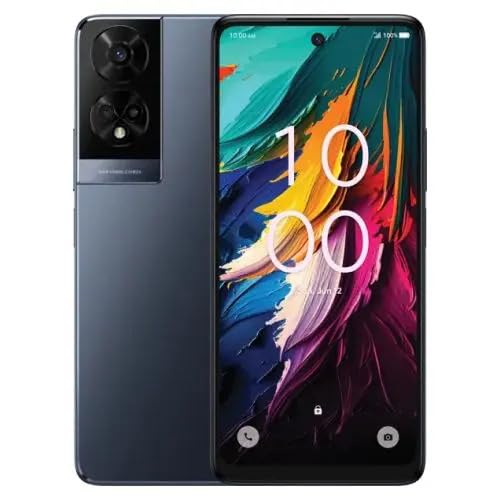
TCL 50 XE NxtPaper 5G — Around the mark, gentlest screen
The TCL 50 XE completes the guide’s capacity tour by living right at the milestone’s doorstep: its battery sits in the roughly 5,010mAh neighbourhood — call it the 5,000 class, because that is what it is — and its contribution to this guide is not the number but the spending. TCL’s NxtPaper display, a matte paper-textured panel, stays legible at lower brightness than glossy rivals, and lower brightness is lower draw, hour after reading hour. For the phone user whose screen time is dominated by text — the commuter reader, the student, the message-thread marathoner — the XE converts its around-the-mark capacity into endurance that punches at the class above, simply by refusing to waste charge on glare-fighting.
The rest of the proposition is honest budget craft. The listing is the 128GB phone unlocked for Verizon, T-Mobile and AT&T — a genuinely multi-network budget handset, rare at any price — the processor is an efficiency-minded unit, and the software is TCL’s light Android skin. In reading-heavy life the phone is a calm companion: documents, e-books, feeds and maps, all day, on a screen that does not make your eyes pay for the privilege. It is also the gentlest phone here to hand to someone who finds modern displays harsh, which is a battery feature in disguise — a screen you can stand to look at dimmer is a screen that lasts longer.
The compromises are the class’s. The matte panel softens video contrast, so film fans trade spectacle for comfort; performance is everyday-grade; TCL’s update commitment is the shortest story in this guide. And the capacity itself should be quoted the way this guide quotes it — around the mark, in the class — rather than with false precision. None of that stops the XE from being the most thoughtful budget answer here for readers. If your battery dies because your screen never sleeps and your eyes ache before the percentage does, this phone was designed for your exact complaint.
- Line: TCL 50 series, XE NxtPaper variant
- Listing condition: Unlocked for Verizon / T-Mobile / AT&T as listed
- Memory and storage: 128GB storage as listed
- Battery: Around the 5,000mAh mark — roughly the 5,010 class
- Distinguishing feature: Matte NxtPaper display for low-brightness legibility
Strengths
- Reading-friendly screen stretches its capacity further than the number suggests.
- Multi-network unlocked listing suits all three big US carriers.
- Easiest display here on tired eyes during long text sessions.
Trade-offs
- Matte panel trades away punchy video contrast.
- Shortest update story in this guide.
- Everyday performance — not a gaming or heavy multitasking phone.
Best for: Readers and commuters whose screen time is mostly text. Not suited for: Video-first users and buyers wanting a long update runway.
How do the six compare on capacity, condition and character?
| Phone | Battery position | Condition / variant | Character |
|---|---|---|---|
| Moto G Power 2025 | 5,000mAh, on the mark | New, US unlocked | The specialist |
| Pixel 9a | ~5,100mAh, past the mark | New, unlocked | Camera plus stamina |
| Galaxy A55 | 5,000mAh, on the mark | Latin GSM variant | Polished all-rounder |
| Galaxy A35 | 5,000mAh when new | Renewed | The value Samsung |
| OnePlus 12R | 5,500mAh class, beyond | Renewed, US unlocked | Speed plus surplus |
| TCL 50 XE | ~5,010 class, around | Multi-network unlocked | The reader’s phone |
Read the middle column as the guide’s conscience. Capacity figures mean different things on a new phone, a renewed phone and a phone whose first life was lived on a fast charger, and the table refuses to let the numbers pretend otherwise. The honest ordering for a heavy user is roughly the order of usable, verified capacity in your hand on day thirty — which is why the renewed picks can climb or fall a place depending entirely on the unit that arrives and the check you run on it.
How can you verify a battery’s real health when the phone arrives?
For the renewed phones, the ritual is short and decisive. Find the battery health figure in settings where the maker exposes it, and record it as your baseline. Then live one normal day — your apps, your signal, your brightness habits — and compare the evening percentage against the expectations in the pick’s section. A healthy big-battery phone should feel unhurried; a unit that races downward through an ordinary day is telling you its history, and the returns window is where you answer it. Finally, charge it fully once and watch the last stretch: a battery that leaps suspiciously from eighty to a hundred in moments is estimating, not measuring, and that too is information.
New-phone buyers get the gentler version of the same advice: give the phone its first week before judging, because indexing, photo library syncing and adaptive learning all spend charge that will not be spent in week three. Judge stamina on the settled phone, in your settled routine, and you will be judging the phone you actually bought rather than its housewarming.
What charging habits protect a big battery’s size advantage?
A 5,000mAh battery’s worst enemy is not use but heat and extremes. The habits that preserve it are boring and effective: prefer slow overnight charging with adaptive features enabled, use fast charging as the exception that rescues bad days rather than the daily ritual, keep the phone off hot dashboards and out of bedding while it charges, and use the charge-limit settings several of these phones offer if your routine is desk-bound and the phone lives near a socket anyway. A battery kept mostly between low and high extremes, charged coolly and cycled shallowly — exactly the pattern a big cell encourages, since you rarely empty it — can hold its capacity advantage for years, which is the quiet second dividend of buying capacity in the first place.
What mistakes do 5000mAh shoppers keep making?
The founding mistake is worshipping the number: buying any phone with 5,000mAh printed near it and ignoring the screen size, processor appetite and signal conditions that will spend it. The second is false precision — treating a roughly-around-the-mark capacity as a laboratory figure, or assuming two phones with the same number will live the same day. The third belongs to renewed buyers: quoting the as-new capacity of a used cell and skipping the health check that converts the quote into a fact. The fourth is charging a big battery like a small one — fast-charging daily out of habit, cooking away in a year the advantage that was the reason for the purchase. And the fifth is forgetting that capacity is bought once but spent daily: the cheapest stamina is still the settings audit, the downloaded maps, the brightness discipline that lets any phone in this guide behave like the class above it.
Why do manufacturers quote milliamp-hours instead of something clearer?
Because milliamp-hours are traditional, comparable within a phone’s voltage class, and flattering in their roundness — but a buyer deserves the footnote. The energy a battery holds is really measured in watt-hours, capacity multiplied by voltage, and phones run at similar enough voltages that mAh comparisons within this guide are fair. Where the unit misleads is across categories — a power bank’s mAh is quoted at a different voltage, which is why a modest-looking power bank can refill a 5,000mAh phone more than its numbers seem to promise, minus conversion losses on the way. Inside this guide’s six phones, though, the milestone means what you think it means, and the differences that matter are the spending differences the pick sections describe: screen, silicon, signal and software, spending one honest currency at four different rates.
There is a second quiet footnote: the capacity printed for a model is the design capacity, and individual cells vary by a small manufacturing tolerance, while the usable capacity a phone reports is managed conservatively by its software to protect longevity. None of this is deception — it is engineering margin — but it explains why two identical phones can report slightly different health figures out of the box, and why this guide’s advice is always to judge your unit by its behaviour across your days rather than by a decimal in a settings page.
What does a 5000mAh battery cost you in weight and pocket?
Energy has mass, and the big-battery class pays for its stamina in grams and millimetres. Phones built around 5,000mAh and beyond cluster at the heavier, thicker end of their ranges, and the difference is felt in specific places: the shirt pocket that sags, the one-handed reach that becomes a shuffle, the run with the phone in an armband, the small hand at the end of a long day. None of the six phones here is a brick — modern design hides capacity well — but the guide would be dishonest if it pretended the milestone were free. Buyers for whom weight is a first-order concern should handle the candidates with that lens, or look at the companion guide to small Android phones and accept the smaller cells that small bodies impose. Stamina and lightness remain a seesaw; this guide’s job is to make sure you choose your end of it knowingly.
The counterweight, literally, is what the capacity replaces. A 5,000mAh phone deletes the power bank from the everyday carry — several hundred grams of brick, cable and anxiety that the small-phone owner tows through airports and festivals. Counted as a system, phone plus nothing is frequently lighter than phone plus insurance, and always simpler. The fair comparison is never phone against phone; it is day against day, fully loaded.
One travel day, six batteries: how the class behaves under pressure
Put the six on the same itinerary: a 5 a.m. alarm, boarding passes and maps through two airports, a hotspot hour feeding a laptop during a delay, photographs at the destination, an evening of navigation in an unfamiliar city. The OnePlus 12R treats the day as a demonstration — the largest reserve at every checkpoint and a refill during the delay that makes the evening a formality. The Pixel 9a runs it a close second and takes the day’s best photographs while doing so, its adaptive software visibly tightening around the travel apps. The Moto G Power finishes with the calm of a phone that has done this a thousand times, because its owners have.
The Samsung pair split by condition rather than capacity: the A55, new-cell healthy behind its Latin passport, ends the day composed; the renewed A35 ends it exactly as well as its first life allows — which, on a good unit, is well enough, and on a tired unit is the moment the traveller learns why this guide insists on the arrival check while the returns window is still open. The TCL reads its way through the delay at a brightness the others cannot match for comfort, and its around-the-mark cell, spent on text instead of video, surprises nobody who has read its section. Six phones, one itinerary, and the ordering was decided less by the printed capacities than by condition, charging and the shape of the spending — the guide’s whole thesis, enacted at an airport.
When the battery finally fades, is replacement worth it?
Every phone in this guide will one day hold less than it did, and the owner’s options then are a battery service, a renewed replacement or a new phone. The economics favour service more often than the industry advertises: a battery replacement costs a fraction of a phone, restores the specification you originally bought, and keeps a device whose software support — on the Pixel and Samsungs especially — still has road left. The calculus flips when the screen is also tired, the storage full and the updates nearly done; then the replacement phone inherits. The discipline is to decide with numbers rather than vibes: check the health percentage, price the battery service for your model, count the remaining update years, and let those three figures vote. Owners who run that arithmetic at year three routinely discover their “old” phone had a second life priced at an evening’s errand.
This is also where the renewed picks repay a second thought. A renewed A35 or 12R bought cheaply, whose battery eventually fades, can be re-batteried into a genuinely long service life for less total outlay than a new phone — provided the rest of the unit was verified sound at purchase, which returns us, for the last time, to the arrival inspection. In the big-battery class more than any other, the purchase and the maintenance are one continuous decision, and the buyers who treat them that way own the cheapest stamina of all.
Does 5G change the 5000mAh calculation?
Somewhat, and mostly at the edges of coverage. In strong 5G areas the modern radios in these phones are efficient enough that the capacity class behaves as advertised; on fringe 5G, where the phone strains to hold a faster but weaker connection, the same battery can spend noticeably faster than it would settled on LTE. The practical responses are built into the phones: prefer-LTE settings for rural routes, Wi-Fi calling where signal is poor indoors, and downloaded media for journeys through patchy country. None of this dethrones 5,000mAh as the class to buy — it merely reminds the buyer that the radio is a spender like any other, and the biggest battery in a dead zone is still in a negotiation. Choose the carrier whose map covers your life, and the milestone resumes its full value.
How should a parent or employer buying several of these choose?
Fleets change the question from “which phone is best” to “which phone is most alike, most supported and least surprising across ten pockets”. For a family or a small business, the new phones in this guide carry the argument: the Moto G Power for field staff whose days are long and whose sockets are few, the Pixel 9a for the household that wants one model to learn and years of updates to lean on, each bought new so every unit starts with the same battery health and the same warranty story. The renewed picks are brilliant for one careful buyer and awkward for ten — unit-to-unit battery variation becomes a support burden when multiplied — and the A55’s variant homework multiplies too. Standardise on the new, identical and supported, keep one spare on a shelf, and the fleet’s battery questions reduce to a single answer everyone can memorise.
Whatever the fleet, set the phones up identically before handing them out: adaptive charging on, charge limits where the software offers them, battery-health pages shown to each owner once so the number means something when it moves. A fleet taught the same habits ages at the same gentle rate, and the administrator’s future self — the one fielding “my battery is worse than hers” calls — will be grateful the lesson was taught on day one.
What does “fast charging” do to a big battery over two years?
It trades a little longevity for a lot of convenience, and the size of the trade depends on frequency. Heat is the mechanism: rapid charging warms the cell, warm cells age faster, and a phone fast-charged twice daily for two years will typically surrender measurably more capacity than its slow-charged twin. Occasional fast charging — the travel day, the forgotten overnight — costs almost nothing, because ageing is cumulative exposure rather than a per-event penalty. The rational pattern for the phones here is therefore asymmetrical: slow and adaptive overnight as the default, fast as the rescue, and on the OnePlus 12R — whose whole proposition includes its refill pace — the same pattern with a shorter leash, since its speed makes the rescue so easy to reach for. Discipline is cheapest on the days you do not need rescuing.
Why does the same phone drain faster on holiday than at home?
Because home is a conspiracy of kindness: strong Wi-Fi, a familiar tower, a routine the adaptive software has memorised. Holiday removes every term of the conspiracy at once — roaming radios hunting foreign networks, maps running for hours, a camera working overtime, photographs backing up over hotel Wi-Fi at midnight, and a screen pushed bright against unfamiliar sun. Owners routinely misread the result as the battery “suddenly getting worse” and return home to find it healed. Nothing healed; the spending changed. The lesson generalises beyond holidays: judge any phone in this guide by the life you bought it for, expect travel to tax it a class harder, and let the reserve you chose — the cushion above empty at day’s end — be the margin that absorbs the difference without a mid-trip charger hunt.
What should you set up in the battery menu on day one?
Five minutes in the battery settings pays rent for years. Switch on adaptive charging so overnight fills finish gently near your alarm rather than sitting full for hours. If your phone offers a charge limit and your life is desk-centred, enable it and let the phone live in its healthiest band. Open the per-app battery view once, not to act but to learn its geography, so a future anomaly has a familiar map. Turn on the battery-health display where offered and note the starting figure in the same note where you keep the purchase date. And set the low-battery warning to a level that gives you options rather than panic. None of this is maintenance; it is introduction — you and the battery agreeing, on the first day, how the next thousand days will be run.
Keep the charger that came with your routine, not the fastest one the internet admires: the right brick is the one that fits your night, your desk and your travel bag, because a charging habit you actually keep is worth more capacity than a specification you admire and quietly abandon by February of the very first year of ownership. Habits outlast hardware, always, in every household, without exception, in the end, for everyone, everywhere, every single ordinary day.
Final Recommendation
Buy the Moto G Power 2025 if the brief is the brief: 5,000mAh, new, unlocked, tuned for nothing else — it remains the category’s reference answer. Buy the Pixel 9a if you want the mark beaten and the camera crown with it, in the guide’s longest-lived package. The Galaxy A55 is the connoisseur’s pick for buyers whose networks fit its Latin GSM passport, and the renewed A35 is the same Samsung formula for buyers who will run the health check and pocket the difference. Heavy users should stretch to the renewed OnePlus 12R, whose capacity overshoot and refill pace together make the strongest heavy-day case here, and readers should take the TCL home and enjoy a screen that spends its around-the-mark battery like a miser. Whatever you choose, verify the cell you actually received — in this category, the inspection is not diligence theatre; it is the moment the number on the page becomes the battery in your hand.
Frequently Asked Questions
Is 5000mAh enough for two days?
For moderate users on the efficient phones in this guide, yes — messages, browsing, reading and light media across two days is a realistic expectation for the Moto G Power, the Pixel 9a and the Samsung pair. Heavy users — navigation, hotspots, gaming, weak signal — should expect one long day with reserve, which is the honest promise of this capacity class and the reason the reserve matters more than the second day.
Why do two 5000mAh phones last different lengths of time?
Because capacity is only the budget. Screen size and brightness, processor efficiency, modem behaviour on your local signal and background software all spend from the same account at different rates. That is why this guide pairs every capacity with the phone that spends it, and why the TCL’s modest capacity can outlast thirstier rivals in reading-heavy use.
Does the OnePlus 12R’s bigger battery make it the automatic winner?
It makes it the heavy user’s winner — the 5,500mAh-class cell plus very fast charging is the strongest stamina combination here. But it is a Renewed listing, so its real capacity is the unit’s verified health, and lighter users may never spend the surplus they paid for. The Moto G Power and Pixel 9a remain better answers for buyers whose days are ordinary and whose priorities include camera or simplicity.
How much capacity does a renewed 5000mAh battery really have?
Less than 5,000 by an amount set by its first life — which is precisely why this guide instructs an arrival health check and a real-day test inside the returns window for the Galaxy A35 and OnePlus 12R. A well-kept unit retains most of its capacity and is a bargain; a tired unit announces itself quickly to anyone who checks.
Is a bigger battery harder on charging time?
All else equal, a larger cell takes longer to fill — which is why charging speed is treated in this guide as stamina’s second half. The OnePlus 12R’s fast charging erases the penalty; the Pixel 9a’s measured pace makes overnight charging its natural rhythm; the rest sit between. Match the phone’s refill style to your routine, not just its capacity to your day.
Will a 5000mAh battery still be good in three years?
On the new phones here, with sane charging habits, it should retain the clear majority of its capacity — and because big cells cycle shallowly in daily use, they often age more gracefully than small cells run empty daily. The settings and habits in the charging section are the whole secret: cool, shallow, unhurried, and the milestone you bought remains roughly the milestone you own.
Can I trust the battery percentage on a new phone?
Mostly — modern fuel-gauge systems learn your individual cell across its first cycles and settle into honest reporting, which is another reason week-one judgements mislead. If a settled phone’s percentage ever behaves strangely, a full charge followed by a normal day’s use usually recalibrates it. Treat the gauge as a good instrument that occasionally wants a reference point, not as a liar and not as gospel.
Does a case with a built-in battery make sense for these phones?
Rarely. Battery cases exist for travellers facing exceptional days, but on a phone already built around 5,000mAh they add bulk and heat to solve a problem the phone was bought to eliminate. A small separate power bank, carried only on the days that need it, is the better insurance — the phone stays slim for the three hundred ordinary days and the brick comes out for the five extraordinary ones.
Is wireless charging a good idea for a big-battery phone?
It is a convenience with a small tax. Wireless charging is less efficient than a cable and the lost energy becomes heat at the phone’s back — gentle heat, but nightly, across years. Owners who love the bedside pad can use it without drama, especially at modest power; owners optimising for maximum battery lifespan will cable-charge slowly instead and keep the pad for desks and cars. Either way, the big cell forgives the choice more readily than a small one would.
Should I drain a new battery to zero before its first charge?
No — that ritual belongs to an older battery chemistry and modern lithium cells neither need nor enjoy it. Charge the new phone as your life dictates, let the software learn across the first week, and ignore any advice that arrives dressed as folklore from the nickel-cadmium era. The kindest first week for a modern battery is an ordinary one.
Related Guides
Continue with affordable smartphones chosen for battery life for the wider stamina field, affordable unlocked LTE smartphones for carrier freedom, and the best AMOLED smartphones — whose dark themes stretch every milliamp-hour in this guide.
Related guides
- Best Canon Point and Shoot Digital Cameras: PowerShot Picks From Pocket Compacts to Travel Zooms
- Best Balancing Stabilizers for Mirrorless Cameras: Payload, Balancing and Native Vertical Shooting
- Best Basic Phones Camera Buyers Can Trust: Flip Phones and Simple Handsets That Still Take a Photograph
- Best Sony Full Frame Cameras for Astrophotography: Sensitivity vs Resolution


