Our Top Picks
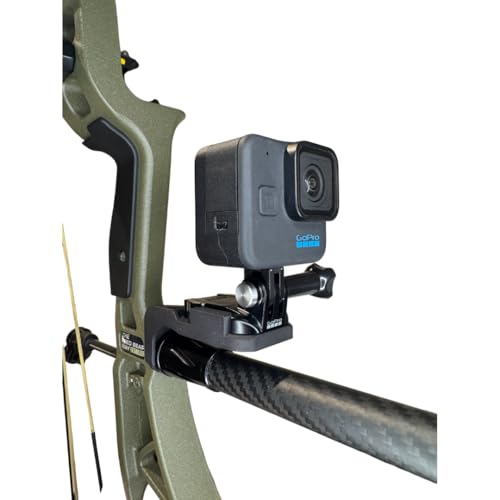
 Stabowmount Classic Bow Camera Mount for GoPro and3 x 1 x 1.5 inches1 x 3 x 1.5 inches0 poundsCheck on Amazon


What's inside
- What a bow-mounted camera is actually for
- Two ways onto the bow: stabilizer port and riser mount
- Added weight: 100 to 200 grams that change the bow
- The shock of the loose: why action cameras survive it
- Field of view and the mathematics of a deer at distance
- Low light: sensors, apertures and the legal hours
- Batteries in the cold: chemistry at zero and below
- One button, cold hands and the tell-tale light
- Sound: the release, the woods and the second channel of evidence
- Shot placement review: the discipline the camera exists to serve
- Legal notes, stated neutrally and checked locally
- Building the shortlist: a specification order that works
- Dedicated bow cameras versus adapted action cameras, weighed properly
- Practice: the unglamorous season before the season
- After the hunt: files, review partners and honest archives
- Check prices on Amazon
- Care, storage and the seasons between
As an Amazon Associate I earn from qualifying purchases. This post may contain affiliate links at no extra cost to you.
A note before the specifications: this guide is assembled entirely from manufacturer documentation, published ratings and the geometry of the archery shot itself, and it makes no claim that any camera here was carried on a hunt by the writer. If a reader follows a buying link on this site and completes a purchase, the site may receive a commission that supports its publication, at no extra cost to that reader.
What a bow-mounted camera is actually for
A bow-mounted camera has one job that no other camera on a hunt can do. It rides the bow itself, looks where the bow points, and records the few seconds that decide everything: the draw, the settle, the release, the arrow’s departure, and the animal’s reaction. Its footage is not primarily entertainment, however enjoyable it can be to revisit. Its primary value is evidence. After a shot, memory becomes unreliable within minutes, coloured by hope, adrenaline and the speed of the event. A recording does not share those weaknesses. It shows where the arrow actually went relative to the aiming point, how the animal actually moved, and in which direction it actually ran. For the bowhunter deciding whether to follow a trail immediately or wait, that evidence can change the decision and improve the outcome for hunter and animal alike.
Everything about the equipment follows from the violence and brevity of the moment it must capture. A bow at release is a hostile place for electronics: a sharp mechanical shock, a burst of vibration through the riser and stabilizer, cold air at dawn, gloves on the hands, and no second chance to press the right button. A camera that excels on a bicycle or a dashboard may fail on a bow for reasons that never appear in ordinary reviews. That is why this guide reads bow camera specification sheets through archery first and video second, beginning with the mount, because a camera that is not securely and sensibly attached is not a bow camera at all, whatever its sensor can do.
The category divides into dedicated bow cameras, built small and light around the mounting task, and general action cameras adapted to the bow with a mount accessory. Dedicated units tend to be lighter, simpler and quicker to operate, with fixed fields of view chosen for typical archery distances. Adapted action cameras tend to offer richer video settings, larger sensors in the premium tier, replaceable batteries and deep accessory ecosystems, at the cost of more added weight and more menu complexity than a cold dawn rewards. Hunters comparing the adapted route will find useful background in best 1080p action cameras, where the baseline video specifications of the broader category are laid out in detail.
Two ways onto the bow: stabilizer port and riser mount
The most common attachment uses the stabilizer port, the threaded bushing on the front of the riser that normally receives the stabilizer. The thread is a shared standard across the archery industry: 5/16-24 UNC, meaning a nominal diameter of five sixteenths of an inch with twenty-four threads per inch. A bow camera or its mounting stud screws into that port, either replacing the stabilizer or, in pass-through designs, accepting the stabilizer behind it so both devices share the port in a stack. The virtues of this position are real. The camera sits low and forward, aligned close to the bow’s line of aim, and the installation takes seconds with no tools beyond fingers. The costs are equally real, and they are the subject of the weight discussion below: mass added at the end of the stabilizer axis changes how the bow balances and how it behaves at the shot.
The alternative family clamps to the riser itself, to the sight bracket, or to a barrel-style mount that grips a cylindrical section of the stabilizer or riser. Clamp and barrel mounts free the stabilizer port entirely, let the hunter position the camera slightly higher or off to the side, and sometimes place the lens closer to the arrow’s line, which reduces the parallax offset between what the camera sees and where the arrow goes. Their weaknesses are mechanical. A clamp depends on friction and correct tightening; a hard shock can rotate a poorly seated clamp by a few degrees, which is enough to point the lens at sky or ground for the one shot that mattered. Published mount designs answer this with knurled locking rings, rubber-lined jaws that grip without marring finishes, and secondary safety tethers, and the specification worth hunting for is whether the maker states a positive locking method rather than friction alone.
Alignment, parallax and the honest limits of the view
No bow-mounted camera sees exactly what the sight sees. The lens sits below, beside or ahead of the archer’s eye line, separated by several centimetres, so at close range the camera’s frame and the arrow’s path diverge measurably. At twenty yards and beyond the divergence shrinks to a small fraction of a deer-sized frame and matters little for reviewing shot placement. At very close range, a steep treestand shot at eight or ten yards, the offset matters more, and hunters who review footage should remember that the arrow enters the frame from a slightly different origin than the lens position suggests. Some mounts offer tilt adjustment so the lens can be angled to converge with the expected point of impact at a chosen distance, commonly around twenty yards. A maker that publishes the adjustment range in degrees is giving the hunter a tool; a maker that fixes the angle has chosen the convergence distance on the hunter’s behalf, and the documentation should say what that distance is.
Vibration behaviour also differs by mount position. The stabilizer exists to absorb and damp the bow’s post-shot vibration, and a camera mounted at the stabilizer port sits at the point of maximum excursion, riding the full arc of the stabilizer’s flex. A riser-clamped camera sits closer to the bow’s structural centre, where displacement is smaller though the shock arrives sharper. Neither position is categorically gentler; they deliver different mixtures of movement and shock, which is one reason published drop and shock ratings, discussed shortly, deserve more trust than intuitions about which spot on the bow looks calm.
Added weight: 100 to 200 grams that change the bow
Bow cameras and their mounts commonly add between about 100 and 200 grams at or near the front of the bow. In isolation that sounds trivial, roughly the weight of a small apple. In leverage it is not trivial at all. Mass placed at the end of a stabilizer, perhaps 15 to 25 centimetres ahead of the grip, exerts a turning effect, a moment, equal to its weight multiplied by its distance from the hand. A 150 gram camera at 20 centimetres adds a nose-down moment that the archer’s wrist and forearm must counter for the entire hold, and holds in archery are measured in the seconds when steadiness decides accuracy. The bow feels more front-heavy, the sight pin’s float pattern changes shape, often slowing into a heavier, lazier drift that some archers like and others fight, and the shoulder tires sooner across a long sit with repeated practice draws.
The remedy is neither mysterious nor optional: after fitting a camera, the bow setup needs re-checking as though any other front mass had changed. Sight levels should be confirmed, because a changed balance can tilt the archer’s natural hold and cant the bow slightly. Pin float should be observed honestly over several practice sessions rather than one. Some archers add a small amount of rear or side-rod weight to restore the original balance point; others shorten the stabilizer to bring the camera’s mass closer; others simply adapt their hold. What the documentation of a responsible mount maker will acknowledge, and what hunters should budget time for, is that the camera is a tuning change, not a neutral accessory. A bow that was perfectly balanced bare will not be perfectly balanced wearing 180 grams of camera and mount, and pretending otherwise trades accuracy for footage.
Why the weight lands differently on different bows
Short, light hunting bows feel added front mass more than long, heavy target-influenced bows, for simple proportional reasons: 150 grams is a larger fraction of a light bow’s total mass and a larger disturbance to its designed balance. Brace height, axle-to-axle length and factory stabilizer configuration all mediate the effect. Hunters shooting compact bows should weight the lightest camera options more heavily in their shortlisting, even at some cost in video features, while hunters with heavier rigs have more headroom. The mount’s own mass belongs in the arithmetic too; specification sheets that quote camera weight alone, excluding a steel mounting stud and clamp, understate the true addition, and careful readers add both figures before judging.
The shock of the loose: why action cameras survive it
At the moment of release, stored energy leaves the bow in a fraction of a second. Limbs snap forward and stop hard against the string, the string oscillates, the riser rings with vibration, and any attached device experiences a sharp acceleration spike followed by a decaying buzz. Manufacturers of rugged cameras quantify survival with published drop ratings, commonly stated as survival of drops onto hard surfaces from heights around 1.5 to 2 metres for phone-class devices and considerably more abuse for action cameras built around rigid frames, reinforced lens covers and solid-state storage with no moving parts. The action camera’s structural idea is a stiff housing that keeps the sensor and board aligned as one unit, memory that cannot skip or unseat because it is soldered or firmly socketed flash, and a lens assembly without the extending mechanisms or large, delicately suspended glass stacks found in other devices.
A phone, by contrast, carries a large thin glass slab, an optical image stabilisation system that suspends its lens on tiny actuators designed for gentle hand tremor rather than mechanical shock, and a battery and board layout spread across a wide, flexible frame. Phone makers publish no rating that contemplates repeated bow-release shock, and the failure modes are easy to picture: stabilisation actuators damaged by repeated spikes, autofocus assemblies knocked out of calibration, screens cracked by the combination of clamp pressure and vibration. Hunters do mount phones on bows with third-party holders, and the footage can be good, but the risk accounting is different, and it belongs to the hunter rather than to any published specification. The bow camera category exists precisely because the shock environment is real, repeated and cumulative: a device must survive not one release but hundreds across practice and seasons.
Electronic stabilisation meets bow shock
Electronic image stabilisation deserves a specific caution. These systems crop the sensor image and counter-shift it to cancel motion, using gyroscopic data sampled many times per second. The slow sway of a drawn bow is exactly the kind of motion they handle well, and stabilised footage of the aim and the animal’s approach can look remarkably calm. The release itself is another matter: the acceleration spike can exceed the correction range in a single frame interval, producing a brief warp or jolt in the recording at the precise frame the hunter most wants to study. Some cameras let the user reduce or disable electronic stabilisation, trading a shakier approach sequence for a cleaner record of the shot instant. Documentation that explains this trade honestly is worth more than a stabilisation brand name, and hunters reviewing footage should learn to recognise the warp artefact so they do not misread it as arrow behaviour.
Field of view and the mathematics of a deer at distance
Field of view decides whether the animal is in the frame at all, and simple trigonometry turns the specification into predictions. The width of a scene captured at a given distance equals twice the distance multiplied by the tangent of half the horizontal field angle. At a 120 degree horizontal field, the frame at 20 yards spans roughly 69 yards across, an enormous width that guarantees the animal is somewhere in frame and equally guarantees it will be small within it. At a 90 degree field, the frame at 20 yards spans about 40 yards. In narrower linear or narrow modes, commonly near 60 to 70 degrees of effective field, the frame at 20 yards spans roughly 23 to 28 yards. At 40 yards every one of those widths doubles.
Now place the subject inside those widths. A deer body, broadside, is roughly 1.2 to 1.4 metres long, call it about 1.4 yards. At 20 yards in a 120 degree frame spanning 69 yards, the deer’s length occupies about 2 percent of the frame width. On a 1920 pixel wide recording that is roughly 40 pixels of deer: enough to confirm presence, direction and a coarse sense of hit location, not enough for fine detail. In a 90 degree frame the same deer spans about 3.5 percent, around 67 pixels. In a 65 degree linear frame it spans about 6 percent, around 115 pixels, and the vital zone becomes a reviewable region rather than a smudge. At 30 yards each share falls by a third; at 40 yards it halves relative to 20. These are approximations that ignore lens distortion and cropping, but they expose the central trade with clarity: width buys certainty of capture, narrowness buys information per animal.
Fisheye, linear modes and the record of the shot
Wide action camera lenses achieve their field with fisheye geometry, bending straight lines near the edges and compressing the centre where the animal usually stands. Digital linear modes correct that bend in the camera by remapping the image, at the cost of some field and some edge resolution. For shot review, linear footage has a genuine analytical virtue: distances and positions within the frame map more predictably, so judging whether an arrow struck forward or back of the intended point is less distorted by the lens itself. Wide uncorrected footage keeps more of the surroundings, which helps when the question is not the hit but the exit route, the direction of flight across a wide frame after the shot. Hunters who can choose modes in the field are choosing between two kinds of evidence, and the wiser choice depends on which question they expect to ask. Readers weighing the wider action camera market will find the mode vocabulary explained further in best 4k action cameras inexpensive, where field settings and resolution interact in the same way.
Resolution interacts with field through pixel density on the subject. A 4K frame carries four times the pixels of a 1080p frame across the same field, so the deer that occupied 40 pixels of width at 1080p occupies about 80 at 4K, and digital enlargement during review stays informative longer. That is the strongest technical argument for higher resolution in a bow camera, stronger than any general claim about sharpness: the subject is small, distant and centred, and pixels on target are the currency of review. The costs are file size, battery draw and heat, each of which returns later in this guide wearing a different hat.
Low light: sensors, apertures and the legal hours
Archery hunting concentrates at the edges of the day. Legal shooting hours in many jurisdictions run from before sunrise to after sunset by a stated margin, and deer movement peaks in the same dim windows. The bow camera therefore works, at its most important moments, in the worst light of the day. Two published specifications dominate its chances. The first is sensor size. A 1/2.3 inch sensor, long the action camera staple, has a diagonal near 7.7 millimetres and a correspondingly small light-collecting area per pixel at high resolutions. A 1 inch sensor has a diagonal near 16 millimetres and roughly four times the area, which translates directly into cleaner images at a given sensitivity. The second is lens aperture, commonly f/2.8 in this category: the ratio that sets how much light the lens passes per unit area. A fixed f/2.8 lens on a small sensor is fighting physics at dusk, and no processing fully repeals the arithmetic.
What the fight looks like in footage is noise: grain that crawls in shadow areas, smeared detail where noise reduction works overtime, and colours that flatten as the camera raises sensitivity to hold exposure. For entertainment footage this is an aesthetic problem. For shot review it is an evidence problem, because the frames that matter, the arrow’s arrival and the animal’s first reaction, may be the darkest frames of the day. Practical mitigations follow from the specifications. A camera that allows a capped maximum sensitivity, accepting a darker but cleaner image, can preserve more usable detail than one that boosts sensitivity without limit. A lower frame rate gathers more light per frame: at 30 frames per second each frame can expose for up to a thirtieth of a second, twice the light per frame available at 60 frames per second. Hunters who prioritise dusk review over slow-motion smoothness should read the frame rate menu as a light control, because that is what it physically is.
Slow motion and its honest price
High frame rates, 120 or 240 frames per second in cameras that offer them, promise a seductive analysis: the arrow’s flight slowed to a visible arc, the animal’s drop at the string made measurable. The promise is real in good light and largely illusory at dawn, because each frame’s exposure window shrinks to a sliver and the camera must raise sensitivity steeply to compensate, flooding the very frames under study with noise. There is also a storage and battery cost, and a field-of-view cost on models that crop the sensor to reach their highest rates. The specification sheet tells this story if read completely: the fine print that ties maximum frame rate to reduced resolution or narrowed field is the maker disclosing the trade. Slow motion is a midday practice tool and an early-season luxury; at last light, 30 honest frames beat 240 noisy ones.
Batteries in the cold: chemistry at zero and below
Lithium-ion cells dislike cold for chemical reasons. As temperature falls, the electrolyte’s viscosity rises and ion movement slows, internal resistance climbs, and the cell delivers less of its stored energy before its voltage sags below the camera’s cutoff. Published figures for the chemistry generally describe usable capacity near 80 percent of the warm rating around 0 degrees Celsius, falling toward roughly half near minus 10 degrees, with exact numbers varying by cell design and discharge rate. A camera drawing hard for 4K recording is a high discharge rate, so the pessimistic end of any range is the relevant planning figure. The practical translation: a battery rated for ninety minutes of recording on a mild afternoon may offer forty-five to sixty minutes of readiness and recording on a frosty morning sit, and a battery already part-used the previous evening can die quietly before the decisive minute.
Design answers this in two ways. Removable batteries let the hunter carry a warm spare in an inside pocket, where body heat keeps the cell near its happy temperature, and swap it in seconds. Sealed internal batteries deny that option and make the whole camera the spare problem. The swap itself must be glove-compatible to count: a battery door that needs a fingernail, a tiny latch that needs bare fingertips, or a memory card slot sharing the same fiddly door all fail the real test, which is a numb-handed swap in dim light without dropping anything from a treestand. Makers publish door and latch designs in their manuals, and hunters should rehearse the swap at home with hunting gloves on, because the specification that matters is measured in seconds and dropped batteries, not in photographs of the door.
Cards, capacity and the supporting kit
Cold also argues for margin in storage. A camera that stops recording because its card filled during the approach has failed as completely as one with a dead battery. Card speed classes matter because high-bitrate video needs sustained write performance, and the vocabulary of that world, speed classes, capacities that survive formatting overhead, and the discipline of starting each hunt with a fresh, formatted card, is covered for the trail camera context in best trail cam sd cards, and every word of it transfers to the bow. Many hunters run a bow camera and one or more unattended cameras on the same property, checking the unattended units’ cards to pattern movement before a sit; the scouting side of that system is surveyed in best affordable trail cameras, and the bow camera’s footage closes the loop that the scouting footage opens.
Power management settings are the software half of the cold problem. Auto-sleep timers that are too eager can put a camera to sleep during the long motionless minutes before a shot; timers that never sleep drain the cell in standby. The useful middle, a standby that wakes on a single button press within a second or two, is a behaviour the manual should describe in plain terms: wake time, standby draw, and whether the camera can be set to begin recording on wake rather than merely to wake. A camera that wakes into a menu has added a step at the worst moment. A camera that wakes into recording has understood the assignment.
One button, cold hands and the tell-tale light
Operation design for a bow camera reduces to a single question: can a hunter wearing gloves, holding a bow, watching an approaching animal, start recording with one certain press and confirm the recording without looking at the camera? The physical answers are a large, raised, mechanically distinct record button, operable by a gloved thumb or forefinger, with a press feel that cannot be confused with the smaller mode and power buttons around it. Voice control, offered on some action cameras, answers the same question differently and works until wind, whisper discipline or a mask intervenes. Remote controls move the button to the grip or the wrist and add a battery and a pairing state to manage. Each method has a failure mode, and the documentation should state the behaviour that matters most: from sleep, how many actions stand between the hunter and a recording in progress. The best answer in the category is one.
Confirmation is the twin problem. A recording indicator light tells the hunter the camera is rolling, but a bright red light on the bow is also a signal flare to a deer at close range in dim woods, and many hunters reasonably refuse to carry one uncovered. Camera makers respond with settings to dim or disable the indicator, sometimes buried in menus, sometimes a simple option in the companion application. Disabling the light creates its own risk, the silent uncertainty of not knowing whether the press registered, which better designs answer with a short vibration pulse or an audible beep at a volume the hunter can set low. The specification hunt here is for configurability itself: indicator brightness levels, a full off setting, and confirmation alternatives. A camera that offers none of these has made a hunting decision on the hunter’s behalf, and not the cautious one.
Water, dust and the weather rating that counts
Published ingress ratings translate directly to hunting weather. An IPX8 rating describes submersion protection under maker-stated conditions and implies a camera indifferent to rain of any intensity. IPX4 describes splash resistance, adequate for drizzle and wet handling but a weaker promise in a downpour. Ratings apply with doors closed and seals intact, which returns responsibility to the user: a battery door opened with grit on the seal, or a lens cover cross-threaded after a swap, voids the rating in practice whatever the sheet says. Frost adds a subtler hazard, condensation forming when a cold camera enters a warm vehicle or cabin, and the standard field habit, sealing the camera in a bag before bringing it into the warmth so moisture condenses on the bag instead, protects bow cameras exactly as it protects every other optic on the hunt.
Sound: the release, the woods and the second channel of evidence
Video gets the attention, but the audio track of a bow camera recording carries its own evidence. The microphone sits centimetres from the string and riser, so the release registers as a sharp, unmistakable transient that timestamps the shot to the exact frame far more reliably than the visual blur of the string. Before the shot, the same microphone captures the small sounds that structure a hunt: footsteps in leaf litter, a snort, the soft tick of antler or branch, breathing, and the draw itself if clothing or rest makes any noise at all. Reviewing a recording with attention to sound reconstructs the animal’s alertness at the moment of release, which bears directly on how much it moved before the arrow arrived, the phenomenon hunters discuss as the animal reacting to the shot. A camera whose documentation specifies microphone placement, wind-noise reduction that can be switched off, and an unprocessed audio option is treating sound as evidence; heavy automatic processing that pumps and gates quiet audio can erase exactly the faint cues worth keeping.
Wind is the enemy of all of it. A bow held at draw in a breeze presents the microphone with moving air across its ports, and foam covers or furry windscreens sized for small cameras reduce that roar at the cost of one more accessory to fit and lose. Some cameras sample audio at rates and bit depths that preserve the release transient crisply; others compress aggressively to save space. For the review purpose, the transient’s timing matters more than fidelity, so even modest audio serves the central task, but hunters who also hope to identify a distant gobble or a second animal’s approach should weight the audio specifications higher than the category’s marketing usually does.
Shot placement review: the discipline the camera exists to serve
The review itself deserves method, because footage read carelessly can mislead as confidently as memory can. The sound method runs in passes. First, watch at full speed for the story: the animal’s posture, its direction, the visible reaction, the line of its departure. Second, step through the release frames slowly, using the audio transient to fix the shot instant, and locate the arrow’s entry relative to the intended aiming point, remembering the parallax offset between lens and arrow path. Third, watch the animal’s first three seconds after the hit with particular care, since gait, posture and the height at which the body is carried all inform the decision about how long to wait before following. Fourth, note what the footage cannot show: an arrow that passed out of frame, a hit obscured by the animal’s own shoulder angle, the far side of the body entirely. Writing those limits down, alongside the conclusions, is what separates evidence from highlight reel.
Frame rate and field choices made hours earlier decide how much of that method is possible. A narrow linear frame at higher resolution rewards the second pass with a legible vital zone. A wide frame rewards the first and third passes with context and departure direction. There is no setting that maximises both, which is why experienced users settle the question before the season by deciding which uncertainty they most want to reduce: uncertainty about the hit, or uncertainty about what happened next. The camera’s mode menu, read with that decision in hand, stops being a list of features and becomes a statement of hunting priorities.
Arrows, animals and reaction time: reading movement honestly
One analytical habit protects against the most common misreading. An animal that drops or wheels at the release can move a surprising distance during the arrow’s flight, which at 30 yards occupies roughly a tenth of a second for a fast modern bow, longer for heavier arrows at lower speeds. Footage that seems to show a perfect hold and a baffling result often resolves, frame by frame, into an animal that began moving before arrival. Counting frames between the audio transient and visible movement, and between movement and the arrow’s arrival, converts argument into arithmetic. The camera cannot make the decision about whether the shot should have been taken, and it cannot shorten the wait before tracking, but it can replace the two least reliable witnesses, hope and horror, with a count of frames, and that replacement is the deepest justification for carrying one.
Legal notes, stated neutrally and checked locally
A necessary caution belongs in any discussion of electronics on a bow. Rules governing electronic devices attached to archery equipment vary by jurisdiction, by season and by the type of hunt, and they change. Some regulatory frameworks distinguish between devices that merely record and devices that could aid aiming, such as lights, lasers or electronic sights, treating the categories very differently. Others regulate electronics on archery tackle more broadly during particular seasons or in particular units. No general guide can state the rule for a reader’s specific hunt, and this one will not try. The responsible practice is to check the current regulations published by the wildlife agency for the exact place and season being hunted, before the hunt, with the camera and mount described accurately if any doubt exists. A recording is never worth a violation, and the check takes minutes compared with the consequences of guessing wrong.
Related practicalities follow the same local logic. Landowner permission for recording, the rules of any lease or club, and ordinary courtesy toward other hunters sharing a property are matters of the specific place. Treating them as part of the equipment check, alongside batteries and cards, costs nothing and prevents the particular misery of perfect footage of a hunt that should not have happened as it did.
Building the shortlist: a specification order that works
Read in the right order, a bow camera specification sheet sorts itself. Begin with the mount: thread standard or clamp design, locking method, tilt adjustment and the combined weight of camera and mount together, since that sum is what the bow will actually carry. Move to survival: the maker’s stated shock and drop information, the ingress rating with its conditions, and the operating temperature range, which should honestly cover the coldest morning of the intended season. Then the evidence specifications: sensor size, aperture, the field of view in each mode with its resolution and frame rate attached, and the stabilisation behaviour at the release instant as the manual describes it. Then the endurance specifications: battery type, removable or sealed, rated recording time at the intended resolution, and standby behaviour with its wake time. Finish with operation: the count of actions from sleep to recording, glove-compatible controls, indicator light configurability, and confirmation signals that do not betray the hunter.
What survives that reading is rarely the camera with the longest feature list. It is the camera whose compromises point the same direction as the hunter’s own: light enough not to corrupt the hold, tough enough to forget about, wide or narrow in the pattern that matches the review questions that matter most, alive in the cold for the whole sit, and awake in one press when the woods finally move. The bow does the shooting. The camera’s humbler task is to remember, accurately and without flinching, what the bow did, and a specification sheet read in this order is how a hunter chooses a memory worth trusting on the mornings when their own cannot be.
Dedicated bow cameras versus adapted action cameras, weighed properly
The two families deserve a direct comparison because hunters often drift into one by accident, owning an action camera already or meeting a dedicated unit first. The dedicated bow camera is a study in subtraction. Its lens is fixed, its field is chosen by the maker for archery distances, its controls may be a single switch, and its body is shaped around the mount rather than adapted to it. Published weights for the family commonly sit at the light end of the range this guide opened with, and that lightness is the family’s whole argument: the least disturbance to the bow, the least to learn, the least to go wrong with cold hands. The sacrifices are rigidity of a different kind. If the fixed field does not suit a hunter’s typical shot distance, there is no mode to change. If the sensor struggles at dusk, there is no larger sibling in the same shape. The documentation of a dedicated unit should therefore be read with unusual care, because what it says is all there will ever be.
The adapted action camera argues from abundance. Modes multiply: several fields, several resolutions, frame rates from stately to extreme, stabilisation systems with their own sub-menus, replaceable batteries on many models, and mounts for helmets, chest harnesses and tripods that let the same camera work the rest of the year. For the hunter who also films family, travel or other sports, that abundance has real economic logic. The costs arrive at the bow. The camera body plus its protective frame plus the bow mount together commonly reach the heavy end of the added-weight range, sometimes beyond it. Menus designed for bare summer fingers become expeditions with gloves. Features that help elsewhere, touchscreens above all, contribute little on a dawn treestand and can demand a bare hand the hunter would rather keep warm and still.
A middle path exists in the smaller action camera formats, cube and mini designs whose published weights undercut their full-size siblings while keeping removable storage and respectable sensors. Their fields and low-light behaviour still follow the physics already covered, and their small buttons can be the worst of both worlds for gloved use, so the middle path rewards the same specification discipline rather than replacing it. The honest summary is that neither family wins. The dedicated camera wins on the bow and loses everywhere else; the action camera wins everywhere else and must be forgiven, managed and rebalanced on the bow. A hunter’s calendar, not a feature table, should decide which forgiveness is cheaper.
Practice: the unglamorous season before the season
Every claim in this guide becomes testable, in the legitimate sense of rehearsal rather than product evaluation, on the practice range, and the hunters who get value from a bow camera are the ones who rehearse with it. The rehearsal has a curriculum. First, fit the camera and re-tune the bow as the weight section demands, then shoot enough practice arrows, across several sessions, for the changed hold to become the new normal rather than a novelty managed by attention. Second, learn the frame. Record practice shots at known distances at a target, then review where the target sat in the frame at each distance, building the mental map that will later interpret hunting footage: where a deer at twenty yards will appear, how large it will be, where the edges of the frame cut at thirty. Third, rehearse the operation sequence until it is one motion: wake, confirm, draw, in that order or the camera’s own order, performed with hunting gloves, in poor light, without looking down.
Practice also exposes the small betrayals. A mount that creeps a degree per shot reveals itself across fifty practice arrows, not across one. A battery door that a gloved thumb cannot open reveals itself in the garden rather than at height in the dark. An indicator light that seemed modest indoors announces itself across a dusk practice session. Each discovery made in rehearsal is a failure moved from the moment that matters to a moment that does not, and the total cost is a few evenings. Hunters already accept this logic for broadhead tuning and cold-weather clothing; the camera, which touches accuracy, evidence and legality all at once, has earned the same seriousness.
Treestand, ground blind and spot-and-stalk: three different cameras in effect
Hunting style rewrites the specification priorities one more time. The treestand hunter shoots downward at close to moderate range, often at steep angles where parallax and frame placement matter most, sits motionless for hours in the coldest air of the day, and needs the camera awake through long standby. Battery endurance, wake behaviour and tilt adjustment dominate that shortlist. The ground blind hunter shoots on the level from concealment, can manage the camera with slightly more freedom of movement, and often films through small windows that punish a badly placed mount; size and mount profile rise in importance, and the blind’s darkness makes the indicator light question sharper, since a glowing dot inside a black blind is visible to its occupant all morning and must be trusted to be invisible outside. The spot-and-stalk hunter walks, crawls and draws in the open, where every added gram rides all day and a snagged mount can end a stalk; weight and a low, locked profile dominate, and the wide field earns its keep because shot distances vary without warning. One camera can serve all three styles, but it will serve them as a compromise, and naming the primary style before reading specification sheets is what turns the compromise into a chosen one.
After the hunt: files, review partners and honest archives
The hunt ends; the footage begins its second life. Sound practice treats the memory card as evidence from the moment it leaves the camera. Copy the files before reviewing them repeatedly on the card itself, keep the original file names and timestamps untouched in the archive copy, and do any trimming or enlargement on duplicates. Timestamps matter because they anchor the sequence of decisions, when the shot happened, how long the wait was, when tracking began, and an archive that preserves them can teach a hunter more across a season than any single dramatic clip. Storage mathematics are undemanding but worth doing once: high-bitrate 4K recording consumes roughly 350 to 700 megabytes per minute depending on the maker’s chosen bitrate, so a long morning with the camera rolling through every approach can produce tens of gigabytes, and the card and archive should be sized from that arithmetic rather than from hope.
Reviewing with a partner, the landowner, a mentor or the friend who will help track, is where footage repays its carriage most generously, because a second viewer reads the same frames without the shooter’s adrenaline editing them. The methodical passes described earlier work even better spoken aloud between two people, one advancing frames, one narrating what the animal does. Disagreement between the two readings is not a problem to be smoothed over; it is the signal to slow down, return to the audio transient, and count frames again. Decisions made after that kind of review, to follow or to wait, carry a steadiness that neither memory nor optimism can supply on their own.
There is also a longer archive value that has nothing to do with any single recovery. A season of dated, preserved footage is a record of a hunter’s own tendencies: the distances actually taken rather than remembered, the shot placements that actually occurred, the animals that moved and the ones that stood. Reviewed in the off-season, that record instructs without flattering, and it sets the practice curriculum for the next year with a precision no generic advice can match. The camera that began as a gadget ends, used this way, as the most honest coach a bowhunter owns, one whose entire method is to show, frame by frame, what really happened.
Check prices on Amazon
Live listings for the shortlist in this guide are pulled from Amazon below, so prices and availability are always current at the moment you look.


Care, storage and the seasons between
Bow cameras live hard and store long, and storage is where quiet damage happens. Batteries should not sit fully charged or fully empty for months; the chemistry prefers a partial charge, commonly around half, in a cool dry place, and makers’ manuals state their own storage guidance that should override any general rule. Seals and battery doors benefit from inspection before the season rather than during it, since a perished seal discovered in September can be replaced while one discovered in November becomes a story about rain. Lens surfaces need the same grit discipline as any optic: clear debris before wiping, always, because the wide lens of an action camera sits exposed at the front of the bow collecting exactly the dust and brush contact that the hunting environment provides. Firmware updates, where a maker offers them, belong in the off-season too, applied at a desk with a full battery, never on the eve of a hunt, because an update that changes a menu or a wake behaviour has quietly invalidated the rehearsal the hunter paid for in practice evenings.
Carried well, rehearsed honestly, and read with method, a bow camera adds a rare thing to an old pursuit: a witness. It will not hold the bow steadier, judge the wind, or decide the moment, and any hunter who asks it to has misunderstood the tool. What it offers is narrower and, in the long run, more valuable. When the arrow is gone and the woods have closed over the event, the camera remembers the second that memory cannot hold, and it remembers it the same way for the hunter, the tracking partner and the off-season student alike. Choose the witness by its mount, its toughness, its cold endurance and its one honest button, and the remembering will take care of itself.
A final word belongs to expectations, because bow cameras suffer from a gap between what their footage looks like in advertisements and what physics delivers in the woods. The animal will usually be small in the frame. The decisive frames will often be the darkest of the day. The arrow, travelling faster than any frame rate in this category can freeze, will appear as a streak, a flicker, or an absence followed by a reaction, rather than as a crisp object in flight. None of that is failure. The camera’s evidence was never the arrow in portrait; it is the aiming point held, the animal’s posture and motion, the reaction’s timing counted against the release transient, and the direction of departure, all preserved without the editing that memory performs uninvited. A hunter who buys for those deliverables, sizes the field and resolution to them, powers the camera through the cold with margin to spare, and rehearses the single press until it is reflex, will find the small, dark, honest footage more useful than any polished highlight. That usefulness, compounded across seasons of archived mornings, is the real specification, the one no sheet can print and every sheet in this guide has been pointing toward.
Before the first hunt of a season, one short checklist gathers every thread in this guide into a single minute of work. Charge both batteries and warm the spare’s place in an inside pocket. Format a fresh card in the camera itself. Work the mount’s locking ring and confirm the tilt against a target at the expected distance. Run the wake-and-record sequence three times with gloves on. Set the indicator light the way the woods require, and confirm the setting survived a power cycle. Check the current local regulations one final time. Then hang the bow, with its small extra weight already familiar from practice, and let the season ask its questions. The camera, prepared this way, will answer the one question it was built for, and it will answer it truthfully.
Related guides
- Best 1080p IP Cameras: PoE Domes, Turrets, Bullets and a PTZ That Earn Their Cable
- Best AC Powered Wireless Security Cameras: Wi-Fi Data, Mains Power, Zero Sleep
- Best Sony Full Frame Cameras for Astrophotography: Sensitivity vs Resolution
- Best Canon Point and Shoot Digital Cameras: PowerShot Picks From Pocket Compacts to Travel Zooms


