Our Top Picks


What's inside
- What credit card size actually means
- Why flat chargers are possible now
- Heat behaviour in a thin enclosure
- What an iPhone actually requires
- Folding prongs and travel fit
- Card-format power banks, without the wishful arithmetic
- Cable pairing for a flat kit
- Safety and certification in a thin shell
- Verifying the claim before and after buying
- A buying checklist for this category
- Check prices on Amazon
- The category, judged on its own terms
As an Amazon Associate I earn from qualifying purchases. This post may contain affiliate links at no extra cost to you.
A charger described as credit card size invites a very specific picture: something that slips into a wallet slot, disappears into a shirt pocket, and still delivers the fast wired charge a modern iPhone expects. That picture is partly real and partly marketing shorthand. A handful of wall chargers and power banks genuinely approach the footprint of a payment card, and their flat shapes solve real problems on crowded power strips, in shallow hotel sockets, and inside overpacked carry-on bags. Yet the phrase also gets stretched to cover products that are card-shaped only in a photograph, or card-sized in length and width while being far too thick to sit in any wallet. Sorting the honest designs from the stretched claims starts with the dimensions of the card itself, then moves through the electronics that make flat construction possible, the heat that flat construction struggles to shed, and the published charging requirements of the iPhone generations a buyer might own.
This guide treats the category as two related families rather than one. The first family plugs into a wall outlet: a flat mains charger with folding prongs, a USB-C port on its edge or face, and an output in the class an iPhone can actually use for fast charging. The second family stores energy: a card-format power bank with a flat lithium cell, a much lower height than a conventional brick, and a capacity figure that needs translating before it means anything at the phone. Both families borrow the same visual language, both get photographed beside a payment card, and both fail in different ways when a specification sheet is read carelessly. Keeping the two apart is the single most useful habit a buyer can bring to this category.
One boundary should be stated early, because it shapes every comparison that follows. This guide rests entirely on published specifications and manufacturer documents, with no hands-on use of the products discussed, and its conclusions are drawn from dimension tables, output profiles, certification listings, and the charging documentation issued for the iPhone itself. Purchases made through retail links in a published version of this guide may earn the site a commission from the retailer, at no extra cost to the buyer. That arrangement does not change which dimensions count as card size, which output profile counts as fast charging, or which safety listing counts as verified, and readers should hold the numbers in the sections ahead to the same published sources named in them.
What credit card size actually means
The reference object is not vague. A standard payment card follows the ID-1 format defined in ISO/IEC 7810, measuring 85.60 millimetres long by 53.98 millimetres wide, with a thickness of about 0.76 millimetres. Nobody expects a charger to match that thickness, because a charger contains a transformer, switching components, a cell or a mains isolation barrier, and a housing that must survive being dropped and plugged in thousands of times. When honest makers use the phrase card size, they mean the footprint: length and width close to 85 by 54 millimetres, give or take a few millimetres for rounded corners and port housings. Thickness is then quoted separately, and for this category the interesting range is roughly 8 to 13 millimetres for a wall charger with its prongs folded flat, and roughly 6 to 12 millimetres for a power bank depending on its stored capacity.
That separation between footprint and thickness is where misleading listings do their work. A product can truthfully claim a card-like footprint while measuring 18 or 20 millimetres thick once a fixed prong, a raised coil area, or a domed face is included. At that thickness it may still be a slim charger, and it may still travel well, but it will not sit in a card sleeve, it will print through a wallet, and it will behave differently on a tight power strip than a genuinely flat unit. A careful listing states all three dimensions, states whether the thickness includes folded prongs, and shows a side profile rather than only a flattering top-down photograph. A careless listing gives two dimensions, crops the side view, and lets the buyer discover the third dimension at the door.
Flat wall chargers in this class
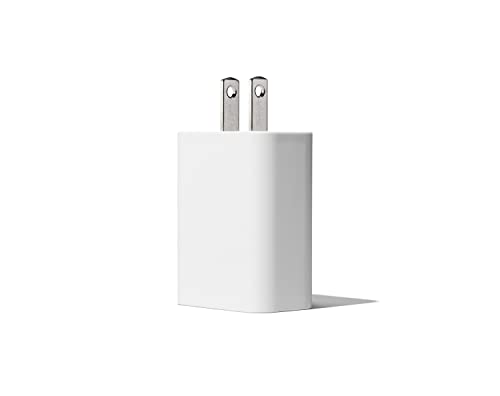
A flat wall charger spreads its electronics across a wide, thin board instead of stacking them in a cube. Its prongs fold into recesses on the back face so that, folded, the back sits almost flush and the whole unit slides into a pouch or a laptop sleeve pocket without a lump. The USB-C port usually sits on the bottom or side edge, which changes how a cable hangs from a socket: a port on the lower edge lets the cable drop straight down from a wall outlet, while a port on the face can push the cable outward and add leverage on the prongs. Output in this class most often sits in the 20 to 30 watt range from a single port, because that range matches what iPhones negotiate for wired fast charging and because higher outputs demand larger magnetics and more heat dissipation than a thin shell easily provides. Multi-port flat chargers exist, but splitting output across two ports often drops the per-port figure below the level an iPhone needs for its fastest wired rate, a detail buried in the output table rather than the headline number.
Card-format power banks in this class
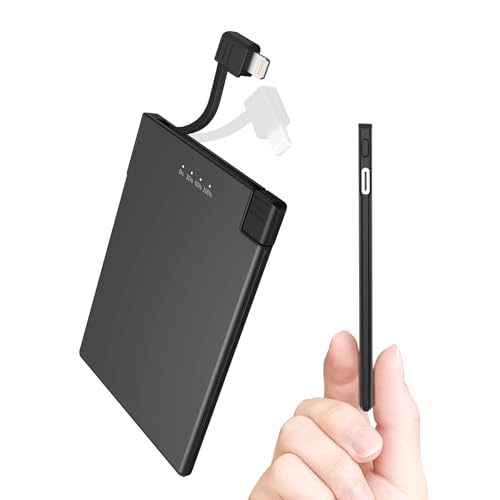
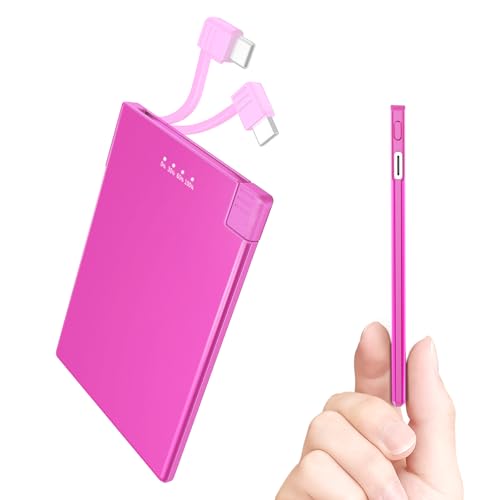
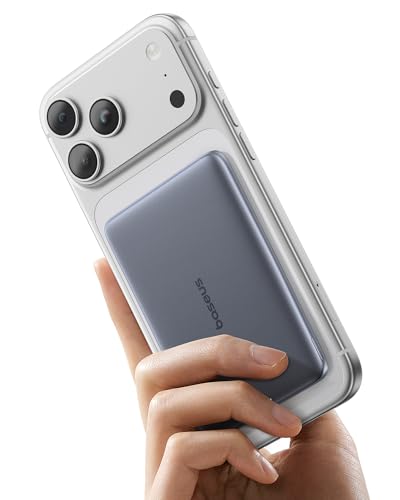
A card-format power bank replaces the cylindrical or chunky prismatic cells of a conventional bank with a flat pouch or thin prismatic cell laid across the full area of the housing. That layout is why capacity in this format clusters in a narrow band: there is only so much cell volume inside an 85 by 54 millimetre outline at single-digit thickness. Published capacities around 3,000 to 5,000 milliamp-hours are typical for genuinely thin models, with thicker card-shaped models pushing higher by quietly leaving the thickness range that makes the format useful. Some models add a magnetic alignment surface for compatible iPhones, some add a short integrated cable, and some keep the design to a single USB-C port and a row of indicator lights. Each addition costs thickness or area, so a model that claims high capacity, magnetic attachment, an integrated cable, and true card thickness at once deserves a particularly close reading of its dimension table.
Why makers stretch the phrase
The incentive is plain. Card size is searchable, visual, and instantly understood, while a phrase like low-profile 11 millimetre charger is accurate but forgettable. So the language drifts: a charger is compared to a card in a render where the card is enlarged, a power bank is photographed at an angle that hides its stepped back, or a measurement is taken at the thinnest edge of a tapered housing rather than at the thickest point the buyer will feel in a pocket. It means the phrase functions as a starting question rather than an answer, and the sections on verification later in this guide describe how to check a claim with a ruler, a set of calipers, and the stated dimensions in the manufacturer’s own document.
Why flat chargers are possible now
Ten years ago a 20 watt charger was a chunky object because the components inside it were chunky. The transformer needed a certain core volume, the switching transistor needed a heatsink, the output capacitors needed height, and the safest layout stacked those parts in a roughly cubic enclosure with air and plastic around them. Three developments changed the geometry. Gallium nitride switching devices, usually shortened to GaN, switch faster and waste less energy as heat than comparable silicon parts, so they can be smaller and need less metal to cool them. Planar magnetics replace a wound transformer standing tall on the board with flat windings layered into or across the board itself, trading height for area, which is exactly the trade a card-shaped housing wants to make. And dense, well-planned board layouts place components on both sides of the board, interleave low-profile parts, and use the housing itself as part of the thermal path.
Each of those developments trades something away, and a buyer benefits from knowing what. A planar transformer spreads sideways, so the board grows and the design becomes harder to shrink in footprint even as it gets thinner. GaN devices reduce losses but do not abolish them; at a sustained 20 watt output a small percentage lost as heat still has to leave through a shell with very little internal air volume. Removing heatsink mass removes a thermal buffer, so a flat charger can reach its surface temperature limit sooner during a long charge than a heavier cube that absorbs heat into metal for longer before shedding it. These are not flaws so much as the physics of the format, and they explain why the most credible flat chargers publish a clear continuous output figure and a protection behaviour, while weaker listings publish only a peak number.
GaN in plain terms
Gallium nitride is a semiconductor material used for the power switches that chop incoming mains electricity into the high-frequency pulses a small transformer can handle. Because GaN switches can change state faster with lower losses, the transformer can run at a higher frequency and be physically smaller, and the cooling burden shrinks with it. In a flat charger that saved volume is spent on making the enclosure thinner rather than on raising output without limit. Listings sometimes present GaN as if the material alone guarantees cool running or high efficiency at every load. It does not. Circuit design, component quality, firmware control of the switching, and the thermal path to the shell matter as much as the switch material, which is why two chargers with the same headline technology can publish noticeably different dimensions and sustained-output behaviour.
Planar magnetics and sideways design
A conventional transformer looks like a small spool: wire wound around a core, standing proud of the board. A planar design flattens that spool into layers, using traces on the circuit board or thin stacked windings pressed into a low, wide core. The magnetic part becomes a pancake instead of a tower. Around it, designers lay capacitors on their sides, split circuitry across both board faces, and route high-voltage and low-voltage sections with the isolation distance that safety standards require still preserved across the wider board. The result is an assembly that can be 8 to 12 millimetres tall inside its shell. The cost is repairability and, in some designs, a wider footprint that cannot shrink further, but for a product whose entire appeal is a card outline, that cost is the point of the exercise.
There is also a quieter enabler: the USB-C Power Delivery standard itself. Because the phone and charger negotiate voltage and current digitally, a compact charger does not need a row of fixed outputs or bulky dedicated circuitry for each device class. One well-controlled USB-C port can offer the 5 volt fallback every device accepts and the 9 volt profile an iPhone uses for fast charging, then step to other profiles for larger devices if the design supports them. Negotiation moves complexity from copper and iron into a controller chip, and controller chips are flat. That shift is a large part of why a modern 20 watt class charger can be a card at all while its fixed-output ancestors could not.
Heat behaviour in a thin enclosure
Every charger warms up. Converting mains power to the direct current a phone accepts is efficient in modern designs, often well above four fifths of the energy passing through, but the remainder leaves as heat, and at 20 watts delivered even a modest loss means a few watts of warmth inside a shell with the surface area of a playing card and almost no depth. A flat housing has one thermal advantage and one thermal weakness. The advantage is area: a broad face can spread heat across a wide surface, avoiding a single intense hot spot if the internal layout is thoughtful. The weakness is mass and airflow: there is little material to absorb a surge, the back face sits against a wall or a strip where air barely moves, and the front face is often close to bedding, a sofa arm, or the inside of a travel pouch if someone charges in a bag, which should never be done with any mains charger.
Published behaviour to look for is thermal throttling described honestly. When internal temperature climbs past a set threshold, a well-designed charger reduces output in steps rather than failing or cooking its own components. To the phone, that looks like a fast start followed by a slower middle stretch: the iPhone accepts a high rate while its own battery is low and cool, then both phone and charger moderate as heat builds and as the battery fills. A buyer who sees charging slow after the first portion of a session is not necessarily seeing a defect. iPhones themselves taper charge as the battery approaches full, and they reduce intake when the phone is warm from navigation, gaming, or a hot car. The charger’s job is to stay within its published limits while the phone makes those decisions, and a design that admits to stepping down under sustained load is more credible than one promising full output indefinitely in a sealed thin shell.
Surface temperature and touch
Safety standards for information technology equipment, principally IEC 62368-1 and its national versions, set limits for accessible surface temperatures depending on material and contact duration. A plastic charger shell can legitimately feel quite warm to the hand while remaining inside those limits, because warm and unsafe are different thresholds and human skin is a sensitive but uncalibrated instrument. What should concern a buyer is not warmth itself but the warning signs around it: a shell that becomes uncomfortable to hold for a few seconds, a smell of hot electronics, discolouration near a port, or a charger that repeatedly disconnects and reconnects as protection trips. Those signs point to a unit operating beyond its intended envelope, or to a counterfeit unit with no real protection at all, and the correct response is to stop using it rather than to prop it on a cold surface and carry on.
Placement changes the result
Where a flat charger sits matters more than where a bulky charger sits, precisely because its cooling depends on its broad faces. Plugged into a wall socket with its back near the wall and its front exposed to room air, it sheds heat as designed. Plugged into a power strip lying under a desk, with its face covered by cables or pressed against carpet, it sheds less. Wedged behind furniture so the housing touches fabric, it sheds least of all and also creates a needless fire-risk pattern that no certification contemplates. Sensible habits are boring and effective: charge on a hard, clear surface, keep the charger uncovered, avoid running a thin high-output unit inside a closed bag, and give a warm unit air rather than insulation.
The phone contributes heat too, and card-format power banks add a particular version of this problem. A magnetic bank attached to the back of an iPhone stacks two warm objects together: the bank’s conversion electronics and cell on one side, the phone’s charging circuitry and battery on the other, with the phone’s case, if fitted, trapping warmth between them. Wireless transfer also loses more energy as heat than a cable does. None of that rules the format out, but it explains why a wired connection from the same bank, where the design offers one, usually charges faster and cooler, and why published specifications for magnetic charging often quote a lower wattage than the same bank’s wired port.
What an iPhone actually requires
An iPhone does not draw whatever a charger offers; it negotiates. Under USB Power Delivery, the charger advertises its available voltage and current profiles, the phone selects a profile it supports, and the two settle at a rate the phone’s own charging controller judges appropriate for its battery level and temperature. For fast wired charging across many recent iPhone generations, the relevant figure is a USB-C Power Delivery source in the 20 watt class or above, delivering a 9 volt profile the phone can accept. A charger rated higher does not force more power into the phone; it simply has headroom the phone will not use beyond its own limit. A charger rated lower, or an old 5 watt USB-A brick, still charges, just at the slower legacy rate that turns an overnight habit into a poor daytime option.
Manufacturer documentation for the iPhone has long described fast charge as reaching roughly half the battery in about half an hour with a suitable adapter and cable, with the exact result depending on model, battery size, temperature, and what the phone is doing at the time. Larger models with larger batteries can accept higher peak rates in some generations, and recent generations have raised their wired ceilings, but the buying rule for this category stays simple: a single-port flat charger publishing a genuine Power Delivery output of 20 watts or more covers the fast-charge requirement for the iPhone generations most buyers own, and a higher headline figure matters mainly if the same charger will also serve a tablet or a laptop, where the extra profiles earn their keep.
Lightning-era iPhones
iPhones from the iPhone 8 generation through the iPhone 14 generation charge through a Lightning connector. They support fast charging, but only when fed from a USB-C source through a USB-C to Lightning cable; the old USB-A to Lightning cable paired with an old brick cannot trigger the faster negotiated profiles. That cable detail is the most common reason an owner buys a capable flat charger and sees no improvement: the charger is right, the cable is the legacy one from a drawer, and the pair falls back to slow charging. Genuine and properly certified Lightning cables carry an authentication component, and the Made for iPhone programme exists largely because poorly made Lightning connectors have a long record of overheating, breaking off in ports, and failing after an operating system update. For a connector that will be plugged in daily, cable certification matters as much as charger certification.
USB-C-era iPhones
From the iPhone 15 generation onward, the phone itself carries a USB-C port, and a USB-C to USB-C cable connects it to a flat charger directly. This simplifies the drawer: the same cable can serve the phone, a tablet, and many laptops, although cable ratings still differ, with some cables limited to charging at lower currents and slow data rates while others support higher current and faster transfer. For charging an iPhone, a standard USB-C cable rated for at least 60 watts covers the phone’s needs with room to spare. Owners of both generations, common in households where phones pass between family members, need both cable types on hand, and a flat charger with a single port serves each in turn but not both at once, a limitation worth weighing before a trip.
Readers comparing the wider charger market beyond the card format will find output classes and cable pairings laid out across several neighbouring guides, and one useful starting point for the general landscape sits here:
best 3rd party iphone chargers
That broader view helps put the card category in proportion: flat chargers win on carriage and socket fit, while larger chargers often win on sustained output, port count, and price per watt, and neither victory cancels the other.
Folding prongs and travel fit
The folding prong is the mechanism that makes or breaks this category. On North American and Japanese style designs, two flat blades rotate or slide into slots in the back of the housing. A good mechanism opens with a firm, positive stop, holds the blades perpendicular under the weight of the charger and the tug of a cable, and folds away without a wobble that suggests the pivot is wearing. A poor mechanism feels loose within months, lets the charger sag in the socket until one blade loses contact, and arcs or disconnects under movement. Because the prongs carry mains voltage, their mechanism is also a safety component: cracked recesses, blades that bend sideways, or a housing that flexes around the pivot are reasons to retire a charger, not quirks to live with.
Regional variation matters before travel rather than after landing. The flat folding blades described above suit Type A and Type B sockets. British and Irish sockets take three rectangular pins that cannot fold into a card profile as elegantly, so genuinely flat designs for that market use different geometries and are usually thicker. Much of continental Europe uses round pins, which again changes the housing. A buyer whose travel crosses regions may find a slim charger plus a quality adapter is bulkier than expected, because the adapter restores the depth the flat design removed. Checking prong style against destination, and against the fine print that states which input standard a model is built for, belongs on the checklist before any comparison of wattage.
Socket clearance and crowded strips
Here the format earns its keep in daily life, not just in luggage. A conventional cube charger on a power strip often covers the neighbouring socket, especially on strips with tight spacing or sockets oriented in a row. A flat charger with prongs near one end and a body that extends along the strip rather than across it can leave adjacent sockets usable, and on a wall duplex it can occupy the upper socket while leaving the lower one free for a lamp or a laptop brick. Port position interacts with this: a cable leaving the bottom edge of a flat charger on a wall socket drops clear of the socket below, while a cable leaving the side may cross it. Surge strips in home offices, media units with a tangle of standby devices, and the single accessible socket in a cafe all reward a charger whose shape was designed around other plugs rather than in isolation.
Carrying one in a wallet, honestly
Marketing photographs love a charger in a wallet. Reality imposes conditions. A wallet flexes every time its owner sits down, and a rigid electronic device inside it receives that bending force through leather and card slots never designed to protect electronics. Pressure on a thin lithium power bank is a genuine hazard: pouch cells dislike puncture, crushing, and repeated flexing, and a damaged cell can swell or fail. Pressure on a flat wall charger is less hazardous but still hard on prong pivots, port solder joints, and a housing seam. A card sleeve in a laptop bag, a rigid pocket in a tech pouch, or the flat compartment of a purse gives the same carriage benefit without the bending load, and most owners who carry these products daily end up there. If a wallet is used at all, the charger belongs in a stiff outer slot, the wallet should not be sat on with the device inside, and any swelling, cracking, or new looseness ends the experiment immediately.
Thickness interacts with carriage in smaller ways too. At 8 or 9 millimetres a wall charger rides in a shirt pocket without dragging the fabric, and slips beside a laptop in a sleeve designed only for the machine. At 13 millimetres it still travels flat but starts to compete with the laptop’s own charger in the same pocket. Owners who carry a phone, a charger, and a short cable as a matched set often find the cable, coiled, is the bulkiest element, which is why the cable section below gives short and flat cables their own consideration rather than treating them as an afterthought.
Card-format power banks, without the wishful arithmetic
A power bank’s headline capacity is quoted in milliamp-hours at the internal cell’s nominal voltage, usually around 3.7 volts, not at the 5 or 9 volts delivered to the phone. That single fact explains most disappointment in this category. A cell marked 5,000 milliamp-hours stores about 18.5 watt-hours of energy. Converting that energy up to USB output voltage loses a portion as heat in the conversion circuitry, the cable loses a little more, and the phone’s own charging circuitry loses a further portion while filling a battery with its own capacity quoted at yet another nominal voltage. A realistic expectation is that roughly two thirds to three quarters of the stored energy arrives as usable charge in the phone, varying with temperature, discharge rate, and whether the connection is wired or magnetic. For many iPhones, whose batteries sit broadly in the 3,000 to 4,700 milliamp-hour range depending on model, a thin 5,000 milliamp-hour bank therefore delivers one substantial top-up rather than the two full charges a naive division suggests.
None of this is deception when it is disclosed properly, because watt-hours are printed on the cell and often on the housing, and watt-hours are the honest currency for comparing banks of any shape. The deception risk lies in listings that quote only the cell figure in large type and bury the rated output capacity, meaning the capacity actually available at the USB port at a stated voltage, in small print or omit it entirely. Reputable manufacturers publish that rated figure, and it is the number a buyer should compare. A bank that publishes both figures, and whose rated figure sits in the expected proportion to its cell figure, is describing its physics accurately. A bank that promises several full charges for a large phone from a card-thin cell is describing arithmetic that energy conservation does not permit.
Pass-through and simultaneous use
Pass-through charging means the bank can charge itself from a wall source while charging a phone at the same time, an appealing hotel-room arrangement with one socket and two depleted devices. In thin banks the feature deserves scrutiny. Passing power through adds heat in a housing with little thermal headroom, some designs drop the phone’s rate sharply while the bank itself is charging, and some manufacturers advise against routine pass-through use because holding a lithium cell at full charge while warm and cycling lightly is unkind to its lifespan. Where a specification sheet describes pass-through plainly, including the output available during it, a buyer can judge the trade. Where a listing is silent, assuming the feature exists is unwise. The safer overnight pattern is often the dull one: charge the phone from the wall charger, charge the bank from the same charger afterwards or from a second port elsewhere, and let each device do one job at a time.
Indicators that tell the truth
Four small lights are the traditional fuel gauge of a power bank, and their honesty varies. A well-calibrated indicator spreads its steps across the usable capacity, so the drop from four lights to three takes roughly as long as the drop from two to one. A poorly calibrated one holds four lights for most of a discharge and then collapses through the remaining steps quickly, which is worse than no gauge because it teaches the owner to trust a reading that lies. Percentage displays on slightly thicker models solve this at the cost of a screen and its housing. Either way, the specification clue is whether the manufacturer states the indicator behaviour and the low-battery warning at all. Buyers also benefit from a bank that shows when fast charging is active, through a coloured light or symbol described in its manual, because that confirmation separates a cable problem from a bank problem in seconds.
Watt-hours and flying
Airlines and regulators express battery limits in watt-hours, with the familiar threshold allowing lithium batteries up to 100 watt-hours in carry-on baggage without special approval, and spare batteries and power banks required to travel in the cabin rather than checked luggage. A card-format bank at around 18 to 20 watt-hours sits far below that threshold, so it raises no approval question, but the labelling still matters for two reasons. First, security staff must be able to read the capacity marking; a bank whose watt-hour figure is printed legibly on the housing passes checkpoints more smoothly than one whose markings have worn off or were never present. Second, the same watt-hour figure is the buyer’s own best comparison tool on the ground. Rules differ slightly between carriers and jurisdictions, and checking a carrier’s current published limits before a long trip remains sensible, but the card format’s small energy store is, in this one respect, an uncomplicated advantage.
Owners who mainly need a bank for a single long day, a festival, a conference, or a delayed train will find the card format’s bargain reasonable: less stored energy than a brick, in exchange for a device that is actually carried. The best power bank is routinely the one in the pocket when the phone reaches its final fifth of charge, and a bulky bank left at a hotel has a usable capacity of exactly zero. That logic fails only when the day demands multiple full charges, video recording for hours, or sharing power between travellers, where a larger bank or a wall outlet must do the work and the card becomes a supplement rather than the plan.
Cable pairing for a flat kit
A charger and its cable function as one system, and in a flat kit the cable often determines whether the set packs flat, charges fast, and survives the year. Length is the first decision. A short cable of around 30 to 50 centimetres suits a power bank in the same pocket as the phone, a charger on a desk edge, and a neat coil in a pouch, while being useless for a socket behind a bed. A one-metre cable covers most wall sockets and nightstands. Longer cables serve sofas and airport seating, and readers who know a longer run is their normal case will find the dedicated discussion here:
best 6ft iphone chargers
Voltage drop grows with length and with thin conductors, so a long, cheap, unrated cable can quietly slow a charge that a short quality cable delivers properly, even from the same charger.
Matching cable to iPhone generation
Lightning-era phones need a USB-C to Lightning cable to fast charge from a modern flat charger, as covered earlier, and that cable should carry proper certification for the connector system it uses. USB-C-era phones need a USB-C to USB-C cable, where the traps are different: some bundled cables are built for low current and slow data, e-marking chips are required for higher current levels on longer or higher-rated cables, and a cable rated at 60 watts comfortably covers iPhone charging while a 100 watt rated cable adds headroom for a laptop from the same pouch. Households with both generations do best with a small labelled set rather than a tangle of lookalike leads, because the penalty for grabbing the wrong cable is a slow charge discovered at departure time.
Flat cables and strain relief
Flat ribbon-style cables coil into a flatter package than round cables and resist tangling in a pouch, which makes them natural partners for this category. Their weakness lives at the ends. Every cable fails eventually at the point where the flexible lead meets the rigid connector, because that junction concentrates bending stress on the conductors inside. On thin connectors the reinforcement at that junction is sometimes slimmed down for appearance, and the cable begins to fail intermittently within months: charging that starts and stops as the lead moves, or works only at one angle. A well-made cable shows a graduated strain relief, a firm connector housing, and a published bend or durability specification. Pulling a cable out by its lead rather than its housing, and avoiding a tight bend where the cable leaves a charger wedged behind furniture, extends the life of any design. Right-angle connectors deserve mention for flat chargers on wall sockets, since they let the lead turn downward immediately instead of projecting outward where it can be knocked.
Integrated cables on power banks remove the forgotten-cable problem and pack perfectly flat by definition, because the lead tucks into a channel in the housing. The trade is permanence: when an integrated cable frays, the bank loses its most convenient output, and when Apple changes a connector generation, as happened with the move from Lightning to USB-C, an integrated cable locks the bank to the older generation while a port-only bank simply pairs with a new lead. Buyers who change phones often should weight ports more heavily; buyers outfitting a fixed emergency kit for one phone can reasonably prefer the integrated lead.
Safety and certification in a thin shell
A mains charger is one of the few consumer products that connects a pocket device directly to household wiring, and its safety case rests on isolation, component quality, and protection circuits that a buyer cannot see. That invisibility is exactly why third-party certification exists. In North America, a genuine listing to the applicable standard, through UL, ETL, CSA, or another nationally recognised testing laboratory, means a sample of the design was examined and production is subject to follow-up checks. In Europe the picture involves the CE marking and the standards behind it, and in the United Kingdom the UKCA marking plays the corresponding role. A listing mark includes a control or file number that can be looked up in the certifier’s public directory, and that lookup is the difference between a verified claim and a printed logo, because counterfeit products copy logos freely and copy file numbers less convincingly when a buyer actually checks them.
USB-IF certification answers a different question. The USB Implementers Forum tests compliance with the USB specifications, including Power Delivery behaviour, and certified products appear in its public listings. A charger can be electrically safe without being fully specification-compliant, and it can negotiate politely while having a weaker safety case, so the two credentials complement rather than replace each other. For cables, certification and programme marks matter in the same layered way, particularly for Lightning cables with their authentication history and for USB-C cables carrying higher currents.
Protection inside a thin enclosure
The protection set a specification sheet should name includes over-voltage protection, over-current protection, short-circuit protection, and over-temperature protection, with the last carrying special weight in this category. In a thin shell the temperature sensor’s placement and the firmware’s response define whether a charger gracefully steps down on a hot day or cycles unpleasantly between full output and shutdown. Surge handling also deserves a line in the documentation, since a charger that travels will meet hotel wiring, generators, and ageing power strips in worse condition than a home office socket. Flame-retardant housing material ratings, such as a UL 94 V-0 classification for the enclosure plastic, appear in better specification sheets and signal that the shell itself was chosen to resist ignition and stop burning if an internal fault occurs. None of these details photographs well, which is why they separate serious listings from decorative ones.
Reading the fine print of a listing
A careful read takes minutes and follows a pattern. Start with the legal model number, which should match the certification lookup, since brands often sell several similar models under one marketing name. Check the input rating, which should cover the voltage range of the regions where the charger will be used, commonly a wide 100 to 240 volt range for travel designs. Check the output table line by line: the headline wattage may describe a single-port peak, a combined total across ports, or a profile available only at a voltage the iPhone does not request. Check whether dimensions include the prongs. Check the operating temperature range and any statement about altitude or indoor use. Finally, look for a real support channel and a warranty measured in years rather than days, because a manufacturer expecting a product to survive stands behind it differently from one expecting a listing to survive. Shoppers who also charge larger devices will want to cross-check higher output classes against a guide devoted to them, such as this one:
best 100w chargers
The comparison underlines how much of a large charger’s bulk is magnetics and cooling for outputs an iPhone alone will never request.
Verifying the claim before and after buying
Dimensions are one of the few product claims a buyer can check completely, with tools already in many homes. A ruler settles length and width against the 85.60 by 53.98 millimetre card standard, remembering that a few millimetres of extra length for a port housing is a reasonable design choice while a centimetre is a different product wearing the category’s name. Thickness needs more care. Calipers, even an inexpensive set, measure the housing at its thickest point, and the measurement that matters includes everything the pocket will feel: the folded prongs if they sit proud of the back, a raised magnetic ring on a power bank, a lanyard loop, a domed indicator window, and the step where an integrated cable rests in its channel. Measure with prongs folded, then open, and compare both figures with the listing; a manufacturer that states folded thickness including prongs is answering the question the buyer is actually asking.
Weight deserves the same treatment, on a kitchen scale if one is available. Published weight for a card power bank should rise with its watt-hours in a predictable way, because lithium cells have a known energy density range. A claimed capacity that would require the cell alone to weigh more than the entire product is a claim that fails arithmetic before it fails in use. For wall chargers, comparing the stated weight against similar certified models gives a rough sense of whether shielding and magnetics are present in the expected quantity.
Spotting renders that hide a bulge
Product photography in this category follows recognisable tricks. The top-down hero image shows footprint honestly but conceals thickness entirely. The lifestyle image places the charger beside a card photographed closer to the camera, so perspective flatters the comparison. The side image, when one exists, may show the thin edge of a tapered housing rather than the raised centre where the transformer or cell sits. A magnetic power bank may be shown attached to a phone, where the phone’s own bulk hides the bank’s stepped back. Honest listings counter these habits with a dimensioned diagram, a straight side profile, and a photograph of the prongs folded and open. Where a listing offers only renders rather than photographs, and no dimensioned diagram at all, a buyer is being asked to trust the one claim this category exists to make, without evidence.
Checking output without a laboratory
Most buyers own no USB power meter, and none is required to catch the largest output misstatements, although an inexpensive meter is a genuinely useful tool for anyone who buys chargers often. Without one, behaviour gives clues. A cool iPhone with a low battery should move quickly through its first portion of charge on a genuine 20 watt class Power Delivery pairing, then slow as the battery fills; a pairing that crawls from the start suggests a fallback to a legacy profile, most often because of the cable. The phone’s own settings screens report whether a battery is charging and, on power banks, repeated sessions reveal whether delivered capacity matches the rated figure in spirit. A charger whose documentation lists its exact profiles, for example 5 volts at 3 amps and 9 volts at a stated current, can also be cross-checked against the phone maker’s published adapter guidance. Readers whose phone supports a higher wired ceiling, or who share a charger with a tablet, may want the intermediate output class explained in its own right:
best 45w usb c chargers
That middle class often suits a flat design better than the largest adapters, because its magnetics and heat load remain closer to what a thin shell can sustain.
A buying checklist for this category
Footprint first: length and width stated in millimetres, close to the 85 by 54 millimetre card standard, with any extra length explained by a port or prong housing. Thickness second: a single figure for the thickest point, folded prongs included for a wall charger, raised rings and integrated cable channels included for a power bank, and a side profile or dimensioned diagram to back the figure. Output third: a USB-C Power Delivery profile that covers the 20 watt class an iPhone uses for fast wired charging, stated as voltage and current lines rather than a lone headline wattage, with multi-port models stating what one port receives when two are in use. Capacity, for a bank, stated in watt-hours as well as milliamp-hours, with a rated output capacity at the port. Certification named precisely enough to look up: the testing laboratory and file or control number for safety, and a USB-IF listing where compliance is claimed. Prong style matched to the buyer’s region and travel pattern, with a mechanism described as folding or fixed rather than left to a photograph. Cable requirements stated for the buyer’s iPhone generation, Lightning or USB-C, with the cable’s own rating and certification considered part of the purchase. Protection features listed individually, including over-temperature behaviour appropriate to a thin shell. Weight that makes sense against the claimed capacity and components. And finally a warranty and support channel proportionate to a product that connects a phone to mains power.
Two or three failures on that list do not always disqualify a product, but the pattern of failures tells a story. Missing thickness and missing certification together suggest a listing built around a photograph. A precise dimension table, a lookup-able file number, a rated capacity, and a plain statement of what happens when the unit grows hot suggest a manufacturer describing a real object. In a category sold on a physical claim, the quality of the documentation is itself evidence about the quality of the hardware, because both come from the same engineering culture.
Check prices on Amazon
Live listings for the shortlist in this guide are pulled from Amazon below, so prices and availability are always current at the moment you look.



The category, judged on its own terms
Credit card size chargers for iPhone succeed when they are judged by the problem they set out to solve. They do not store the most energy, sustain the highest output, or charge the most devices at once, and their specification sheets should not pretend otherwise. What they offer is presence: a charger flat enough to live where the owner actually is, in the pouch that is always carried, on the strip where no cube fits, in the hotel socket behind the bed, ready for the ordinary moment when a phone is low and the day is not finished. The honest models in this category publish their dimensions to the millimetre, their output as profiles, their capacity in watt-hours, and their certifications as numbers a stranger can verify. The rest publish a photograph beside a card and hope the comparison ends there. A buyer equipped with the card’s real measurements, the iPhone’s real requirements, and the short checklist above can tell those two groups apart in minutes, and that, more than any single model, is the purchase this guide exists to support. When the flat charger in a traveller’s pouch quietly rescues a boarding pass on a dimming phone, the category has kept its promise in full.