Our Top Picks




What's inside
- What a Treat Camera Actually Does, and Why It Is Not Just a Camera With a Snack Drawer
- How the Treat Launcher Works: Springs, Impellers, and Launch Distance
- Treat Compatibility: Diameter Limits, Dry Versus Moist, and Why Jams Happen
- Reservoir Capacity and Portion Discipline
- Camera Quality That Matters: Resolution, Field of View, and Night Vision
- Two-Way Audio, Bark Alerts, and the Latency Between Them
- The App and Subscription Model, Explained Without the Sales Language
- Safety and Materials: Plastics, Chew Resistance, and Where the Unit Sits
- Wi-Fi Requirements: The 2.4 GHz Band, Walls, and Stream Stability
- Multi-Pet Households, Cleaning the Treat Path, and Choosing Well
- Check prices on Amazon
- Building a Daily Routine Around the Device, and Solving the Common Failures
As an Amazon Associate I earn from qualifying purchases. This post may contain affiliate links at no extra cost to you.
This guide is reader-supported through affiliate links, and the site may earn a commission when a purchase follows one of those links at no added cost to the buyer. Product lineups, feature sets, and availability shift over time, so checking the current specification sheet before ordering is always worthwhile. Nothing in these pages depends on a commission, and the selection criteria below are explained in full so readers can weigh the same trade-offs themselves.
What a Treat Camera Actually Does, and Why It Is Not Just a Camera With a Snack Drawer
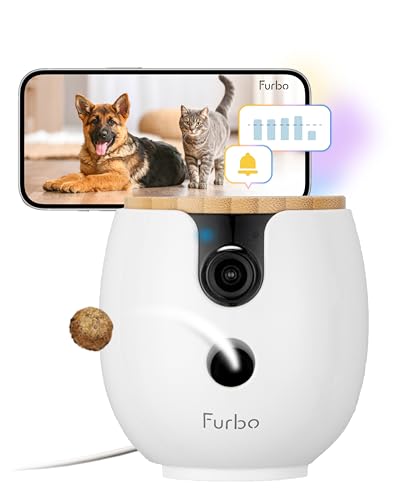
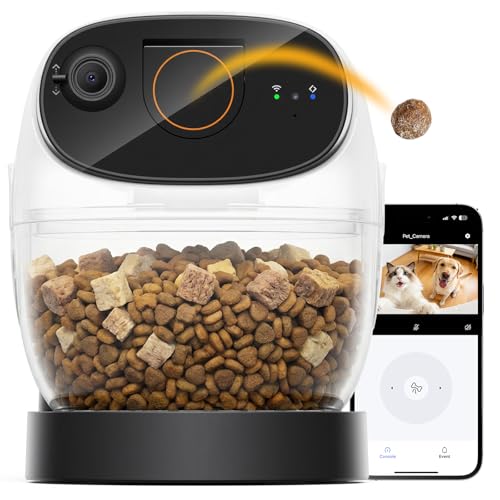
A treat camera combines three systems that an ordinary indoor camera keeps separate: an imaging unit that watches the room, a storage reservoir that holds dry treats, and a launching mechanism that throws one or a few pieces toward the pet on command from a phone app. The appeal is interaction rather than surveillance alone. A standard camera lets an owner watch a dog pace by the door; a treat model lets that owner speak through the speaker, get the dog’s attention, and reward calm behaviour from another building or another country. That loop of seeing, speaking, and rewarding is the entire reason the category exists, and every buying decision should be judged against how well a particular model closes that loop.
The category grew out of two separate product lines that owners were already combining informally. Pet cameras offered live viewing, motion alerts, and two-way talk, while automatic feeders offered scheduled portions from a sealed hopper. Treat cameras merge the camera of the first group with a much smaller, manually triggered version of the second group’s dispenser. Because the dispensing is deliberate rather than scheduled, the reservoir can be smaller, the mechanism simpler, and the whole unit compact enough to sit on a shelf. Understanding that heritage explains many design choices, from the modest hopper sizes to the emphasis on app responsiveness over portion precision.
Readers comparing this category with general pet monitoring may find it useful to start from a broader survey such as best cameras to watch your pets and then narrow toward the tossing feature specifically. The distinction matters because a buyer who only wants to check in visually will overpay for a launcher that never gets used, while a buyer who wants remote training reinforcement will find a plain camera frustrating within a week. Treat tossing is a behaviour tool first and a novelty second; the owners who report the most satisfaction are those who fold it into an existing training routine, rewarding quiet settling, recall to a mat, or calm behaviour during departures.
Several practical scenarios drive most purchases. Separation anxiety management is the most common: a midday toss can interrupt a barking spiral and give a dog a small positive event during an otherwise empty afternoon. Owners of puppies use short-range tosses to reward crate settling without opening the crate door and resetting the exercise. Households with a dog recovering from surgery use the camera to confirm rest and the launcher to deliver a permitted treat without a visitor entering the room. Each scenario stresses a different part of the hardware, which is why no single specification, least of all camera resolution, decides which model suits a given home.
It is also worth naming what these devices cannot do. A treat camera cannot exercise a dog, cannot correct behaviour it cannot see, and cannot substitute for the gradual desensitisation work that genuinely anxious animals need. The toss is a moment of contact, not a programme. Buyers who approach the category with that expectation tend to choose more sensibly, favouring reliability of the launch, clarity of the audio, and honesty of the alert system over gimmicks such as moving bases or laser pointers. The sections that follow take each subsystem in turn, explain the mechanics behind the marketing language, and give concrete figures that can be compared across models without needing to handle any of them.
How the Treat Launcher Works: Springs, Impellers, and Launch Distance
Two launching architectures dominate the category, and they behave differently enough that the choice affects treat selection, noise, and reliability. The first uses a spring-loaded arm or paddle: a small motor draws the arm back against spring tension, a treat drops into a pocket at the arm’s end, and releasing the latch lets the spring snap the arm forward, flicking the treat in a low arc. The second uses a pair of counter-rotating soft wheels, an impeller arrangement borrowed from ball launchers, which grip a treat that falls between them and squeeze it out at speed. Spring designs tend to throw in a predictable arc with modest force, while wheel designs can vary distance more smoothly by changing motor speed.
Launch distance figures quoted for the category generally fall between roughly three feet and ten feet, with most indoor models settling in the middle of that band. Distance depends on treat mass as much as mechanism power: a dense kibble piece carries farther than a light puffed treat of the same size, and a slightly sticky treat loses energy gripping the wheels or pocket. Manufacturers measure with their own recommended treat on a hard floor, so real carpet, which kills the bounce and roll that make a toss look longer, shortens the practical scatter zone. For training purposes a shorter, consistent toss is usually better than a long, variable one, because the dog learns where rewards land and settles in that spot.
Consistency matters more than raw range for another reason: the camera needs to see the reward event. If treats routinely fly outside the lens’s field of view, the owner cannot confirm the dog found the piece, and pieces accumulate under furniture where they attract pests and stale. Better designs deliberately limit throw energy so treats land within the visible floor area a few feet in front of the unit. When comparing models, treat any distance claim as a maximum under ideal conditions and look instead for evidence of a repeatable landing zone, which owner reports and demonstration footage reveal more honestly than a specification table.
The firing sequence itself involves several steps that explain the short delay owners notice between tapping the app button and seeing the toss. The app command travels to a cloud service, then to the home unit, which wakes the feed mechanism, meters one portion into the launch pocket, confirms the pocket is loaded, and only then releases. Some models add an audible chime before firing, a useful conditioning cue that teaches the dog to look toward the unit rather than being startled by a projectile arriving unannounced. A chime also protects a sleeping dog from a rude awakening and gives the owner a final moment to cancel if the dog has wandered behind the unit.
Mechanical wear concentrates in predictable places. Spring mechanisms fatigue slowly and usually fail by losing distance rather than stopping outright, while wheel mechanisms depend on the grip of soft rollers that harden or glaze with treat oils over months of use. Feed gates that meter treats from the reservoir into the pocket are the most common jam site in both designs, especially when treat sizes vary within one fill. None of this makes either architecture unreliable, but it does mean that a model with a user-cleanable, accessible treat path will age more gracefully than a sealed unit whose mechanism can only be serviced by replacement.
Treat Compatibility: Diameter Limits, Dry Versus Moist, and Why Jams Happen
Every launcher imposes a treat size window, and respecting that window is the single largest factor in trouble-free ownership. Typical guidance across the category centres on round or roughly uniform dry treats between about half an inch and one inch in diameter, with the exact band stated in each model’s manual. Treats below the minimum fall through metering gaps two at a time and produce double tosses that wreck portion discipline, while treats above the maximum wedge in the feed throat. Irregular shapes such as bone-shaped biscuits bridge across the reservoir outlet and form a stable arch that starves the mechanism even though the hopper looks full, a failure mode borrowed directly from grain-silo engineering.
Dry treats are effectively mandatory in this category, and the reason is friction rather than fussiness. Moist and semi-moist treats smear under the pressure of metering gates and impeller wheels, coating the treat path with a film that grabs subsequent pieces and grows stickier as it warms. Soft treats also deform, so a piece that entered the reservoir within the size limit may arrive at the gate squashed into an oval that no longer fits. Freeze-dried pieces sit at the opposite extreme: they are dry and light, but brittle, and the metering action can crush them into fragments and dust that sift into the mechanism and foul the pocket sensor. Dense, hard, uniformly sized kibble-style treats remain the reliable middle ground.
Mixing treat types in one fill is a quiet cause of chronic jamming that owners often blame on the machine. A reservoir holding two sizes behaves like a sieve in reverse: vibration from each launch cycle lets smaller pieces settle downward, so the mechanism receives an unpredictable sequence of sizes even though the overall mix looked even when poured in. Single-treat fills keep the metering geometry honest. Owners who rotate flavours should finish one fill before starting another, or choose two products manufactured to the same nominal diameter, rather than blending handfuls in the hopper.
When a jam does occur, the better apps report it as a failed dispense rather than silently counting a treat that never left the unit. That distinction matters for households tracking a dog’s intake, because a phantom portion recorded in the app can lead to a second toss and an accidental double reward once the blockage clears mid-cycle. Clearing procedure also separates designs: some models expose the full treat path once the reservoir lifts out, letting a chopstick or the handle of a teaspoon shift a wedged piece, while others require shaking the inverted unit over a counter, which spills the remaining fill. A removable reservoir with a wide mouth is worth real money over a model owned for years.
Storage conditions inside the reservoir deserve attention because treats stale faster in a warm, frequently opened hopper than in a sealed bag. Most reservoirs in the category hold enough for days rather than weeks of typical use, which conveniently limits staleness if owners refill modestly instead of topping up to the brim. A lid that seals with a gasket slows moisture exchange, and a desiccant pocket in some lids absorbs the humid air admitted at each refill. Treats that have absorbed moisture swell slightly and soften, drifting outside the size and friction assumptions the mechanism was tuned for, so a dog that suddenly experiences jams after months of clean operation may simply be eating last month’s fill.
Reservoir Capacity and Portion Discipline
Reservoir capacities in this category are usually expressed in cups or ounces, and the honest range runs from roughly one and a half cups in compact models to around three cups in the largest countertop units, equivalent to somewhere near thirteen to twenty-four ounces of typical dry treats depending on piece density. Translating volume into tosses requires knowing portion size, which varies by design: some launchers throw a single treat per command, others meter a small handful of three to five pieces. A single-treat model with a mid-sized reservoir can deliver well over a hundred individual rewards before refilling, while a handful-per-toss design empties the same volume in a few dozen interactions.
Portion discipline sounds like a human dieting concern, but for dogs it is a genuine health variable that treat cameras can either support or undermine. Treats are calorie-dense relative to their size, and veterinary guidance commonly suggests keeping treats to a modest share of daily intake, which a cheerful owner tossing remotely five or six times a day can exceed without noticing. Models whose apps count tosses and log the time of each one give the household a shared record, preventing the classic multi-owner problem where each person rewards the dog in ignorance of the others. A visible log also helps a trainer reviewing whether rewards actually coincided with the behaviour being reinforced.
Some models offer portion settings that change how many pieces a single command releases, and the useful range is narrow. The smallest setting suits training repetitions, where the reward is a marker rather than a meal, while larger settings suit a single midday event for a big dog. What matters is repeatability: a setting that averages four pieces but ranges between two and seven makes calorie tracking fictional. Repeatability depends on treat uniformity, which circles back to the compatibility rules in the previous section; a mechanism fed consistent pieces meters consistently, and one fed mixed shapes cannot.
Refill behaviour shapes real-world capacity more than the moulded volume does. A reservoir that must be unscrewed or unlatched with two hands encourages owners to fill it completely each time, which maximises staleness, whereas a flip lid invites small top-ups of fresh treats. Low-level indicators, whether a transparent wall section or an app estimate based on toss count, prevent the empty-reservoir discovery from happening during the one midday check-in that mattered. Transparent walls have a side benefit for multi-pet homes: anyone walking past can see at a glance whether the unit holds the dog’s treats or was last filled by someone else with a different product.
Households managing a dog on a veterinary diet should treat the reservoir as part of the feeding system rather than a toy. Using pieces of the dog’s own prescribed kibble as the loaded treat is the simplest way to keep remote rewards inside the diet plan, and most kibble falls comfortably inside the size windows these launchers accept. Where a dog requires a specific therapeutic treat, checking its diameter against the manual before purchase is essential, because a launcher that cannot handle the prescribed treat is furniture. This is one of several places in the category where a boring specification, checked early, decides whether the product works at all.
Camera Quality That Matters: Resolution, Field of View, and Night Vision
Resolution marketing in this category clusters around 1080p and 2K sensors, and the practical difference for pet monitoring is narrower than the numbers suggest. A 1080p image across a wide lens shows a whole room with the dog clearly identifiable, posture readable, and objects such as a chewed shoe or an overturned bin recognisable. A 2K sensor adds digital zoom headroom, letting an owner crop into one corner to check whether the dog is licking a bandaged paw or merely resting its head. What neither resolution provides is licence-plate sharpness across a large room, because the wide lenses needed for room coverage spread their pixels thinly. Buyers choosing between models should weigh zoom headroom against price rather than treating the higher number as automatically better.
Field of view, expressed in degrees, decides how much of the room a fixed camera can watch from one position. Indoor pet models typically offer somewhere between 130 and 170 degrees horizontally, with the widest designs using fisheye-style optics that curve straight lines near the frame edges. A very wide view suits a camera placed in a corner covering an open-plan space, while a moderate view gives a less distorted, more detailed image of a smaller area such as the zone around a crate or a dog bed. Some models add mechanical pan, rotating the lens to follow motion, which extends effective coverage beyond the static field but introduces motor noise and a moving part that can draw a curious dog’s attention.
Night vision in these units relies on infrared LEDs, usually in the 850 nanometre band, which produces a faint red glow at the emitter that some light-sleeping dogs notice, or the 940 nanometre band, which is invisible at the source but yields a dimmer image for the same power. Quoted infrared ranges for indoor models commonly run from about fifteen to thirty feet, comfortably beyond the dimensions of most rooms where a dog sleeps. Image quality at night depends as much on the sensor’s low-light sensitivity as on LED power, and monochrome night footage is normal rather than a fault. Owners checking a restless dog at 3 a.m. need contrast and motion clarity, not colour, and the better units deliver exactly that.
Frame rate and compression behaviour show up in how motion looks rather than in stills. A dog trotting across the frame at a low frame rate strobes between positions, making gait hard to judge, while a smoother stream lets an owner spot a limp or a favouring of one leg. Compression that is too aggressive smears detail in exactly the textured areas, such as a patterned rug or a brindle coat, where an owner is trying to read what the dog is doing. Live-stream delay, governed by the app pipeline rather than the sensor, affects treat timing: a reward launched for behaviour seen two seconds ago may land after the dog has moved on, weakening the training association.
Placement interacts with all of these specifications. A camera mounted at roughly dog height gives the most informative angle on posture and the treat landing zone, while a high shelf mount sees more of the room but foreshortens the dog and hides the floor area immediately below the unit where treats land. Readers building a wider home monitoring setup alongside a treat camera can compare dedicated options in best 10 security cameras to decide which rooms need a tossing unit and which need only a lens. The treat camera belongs where the dog spends unsupervised hours, not necessarily where the household’s other cameras already point.
Two-Way Audio, Bark Alerts, and the Latency Between Them
Two-way audio is the feature that turns a treat camera from a dispenser into a conversation, and its quality varies more than any specification sheet admits. The microphone must pick up a dog’s sounds from across a room without drowning them in the hiss of a refrigerator or the rumble of a heating system, while the speaker must reproduce a familiar voice clearly enough that the dog recognises its owner rather than reacting to a distorted stranger. Small enclosures limit speaker size, so voices sound thin on nearly every model; what separates the better units is intelligibility at moderate volume rather than richness. A speaker that must be shouted through at full volume to be understood will startle a dog instead of reassuring it.
Half-duplex versus full-duplex audio changes how natural the exchange feels. Half-duplex systems behave like a walkie-talkie, transmitting in one direction at a time and often clipping the first syllable after each switch, while full-duplex designs allow simultaneous sound both ways, closer to a phone call. For calming a barking dog, duplex design matters because the owner needs to hear whether the barking has stopped while speaking, not discover the result only after releasing a talk button. Echo cancellation also matters in hard-surfaced rooms, where the speaker’s output re-enters the microphone and can build into a feedback squeal that upsets the animal the call was meant to settle.
Bark alerts are generated by audio analysis that distinguishes a bark’s sharp onset and rhythmic repetition from other household sounds. Systems range from simple level detectors, which fire on any loud noise including a dropped pan, to trained classifiers that look for the spectral shape of canine vocalisation. Sensitivity settings trade missed barks against false alarms from televisions, doorbells, and neighbouring dogs audible through walls. The useful middle setting for most homes triggers on sustained barking bouts rather than a single woof, because the behavioural question an owner needs answered is whether the dog is settling or escalating, not whether it made any sound at all.
Alert latency, the gap between the dog barking and the phone buzzing, decides whether an owner can intervene during an episode or only review it afterwards. Latency accumulates across the microphone buffer, the classification step, the cloud relay, and the phone’s push notification service, and in practice ranges from a couple of seconds on a healthy connection to half a minute when any link in that chain is congested. Video clips attached to alerts usually begin a few seconds before the trigger, thanks to a rolling pre-event buffer, so the owner sees what provoked the barking rather than only its aftermath. For round-the-clock coverage questions beyond the pet room, a dedicated always-recording setup such as best 24 7 security cameras follows different design rules than an event-driven pet unit.
Sound and motion alerts work best tuned together. A camera that reports every motion event in a room with sunlit curtains will train its owner to ignore notifications within days, after which the one bark alert that mattered is missed among the noise. Sensible configuration narrows motion alerts to the dog’s area, sets bark alerts to sustained episodes, and reserves instant push delivery for those two categories while letting lesser events accumulate silently in the app timeline. Alert fatigue is a product failure mode as real as a jammed launcher, and it is prevented by configuration rather than by buying a different camera.
The App and Subscription Model, Explained Without the Sales Language
Nearly every treat camera is controlled through a companion app that handles live viewing, the toss command, alert settings, and the household’s list of authorised viewers. The quality of that app is a long-term ownership factor because the hardware rarely changes while the software is updated, redesigned, or occasionally abandoned. A well-kept app loads the live stream quickly, keeps the toss button reachable without menu diving, and makes alert history searchable by date and event type. Buyers should check how recently an app was updated and whether its developer maintains a visible support channel, since a camera whose app stops working after a phone operating system update becomes a paperweight regardless of its optics.
Cloud clip storage is where subscription tiers enter the category. The common structure offers a free level that keeps short event clips or still snapshots for a brief rolling window, with paid levels extending retention to weeks or a month and unlocking longer clips or continuous recording review. The genuine question for a pet owner is how far back useful footage ever needs to reach: most people review a barking episode the same day, so very long retention matters mainly for incidents discovered late, such as a slow-developing house-training regression or a neighbour complaint about noise on a specific date. Continuous recording tiers consume far more upload bandwidth and suit households already comfortable with that trade.
Some models store clips on a local memory card instead of, or alongside, the cloud. Local storage avoids an ongoing fee and keeps footage inside the home, but the card sits inside a unit the dog can knock over, and reviewing footage remotely still depends on the camera uploading it on demand. Card capacity and overwrite behaviour deserve a look in the manual: a small card in a busy room may retain only a day or two before the oldest clips are erased. Hybrid designs that keep a local copy and mirror alert clips to the cloud give the most forgiving failure behaviour, at the cost of more settings for the owner to understand.
Account sharing rules affect multi-adult households more than any storage tier. Look for the ability to invite family members with their own logins rather than sharing one password, and for permission levels that let a dog walker view the stream and toss a treat without changing settings or deleting clips. Guest access that expires is genuinely useful for holiday pet sitters. Two-factor sign-in protection is worth enabling on any account that controls a camera inside the home, and an app that supports it signals a developer treating the product as part of the household’s security surface rather than as a novelty gadget.
Finally, consider what happens if the service behind a camera is discontinued, a risk that has materialised repeatedly in connected home products. Cameras that keep local viewing or local recording when cloud services end degrade gracefully; cameras that route every function through a proprietary service do not. No buyer can eliminate this risk, but favouring established makers with a broad product line, and avoiding dependence on subscription-only features for basic functions like live view and the toss itself, keeps the exposure proportionate. The treat camera should still work as a camera on the worst day its maker ever has.
Safety and Materials: Plastics, Chew Resistance, and Where the Unit Sits
A treat camera spends its life within reach of an animal that investigates the world mouth-first, so its materials are a safety specification rather than a cosmetic one. Food-contact parts of the treat path, meaning the reservoir interior, metering gate, and launch pocket, should be made from food-grade plastic, and many makers state that those components are free of bisphenol A. The claim matters most for the reservoir, where treats sit in prolonged contact with the surface, and less for the outer shell. Dishwasher-safe removable reservoirs and treat-path parts, where offered, simplify the deep cleaning that oils and crumbs eventually demand.
Chew resistance is a design posture rather than a certification. Determined dogs can damage almost any household plastic, so responsible designs assume the unit will be investigated and remove the worst outcomes: no small detachable parts that could be swallowed, no exposed cable within reach of the chewing zone, and a reservoir lid that latches against a pawing or nosing attack rather than resting in place by gravity. A dog that learns the lid lifts freely will empty the reservoir once and remember the trick permanently. Cord management deserves equal attention; a power lead dangling to a floor socket crosses the exact space a bored dog chews, and routing it behind furniture or through a protective conduit is part of correct installation.
Placement is the strongest safety control available. Floor placement puts the unit inside the dog’s physical world, where it can be tipped, slid, and mouthed, but gives the most natural camera angle and the shortest treat flight. Shelf or counter placement at roughly three to four feet lifts the mechanism away from determined chewing and still frames the room well, provided the shelf edge does not block the launch arc. Wall mounting, supported by some models with a bracket, fixes the unit permanently out of reach and is the best answer for large, boisterous dogs, at the cost of committing to one room layout and making reservoir refills a step-stool task.
Stability under impact is its own quiet specification. A unit with a wide, weighted base and low centre of gravity survives being bumped by a passing Labrador; a tall, narrow design on a smooth shelf may not. Treats stored inside add useful ballast low in some designs and raise the centre of gravity in others where the reservoir sits at the top. Owners of large breeds should also consider launch direction safety: treats should arc toward open floor, never toward stairs, a baby gate gap, or the dog’s own face at point-blank range, which means the unit should face into the room rather than sitting where a pet sleeps directly beneath the outlet.
Electrical and thermal safety follow ordinary appliance logic. The unit should run cool, ventilate freely rather than being boxed into a closed cabinet, and be kept away from water bowls whose splashes reach further than owners expect. Battery backup, where present, exists to ride out short outages and keep alerts flowing, not to run the launcher for days. As with any device combining food, electronics, and an unsupervised animal, the sensible standard is layered: sound materials, latched construction, thoughtful placement, and a household that checks the unit during normal feeding rounds rather than treating it as install-and-forget.
Wi-Fi Requirements: The 2.4 GHz Band, Walls, and Stream Stability
Almost every treat camera connects on the 2.4 gigahertz Wi-Fi band rather than the faster 5 gigahertz band, and that choice is deliberate. The longer wavelength of 2.4 gigahertz signals penetrates walls and floors more effectively, reaching the utility room or far bedroom where a dog spends the day, while 5 gigahertz offers more speed over shorter, clearer paths. A pet camera’s stream needs modest but steady throughput, well within what the slower band provides, so range and reliability win over peak speed. The practical consequence for setup is that the phone used for pairing must often join the 2.4 gigahertz network temporarily, and homes with combined band names sometimes need the router’s band steering relaxed during installation.
Signal strength at the camera’s exact position matters more than the router’s headline performance. Two interior walls, especially masonry or foil-backed insulation, can reduce a strong signal to a marginal one, and a marginal connection shows up as delayed live view, pixelated night footage, and toss commands that arrive seconds late or fail silently. Before committing to a room, owners can stand in the proposed spot with a phone on the same band and check both signal level and, more tellingly, upload speed, because a camera is primarily an uploading device pushing video out to the cloud. A mesh satellite or a relocated router often fixes a weak pet room more cheaply than returning a camera.
Bandwidth budgeting becomes relevant in busy households. One camera streaming at typical indoor bitrates consumes a noticeable but manageable slice of upload capacity; several cameras, a video call, and a cloud backup running together can saturate a modest connection, and the pet camera’s stream is usually the first to degrade because it adapts its quality downward silently. Households planning exterior coverage as well as indoor pet monitoring should map the whole load, and those comparing weather-sealed models for the yard will find relevant selection criteria under best 4k outdoor security cameras rather than in pet-specific lineups. Keeping the treat camera on a lightly loaded network segment pays off in alert speed every single day.
Router features can help or hinder quietly. Some routers deprioritise devices they classify as low-importance internet-of-things hardware, which is exactly the category a treat camera falls into, adding latency during peak hours. Others offer a guest network that isolates cameras from the household’s computers, a reasonable security posture that still allows normal cloud operation. Address reservation, which gives the camera a fixed local address, prevents occasional reconnect confusion after router restarts. None of these settings is mandatory, but a household that has fought a flaky smart device before will recognise the value of setting them once, deliberately, during installation.
Outage behaviour completes the network picture. When Wi-Fi drops, a well-designed unit keeps recording locally if it has card storage, queues its alert, and reconnects without demanding a fresh pairing ritual when service returns. When power drops and returns, the camera should rejoin on its own; a unit that needs a physical button press after every flicker is unsuitable for a home whose owners travel. Testing recovery once, by unplugging the router for a minute during a calm afternoon, is a legitimate setup step for the owner to perform, and a camera that passes it will rarely be the source of a ruined holiday check-in.
Multi-Pet Households, Cleaning the Treat Path, and Choosing Well
Multi-pet homes expose the limits of a device designed around one animal’s behaviour. Two dogs watching a single toss compete for the landing zone, and the faster or bolder animal collects nearly every reward, which can build frustration in the slower one and guarding behaviour around the unit itself. Households with several dogs do better with multiple smaller reward events supervised live through the camera, tossing only when the intended recipient is the one in frame, or with separate units in separate resting areas for dogs that already spend their days apart. Cats add a different wrinkle: many discover the reservoir within days, and a lid that defeats a dog’s nose may not defeat a cat’s patient paw work at the seams.
Feeding equity also has a dietary dimension when pets eat different foods. A senior dog’s low-calorie treats and a puppy’s growth-formula treats cannot share a reservoir, so the camera inevitably serves one animal’s plan, and the other pet’s access to the room during tossing hours needs managing. Owners should be honest about this rather than expecting the device to arbitrate. Where one pet is on a strict elimination diet for allergy investigation, even a few stolen tosses contaminate the trial, and the camera belongs in a space that pet cannot enter until the investigation ends.
Cleaning the treat path is the maintenance task that decides whether a unit still works smoothly in its second year. Treat oils migrate onto metering surfaces and impeller wheels, crumbs settle into the launch pocket, and the combination gradually changes friction until portions drift and jams begin. A sensible rhythm is a quick empty-and-wipe of the reservoir at each refill, plus a deeper clean on a monthly cycle for daily users: remove the reservoir, wash it if the maker permits, brush crumbs from the gate area with a dry bottle brush, and wipe the wheels or paddle with a barely damp cloth, allowing everything to dry fully before refilling so fresh treats meet dry surfaces.
Certain cleaning shortcuts cause more harm than neglect. Compressed air can drive crumbs deeper into the mechanism and onto the lens. Soaking a non-removable treat path introduces moisture that the next fill absorbs. Scented cleaners leave residues exactly where food travels, and dogs read those residues clearly even when humans cannot smell them. The manual’s cleaning page, unglamorous as it is, should be read before the first refill rather than after the first jam, and models whose treat path fully disassembles without tools deserve preference for exactly this reason.
Pulling the whole category together, the right purchase sequence runs from the dog outward: confirm the prescribed or preferred treat fits the size window, choose a launcher style whose landing zone suits the room, place the unit where Wi-Fi is strong and chewing is unlikely, and only then compare camera resolution and app tiers. A treat camera succeeds when the dog understands it, the mechanism fires predictably, the alerts respect the owner’s attention, and the household’s treat budget stays honest. For the owner whose dog settles a little easier because a familiar voice and a small reward arrived in the middle of an empty afternoon, that quiet reliability is the whole point of the machine.
Check prices on Amazon
Live listings for the shortlist in this guide are pulled from Amazon below, so prices and availability are always current at the moment you look.

Building a Daily Routine Around the Device, and Solving the Common Failures
A treat camera earns its place when it disappears into a routine rather than demanding attention as a gadget. The most sustainable pattern anchors tosses to events that already structure the dog’s day: a mid-morning check after the household leaves, a lunchtime reward tied to a virtual visit, and a late-afternoon interaction that bridges the gap before someone returns. Anchoring matters because dogs learn schedules quickly, and a dog expecting contact at roughly consistent times rests more calmly between them than a dog startled by random projectiles at unpredictable hours. Owners who toss impulsively whenever they open the app often create a dog that watches the unit instead of sleeping, which is the opposite of the intended effect.
Introducing the device gradually protects both the training value and the dog’s confidence. The sensible sequence begins with the unit present but silent, so it becomes furniture, then introduces the alert chime paired with a treat delivered by hand beside the unit, and only later fires the first launched treat while the owner is home to observe the reaction. Some dogs chase the flying treat happily from the first throw; others retreat from the mechanism’s sound and need the toss distance shortened or the unit moved further from their bed. Watching the first dozen launches live, rather than debuting the feature from the office, lets the owner calibrate distance, volume, and timing to the individual animal.
Sound conditioning deserves its own mention because the chime becomes the most powerful signal in the system. A consistent pre-toss tone teaches the dog to orient toward the landing zone, which prevents treats from being lost and turns the toss into a recall exercise: hear the tone, come to the mat, receive the reward. Over weeks that sequence can be shaped deliberately, with the tone used to interrupt pacing or door-watching and redirect the dog to a settled position. Owners working with a professional trainer can describe this mechanism precisely and integrate it into a broader separation protocol, which is another reason to prefer models whose chime timing and volume are adjustable rather than fixed.
When performance drifts, the failures cluster into a short list worth checking in order. A unit that fires but lands treats in shifting places may have oil-glazed wheels, a weakening spring, or a new treat batch whose pieces differ slightly from the last. A unit that reports a dispense the dog never finds may be dropping treats behind its own housing because it was nudged during cleaning and no longer faces the open floor assumed at installation. Streams that stutter only in the evening usually indict household bandwidth competition rather than the camera. Working through mechanism, placement, and network in that sequence resolves most complaints without contacting support.
Intermittent alert problems follow a similar diagnostic logic. Missed bark notifications after months of good service often trace to a sensitivity setting silently reset by an app update, a microphone port filmed over with household dust, or a dog that has simply moved its daytime resting place to a room further from the unit. False alerts that begin suddenly can follow furniture rearrangement, which changes room acoustics, or the arrival of a new sound source such as a construction project on the street. Treating the camera as a small system whose environment changes, rather than as a sealed appliance, keeps troubleshooting grounded in causes an owner can actually adjust.
Long-term ownership also involves consumables and spares that rarely appear in buying guides. Impeller wheels, reservoir lids, and power adapters are the parts most likely to need replacement, and makers differ sharply in whether those parts are sold separately or require a full unit exchange. Checking parts availability before purchase is a five-minute task that can double a device’s useful life. Keeping the original box’s quick-start card, or saving the manual’s digital copy, preserves the pairing instructions and reset procedure that become surprisingly hard to reconstruct two years later when a new router forces every connected device in the home to be set up again.
There is also a household etiquette layer that technology cannot settle by itself. Everyone with app access should agree on daily toss limits, on not using the speaker to scold the dog remotely, and on respecting the privacy of other people in the home who did not choose to live in front of a camera. Visitors, cleaners, and dog walkers deserve to know the unit exists and what it records. A treat camera pointed at a dog’s resting area is a benign device; the same camera drifting toward general household surveillance changes its character, and families are happier when that boundary is discussed while the unit is still new rather than after an awkward discovery.
Judged over a full year of ownership, the models that satisfy are rarely the ones with the longest feature lists. They are the ones whose reservoir never mysteriously empties, whose chime the dog trusts, whose alerts arrive when the barking is real, and whose treat path still cleans up in minutes after hundreds of launches. That is the standard this guide has applied throughout: ordinary reliability, repeated daily, in the unglamorous details of springs, crumbs, signals, and sound. When those details align, the device stops being a novelty on the shelf and becomes part of how a household cares for its dog across the hours it cannot be home.
Gift purchases and second-hand units introduce two final checks that new retail purchases skip. A treat camera given to a new dog owner works best when the giver also supplies a bag of correctly sized treats and a note about the household’s daily treat allowance, because the recipient otherwise faces the size-window puzzle and the portion puzzle simultaneously during the busiest first week. A used unit should be factory-reset before pairing, its reservoir and treat path washed thoroughly, and its previous owner’s account access confirmed removed, since lingering shared access to an indoor camera is a genuine privacy problem rather than a theoretical one. The reset procedure in the manual, followed step by step, closes that door properly.
Seasonal changes alter how the device performs in ways that surprise first-year owners. Summer heat softens some treat formulations enough to change their metering behaviour, and treats stored in a sunlit room can turn rancid faster than the same product kept in a cool cupboard, which argues for smaller, more frequent refills during warm months. Winter heating dries indoor air and can make lightweight treats more prone to static cling inside a plastic reservoir, occasionally holding a piece against the wall instead of letting it fall to the gate. Neither effect is a defect; both are reminders that the reservoir is a small food-storage environment whose contents respond to the room around it.
Travel use is the last scenario worth planning rather than improvising. A treat camera moved to a holiday rental or a relative’s house needs that network’s password entered, a fresh check of launch direction in an unfamiliar room, and a conversation with the hosts about a camera operating in their living space. Many owners instead leave the unit home, where its routine is established, and rely on a sitter’s visits supplemented by the usual midday check-ins on the dog’s familiar resting place. Either approach works when chosen deliberately; the failures come from unplugging the unit on departure morning and assuming a new setup will assemble itself in an empty house. Planned simply and used kindly, the treat camera closes the distance of an ordinary working day in a way few other pet products genuinely can.
One more consideration belongs in every buying decision, and it is the dog’s own vote. Some animals adore the game immediately, orienting to the chime within days and treating the landing zone as the best spot in the house. Others remain politely indifferent, eating whatever lands but never building anticipation around the device, and a few actively dislike the mechanism’s sound no matter how gently it is introduced. A household that borrows a unit, buys from a retailer with a fair returns window, or starts with modest expectations can discover which dog they have before committing fully. Respecting that answer is part of responsible ownership, because a tool meant to comfort an animal that instead unsettles it has failed regardless of its specifications. The best outcome in this category is a dog that naps through the afternoon, lifts its head at a familiar chime, and trots to a familiar patch of floor, entirely unbothered by the cleverness of the machine that called it there.
Related guides
- Best Canon Point and Shoot Digital Cameras: PowerShot Picks From Pocket Compacts to Travel Zooms
- Best Barn Cameras: 4G LTE, Long-Range Wi-Fi and Hub Systems Compared
- Best 400 FPS High Speed Cameras: The Honest Truth About Burst Slow Motion
- Best Airbnb Security Cameras: Compliant Outdoor Cameras and Noise Sensors for Hosts


