What's inside
- Key Takeaways
- Quick Picks
- How Did We Compare Chargers That Live Bolted Inside a Hull?
- Which Bank-and-Amp Layout Fits Which Boat?
- How Is an On-Board Charger Installed and Wired Safely?
- What Does Temperature Compensation Actually Protect Against?
- What Mistakes Shorten Battery Life Even With a Good Charger?
- How Does the Shore-Power Routine Change With an Installed Charger?
- When Is a Portable Bench Charger Still the Right Tool?
- How Should the Charger Be Matched to a Future Battery Upgrade?
- What Does a Season of Ownership Actually Look Like?
- Final Recommendation
- Frequently Asked Questions
- Related Guides
As an Amazon Associate I earn from qualifying purchases. This post may contain affiliate links at no extra cost to you.
gizmoverdict.com is reader-supported. When you buy through links on our site, we may earn an affiliate commission.
Where to buy: The six chargers below are permanent-install marine units sold through Amazon, wired to the boat’s batteries and to shore power, then left to work unattended for seasons at a time. They are not bench chargers with clips, and the loose AC inlet ports sometimes sold beside them are accessories, not chargers — nothing in this guide treats an inlet as a pick. Judge each unit by the two numbers its title states plainly: how many battery banks it serves, and how many amps it can deliver.
The search for the best on board chargers for boats starts with a dead battery at a dock, which is where most boat electrical stories start. A marine battery bank lives a harder life than any car battery: it is drained by trolling motors, fish finders, lights and bilge pumps, left sitting through weeks of neglect, cooked in a sealed compartment in August and frozen in the same compartment in January. A portable charger with alligator clips can rescue that bank once. An on-board charger, bolted down and wired in, prevents the rescue from being necessary — every return to the dock ends with shore power connected, and every battery is charged, then maintained, automatically.
The organising unit of this category is the bank. One bank means one battery, or one group of batteries wired together and treated as a single battery. A bass boat with a starting battery and two trolling batteries has three banks. A charger must have at least as many banks as the boat has battery groups, because each bank gets its own charging output, its own sensing and its own maintenance behaviour. The six picks here span two, three and four banks, and their titles state the bank count and the total amperage with unusual clarity — NOCO and Minn Kota and ProMariner all publish the arithmetic in the open, which makes this a refreshingly honest category to shop.
Amperage per bank is the second number, and it decides recovery speed. A bank fed 5 amps overnight returns a lightly used battery by morning; a bank fed 10 amps returns a deeply drained trolling battery in the same window. The titles divide cleanly on this point. Minn Kota states its per-bank figures directly — three banks at 10 amps on the MK 330D, four banks at 10 amps each on the Precision MK-440PCL. ProMariner’s ProSport HD states 20 amps across three banks with a named distribution behaviour. NOCO states totals — 10A, 15A and 40A across two, three and four banks respectively — which divide to 5, 5 and 10 amps per bank when shared evenly, though the spec lists record the stated totals as the primary fact.
Waterproofing is the third axis, and the titles divide cleanly there too. NOCO states IP68 for all three of its units; ProMariner states IP67 and calls its unit waterproof outright. Minn Kota’s two titles say nothing about an ingress rating, so their spec lists record that silence rather than dressing these long-proven chargers in a rating their listings do not claim. On a boat, where the charger lives in a compartment that breathes salt air and takes spray, the difference between a stated rating and an unstated one is worth knowing before the unit is bolted down for a decade.
Key Takeaways
- Bank count must match the boat: two banks for a starting battery plus one trolling battery, three or four as the trolling bank grows.
- Per-bank amps set recovery speed — Minn Kota states 10 amps per bank on both its picks; NOCO’s totals divide to 5, 5 and 10 amps per bank across its three units.
- NOCO states IP68 waterproofing and ProMariner states IP67; Minn Kota’s titles state no ingress rating, recorded as not stated below.
- NOCO’s titles name lead-acid and lithium support plus temperature compensation; ProMariner names lithium, flooded, AGM and gel compatibility.
- An on-board charger is a permanent installation — mounting, AC wiring and battery leads — not a clip-on rescue tool.
- A separate AC inlet port is a fitting that feeds the charger shore power; it charges nothing by itself and is not a substitute pick.
Quick Picks
| Pick | Badge | Why it is here |
|---|---|---|
| NOCO GEN5X2 12V 10A 2-Bank OnBoard Marine Battery Charger | Two-bank IP68 starter unit | NOCO’s compact 2-bank charger and maintainer with IP68 waterproofing stated in the title, for a starting battery plus one trolling battery. |
| NOCO GEN5X3 12V 15A 3-Bank OnBoard Marine Battery Charger | Three banks, sealed case | The 3-bank sibling at 15A total, matching the classic bass-boat layout of one starting and two trolling batteries. |
| NOCO GENPRO10X4 12V 40A 4-Bank OnBoard Marine Battery Charger | Four banks at full pace | 40A across four banks — the heavy NOCO for 36V trolling systems plus a starting battery, still IP68 per its title. |
| Minn Kota MK 330D Digital On-Board Charger, 3 Bank x 10 Amps | Proven 3-bank workhorse | Minn Kota’s digital 3-bank unit states its per-bank output right in the model description: 10 amps to each of three banks. |
| Minn Kota Precision MK-440PCL On-Board Charger, 4 Banks, 10 Amps Each | Precision 4-bank flagship | The Precision line’s 4-bank charger, 10 amps per bank, from the brand that builds the trolling motors these banks feed. |
| ProMariner ProSport HD 20A 3-Bank Waterproof Onboard Charger | Distributed charging, IP67 | A waterproof 3-bank unit whose Distributed-On-Demand behaviour sends amps to the bank that needs them, with an LED status display. |
How Did We Compare Chargers That Live Bolted Inside a Hull?
An on-board charger is judged differently from anything with a handle, because it will be installed once and expected to work for a decade in the worst room on the boat. The first criterion was therefore stated disclosure: bank count and amperage in the title, with per-bank figures preferred where a maker publishes them. All six picks clear that bar, which is why this category’s spec lists are shorter on guesswork than most. The second criterion was environmental honesty — a stated IP rating counts, an absent one is recorded, and no credit was given for the word ‘marine’ alone, since every title here says it and it guarantees nothing by itself.
Battery chemistry support came third. Modern boats increasingly run lithium trolling batteries beside a lead-acid starting battery, so a charger whose title names both chemistries — as all three NOCO units do — answers the mixed-bank question in writing. ProMariner names four chemistries outright: lithium, flooded, AGM and gel. Minn Kota’s titles name no chemistries, and their spec lists say so; the makers’ documentation carries the compatibility tables, and a mixed-chemistry boat should consult them before choosing either Minn Kota unit.
Maintainer behaviour mattered fourth. Every NOCO title pairs ‘charger’ with ‘maintainer’, and that second word is the one that earns its keep across a winter: a maintainer holds a full battery at full without overcooking it, which is the difference between a five-season battery and a two-season one. Overcharge protection and temperature compensation, both stated in the NOCO titles, are the mechanisms behind that promise — temperature compensation in particular, since a battery in a freezing compartment and the same battery in a summer compartment accept charge very differently.
Finally, the guide held the category boundary firmly. Listings for standalone AC inlet ports, extension leads and bench chargers were excluded even when they appeared beside these units, because an inlet is a doorway for shore power, not a charger, and a bench unit answers a different problem. What remains is six bolt-down chargers from the three brands that define this shelf: NOCO, Minn Kota and ProMariner.
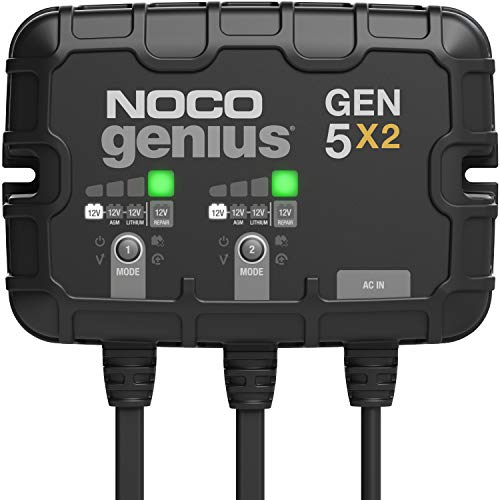
NOCO GEN5X2 12V 10A 2-Bank OnBoard Marine Battery Charger & Maintainer — Two-bank IP68 starter unit
The GEN5X2 is the entry point to permanent charging, sized for the most common small-boat layout afloat: one starting battery and one trolling battery, two banks, 10 amps of total output to share between them. NOCO’s title packs the unit’s whole character into one line — it charges two batteries at once, it carries an IP68 waterproof rating, it includes overcharge protection and temperature compensation, and it serves both lead-acid and lithium batteries. That is an unusually complete disclosure for the smallest charger in this guide, and it makes the GEN5X2 the easiest unit here to buy with confidence from the listing alone.
Five amps per bank, when the 10A total divides evenly, defines its pace honestly. A trolling battery used for an evening’s fishing will be full well before morning; a trolling battery flattened by a full day of tournament running will take the longer part of the night. For weekend boats, that arithmetic is entirely comfortable, and the maintainer half of the title takes over once full is reached — holding both batteries at readiness through the weeks the boat sits, which is when un-maintained batteries quietly sulphate and die. Temperature compensation adjusts the charge to the compartment’s conditions, so the same unit behaves correctly in a cold spring marina and a hot August storage lot.
The IP68 rating deserves a plain explanation, because it is the strongest environmental claim in this guide. The IP scale’s second digit describes water protection, and 8 is the immersion tier — beyond jets, beyond spray, into sustained submersion territory as the maker defines it. A charger with that rating, mounted in a bilge-adjacent compartment, treats a flooded compartment or a hosing-down as an inconvenience rather than a death sentence. Combined with the sealed, fanless character typical of units built to this rating, it suits the small centre-console and jon-boat installations where the charger cannot hide from the weather.
- Banks: 2 — charges 2 batteries at once
- Total output: 12V 10A (5A per bank when divided evenly)
- Waterproofing: IP68 stated in the listing title
- Chemistries: lead-acid and lithium stated in the listing title
- Protection: overcharge protection and temperature compensation stated
- Role: charger and maintainer
Strengths
- The most complete title disclosure of any small charger here — rating, chemistries and protections all in writing.
- IP68 sealing suits exposed compartments on small boats where spray is a certainty.
- Maintainer behaviour protects both batteries through long storage gaps between trips.
Trade-offs
- Two banks is a hard ceiling; adding a second trolling battery means replacing the unit.
- 5A per bank is overnight pacing, not a fast turnaround between a morning and evening trip.
- Boats with a house battery as a third bank outgrow it immediately.
Best for: a buyer seeking a sealed 2-bank charger for a starting battery plus one trolling battery, left connected and forgotten between weekends.
Not suited for: three- or four-bank trolling systems, or same-day double trips that demand a faster per-bank recovery.
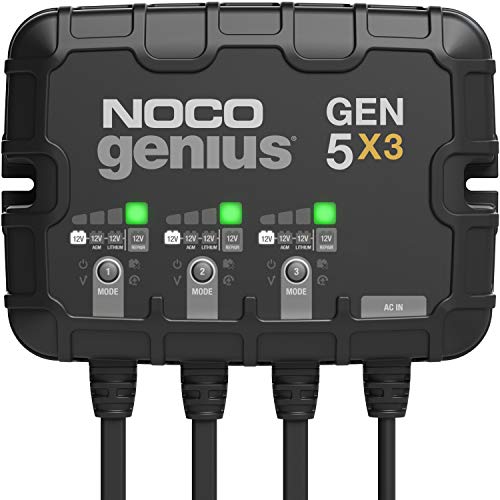
NOCO GEN5X3 12V 15A 3-Bank OnBoard Marine Battery Charger & Maintainer — Three banks, sealed case
The GEN5X3 exists because the most popular tournament layout in freshwater fishing runs three batteries: one to start the outboard, two wired for a 24V trolling motor. Fifteen amps across three banks keeps NOCO’s per-bank pace at the same 5A as its smaller sibling while adding the third output, and the rest of the title repeats the disclosure that makes this line easy to recommend — IP68 waterproofing, overcharge protection, temperature compensation, and support for lead-acid and lithium chemistries in the same unit.
That chemistry breadth matters more at three banks than at two. A three-bank boat is precisely the boat most likely to be mixed: lithium trolling batteries for weight and endurance, a lead-acid starting battery because the outboard’s charging system expects one. A charger whose title promises both chemistries lets each bank be served on its own terms from a single bolted-down box, rather than forcing a second charger or a compromise profile. The maintainer function then holds all three at readiness, so the boat leaves the dock with every battery at full — the unglamorous condition behind every reliable start and every full day of trolling power.
Against the Minn Kota 330D, the other three-bank pick in this guide, the GEN5X3 trades per-bank speed for sealing and chemistry disclosure: 5A per bank against Minn Kota’s stated 10A, IP68 stated against no rating stated. Neither trade is a defect. A boat stored outdoors, hosed down after salt trips, values the sealed case; a boat fished hard on consecutive days values the faster recovery. The spec list below keeps the two profiles distinct so the choice can be made on the boat’s actual life rather than on brand habit.
- Banks: 3 — charges 3 batteries at once
- Total output: 12V 15A (5A per bank when divided evenly)
- Waterproofing: IP68 stated in the listing title
- Chemistries: lead-acid and lithium stated in the listing title
- Protection: overcharge protection and temperature compensation stated
- Role: charger and maintainer
Strengths
- Matches the classic one-starting, two-trolling layout exactly, with NOCO’s full disclosure in the title.
- Mixed lithium and lead-acid banks are served by one unit, stated in writing.
- IP68 sealing for compartments that take spray or a hose-down.
Trade-offs
- 5A per bank recovers a flattened trolling battery slowly compared with 10A-per-bank rivals.
- A fourth bank — a house battery or a 36V trolling upgrade — requires the larger GENPRO10X4 instead.
- The title states total amps only; the even-division figure is arithmetic, not a per-bank promise.
Best for: a buyer seeking a sealed 3-bank maintainer for a 24V trolling setup, especially one mixing lithium trolling batteries with a lead-acid starting battery.
Not suited for: hard daily tournament use where trolling batteries must recover at 10A per bank between dawn launches.
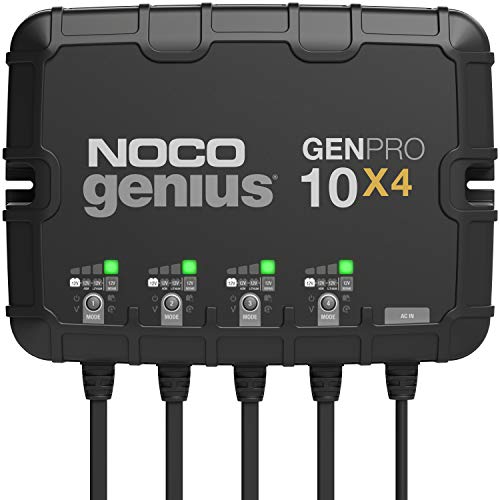
NOCO GENPRO10X4 12V 40A 4-Bank OnBoard Marine Battery Charger & Maintainer — Four banks at full pace
The GENPRO10X4 is the heavy unit of the NOCO line and the joint-heaviest in this guide: 40 amps across four banks, which divides to 10 amps per bank — double the per-bank pace of its smaller siblings, across twice the banks of the GEN5X2. The model name encodes the same arithmetic, 10 by 4, and the title keeps the family disclosure intact: charges four batteries at once, IP68 waterproof, overcharge protection, temperature compensation, lead-acid and lithium support. Four banks serve the serious end of freshwater and nearshore boating: a starting battery plus a 36V trolling system, or a starting battery, a 24V trolling pair and a house battery running electronics and lights.
At this scale the maintainer function stops being a convenience and becomes battery economics. Four marine batteries represent a serious investment, lithium sets especially, and the difference between a bank held correctly at full and a bank left to self-discharge and sulphate is measured in seasons of service life. A 40A charger that also maintains, compensates for temperature and protects against overcharge is effectively insurance bolted to the hull. The installation commitment is correspondingly real: four sets of leads to route, four batteries to connect correctly, and a mounting spot with the airflow and access a flagship unit deserves.
The honest comparison inside this guide is with the Minn Kota Precision MK-440PCL, the other four-bank, 10A-per-bank pick. The NOCO states its sealing and chemistry support in the title; the Minn Kota carries the Precision name and the trolling-motor maker’s ecosystem behind it, with its title silent on ingress rating and chemistries. A buyer cross-shopping the two should read the NOCO’s title as the more complete document and the Minn Kota’s documentation as the necessary second step — both are flagship-grade units, and the deciding factors will be the boat’s chemistry mix and how wet the charging compartment truly gets.
- Banks: 4 — charges 4 batteries at once
- Total output: 12V 40A (10A per bank when divided evenly)
- Waterproofing: IP68 stated in the listing title
- Chemistries: lead-acid and lithium stated in the listing title
- Protection: overcharge protection and temperature compensation stated
- Role: charger and maintainer
Strengths
- 10A per bank across four banks — flagship recovery speed with no compromise on bank count.
- The full NOCO disclosure set: IP68, both chemistries, temperature compensation, overcharge protection.
- Maintainer behaviour protects a four-battery investment across storage and winter.
Trade-offs
- The largest installation job in this guide — four lead runs and a proper mounting location.
- Oversized for any boat running fewer than four banks; unused outputs buy nothing.
- Flagship capacity carries a flagship price tier within the category.
Best for: a buyer seeking one sealed charger for a 36V trolling system plus starting battery, or a four-bank boat mixing lithium and lead-acid, maintained year-round.
Not suited for: two- or three-bank boats, where the GEN5X2 or GEN5X3 covers the layout at a fraction of the installation effort.

Minn Kota MK 330D Digital On-Board Marine Battery Charger, 3 Bank x 10 Amps — Proven 3-bank workhorse
The MK 330D’s title does one thing with total clarity: it states the per-bank output directly, three banks at 10 amps each, 30 amps in total. No division is required and no documentation hunt is needed to learn the number that decides recovery speed. That directness, plus the word ‘digital’ describing its charging control, is the whole pitch — and after years on the market, it is a pitch backed by an enormous installed base on exactly the boats this guide serves: bass boats and walleye rigs running a starting battery and a 24V trolling pair.
Ten amps per bank changes the rhythm of a fishing week compared with the 5A NOCO units. A trolling battery drained by a long day is genuinely ready the next morning rather than mostly ready, and back-to-back fishing days — the pattern that kills undersized charging setups — become routine. Digital control, in this class of charger, means the unit meters its output against the battery’s state rather than applying a dumb timed blast, which is kinder to battery life across a season of daily cycles. Minn Kota’s position as a trolling-motor manufacturer is relevant context: the company knows precisely how its motors drain batteries, and its chargers are sized by the maker that sets the drain.
The title’s silences are recorded plainly in the spec list. No ingress rating is stated, and no battery chemistries are named, so a lithium-bank boat or a very wet installation should verify both points in Minn Kota’s documentation before purchase. Those silences should be weighed fairly: this is an older, proven listing whose title was written before lithium trolling batteries were common, and the absence of a claim in the title is not evidence of absence in the product — it is evidence that the listing alone does not settle the question.
- Banks: 3
- Output: 10 amps per bank stated in the listing title (30A total)
- Control: digital on-board charging
- Waterproofing: Not stated in the listing title — verify with Minn Kota documentation
- Battery chemistries: Not stated in the listing title — verify with Minn Kota documentation
Strengths
- Per-bank output stated outright — 10A to each bank, double the NOCO three-bank unit’s divided pace.
- A long-proven design with a deep installed base on three-bank fishing boats.
- Built by the trolling-motor maker, sized with first-hand knowledge of how the banks are drained.
Trade-offs
- No waterproof rating in the title, so very wet compartments need a documentation check first.
- Chemistry support is unstated in the title — lithium-bank boats must verify compatibility.
- Three banks caps the layout; 36V trolling systems need a four-bank unit.
Best for: a buyer seeking a 3-bank charger with stated 10A-per-bank recovery for back-to-back fishing days on a starting-plus-24V layout.
Not suited for: a mixed lithium installation or an exposed mounting location, until the documentation confirms chemistry support and sealing.

Minn Kota Precision MK-440PCL On-Board Marine Battery Charger, 4 Banks, 10 Amps Each — Precision 4-bank flagship
The Precision MK-440PCL is Minn Kota’s flagship answer to the four-bank boat: four banks, 10 amps each, stated in the title with the same directness as its smaller sibling. Forty amps of total output puts it level with the NOCO GENPRO10X4 on the headline arithmetic, and the Precision name marks it as the upper tier of Minn Kota’s on-board line — the series the company aims at serious anglers running 36V trolling systems, multiple batteries and long seasons of daily cycling.
Four banks at 10 amps each is the configuration that removes charging from the list of things a fishing trip must plan around. Every battery — starting, three trolling, or starting, two trolling and a house bank — recovers at full pace simultaneously, and the boat leaves each morning with the whole electrical system at full. On a guide boat or a tournament boat, where the batteries are the business, that simultaneity is the product. The Precision designation, in Minn Kota’s line, denotes the more refined charging control tier; the title itself commits only to the bank and amp figures, and the spec list below respects that boundary.
As with the 330D, the title is silent on ingress rating and chemistry support, and at this tier those silences deserve a documentation check rather than an assumption either way — flagship chargers are bought for a decade, and a decade is long enough for a boat’s battery chemistry to change mid-ownership. What the title does establish is the essential skeleton: the right bank count for the biggest common layouts, full-pace output per bank, and the Precision nameplate from the trolling-motor maker itself.
- Banks: 4
- Output: 10 amps each stated in the listing title (40A total)
- Line: Minn Kota Precision series on-board charger
- Waterproofing: Not stated in the listing title — verify with Minn Kota documentation
- Battery chemistries: Not stated in the listing title — verify with Minn Kota documentation
Strengths
- Four banks at a stated 10A each — full-pace recovery for every battery on the boat at once.
- Precision-series flagship from the manufacturer of the trolling motors the banks serve.
- Bank count covers 36V trolling systems and house-battery layouts without a second charger.
Trade-offs
- Ingress rating unstated in the title; exposed installations need the documentation first.
- Chemistry support unstated in the title, a real question for lithium trolling banks.
- The largest wiring job alongside the GENPRO10X4 — four banks to connect and route.
Best for: a buyer seeking a flagship 4-bank charger with stated 10A-per-bank output for a 36V trolling system fished on consecutive days.
Not suited for: smaller layouts, or a lithium conversion planned without first confirming chemistry support in the maker’s documentation.

ProMariner ProSport HD 20A 3-Bank Waterproof Onboard Battery Charger — Distributed charging, IP67
ProMariner’s ProSport HD approaches the three-bank problem from a different philosophy: instead of fixing an even split, its Distributed-On-Demand charging — named in the title — sends the 20-amp total where the need is. A starting battery that only ran the outboard’s starter needs a sip; a trolling battery after a windy day needs a gulp. A fixed split feeds both alike and finishes neither optimally, while a distributed design finishes the light bank quickly and then concentrates on the heavy one. For boats whose banks drain unevenly — which is to say, nearly all boats — that behaviour is worth more than a larger fixed total spent evenly.
The rest of the title is equally forthcoming. The unit is described as waterproof with an IP67 rating stated — one tier below NOCO’s IP68 on the immersion scale, still a sealed unit built for marine compartments rather than a vented bench box. An LED status display is named, a small feature with outsized value on an installed charger: a glance into the compartment confirms which banks are charging and which are full, without connecting anything or opening an app. And the chemistry list is the broadest in this guide — lithium, flooded, AGM and gel all named — which makes the ProSport HD the most explicit mixed-fleet answer among the three-bank picks.
The trade is headline amperage. Twenty amps across three banks is less than Minn Kota’s 30A fixed total and must be understood as a budget the charger allocates intelligently rather than a per-bank promise. A boat that flattens all three banks daily and needs all three full by dawn should compare recovery times carefully against the 10A-per-bank units. A boat whose banks drain unevenly — the far more common pattern — will often find the distributed 20A finishing the real job sooner than a rigid 30A split.
- Banks: 3
- Total output: 20A with Distributed-On-Demand charging
- Waterproofing: IP67 stated in the listing title
- Chemistries: lithium, flooded, AGM and gel stated in the listing title
- Display: LED status display stated
- Per-bank fixed output: Not stated in the listing title — output is distributed on demand; verify with ProMariner documentation
Strengths
- Distributed-On-Demand allocation matches how boats actually drain their banks — unevenly.
- The broadest stated chemistry support in this guide, covering mixed fleets in one unit.
- An LED status display makes an installed charger’s state readable at a glance.
Trade-offs
- 20A total is the lowest three-bank budget here; three flattened banks recover slower than on 10A-per-bank units.
- No fixed per-bank figure exists to plan against — the distribution is the design’s point and its caveat.
- IP67 sits one tier below the NOCO units’ stated IP68 for immersion protection.
Best for: a buyer seeking a waterproof 3-bank charger for unevenly drained banks and mixed battery chemistries, with status visible at a glance.
Not suited for: a routine that flattens all three banks daily and needs maximum fixed amps into each by morning.
Which Bank-and-Amp Layout Fits Which Boat?
| Pick | Banks | Amps | Waterproofing stated | Chemistries stated |
|---|---|---|---|---|
| NOCO GEN5X2 | 2 | 10A total (5A/bank divided) | IP68 | Lead-acid, lithium |
| NOCO GEN5X3 | 3 | 15A total (5A/bank divided) | IP68 | Lead-acid, lithium |
| NOCO GENPRO10X4 | 4 | 40A total (10A/bank divided) | IP68 | Lead-acid, lithium |
| Minn Kota MK 330D | 3 | 10A per bank stated | Not stated in title | Not stated in title |
| Minn Kota MK-440PCL | 4 | 10A each stated | Not stated in title | Not stated in title |
| ProMariner ProSport HD | 3 | 20A total, distributed on demand | IP67 | Lithium, flooded, AGM, gel |
The table’s shape tells the category’s story. Two brands state their electrical figures and fall silent on sealing and chemistry; two state everything. That is not a ranking — it is a division of homework. A NOCO can be specified almost entirely from its title. A Minn Kota’s title settles the electrical question completely and leaves the environmental and chemistry questions to one documentation lookup, which any decade-long installation deserves anyway. The ProSport HD sits between the philosophies: a stated rating, a stated chemistry list, and a total whose distribution is a behaviour rather than a fixed split.
Match the rows to boats and the pattern resolves. A two-bank skiff takes the first row. A three-bank bass boat chooses among rows two, four and six by temperament: sealed and gentle, fast and proven, or distributed and chemistry-flexible. A four-bank boat chooses between rows three and five, NOCO’s stated sealing against Minn Kota’s Precision flagship. No row is the wrong row; each is the right answer to a differently lived boat.
How Is an On-Board Charger Installed and Wired Safely?
Installation is the price of admission for this entire category, and it should be planned as a permanent piece of the boat’s electrical system. The charger mounts in a compartment near the batteries — close enough that its leads reach every bank without strain or extension, ventilated enough that heat can escape, and positioned so its status can be checked without dismantling half the boat. Each bank’s leads connect to one battery group only, with polarity observed and terminals protected; mixing banks at the wiring stage defeats the entire point of independent outputs.
The AC side deserves equal care. The charger needs shore power when the boat is docked, delivered through a proper marine inlet and cable — and here the accessory boundary matters: the inlet is a separate fitting that simply passes AC power into the boat, sometimes sold alongside these chargers, and it is not itself a charger or a pick in this guide. Route the AC run away from bilge water, secure it against chafe, and keep the connection point somewhere that can be reached from the dock without boarding and crawling. A charger that is awkward to plug in will, in practice, not be plugged in — and an unplugged maintainer maintains nothing.
After installation, commission the system deliberately. Connect shore power with the batteries at a partial charge and confirm each bank shows charging behaviour; then leave the boat for a week and verify that every battery sits at full on return. That week-long test proves the maintainer half of the purchase, which is the half that will quietly determine how many seasons the batteries survive. Any bank that lags points to a wiring fault, a failing battery or a mismatched profile — all better discovered at the dock in spring than at a launch ramp in June.
What Does Temperature Compensation Actually Protect Against?
Battery charging is chemistry, and chemistry is temperature-sensitive. A cold battery accepts charge sluggishly and needs a higher voltage to reach full; a hot battery reaches full at a lower voltage and is damaged by being pushed past it. A charger without temperature compensation applies one fixed idea of ‘full’ to a battery whose idea of full changes with the weather. In a boat stored outdoors, that mismatch is not an edge case — it is the operating condition for half the year, in both directions.
Temperature compensation, stated in all three NOCO titles, adjusts the charging voltage against the measured temperature, so a January battery and a July battery each get the charge their condition actually requires. The slow damage it prevents is the kind that never announces itself: a battery chronically undercharged in winter sulphates and loses capacity; a battery chronically overcharged in summer loses water and plates. Both batteries ‘worked fine’ until the season they suddenly did not. Compensation is invisible when it works, which is precisely why it belongs in a title rather than being left to assumption.
Overcharge protection, the other NOCO title claim, is the maintainer’s safety net: once a bank reaches full, the charger must stop pushing and merely hold. A unit that trickles blindly into a full battery for a month of storage does slow harm the whole time. Together, the two features describe a charger designed to be left connected indefinitely — which is the entire premise of an on-board unit, and the reason these stated features carry more weight in this category than raw amperage bragging.
What Mistakes Shorten Battery Life Even With a Good Charger?
The most common mistake is bank mismatch: wiring two batteries of different ages or chemistries into one bank and expecting the charger to serve both. A bank is charged as a unit, so the weaker battery dictates the outcome — the charger reads the pair’s combined behaviour and the strong battery is under-served while the weak one is overworked. Banks should be built from matched batteries, replaced together, and a charger with enough banks lets each group live on its own terms.
Second is the unplugged winter. An on-board charger only maintains while shore power is connected, and a boat stored ‘just for a few weeks’ without power, repeatedly, accumulates exactly the deep self-discharge that kills marine batteries. Third is ignoring the one lagging bank: when three banks sit at full and one never quite arrives, the battery itself is usually failing, and replacing it early protects its bank-mates and the charger alike. Fourth is treating the charger as a substitute for battery inspection — terminals corrode, water levels in flooded batteries fall, and no charger, however intelligent, compensates for a terminal green with neglect.
How Does the Shore-Power Routine Change With an Installed Charger?
Before installation, charging a boat is an errand: haul out the portable unit, open compartments, clip leads, check on it later, unclip, stow. Errands get skipped, and skipped errands are how batteries die young. After installation, charging becomes a single gesture at the dock — connect the shore-power cable, walk away. The behavioural difference is the product. A routine reduced to one plug is a routine that happens after every trip, including the tired ones, the late ones and the rainy ones, and batteries live or die on exactly those unglamorous repetitions.
Marina neighbours notice the difference too: a boat that is always plugged in is a boat being cared for, and its batteries stop being the dock’s cautionary tale.
The routine also changes what can be checked. With an installed unit, a glance at the charger — the ProSport HD’s LED display makes this literal — confirms the state of every bank before the boat is even untied. Problems surface at the dock, where they are cheap: a bank that did not charge overnight announces itself while the trailer or the marina staff are still within reach. The portable-charger routine discovers the same problem at the launch ramp or, worse, at the far end of the lake, where a dead trolling bank ends the day.
There is a storage dividend as well. Boats kept on trailers at home gain the same dock routine in the driveway: plug in after the trip, stay plugged in between trips, and the maintainer holds the banks at readiness for months. That is the pattern that stretches a set of marine batteries across the most seasons, and it asks nothing of the owner beyond a cable and an outdoor socket. Every pick in this guide is built for that pattern; the differences among them are pace, sealing and chemistry breadth, not purpose.
When Is a Portable Bench Charger Still the Right Tool?
Honesty about the category boundary helps both sides of it. A bench charger with clips remains the right tool for a battery that has been removed from the boat — for winter storage on a garage shelf, for reviving a spare, for the workshop battery that serves three machines. It is also the right tool for a boat used twice a year, where a permanent installation’s cost and wiring effort will never be repaid in convenience. And it is the diagnostic tool: a battery that behaves strangely on the boat can be isolated on the bench and tested on its own terms.
What a bench charger cannot do is be present. It cannot maintain a bank through a month of neglect, because it is in a locker. It cannot charge three banks simultaneously on three correct profiles, because it has one output and a pair of clips. It cannot compensate, session after session, for the owner’s forgetfulness. The on-board units in this guide exist to remove the human from the loop of a routine that humans reliably forget, and that removal — not amperage, not sealing — is the deepest reason the category exists. A boat fished weekly earns an installed charger the way a house earns a water heater: the alternative is a chore that quietly stops happening.
How Should the Charger Be Matched to a Future Battery Upgrade?
Boats outlive their batteries, and many outlive their battery plans. A two-bank boat today becomes a three-bank boat the season a second trolling battery arrives; a lead-acid boat becomes a lithium boat the season the old set wears out and the weight savings tempt. A charger bought only for today’s layout can become the obstacle to both upgrades, so the forward-looking questions belong in the purchase: does the bank count leave one output spare, and does the stated chemistry support cover the batteries the boat will run next, not merely the ones it runs now?
The picks divide instructively on those questions. The NOCO line’s stated lithium support across all three units means a NOCO bought for lead-acid today is not stranded by a lithium conversion tomorrow — the same box serves the next battery set. Bank count is the harder constraint, because it cannot be extended: a GEN5X2 will never grow a third output. The pragmatic rule is to buy the bank count of the boat’s plausible next layout when the price step is modest, and the exact count when a re-layout is genuinely unlikely. A spare bank costs little; a replaced charger costs the unit, the wiring labour and a Saturday.
Amperage ages differently. Battery capacities creep upward as trolling batteries grow, and a bank that recovered overnight at 5A when the battery was small may want the full night and part of the morning once a larger battery takes its place. That slow drift argues for the 10A-per-bank tier — the GENPRO10X4, the MK 330D, the MK-440PCL — on any boat whose batteries are likely to be replaced by larger ones, and for treating the 5A tier as the right-sized choice for stable, modest banks rather than as a compromise. Sized with one eye on the next battery set, an on-board charger stops being an accessory purchase and becomes part of the boat’s electrical architecture, which is what a bolted-down decade-long appliance ought to be.
What Does a Season of Ownership Actually Look Like?
Spring begins with commissioning: shore power connected, every bank verified at full, terminals inspected while the compartments are open anyway. A charger that has maintained all winter makes this a ten-minute confirmation rather than a week of recovery charging, and any bank that lags is caught while the boat is still beside the workshop. Summer is the invisible season — the charger works nightly, unnoticed, which is the highest compliment this category can earn; the only interaction is the plug at the dock and the occasional glance at a status light.
Autumn is where the maintainer earns its purchase price a second time. As trips space out, self-discharge and parasitic loads — a clock, a stereo’s memory, a bilge monitor — nibble at every bank, and the plugged-in boat simply does not care. Boats stored ashore get the driveway version of the same care. The discipline required is minimal but real: keep the power connected, check in monthly, and let the compensation and protection features stated in the titles do the chemistry. Owners who follow that light routine routinely report battery sets lasting seasons beyond the dockside average, and the chargers in this guide — sealed, distributed or flagship — differ in pace and disclosure, not in their ability to anchor that routine.
Final Recommendation
Count banks first, then amps per bank, then read the titles for sealing and chemistry. Two-bank boats take the GEN5X2 and its complete disclosure. Three-bank boats divide by life: the GEN5X3 for sealed, mixed-chemistry, weekend-paced use; the MK 330D for stated 10A-per-bank recovery across back-to-back days; the ProSport HD for unevenly drained banks and the broadest stated chemistry list. Four-bank boats choose between the GENPRO10X4’s fully stated specification and the Precision MK-440PCL’s flagship nameplate. Fit the charger to the boat that exists — its banks, its chemistries, its compartment — and the batteries will repay the fit with seasons.
Frequently Asked Questions
What is a bank, and how many does a boat need?
A bank is one battery, or one group of batteries wired together and charged as a single unit. A boat needs one charger bank per battery group: a starting battery is one bank, a 24V trolling pair is a second bank in series terms as fitted by the charger maker, and a 36V trolling set adds another. Count the boat’s battery groups, then choose a charger with at least that many banks — two, three or four among these picks.
How many amps per bank are enough?
For overnight recovery of moderately used batteries, 5A per bank suffices, which is the divided pace of the smaller NOCO units. For deeply drained trolling batteries that must be full by the next dawn, 10A per bank — stated by both Minn Kota picks and reached by the GENPRO10X4’s division — is the comfortable figure. The ProSport HD’s distributed 20A suits uneven drain, sending more to the bank that worked hardest.
Can one charger handle lithium and lead-acid batteries together?
Only where the maker says so. NOCO’s titles state lead-acid and lithium support across all three of its units, and ProMariner names lithium alongside flooded, AGM and gel. Minn Kota’s titles do not state chemistries, so a mixed boat should confirm compatibility in Minn Kota’s documentation before installation rather than assuming the profiles exist.
What does the IP rating on a marine charger mean?
The second digit of an IP rating grades water protection. IP67, stated for the ProSport HD, covers immersion under defined conditions; IP68, stated for the NOCO units, is the higher immersion tier as defined by the maker. Both describe sealed units built for wet compartments. Where a title states no rating — the Minn Kota picks here — the listing simply does not settle the question, and the documentation should be checked for wet installations.
Is an AC inlet port the same thing as an on-board charger?
No. An inlet is a through-hull or bulkhead fitting that passes shore power into the boat; it converts nothing and charges nothing. The charger is the unit wired between that AC supply and the batteries. Inlets are useful accessories and are sometimes sold beside chargers, but no inlet appears as a pick in this guide, because the charging intelligence lives entirely in the charger.
Should the charger stay connected all winter?
That is the maintainer’s purpose, and the NOCO titles name the role explicitly: charger and maintainer. Left on shore power, a maintainer holds each bank at full against self-discharge, with overcharge protection and temperature compensation guarding against the two failure modes of long connection. The condition is that shore power actually stays connected — check on the boat periodically rather than assuming the marina supply never trips.
Can an on-board charger charge while the boat is being trailered home?
No — these units run on AC shore power, so charging happens where an outlet exists: the dock, the marina or the driveway. The road hours charge nothing, which is one more reason the plug-in habit matters on arrival. Boats that need charge recovery during long tows rely on the tow vehicle’s arrangements or simply arrive and plug in; the maintainer then restores the banks before the next launch.
Where should the charger be mounted inside the boat?
Near the batteries, in a compartment with some airflow, high enough to stay clear of bilge water, and visible enough that its status can be checked without unloading gear. Lead length, heat and standing water are the three enemies of the mounting decision; a dry, ventilated spot within easy lead reach of every bank satisfies all three and makes the weekly glance at the charger a habit rather than an expedition.
How long does a full recovery take after a hard day of trolling?
Recovery time is the battery’s capacity divided by the bank’s amperage, roughly: a half-drained large trolling battery on a 5A bank is an overnight project, while the same battery on a 10A bank returns in an evening. That arithmetic is why this guide keeps returning to amps per bank as the deciding figure, and why boats fished on consecutive days should weight the 10A-per-bank picks — both Minn Kota units and the GENPRO10X4 — ahead of gentler units regardless of brand preference.
Does a four-bank charger waste power on a three-bank boat?
An unused bank output simply idles, and buying one bank of headroom is a deliberate strategy when a battery upgrade is plausible — a house battery added later, a 36V conversion, a second trolling set. The cost is the larger unit and one unused lead run to secure safely. Where no upgrade is realistically planned, the exact-count charger is the tidier purchase, and this guide’s two- and three-bank picks exist for precisely those boats.
Related Guides
For the batteries’ other half of life afloat, see our guide to charging stations for multiple devices for the dock box at home, our Anker wall chargers roundup for the house side of the charging drawer, and our solar panel chargers for backpacking guide for power that never touches a socket at all.
Related guides
- Best 3D Art Tablets
- Best Balancing Stabilizers for Mirrorless Cameras: Payload, Balancing and Native Vertical Shooting
- Best Canon Point and Shoot Digital Cameras: PowerShot Picks From Pocket Compacts to Travel Zooms
- Best Basic Phones Camera Buyers Can Trust: Flip Phones and Simple Handsets That Still Take a Photograph


