What's inside
- Key Takeaways
- Quick Picks
- How Did We Choose These Picks?
- What Is PPS, and Why Does Your Samsung Care?
- How Can You Tell Whether Your Phone Is Charging at Its Best?
- What Mistakes Do Android Charger Buyers Make?
- How Does the Household Census Decide the Charger?
- What Does GaN Actually Buy You at the Wall?
- How Should You Treat the Battery All This Speed Serves?
- The Travel Kit, Assembled From This Guide
- Why Did Phones Stop Including Chargers, and What Should You Do About It?
- What Should You Check When a New Charger Arrives?
- A Field Guide to the Announcements Your Phone Makes
- The Office, the Car and the Other Rooms of a Phone’s Life
- What About Wireless Charging, USB-A Holdouts and Other Detours?
- The Two-Charger Household, Defended
- How Long Should a Good Charger Last, and When Is It Done?
- Final Recommendation
- Frequently Asked Questions
- Related Guides
As an Amazon Associate I earn from qualifying purchases. This post may contain affiliate links at no extra cost to you.
gizmoverdict.com is reader-supported. When you buy through links on our site, we may earn an affiliate commission.
Where to buy: All six chargers link to listings verified in this site’s product pool. Where a charger includes a cable, the pick says so; where it does not, the pick says that too — because a charger without a cable charges nothing until you supply one.
The search for the best android cell phone chargers looks simple until you meet the acronym that runs the category: PPS. Modern Android fast charging, above all Samsung’s Super Fast Charging, depends on Programmable Power Supply — a refinement of USB Power Delivery that lets the charger adjust its voltage in fine steps, following the phone’s requests closely enough to pour power in quickly without cooking the battery. A charger can be powerful, well made and entirely reputable, yet if it lacks PPS, a Samsung flagship plugged into it will charge at a noticeably more modest rate than its best. Wattage is the headline; PPS is the handshake. This guide checks for the handshake on every pick where it matters.
The reference point for the whole discussion sits at the top of the list: Samsung’s own 45W Super Fast Charging adapter, sold with its cable, is the charger Samsung’s fastest phones were designed around, and it is the benchmark every third-party pick below is measured against. Around it, the guide arranges the modern GaN field — an Anker Nano 65W with PPS in a folding body, a three-port UGREEN Nexode 65W, Anker’s 65W three-port block, a dual-port Belkin 65W, and an Anker 45W two-pack with cables included — because Android households rarely charge one device, and never charge only phones.
One more honesty rule before the picks: a charger offers, the phone decides. Your handset takes the lesser of what the charger can give and what the phone was built to accept, and a phone without fast-charging support will charge at its own calm pace from every pick here. The fastest charger for your Android is the one that speaks your phone’s dialect — PPS for the Samsung flagships, plain Power Delivery for Pixels and most others — with enough total output for the household plugged in around it.
Key Takeaways
- PPS is the feature that unlocks Samsung Super Fast Charging — raw wattage without PPS leaves a Galaxy flagship charging below its best.
- Samsung’s own 45W adapter, cable included, is the reference point the whole category is measured against.
- The Anker Nano 65W GaN II carries PPS in a fold-flat travel body — the Samsung owner’s third-party benchmark.
- Multi-port 65W chargers from UGREEN, Anker and Belkin serve the whole household, but their totals are shared across ports.
- Check the cable: some picks include one, some do not, and the cable must be rated for the power you expect to move.
Quick Picks
| Pick | Badge | Why it is here |
|---|---|---|
| Samsung 45W Super Fast Charging Adapter | The reference point | Samsung’s own 45W PPS charger, with the cable in the box, exactly as the phones expect. |
| Anker Nano 65W GaN II | Best PPS traveller | PPS support and 65W in a compact, fold-flat GaN II body. |
| UGREEN Nexode 65W | Best three-port all-rounder | Three ports and a 65W total for the phone-tablet-laptop household. |
| Anker 65W 3-Port Charger | Best Anker multi-port | A compact folding three-port block with Anker’s negotiation polish. |
| Belkin 65W Dual GaN | Best dual-port | Two USB-C ports with PD 3.0 fast charging in a travel-ready GaN body. |
| Anker 45W Charger 2-Pack | Best value pair | Two 45W chargers, each with a 5ft USB-C cable included, for two rooms at once. |
How Did We Choose These Picks?
Protocol support came first. For a guide aimed at Android, a pick had to speak the dialects Android phones actually use: USB Power Delivery as the common tongue, and PPS wherever the Samsung flagships in so many pockets require it for their fastest rates. Chargers that were powerful but dialect-deaf were marked down, however handsome their wattage. Totals were read as totals — shared across ports — and per-port behaviour under a household’s real load mattered more than solo heroics. Cable honesty was audited pick by pick, because a charger listing that whispers its missing cable is selling you half a product.
Then the physical audit: GaN designs for size and heat, folding prongs for the travellers, build quality from makers who will exist at warranty time. And throughout, the phone’s veto was respected — no pick is praised for charging a phone faster than that phone allows, because no charger can, and a guide that implies otherwise is writing fiction.
What Is PPS, and Why Does Your Samsung Care?
Standard USB Power Delivery negotiates from a menu of fixed voltages; the phone picks the closest fit and converts the difference internally, wasting some as heat. PPS — Programmable Power Supply — replaces the menu with a conversation: the charger adjusts its output in small steps, tracking what the phone’s battery actually wants moment by moment, so more of the energy becomes charge and less becomes warmth. Samsung built its Super Fast Charging tiers on that conversation, which is why the genuine article — Samsung’s own 45W adapter — and PPS-equipped third-party chargers can feed a Galaxy flagship at its designed rate, while an equally powerful non-PPS charger, for all its virtues, cannot complete the handshake and settles for less.
For Pixel owners and most other Android households, plain Power Delivery does the heavy lifting and PPS is a bonus rather than a requirement — one more reason this guide arranges its picks by household rather than by a single crown. The practical rule is short enough to keep: Samsung flagship, insist on PPS; everything else, insist on honest Power Delivery, enough total watts, and a cable rated for the current. The rest of the category is packaging.

Samsung 45W Super Fast Charging Adapter — The reference point
Every category needs its control sample, and this is Android charging’s: the adapter Samsung itself sells for its fastest phones, with PPS implemented exactly as the phones expect and a USB-C cable in the box so the system works the moment it is opened. Plug a supported Galaxy flagship into it and the phone’s own Super Fast Charging engages as designed — no dialect gaps, no negotiation surprises, no forum threads required. That certainty is the product. Third-party chargers in this guide match it, approach it or out-feature it, but they are all, in the end, being compared to the behaviour of this unassuming black block.
Its limits are the limits of a reference: one port, one device, no household ambitions, and a design that assumes the phone is the centre of the world. A family with a tablet and a laptop to feed will outgrow it by the second evening. But as the first charger a Samsung flagship owner buys — the known-good against which cables, symptoms and third-party rivals can be tested — it has no substitute. Keep it even after the multi-port chargers arrive; every household with a fast-charging Samsung should own one indisputable charger, and this is the indisputable one.
Note the included cable with the seriousness it deserves: the system was specified as a pair, and using the bundled lead removes the commonest variable from fast-charging troubleshooting. When a Samsung charges slowly, the first test is this charger and this cable, together.
- Genuine Samsung 45W adapter with PPS for Super Fast Charging
- Cable included in the box — a 1m USB-C cable, per the listing
- The charger Samsung’s fastest phones were designed around
- Single-port focus: one device, full attention
- The benchmark for judging every third-party claim
Strengths
- The genuine PPS handshake, guaranteed by the maker of the phones
- Cable included — a complete, working system in the box
- The diagnostic reference every Samsung household needs
Trade-offs
- One port serves one device at a time
- No multi-device or laptop ambitions
- Plain design that will not excite the desk
Best for: Samsung flagship owners who want Super Fast Charging exactly as designed, guaranteed.
Not suited for: households charging three devices nightly, who should treat this as the reference and buy a multi-port pick as the workhorse.
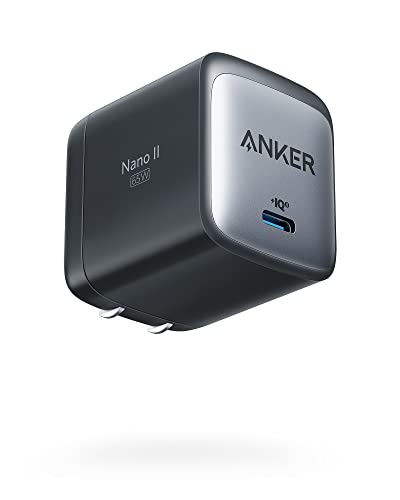
Anker Nano 65W GaN II — Best PPS traveller
The Nano 65W is where third-party charging grows up: a GaN II body scarcely larger than the feeble adapters phones once shipped with, folding flat for a bag, yet carrying both the wattage and — the detail this guide cares about — the PPS support that lets a Samsung flagship charge at its designed rate. For the Samsung owner who travels, this is the benchmark pick: one small block that feeds the phone at full Super Fast Charging speed, tops a tablet happily, and can keep a slim laptop alive in a pinch, all from a body that disappears into a wash bag. Anker’s negotiation polish means the dialects are spoken without drama across brands, which matters in households where the second phone is a Pixel and the tablet is anybody’s guess.
The single port is the honest trade: this is a personal charger, not a household hub, and two devices means taking turns. The wattage figure is the port’s own — no sharing arithmetic — which makes its behaviour the most predictable in the guide. Buy it as the travel and desk charger of one demanding phone, pair it with the Samsung original as the home reference, and the two cover a Samsung owner’s life more completely than any single product here.
A cable note, printed because the category so often whispers it: bring your own rated USB-C lead, and make it a good one, because at these rates the cable is a component, not an accessory.
- 65W GaN II charger with PPS support
- Compact body with folding prongs for travel
- Single USB-C port at full focus
- Feeds phones at their fast rates and laptops at a useful one
- Cable not the headline — plan to use your own rated lead
Strengths
- PPS plus 65W in a genuinely pocketable GaN II body
- Folding prongs make it the guide’s natural traveller
- Single-port predictability — no sharing surprises
Trade-offs
- One port means one device at a time
- Cable is your own responsibility
- Laptop service is a useful pinch, not a workstation promise
Best for: Samsung owners who travel, and anyone who wants one small charger that speaks every dialect.
Not suited for: multi-device households needing simultaneous charging — the three-port picks below exist for them.

UGREEN Nexode 65W — Best three-port all-rounder
The Nexode 65W is the household charger drawn correctly: three ports, a 65W total shared among them, GaN II compactness and a folding plug, sized for the actual nightly load of an Android home — a flagship phone charging fast, a tablet drinking steadily, and a third device taking what remains. Its behaviour under that load is the product: shares are apportioned predictably, the phone’s fast rate survives the tablet’s company in the configurations that matter, and the whole block runs with the cool composure GaN buys. For Samsung households it speaks the household’s language across its ports, and for mixed-brand homes it negotiates without favouritism.
Read the total with this guide’s standing discipline: 65W is the sum, not a per-port promise, and a hungry laptop joining the party will ask the phones to share more modestly. Within that arithmetic, the Nexode is the pick this guide would install by the sofa and in the travel kit, the charger that ends the nightly negotiation about whose phone gets the good block. Against the Anker three-port below it, the choice is taste and price-of-the-week; against the single-port picks, it is a philosophy — the household served whole, rather than one device served perfectly.
Its compactness deserves a practical footnote: three-port chargers this small make excellent permanent residents of a bag, and many owners will buy two — one that lives at home, one that lives packed — rather than perform the nightly migration. That is not extravagance; it is the correct response to a small, inexpensive object that everything else depends on.
- 65W total shared across three ports
- GaN II design with a foldable plug
- Two USB-C-class ports plus a third for the household mix
- Serves phone, tablet and a modest laptop together
- Compact enough to live in a travel kit permanently
Strengths
- Three ports cover the real nightly household
- 65W total with predictable, composed sharing
- GaN II size and a folding plug travel beautifully
Trade-offs
- The total is shared — a laptop’s arrival trims the phones
- Not the Samsung reference; the original remains the control sample
- Cables are yours to supply and to rate
Best for: Android households charging a phone, a tablet and a third device every night.
Not suited for: single-device purists and workstation-laptop owners, both served better elsewhere in this guide.

Anker 65W 3-Port Charger — Best Anker multi-port
Anker’s three-port 65W block is the Nexode’s great rival, and the resemblance is a compliment to both: the same household brief — three ports, a shared 65W total, a folding compact body — executed with Anker’s particular polish in negotiation and finish. Mixed households will feel that polish in the small moments: a Samsung and a Pixel and an iPad dividing the total without resets or sulking, a slim laptop taking its share while the phones keep their dignity. The total, repeated here because the category’s grammar demands it, is shared; configure the load with that in mind and the charger rewards you with the least dramatic charging in this guide.
Choose between this and the UGREEN the way you would choose between two good hotels on the same street: by the week’s price, by a port arrangement preference, by loyalty earned from previous stays. Choose either over the single-port picks when the household’s nightly census exceeds one device, and over the flagships of the car-charging world when the load is phones and tablets rather than workstations. For the Android home that also contains a laptop of ordinary appetite, this class of charger — Anker’s execution of it included — is the centre of the market for a reason.
One habit will double its usefulness: dedicate the strongest port to the household’s fastest phone by custom, so nobody has to think at midnight. Chargers reward households that assign seats.
- 65W maximum total across three ports
- Compact, foldable design in Anker’s GaN line
- Fast charging for phones, tablets and MacBook-class laptops
- Anker’s mature device negotiation across brands
- The three-port configuration for mixed households
Strengths
- Anker polish in negotiation across mixed brands
- Three ports and a shared 65W for the whole census
- Folding, compact, travel-ready body
Trade-offs
- Total is shared across the three ports
- The Samsung original remains the PPS reference point
- Cables not the story — supply rated ones
Best for: mixed-brand households that want Anker’s manners on a three-port block.
Not suited for: buyers who need a single device fed at full 65W while others charge — that load wants a bigger total.
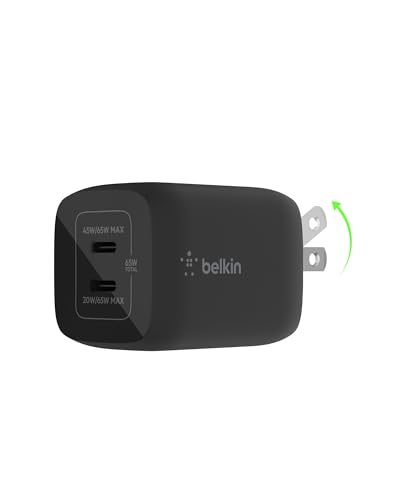
Belkin 65W Dual GaN — Best dual-port
Belkin’s dual-port 65W occupies the guide’s most contested middle: two devices, charged properly, from a body built for travel by a company that has made accessories since accessories were beige. The two USB-C ports divide a 65W total — shared, as this guide always specifies — which covers the couple-scale household’s real pattern: two phones at their fast rates, or a phone at full appetite beside a tablet, or a slim laptop given the run of the block when it travels alone. PD 3.0 fast charging keeps the dialects current, and Belkin’s long retail history shows in the fit and finish of a product meant to be handled daily and judged in shops.
Against the three-port picks it trades the third seat for simplicity and, often, a friendlier price of admission; against the single-port Nano it trades solo purity for the second seat that most adults actually need by the second week. Samsung owners should confirm the PPS conversation for their specific flagship’s fastest tier — the guide’s rule stands: for guaranteed Super Fast Charging at the designed rate, the Samsung original is the reference, and PPS-labelled support is the requirement in any rival. Judged as the two-device travel and bedside charger, the Belkin is the calm, reputable answer.
Its dual-port symmetry has a domestic virtue worth naming: no port hierarchy means no household argument about who took the good port, because there are two good ports and a total sized for both. Small mercies compound across a year of nights.
- 65W total across two USB-C ports
- GaN design with PD 3.0 fast charging
- Travel-shaped body from an accessories veteran
- Two ports for the couple-scale household
- Suits Samsung, Pixel, tablet and slim laptop rotations
Strengths
- Two equal USB-C ports end the good-port argument
- 65W total covers two phones or phone-plus-tablet properly
- Belkin’s build and travel manners are seasoned
Trade-offs
- Two ports is the whole census — three-device homes step up
- Total shared between the ports
- For a Samsung’s fastest tier, verify PPS against the reference pick
Best for: couples and two-device travellers who want reputable dual-port charging.
Not suited for: three-device households and anyone feeding a hungry laptop nightly.

Anker 45W Charger 2-Pack — Best value pair
The two-pack is the guide’s most domestic idea: the recognition that households do not have a charging location, they have charging locations, and the nightly migration of one good charger between bedroom and kitchen is a tax nobody should pay. Anker’s answer is two 45W chargers, each with a 5ft USB-C cable included — the cable honesty this guide keeps auditing, satisfied in full — sized for phones and tablets and priced as a pair. Install one where the day ends and one where it begins, and the migration ends with it. Forty-five watts, for the record, is a phone-and-tablet figure: it feeds modern handsets at their fast rates where the dialects align, and it does not pretend to be a laptop station.
Samsung owners should apply the guide’s standing rule to this pick as to all third-party chargers: the fastest Samsung tier wants the PPS handshake, with the Samsung original as the guaranteed reference; the pair’s strength is coverage and convenience, with fast, honest charging for the household’s phones and tablets. As the second and third chargers of a home — the bedside, the office, the teenager’s room — nothing else in this guide competes on sense per purchase. The included 5ft cables deserve the last word, because length is a feature: five feet reaches from the socket behind the sofa to the human on it, which is the distance that actually governs bedside charging.
Buy the pair, split them on arrival, and notice, a month later, that nobody in the house has asked where the charger is. That silence is the product working.
- Two 45W USB-C chargers in one purchase
- Each includes a 5ft USB-C cable — cables genuinely in the box
- Fast charging sized for phones and tablets
- One for home, one for the office, the bag or the car
- Anker negotiation in a value format
Strengths
- Two chargers and two long cables end the nightly migration
- 45W is honestly sized for phones and tablets
- Included 5ft cables reach real furniture
Trade-offs
- Not a laptop charger — the wattage is a phone figure
- For Samsung’s top tier, the PPS reference remains the original
- Two single ports means two locations, not one hub
Best for: households that charge in two places and are tired of moving one charger between them.
Not suited for: single-desk power users and laptop owners, who need the multi-port or higher-wattage picks.
How Can You Tell Whether Your Phone Is Charging at Its Best?
Your phone will usually tell you, in its own dialect: Samsung handsets announce their fast modes on the lock screen when the PPS conversation succeeds, and most Android phones distinguish a fast charge from a slow one in their battery settings or with an on-screen note. Learn your phone’s announcement and you own a diagnostic instrument — when the announcement downgrades, the chain has changed: a different cable, a shared port under load, a charger without the right protocol. Work the chain in that order, cable first, because cables are the variable that migrates between bags and gets borrowed by households. And judge speed across the middle of the charge, not the first minutes or the last: every phone sprints early and tapers late by design, protecting its battery, so a charger comparison made at the extremes is a comparison of tapers, not of chargers.
Heat is the other honest signal. A phone that grows hot while charging slowly is a phone converting badly — often the signature of a mismatched protocol or a tired cable — while a phone charging fast and merely warm is a system in agreement. Your hand is a better instrument here than most apps.
What Mistakes Do Android Charger Buyers Make?
The defining mistake is buying wattage without dialect: a powerful charger with no PPS, plugged into a Samsung flagship, delivering a polite fraction of the phone’s designed speed while its owner blames the phone. The second is reading a multi-port total as a per-port promise, then feeling cheated when three devices divide what one device was shown drinking. The third is the cable amnesia this guide keeps flagging — a superb charger throttled by an unrated lead, or a charger with no cable at all, discovered at midnight in a hotel. Fourth, buyers duplicate the wrong thing: three identical single-port chargers where one three-port hub and one reference charger would have served the household better.
Fifth, and most quietly, owners charge against their battery’s interests nightly — fast-charging to full and holding it there for hours, every night, then wondering at the year’s capacity. Use the fast chargers for the sprint you need, let the overnight charge be the gentle one where your phone offers the option, and the battery that all this speed exists to serve will serve you longer in return.
How Does the Household Census Decide the Charger?
Count the devices that charge on an ordinary night, in the rooms where they actually charge, and the guide’s six resolve into a shopping list almost without argument. The one-phone household — rarer than it admits — is served by the reference or the traveller: the Samsung original for the guaranteed handshake at home, the Nano for the same dialect in a bag. The two-phone household, the statistical heart of the market, belongs to the Belkin dual or to a pair of singles stationed where the phones sleep; both arrangements beat the nightly negotiation over one block, which is the true enemy — not slow charging, but contested charging. The three-plus household, with tablets and a laptop orbiting the phones, is the multi-port chargers’ natural country, and there the shared total becomes the specification to size: add the appetites of everything that plugs in together, then buy the total that covers the honest sum rather than the hopeful one.
Two refinements keep the census honest. First, count simultaneous demand, not device ownership: the tablet that charges on Sunday afternoons does not tax the nightly hub, and the laptop that lives at the office taxes nothing at home. Second, count locations separately — a household of two phones that sleep in different rooms is two one-phone households wearing a trench coat, and the two-pack was invented for exactly that disguise. The census takes ninety seconds, requires no equipment, and predicts satisfaction with a charger better than any benchmark this guide could print.
What Does GaN Actually Buy You at the Wall?
Gallium nitride switches power more efficiently than the silicon it replaces, and the dividends arrive as size and temperature: a 65W GaN charger is a fraction of the bulk of its silicon ancestor and runs cooler while delivering the same energy. At the wall those dividends compound into lifestyle. A cooler charger is kinder to its own components and to the phone negotiating with it in a warm room; a smaller one fits the crowded socket behind the bedside table, travels in a pocket rather than a pouch, and — the unglamorous clincher — is the charger that actually gets taken on trips, which makes it the fastest charger in the only sense that matters at a hotel. The Nano in this guide is the dividend made visible: flagship-class output and PPS in a body that folds flat.
GaN is not magic, and the guide will not pretend otherwise: it does not change protocols, it does not add PPS to a charger whose designer omitted it, and it does not rescue a bad sharing rule on a multi-port block. It makes good chargers smaller and cooler. Judge it as exactly that — a genuine, physical improvement to the products that were already worth buying — and be suspicious of any listing that uses the material as a substitute for stating its protocols and its per-port arithmetic.
How Should You Treat the Battery All This Speed Serves?
Fast charging exists in a tension with battery longevity, and an honest guide should hand you the terms rather than hide them. Heat and high states of charge are the two stresses batteries age under, and fast charging, by design, visits both — which is why phones taper their own rates, why PPS exists to reduce the wasted heat, and why the makers’ systems are safer than the folklore suggests: the phone is managing the negotiation with its own lifespan in the brief. Your part of the bargain is behavioural. Use the fastest charging for the moments that need it — the morning top-up, the pre-departure sprint — and let the long overnight charge be gentler where your phone offers a scheduled or adaptive mode, since a battery held at full and warm for eight hours ages faster than one filled slowly and finished near the alarm.
None of this asks you to fear the chargers in this guide; they were chosen partly for the quality of their negotiation, which is where battery kindness actually lives. It asks you to spend speed deliberately, the way you spend anything finite. The household that fast-charges with intent and slow-charges by default will, in three years, own phones whose batteries still behave like the phones are new — and will credit the chargers, correctly, for a discipline the chargers only made possible.
The Travel Kit, Assembled From This Guide
A traveller’s charging kit has three jobs: feed the phone at its best in an unknown room, weigh almost nothing, and survive being forgotten in a hotel once a year without ruining the year. From this guide, the kit builds itself: the Nano as the primary block, because PPS and 65W in a folding body covers the phone’s fastest rate and the laptop’s dignity in one object; one rated cable of honest length, because hotel sockets live behind furniture designed by enemies; and, for couples, the Belkin dual or the second unit of the two-pack, because two travellers negotiating over one block in a foreign hotel room is a small, preventable tragedy. The Samsung original stays home as the reference — its job is certainty, and certainty travels badly.
One habit completes the kit: photograph your phone’s fast-charge announcement at home, on the reference charger, so that in the field you can tell at a glance whether the hotel chain — charger, cable, socket — is delivering the real handshake or a polite imitation. Diagnosis at a glance is the difference between swapping a cable and accepting a slow week.
Why Did Phones Stop Including Chargers, and What Should You Do About It?
The empty box is now the industry’s default, justified by makers on environmental grounds and experienced by buyers as a homework assignment. The honest response is to treat the assignment as an opportunity the bundled era never offered: the charger you choose can be better than the one that would have been included — matched to your phone’s fastest dialect, sized to your household, duplicated across your rooms. The bundled charger was always a compromise wearing a logo; the six picks here are what the compromise looks like when the buyer, not the bundle, decides. A household that responds to the empty box by buying one reference charger, one household hub and one travel block has not been taxed by the change; it has been promoted by it, from recipient to specifier.
There is also a legacy dividend to collect. The drawer of older chargers every home accumulates is not worthless — those blocks remain perfectly good slow chargers for overnight duties, bedside guests and the devices whose batteries prefer a gentle life. Sort the drawer by dialect rather than discarding it: the old blocks take the night shift, the picks in this guide take the sprints and the census, and the household’s charging becomes a small, well-run utility instead of a nightly improvisation. That, in the end, is the grown-up answer to the empty box: a system, assembled once, from parts chosen on purpose.
What Should You Check When a New Charger Arrives?
Run the handshake test before anything else: plug in your fastest phone, with the cable you intend to live with, and confirm the phone’s own fast-charge announcement appears as it does on the reference. No announcement means a link in the chain is wrong — protocol, cable, or a port sharing its total with a hungry neighbour — and the returns window is the cheapest time to learn which. Then the load test: attach the household’s ordinary nightly census and confirm that the phone’s rate survives the company it will actually keep, because a hub that only performs solo has been auditioned, not employed. Then the warmth test, an hour in: a good charger under load is warm and composed, never hot and interesting.
Finally, the morning-after test, which is really about your life rather than the product: did charging cross your mind at all between plugging in and leaving? The chargers in this guide are designed to fail that test gloriously — to be unremembered by breakfast. If a charger is still a topic after a week, something in the match between its arithmetic and your household is wrong, and this guide’s census section is the tool for finding what.
A Field Guide to the Announcements Your Phone Makes
Since the phone is the referee of every negotiation in this guide, its vocabulary deserves a translation. When a Samsung flagship recognises the full PPS conversation, it says so — the Super Fast Charging announcement is the phone confirming that charger, cable and protocol have all satisfied it, and its absence, on a charger that claims the tier, is evidence, not mystery. Other Android phones speak more quietly: a fast-charging note, a time-to-full estimate that suddenly halves, a battery screen that names the rate’s class. Learn the sentence your own phone uses, because it converts every future charger, cable and hotel socket into a pass-fail test you can run in three seconds. Owners who know the sentence stop buying chargers by hope; owners who do not keep a drawer of almost-right blocks and a suspicion that fast charging is partly a rumour.
The estimate deserves the same literacy. A time-to-full shown early in the charge is the phone’s optimism at sprint pace; the same phone an hour later, tapering as designed, will quietly extend it. Neither number is lying — they are describing different phases of a curve the phone manages for its battery’s sake. Judge a charger by the middle of that curve and by the announcement’s presence, and you will never again mistake a taper for a betrayal or a sprint for a specification.
The Office, the Car and the Other Rooms of a Phone’s Life
A phone charges in more places than the bedroom, and the picks divide the territory naturally. The desk at work wants the second unit of the two-pack or the Nano — a charger that lives there permanently, because a charger that commutes in a bag is a charger that is, on the crucial morning, in the other bag. The car, for Android owners, wants the same dialects respected at the socket — the companion guide to car charging on this site applies the same PPS logic to the dashboard — and the phone that arrives charged is a phone whose home charging can afford to be gentle. Even the kitchen, the modern household’s unofficial charging station, deserves a deliberate block rather than the drawer unit of unknown ancestry that currently serves it, because the kitchen is where phones charge in sprints between tasks, and sprints are where dialect and cable quality pay.
Seen whole, the pattern is the guide’s argument in miniature: a small number of right chargers, stationed where life happens, each speaking the household’s dialects. The alternative — one charger, endlessly migrated, dialect unknown — is how phones end up almost charged in every room of the house.
What About Wireless Charging, USB-A Holdouts and Other Detours?
Wireless charging is the convenience the wired picks in this guide quietly compete with, and the comparison clarifies both. A pad removes the cable ritual and adds heat, alignment fuss and a slower rate; for the overnight bedside, where hours are free and gentleness is a virtue, that trade is often correct, and nothing in this guide begrudges it. For the sprint — the twenty minutes before departure, the flagship that must be fed at its designed rate — the wired handshake remains unchallenged, and PPS has no wireless equivalent in the phones this guide serves. Most considered households end with both: a pad for the night, a pick from this list for the moments that matter, each used where its physics wins.
The USB-A holdouts in the drawer deserve their verdict too. The old rectangular port’s charging dialects top out well below the modern phones’ appetites, so an A-port block, however beloved, cannot complete the conversations this guide is about; keep those chargers for the night shift and the guest room, where their slowness is a feature, and let USB-C handle the day. Adapters that promise to translate between the worlds translate the plug, not the protocol, and a phone fed through one will tell you so in its announcements — or, more eloquently, in their absence.
The Two-Charger Household, Defended
If this guide’s recommendations had to shrink to a single sentence for the typical Android home, it would be this: own the reference and the hub. The reference — Samsung’s original for Samsung homes, the Nano as the travelling dialect-speaker — guarantees that one charger in the house is beyond argument, the control sample against which every symptom can be tested. The hub — UGREEN, Anker or Belkin, sized by the census — does the nightly work for everyone. Between those two objects, every charging situation a household ordinarily meets is covered with competence, and most are covered with speed. Everything beyond them, the two-packs and the travel spares, is refinement of an already-solved problem — pleasant, worthwhile, and correctly bought after the sentence, not instead of it.
How Long Should a Good Charger Last, and When Is It Done?
A well-made charger from the makers in this guide should outlast the phone it was bought for, and usually the phone after that, because its protocols age slowly and its job does not change. The signs of genuine retirement are physical and behavioural rather than chronological: a body that runs hot at loads it once took coolly, a negotiation that drops and restarts, a port grown loose enough to make contact a negotiation of its own, a cable — always check the cable first — that has begun to fray at the strain relief. Retire on those evidences, not on anniversaries, and replace like with like where the match was happy. The household that treats chargers as infrastructure, inspected occasionally and replaced on evidence, spends less across a decade than the household that buys by fashion or by emergency, and charges better in every week of the decade.
When a charger does retire, its replacement decision is the census again, refreshed: the household’s devices will have changed, a new flagship may speak a faster dialect, the laptop may have joined the nightly load. The picks in this guide are the current answers to the current census; the method — dialect first, total second, cable always — will outlive every product named here, and it is the method, more than any single block of GaN, that this guide hopes you keep.
One audience remains to be served by name: the household that has just switched to Android, or just upgraded within it, and is discovering that the old chargers in the drawer belong to a slower civilisation. The upgrade path is mercifully short. Confirm the new phone’s fastest dialect — for a Samsung flagship, that means PPS; for most others, Power Delivery at the phone’s stated rate. Buy the reference or the Nano to guarantee that rate tonight. Then, when the household’s rhythm reveals itself over a fortnight, add the hub or the two-pack that the census demands. Sequenced that way, the switch costs two calm purchases instead of a month of almost-fast charging and drawer archaeology, and the new phone spends its first season being fed the way its maker intended — which is, not coincidentally, the season in which its owner is forming their opinion of it.
And a closing word for the gift-buyer, who gives more chargers than anyone: a charger is a good gift precisely when it is chosen by dialect rather than by box size. Ask, or quietly discover, what phone the recipient carries; match the pick to it from this guide; include the cable if the pick does not. A charger chosen that way says something a generic one cannot — that the giver understood the recipient’s daily life well enough to speed it up, invisibly, every single day.
Keep, finally, a small humility about the whole subject, because it improves every purchase in this category: the charger is the least visible technology in your life and the one your most visible technology depends on absolutely. Nobody frames a charger, nobody shows one to guests, and yet the phone that runs your navigation, your photographs, your messages and your money begins every day at the mercy of this small block and its cable. Choosing it well — dialect matched, total sized, cable rated, maker reputable — is not a hobbyist’s fussiness. It is the cheapest reliability a household can buy, renewed silently every night, and noticed only in the one way that matters: by never, ever being noticed at all.
So do the ninety-second census tonight, before the next purchase rather than after it: the phones, their dialects, the rooms, the hours. Write it on the same note you use for the household’s other infrastructure, because that is what it is. Then buy from this guide with the calm of someone who has already made the decision — the products above are merely where the decision lands, in GaN and good manners, ready to disappear into your walls and your routines and to be forgotten by breakfast for years.
Forgotten by breakfast, and yet decisive at breakfast: the phone in your hand, full and cool and ready, is the charger’s whole autobiography, written fresh each morning in a language of percentages that finally say the right thing. Every pick in this guide was chosen to write that autobiography in your house, in your rooms, at your phones’ own best speeds — and to keep writing it, without drama or revision, for longer than the phones themselves are likely to stay.
That longevity is the last specification, and the one no box prints: a charger bought by dialect and census does not become obsolete when a phone is replaced, because the dialects persist across generations and the census changes slowly. Buy the six’s logic once, and the next phone — whatever its badge, whatever its appetite — will very likely find its handshake already waiting in your wall.
Waiting, and working, and asking nothing — no updates, no attention, no forgiveness. In a house filling with devices that demand all three, the charger’s silence is a kind of courtesy, and the six above extend it more reliably than anything else their prices can buy.
Choose yours, plug it in tonight, and let the morning make the argument this guide has been making in words — in the only evidence that has ever settled a charging question, which is a phone, full, in your hand, before the coffee is.
Full, cool and ready — three small words that describe a phone and, if the choice was made well, an entire household’s mornings for the next several years of upgrades, journeys and ordinary days.
Ordinary days are the point, in the end. Spectacular charging is easy to demo and pointless to own; what a household needs is the unremarkable miracle, repeated nightly, of everything it loves waking up ready, at full strength, in every room, without a single thought having been spent on the small, silent, indispensable machines that made it happen overnight, and will go on making it happen, faithfully, long after this guide and its six recommendations have been replaced by newer models and faster dialects.
Final Recommendation
Begin with the reference: a Samsung flagship household should own Samsung’s own 45W adapter, cable included, as its guaranteed handshake. Add the Anker Nano 65W for travel and PPS in a pocketable body, the UGREEN Nexode or Anker three-port 65W for the nightly household census, the Belkin dual for the couple-scale version of the same life, and the Anker 45W two-pack to end the migration between rooms. Match the dialect to the phone and the total to the household, and your Android will stop being the device that is always almost charged — it will simply be charged, at the speed its maker intended, in every room where you live.
Frequently Asked Questions
What is PPS, in one sentence?
PPS lets a charger adjust its voltage in fine steps, following the phone’s requests closely, so more energy becomes charge and less becomes heat — and Samsung’s Super Fast Charging is built on it, which is why PPS support, not raw wattage, is the requirement for a Galaxy flagship’s fastest rate.
Will a 65W charger damage my phone?
No. Charging is negotiated: the phone requests and the charger supplies what was requested, so a phone plugged into a 65W block simply takes its own designed rate. The headroom exists for laptops, tablets and multi-port sharing, not for forcing power into a handset.
Why does my Samsung charge slower on a third-party charger?
Most often because the charger lacks PPS, so the Super Fast Charging handshake never happens and the phone settles for a lower tier. The fix is a PPS-equipped charger — the Samsung original guarantees it — and a rated cable, since the cable is the chain’s other usual suspect.
Do these chargers include cables?
Some do and the guide says which: Samsung’s 45W includes its cable, and Anker’s 45W two-pack includes a 5ft USB-C cable with each charger. The multi-port and travel picks generally expect your own leads — budget for rated USB-C cables when you buy them, because the cable is half the system.
Is one 65W three-port charger better than three small ones?
For one location, yes: a single hub with a shared 65W total apportions power intelligently and ends the socket shortage. For several locations, the two-pack’s logic wins — coverage beats concentration when the household charges in the bedroom, the kitchen and the office. Most homes end with one of each, and this guide approves.
What should a Pixel owner prioritise?
Honest USB Power Delivery, a rated cable and enough total watts for the household; PPS is a welcome bonus rather than the requirement it is for Samsung’s fastest tier. Any pick in this guide serves a Pixel household well, with the multi-port models suiting the nightly census best.
Related Guides
Continue with best affordable smartphones battery for handsets that go longest between charges, best 400 dollar smartphones for the phones most worth feeding well, and best affordable smartphones 200 300 for the budget tier where a good charger matters most.


