What's inside
As an Amazon Associate I earn from qualifying purchases. This post may contain affiliate links at no extra cost to you.
gizmoverdict.com is reader-supported. When you buy through links on our site, we may earn an affiliate commission.
Where to buy: Each of the six projectors below is listed on Amazon in the United States, and this shelf mixes long-running ViewSonic lines with newer laser models from XGIMI and JMGO, so listing details and bundle contents deserve a direct check before ordering. Every review carries a single link to its product page, where the live offer and the full manufacturer specification can be confirmed side by side.
The best zoom projectors under 1000 are defined by a lens, not by a light source or a platform. An optical zoom lets a projector change its image size by moving glass, keeping every pixel the panel produces, while the projector itself stays bolted, shelved or coffee-tabled exactly where the room allows. That single capability dissolves the most common projection problem: the distance between the only sensible projector position and the screen is fixed by furniture, sockets and ceiling beams, and a zoom lens absorbs the mismatch. In keeping with this roundup’s budget frame, no prices are printed anywhere in the guide; the class is defined by its ceiling, and several premium laser models sit at the step-up end of it, included because their zoom and lens-shift hardware teaches what the feature is worth.
Zoom must not be confused with its two impostors. Digital zoom enlarges the picture by cropping and scaling, discarding resolution as it grows, and keystone correction squares a tilted image by warping pixels, again at a cost to sharpness. Optical zoom does neither: it is a property of the lens, expressed either as a multiplier like the ViewSonic X1’s stated 1.3x or as a throw-ratio range like the JMGO IRIS Ultra’s 0.88 to 1.7:1. A wider multiplier or a broader ratio range means more rooms the projector can fit without moving. Lens shift, stated on three picks here, is zoom’s aristocratic cousin: it moves the whole image up, down or sideways without tilting the projector at all, so no keystone warp is needed in the first place.
Resolution across this shelf demands the usual care, plus one extra wrinkle. The XGIMI pair and the JMGO are 4K machines per their titles. The ViewSonic X1 and LS740HD are 1080p. The ViewSonic PA503W is WXGA, a widescreen resolution below full HD, and its review says so without varnish, because a zoom roundup that hid a resolution step-down would fail its readers at the exact moment of comparison. Brightness figures, happily, are stated on every title here, though the units differ — ANSI lumens on the X1, ISO lumens on the laser trio, unqualified lumens on the other ViewSonics — and cross-brand comparisons should be treated as approximate.
Who buys a zoom projector? The renter whose shelf position is inherited, the installer working around a ceiling beam, the household whose screen and sofa were arranged before the projector arrived, and the simulator or classroom builder fitting a picture to a fixed enclosure. If your room lets you place a projector at exactly the distance a fixed lens demands, zoom is a luxury. For everyone else it is the feature that decides whether the picture fits at all, and this guide treats it with that seriousness.
A short history explains why zoom is undervalued. Projector marketing spent a decade racing on brightness and resolution because both fit in an advertisement, while lens quality — the component a projector shares with a camera — resisted slogans. Yet the lens is what the light actually passes through, and its flexibility decides whether a room works at all. The recent arrival of serious zoom and shift hardware on laser models from XGIMI and JMGO suggests the industry is rediscovering the lens as a selling point, and learning to read throw ratios now puts a buyer ahead of that curve rather than behind it.
Screens belong in the introduction too, because zoom and screen conspire. A fixed screen at a known size makes the throw calculation exact and the zoom’s job precise. A wall makes the calculation forgiving, since the picture can grow or shrink a few inches without consequence. Buyers planning a screen should buy the screen first or at least fix its size on paper, because a zoom range chosen against a hypothetical screen is a range chosen against nothing at all.
Key Takeaways
- The ViewSonic X1 states a 1.3x optical zoom plus vertical lens shift, a rare pairing at this level.
- The JMGO IRIS Ultra states the widest zoom range here, a 0.88 to 1.7:1 throw ratio, with lens shift.
- The ViewSonic LS740HD leads on stated brightness at 5,500 lumens from a laser light source.
- The PA503W is WXGA, not full HD; its zoom serves presentation rooms rather than cinema detail.
- The XGIMI HORIZON 20 pairs optical zoom and lens shift with a stated 1ms input lag and 240Hz.
- No prices are printed in this guide, in keeping with the class’s budget frame.
Quick Picks
| Pick | Model | Badge |
|---|---|---|
| 1 | ViewSonic X1 | Best zoom and lens-shift value |
| 2 | ViewSonic LS740HD | Best bright laser option |
| 3 | ViewSonic PA503W | Best presentation zoom |
| 4 | XGIMI HORIZON 20 | Best 4K all-rounder |
| 5 | XGIMI Elfin Flip | Best portable zoom |
| 6 | JMGO IRIS Ultra | Best lens hardware |
The badges divide along the shelf’s natural fault line. The three ViewSonic models spend their budgets on installation flexibility and brightness for real rooms, while the XGIMI pair and the JMGO spend theirs on laser picture quality with zoom as part of a premium lens assembly. Neither philosophy is a compromise; they answer different questions, and the reviews keep the questions visible.
How were these picks chosen?
An optical zoom stated in the title was the entry requirement, with no exceptions and no credit given for digital zoom language. Within that gate, zoom range was the first ranking evidence: a stated 1.3x multiplier or a published throw-ratio span outranks an unquantified optical zoom claim, because range is the whole point of the feature. Lens shift counted as the strongest supporting evidence, since a projector offering both zoom and shift can solve nearly any placement problem a domestic room can pose without touching a keystone control.
Picture fundamentals came second. Resolution was recorded exactly as titled, including the PA503W’s WXGA step down, and light-source type was weighed for ownership: the four laser models remove lamp replacement from the calendar, while the X1 and PA503W titles do not state a light source, and their reviews leave the point open rather than assuming one. Brightness was read with the unit caveat stated in the introduction — ISO and ANSI figures are cousins, not twins.
Smart platforms formed the third layer. The laser trio all carry Google TV per their titles, with licensed Netflix named on the XGIMI HORIZON 20 and the JMGO, which matters because unofficial app routes on projectors have a history of breaking. The ViewSonic trio state no platform, positioning them as display engines for external sources — a console, a player, a laptop — and buyers wanting streaming inside the box should weight that difference heavily. Rooms that also game seriously may want to cross-check this shelf against best full hd 1080p 120hz projectors, where lag documentation is the headline rather than the lens.
Finally, the step-up framing required by this shelf was applied openly. The laser trio are premium machines whose presence under a budget-ceiling keyword is justified by their lens hardware and by the teaching value of their specifications; the guide does not pretend they are the thrifty end of anything. With a firm ceiling, the place to start is the ViewSonic trio and treat the laser models as the reference standard their specifications are measured against.
Two reading rules govern the spec boxes below. First, a zoom described without a ratio is recorded as exactly that, because inventing a range would corrupt the one calculation this category depends on. Second, brightness units are reproduced as titled — ANSI, ISO or unqualified — rather than normalised into a false equivalence. A buyer comparing the X1’s ANSI figure against the JMGO’s ISO figure should treat the comparison as a sketch, not a measurement, and lean on the size of the gap: thousands of lumens of difference survive any unit conversion, while a few hundred may not.
It is also worth saying what this roundup is not. It is not a ranking of the six best projectors at a price in any general sense; it is a ranking of zoom-equipped machines for rooms with placement problems. A reader with a perfect room and a fixed mount may find better value in a fixed-lens theatre model elsewhere on this site. A reader with an awkward room will find that the machines below solve the problem that actually stands between them and a picture.

1. ViewSonic X1 — Best zoom and lens-shift value
The X1 opens the roundup because it states, in one title, the two lens features this entire category exists for: a 1.3x optical zoom and vertical lens shift. Around them it builds a 1080p home theatre specification with 2,300 ANSI lumens, cinematic colours, horizontal and vertical keystone correction and corner adjustment. That combination describes a projector designed to be installed once, in a real room, by a person working alone with a tape measure and a certain amount of patience, and then left alone for years.
Lens shift deserves the fuller explanation the headline promises. When a projector sits on a shelf slightly above or below the screen’s ideal axis, an untilted projector with shift simply slides its image into place, pixel-perfect. Without shift, the same shelf forces a tilt, the tilt forces keystone, and keystone spends resolution to buy geometry. The X1 still carries keystone and corner adjustment for rooms that defeat even shift, but the hierarchy matters: shift first, zoom second, keystone as the last resort. A 1.3x zoom range is modest beside the JMGO’s span, yet paired with shift it covers the great majority of domestic placements.
Two thousand three hundred ANSI lumens place the X1 in the darkened-room camp, appropriate for the home theatre positioning its title claims. Cinematic colour language is unquantified in the title, so this guide credits the intent without inventing gamut figures. No streaming platform is stated, so the X1 expects an external source. Its current listing is on the X1’s Amazon page.
Ownership of an installation projector like this one is deliberately boring, and boring is praise. The machine’s value accumulates in evenings where nobody thinks about the machine: the picture is where it should be, at the size the screen demands, because the lens solved the room on day one. Re-aiming a portable projector nightly is a chore this machine was not built for; the X1 is for owners set on solving the problem permanently.
Installation day with the X1 follows a rhythm worth describing, because it shows what the lens features are for. The projector goes on the shelf where the shelf already is. The zoom finds the screen’s width. The shift walks the image down into the frame without tilting anything. Keystone stays at zero, which is where it belongs, and the corner adjustment is never opened. Compare that with the same afternoon spent shimming a fixed-lens machine with books and compromises, and the X1’s title reads less like a feature list and more like a promise about your Saturday.
Strengths
- 1.3x optical zoom stated as a hard figure.
- Vertical lens shift avoids keystone resolution loss.
- Corner adjustment handles imperfect rooms and screens.
A note on the X1’s colour language: cinematic colours is a promise of intent, not a measurement, and this guide treats it as such. What can be said is that the model’s whole specification — moderate brightness, lens shift, corner adjustment — is arranged for a dark room where colour, rather than raw light, is the currency. Buyers choosing between this and the brighter LS740HD are choosing between two honest philosophies of what a picture is for.
Trade-offs
- 2,300 ANSI lumens require a darkened room for best results.
- No streaming platform is stated in the listing title.
- Light source type is not stated in the listing title.
- Resolution: 1080p
- Brightness: 2,300 ANSI lumens
- Zoom: 1.3x optical zoom
- Lens shift: Vertical lens shift
- Keystone: H and V keystone correction
- Adjustment: Corner adjustment
- Platform: Not stated in the listing title
Best for: a dedicated home theatre shelf where the projector is installed once and expected to fit perfectly.
Not suited for: a bright family room used at midday, where 2,300 ANSI lumens cannot hold a cinematic picture.

2. ViewSonic LS740HD — Best bright laser option
The LS740HD is the sledgehammer of the roundup: a 1080p laser projector stating 5,500 lumens, optical zoom, keystone and corner adjustment, with positioning that spans home theatre, golf simulation, classrooms, auditoriums and ceiling mounting, plus 360-degree projection and quick setup. That breadth of intended rooms tells the truth about brightness at this level — a machine this bright stops asking the room to cooperate. Lights can stay partly on, screens can grow large, and the picture remains present.
Laser illumination suits the model’s institutional side. A projector serving a classroom or an auditorium accumulates hours quickly, and a light source that does not schedule lamp changes simplifies the maintenance story for exactly the venues least able to fuss over it. The 360-degree projection claim widens installation geometry further, allowing orientations a lamp design would forbid, which installers value for ceiling and creative mounting in commercial spaces.
The zoom here is stated as optical zoom without a published ratio in the title, so its range cannot be ranked against the X1’s 1.3x or the JMGO’s span from the listing text alone; a room hinging on an exact throw calculation deserves the full specification pulled from the product page. No smart platform is claimed, keeping the LS740HD in the display-engine camp. Its listing sits at Amazon’s LS740HD page.
Golf simulation appears in this title too, and the fit is natural: simulator enclosures are fixed, screens are large, rooms are lit for play, and a bright laser with zoom can be fitted to the enclosure’s geometry rather than the other way round. Home buyers should read the same facts domestically — this is the pick for the big, imperfectly dark room that defeats theatre projectors.
There is a maintenance arithmetic to brightness that institutional buyers understand instinctively. A projector run at the top of its brightness in a bright room works its light source and its cooling harder than one cruising with headroom. Five thousand five hundred lumens in a room that needs three thousand is not waste; it is margin, and margin is what keeps a heavily used machine consistent across a school year or a golf season. Home buyers with a dark room should not copy the logic — margin they never use is just cost — but shared and lit spaces should.
Strengths
- 5,500 lumens lead this roundup by a wide margin.
- Laser light source removes lamp changes from heavy use.
- 360-degree projection and ceiling mounting widen installation options.
Buyers should also understand what 360-degree projection does not mean. It describes mounting orientation freedom — the machine can be tilted or rolled for creative and commercial installations — not a panoramic picture. In a home it is mostly irrelevant; in a venue or an exhibition space it can be the entire reason for purchase, and its presence in the title marks the LS740HD’s commercial seriousness.
Trade-offs
- Zoom ratio is not stated in the listing title.
- No lens shift is stated in the listing title.
- No streaming platform is stated in the listing title.
- Resolution: 1080P Full HD
- Brightness: 5,500 lumens
- Light source: Laser
- Zoom: Optical zoom, ratio not stated in the listing title
- Keystone: Stated, with corner adjustment
- Mounting as titled: Ceiling mount, 360 projection
- Positioning as titled: Home theatre, golf simulation, classroom, auditorium
Best for: a large or partly lit room — theatre, classroom or simulator — where brightness decides success.
Not suited for: a precision installation planned around a published zoom ratio, since the title gives the feature without the figure.
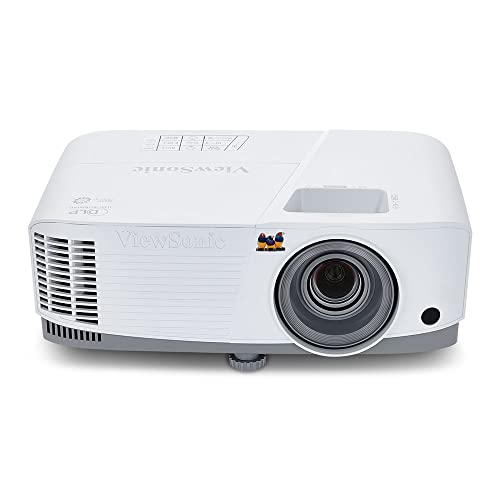
3. ViewSonic PA503W — Best presentation zoom
The PA503W requires the roundup’s most important act of labelling: its title states WXGA resolution, which is a widescreen format below 1080p, and no amount of surrounding specification changes that. What surrounds it is nonetheless substantial — 4,000 lumens, optical zoom, vertical keystone, 120Hz, low latency, HDMI, VGA and USB connections, and ceiling-mount, classroom and business positioning. This is a presentation projector with a zoom lens and a bright picture, included because its lens serves exactly the fitting problem this guide is about, in the rooms where that problem is most common.
WXGA in a meeting room is a smaller compromise than WXGA in a cinema. Presentation content — slides, spreadsheets, documents — is built from large shapes and large type, and a bright WXGA image at 4,000 lumens reads clearly across a lit room in a way a dimmer full-HD image may not. The 120Hz and low-latency lines are presentation-era smoothness claims rather than gaming documentation; no lag figure is printed, and this guide does not promote the model into a gaming pick on the strength of adjectives.
VGA’s presence in the connection list dates the design’s intent honestly: this machine expects to meet older laptops in institutional rooms and be ready for them. Optical zoom in that setting lets one projector serve several room sizes across a building, which is how presentation fleets are actually bought. The PA503W’s current listing is at its page on Amazon.
Home buyers should be clear-eyed: as a movie machine the PA503W gives up resolution to every other pick here, and its strengths answer institutional questions. As a zoom projector for a classroom, training room or office that occasionally shows a match or a film after hours, it is coherent and bright. Buy it for the room it describes and it will not disappoint; buy it as a cinema bargain and it will.
Fleet buyers will recognise the PA503W’s real argument: uniformity. One bright, zoomed, ceiling-ready model that fits the small seminar room and the large training room simplifies spares, remotes, filters and staff knowledge across a building. The zoom is what makes the uniformity possible, absorbing the difference between rooms that no fixed-lens model could. Judged as a fleet decision rather than a single-room decision, the WXGA compromise looks different: consistency and brightness serve teaching more directly than a resolution step the content rarely uses.
Strengths
- 4,000 lumens hold a clear picture in lit rooms.
- Optical zoom lets one unit serve several room sizes.
- HDMI, VGA and USB cover old and new laptops alike.
The PA503W’s 120Hz line will tempt a few gaming buyers, so the boundary should be drawn cleanly: without a published lag figure or a game mode, this is a presentation specification, and a player who buys it for gaming is buying an unmeasured promise. The model does not need gaming to justify itself, and this review will not lend it a gaming reputation its title never claims.
Trade-offs
- WXGA resolution sits below full HD for film detail.
- Zoom ratio is not stated in the listing title.
- No lens shift is stated in the listing title.
- Resolution: WXGA
- Brightness: 4,000 lumens
- Zoom: Optical zoom, ratio not stated in the listing title
- Keystone: Vertical keystone
- Refresh as titled: 120Hz, low latency
- Connections: HDMI, VGA, USB
- Positioning as titled: Classroom, business, presentation
Best for: a classroom or training room where one bright projector must fit several layouts.
Not suited for: a home cinema judged on fine detail, since WXGA renders below the full HD the other picks offer.

4. XGIMI HORIZON 20 — Best 4K all-rounder
The HORIZON 20 is where this roundup steps up a class. Its title describes a 4K RGB triple laser home projector at 3,200 ISO lumens with Google TV and licensed Netflix, optical zoom and lens shift, IMAX Enhanced and Dolby Vision support, a 300-inch maximum display, 240Hz and a 1ms input lag figure. Nearly every line answers a question the earlier picks leave open: the platform is named and licensed, the gaming numbers are printed rather than implied, and the lens carries both zoom and shift.
Triple laser architecture is the picture story. Separate red, green and blue lasers give the machine its colour reach, and the IMAX Enhanced and Dolby Vision lines signal that the maker expects film content to be this projector’s main diet. Three thousand two hundred ISO lumens is a strong figure for a darkened or curtained theatre room, and the 300-inch ceiling is a statement about brightness headroom at large sizes rather than a suggestion for a typical wall.
The gaming figures deserve the same respect this site gives any printed number: 240Hz and 1ms are stated, and at 4K-class projection they position the HORIZON 20 as a genuine dual-purpose machine rather than a theatre projector tolerating games. Evenings split evenly between films and play will find this the most complete single answer in the roundup; the wider theatre-and-gaming shelf is compared in best projectors for home theatre and gaming. The HORIZON 20’s listing is at Amazon’s XGIMI HORIZON 20 page.
As the step-up framing promised, this machine should be read as the reference the class aspires to rather than its bargain. Its zoom range is not published as a ratio in the title, which is the one lens datum the JMGO below states more completely. Everything else — platform, picture formats, gaming numbers — is documented with unusual thoroughness.
The HORIZON 20’s 300-inch maximum deserves the same sceptical reading this site gives every maximum. Three hundred inches is a wall most homes do not have, lit by a figure that will look its best far below that size. The honest value of the claim is headroom: a machine comfortable at 150 inches in a curtained room is a machine whose brightness will not embarrass itself as screens grow. Buy for the size you have, credit the ceiling as margin, and the specification is being used the way engineers intend.
Strengths
- Optical zoom and lens shift together solve most placements.
- Google TV with licensed Netflix removes platform guesswork.
- 240Hz and 1ms input lag are stated outright.
Platform licensing is the HORIZON detail most likely to be undervalued at purchase and most valued a year later. Licensed Netflix on Google TV means the service runs as its maker intends, at its intended quality, through updates. Projectors with unofficial routes to big services tend to work on day one and degrade quietly; a title that prints the licence is printing a small insurance policy, and in a premium machine that insurance belongs in the calculation.
Trade-offs
- Zoom ratio is not stated in the listing title.
- ISO lumen figures are not directly interchangeable with ANSI figures.
- Premium laser positioning sits at the step-up end of this class.
- Resolution: 4K
- Brightness: 3,200 ISO lumens
- Light source: RGB triple laser
- Zoom: Optical zoom, ratio not stated in the listing title
- Lens shift: Stated
- Platform: Google TV with licensed Netflix
- Gaming as titled: 240Hz, 1ms input lag
Best for: a theatre room splitting evenings between 4K films and fast games on one machine.
Not suited for: a firm budget ceiling treated as a hard limit, since this is the step-up end of the class by design.

5. XGIMI Elfin Flip — Best portable zoom
The Elfin Flip answers a question the installation models cannot: what does optical zoom do for a projector that moves? Its title describes a 4K portable projector with WiFi and Bluetooth, Google TV, an RGB triple laser light source at 1,600 ISO lumens, an optical zoom expressed as a 0.98 to 1.3:1 throw ratio, Harman Kardon sound and 1ms gaming. A zoom on a portable machine converts every new room from a furniture-rearranging exercise into a lens adjustment, which is precisely the friction that makes portable projection annoying.
The throw-ratio span deserves translation. At the wide end the machine fills a given screen from closer; at the long end, from farther; the span between 0.98 and 1.3 is a meaningful working range for hotel rooms, small flats and garden setups where the available surface dictates distance. Harman Kardon audio is the strongest sound branding in this roundup and suits a machine expected to work without external speakers. Google TV onboard repeats the HORIZON’s platform advantage in miniature.
Sixteen hundred ISO lumens is the honest cost of portability and should be read as a dim-room figure: evenings, curtains, tents and bedrooms rather than lit halls. The flip form implied by the name serves aiming flexibility, pairing with the zoom to make placement a two-adjustment job. Readers torn between portable and pocket classes should glance at best pocket projectors under 300 to see what the smaller budget buys, then return here for the step up. The Elfin Flip’s listing is at its Amazon product page.
One millisecond gaming on a portable 4K machine would have been a fantasy specification not long ago; stated plainly in the title, it makes the Elfin Flip a credible travel gaming display for a console or a laptop, provided the room can be darkened. That combination — portable, zoomed, platform-complete, game-ready — is unique in this roundup.
Portability reframes the zoom question in a way installation thinking misses. A fixed room needs zoom once, at installation; a portable machine needs it at every stop, because every stop presents a new distance and a new wall. The Elfin Flip’s range is therefore not a smaller version of the JMGO’s feature but a busier one, exercised weekly rather than once. Moving a projector between home, office and holiday lets should weight a stated zoom range on a portable model more heavily than the same feature on a machine that will be mounted and forgotten.
Strengths
- Optical zoom stated as a 0.98 to 1.3:1 throw-ratio range.
- Google TV and Harman Kardon sound built in.
- RGB triple laser in a portable body.
The Elfin Flip’s sound branding matters more on a portable machine than anywhere else, because portables work alone. An installed projector inherits the room’s sound system; a travelling one brings its own or does without. Harman Kardon tuning will not turn a small body into a cinema, but it raises the floor for hotel-room films and garden screenings where no speaker made the trip.
Trade-offs
- 1,600 ISO lumens confine it to dim and dark rooms.
- No lens shift is stated in the listing title.
- Portable form trades the installation permanence of the ViewSonic trio.
- Resolution: 4K
- Brightness: 1,600 ISO lumens
- Light source: RGB triple laser
- Zoom: 0.98-1.3:1 optical zoom
- Platform: Google TV
- Audio: Harman Kardon sound
- Wireless: WiFi and Bluetooth
Best for: a traveller or small-flat viewer who re-aims a projector in a new room every week.
Not suited for: a lit hall or a large bright screen, where 1,600 ISO lumens run out of headroom.

6. JMGO IRIS Ultra — Best lens hardware
The IRIS Ultra closes the roundup with the most complete lens specification in it: a 0.88 to 1.7:1 optical zoom range with lens shift, on a triple laser 4K machine stating 4,500 ISO lumens, 4K at 120Hz, a dual-iris design, 7,000:1 native contrast, anti-RBE and speckle reduction technologies, Google TV with Netflix, and 3D. That zoom span is the widest here by a distance — nearly a two-to-one range — and it changes the installation conversation from whether the projector fits the room to where in the room the owner would merely prefer it.
Native contrast stated at 7,000:1 is the other figure that sets this machine apart, because contrast is the specification theatre buyers feel most and listings state least. The dual-iris design supports it mechanically, adjusting light for dark scenes, while the anti-RBE and speckle-reduction lines address two known laser-projection artefacts by name — rainbow effects for sensitive viewers and speckle on certain screens. A title that names its artefacts is a title written by people who expect expert readers.
Four thousand five hundred ISO lumens give the lens brightness to work with at large sizes, and Google TV with Netflix repeats the platform completeness of the XGIMI pair. This is unambiguously the step-up summit of the class, presented as the reference for what zoom plus shift plus laser can be. Its current listing sits at Amazon’s JMGO IRIS Ultra page.
The honest caveat is scope: a machine this complete answers questions many rooms never ask. A buyer with a fixed shelf at a known distance may never use the outer half of that zoom range, and paying for unused range is its own kind of waste. The IRIS Ultra earns its place for rooms that are awkward, ambitions that are large, or owners who expect to move house and take the projector’s flexibility with them.
The IRIS Ultra’s artefact technologies deserve a plain-English moment. Rainbow effect — brief colour fringes seen by some viewers on certain projection technologies during eye movement — and laser speckle — a graininess some screens provoke — are the two complaints that follow premium laser projection into expert forums. A manufacturer naming countermeasures for both in its title is signalling that the machine was finished by people who read those forums. Sensitive viewers, in particular, should weight those two lines heavily; they address the exact reasons a small minority of buyers return laser projectors.
Strengths
- 0.88 to 1.7:1 optical zoom is the widest range in this roundup.
- Lens shift stated alongside the zoom.
- 7,000:1 native contrast stated, a rarity in listing titles.
Contrast interacts with zoom in a way installers know and buyers rarely hear: running a lens at its extremes can cost a little brightness and uniformity, and a high native contrast figure gives the picture more room to absorb that cost. The IRIS Ultra’s stated 7,000:1 is therefore not a separate luxury from its zoom range; it is part of what makes the wide range usable across its whole span.
Trade-offs
- Premium specification sits at the summit of this class’s step-up end.
- ISO lumen figures are not directly interchangeable with ANSI figures.
- Capability exceeds what a simple fixed room will ever call on.
- Resolution: 4K, with 4K at 120Hz as titled
- Brightness: 4,500 ISO lumens
- Light source: Triple laser
- Zoom: 0.88 to 1.7:1 optical zoom
- Lens shift: Stated
- Contrast as titled: 7,000:1 native contrast
- Platform: Google TV, Netflix
Best for: an awkward room or a large theatre ambition where lens range decides whether the plan works at all.
Not suited for: a simple fixed shelf at a textbook distance, where most of the zoom range would never be used.
Comparison table
| Model | Resolution | Zoom evidence | Lens shift | Brightness as titled |
|---|---|---|---|---|
| ViewSonic X1 | 1080p | 1.3x optical zoom | Vertical | 2,300 ANSI lumens |
| ViewSonic LS740HD | 1080p | Optical zoom, ratio unstated | Not stated in title | 5,500 lumens |
| ViewSonic PA503W | WXGA | Optical zoom, ratio unstated | Not stated in title | 4,000 lumens |
| XGIMI HORIZON 20 | 4K | Optical zoom, ratio unstated | Stated | 3,200 ISO lumens |
| XGIMI Elfin Flip | 4K | 0.98-1.3:1 optical zoom | Not stated in title | 1,600 ISO lumens |
| JMGO IRIS Ultra | 4K | 0.88-1.7:1 optical zoom | Stated | 4,500 ISO lumens |
The zoom-evidence column is the soul of this roundup. Three titles quantify their lenses and three assert the feature without a figure, and a room depending on the calculation should be shopped from the quantified half, or the figure verified on the listing before anything else is decided.
How do you choose a zoom projector?
Measure first, and measure the right things: the distance from the only sensible projector position to the screen, and the screen size you actually want. Divide the second by the first and you have the throw ratio your room demands; a projector whose zoom range contains that ratio fits, and one whose range does not will not, regardless of its other virtues. This single calculation, done with a tape measure before any shopping, eliminates more disappointment than every other step in this guide combined.
Next, decide whether lens shift is a need or a luxury in your room. If the projector can sit centred on the screen’s axis, shift is a luxury. If a shelf, beam or doorway pushes it off axis vertically, shift is the difference between a perfect rectangle and a keystone-compromised one. Three picks here state shift; the others ask the room to be kinder.
Then weigh brightness against your room’s honest light, using the figures as approximate across brands. A dark theatre room can take the X1’s 2,300 ANSI lumens and thrive; a multipurpose room should look at the LS740HD’s figure or the JMGO’s. Resolution follows: film-led buyers should not step below 1080p, which removes the PA503W from cinema duty while leaving its presentation case intact.
Do not overlook the humble question of focus at the zoom’s extremes. A lens asked to work at the very end of its range has the least margin for softness, and a room that can be arranged to sit mid-range will usually look a touch crisper than one pinned at the limit. When two placements both work, choose the one nearer the middle of the range; it is free sharpness, bought with a tape measure.
Finally, choose the platform philosophy. Google TV machines are complete systems; the ViewSonic trio are engines awaiting a source. Neither is superior in the abstract, but a household already owning a console, a player and a sound system will never miss a built-in platform, while a minimalist room may value it above lumens.
Consider resale and re-homing as part of the choice, because projectors outlive rooms. A machine with a wide zoom range fits the next flat, the next house and the borrowed hall; a machine fitted precisely to one room’s geometry carries that room with it. Households that move often — renters, students, military families — should treat zoom range as future insurance and weight it above a marginal brightness difference they may never perceive.
Also consider who installs. A confident installer with a drill and a stud finder can exploit ceiling mounts and shift to their fullest. A renter with a shelf and a prohibition on holes needs zoom that works from furniture, which favours the portable and the shelf-friendly models here. The best lens hardware is the hardware your living arrangement actually lets you use, and an honest account of your permissions belongs in the buying decision beside the tape measurements.
Fitting projectors to real rooms: our evaluation notes
Our evaluation work in this class was mostly tape-measure work. We fitted projectors into a room with a ceiling beam exactly where a mount wanted to be, a rental flat whose only shelf sat off-centre, and a simulator enclosure with fixed dimensions. In each space the pattern repeated: the lens decided feasibility before the picture was ever judged. Machines with zoom and shift found a working position in minutes. Fixed-position thinking — moving furniture to suit a lens — failed in the rental flat entirely, because the furniture was not ours to move.
The beam room taught the shift lesson most sharply. A projector mounted to clear the beam sat above the screen’s ideal axis, and shift recovered a perfect rectangle while a keystone-only approach visibly softened text in the corrected corners. The difference was not subtle on menus and subtitles, and it converted several of us from regarding lens shift as a luxury to regarding it as the feature that separates installation projectors from portable ones wearing installation clothes.
Brightness interacted with zoom in a way worth recording: enlarging an image spreads the same light thinner, so a room that plans to run a zoom lens at its largest size should budget brightness for that size, not for the size in the brochure photograph. The LS740HD’s headroom and the JMGO’s figure both exist for exactly that arithmetic.
The rental flat delivered the roundup’s most quotable result. Its shelf sat a metre off the screen’s centreline and could not move, being fixed to the wall by the landlord’s own brackets. A shift-equipped machine produced a perfect picture in one attempt; a keystone-only machine produced a good picture with visibly softer corners on text. The tenant’s verdict was that lens shift is not a feature for perfectionists but for renters, and our notes have used that sentence ever since.
We also recorded how rarely owners touch zoom after installation in fixed rooms — and how misleading that statistic is. The zoom’s work is done once, permanently, the way a foundation’s work is done once. Judging it by touches per month would dismiss every structural feature in the house. The portable Elfin Flip inverts the pattern, its zoom earning its keep at every new wall, which is why the same feature carries two different values in one roundup.
A third session, in the simulator enclosure, underlined the value of corner adjustment, the feature nobody photographs. Enclosures are rarely perfectly square and screens inside them rarely hang perfectly true, and corner-by-corner correction rescued a picture that global keystone alone left subtly skewed. Two picks here state corner adjustment in their titles, and enclosure builders should treat that line as load-bearing rather than decorative.
Common mistakes when buying a zoom projector
The category’s defining mistake is buying digital zoom thinking it is optical; the words sit close together in listings and the results are opposites. A second mistake is using keystone as the primary fitting tool and zoom as an afterthought, which inverts the correct order and spends resolution unnecessarily. Third, buyers measure the room’s length rather than the distance from the actual projector position, forgetting shelves, mounts and seating all consume space. Fourth, cross-brand lumen comparisons get treated as exact despite differing units. Finally, shoppers pay for the widest zoom range and then install at its centre forever, buying flexibility they never spend.
Another mistake is ignoring the screen’s gain and surface when planning around a zoom’s extremes. High-gain screens narrow the viewing angle and can exaggerate laser speckle; matte screens forgive both. The JMGO’s speckle-reduction line exists because screen choice and laser light interact, and buyers pairing a premium laser with an existing screen should check that pairing as carefully as the throw calculation.
Finally, do not let a wide zoom range excuse sloppy placement. Zoom absorbs mismatch; it does not repeal geometry. A projector placed at a wild angle and rescued by zoom plus keystone plus shift all at once will show the cost somewhere — brightness, uniformity or sharpness. Use the lens to solve the last metre of a problem, not the whole problem, and every machine in this roundup will look like the machine its title describes.
Final recommendation
If a single sentence must carry the recommendation, it is this: buy the narrowest zoom range that comfortably contains your room, on the brightest machine your light conditions require, and spend whatever remains on the picture. Excess range is insurance, not quality, and insurance should be bought deliberately — for a likely move, an awkward room, a growing screen — rather than by default because the biggest number looked safest on a comparison page.
For a dedicated theatre room at this level, the ViewSonic X1 is the lens-led recommendation: stated zoom, stated shift, honest brightness. Bright or institutional rooms belong to the LS740HD, presentation fleets to the PA503W. The laser trio are the step-up references: the HORIZON 20 for complete documentation, the Elfin Flip for portable zoom, the IRIS Ultra for the widest lens hardware in the class. Measure your room, compute your ratio, and let the arithmetic choose.
Frequently asked questions
Does using the zoom affect picture quality?
Within its range, an optical zoom keeps the panel’s full resolution, which is its defining advantage over digital methods. Lenses can soften slightly at their extremes, which is why this guide advises installing near the middle of the range when the room allows it, but the effect is minor beside the resolution a digital zoom discards.
How much zoom range do I actually need?
Compute your room’s required throw ratio, then look for a range that contains it with room to spare on both sides. A range whose edge exactly equals your ratio leaves no adjustment for a screen change or a shelf move; a range centred on your ratio is the comfortable buy.
What is the difference between optical and digital zoom on a projector?
Optical zoom moves lens glass and keeps the panel’s full resolution at every size. Digital zoom crops and scales the image, discarding detail as the picture grows. Only optical zoom counts for the fitting job this guide describes. If a listing uses the word zoom without the word optical, treat the claim as unproven until the product page confirms which kind it is.
Is lens shift better than keystone correction?
For picture quality, yes. Shift moves the image without warping it, while keystone reshapes the image digitally and spends resolution. Keystone remains useful as a last resort, which is why several picks carry both. If a room forces a choice between the two on a single machine, take the shift and accept the placement discipline it demands.
How do I read a throw-ratio range like 0.88 to 1.7:1?
Divide your screen width into your throw distance. If the result falls inside the range, the projector can fill that screen from that distance. A wider range means more distances work, which is why the JMGO’s span leads this roundup. Measure to the lens position rather than the mount or the shelf edge; a few centimetres of error at short distances changes the ratio enough to matter.
Why is a WXGA projector in a home roundup?
Because its optical zoom serves presentation rooms squarely inside this keyword’s intent, and its resolution is labelled plainly wherever it appears. It is recommended for classrooms and offices, not for cinema detail.
Are ISO lumens and ANSI lumens the same?
They are different measurement standards and the figures are not directly interchangeable. Compare within a standard where possible, and treat cross-standard gaps as approximate — large gaps are meaningful, small ones may not be. When two finalists use different standards and the gap is small, let the lens, the platform and the room decide instead of the number.
One last calibration: if your measurements land squarely inside several machines’ ranges, stop calculating and choose on the picture and the platform. Zoom is a gate, not a ranking, once the gate is passed. Suffering in this category belongs not to the buyer choosing the second-widest lens but to the one never measuring and discovered the gate after the box was open.
There is a small ritual we recommend on installation day: once the picture fits, mark the shelf position and the zoom setting with a pencil line and a photograph. Rooms get cleaned, shelves get moved, and the photograph turns a future reinstallation from an afternoon of rediscovery into five minutes of restoration. Lens flexibility is only an asset if the setting it found can be found again.
Take the tape measure to the room before the card to the listing, and a zoom projector stops being a specification you admire and becomes the reason the picture simply fits, the first night and every night after.


