What's inside
As an Amazon Associate I earn from qualifying purchases. This post may contain affiliate links at no extra cost to you.
gizmoverdict.com is reader-supported. When you buy through links on our site, we may earn an affiliate commission.
Where to buy: Every headset on this page is sold through Amazon in wired form, so stock turns on the listing rather than on a regional distributor, and a sales floor can usually replace a failed unit within days instead of waiting on a procurement cycle. Check each listing for the connector variant before ordering a batch, because several models here ship in more than one plug configuration.
The best headsets for pc sales calls live or die on one moment: a prospect leans toward the phone in a noisy kitchen, your colleague laughs two desks away, and your voice either arrives clean or arrives buried. Outbound calling is not meeting audio. A meeting forgives a muffled syllable because faces and slides carry the meaning. A cold call offers no such backup, so the microphone, its noise handling, and the controls under your fingers matter more than plush cushions or brand prestige.
Sales work also splits into two physical styles. Some reps pace, gesture, and keep one ear on the room so they can hear a manager’s whispered objection handling tip. Others seal both ears, work a power-dialer queue, and treat outside sound as pure distraction. This list deliberately carries both shapes: two Jabra Engage 50 variants anchor the extremes, one mono and one stereo, while four USB headsets from JIAMQISHI, LEVN, MAIRDI, and EKSA cover the home-office and small-team budgets between them.
Key Takeaways
- Microphone noise cancelling is the headline feature for outbound work, and all six picks claim some form of it in their listing titles.
- The Jabra Engage 50 Mono and Stereo share a three-microphone system, so the real choice between them is one ear open versus two ears sealed.
- Inline controls earn their keep on a dialer queue, where mute and volume adjustments happen dozens of times a day without touching the mouse.
- Connector flexibility decides desk compatibility: USB-only, USB plus 3.5mm, and USB-C/A variants all appear here.
- None of these headsets is wireless, which suits fixed desks and removes battery management from a team’s daily routine.
Quick Picks
| Pick | Label | Why it is here |
|---|---|---|
| JIAMQISHI USB Headset | Best for mixed-device desks | USB and 3.5mm plugs cover laptops and phones from one on-ear frame. |
| LEVN USB Headset | Best for open-plan sellers | Built and titled squarely for open office and call center calling. |
| MAIRDI USB Headset | Best for dictation-heavy reps | Its title names Dragon dictation software alongside Teams and Zoom. |
| Jabra Engage 50 Mono | Best one-ear professional pick | Three-microphone system with hearing protection in a mono telephone headset. |
| Jabra Engage 50 Stereo | Best for focused dialer blocks | The same microphone system with both ears covered for concentration. |
| EKSA H8 USB Headset | Best connector coverage | 3.5mm, USB-C, and USB-A options on an over-ear wired frame. |
Think about what a prospect actually experiences. They answer an unknown number during a busy morning, grant you perhaps twenty seconds of patience, and decide whether you sound like a professional worth hearing or a call-center echo worth hanging up on. That judgment forms before your pitch’s content registers. It forms on vocal clarity, on the absence of clatter behind you, and on the confidence that a close, steady microphone projects. Every selection decision in this roundup traces back to protecting those twenty seconds.
How were these picks chosen?
Selection started with the microphone, because that is the half of the headset your prospect actually hears. Every model here states noise cancelling at the microphone in its listing title, though the mechanisms differ and the titles rarely explain them, so we treated the claim as a floor rather than a ranking. Above that floor, we weighed how a rep physically works: one ear or two, on-ear or over-ear, and whether the controls sit on a cable pod reachable without looking down.
Platform fit came next. Sales stacks run on softphones, Teams, Zoom, and browser dialers, often on the same machine in the same hour. Titles naming those platforms earned preference, as did dual-connector designs that survive a laptop swap. Finally, we kept the list entirely wired. A dead battery mid-queue costs calls, and a cable also tethers a rep to the desk during recorded conversations, which compliance teams quietly appreciate. Readers comparing adjacent categories will find our coverage of best one ear headsets for pc useful for the mono side of this decision.
1. JIAMQISHI USB Headset — Best for mixed-device desks
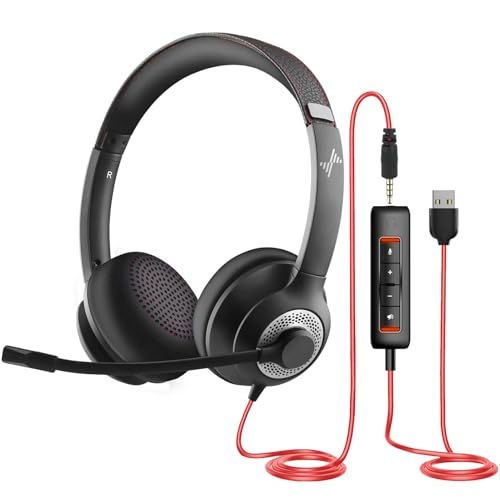
The JIAMQISHI opens the list because its title solves the most common small-team annoyance: two plugs in the box. USB serves the PC running your dialer, while the 3.5mm jack covers a desk phone, a tablet used for demos, or a personal phone when the CRM’s click-to-call routes audio there. Reps who hot-desk between a laptop station and a phone-heavy corner of the office stop carrying two headsets, and managers stop stocking two spares.
Its on-ear shape sits on the ear rather than around it, which keeps some room awareness during calls. That matters in sales pods where a team lead walks the floor and drops live coaching within earshot. The noise cancelling microphone is the sales-relevant half of the design: your voice gets the processing, while your ears stay partly open to the room. Inline control handles the routine call operations from the cable, so muting during a cough or a side conversation takes a thumb press instead of a scramble for the softphone window.
Honesty requires noting what the title leaves unsaid. It names Skype and Zoom plus online class and home office use, which signals a generalist tool rather than a call-center instrument tuned for eight-hour dialer shifts. Nothing in the title mentions platform certification, a quick-disconnect cable, or a replaceable ear cushion, so teams standardizing on one model for years of service should treat this as a flexible starter or spare rather than a flagship. For a two-person startup where the same person sells, supports, and demos, that generalist profile is precisely the point.
Daily handling rounds out the picture. An on-ear headset gets put on and taken off between every call block, demo, and coffee run, so headband flexibility and cushion resilience quietly decide its service life. The JIAMQISHI’s generalist brief — home office, online class, Skype, Zoom — suggests a design expected to migrate between tasks rather than live bolted to one workstation, and that portability suits the rep whose selling day is really three jobs wearing one calendar. Keep a soft case in the laptop bag and this is the headset most likely to be present, working, wherever the next call happens to be taken.
Strengths
- USB and 3.5mm connectors in one headset, per the listing title.
- Noise cancelling microphone aimed at calls rather than music playback.
- Inline control for handling call functions from the cable.
Trade-offs
- On-ear fit keeps less outside sound out than an over-ear design.
- The title states no platform certification for Teams or similar suites.
- Cable length and cushion replacement options are not stated in the listing title.
- Form factor: On-ear
- Connection: USB and 3.5mm
- Microphone: Noise cancelling, per title
- Controls: In-line control
- Colors named: Black
- Certification: Not stated in the listing title
Best for: a rep splitting calls between a PC softphone and a 3.5mm phone or tablet. Not suited for: a sealed, two-ear dialer station where blocking the room matters more than hearing it.
Reps outfitting a mixed desk can check price on Amazon and confirm the plug variant on the listing before ordering spares.
Consider how this headset behaves across a full shift rather than a single call. The first hour flatters almost any cushion; the seventh hour is where on-ear pressure and boom drift announce themselves. Because the title stays silent on weight and cushion construction, the honest guidance is procedural: rotate this model through your loudest pod for a week before signing a quantity order, and let the reps who talk eight hours a day deliver the verdict. Sales gear succeeds or fails on accumulated small comforts, and a headset that a rep unconsciously removes between calls will also be off their head when a callback lands early.
There is also a training angle to the dual-plug design. New hires often learn the dialer on a training laptop, then graduate to a personal workstation and a desk phone for warm transfers. A headset that follows them across both stations keeps their microphone position identical, and consistent mic distance is one of the quiet variables behind consistent call recordings. Coaches reviewing a rep’s week hear the same voice placement on day one and day thirty, which makes feedback about pacing and tone far easier to isolate from feedback about equipment.

2. LEVN USB Headset — Best for open-plan sellers
LEVN titles this headset for the call center and the open office in the same breath, and that pairing describes most modern sales floors accurately. Rows of reps pitch simultaneously, so each microphone must reject the neighbor’s pitch while passing its own wearer’s voice. The title claims a noise canceling microphone for exactly that job, and the USB connection keeps setup to a single plug on whatever laptop the rep was issued.
The design language is work-first: black finish, microphone boom, no mention of music tuning or lifestyle features. That plainness is a virtue in a team purchase, because nobody’s headset becomes the office fashion statement and replacements match the fleet. Work-from-home sellers get the same benefit in reverse — the headset reads as professional equipment on a video check-in rather than a gaming accessory borrowed from a teenager’s room.
What the title does not give us is equally clear. It states no cable length, no weight, and no second connector, so this reads as a USB-only desk tool. A rep whose workflow includes a hardware desk phone will need an adapter path the title does not describe. There is also no mention of inline controls in the title copy provided, so buyers for whom a physical mute pod is non-negotiable should read the full listing carefully before committing a whole pod to this model.
There is a signaling benefit to a purpose-titled work headset that managers underestimate. When a prospect joins a video call and sees a proper boom headset rather than earbuds, they subconsciously file the conversation as a business call with a prepared professional. That framing buys patience during the opening minute. LEVN’s plain, work-first presentation leans into exactly that effect, and for outbound teams whose calls often escalate to video, the visual register of the equipment is a small but real part of the pitch environment.
Strengths
- Titled explicitly for call center and open office calling.
- Noise canceling microphone matched to neighboring-talk environments.
- Single USB plug suits issued-laptop fleets and hot desks.
Trade-offs
- No 3.5mm option appears in the title, limiting phone use.
- Inline controls are not mentioned in the listing title.
- Weight and cable length are not stated in the listing title.
- Form factor: Headset with boom microphone
- Connection: USB
- Microphone: Noise canceling, per title
- Intended settings: Work from home, call center, open office
- Controls: Not stated in the listing title
- Color named: Black
Best for: a seller on an issued laptop working a loud open-plan floor. Not suited for: a desk built around a 3.5mm hardware phone with no USB audio path.
Team leads buying for a pod can see the current listing on Amazon and verify control layout in the product photos.
Open-plan selling has a second, less discussed audio problem: your prospect hears fragments of neighboring pitches. When six reps sell across one room, a leaky microphone can carry a colleague’s conversation into a call, which at best sounds unprofessional and at worst creates a genuinely awkward moment mid-discovery. A microphone with serious background rejection is therefore not only a clarity tool but a confidentiality tool, and team leads evaluating this LEVN should test exactly that failure mode: two reps pitching simultaneously at adjacent desks, each listening for the other’s words in their own call recording afterwards.
The USB-only design also simplifies the support conversation. There is one plug, one device entry in the operating system’s sound settings, and one troubleshooting script for the office manager to follow when a rep reports silence. Fleets built on a single connection standard generate fewer support tickets than mixed fleets, and in a small sales org the office manager’s time is worth real money. That simplicity, paired with the open-office positioning in the title, defines this model’s lane: not the most flexible headset here, but arguably the easiest to deploy at pod scale.

3. MAIRDI USB Headset — Best for dictation-heavy reps
MAIRDI earns its slot through a line in its title that none of the other five carries: dictation. The headset is titled as a dictation headset for Dragon Naturally Speaking, which signals a microphone voiced for speech recognition as well as human listeners. Plenty of sales professionals live in that overlap. They talk to prospects all morning, then dictate call notes, follow-up emails, and CRM updates all afternoon, and a microphone that serves both masters removes a device swap from the routine.
The rest of the title reads like a checklist of the modern rep’s software day: Teams, Zoom, office work, call center business, and softphone use are all named. That breadth matters because speech-recognition accuracy and call clarity pull in the same direction — a close, consistent microphone position and background rejection — so a headset chosen for dictation rarely disappoints on calls. The noise canceling claim sits at the microphone, where a home office’s dishwasher and a sales floor’s chatter both need suppressing before they reach either the prospect or the transcription engine.
Temper the enthusiasm with the title’s limits. No connector beyond USB is mentioned, and no physical control set is described, so the listing’s fine print carries those answers. The title also makes no comfort claims for marathon wear, and dictation users often wear a headset longer in a day than callers do, since note cleanup stretches past the last dial. Treat this as the specialist for voice-driven workflows, and confirm fit details on the listing if your reps dictate for hours.
Speech-recognition users should also think about session rhythm. Dictation works best in uninterrupted runs where the microphone position never changes, so a headset that stays comfortable and stable through a forty-minute note-clearing session outperforms a nominally clearer model that begs to be removed after ten minutes. The MAIRDI’s combined call-and-dictation brief makes it the natural candidate to test under that specific discipline: one long dictation run, scored by correction count, tells you more than any specification paragraph can.
Strengths
- Dictation use named in the title, including Dragon software.
- Teams, Zoom, softphone, and call center use all named.
- Noise canceling microphone serves both calls and transcription.
Trade-offs
- USB appears to be the only connection the title describes.
- Inline control details are not stated in the listing title.
- Comfort features for long dictation sessions are not stated in the listing title.
- Form factor: Computer headset with microphone
- Connection: USB
- Microphone: Noise canceling, per title
- Named software: Teams, Zoom, Dragon Naturally Speaking
- Controls: Not stated in the listing title
- Dictation support: Named in title
Best for: a rep dictating CRM notes and follow-ups between outbound calls. Not suited for: a workflow split across USB and 3.5mm devices throughout the day.
If your notes workflow runs on your voice, look at the MAIRDI listing on Amazon and check the control pod in the images.
Dictation deserves a deeper word, because it changes how a microphone should be judged. Human listeners forgive variation; speech recognition engines do not. A boom that drifts two centimeters between sessions quietly degrades transcription accuracy, and the rep pays for that drift in correction time after every call block. A headset chosen for dictation should therefore be judged on how repeatably it sits, session after session, and reps should develop the habit of checking boom position before a dictation run the way they check mute status before dialing.
The MAIRDI’s platform list also hints at its intended buyer: the solo operator or tiny team whose stack is whatever the client uses. One prospect insists on Teams, another sends a Zoom link, a third still runs a legacy softphone, and the rep’s headset must sound identical across all three. A generalist USB headset with a dictation-friendly microphone fits that reality better than a certified single-platform instrument, provided the rep accepts the homework of confirming control details on the full listing before purchase.

4. Jabra Engage 50 Mono — Best one-ear professional pick
Here the list steps into purpose-built telephone equipment. The Engage 50 Mono is a wired telephone headset whose title leads with a three-microphone system designed to block background noise for agent focus. Three microphones give the processing more information to separate voice from room than a single-element boom can, and on a sales floor the room is the enemy: forty other pitches, a coffee machine, and a manager’s huddle all compete with your sentence.
The mono configuration is a deliberate professional choice, not a cut-down stereo model. One ear carries the prospect; the other stays available for the floor. A rep hears a colleague flag that a gatekeeper gave a direct line, hears their own voice naturally instead of through sidetone alone, and stays aware of a supervisor approaching with a save. Jabra also titles enhanced hearing protection into this model, a feature aimed at acoustic shocks and sustained call volume across long shifts — the kind of detail consumer headsets rarely mention.
Set expectations correctly, though. This is a telephone headset from a contact-center line, sold as a single-ear wired unit. The title does not promise music performance, a second connector type, or inline consumer controls, and buyers should not project those onto it. Its value concentrates entirely on call clarity and shift-length wear for people whose revenue arrives through conversation. For a senior AE running high-value discovery calls from a busy office, that concentration is exactly right.
Procurement teams should note what the Engage 50 Mono’s title does not try to do. It does not chase gamers, commuters, or music listeners, and that focus is precisely why contact-center buyers trust the line. Every design compromise points at the same target: a voice call, held for hours, in a loud room, by a professional whose employer records the result. Sales organizations are simply contact centers with better coffee, and equipment specified for that world transfers without translation.
Strengths
- Three-microphone system titled for blocking background noise.
- Mono fit keeps one ear available for coaching and room cues.
- Enhanced hearing protection named in the title.
Trade-offs
- Single-ear audio cannot isolate a rep from a loud floor.
- Connector details beyond wired are not stated in the listing title.
- Music and media performance are not addressed in the listing title.
- Form factor: Mono telephone headset
- Connection: Wired
- Microphone: 3-microphone system
- Hearing protection: Enhanced, per title
- Stereo audio: No — single ear
- Intended setting: Call center agent work
Best for: an experienced caller keeping one ear on the sales floor. Not suited for: a power-dialer block demanding full two-ear isolation from neighboring pitches.
Floor-focused reps can review the Engage 50 Mono on Amazon for the exact cable and connector configuration.
Hearing protection, mentioned in both Engage 50 titles, deserves explanation for buyers outside the contact-center world. Call audio can spike: a dropped handset, a misrouted fax tone, a prospect’s dog barking directly into a phone. Protection circuitry limits those peaks before they reach the ear. Across thousands of calls a year, that limiting is the difference between a rep ending the day with ringing ears and one who never thinks about the subject. It is an unglamorous specification that signals a design team thinking about careers, not weekends.
The mono model also changes how a rep uses their desk. With one ear open, a second audio source stays usable: a team lead’s call review played quietly, a training recording, the office door announcing a walk-in client. Mono users build a two-channel work life, call in one ear and environment in the other, and many veteran sellers refuse to surrender that arrangement even when offered premium stereo gear. If your top performers ask for one-ear headsets by name, believe them; they are describing a workflow, not a preference for cheaper equipment.

5. Jabra Engage 50 Stereo — Best for focused dialer blocks
The stereo sibling shares the mono model’s three-microphone system and hearing protection, and changes exactly one variable: both ears are covered. That single change redefines the headset’s job. Instead of balancing prospect against room, the stereo version commits the rep entirely to the call, which suits structured dialer blocks where a queue feeds conversations back to back and any floor distraction costs the opening thirty seconds of the next pitch.
Two-ear coverage also helps the listener’s side of selling. Prospects reveal budget hesitation in small vocal cues — a pause, a flattened tone — and hearing those cues clearly, in both ears, without the office bleeding through, sharpens a rep’s read of the conversation. Recorded-call review benefits too, since the rep evaluating their own calls hears them closer to how the prospect did. The shared microphone system means the outbound half of the call sounds identical to the mono version; the difference is purely what the rep hears and what the rep shuts out.
Choosing between the two Engage 50 variants is therefore a management decision about floor culture as much as a personal preference. Collaborative floors where leads circulate tips favor mono. Heads-down floors running sequenced outbound campaigns favor stereo. Buying both for a team and letting reps pick per block is defensible, since the microphone experience stays consistent across the fleet and training materials do not fork. The title gives no wireless option and no consumer media claims, keeping this firmly in professional telephone territory.
One scenario separates the stereo model from its mono twin more sharply than any other: the whisper-quiet prospect. Some decision-makers speak softly, trail off at sentence ends, and bury the crucial condition in the last three words. Two-ear coverage with the room shut out gives the rep a genuine chance to catch that condition live instead of discovering it in the recording. Deals have turned on less, and reps who regularly sell to soft-spoken executives should weight this model accordingly.
Strengths
- Same three-microphone noise-blocking system as the mono version.
- Two-ear coverage supports concentration during dialer queues.
- Enhanced hearing protection named in the title.
Trade-offs
- Room awareness drops sharply compared with the mono model.
- Live coaching from the floor becomes harder to hear mid-call.
- Connector details beyond wired are not stated in the listing title.
- Form factor: Stereo telephone headset
- Connection: Wired
- Microphone: 3-microphone system
- Hearing protection: Enhanced, per title
- Stereo audio: Yes — both ears
- Intended setting: Call center agent work
Best for: sequenced outbound blocks where concentration outranks floor awareness. Not suited for: a pod culture built on overhearing teammates and trading live tips.
Dialer-focused teams can compare the stereo Engage 50 on Amazon against the mono version before standardizing.
The stereo Engage 50 also reframes breaks and call review. Reps commonly review their own recorded calls between dialer blocks, and hearing those recordings in the same two-ear presentation as the live call makes self-coaching more faithful. Tone, pacing, and the prospect’s hesitations all survive the transfer from live call to review session. Managers building a call-library culture, tagging great discovery calls for new hires to study, get more from that library when the study headset matches the selling headset.
There is a fatigue consideration as well. Full coverage can feel enclosing across an eight-hour shift, and some reps alternate: stereo for the morning dialer block, a lighter option for afternoon admin. The shared microphone platform across both Engage variants makes that alternation painless, since the prospect-facing sound never changes when the rep swaps. A fleet decision that looks like duplication is actually continuity insurance, letting individuals manage comfort without fragmenting the team’s audio identity.

6. EKSA H8 USB Headset — Best connector coverage
EKSA closes the list with the broadest plug story of the six: a 3.5mm jack plus USB-C and USB-A, per its title. Modern sales laptops increasingly ship with USB-C as the primary port, older docks and desktops still offer USB-A, and the H8 speaks to all of them without a dongle hunt. For an IT-light sales org issuing whatever laptop was on sale that quarter, that flexibility quietly prevents a shelf of incompatible headsets.
The over-ear frame distinguishes it from the on-ear JIAMQISHI and the telephone-focused Jabras. Cups around the ear give passive isolation that helps a rep follow a quiet-spoken prospect, and the title pairs the fit with a noise cancelling microphone for the outbound direction. Inline controls are explicitly named, covering the mute-and-volume routine from the cable. Teams, office, and call center use are all in the title, so the positioning is unambiguous: this is a work headset that happens to connect to nearly everything.
Two cautions belong in the record. The title does not state platform certification, so organizations locked to a certified-device policy should verify status separately. It also describes a stereo over-ear experience, which is the wrong shape for reps who rely on hearing their surroundings. Neither point diminishes the H8’s core appeal — connector insurance plus over-ear focus at the generalist end of the market — but both shape which desk it belongs on.
The H8 also suits the bring-your-own-device reality of contract and seasonal selling. Temporary reps arrive with personal laptops spanning five years of port standards, and a headset covering USB-C, USB-A, and 3.5mm ends the onboarding-day scramble for adapters. Operations managers running seasonal outbound pushes — renewal campaigns, event follow-ups, holiday order desks — can stock one SKU and know it will physically connect to whatever walks through the door. That logistical calm is a feature, even if it never appears in an audio specification.
Strengths
- 3.5mm, USB-C, and USB-A connectivity named in one title.
- Over-ear fit adds passive isolation for listening.
- Inline controls are explicitly stated in the title.
Trade-offs
- Full two-ear coverage removes room awareness during calls.
- Platform certification is not stated in the listing title.
- Cable length is not stated in the listing title.
- Form factor: Over-ear stereo
- Connection: 3.5mm, USB-C, USB-A
- Microphone: Noise cancelling, per title
- Controls: In-line controls
- Named platforms: Teams, plus PC and laptop office use
- Certification: Not stated in the listing title
Best for: a mixed laptop fleet spanning USB-C and USB-A generations. Not suited for: a one-ear workflow where hearing the room is part of the job.
Before equipping a mixed fleet, check the H8 details on Amazon and match the plug set to your laptops.
EKSA’s gaming-adjacent brand heritage might give a traditional sales manager pause, so judge the H8 on its title rather than its badge: the title is all business, naming Teams, call center work, and office deployment, with no lighting or surround-sound distractions. That restraint matters in client-facing video calls, where a professional silhouette keeps attention on the conversation. The over-ear cups do read larger on camera than the on-ear models here, a cosmetic point that video-heavy sellers may weigh alongside the isolation benefit.
One more practical note belongs to every wired pick on this page, and the H8’s long connector list highlights it: cable routing is a desk-design task. A cable crossing the keyboard tray gets rolled over by chair casters and yanked at the worst moments. Route the lead behind the monitor, leave slack at the headset end, and the wired design’s reliability advantage survives contact with a real office. Teams that skip this five-minute setup step often misdiagnose the resulting tugs and drops as product failures.
Recording quality deserves its own paragraph because it outlives the call itself. Modern sales organizations coach from recordings, settle disputes from recordings, and increasingly feed recordings into analysis tools that transcribe and score conversations. Every one of those uses degrades when the original capture carries the room along with the rep. A microphone that rejects the floor therefore compounds in value across the whole revenue operation, long after the headset’s purchase price is forgotten. When two models seem tied on live-call impressions, the one producing cleaner recordings is the better buy.
Comfort has a similar compounding effect that spec sheets hide. A rep wearing a slightly wrong headset makes dozens of micro-adjustments a day, each one a tiny withdrawal from the attention account they spend on prospects. Multiply by a team, then by a quarter, and the wrong fleet choice becomes a measurable tax on call quality. This is why the reviews below keep returning to fit shape — on-ear, over-ear, mono — rather than treating it as a cosmetic footnote. Fit is a performance specification in a job performed entirely through the ears.
Headset comparison for sales desks
| Headset | Ears covered | Connection | Microphone claim in title | Standout titled feature |
|---|---|---|---|---|
| JIAMQISHI USB Headset | On-ear, both | USB and 3.5mm | Noise cancelling microphone | Dual plugs for PC and phone |
| LEVN USB Headset | Both | USB | Noise canceling microphone | Titled for open office and call center |
| MAIRDI USB Headset | Both | USB | Noise canceling microphone | Dictation for Dragon named in title |
| Jabra Engage 50 Mono | One | Wired | 3-microphone system | Enhanced hearing protection |
| Jabra Engage 50 Stereo | Both | Wired | 3-microphone system | Enhanced hearing protection |
| EKSA H8 | Over-ear, both | 3.5mm, USB-C, USB-A | Noise cancelling microphone | Widest connector set on this page |
Budget allocation follows from that diagnosis. A team with a quiet office and loud individual talkers should spend on microphone quality first. A team in a roaring open plan should spend on the combination of microphone rejection and ear coverage together, because fixing only the outbound half leaves reps unable to hear prospects over the same noise the microphone is busy rejecting. The six models here sort neatly along that spectrum once you read them as answers to specific rooms rather than as a generic ranking.
How do you choose a headset for outbound calling?
Start with your floor, not with a spec sheet. Stand where the rep sits during the loudest hour and listen. If neighboring pitches are clearly audible, microphone noise handling and ear coverage both matter; if the room is a quiet home office, connector fit and comfort move to the front of the queue. Sales audio problems are environmental first and electronic second, so diagnose the environment honestly before spending.
Next, count ears against culture. Teams that coach live, celebrate closed deals out loud, and swarm a struggling call need mono headsets or on-ear models that leak some room sound in. Teams running sequenced dialers with strict talk-time metrics need stereo coverage. Neither is universally better; each matches a management style. Buying stereo for a coaching floor silences the coaching, and buying mono for a dialer floor leaves reps straining against the noise.
Then audit the desk itself. List every device the headset must serve across a week — laptop, dock, desk phone, personal phone for the CRM app — and match connectors to that list. The JIAMQISHI and EKSA designs exist precisely because single-plug headsets fail this audit in mixed offices. Finally, test the control routine: mute, volume, and call answer should happen without the rep looking away from the CRM record. A rep hunting for a mute toggle while a prospect says “hold on” loses the thread of the deal. Shoppers narrowing the field further may also weigh the picks in our roundup of best noise cancelling headsets for open office where the surrounding noise is the whole office rather than a sales pod.
Putting these headsets through a calling week
We evaluated this class the way a sales week actually unfolds, not as a single staged call. Monday’s scenario was the cold open: first calls of the week into a room already loud with other first calls, where microphone rejection decides whether a prospect hears confidence or chaos. In that setting the Engage 50 pair’s three-microphone pitch and the general noise cancelling claims across the list stopped being marketing lines and became the entire product.
Midweek we shifted to the follow-up grind — longer discovery conversations where listening quality matters more than outbound punch. Stereo models earned their place there, because thirty minutes of a prospect explaining a procurement process punishes any headset that makes the rep ask for repetitions. Asking a champion to repeat their budget process because your earcup leaked floor noise is a small embarrassment that compounds across a quarter.
Friday’s test was administrative reality: dictating notes, clearing the CRM, and jumping between the dialer, a Teams huddle, and a Zoom demo. That rotation rewarded the MAIRDI’s dictation positioning and the dual-plug designs, and it punished any setup requiring a settings-menu visit at each hop. A headset for sales is a workflow tool wearing an audio costume, and the week-long view exposes which models understand that.
Do not overlook the humble question of who owns the headset. Personally issued headsets get cared for; pooled headsets shared across shifts get treated as disposable, and hygiene concerns quietly discourage exactly the consistent use you bought them for. If budget forces pooling, choose models with replaceable cushions and budget the replacements upfront. If budget allows individual issue, the fleet will last longer and reps will actually wear the things, which is the entire point.
Accessories and setup deserve a final pass before any order. Confirm the operating system’s default-device behavior with your dialer: some softphones follow the system default, others pin a device per user, and a headset that keeps losing the assignment will generate phantom “broken headset” reports. Spend ten minutes documenting the correct sound settings for your exact stack, pin that note to the team’s wiki, and half of all headset support tickets evaporate. Also confirm how each model handles the operating system’s sidetone or monitoring settings, because reps who cannot hear their own voice at a natural level tend to shout, and shouting reads as aggression on a sales call.
Volume discipline ties into that point. Reps should set call volume so a prospect’s normal speaking voice sits comfortably below the level that triggers the hearing protection these professional models describe. A quick calibration call at the start of a shift — thirty seconds with a colleague — keeps levels sane and gives the rep a moment to check boom position before the first prospect hears them. Teams that ritualize that half-minute have noticeably fewer “you sound far away” openings.
Common mistakes when buying headsets for sales calls
The most expensive mistake is buying for the demo instead of the floor. A headset that sounds wonderful in a quiet one-to-one test can collapse in a twelve-rep pod, because the demo never exercised its microphone against real neighboring speech. Always trial in the loudest hour, with real calls, before a fleet purchase.
Second, managers often standardize on stereo for tidiness and accidentally mute their own coaching culture. If your floor’s edge comes from overheard saves and live tips, one-ear designs protect that edge. Third, buyers ignore the note-taking half of the job: reps who dictate follow-ups into speech software need a microphone positioned consistently, which favors boom designs like those here over earbud improvisation. Fourth, nobody checks the spare-parts story — cushions and cables fail months before electronics do, and a model whose wear parts cannot be replaced becomes a recurring full-price purchase.
Finally, teams forget the recorded-call audit. Compliance and coaching both review recordings, and a poor microphone makes those recordings useless for either purpose. The cheapest headset that produces clean, reviewable call audio is cheaper than the bargain model whose recordings nobody can learn from.
A further scenario shaped our thinking: the hybrid rep who sells from headquarters three days a week and from a kitchen table twice a week. The headquarters desk is loud and social; the kitchen is quiet but punctuated by household interruptions. Headsets with strong microphone rejection served both rooms, because a barking dog and a barking sales pod are the same problem to a microphone. Meanwhile the control question changed shape at home: with no IT neighbor to ask, a physical mute on the cable beat a software toggle buried in a settings panel every single time.
We also paid attention to the first ninety seconds of each calling session. Headsets that were already plugged in, already selected as the default device, and already positioned on a stand got used properly from the first dial. Any model requiring a daily ritual of plugging, selecting, and adjusting invited shortcuts, and shortcuts in audio setup surface later as bad recordings and missed words. The best sales headset is partly the one whose correct setup is the path of least resistance.
One more evaluation lens: the objection-handling call. Discovery rewards listening, but the tense middle of a negotiation rewards something else — the ability to hear a prospect’s exact wording when they push back on price or timing. Reps routinely mishear numbers under pressure, and a misheard budget figure can bend a proposal for weeks. Clear two-ear audio, or a quiet mono ear with the room hushed, protects those moments. We weighted close-listening performance accordingly, favoring designs whose titles promise controlled, protected call audio over designs chasing entertainment features.
Durability thinking rounded out the week. Sales headsets live hard lives: dropped into drawers, trapped in chair mechanisms, carried home in laptop bags on hybrid days. Wired models concentrate their fragility in the cable, which argues for strain-relieved routing and a spare unit per pod rather than per person. A pod spare keeps a rep dialing within minutes of a failure, and minutes are the currency a sales floor actually trades in.
Storage sounds trivial until a headset dies from it. Cables kinked around a monitor arm, cushions compressed under a laptop, booms bent by drawer edges — most fleet mortality is storage mortality. A simple stand or hook per desk, plus the rule that headsets never travel loose in a bag, extends service life more cheaply than any warranty upgrade. Include the stand in the per-seat budget from the start and the fleet math improves on its own.
A last mistake hides in purchasing paperwork: ordering headsets without ordering the meeting about headsets. Thirty minutes spent aligning reps, coaches, and whoever supports the laptops — which model is standard, which is the approved alternative, where spares live, how a failure gets reported — prevents the slow drift into a dozen personal exceptions that no one can support. The fleet decision is a small piece of sales operations, and treating it with the same seriousness as the dialer contract pays off in quieter floors, cleaner recordings, and reps who stop thinking about their equipment at all.
There is also a courtesy dimension that never appears in buying guides. Prospects can hear typing, side conversations, and the clatter of a rep multitasking, and they interpret all of it as disrespect. A headset setup that keeps your environment out of the call is therefore part of professional manners, on par with silencing notifications before a meeting. Teams that frame the purchase that way — as respect for the prospect’s time and attention — tend to maintain the equipment better, because the headset stops being office furniture and becomes part of how the company presents itself.
Finally, revisit the fleet choice twice a year. Floors change, dialers change, and a headset that was perfect for a six-person pod may strain in a thirty-person hall. A short recurring review keeps the standard honest and catches failing models before they fail mid-call.
Final recommendation
For most PC sales desks, start with the shape of your floor. Collaborative pods should take the Jabra Engage 50 Mono for its three-microphone system and room awareness, while focused dialer teams should take the Stereo version for the same microphone with both ears committed. Mixed-device and mixed-laptop desks are better served by the JIAMQISHI’s dual plugs or the EKSA H8’s triple-connector coverage, and voice-driven reps who dictate their pipeline notes will get the most from the MAIRDI. The LEVN remains the straightforward USB answer for open-plan teams buying in quantity. Readers whose interviews and demos matter as much as cold calls can cross-check the options in our guide to best headsets for interview before deciding.
Frequently asked questions
Does microphone noise cancelling hide a loud sales floor from prospects?
It reduces the floor’s contribution to your transmitted audio, per each model’s title claim, but no headset microphone makes a loud room silent. Positioning the boom close and consistent, plus choosing a model like the Engage 50 line with a multi-microphone system, gives the processing the best chance to keep your voice in front.
Mono or stereo for a new sales hire?
Mono suits hires who benefit from overhearing experienced reps and receiving live coaching. Stereo suits hires placed straight onto sequenced dialer work. Many teams start new reps on mono and let them graduate to stereo once their call instincts are formed.
Why does every pick here use a cable?
Wired connections remove battery failures from the calling day, keep latency and pairing out of the support queue, and hold microphone position steady. For fixed desks running softphones, those are practical advantages rather than compromises.
Can one headset serve both calls and dictation?
Yes — the MAIRDI title names dictation software directly, and any boom microphone that holds a consistent distance from the mouth serves speech recognition better than a laptop’s built-in microphone array across the desk.
How long should a wired sales headset realistically last?
With individual issue, sane cable routing, and cushion replacement when the padding flattens, a wired work headset should serve through several selling seasons. The electronics rarely die first; cables and cushions set the real lifespan, which is why spare units and wear parts matter more than extended spec sheets.
What should a manager trial before a fleet order?
Run each candidate through the loudest calling hour, a long discovery call, a dictation session, and a recorded-call review. If the recordings are clean enough to coach from, the headset has passed the test that matters most.
Selling is a listening profession conducted through a speaking tool, and the headset that respects both directions of that exchange — clean voice out, clear prospect in, room awareness tuned to your floor’s culture — will quietly pay for itself in conversations that never had to be repeated.