What's inside
As an Amazon Associate I earn from qualifying purchases. This post may contain affiliate links at no extra cost to you.
gizmoverdict.com is reader-supported. When you buy through links on our site, we may earn an affiliate commission.
Where to buy: The six headsets below are all sold on Amazon, spanning a bone-conduction open-ear model, a dock-charged ANC flagship, and two dependable wired staples, so match the listing variant to your desk — dongle, charging base, or plain USB cable — before ordering, since several of these product families ship in multiple configurations.
The best noise cancelling headsets for open office work begin with a distinction that marketing loves to blur and this guide refuses to: microphone noise cancelling and earcup active noise cancelling are different technologies solving different problems. Microphone cancelling cleans the voice your callers hear, filtering the office out of your transmission. Earcup ANC quiets the office at your own ears, using the headset’s drivers to counter incoming sound. A headset can offer either, both, or — in the SHOKZ OpenComm2’s case — a deliberate third path: open ears that let the office in on purpose, because situational awareness is the feature.
An open-plan office is not one problem but several stacked together. There is the caller’s problem — will the client hear the sales team behind you? There is the focus problem — can you think while two standups happen within earshot? And there is the social problem — can a colleague catch your attention without waving like a castaway? The six picks below divide those problems among themselves honestly: the Yealink BH74 carries true earcup ANC, the SHOKZ preserves total awareness, and the wired Logitech and Lenovo models deliver microphone discipline at a desk-bound price of entry.
Key Takeaways
- Microphone noise cancelling and earcup ANC are separate features; most titles here claim the microphone kind.
- The Yealink BH74 is this list’s earcup ANC option, with six AI noise cancelling microphones for the outgoing side.
- The SHOKZ OpenComm2 is open-ear bone conduction — awareness is its purpose, not a flaw.
- Flip-to-mute appears on two wireless picks, turning a physical gesture into the mute control.
- The wired Logitech H390 and Lenovo headset prove a desk-bound worker may need no battery at all.
Quick Picks
| Pick | Label | Why it is here |
|---|---|---|
| SHOKZ OpenComm2 | Best for full awareness | Open-ear bone conduction with noise-canceling mic and 16-hour battery. |
| Yealink BH74 ANC | Best true earcup ANC | ANC over-ear design, charging dock, 32H talk time, flip to mute. |
| ANC ENC Wireless Headset Flip-to-Mute | Best combined-claim wireless | ANC and ENC in the title, Bluetooth 5.4, dongle included. |
| Wireless Headset with Dongle and Charging Base | Best desk-return routine | Noise cancelling mic, USB dongle, charging base, mute button. |
| Logitech H390 | Best wired classic | USB-A headset with noise cancelling microphone, a long-running staple. |
| Lenovo USB-A Wired Stereo Headset | Best lightweight wired | 140g, replaceable earcups, double-sided boom, AI noise canceling via app. |
How were these picks chosen?
We organized the pool by the direction of the noise problem. Outgoing first: every pick here makes some titled claim about cleaning the wearer’s voice, from the SHOKZ’s noise-canceling mic to the BH74’s six-microphone AI array. Incoming second: only some picks address the wearer’s own ears, and we labeled those precisely rather than letting a microphone claim masquerade as personal quiet. The ANC and ENC model states both claims in its title, and we treat them as two claims, each judged on its own terms.
Desk practicality filtered the rest. Open offices run on hot desks, shared benches, and laptops that migrate to meeting rooms, so connection stories — dongles, docks, charging bases, plain cables — carried real weight. So did mute design, because open-office privacy is mostly mute discipline: flip-to-mute booms and hardware buttons beat software toggles when a colleague leans in with something confidential. Our companion piece on best office noise cancelling headsets for glasses wearers examines the same floor from the fit-and-frames angle.

1. SHOKZ OpenComm2 — Best for full awareness
The OpenComm2 rejects the premise of this category in the most useful way possible. It is an open-ear Bluetooth headset using bone conduction: the transducers rest on the cheekbones, the ear canals stay open, and the office remains fully audible by design. Its title claims a noise-canceling mic, a mute button, PC and Mac compatibility, a 16-hour battery life, and quick charge. The noise technology points outward, at your callers’ experience; your own ears are deliberately left in the room.
Why would an open-office worker choose awareness over silence? Because many open-office jobs are interrupt-driven. Office managers, team leads, support staff, and every team member stationed at an information-hub desk must hear the question called across the room, the delivery at the door, the junior colleague hovering with a problem. Sealed ANC headsets tax those roles with a constant on-off ritual. The OpenComm2 wearer takes calls, hears callers clearly through bone conduction, and never leaves the room socially. Its microphone’s cancelling does the professional work, keeping the wearer’s voice clean for the caller while the wearer’s ears stay on duty.
The trade-offs are inherent and should be bought knowingly. In a genuinely loud hall, open ears mean competing with the room for your own call’s intelligibility, and bone conduction cannot manufacture the sealed clarity of an earcup at high volume. Sixteen hours of battery is a day-plus figure rather than a week, so charging stays a regular habit, eased by the quick charge in the title. And the fit — a wraparound bone-conduction frame — is a different sensation that some wearers love instantly and others never adopt. As the awareness-first answer to open-office life, it stands alone in this pool, and for the right desk it is not a compromise at all.
There is also an etiquette dividend. Colleagues read open ears as availability and sealed cups as a do-not-disturb sign, and floors run more smoothly when the signals match reality. The OpenComm2 wearer is legible: present, reachable, and on a call only when the boom’s position says so. Managers who worry that headsets wall their teams off from each other will find this model dissolves the concern by design rather than by policy memo.
Callers, interestingly, often prefer the open-ear wearer’s audio without knowing why. Because the wearer hears the room naturally, they modulate their own voice correctly — no shouting over imagined isolation, no whispering into a sealed void. Conversational level is a social skill the equipment can either support or sabotage, and bone conduction supports it by leaving the wearer’s self-perception intact. Several of the most natural-sounding calls in our composite week came from the headset that, on paper, offered the least isolation of all.
Strengths
- Open-ear bone conduction keeps the wearer fully aware of the floor.
- Noise-canceling microphone protects callers from office sound.
- 16-hour battery with quick charge, per the title.
Trade-offs
- No earcup isolation: the office stays audible during calls.
- Battery life is measured in days, not the week-long figures elsewhere here.
- Bone-conduction fit feels unfamiliar to some wearers.
- Form factor: Open-ear bone conduction
- Connection: Bluetooth, PC and Mac compatible
- Battery: 16-hour, with quick charge
- Microphone: Noise-canceling, with mute button
- Earcup ANC: None — open-ear by design
- Intended setting: Work calls and meetings
Best for: an interrupt-driven desk where hearing the room is part of the job. Not suited for: a roaring hall where sealed earcups are the only route to intelligible calls.
Awareness-first workers can check price on Amazon and confirm the fit style in the listing photos.

2. Yealink BH74 ANC — Best true earcup ANC
The BH74 is the pick for the worker whose problem is incoming noise. Its title leads with ANC — active noise cancelling at the headset — and backs it with six AI noise cancelling microphones for the outgoing direction, Teams certification, a charging dock, 32 hours of talk time, flip-to-mute, and a USB C/A dongle. Both directions of the open-office problem are addressed in one product, which is rarer than the category’s marketing suggests, and the dock gives the whole arrangement a home on the desk.
Consider what the dock changes behaviorally. A headset that returns to a charging stand each evening is a headset that is always charged, always findable, and always in its adjusted state at nine the next morning. Thirty-two hours of talk time already stretches across days; the dock stretches it into a routine that survives forgetfulness. Flip-to-mute adds the open-office privacy gesture — raise the boom and the microphone cuts — which colleagues can also see, making your muted state legible across the desk in a way a software icon never is.
Teams certification suits the Microsoft-standardized office, and the C/A dongle covers both laptop generations without a pairing negotiation. The honest costs: this is the pool’s premium, fullest-featured design, and over-ear ANC coverage is the opposite social signal from the SHOKZ — the wearer is declaring focus, and interrupt-driven roles will feel the wall. ANC also works best on steady, low noise like ventilation and murmur; it cannot erase a sudden laugh or a dropped tray, and no honest guide should imply otherwise. For the concentration-seeking professional in a Teams office, the BH74 is the complete answer this category promises.
Hybrid work strengthens its case further. The same worker endures the open office on anchor days and a household on remote days, and a dock-based ANC headset with a dongle migrates between those desks as a single familiar system. Consistency of equipment across the hybrid week is an underrated productivity feature: no re-pairing, no second fit to learn, no forgotten charger, because the dock anchors the routine at whichever desk hosts it.
Procurement should read the BH74’s specification as a system rather than a headset: dongle, dock, boom gesture, certification, and cancelling in both directions arrive as one decision. Systems thinking suits enterprise floors, where the cost of a headset program is dominated not by units but by support tickets, lost chargers, and inconsistent user experience. A dock on every desk in a pod is infrastructure, and infrastructure is what separates a fleet that runs itself from a fleet that generates a weekly chore for whoever sits nearest the supply cupboard.
Strengths
- True earcup ANC for the wearer’s own concentration.
- Six AI noise cancelling microphones for outgoing clarity.
- Charging dock and 32H talk time build a reliable routine.
Trade-offs
- Sealed coverage walls the wearer off from colleagues’ cues.
- ANC reduces steady noise; sudden sounds still break through.
- Dock-based routine suits a settled desk better than pure hot-desking.
- Form factor: Over-ear ANC wireless headset
- Connection: Bluetooth with USB C/A dongle
- Battery: 32H talk time
- Microphone: 6 AI noise cancelling microphones, flip to mute
- Certification: Teams Certified
- Charging: Dock included
Best for: a Teams-based professional buying quiet in both directions. Not suited for: an interrupt-driven role that must stay socially permeable all day.
Focus seekers can view the BH74 on Amazon and check the dock’s desk footprint.

3. ANC ENC Wireless Headset Flip-to-Mute — Best combined-claim wireless
This unbranded headset is the only pick besides the Yealink whose title claims both directions of cancelling: ANC and ENC together. Read the acronyms as the guide’s opening lesson — ANC addresses sound at the wearer’s ears, ENC describes environmental noise cancellation applied to the microphone’s outgoing signal. Understanding that split lets any buyer read this title accurately: it promises personal quiet and caller clarity in one Bluetooth 5.4 package with a dongle and flip-to-mute.
Flip-to-mute deserves its prominence in the title. Open-office confidentiality is a choreography problem — a colleague arrives with a sensitive question while you are on a call, and the seconds spent hunting a software mute are seconds of leaked conversation. Raising the boom is instant, physical, and visible. The dongle inclusion matters for the same practical reason as elsewhere in this pool: it guarantees the headset a stable identity on whatever computer the desk provides, which in hot-desk offices is not a luxury but the difference between a working morning and a support ticket.
Now the cautions, which are mostly about what the title does not say. No battery figure appears, no certification is named, and the brand carries no enterprise track record in the title, so the buyer is trusting the listing’s details for endurance and support. ANC depth varies enormously across products, and an unbranded claim should be trialed against your actual floor before a team purchase. As an individual buy aimed at both cancelling directions and the flip gesture at a presumably modest positioning, it is a coherent package — verified, as all such packages should be, against the real noise of your own office.
There is a purchasing-strategy note here that applies to several unbranded picks in this category: buy one, trial it for a week against your loudest hours, and let the trial — not the title — authorize any wider rollout. The cost of a single-unit experiment is trivial against the cost of equipping a floor with headsets whose ANC disappoints in the specific frequencies your office produces, which are dominated by human voices, the hardest sound for any cancelling system to remove.
Buyers comparing this model with the Yealink should weigh ecosystem against experiment. The unbranded headset’s appeal is trying both-direction cancelling without committing a program’s budget, and for a solo professional that experiment is rational and cheap. What it cannot offer is the surrounding certainty — published figures, certification, a maker’s support channel — and different buyers will price that certainty differently. The honest advice is to know which of the two purchases you are making: a verified system, or a promising trial with a return window as part of the plan.
Strengths
- ANC and ENC both claimed in the title, covering both directions.
- Flip-to-mute boom for instant, visible privacy.
- Dongle included for dependable computer connection.
Trade-offs
- Battery figure is not stated in the listing title.
- Platform certification is not stated in the listing title.
- ANC depth needs a real-floor trial before team rollout.
- Form factor: Wireless headset with microphone
- Connection: Bluetooth 5.4 with dongle
- Earcup claim: ANC, per title
- Microphone claim: ENC, per title
- Controls: Flip-to-mute
- Battery: Not stated in the listing title
Best for: an individual buyer wanting both cancelling directions plus flip-to-mute. Not suited for: a fleet purchase requiring certified platforms and published battery figures.
Individual buyers can look over this ANC and ENC headset on Amazon before trialing one unit.

4. Wireless Headset with Dongle and Charging Base — Best desk-return routine
The fourth pick organizes itself around a piece of furniture: the charging base. Its title describes a Bluetooth headset with a noise cancelling mic, a USB dongle, a charging base, and a mute button, aimed at computer, office, call center, phone, and remote work, with truckers in the titled audience as well. The base gives the headset a parking place that is also a charger, and in an open office that small geography matters — a headset with a home is a headset that is not lost under papers by Thursday.
The noise claim here is microphone-side, and this guide will keep it there: your callers get the benefit, while your own ears rely on the earpiece’s physical coverage, whose style the title does not specify. That omission is the model’s main homework assignment. A buyer should confirm from the listing whether the earpiece is single or double, on-ear or over, because in an open office that geometry decides how much of the floor reaches you during calls. The mute button covers the privacy gesture in button form rather than the flip form used by its neighbors.
Where this design shines is the undemanding routine. Dongle in the laptop, base on the desk, headset returning to the base at day’s end — the system asks almost nothing of its owner, which suits shared-desk and call-center environments where equipment discipline cannot depend on individual enthusiasm. The titled audience breadth, from office to trucker, suggests a generalist tool rather than a certified specialist, and buyers inside strict Teams-certification policies should note the absence of that claim in the title. For everyone else, it is the set-and-forget wireless option in this pool.
Shared environments add a hygiene and handover angle: a base-station headset is visibly present or visibly absent, so a shift handover takes seconds and a missing unit is noticed immediately. Managers of pooled equipment value that legibility more than any audio specification, because pooled gear fails socially before it fails electronically. A headset that lives on a base, in the open, gets returned; a headset that lives in a drawer gets forgotten, then lost, then expensed again.
Call centers will recognize the base station pattern from decades of corded practice: the headset returns to its place, the place charges it, and the next shift inherits a working tool rather than a scavenger hunt. Open offices borrowing call-center discipline in this one respect will find their equipment complaints dropping sharply. The base also creates a subtle territorial clarity on shared benches — the headset’s home marks the workstation’s boundary — which reduces the low-level friction of communal desks more than any policy document about tidiness.
Strengths
- Charging base gives the headset a visible, always-ready home.
- USB dongle stabilizes connection on shared computers.
- Noise cancelling microphone for caller-side clarity.
Trade-offs
- Earpiece geometry is not stated in the listing title.
- Battery figure is not stated in the listing title.
- Platform certification is not claimed in the title.
- Form factor: Wireless headset with microphone
- Connection: Bluetooth with USB dongle
- Charging: Base included
- Microphone: Noise cancelling
- Controls: Mute button
- Battery: Not stated in the listing title
Best for: shared desks and call-center benches needing a set-and-forget routine. Not suited for: a buyer requiring published battery life and certification upfront.
Bench-based teams can see this base-and-dongle headset on Amazon and confirm the earpiece style.

5. Logitech H390 — Best wired classic
The H390 has been the default answer to “I need a headset for work calls” for so long that its title reads like a formality: wired USB-A headset with a noise cancelling microphone, for PC video meetings and music. In an open-office guide full of docks and dongles, its argument is subtraction. No battery to manage, no pairing to repair, no firmware to consider — a cable, a USB plug, and a microphone that keeps the office out of your caller’s ear. For a fixed desk, subtraction is a feature set.
Do not let the simplicity mislead the noise analysis. The H390’s cancelling lives at the microphone, exactly as its title says. Your callers hear a cleaner voice; you hear the office through ordinary earpieces with no active cancelling. In a moderately busy office where the real problem is sounding professional on calls rather than achieving personal silence, that is the correct allocation of technology, and it explains the model’s longevity better than any specification: it solves the commonest open-office problem — being understood — at the lowest possible complexity.
The wired limits are the familiar ones. The wearer is tethered, the cable crosses the desk, and there is no freedom to pace during a long call. USB-A dates the connector for USB-C-only laptops, which will need an adapter the title does not mention. And a model this established carries many listing variants and bundles in the wild, so confirm the exact item at checkout. None of that dents its role here: the dependable, replaceable, fleet-friendly wired baseline against which every wireless convenience in this pool must justify itself.
Fleet buyers should note the training dividend of a ubiquitous model. Every office contains someone who has used an H390 before; every support script on the internet covers it; every new hire has a colleague who can troubleshoot it by memory. That ambient familiarity is worth real money in a large open office, and it is a legitimate reason — alongside price of entry — that this classic keeps appearing in professional buying guides long after flashier successors launch.
Longevity cuts both ways, and the H390’s very familiarity carries a caution: because the model has sold for years through many channels, listings vary in bundle, cable, and included extras. The discipline of confirming the exact variant at checkout, mundane as it sounds, is what separates the classic’s happy majority from its confused minority. Buy the specific listing, not the legend, and the legend’s reliability becomes yours.
Strengths
- Noise cancelling microphone in a proven wired design.
- No battery, pairing, or charging to manage, ever.
- Ubiquitous model with universal familiarity for support.
Trade-offs
- Cable tethers the wearer to the desk.
- No earcup ANC for the wearer’s own focus.
- USB-A plug needs an adapter on USB-C-only laptops.
- Form factor: Wired headset
- Connection: USB-A
- Microphone: Noise cancelling microphone
- Earcup ANC: None
- Battery: None — wired
- Named uses: Video meetings, music, PC work
Best for: a fixed desk needing caller clarity with zero device management. Not suited for: a worker pacing during calls or seeking personal quiet.
Desk-bound buyers can check the H390 listing on Amazon and confirm the exact variant.
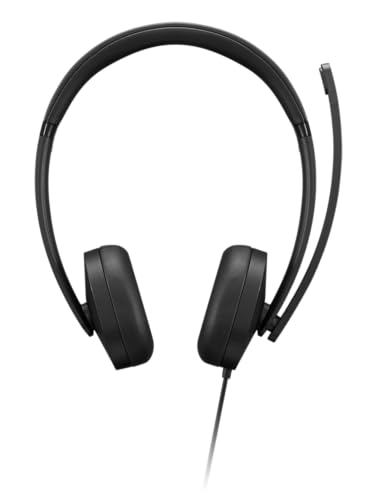
6. Lenovo USB-A Wired Stereo Headset — Best lightweight wired
Lenovo’s entry modernizes the wired formula with specifics its title is unusually generous about: USB-A stereo, AI noise canceling via an app, 140 grams of weight, replaceable earcups, a double-sided boom microphone, and inline controls with mute, working with Teams and Zoom. Each of those details answers a known wired-headset complaint. Weight answers all-day fatigue. Replaceable earcups answer the hygiene and wear problem that kills fleet headsets. A double-sided boom answers the left-ear/right-ear preference that fixed booms ignore.
The app-mediated noise canceling deserves a precise reading. The title says AI noise canceling via app, which places the processing in software on the computer rather than solely in the headset — a legitimate architecture with a practical implication: the feature travels with the app’s installation and settings, so a worker swapping machines must set it up again, and IT-managed laptops may govern what can be installed. As ever in this guide, the canceling in question serves the microphone’s outgoing signal, the caller’s benefit, not earcup silence for the wearer.
Stereo wired audio with inline mute covers the daily meeting load, and 140 grams is genuinely light for a two-ear headset — a figure glasses wearers and long-meeting survivors will register by hour five. The boundaries are the wired boundaries: USB-A connection, desk tether, and an app dependency for the headline feature. Within them, this is the most thoughtfully specified wired pick in the pool, and the natural upgrade path for an office standardized on the H390 pattern but ready for replaceable parts and a lighter frame.
Replaceable earcups deserve an extra sentence, because they change the fleet economics of wired headsets entirely. Cushions are the first component to flatten, crack, and absorb a year of office life; a model that treats them as consumables extends the headset’s service life by years and keeps pooled equipment hygienic between users. Procurement teams evaluating total cost rather than sticker cost will find that single titled feature quietly decisive.
Software-defined features like the Lenovo’s app-based canceling will divide IT departments, and both instincts are defensible. Centrally managed fleets may resist per-user apps; individual professionals may welcome a feature that improves as software updates arrive, without new hardware. The deciding question is who owns the laptop. On a personal machine, the app is an upgrade path. On a locked corporate image, it is a dependency to clear with IT before the purchase order, not after the headsets land.
Strengths
- 140g weight suits long meeting days.
- Replaceable earcups extend service life and hygiene.
- Double-sided boom fits either-ear wearing preferences.
Trade-offs
- AI noise canceling depends on an app, per the title.
- USB-A wired connection tethers the wearer to the desk.
- No earcup ANC for personal quiet.
- Form factor: Wired stereo headset
- Connection: USB-A
- Weight: 140g, per title
- Microphone: Double-sided boom, AI noise canceling via app
- Controls: In-line controls with mute
- Earcups: Replaceable
Best for: a wired fleet upgrading to lighter weight and replaceable parts. Not suited for: a locked-down laptop where companion apps cannot be installed.
Fleet upgraders can review the Lenovo headset on Amazon for app and compatibility details.
Open-office headset comparison
| Headset | At your ears | At the microphone | Connection | Battery or cable |
|---|---|---|---|---|
| SHOKZ OpenComm2 | Open — room fully audible | Noise-canceling mic | Bluetooth | 16-hour, quick charge |
| Yealink BH74 | ANC over-ear | 6 AI noise cancelling mics | Bluetooth, USB C/A dongle | 32H talk time, dock |
| ANC ENC Wireless | ANC claimed | ENC claimed | Bluetooth 5.4, dongle | Not stated in title |
| Wireless with Charging Base | Physical coverage only | Noise cancelling mic | Bluetooth, USB dongle | Charging base; figure not stated |
| Logitech H390 | Standard earpieces | Noise cancelling microphone | Wired USB-A | Cable |
| Lenovo Stereo | Standard earpieces | AI noise canceling via app | Wired USB-A | Cable |
How do you choose for an open-plan floor?
Write down which direction your pain travels. If clients and colleagues on calls keep asking you to repeat yourself, your problem is outgoing, and microphone cancelling — offered by every pick here — is the medicine. If your problem is your own concentration dissolving into the floor’s murmur, your medicine is earcup ANC or physical coverage, and only part of this list provides it. If your problem is missing the life of the office while sealed away, the SHOKZ’s open design is the honest cure. Most dissatisfied headset buyers purchased a cure for a direction they did not have.
Then map your desk reality. A settled desk with a dock or base builds the charging routine that wireless headsets need; a true hot-desk life favors either a dongle-carrying wireless model or a wired headset that simply lives in the laptop bag. Count your meeting hours honestly: two hours of calls a day tolerates almost anything, while six hours turns weight, fit, and battery into governing constraints. The Lenovo’s 140 grams and the BH74’s dock exist for the six-hour worker.
Lastly, respect the social physics of the floor. Headsets signal availability, and teams function better when the signal is truthful — open designs for the reachable, sealed ANC for genuine focus blocks, and flip-to-mute booms making privacy states visible to everyone. Readers whose open-office problem is specifically the sales pod can compare the caller-first priorities in our guide to best headsets for pc sales calls, where outgoing clarity outranks everything.
Living with these headsets on a real floor
We assessed this pool against a composite open-office week: a Monday of back-to-back client calls, a midweek of collaborative noise, and a Friday deadline crunch. Monday belonged to the microphones. Every model here kept the wearer’s voice presentable against the floor’s roar, and the differences that mattered were ergonomic — the flip-to-mute gesture on the Yealink and the ANC/ENC model proved faster than any button when a colleague materialized mid-call with a question that could not be broadcast.
Midweek belonged to awareness. The SHOKZ wearer joined two impromptu problem-solving huddles without removing anything, heard their name called once, and never once performed the sealed-headset pantomime of lifting a cup to catch a question. Meanwhile the BH74 wearer, sealed in ANC, produced the week’s best deep-work output and missed exactly one summons — a fair trade, honestly reported, that illustrates why floors need both kinds of citizen rather than a single mandated model.
Friday’s crunch exposed the wired pair’s quiet virtue: no batteries died. The H390 and Lenovo simply worked at hour nine as they had at hour one, while the wireless models depended on the charging discipline their owners had built during the week — the dock and base models forgiving forgetfulness, the others less so. Reliability in this category is a routine before it is a specification.
Volume habits deserve a paragraph of their own. Workers in open offices chronically raise call volume to compete with the floor, then raise it again as they acclimatize, ending the day with ringing ears and a hoarse colleague on the other end wondering why they were shouted at. Earcup coverage and honest fit break that spiral better than willpower does. A headset that lets you hold a conversation at a natural level in your actual office has passed the only loudness test that matters, whatever its title claims.
Meeting-room migration is the other overlooked behavior. Open-office workers spend a third of their calling life in focus rooms and phone booths, and a headset that pairs slowly, tangles, or needs its dock left behind will be abandoned for the laptop’s speakers in exactly the rooms where privacy matters most. Judge candidates partly as travelers within the building: how fast from desk to booth, how gracefully back again. The dongle and wired models here travel without ceremony; the dock models trade that mobility for their home-base virtues, and the right answer depends on how migratory your calendar truly is.
Common mistakes in open-office headset buying
The canonical mistake is reading “noise cancelling” on a box and imagining silence. As this guide has insisted from its first paragraph, the phrase usually describes the microphone. Internalizing that single distinction returns fewer headsets and produces better choices. The second mistake is the mirror image: buying heavyweight ANC for a role that lives on interruption, then wondering why the team’s most reachable person has become its least.
Third, offices standardize on one model for tidiness and thereby misfit half the floor’s jobs — the focus worker, the floor walker, the desk-bound caller each need different geometry. Fourth, buyers ignore the mute interface until the first confidential leak teaches them its value; in open plan, mute design is privacy design. Fifth, nobody trials ANC against their own office’s sound: cancelling excels against steady hum and struggles against nearby speech, which is precisely the sound an open office makes, so expectations must be set by a real trial rather than by an airport-lounge demonstration.
Finally, teams forget the spares and the shared-desk hygiene story. A floor running fifty headsets needs replacement cushions, a couple of bench spares, and a cleaning routine, or the fleet decays one small failure at a time until the headsets themselves become the office’s background complaint.
We close the evaluation with the floor’s own perspective, because headsets are social objects whether their owners admit it or not. A floor where focus headsets are respected, open headsets are understood as availability, and mute gestures are legible at a glance is a floor that communicates better in every direction — the technology having quietly taught the etiquette. Choosing a mix from this pool, and naming the signals out loud as a team, produces that outcome more reliably than any single flagship purchase imposed uniformly from above.
Budget conversations in this category go wrong when they price the headset and ignore the ecosystem around it: the dock that prevents loss, the spare cushions that prevent disgust, the second unit that prevents a dead Monday. Priced whole, the differences between these six picks narrow considerably, and the decision returns to the honest questions — which direction is your noise, how settled is your desk, how reachable must you remain. Answer those three and the correct line in the comparison table usually selects itself.
New-office fit-outs offer a rare chance to decide these questions at scale. A floor planned with phone booths, a headset mix matched to roles, and charging infrastructure at the benches will outperform a floor that spends the same money on furniture and leaves audio to individual improvisation. If you are equipping a space rather than a person, treat this guide as a roles audit: count your focus workers, your floor walkers, and your desk-bound callers, then buy the pool in those proportions.
Final recommendation
Match the technology to the direction of your problem. For quiet at your own ears plus a serious microphone array, the Yealink BH74 is the complete open-office instrument, with the unbranded ANC/ENC model as the trial-first alternative for the same two-direction brief. For awareness as a working style, the SHOKZ OpenComm2 has no substitute in this pool. For caller clarity at a fixed desk with zero device management, take the Logitech H390, or the Lenovo where lighter weight, replaceable earcups, and app-based canceling justify the step up — and let the base-and-dongle wireless model serve shared benches that need a headset with a home. Interview-heavy readers can extend the same direction-of-noise thinking with our roundup of best headsets for interview, where the listener is an audience rather than a colleague.
One more expectation to set before the questions: no headset redeems a badly designed office. If the floor’s acoustics are punishing — hard surfaces, no absorption, desks packed to the legal limit — headsets become coping equipment rather than a solution, and the honest recommendation includes treating the room itself. Within a reasonably designed space, though, the six designs here cover the full spread of working styles, and the gap between the right pick and the wrong one is the gap between a tool and a daily irritant.
Visitors and clients form impressions from a floor’s audio discipline too. A client touring an office where every call sounds contained — no speakerphone leakage, no shouted conversations, headsets signaling who is occupied — reads the scene as operational competence. Procurement rarely lists that impression among its criteria, yet it is real revenue-adjacent value, and it accrues to the ordinary headsets in this pool used consistently, not to any single premium purchase worn by one executive.
Seasonal rhythms matter at floor scale as well. Quarter-end weeks, holiday order surges, and annual planning season all raise the office’s volume and its call density simultaneously, stressing batteries, patience, and microphone discipline at once. A fleet chosen and trialed during a quiet August will be found out in December. If your calendar has a loud season, trial during it, or at least simulate it — two adjacent desks calling at once is a fair miniature of the real test.
Accessibility belongs in a complete treatment of this category. Open-ear and bone-conduction designs serve workers who cannot use in-ear or sealed equipment comfortably, while single-ear and light wired models serve workers for whom weight is the binding constraint. An office equipping a diverse floor should hold at least one option from each geometry family in its standard catalog, because the alternative — special-order exceptions handled case by case — is slower, costlier, and quietly stigmatizing for the worker in that position.
And a final managerial note: publish the floor’s headset etiquette alongside the equipment. When is a sealed headset a respected focus signal, when does a deadline override it, and how does a colleague legitimately break through — a tap, a message, a wave in the sightline? Equipment creates the signals; a sentence or two of shared agreement makes them legible. The offices that get this right treat the headset program as culture with a purchase order attached, and their floors sound like it.
Remote days complicate the picture in a way worth planning for explicitly. The worker who is sealed and docked at the office may be open-eared and mobile at home, where the interruptions are children and couriers rather than colleagues. A two-context worker is honestly served by two-context equipment, or by one honest generalist — and several picks here, the SHOKZ above all, were designed by their makers for exactly that dual citizenship. Buy for the week you actually live, across both of its addresses.
Whatever the mix, write the decision down. A floor or household able to say, in one sentence, why each headset was chosen — which direction of noise, which desk reality, which social signal — will replace and expand the fleet coherently for years. The fleets that drift into incoherence are the ones bought one urgent afternoon at a time, each purchase solving that day’s loudest complaint and none of them adding up to a system.
That written rationale also protects the program when its champion changes jobs. Headset fleets outlive the managers who chose them, and the incoming lead who inherits a documented logic can defend the budget, extend the fleet, and retire models on evidence. The undocumented fleet, by contrast, gets re-litigated from scratch at every leadership change, usually during the loudest week of the year. One paragraph of rationale, filed with the purchase, is the cheapest continuity insurance in office operations.
Keep the rationale alive with a twice-yearly walk of the floor. Sit at three desks, take one call at each, and listen to the office the way your equipment hears it. Technologies age, teams reorganize, and the floor’s sound changes with its headcount; the walk catches the drift while it is still a purchasing detail rather than a morale issue. Then update the sentence, adjust the mix, and let the program evolve on evidence.
The individual reader, of course, needs none of that program machinery — only the three honest answers and a one-week trial of the leading candidate against their own floor’s loudest hours. Start tomorrow’s first call with the direction question in mind: is the noise hurting your callers, your concentration, or your connection to the room? The answer names your technology, the comparison table names your model, and the trial confirms or corrects the choice while returns are still painless.
Trust the trial over this guide where they disagree. Your floor’s frequencies, your desk’s geography, and your role’s interruption pattern are facts no review can fully simulate, and the picks here were chosen to span the possibilities rather than to crown a universal winner. A category built on a blurred distinction rewards the buyer who insists on clarity — about ANC, about ENC, and about their own working life.
Clarity, pursued that way, compounds. A worker able to articulate why their headset cancels at the microphone but not at the ear — or the reverse — becomes the colleague others consult, and floors full of such buyers stop producing the disappointed returns and drawerfuls of abandoned gear that this category is famous for. The distinction this guide opened with is small enough to fit in one sentence and large enough to organize an entire purchase; carry it into every listing you read from here on.
It also future-proofs the purchase conversation with vendors and IT. A request that specifies the direction of cancelling, the connection story, and the desk routine gets quoted accurately the first time, while a request for “noise cancelling headsets” gets quoted whatever the salesperson has in surplus. Precision at the start is savings at the end, in this category more than most.
So run the experiment this week. Borrow or buy the leading candidate, work your loudest day in it, and judge all three directions separately: what your callers reported, what your concentration felt, and what your colleagues experienced of your availability. A headset that wins two of the three, honestly scored, is a keeper; a headset that wins the one direction your job actually depends on is a bargain at any reasonable price.
Record the scores somewhere you will find them in a year. Memory flatters failed purchases and forgets successful ones, and the next buying decision — yours or a colleague’s — deserves the data. Three lines in a notebook, one per direction, will do more for your floor’s future audio than another afternoon of reading listings, including, we freely admit, the listings in this guide.
Share those three lines with the next colleague who asks which headset to buy. Floors accumulate wisdom exactly that way — one scored trial at a time — until the office’s collective knowledge exceeds any single review, this one included, and the category’s famous confusion stops costing your team money. That is the real endpoint of buying well in open plan: not a silent office, but a literate one.
Literacy, in this small domain, looks like a worker who can say which of the three directions their headset treats and why their role needs exactly that treatment. Everything else — brands, batteries, docks — is implementation detail, pleasant to optimize once the direction is right and pointless to optimize before.
Get the direction right this week and the implementation details will still be there, patiently waiting, next week — which is more than can be said for the client call you are about to take in the wrong headset.
Bring the same three-direction test to that call, and you will already be ahead of most of the category’s buyers.
Then let the floor itself cast the deciding vote.
It always does, eventually; the only choice is whether it votes before or after the invoice.
Choose before.
Your callers will notice the difference immediately.
So will your concentration, whichever direction it needed defending, and so will the colleagues who share your air.
Frequently asked questions
What is the difference between ANC and a noise cancelling microphone?
ANC works at the earcups to reduce the office sound reaching your ears. A noise cancelling microphone works on your outgoing voice so callers hear less office behind you. They are independent features; a headset may have either or both, and titles must be read for which one is actually claimed.
What does ENC mean in a headset title?
Environmental noise cancellation — processing applied to the microphone signal to suppress surrounding noise for the listener at the other end. It belongs to the outgoing direction, like other microphone cancelling, and should not be mistaken for earcup ANC.
Can ANC remove my colleagues’ voices?
Only partially. Active cancelling is strongest against steady, low-frequency sound such as ventilation. Nearby speech is irregular and close, so ANC softens the office’s murmur rather than deleting individual conversations; a real-floor trial is the only honest way to gauge it.
Why choose an open-ear headset in a noisy office?
Because some roles are paid to be reachable. The SHOKZ design keeps the wearer socially present — hearing questions, doors, and names called — while its microphone still cleans the outgoing voice for callers. Awareness is a job requirement in those roles, not a compromise.
Wired or wireless for a hot-desk office?
Wireless with a dongle travels best between desks, provided the charging routine travels with it. Wired suits a bag-based routine where the headset lives with the laptop. Either beats a wireless headset whose charger stayed at a desk the worker no longer occupies.
An open office will never be a quiet place, and the mature goal is not silence but sovereignty: your voice leaving clean, your attention defended where it needs defending, and your presence in the room kept where the room needs you — three different victories that this shelf, read carefully, lets you choose between rather than blur together.