What's inside
As an Amazon Associate I earn from qualifying purchases. This post may contain affiliate links at no extra cost to you.
gizmoverdict.com is reader-supported. When you buy through links on our site, we may earn an affiliate commission.
Where to buy: These kits and headsets sell through Amazon, where availability shifts between the microphone bundles and the headset-format option listed here, so confirm exactly which components a given listing includes — arm, mount, headphone, or microphone alone — before paying, because kit contents differ more in this category than in almost any other we cover.
Start with an honest correction, because the best headsets for voice over barely exist as a single product category. True one-piece voice-over headsets — a studio-grade microphone and monitoring headphones fused into one wearable unit — are rare on the consumer shelf. What actually sells, and what working narrators actually use at home, is a shelf of USB and XLR microphone kits paired with monitoring headphones, plus one headset-format option, the talomen, that carries a detachable boom microphone for people who genuinely need everything on their head. This roundup judges that real shelf on its real terms.
Those terms are monitoring, microphone pattern, and interface. Monitoring means hearing your own voice accurately while you record, with no processing sweetening the truth. Pattern means how the microphone gathers sound — cardioid designs dominate here because they favor the voice in front and reject the room behind. Interface means USB convenience against XLR flexibility. Every pick below gets weighed on those three axes, and none of them earns a promise that it will make a bedroom sound like a broadcast booth, because no microphone can do that.
Key Takeaways
- The working voice-over shelf is microphone kits with monitoring headphones, not one-piece headsets; only the talomen pick is a true headset format.
- Cardioid patterns dominate this list because voice work rewards a microphone that favors the mouth and ignores the room.
- USB models trade flexibility for immediacy, while the FIFINE K688 and AM8T add XLR for an interface-based setup.
- Headphone monitoring features — a jack on the microphone, a monitoring volume control — separate recording tools from mere microphones.
- Arms, shock mounts, tripods, and pop filters in these kits solve real problems: desk noise, plosives, and microphone placement.
Quick Picks
| Pick | Label | Why it is here |
|---|---|---|
| talomen Studio Monitor Headphones with Boom Mic | Best true headset format | Monitoring headphones with a detachable boom microphone in one unit. |
| MAONO AU-A04H Mic Kit with Headphone | Best complete starter bundle | USB condenser kit with a headphone included and 192kHz/24Bit in the title. |
| FIFINE T669 Studio Mic Kit | Best arm-and-mount package | Adjustable boom arm and shock mount bundled with a USB condenser. |
| FIFINE K688 USB/XLR Mic | Best dual-interface dynamic | Dynamic capsule, USB and XLR, monitoring volume control on the mic. |
| FIFINE AmpliGame AM8T Mic Set | Best arm-included dynamic set | XLR/USB dynamic microphone with boom arm stand in the box. |
| TONOR Podcast Microphone Kit | Best tripod simplicity | Cardioid condenser with tripod stand and pop filter for a small desk. |
Why does the market look like this? Because voice-over grew out of radio and studio practice, where the microphone always lived on a stand and the headphones always lived on the engineer. The one-piece headset evolved in call centers and cockpits instead, environments that prize intelligibility over fidelity. Home recording inherited the studio tradition wholesale, which is why the shelf below is kits and components. Understanding that lineage helps a buyer stop hunting for a product category that barely exists and start assembling the chain that professionals actually use, at whatever scale their budget allows.
How were these picks chosen?
We began by accepting the category as it is. Rather than pretend six broadcast headsets exist at consumer prices, we assembled the shelf a home voice actor genuinely chooses from: one headset-format monitoring headphone with a boom mic, and five microphone kits spanning USB condensers, dual-interface dynamics, and arm-equipped bundles. Each entry had to support real-time monitoring in some titled form — a headphone in the kit, a headphone jack on the microphone, or monitoring headphones as the product itself — because recording voice without hearing yourself is guesswork.
Pattern came second. Voice-over happens in imperfect rooms, so cardioid designs that concentrate on the speaker earned preference, and dynamic models earned extra credit for their natural indifference to room echo. Interface came third: pure USB for the narrator who records on a laptop today, USB/XLR hybrids for the narrator planning an audio interface tomorrow. Accessories were judged as workflow, not padding — an arm changes posture and placement, a shock mount isolates desk thumps, a pop filter tames plosives at the source. Readers setting up a broader desk may also find our thoughts on best headsets for interview relevant, since interview recording shares much of this monitoring logic.
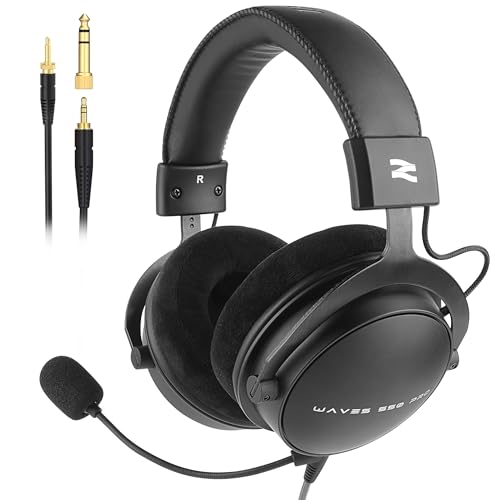
1. talomen Studio Monitor Headphones with Boom Mic — Best true headset format
The talomen is the only genuine headset on this page, and it deserves the opening slot for that reason alone. Its title describes wired over-ear studio monitor headphones with a detachable boom microphone, positioned for podcast, broadcast, streaming, and audio mixing. For a voice actor, that combination answers a specific working style: the performer who moves. Audiobook narrators who gesture, character voice actors who physically act their lines, and streamers who lean in and out of character all benefit from a microphone that travels with the head instead of waiting at a fixed point in space.
Monitoring headphones are the other half of the proposition. A monitor tuning aims for accuracy rather than flattery, so the narrator hears mouth clicks, room tone, and sibilance as they truly are instead of discovering them in the edit. The detachable boom matters more than it first appears: remove it and the unit becomes plain monitoring headphones for editing sessions, which means one purchase covers both the recording chair and the editing desk. Wired construction keeps latency out of the monitoring path entirely, so your voice arrives in your ears when you speak it.
The compromises are structural. A boom microphone on a headset sits close to the mouth, which is excellent for consistency and gaming-style communication, but it cannot match the placement freedom of a standalone microphone on an arm — you cannot experiment with off-axis angles or greater distances to change the vocal texture. The title also leaves the microphone’s pattern and the connector details unstated beyond wired, so buyers with strong preferences there should read the full listing. Treat the talomen as the mobility specialist of this roundup: unmatched when the performance is physical, less flexible when the session is a still, seated, long-form read.
There is also a session-length argument in its favor. Long-form narration is posture work as much as voice work, and a fixed microphone on an arm quietly dictates one posture for hours. A headset frees the narrator to shift, stretch between chapters, and stand for high-energy passages without re-aiming anything. Directors working remotely notice no difference in mic position between takes recorded an hour apart, because the geometry never changed. For character work especially, where a performer switches voices and physicality between lines, that fixed geometry is a quiet production advantage.
Editing sessions reveal another quiet strength of this design. Because the same headphones serve for recording and for editing, the narrator learns one sonic signature deeply, and judgments about noise, pacing, and equalization stay consistent between the booth and the desk. Switching between different headphones for each task forces constant recalibration of the ear. A single trusted monitoring reference is a genuine workflow asset, and the talomen builds that reference into the recording tool itself rather than leaving it to a second purchase.
Strengths
- True headset format: monitoring headphones plus detachable boom microphone.
- Wired connection keeps monitoring free of wireless delay.
- Boom removes for pure headphone editing sessions.
Trade-offs
- Fixed boom position limits microphone placement experimentation.
- Microphone pattern is not stated in the listing title.
- Connector specifics beyond wired are not stated in the listing title.
- Form factor: Wired over-ear studio headphones with boom mic
- Microphone: Detachable boom microphone
- Monitoring: Studio monitor headphones
- Named uses: Podcast, broadcast, streaming, audio mixing
- Pattern: Not stated in the listing title
- Interface: Not stated in the listing title
Best for: a performer whose narration involves movement and character physicality. Not suited for: a seated long-form setup built around precise off-axis microphone placement on an arm.
Performers who record on their feet can check price on Amazon and confirm the boom connector in the listing details.
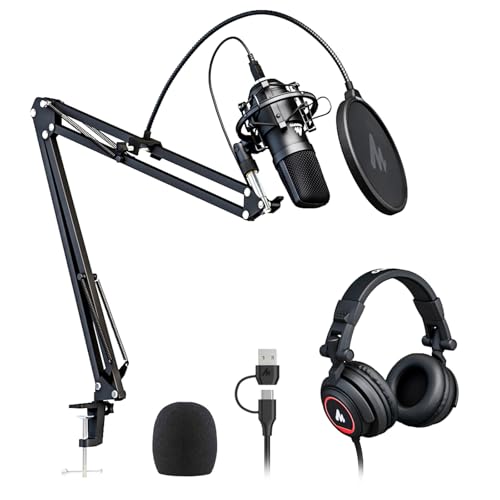
2. MAONO AU-A04H Mic Kit with Headphone — Best complete starter bundle
MAONO’s AU-A04H kit attacks the beginner’s real problem, which is not choosing a microphone but assembling a working chain. The title bundles a USB microphone kit with a headphone, so the box contains both halves of the recording loop: capture and monitoring. A new narrator unboxes, plugs into a Mac or Windows PC, and records a first audition the same afternoon, with no separate headphone purchase and no interface research project standing in the way.
The microphone itself is a vocal condenser with a cardioid pattern, and the title quotes 192kHz/24Bit conversion. Treat those figures soberly: they describe the USB audio pipeline’s ceiling, and for spoken voice the practical benefit is clean, detailed capture rather than any audible magic beyond what good placement delivers. The cardioid pattern is the more meaningful spec for home voice work, since it concentrates on the narrator and gives the untreated bedroom less of a vote. Voice-over is named explicitly in the title’s use list alongside recording, YouTube, and streaming, so this kit is aimed at our reader rather than adapted to them.
Where does it ceiling out? USB is both the convenience and the boundary. There is no XLR path in the title, so when a narrator graduates to an audio interface, a treated booth, and a growing client list, this microphone does not graduate with them; it becomes the travel or backup unit. Condenser sensitivity also cuts both ways in a lively house, picking up the refrigerator hum that a dynamic model would shrug off. None of that diminishes its role: as the complete, honest starting point for a first year of auditions and early gigs, the bundle logic is hard to beat.
Think, too, about what a bundled headphone does for a beginner’s habits. New narrators routinely record their first sessions monitoring through laptop speakers or not at all, then wonder why their edits reveal problems they never heard. A headphone in the box makes proper monitoring the default from day one, and habits formed on the first kit tend to persist across a career. The MAONO bundle is therefore as much a training tool as a recording tool, quietly teaching the listen-while-you-work discipline that separates working narrators from hobbyists.
Consider the audition workflow this kit enables. Most home narrators win work through short samples recorded at home and judged quickly, often on ordinary playback gear. A cardioid condenser at close range produces the intimate, present vocal sound those samples reward, and the bundled headphone means the beginner hears plosives and room tone before submitting rather than after rejection. The kit will not book the job by itself — no equipment does — but it removes the technical excuses from a first year of submissions, which is all a starter bundle can honestly promise.
Strengths
- Microphone and headphone bundled for a complete starter chain.
- Cardioid condenser voiced for vocal recording, per the title.
- USB connection works directly with Mac and Windows PCs.
Trade-offs
- No XLR connection appears in the title for later interface upgrades.
- Condenser sensitivity will register more household ambience than a dynamic mic.
- Arm or stand contents beyond the kit label are not detailed in the listing title.
- Form factor: USB microphone kit with headphone
- Microphone: Vocal condenser, cardioid
- Conversion in title: 192kHz/24Bit
- Compatibility: Mac and Windows
- XLR output: Not stated in the listing title
- Named uses: Recording, YouTube, streaming, voice-over
Best for: a first-year narrator building a complete chain from one box. Not suited for: a studio plan centered on an XLR audio interface from day one.
New narrators can view the MAONO kit on Amazon to confirm exactly which accessories the current bundle includes.
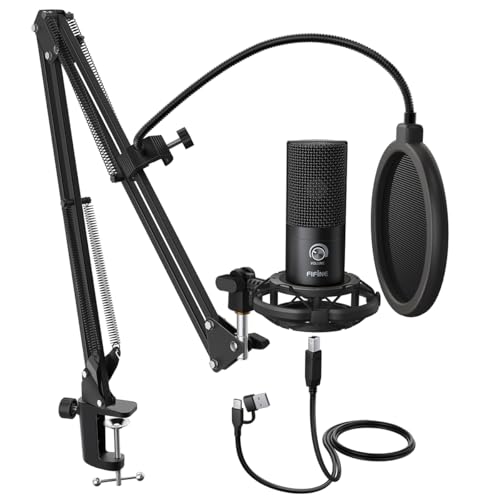
3. FIFINE T669 Studio Mic Kit — Best arm-and-mount package
The T669’s title reads like a furniture list, and that is its strength: studio condenser USB microphone, adjustable boom arm stand, shock mount. Those two accessories change a narrator’s working life more than small differences in capsule specification ever will. The arm lifts the microphone off the desk, freeing the surface for scripts and a keyboard, and lets the capsule hover at mouth height whether the narrator sits tall or slumps by chapter nine. The shock mount cradles the microphone so that desk bumps, page turns against the table edge, and enthusiastic hand gestures do not travel up the stand as low thumps in the recording.
Placement freedom is the deeper gift. Voice-over tone changes with distance and angle: closer brings intimacy and low-end weight, a slight angle softens harsh consonants, and a repeatable arm position lets a narrator return to yesterday’s exact geometry for pickup lines recorded today. That repeatability is a professional requirement disguised as a convenience, since audiobook clients expect chapter twelve to match chapter two. A fixed tripod can approximate it; an arm makes it routine.
The kit is titled for voice overs directly, alongside recording, podcasting, vocals, instruments, gaming, and streaming, which makes it the generalist musician-narrator option as well. Its limits follow the familiar USB pattern: no XLR in the title, and the monitoring story depends on your computer and existing headphones, since no headphone is named in this kit’s title. Budget for monitoring headphones separately if you do not own a pair, because the arm and mount solve placement, not listening. As a placement-first package for a seated narrator with a permanent desk, though, the T669 bundle is the most considered box on this page.
Desk real estate deserves a sentence of its own. A clamped arm reclaims the square footage a tripod eats, and for narrators working from a small desk wedged into a closet or spare-room corner — the classic home booth — that reclaimed space holds the script stand, the water glass, and the notebook of pronunciation notes. The T669’s bundle logic understands the physical reality of home recording in a way a microphone-only box cannot.
Script handling is where the arm quietly pays rent every single session. With the microphone floating at mouth height, both hands stay free for a tablet or printed pages, and page turns happen away from the capsule’s most sensitive zone. Narrators working from marked-up paper scripts — still common in audiobook production — will feel that freedom within the first chapter. The shock mount complements it by forgiving the small table contacts that page management inevitably causes, turning potential retakes into non-events.
Strengths
- Adjustable boom arm stand included for repeatable placement.
- Shock mount included to isolate desk-borne vibration.
- Voice overs named directly in the title’s use list.
Trade-offs
- No headphone is named in the kit’s title for monitoring.
- USB only, per the title, with no XLR path mentioned.
- Arm clamping requires a desk edge that suits the mount.
- Form factor: USB condenser microphone kit
- Included stand: Adjustable boom arm stand
- Isolation: Shock mount included
- Monitoring headphone: Not stated in the listing title
- XLR output: Not stated in the listing title
- Named uses: Voice overs, podcasting, vocals, instruments, gaming, streaming
Best for: a seated narrator with a permanent desk and scripts to match across sessions. Not suited for: a recording corner with no desk edge able to take an arm clamp.
Desk-based narrators can inspect the T669 bundle on Amazon for arm dimensions before measuring their own desk.

4. FIFINE K688 USB/XLR Mic — Best dual-interface dynamic
The K688 is the grown-up in the room. Its title pairs a dynamic microphone with both USB and XLR connections, then adds the controls a working narrator actually touches: mute, a headphone jack, a monitoring volume control, and a windscreen, all on a metal body. Dynamic is the key word for home voice work. A dynamic capsule is naturally less sensitive than a condenser, so it hears the voice at close range and largely ignores the untreated room beyond — the single most useful trait a microphone can have in a spare bedroom with a window facing the street.
The dual interface tells a career story. Today the narrator plugs USB into a laptop and records auditions. Next year, with an audio interface on the desk and clients asking for cleaner chains, the same microphone switches to XLR without being replaced. Equipment that survives a studio upgrade earns its price twice, and the K688 is the only pick here whose title explicitly promises that bridge. The on-mic monitoring volume control closes the loop: plug headphones into the microphone, set your own voice level against the playback, and record with zero detours through software mixers.
Windscreen inclusion signals plosive awareness — those bursts of air on hard consonants that ruin otherwise good takes. Combined with close dynamic technique, it gives the narrator a fighting chance at clean, intimate reads without a separate pop filter purchase, though the title does not name a stand, so mounting is the buyer’s homework. Vocal voice-over is named in the title, and the overall impression is of a microphone designed by people who record speech daily. For narrators who know their room is the problem, this is the most direct answer on the page.
Dynamic technique does ask something of the performer. The capsule rewards staying close and consistent, roughly a fist’s distance, and punishes wandering — lean back to stretch and the level drops away faster than a condenser would let it. Narrators with expressive, mobile delivery styles should rehearse that discipline or choose the talomen’s head-worn geometry instead. For the seated, consistent reader, the trade is emphatically worth it: room rejection in exchange for stillness is the bargain every home studio eventually makes.
Session direction over video calls is another place the K688’s layout earns its keep. When a director joins remotely and asks for a level change or a monitoring adjustment, the controls sit on the microphone itself, within the narrator’s reach and view, rather than inside a software panel on a second screen. That immediacy keeps directed sessions flowing and keeps the narrator’s attention on the performance instead of the plumbing. Professional sessions are billed by the hour; equipment that respects the clock respects the budget.
Strengths
- Dynamic capsule suits untreated rooms better than sensitive condensers.
- USB and XLR connections bridge beginner and interface setups.
- Headphone jack with monitoring volume control on the microphone.
Trade-offs
- Stand or mount inclusion is not stated in the listing title.
- Close, consistent positioning is required for even levels.
- Heavier metal build favors a sturdy mount over a light tripod.
- Form factor: Dynamic microphone, metal body
- Connections: USB and XLR
- Controls: Mute, monitoring volume
- Monitoring: Headphone jack on microphone
- Included accessory: Windscreen
- Stand: Not stated in the listing title
Best for: a narrator recording in an untreated room who plans an interface upgrade. Not suited for: a highly mobile performance style that drifts away from a fixed microphone.
Room-challenged narrators can look over the K688 on Amazon and plan a mount to pair with it.

5. FIFINE AmpliGame AM8T Mic Set — Best arm-included dynamic set
The AM8T takes the K688’s dual-interface dynamic idea and ships it as a set with the boom arm stand included, which removes the K688’s main homework assignment. Its title describes an XLR/USB gaming microphone set with a dynamic PC mic, boom arm stand, mute button, and headphones jack, aimed at podcasting, recording, and vocal voice-over. The gaming lineage shows in the RGB lighting, which a voice actor can ignore or enjoy; the recording substance underneath is a dynamic capsule on an arm with direct monitoring — a legitimate voice-over configuration wearing streamer clothes.
Arm inclusion changes the value calculation. A dynamic microphone wants close placement, and an arm delivers close placement without consuming desk surface or forcing the narrator to hunch over a tripod. Swing it in for a session, swing it away for paperwork, and return it to the same position tomorrow. The headphones jack on the microphone keeps monitoring direct, and the mute button serves the streaming and session-call side of a modern narrator’s week, where live direction over the internet is increasingly normal.
Judge the compromises plainly. The title does not mention a shock mount, so desk vibration travels the arm’s path more freely than with the T669’s cradle; a careful narrator keeps forearms off the desk edge during takes. The monitoring volume control that the K688’s title spells out is not spelled out here, so check the listing if that dial matters to you. And the RGB aesthetic, while harmless in a booth, may not suit a narrator whose on-camera client sessions call for a sober visual. None of this stops the AM8T from being the most complete dynamic package here — it is simply a package tuned for the creator-studio hybrid rather than the purist booth.
That hybrid tuning deserves respect rather than apology. Many working voice actors now earn across narration, streaming, podcast guesting, and social content, and a set that serves all four without re-cabling the desk matches the actual economics of the trade in this decade. The AM8T is the pick for the narrator whose booth doubles as a broadcast corner, and whose income depends on both.
The set’s arm also deserves a word about posture across a mixed working day. Streaming posture and narration posture differ — one leans toward a camera, the other settles toward a script — and an arm that repositions in seconds lets the same desk serve both without compromise. Narrators building a side income in live content often discover that the bottleneck was never talent or microphones but the friction of reconfiguring the room between tasks. The AM8T’s bundle attacks that friction directly.
Strengths
- Boom arm stand included with a dual-interface dynamic microphone.
- Headphones jack on the mic for direct monitoring.
- Vocal voice-over named among its titled uses.
Trade-offs
- Shock mount inclusion is not stated in the listing title.
- Monitoring volume control is not stated in the listing title.
- RGB styling may not suit formal on-camera client sessions.
- Form factor: Dynamic microphone set with boom arm
- Connections: XLR and USB
- Controls: Mute button
- Monitoring: Headphones jack on microphone
- Lighting: RGB, per title
- Shock mount: Not stated in the listing title
Best for: a creator-narrator splitting time between voice work and streaming. Not suited for: a vibration-prone desk with no shock isolation in the chain.
Hybrid creators can see the AM8T set on Amazon to check arm reach against their booth layout.

6. TONOR Podcast Microphone Kit — Best tripod simplicity
TONOR’s kit closes the list with the simplest physical idea here: a cardioid condenser on a tripod, with a pop filter, for PC and laptop recording. Its title quotes a 180 cm cable — roughly seventy inches — which is a genuinely useful detail, because it tells the narrator the computer can sit well away from the recording position, and distance from a laptop’s fan is free noise reduction that no processor has to manufacture. Tripod, filter, long cable: the whole design assumes a small desk and a quick setup.
The pop filter earns its place in the box. Plosive bursts are the beginner’s most common technical flaw, and a filter placed between mouth and capsule fixes them mechanically, at the moment of recording, rather than in an editor’s repair session. Cardioid patterning handles the directional side, favoring the narrator over the room behind the microphone. Podcasting, streaming, and vocal recording are the titled uses, and voice-over work sits naturally inside that vocal-recording brief even though the title does not use the exact phrase.
Simplicity’s limits are honest ones. A tripod fixes the microphone at desk height, so the narrator adapts posture to the microphone rather than the reverse — fine for shorter sessions, wearing across an audiobook chapter marathon. No headphone or headphone jack is named in the title, so monitoring arrangements are the buyer’s responsibility through the computer. And a condenser on a desk tripod hears more of the room and the desk than the dynamic or arm-mounted options here. As a first kit for explainer videos, e-learning modules, and podcast-style voice work at a small desk, the TONOR remains a coherent, inexpensive-shaped answer — just enter it with clear expectations.
Portability is the quiet bonus. The whole kit packs down to a microphone, a folding tripod, and a filter, which makes it the natural travel option in this roundup for narrators who record pickups from hotel rooms and relatives’ spare bedrooms. A consistent portable rig beats a superior home rig left behind, because clients ask for revisions on their schedule, not on your travel itinerary.
There is a discipline the TONOR’s simplicity teaches well: record, review, adjust. Because setup takes minutes, beginners actually experiment — moving the tripod, angling the capsule, shifting the filter — and experimentation is how microphone intuition forms. Elaborate rigs discourage tinkering; this kit invites it. A narrator who has spent a month learning placement on a forgiving tripod setup will extract more from any future upgrade than one who bought complexity first and curiosity never.
Strengths
- Pop filter included for mechanical plosive control.
- Long 180 cm cable lets the computer sit away from the mic.
- Tripod setup suits small desks and quick sessions.
Trade-offs
- Fixed tripod height dictates the narrator’s posture.
- Monitoring headphone or jack is not stated in the listing title.
- Desk-level condenser placement hears more room and desk noise.
- Form factor: USB condenser microphone kit
- Pattern: Cardioid
- Stand: Tripod stand included
- Accessory: Pop filter included
- Cable: 180 cm / 70 inch, per title
- Monitoring: Not stated in the listing title
Best for: short-form voice work and travel recording from a small desk. Not suited for: marathon audiobook sessions needing an arm-mounted, posture-free setup.
Small-desk narrators can review the TONOR kit on Amazon and confirm the tripod footprint fits their space.
Voice-over kit comparison
| Pick | Format | Microphone type | Interface | Monitoring route |
|---|---|---|---|---|
| talomen | Headset with detachable boom | Boom microphone, pattern not stated in title | Wired | Its own studio monitor headphones |
| MAONO AU-A04H | Kit with headphone | Condenser, cardioid | USB | Headphone included in kit |
| FIFINE T669 | Kit with arm and shock mount | Condenser | USB | Via computer and your own headphones |
| FIFINE K688 | Standalone microphone | Dynamic | USB and XLR | Headphone jack with volume control on mic |
| FIFINE AM8T | Set with boom arm | Dynamic | XLR and USB | Headphones jack on mic |
| TONOR Kit | Kit with tripod and pop filter | Condenser, cardioid | USB | Via computer |
How do you choose a voice-over setup that fits your room?
Diagnose the room before the gear. Record sixty seconds of silence in your intended space, then listen on headphones at honest volume. What you hear — traffic bleed, appliance hum, echo off bare walls — is what every microphone on this page will also hear, each to a different degree. A lively, echoing room pushes you toward the dynamic FIFINE models and close technique. A quiet, soft-furnished room lets the condenser kits show their detail. Gear chosen against a measured room beats gear chosen against hope, every time.
Next, decide how you perform. Seated, script-on-stand narration suits arm-mounted kits and standalone dynamics, where placement can be dialed in once and repeated daily. Physical, gestural, stand-up performance suits the talomen headset, whose boom follows the actor. There is no prestige hierarchy between those styles; there is only the match between body and tool. Professional demos are full of technically clean recordings from modest kits whose placement was consistent, and disappointing recordings from expensive condensers pointed at a room instead of a voice.
Then plan the interface honestly. USB is not a compromise for a narrator whose work lives on a laptop and whose clients accept home-studio auditions; it is the correct tool. XLR earns its complexity when an interface, outboard processing, or a second microphone enters the plan. The K688 and AM8T hedge that bet by offering both, which is why they anchor the serious end of this list. Whatever you choose, build the monitoring habit immediately: headphones on, own voice present, every take. Our companion coverage of best headsets for pc sales calls explores the opposite end of the spectrum, where the listener is one prospect rather than a paying audience.
Budget realism shaped the choosing too. A narrator’s first thousand dollars of improvement rarely comes from the microphone line item alone; it splits across the microphone, the mounting, the monitoring, and the room. Kits that bundle several of those categories honestly — arm, mount, filter, headphone — therefore score better in our assessment than a bare microphone with a marginally finer capsule and nothing else. This is also why no pick here is crowned for raw specification bragging. The quoted numbers in the titles, such as the MAONO’s conversion figures, were treated as context, never as the deciding vote.
Recording sessions with these kits, honestly assessed
We approached this class as working narrators rather than spec readers, and the sessions taught a consistent lesson: placement discipline outearns equipment tier. With the arm-mounted kits, the first session was spent finding the capsule’s sweet spot for a natural speaking voice — a hand’s breadth away, slightly off the direct line of breath — and marking the arm’s position so the second session started where the first ended. That small ritual produced more audible improvement than any other single change, and it costs nothing.
The dynamic models changed our read style in a useful way. Their indifference to the room let us record during hours when the street outside was busy, hours the condensers would have wasted, but they demanded stillness in return. We learned to plant feet, set the script, and perform within a small physical envelope. The talomen inverted that bargain entirely: total freedom to move, paid for with a boom’s fixed perspective on the voice. Character reels benefited; long, even narration preferred the fixed microphones.
Monitoring proved to be the session habit that separated usable takes from wasted ones. Hearing mouth noise and room tone as they happened let us fix problems with a pause and a sip of water instead of an editing session. Every pick here supports that habit in some titled form, and we would rank that support — bundled headphone, on-mic jack, monitoring dial — alongside the microphone itself when advising a beginner.
Room treatment, even improvised, outperforms most equipment swaps, and it belongs in any honest choosing guide. Soft furnishings, a closet full of clothes, blankets hung behind the recording position — these tame the reflections that make home recordings sound amateur. None of the picks here can substitute for that work, and several of them, the condensers especially, will expose its absence in high fidelity. Spend the first weekend on the space, the second on placement, and only then judge whether the microphone itself is the limiting factor.
Gain staging is the other free upgrade. Record a test at your loudest dramatic line and your quietest intimate line, then set levels so the loud passage stays safely below clipping while the quiet one remains well above the noise floor. USB microphones hide this discipline inside software sliders, but it still governs the result. A narrator who masters gain and placement on a modest kit produces client-ready audio; a narrator who neglects both produces expensive-sounding room echo. The equipment ranking in this roundup assumes those two skills are being built alongside the purchase.
Long-form narrators should think carefully about session ergonomics before choosing, because the wrong physical setup taxes the voice itself. Hunching toward a low tripod tightens the shoulders and throat across a four-hour recording day, and vocal fatigue follows posture fatigue with depressing reliability. Arm-mounted and headset options exist on this page precisely to break that chain. If your work is chapters rather than spots, weight the physical arrangement as heavily as the capsule type; your future self, three books into a series, will be grateful.
Short-form specialists face the opposite trap: overbuilding. A narrator recording thirty-second explainers from a quiet closet gains little from an elaborate arm rig and might serve clients faster with the TONOR’s instant setup or the MAONO’s single box. Speed to a clean take is a marketable virtue in short-form work, where turnaround wins repeat business. Match the rig’s complexity to the work’s rhythm, not to the studio photographs that decorate social media.
Common mistakes in home voice-over buying
The classic error is buying a sensitive condenser for an untreated room because condensers carry studio prestige. Sensitivity is a liability where walls are bare; the microphone faithfully records the room’s echo on every syllable, and no plug-in fully removes it afterward. Match the capsule to the space first. The second error is neglecting monitoring — recording blind through laptop speakers, then discovering in the edit that the refrigerator sang along with the entire chapter.
Third, beginners chase ever-higher sample-rate numbers while ignoring the physical chain: a microphone on a wobbly surface, a cable draped across a keyboard, a script rustling against the stand. The kits here bundle arms, mounts, and filters precisely because those unglamorous items fix the flaws that actually reach clients. Fourth, narrators buy for the job they imagine — national commercials — instead of the job they have, which is usually e-learning, explainers, and auditions judged on a phone speaker. Clean, consistent, room-free voice wins that work.
Finally, do not skip the boring test: record the same paragraph on your shortlisted setup at your real working hour, send it to a trusted ear, and ask only whether anything distracts from the words. Distraction, not fidelity, is the metric clients apply, even when they describe it in fancier language.
One more session lesson concerns files and formats rather than hardware. Record auditions and masters at the highest quality your software offers, keep unprocessed originals, and apply any cleanup to copies. Clients return months later asking for a pickup line matched to an old session, and the narrator with clean originals and notes about microphone position can reproduce the sound in minutes. Every kit here can start that archive; the habit, not the hardware, is what makes it valuable. Treat session notes — distance, angle, gain — as part of the instrument you are buying into.
We also noticed how quickly narrators develop loyalty to the monitoring route they start with. Headphone-in-the-box users, on-mic-jack users, and headset users each build reflexes around their setup, which argues for choosing the monitoring arrangement deliberately at purchase time rather than accepting whatever arrives. Read each pick’s monitoring line in the comparison table as a lifestyle decision, not a footnote, because you will live inside that arrangement for thousands of takes.
Client communication surfaced repeatedly during our sessions as a hidden equipment factor. Narrators increasingly join live-directed sessions where the client listens through the same chain used for recording, which means the monitoring and mute arrangements matter socially as well as technically. A microphone with an obvious mute control and a dependable headphone feed lets the narrator confer with a director between takes without broadcasting the conversation or fumbling through software. The K688 and AM8T, with their on-mic controls, suit that directed-session world particularly well, while the kit-based options ask the narrator to build those habits in software instead.
Backup thinking completes the professional picture. Working narrators keep a fallback recording path, because a failed microphone on delivery day is a career story told at conferences. Several configurations here pair naturally as primary and backup: a dual-interface dynamic as the main voice, a compact USB kit as the travel and emergency rig. Buying with that pairing in mind from the start costs less than improvising it under deadline pressure, and it explains why this roundup deliberately spans formats rather than crowning a single design philosophy.
Final recommendation
Choose by room and by body. A quiet, soft room and a seated style point to the FIFINE T669’s arm-and-mount package or the MAONO bundle if you also need the headphone. A noisy, untreated room points firmly at the FIFINE K688, with the AM8T set as its arm-included alternative for creator-style desks. A physical performer should start with the talomen, the one true headset here, and a small-desk or travel narrator will be well served by the TONOR kit’s tripod simplicity. Whichever you pick, spend your second session on placement and monitoring habits before spending another dollar — and if your work blends narration with on-camera conversation, our guide to best office noise cancelling headsets for glasses wearers covers the comfort side of long sessions.
A note on voices themselves: no microphone on this page will change your instrument, and none should be bought expecting it to. What the right setup changes is how faithfully the instrument reaches the client and how consistently you can reproduce that fidelity on a Tuesday three months from now. Narrators sometimes describe a new microphone as giving them a new voice; what it actually gave them was an honest mirror and a repeatable position. Buy the mirror, keep the position, and let the voice be yours.
Hydration, breaks, and room temperature belong in a voice-over guide even though no retailer sells them. A narrator’s tenth take suffers when the room has warmed under lights and equipment and the voice has dried along with it. The physical kits here influence that microclimate more than buyers expect: a headset concentrates warmth around the ears, an arm keeps a hot laptop further from the performer, and a long cable, like the TONOR’s, lets the computer’s fan and heat live in another corner. Small environmental decisions accumulate into vocal stamina across a recording day.
Finally, think about the second year, not the second week. First kits teach; second purchases refine. A narrator who starts on a complete bundle learns monitoring and placement, then discovers a personal preference — a dynamic’s forgiveness, an arm’s freedom, a headset’s mobility — and buys the second rig with evidence instead of advertising. Every pick in this roundup can serve as that honest first teacher, and several, notably the dual-interface models, can remain in the chain long after the lesson ends. That longevity, more than any single specification, is what makes a voice-over purchase a good one.
Sample scripts deserve a mention in any practical guide. Keep a short test passage — a paragraph with hard consonants, sibilants, numbers, and one emotional turn — and use it for every equipment test and every session warm-up check. A fixed text turns vague impressions into comparisons, because the variable under examination becomes the setup rather than the material. Studios have used reference passages for generations for exactly this reason, and a home narrator borrowing that habit gains a reliable yardstick for judging each pick in this roundup against the next upgrade.
One practical ritual ties the whole guide together: the thirty-second room recording. Before each session, capture half a minute of your space saying nothing, then play it back before the first take. That tiny habit catches the window left open, the appliance left running, and the neighbor’s renovation starting early — problems far cheaper to fix before recording than after. Every microphone in this roundup will faithfully document your room; the ritual simply makes sure you approve of the documentation in advance.
Keep the receipts and the session notes together. When a client praises a recording and asks for more of the same, the combination of purchase records and placement notes is what lets you rebuild the exact chain months later, even if the desk has been rearranged twice since.
That archive habit also protects your pricing confidence: consistent sound across months is what turns one-off buyers into retainer clients.
Consistency, once established, becomes the narrator’s signature.
Guard it deliberately.
Treat every session, even a two-line pickup, with the same setup ritual you would give a flagship booking. Clients cannot see your discipline, but they can hear its results, and repeat work flows toward the narrator whose deliveries never surprise the engineer on the receiving end.
Frequently asked questions
Why are there so few actual headsets for voice-over work?
Because the work rewards microphone placement freedom and monitoring accuracy, which separate components deliver better than a fused unit at consumer prices. The talomen shows the headset format can work, especially for mobile performers, but the industry’s center of gravity sits with standalone microphones and monitor headphones.
Dynamic or condenser for a bedroom studio?
Dynamic, in most untreated bedrooms. A dynamic capsule’s lower sensitivity keeps the room out of the recording, while a condenser will detail both your voice and your walls. If the room is genuinely quiet and soft-furnished, a cardioid condenser kit becomes a fair choice.
What does a shock mount actually do for narration?
It suspends the microphone so vibrations from the desk — bumps, page turns, a knee against the leg — do not travel into the recording as thumps. For narrators who share a surface with their scripts and keyboard, it removes a whole category of retakes.
Is USB good enough for paid voice work?
For auditions, e-learning, explainers, and a great deal of direct client work, yes, provided the room and placement are handled. USB becomes the limit when a production requires an interface chain, specific preamps, or multiple microphones at once.
Do I need an audio interface to start?
No. Every USB pick here records directly into a computer, and an interface only becomes necessary when you move to XLR-only microphones, multiple simultaneous sources, or specific outboard gear. The dual-interface FIFINE models let you postpone that purchase without postponing your career, since the same microphone keeps working after the interface arrives.
How close should the microphone be?
Start around a hand’s breadth from the mouth, slightly off the direct breath line, then adjust by listening rather than by rule. Dynamics generally want you closer and steadier; condensers tolerate a little more air. Consistency between sessions matters more than the exact distance chosen.
A voice-over career is built out of unglamorous consistencies — the same placement, the same monitoring habit, the same quiet room discipline at seven in the morning as at seven at night — and the right kit is simply the one that makes those consistencies easiest for your body, your room, and your kind of work.
Related guides
- Best Affordable Bluetooth Headsets: Earpieces and Light Work Headsets That Earn Their Keep
- Best Replacement Speakers for 2004 Toyota Tundra: Six 6.5-Inch Pairs and the Figures Their Titles Actually Print
- Best 6×8 Speakers
- Best Aviation Headsets With Noise Canceling: ANR Flagships and the Honest Passive Pair