What's inside
- Key Takeaways
- Quick Picks: The Best Cell Phone Headsets for Sales Reps on the Road
- How Were These Six Judged for a Rep’s Working Day?
- Why Did Truckers Design the Sales Rep’s Headset?
- The Six Headsets, Weighed for the Calling Day
- What Does a Rep’s Mute Button Actually Protect?
- How Do the Six Compare on the Rep’s Big Three?
- What Mistakes Do Sales Teams Make When Buying Headsets?
- Field Notes: A Fortnight of Calls on One Ear
- How Should a Sales Manager Equip a Whole Team?
- How Do You Test a Headset Before the Return Window Closes?
- Final Recommendation
- Frequently Asked Questions
- Related Guides
As an Amazon Associate I earn from qualifying purchases. This post may contain affiliate links at no extra cost to you.
gizmoverdict.com is reader-supported. When you buy through links on our site, we may earn an affiliate commission.
Where to buy: all six headsets below are sold on Amazon, and every product name in this guide links to its listing, where the current version, colour and included case or charger can be verified before an order is placed for one rep or an entire sales floor.
The search for the best cell phone headsets for sales reps leads, perhaps unexpectedly, to the truck stop. The all-day calling class of Bluetooth headset — one ear, a boom microphone, a battery measured in days of talk time, a mute button that can be found by touch — was perfected by and for truck drivers, and sales representatives have quietly adopted the same shelf because their working day rhymes: hours of calls, a noisy environment that changes by the hour, a phone that must stay connected to a second device, and no patience for a headset that dies before the pipeline does. This guide judges the six picks on the criteria the titles themselves put forward: talk time, microphone noise cancelling and mute controls, stated exactly as the listings state them.
A note on the numbers before the shortlist, because this category loves a percentage. Where a listing claims a noise-cancelling figure for its own microphone — BlueParrott’s title, for instance, claims 96% noise cancelling — this guide reports it as that listing’s own attributed claim, never as our measurement. We did not stand beside a motorway with a meter; the maker did its own testing by its own method, and the figure is quoted so buyers can see what the maker asserts, with the attribution attached. Talk-time figures get the same treatment: they are the titles’ stated hours, useful for comparing picks against each other, and real-world endurance will vary with volume, distance from the phone and the age of the battery.
What a sales rep actually needs from this shelf can be said in one breath. The headset must disappear — light enough that the eighth hour feels like the first, simple enough that answering is a touch rather than a negotiation, and honest enough in its microphone that a prospect hears the rep’s voice instead of the coffee shop, the car park or the open-plan office. Everything else — cases, dual connections, water resistance — is a genuine but secondary virtue, and the verdicts below weigh them in that order.
Our Top Picks
Key Takeaways
- Stated working time spans the field from the BlueParrott’s 24 hours of talk time to the Bluetooth 6.1 earpiece’s claimed 100 hours, all figures as titled by their listings.
- Every pick carries a microphone noise-cancelling claim of some kind; the BlueParrott’s 96% figure is that listing’s own claim, quoted with attribution and not independently measured here.
- A physical mute button appears in four of the six titles — LEVN, HEIBAS, PHILIPS and the 6.1 earpiece — because reps mute by touch, mid-sentence, without looking.
- The HEIBAS is the only pick whose title names a charging case, at 500mAh, turning its 72-hour playtime claim into a carry-it-all-week system.
- Dual device connection is stated only by the Bluetooth 6.1 earpiece, the pick built for a phone in each pocket of a rep’s working life.
Quick Picks: The Best Cell Phone Headsets for Sales Reps on the Road
| Pick | Badge | Why it made the cut |
|---|---|---|
| LEVN Bluetooth Headset | The 65-hour desk-and-road bridge | A trucker-style Bluetooth headset with AI noise cancelling, a mute button and 65 hours of stated working time, titled for office, home and Zoom as well as the cab. |
| HEIBAS Bluetooth Headset (72H) | The charging-case marathoner | Seventy-two hours of stated playtime with a 500mAh charging case and a mute button, titled for work, driving and iPhone use. |
| BlueParrott B350-XT | The noise specialist | The listing’s own claim of 96% noise cancelling, with IP54 rating and 24 hours of talk time from the trucker-headset specialist brand. |
| PHILIPS Trucker Bluetooth Headset | The instant-mute mainstream pick | An AI noise-cancelling microphone and an instant mute button under the Philips name, titled for drivers, office and call centres. |
| COSMUSIS Trucker Bluetooth Headset | The detachable-earpad workhorse | Noise cancelling and long battery life as titled, with a detachable earpad that treats the wear part as replaceable. |
| Bluetooth 6.1 Earpiece (100H) | The dual-device hundred-hour earpiece | A claimed 100 hours, dual noise cancelling microphones, a mute button and dual device connection under Bluetooth 6.1. |
How Were These Six Judged for a Rep’s Working Day?
Three titled criteria did the judging, in the order a rep feels them. Talk time first, because a headset that needs a charger at three in the afternoon has failed at the only job that cannot be rescheduled; the titles here state their hours plainly in four cases and claim long battery life in words in the other two, and the spec boxes preserve that difference rather than inventing figures for the quiet pair. Microphone noise cancelling second, because the rep’s voice is the product being sold and the environment is never the rep’s choice. Mute controls third, because a rep who cannot mute by touch cannot cough, confer or take a breath off the record, and a call without a trustworthy mute is a call conducted at half candour.
Beyond the big three, the titles were read for the small print of a travelling life: a charging case that turns a headset into a weekly system, an ingress rating for the rep who walks sites and yards, dual connection for the two-phone reality of field sales, a detachable earpad for the one part that wears against skin all day. None of those secondary features outranks the big three, and the verdicts say so where a pick’s secondary shine might distract from a primary compromise.
Comfort was judged only where titles speak to it — lightweight claims, wearing style, earpad design — because comfort numbers do not exist and comfort adjectives are cheap. A rep’s real comfort test happens across a quarter, not a review week, which is why the guide favours replaceable wear parts and proven wearing styles over any listing’s promise that a headset feels like nothing. Reps comparing the wired end of this world should also read the best wired headsets for truck drivers, and teams equipping a whole vehicle-based force will find the best wireless headsets for truckers a useful companion before standardising.
Why Did Truckers Design the Sales Rep’s Headset?
Because trucking imposed the requirements first and hardest. A driver cannot look at a phone, cannot hold one legally or safely, cannot stop the working day to charge an earpiece, and works inside one of the loudest offices in commerce — a cab at motorway speed with the window cracked. The headset class that survived those conditions is overbuilt for a sales rep’s day in exactly the right ways: boom microphones long enough to sit in front of the mouth rather than hoping the cheek will do, batteries sized for a week of shifts, buttons large enough for a gloved or preoccupied hand.
The rep’s environment is quieter but more various. A single day can run from a silent home office to a departure lounge to a client’s factory floor, and the headset must be equally unbothered by all three. That variety is why the microphone claims dominate these titles: the rep cannot choose the room, so the microphone must forgive it. It is also why the mute button matters more to reps than to drivers — a driver’s cab is private, while a rep’s calls happen within earshot of colleagues, family and strangers, and the ability to go instantly, tactilely silent is a professional courtesy as much as a feature.
The Six Headsets, Weighed for the Calling Day
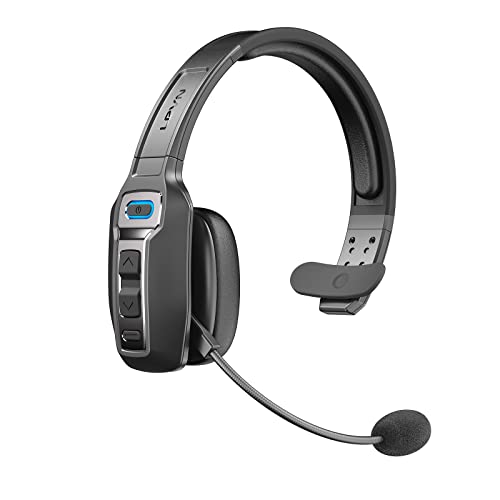
LEVN Bluetooth Headset — The 65-hour desk-and-road bridge
The LEVN’s title reads like a map of the modern rep’s week: trucker, home office, remote work and Zoom are all named, and the headset is asked to be one device across all of them. Its stated working time is 65 hours, which in rep arithmetic means a charge roughly once a fortnight of calling days rather than once a week — a meaningful difference, because the headsets that get forgotten are the ones whose charging rhythm never quite becomes a habit. The microphone is described as AI noise cancelling, the listing’s own framing for its background-suppression processing, and a mute button is present as titled, the two controls a rep’s fingers actually seek.
The wearing style is on-ear with a boom, the trucker pattern, and for a rep that pattern has a social virtue worth naming: it looks like work. A rep wearing a visible boom headset on a video call signals “I am on calls all day and I take the audio seriously,” in a way that a fashion earbud does not. Prospects forgive a headset’s appearance entirely when the voice arriving through it is clear and the rep never once says “sorry, say that again, I’m in a loud place.” The LEVN’s titled combination — long stated hours, a cancelling microphone, a hardware mute — is aimed squarely at never having to say that sentence.
- Stated working time: 65 hours, per the title
- Microphone: AI noise cancelling, as the listing frames it
- Mute: button included, as titled
- Wearing style: wireless on-ear headset with boom microphone
- Stated settings: trucker work, home office, remote work, Zoom
- Charging case: Not stated in the listing title — verify with the maker’s documentation
Strengths
- Sixty-five stated hours stretches the charging rhythm beyond the working week.
- Named mute button supports the rep’s mid-sentence muting habit.
- The title’s setting list matches the hybrid desk-and-road life most reps actually live.
Trade-offs
- No charging case is mentioned, so top-ups mean a cable and a remembered routine.
- Dual-device connection is not stated for two-phone reps.
- The AI cancelling description is the maker’s framing, not a quantified claim.
Best for: hybrid reps splitting the week between home desk, car and client sites on one headset. Not suited for: a two-phone workflow, because the title states no dual device connection to carry it. Its Amazon listing confirms what charging gear ships in the box.
One habit separates reps who love this class from reps who abandon it: the headset lives in one place. A hook by the desk or a spot in the car’s console, always the same, so the morning begins with the headset found rather than hunted. A 65-hour battery forgives a forgotten charge; nothing forgives a forgotten location, and the LEVN’s whole proposition — one headset for every setting in the title — only pays out when the rep’s own logistics rise to meet it.
Zoom’s presence in the title deserves a rep’s attention for a subtler reason: video discovery calls have become the rep’s showroom, and a headset that serves both the phone queue and the video meeting removes the mid-day equipment change that fragments a calendar. The rep who takes a prospect from a phone qualification straight into a screen-shared demo, wearing the same headset throughout, presents a continuity that prospects register as competence. Gear that follows the rep across that seam, rather than forcing a swap at it, is worth more than its specification suggests.
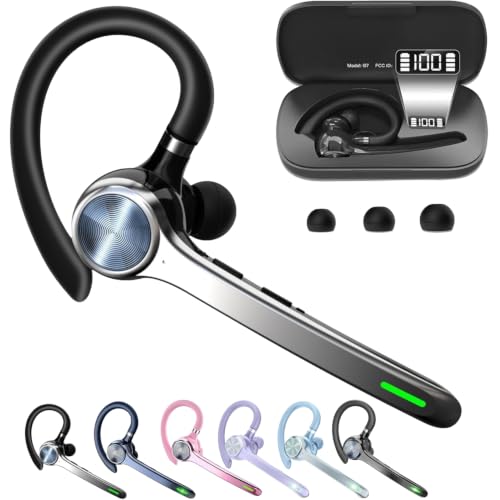
HEIBAS Bluetooth Headset (72H) — The charging-case marathoner
The HEIBAS title leads with endurance and then explains its mechanism: 72 hours of playtime and a 500mAh charging case. The case is the story. A headset that returns each night to a case that refills it stops being a device with a battery and becomes a system with a reservoir, and the rep’s charging question changes from “did I plug in the headset?” to the far less frequent “did I charge the case this month?” For reps who travel — two days on the road, a night in a hotel, a site visit at dawn — that reservoir is the difference between a headset that is simply always ready and one that is ready whenever the rep remembered.
The rest of the title keeps the rep’s checklist intact: a microphone for hands-free calling, a mute button, and named habitats spanning work, trucking, office, driving and iPhone use. The iPhone mention matters more than it looks; a large share of field reps run iPhones, and a listing that names the phone family is at least asserting that its Bluetooth behaviour was considered against it. What the title does not state is a noise-cancelling technology for the microphone, so this guide does not grant it one — the HEIBAS sells endurance and system convenience, and buyers whose calls happen in genuinely loud places should weigh the cancelling-forward picks before this one.
- Stated playtime: 72 hours, per the title
- Charging case: 500mAh, named in the title
- Mute: button included, as titled
- Calling: hands-free calling with microphone
- Stated settings: work, trucking, office, driving, iPhone
- Microphone noise cancelling: Not stated in the listing title — verify with the maker’s documentation
Strengths
- The case-based reservoir makes the 72-hour claim a system rather than a single charge.
- Mute button is present for tactile, eyes-free silencing.
- iPhone use is named in the title, suiting the field rep’s commonest phone.
Trade-offs
- No microphone noise-cancelling claim appears in the title for loud-environment callers.
- A case system is one more object to keep track of on the road.
- Talk-time specifics versus playtime wording are not separated in the title.
Best for: life on the road, where the headset lives in its case and is simply always charged. Not suited for: calls made from persistently loud floors, because the title makes no noise-cancelling claim for its microphone. Check the listing on Amazon for the case’s own charging details before a long trip depends on it.
There is a psychological dividend to the case system that road reps describe consistently: the headset stops generating low-level anxiety. Battery worry is a tax on attention, paid in glances at a phone’s status line during calls that deserved full focus. A reservoir system pays that tax once, at the case’s occasional charging, and the rep’s attention returns to the prospect — where, not coincidentally, the money is. Endurance figures in this category should be read with that dividend in mind, not as a spec-sheet contest.
The case also solves the oldest earpiece problem, which is loss. A headset that lives in a case has a home with edges; a headset that lives loose migrates — into pockets, cup holders, the lining of a laptop bag — and small wireless objects that migrate eventually vanish. Road reps replacing lost earpieces learn to value the case as a container before they value it as a charger. The HEIBAS sells both functions in one object, and for the rep whose working life is a series of vehicles and venues, the container may honestly be the more valuable of the two.

BlueParrott B350-XT — The noise specialist
BlueParrott built its name in truck cabs, and the B350-XT’s title carries the brand’s signature claim: 96% noise cancelling — a figure this guide repeats exactly as what it is, the listing’s own claim about its microphone’s ability to strip background noise from the rep’s voice, not a measurement made here. Set beside that headline are two working facts: IP54 rating, which speaks to dust and splash resistance for reps whose calls happen in yards, workshops and weather, and 24 hours of talk time, the most modest endurance figure in this guide and the one most plainly labelled as talk time rather than playtime or working time.
The honest trade is visible in those numbers. This pick spends its engineering budget on the microphone and the build rather than on the battery, which suits a particular rep precisely: the one whose calls happen in genuinely hostile noise — a distribution floor, a building site, a car with the window down on a motorway run — and whose day still ends at a desk or a home where charging is easy. Twenty-four stated hours covers several calling days; it does not cover a forgetful fortnight, and the rep who charges rarely should look at the marathon picks instead. Lightweight comfort is claimed in the title, and in a class where the device is worn for a shift, a specialist brand’s comfort claim carries the weight of a product line refined across many cab-wearing predecessors.
- Noise cancelling: 96%, the listing’s own claim as titled
- Talk time: 24 hours, as stated
- Rating: IP54, per the title
- Build claim: lightweight comfort, per the title
- Audience named: truck drivers, in the title’s framing
- Mute button: Not stated in the listing title — verify with the maker’s documentation
Strengths
- The strongest microphone claim in the guide, attributed to the listing itself.
- IP54 rating suits site, yard and weather-exposed calling.
- A specialist trucker brand’s comfort and durability lineage stands behind the design.
Trade-offs
- Twenty-four hours is the shortest stated endurance here and demands a charging habit.
- The title does not name a mute button for reps who mute constantly.
- The cancelling percentage is a maker’s claim, not a figure verified by this guide.
Best for: reps whose calls compete with machinery, motorways and weather, and who charge at a base each night. Not suited for: a multi-day trip without charging access, because 24 stated hours is a days-scale battery rather than a weeks-scale one. The Amazon listing sets out the control layout to check against your muting habits.
Reps sometimes ask whether a trucker brand’s microphone claim can be trusted more than a generic one, and the fair answer is structural rather than numerical: a brand whose entire market punishes microphone failure — drivers are not a forgiving focus group — stakes its name on the claim in a way a generalist listing does not. That is a reason to weigh the B350-XT’s attributed 96% seriously as a maker’s assertion. It is still not a laboratory figure, and this guide’s discipline of attribution exists precisely so that distinction never blurs.
The IP54 rating, easy to skim past, redraws where this headset can work. A rep walking a construction client’s yard in drizzle, touring a food plant, or simply caught between the car and a site office in rain does not have to choose between the call and the weather. Ratings in titles are worth reading literally — the digits describe tested resistance to dust and splashing water, not immersion — and within those limits the B350-XT is the only pick here whose title certifies anything about the physical world at all. For outdoor-heavy territories, that single line can outweigh every battery figure in the table.

PHILIPS Trucker Bluetooth Headset — The instant-mute mainstream pick
Philips entering the trucker shelf changes the shelf’s centre of gravity: a mainstream electronics name applying itself to the boom-headset pattern, with an AI noise-cancelling microphone and — the phrase its title chooses — an instant mute button. Instant is the right word to compete on. A rep’s mute is rarely planned; it answers a doorbell, a colleague’s question, a child’s entrance into the home office, a cough that arrives mid-pitch. The value of the control is measured in the fraction of a second between the need and the silence, and a title that advertises instant muting understands the assignment precisely.
The battery claim is where this listing goes quiet: reliable long battery life, in words, with no hour figure attached. This guide reports that as it stands — a qualitative claim from a major maker — and the spec box declines to invent a number. For many buyers the maker’s name does the reassuring that a figure would do elsewhere; for reps comparing endurance across this guide’s table, the absence is a genuine gap, and the listing’s full page is where the figure, if published, will be found. The stated audience — drivers, office, call centres — confirms the rep-shaped intent: this is a calling instrument, not a music accessory with a microphone tolerated.
- Microphone: AI noise-canceling, as the listing frames it
- Mute: instant mute button, as titled
- Battery: reliable long battery life claimed in words; no hour figure in the title
- Stated settings: drivers, office, call centres
- Talk time in hours: Not stated in the listing title — verify with the maker’s documentation
Strengths
- Instant mute is headlined, matching how reps actually use the control.
- A mainstream maker’s support and retail presence stand behind the purchase.
- Call centres are named in the title, aligning it with professional calling duty.
Trade-offs
- No endurance figure is printed in the title for comparison shoppers.
- No charging case or dual-connection claim appears in the title.
- The AI cancelling description is qualitative rather than quantified.
Best for: reps who mute constantly and want a familiar maker’s name behind an all-day calling headset. Not suited for: a buyer comparing batteries by stated hours, because this title declines to publish one. Read the Amazon listing’s specification section for the endurance figure before judging it against the marathon picks.
There is a fleet argument for the mainstream name that individual buyers underestimate. A sales organisation standardising headsets across forty reps cares about warranty handling, replacement availability next year, and a listing that will still exist at reorder time. Philips’ presence on this shelf gives procurement a defensible line item in a way an unknown badge cannot, and for a sales director signing a fleet order, that defensibility can rationally outrank a rival’s longer stated battery. Individual reps should buy the headset; organisations buy the supply chain, and this pick serves the second buyer unusually well.
Call-centre naming in the title carries one more implication worth surfacing: duty cycle. A headset a maker aims at call centres is being aimed at eight-hour wearing, five days a week, by people who will complain collectively and loudly if it pinches, crackles or dies young. That intended habitat does not guarantee comfort for any individual head — nothing can — but it does mean the design brief began with endurance of the object as well as of its battery, and reps who have suffered consumer earbuds collapsing by month three will know exactly how much that brief is worth.

COSMUSIS Trucker Bluetooth Headset — The detachable-earpad workhorse
The COSMUSIS title is the plainest in this guide — trucker headset, noise cancelling, long battery life — and then it adds the detail that reveals a maintenance-minded maker: a detachable earpad. The earpad is the part of an all-day headset that ages against the wearer’s skin: it compresses, it absorbs, it eventually cracks, and on most headsets its decline is the beginning of the whole device’s decline. A pad designed to detach can be cleaned properly and replaced when its day comes, which converts the headset from a disposable with a two-year smell to a tool with a serviceable wear surface.
Everything else in the title is class-standard, stated without inflation: wireless headset with a microphone for work, noise cancelling, long battery life claimed in words rather than hours. This guide treats that restraint as information. The COSMUSIS is not competing on a headline number; it is competing on being the unglamorous correct shape — boom, single ear, cancelling microphone, replaceable pad — for reps whose headset is equipment rather than identity. Buyers who need their endurance quantified should note the absence here as they did with the Philips, and weigh whether the pad’s serviceability is worth more to their working life than a printed hour count.
- Microphone: noise cancelling, as titled
- Battery: long battery life claimed in words; hours not stated in the title
- Wear part: detachable earpad, named in the title
- Stated settings: driving and work calls
- Mute button: Not stated in the listing title — verify with the maker’s documentation
Strengths
- Detachable earpad addresses the wear item that ends most headsets’ useful lives.
- The title’s claims are restrained and class-appropriate, with no inflated figures.
- Noise cancelling is stated for the headset’s working environments.
Trade-offs
- Endurance is unquantified in the title, frustrating direct comparison.
- No mute button is named for heavy muters.
- No case, rating or dual-connection features are claimed in the title.
Best for: reps who wear one headset for years and prefer a serviceable pad to a headline specification. Not suited for: purchase decisions that require a stated talk-time figure, because the title offers the claim only in words. Its Amazon page is the place to confirm pad replacement availability and the battery’s published hours.
Think about the shared-headset scenario this design quietly serves: the pool headset. Small sales teams keep a spare headset for the new starter, the visiting rep, the day someone’s own device dies. Pool gear lives hard and anonymous, and its earpad is where that life shows first. A detachable, replaceable pad makes pool duty hygienic and respectable rather than faintly grim — a small operational virtue that never appears in a spec contest and matters every single week a team actually shares equipment.
There is an environmental footnote to the same design choice, and reps who keep gear for years feel it as simple thrift: a headset retired for a worn pad wastes a working microphone, radio and battery. Replaceable wear parts are how tools stay tools instead of becoming disposables, and in a category where the electronics routinely outlast the foam, the detachable pad is the one feature that lets the rest of the product reach its natural lifespan. Buyers tired of the annual headset replacement cycle are the COSMUSIS’s natural constituency.

Bluetooth 6.1 Earpiece (100H) — The dual-device hundred-hour earpiece
This unbranded earpiece makes the boldest endurance claim in the guide — 100 hours, as titled — and pairs it with the feature set of the two-phone professional: Bluetooth 6.1, dual noise cancelling microphones, HD audio, a mute button, and dual device connection. Read the claim with the guide’s standing discipline: it is the listing’s stated figure, the largest number on this page, and the comparison it invites is against the other listings’ stated figures, not against a laboratory any of them shared. Even discounted by a healthy scepticism, a headset whose maker leads with a hundred hours is telling you its design priority without ambiguity.
Dual device connection is the feature reps should linger on, because it maps to a real and common anatomy: the work phone and the personal phone, or the phone and the laptop, both paired, with the headset arbitrating. A rep whose CRM dials from the laptop while prospects return calls to the mobile lives in that arbitration all day, and a headset that holds both connections removes the re-pairing ritual that quietly discourages reps from taking calls on the move. The dual-microphone arrangement — two cancelling microphones rather than one — is the listing’s stated approach to voice clarity, and the earpiece form keeps the whole apparatus smaller than the boom-and-headband pattern of the trucker picks.
- Stated endurance: 100 hours, the listing’s claim as titled
- Bluetooth: version 6.1, per the title
- Microphones: dual noise cancelling mics, as titled
- Connections: dual device connection, as titled
- Mute: button included, as titled
- Audio: HD audio claimed in the title
- Maker and support details: Not stated in the listing title — verify with the maker’s documentation
Strengths
- The largest stated endurance figure in this guide, by a wide margin.
- Dual device connection serves the two-phone reality of field sales.
- Two cancelling microphones and a mute button complete the rep’s core checklist.
Trade-offs
- The hundred-hour figure is an unbranded listing’s claim, to be weighed as such.
- Earpiece form gives a smaller wearing footprint but a less substantial feel than a headband.
- No case, rating or maker information appears in the title.
Best for: a two-phone workflow carrying the longest stated endurance and connection flexibility in one small earpiece unit. Not suited for: fleet purchasing that relies on a named maker behind warranty and reorders, because the title offers no brand to hold accountable. Its Amazon listing carries the seller and support details that the title omits, and those deserve reading first.
Form factor deserves the last word on this pick, because earpiece versus headband is a genuine fork in this class. The headband picks distribute their presence and read as professional equipment; the earpiece disappears, which some reps prefer for video calls and client meetings where a boom reads as call-centre costume. Neither instinct is wrong, but they lead to different shelves — and a rep who knows their own vanity honestly will choose faster and regret less than one who pretends the question is purely technical.
Bluetooth 6.1 in the title is the quietest claim and worth a sentence of context: newer Bluetooth generations generally bring connection stability and power refinements, and a listing leading with the current version is at least shipping current silicon rather than clearing old stock. For a rep, the practical translation is pairing behaviour — how gracefully the earpiece handles the phone in a pocket, a bag, a different room — and that behaviour, more than any audio adjective, is what a test week will reveal. Pair the bold endurance claim with that recency and the earpiece’s pitch coheres: it is the maximum-specification answer, offered without a brand’s name to vouch for it, and the buyer’s own trial period becomes the voucher.
What Does a Rep’s Mute Button Actually Protect?
It protects the prospect’s experience of being the only person in the rep’s world. Every call contains sounds that break that spell — a colleague’s question, a kettle, a navigation prompt, a sneeze with ambitions — and the mute button, found by touch in a fraction of a second, keeps them on the rep’s side of the line. Reps develop the gesture into reflex within a month, and the reflex is why this guide counts mute controls among the big three rather than among the garnishes: a headset without a trustworthy mute makes its owner measurably more guarded, and guarded reps sell less than candid ones.
The mute also protects information. Pricing discussed with a manager mid-call, a colleague’s aside about stock, the name of another client — the modern rep’s environment is full of speech that is legitimate in the room and improper on the call. A tactile, certain mute is a compliance tool wearing a convenience’s clothing, and sales organisations training new reps would do well to teach it in those terms: mute early, mute often, and never trust a software button you cannot feel. Four of the six titles here name the button outright; the other two picks ask the buyer to verify it, and the verdicts above say so in plain language.
How Do the Six Compare on the Rep’s Big Three?
| Pick | Stated endurance | Microphone claim as titled | Mute button in title | Distinguishing feature |
|---|---|---|---|---|
| LEVN Bluetooth Headset | 65 hrs working time | AI noise cancelling | Yes | Named for truck, office, home and Zoom alike |
| HEIBAS Bluetooth Headset | 72H playtime | Not stated | Yes | 500mAh charging case |
| BlueParrott B350-XT | 24 hr talk time | 96% noise canceling, the listing’s own claim | Not stated | IP54 rating, specialist brand |
| PHILIPS Trucker Headset | Long life, in words | AI noise-canceling | Yes, instant | Mainstream maker, call centres named |
| COSMUSIS Trucker Headset | Long life, in words | Noise cancelling | Not stated | Detachable earpad |
| Bluetooth 6.1 Earpiece | 100Hrs, as titled | Dual noise cancelling mics | Yes | Dual device connection |
The table’s honesty is in its gaps. Two endurance claims arrive in words rather than hours, one microphone column stands empty, two mute cells say “not stated” — and those gaps are purchasing information, not editorial failure. A rep who needs a number can strike the worded rows; a rep who needs a feature can strike the unstated ones; what remains is a shortlist fitted to that rep’s actual constraints, which is more than a table of invented precision could ever offer.
What Mistakes Do Sales Teams Make When Buying Headsets?
The first is buying for the ear instead of the mouth. Reps demo headsets by playing music or listening to a colleague, nod at the clarity, and discover a month later that prospects keep asking them to repeat themselves — because the purchase was judged on the speaker and the job lives in the microphone. Test any candidate the other way round: record a call from a noisy place, listen to what the other end received, and let that recording vote. Every claim compared in this guide is a microphone claim for exactly that reason.
The second mistake is standardising on endurance the team does not need while neglecting the fit it wears for eight hours. A hundred stated hours impresses a spreadsheet; a headset that pinches by Thursday loses the rep by Friday, quietly, in the form of calls taken on speakerphone “just this once” forever. Fleet buyers should put candidate headsets on actual reps for actual weeks before the fleet order, and should treat the detachable-earpad, replaceable-part designs as the long-game bargains they are.
The third is ignoring the second device. Modern reps live across a phone and a laptop at minimum, and a headset that pairs to one at a time manufactures a small daily friction that compounds into avoidance — calls taken late, calls taken on the wrong device, calls not taken. Where the title states dual connection, as the 6.1 earpiece does, that friction is designed out; where it does not, the rep should test the re-pairing ritual before the return window closes, not after.
Field Notes: A Fortnight of Calls on One Ear
The first thing a rep notices, switching from two earbuds to a one-ear boom headset, is how much of the room comes back. Colleagues’ voices, the door, the kettle — the working world re-enters awareness, and most reps find they prefer it: the single-ear class exists because a calling professional is also a person in a place, and total immersion is a liability in an office or a home. The second thing, arriving around day four, is the disappearance of the headset from consciousness during calls. The boom sits where it sits, the button is where the thumb expects it, and attention moves entirely to the prospect.
By the second week the battery rhythm — or its absence — has declared itself. Reps on the marathon picks describe a vague surprise, eventually, at a low-battery prompt they had forgotten existed; reps on shorter-endurance headsets describe a charging spot becoming as fixed as the coffee spot. Neither rhythm is a failure. The failure is only the mismatch: the forgetful rep on the 24-hour pick, the meticulous rep paying for endurance they never use. This guide’s table exists to prevent exactly that mismatch, by putting each listing’s stated figure where a rep can match it against their own honestly assessed habits.
How Should a Sales Manager Equip a Whole Team?
Standardise the class, personalise the pick where the budget allows. The class decision — one-ear Bluetooth boom headsets with hardware mute — can be uniform, because it follows from the work. The pick decision touches bodies and habits: the road warrior needs the case system or the hundred-hour claim, the site-walking rep needs the rated build and the microphone claim, the two-phone rep needs dual connection. A manager who issues one model to all three will serve one of them well and tax the other two daily.
Buy spares as a policy, not as an afterthought: one spare per five reps, held centrally, because a dead headset on a calling day is lost revenue wearing a small disguise. And write the mute discipline into onboarding alongside the CRM training — which button, which gesture, which moments demand it — because the headset’s most professional feature only exists once the rep’s thumb has learned it. Readers speccing the driving side of the role specifically should compare the best driving headsets as well, and anyone whose calls run through a computer softphone as often as a phone should weigh the best bluetooth headsets for making phone calls before the fleet order hardens.
How Do You Test a Headset Before the Return Window Closes?
Run the week you actually fear, not the week you hope for. Take the candidate headset to the loudest place in your territory — the yard, the food court, the motorway services — and call a colleague who will tell you the truth. Ask them to rate not your loudness but your competition: how much of the place is audible behind your voice, and at what point does the place start winning words. Then reverse the test at your desk and listen to a recording of yourself, because the microphone’s version of your voice is the only version prospects will ever meet.
Test the mute with your eyes closed, literally. Mid-call, with the conversation flowing, find the button by touch three times in a row; if you miss once, the button will miss in November, in the rain, during the call that matters. Test the second pairing if you run two devices, test the case ritual if the pick has one, and test an eighth hour of wearing on a day when you can afford the discovery. A headset is one of the few purchases where the return window, used deliberately, is worth more than any review — including, this guide freely admits, its own attributed claims and titled figures.
Finally, test the failure you can foresee: the forgotten charge. Note how the headset warns you, how early, and whether a short top-up restores a calling day or merely a calling hour — a detail no title in this guide states, and one that decides whether a lapse is an anecdote or a lost afternoon. Reps who run that single experiment before committing rarely regret their choice, whatever the table said.
Final Recommendation
Match the headset to the shape of your selling day and let the titles’ own figures arbitrate. The LEVN is the balanced default — 65 stated hours, a cancelling microphone, a mute button, and a title that already includes your office, your car and your video calls. Choose the HEIBAS when travel makes the charging case the real product, the BlueParrott B350-XT when noise is the enemy and its listing’s own 96% claim is the weapon you want, the PHILIPS when an instant mute and a mainstream name matter most, the COSMUSIS when years of service from a replaceable pad outrank a printed battery figure, and the Bluetooth 6.1 earpiece when two devices and the longest stated endurance define your day. Whichever you carry, put it on the same hook every night and let your thumb learn its mute before your next prospect does — because a rep’s headset is judged, in the end, by the calls where nobody on the other end ever thought about it at all, and silence about your equipment is the loudest compliment this category can earn.
Frequently Asked Questions
Why do sales rep headsets look like trucker headsets?
Because the requirements converged. Trucking demanded one-ear awareness, boom microphones that reject a loud cab, batteries that outlast shifts and buttons that work without looking — and field sales discovered it needed precisely the same list. The class is sold to both audiences, often in the same title, as the LEVN, PHILIPS and COSMUSIS listings here show.
Can I trust the noise-cancelling percentages in these titles?
Treat them as what they are: each maker’s own claim, made by its own testing method. The BlueParrott’s 96% figure is quoted in this guide with that attribution and not as an independent measurement. Such claims are useful for seeing what a maker emphasises and for comparing a maker’s models against each other; your own test call from your own noisiest location is the only verification that counts.
How much talk time does a rep genuinely need?
Enough to cover the gap between your realistic charging opportunities, with margin for the day you forget. A desk-based rep who charges nightly is well served by 24 stated hours; a travelling rep who charges weekly should be shopping the 65-to-100-hour claims or a charging-case system like the HEIBAS, whose case turns the question into a monthly one. Judge your own pattern by last month’s behaviour rather than next month’s intentions: reps reliably overestimate their future diligence, and the headset that forgives the rep they actually are outsells, in satisfaction, the headset bought for the rep they meant to become.
Is a mute button really better than muting on the phone?
For a rep, yes, and the difference is tactile certainty. A hardware button can be found without looking, mid-sentence, while walking, and its state can be learned by touch. A phone-screen mute demands eyes, a free hand and an unlocked screen. Four of the six titles here name a mute button; where a title does not, this guide flags it for verification rather than assuming it.
What does dual device connection actually do for me?
It keeps the headset paired to two sources at once — typically a phone and a laptop — so calls from either arrive without re-pairing. Only the Bluetooth 6.1 earpiece states it in this guide. Reps whose CRM dials from a computer while prospects ring the mobile will feel the benefit daily; single-device reps will never miss it.
Should our team standardise on one model?
Standardise the class and the controls, then let roles choose within it. Uniform mute-button placement across a team makes training and cover arrangements simpler, while endurance, rating and connection needs genuinely differ between road, site and desk reps. The comparison table above is built for that two-level decision, and a short trial — two reps, two different picks, one fortnight of real calls — will usually settle arguments that a committee meeting about specifications never could, in either direction, quickly and convincingly.
Add one line to the team’s kit policy that experience argues for: every rep’s headset travels with its charging cable even when its battery claims make the cable feel theoretical. Cables are borrowed, forgotten and sat on; a spare in the glovebox converts most headset emergencies into a ten-minute inconvenience. Managers who audit a quarter’s lost-call complaints usually find the causes embarrassingly material — a cable, a case, a hook by a desk — rather than electronic, which is why equipping a team well is mostly a logistics exercise wearing a technology costume.
Related Guides
Adjacent shelves repay a look before a fleet order settles. Teams weighing phone-first setups for other audiences will find the best headsets for seniors using iphone a reminder of how differently another readership judges the same Bluetooth basics, and reps whose calls are coached as well as made can read the best headsets and microphones for coaching for the second-listener side of the profession.


