What's inside
- Key Takeaways
- Quick Picks
- How were these picks chosen?
- How the six cameras compare
- How do you choose a camera for fishing?
- On the water with these cameras: how we judge them
- Common mistakes when filming fishing
- Mounting positions, and what each one reveals
- Reading lure-camera footage like a scout
- Batteries, cards and heat: the logistics of a filming day
- Fresh water, salt water and the ride home
- Filming companions, clubs and charter guests
- Sound on the water: the half of footage anglers forget
- What a season of footage does to your fishing
- Choosing between generations and ecosystems
- A starter rig list for the first month
- Night fishing and lights, briefly
- Keeping footage findable: a simple archive habit
- Final recommendation
- Frequently asked questions
As an Amazon Associate I earn from qualifying purchases. This post may contain affiliate links at no extra cost to you.
gizmoverdict.com is reader-supported. When you buy through links on our site, we may earn an affiliate commission.
Where to buy: All six products in this guide are sold through Amazon in the United States, and the fishing-camera shelf moves in seasonal waves, with lure cameras in particular appearing and restocking around spring. Each pick below carries one Amazon link so you can confirm the exact bundle contents before ordering, because on this shelf the difference between a bare camera and a kit with spare batteries and mounts is often the difference between a full day on the water and a camera that dies before the evening bite.
The best gopro & action cameras for fishing actually covers two different sports wearing one name. The first is filming the angler: the cast, the fight, the net sliding under a fish at the side of the boat, the grin afterward. Chest mounts, hat clips and rail mounts turn an action camera into a witness that never gets tired, never drops a rod and never misses the strike because it was looking at a sandwich. The second sport is filming the fish, and it uses an entirely different device: a small camera that rides the line or the lure itself, watching the underwater world the angler never sees, recording which fish approached, which one refused, and what the lure was actually doing down there. Four picks in this guide serve the first sport and two serve the second, and keeping those classes distinct matters, because a lure camera is not a worse action camera and an action camera cannot do a lure camera’s job at any price.
Fishing is also unusually hard on cameras. A fishing camera gets sprayed at forty knots, baked on a dark deck, knocked against gunwales, dunked beside the net and handled with hands slicked by bait and fish slime. Waterproofing without a housing, stabilization that survives a bouncing boat, batteries that outlast a tide and mounts that grip a rail all stop being specification-sheet garnish and become the whole product. The six listings below were chosen with that abuse in mind, from three generations of GoPro thinking and DJI’s low-light specialist through to two purpose-built line cameras that film the strike from the fish’s side of the surface.
Our Top Picks
Key Takeaways
- Four picks film the angler from a mount; two picks, the CanFish CamX and the SHiNECAM, ride the fishing line and film at the lure, a separate class with a separate purpose.
- The GoPro HERO13 Black pick is a bundle listing, sold with three Enduro batteries, a dual charger, a 64GB card and a 47-piece accessory kit, and it is named as a bundle throughout this guide.
- DJI’s Osmo Action 4 is the low-light specialist here, with the largest sensor named in any title and a stated 160 minutes of runtime.
- The GoPro MAX2 adds a 360-degree view that lets an angler reframe the shot after the fight, catching strikes that happen outside a fixed frame.
- Depth figures for the line cameras, 656 feet for the CanFish and 164 feet for the SHiNECAM, describe trolling and deep presentations rather than ordinary casting distance from a boat deck.
- Every action camera here is waterproof by design per its title, which matters when a camera’s working day includes spray, rain and the occasional full dunking beside the net.
Quick Picks
| Pick | Model | Badge |
|---|---|---|
| 1 | GoPro LIT Hero | Best lightweight starter |
| 2 | GoPro MAX2 | Best for never missing the strike |
| 3 | GoPro HERO13 Black Bundle | Best complete boat kit |
| 4 | DJI Osmo Action 4 | Best for dawn and dusk fishing |
| 5 | CanFish Fishing CamX | Best lure’s-eye view |
| 6 | SHiNECAM Fishing Camera | Best simple line camera |
Badges here follow the two-class split. Rows one through four compete with each other for space on your chest, hat or rail. Rows five and six compete for a place on your line, and many serious anglers will eventually own one from each group, because the footage answers different questions: what did I do, and what did the fish see.
How were these picks chosen?
Selection began by separating the shelf into its two honest classes and refusing to rank across the divide. Within the action cameras, we prioritized waterproofing stated in the title, stabilization named in the title, and the practical fishing virtues of small size and long battery life. A camera an angler will not carry catches nothing, so the compact LIT Hero earned its place beside flagships rather than beneath them. Bundle value counted heavily on a working boat, where spare batteries and a dual charger are not accessories but infrastructure, and the HERO13 entry is explicitly a bundle listing rather than a bare camera.
Within the line cameras, the criteria invert. What matters is the depth rating for trolled presentations, the width of the lens, how recording is triggered when a camera sits unattended below the surface, and how footage gets off the device afterward. Motion sensing and segmented recording on the CanFish, and built-in storage with OTG transfer on the SHiNECAM, are the features that decide whether underwater footage is a revelation or a chore. Anglers who also swim or snorkel with a camera should compare this shelf against our roundup of the best affordable underwater cameras, where depth ratings and flotation drive a different set of choices.

1. GoPro LIT Hero — Best lightweight starter
The LIT Hero is GoPro’s small, simple answer to a real fishing problem: most anglers will not wear a heavy camera all day. It is described in its title as lightweight and compact, waterproof, and fitted with a built-in light, a combination that reads like it was specified by someone who launches before dawn. That light is the detail to dwell on. Early launches, livewell checks, knot-tying in a dark cockpit and the first photograph of a fish before sunrise all happen in poor light, and a camera carrying its own illumination handles those moments without a headlamp shuffle. Video is stated at 4K60, stills at 12 megapixels, with a touch screen and HyperSmooth stabilization rounding out a specification that gives up little to larger models for the job of documenting a day on the water.
Worn on a chest mount, a camera this light disappears, which changes behavior in a good way: the angler fishes naturally instead of performing for a conspicuous rig, and the footage shows actual fishing rather than a presenter. The touch screen simplifies changing settings with damp fingers at the dock, though like every touchscreen it should be set before the camera gets wet. For a first fishing camera, or a second camera assigned to a kayak where weight and simplicity dominate, the LIT Hero’s formula of small body, real stabilization, high frame rate and its own light is coherent and honest. It is not the flagship of this guide and does not pretend to be; it is the camera most likely to be switched on for every trip, and switched-on beats superior in the long run of a season.
Strengths
- Built-in light covers dawn launches and cockpit tasks no rival in this guide addresses.
- Lightweight, compact body stays comfortable on a chest mount through a full tide.
- 4K60 video with HyperSmooth stabilization suits casting and fight footage alike.
Trade-offs
- 12MP stills are the modest figure in this lineup for anglers printing trophy photographs.
- The title names no accessory bundle, so mounts are separate purchases.
- Battery endurance figures are absent from the title, unlike the DJI’s stated runtime.
Spec box
- Video: 4K60 Ultra HD
- Stills: 12MP
- Stabilization: HyperSmooth
- Screen: Touch screen
- Light: Built-in light
- Battery runtime: Not stated in the listing title
Best for: kayak anglers and first-time camera owners whose trips start before sunrise and whose tolerance for heavy rigs is zero. Not suited for: a boat already rigged with rail mounts and a crew filming for a channel, where the flagship bundles below carry more infrastructure. Dawn patrol anglers can check price on Amazon and look at the mount options alongside.
2. GoPro MAX2 — Best for never missing the strike
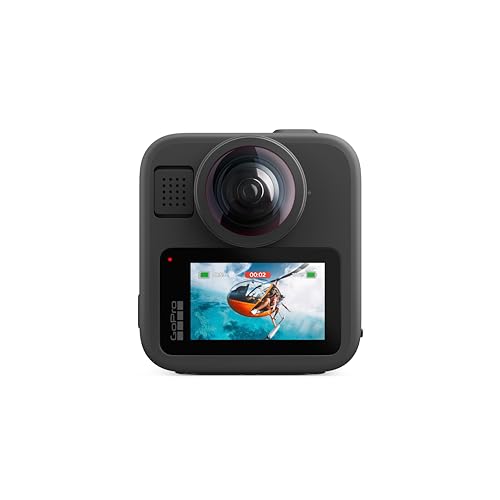
The MAX2 attacks the oldest frustration in fishing footage: the strike happened just outside the frame. As a 360 camera it records in every direction at once, capturing spherical 8K video and 29-megapixel 360 photographs per its title, and the angler chooses the framing later, at a desk, with the whole scene available. A fish that erupts behind the boat, a second rod that doubles over while the first is being fought, a net man lunging from the left while the camera points right: all of it is in the file. The title also describes a traditional action camera mode, so the MAX2 can behave like an ordinary wide-angle GoPro when 360 capture is unnecessary, and its six microphones promise a fuller soundscape of drag clicks, water and shouted instructions than a single-mic camera records.
Two fishing-specific details stand out. The lenses are described as easily replaceable, which on a boat is not a luxury: lenses meet hooks, pliers, cooler lids and concrete ramps, and a camera whose front element can be swapped survives accidents that end other cameras’ seasons. HyperSmooth stabilization carries over, essential when a 360 camera rides a pitching deck. The honest costs of 360 filming are workflow and attention. Files are large, reframing takes time in an editor, and an angler who wants a clip on a phone before the drive home will find the MAX2 slower to gratify than its siblings. It rewards the angler who reviews footage in the evening, studying water and fish behavior, as much as the one chasing a shareable clip.
Strengths
- 360 capture records strikes and action outside any fixed frame, reframed later.
- Easily replaceable lenses answer the scratches and impacts of boat life.
- Six microphones capture drag, water and voices from every direction.
Trade-offs
- Reframing spherical footage adds editing time before a clip is shareable.
- 360 files are large, pressuring cards and storage across a long trip.
- The title states no bundle, so batteries and mounts beyond the box are extra.
Spec box
- Video: Spherical 8K, plus traditional action camera mode
- Stills: 29MP 360 photos
- Microphones: 6
- Stabilization: HyperSmooth
- Lenses: Easy replaceable lenses
- Battery runtime: Not stated in the listing title
Best for: anglers who review their days closely and hate losing a strike to the edge of a frame, especially on multi-rod boats where action erupts anywhere. Not suited for: same-evening phone posting straight off the boat, where reframing spherical files slows the path from catch to clip. If the all-directions approach appeals, see the current Amazon listing for what ships in the box.
3. GoPro HERO13 Black Bundle — Best complete boat kit
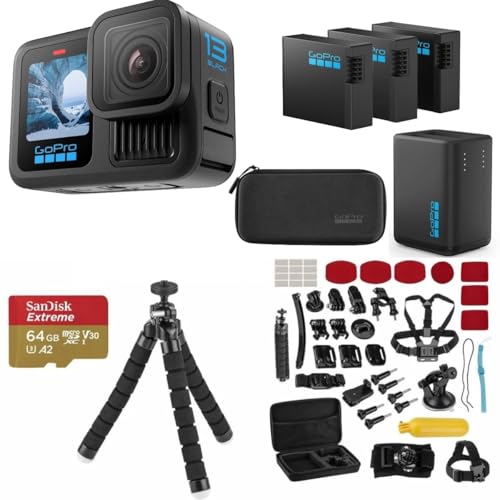
Name the thing correctly first: this pick is the HERO13 Black sold as a bundle, and the bundle is the point. The listing pairs the camera, with its 5.3K HDR video, 27-megapixel photographs and HyperSmooth stabilization, with three Enduro batteries, a dual charger, a 64GB SD card, a 47-piece accessory kit and a one-year warranty. On a fishing boat, that inventory reads like a checklist written by experience. Three batteries rotate through a full day without rationing. A dual charger refills two at once overnight. Forty-seven accessory pieces mean the rail mount, the chest harness and the suction mount are already in the bag when an idea occurs at the dock, instead of arriving by post after the trip that needed them.
The camera itself is the most conventional flagship here: the highest stated video resolution among the single-lens picks, HDR for the brutal contrast of sun on water, and a waterproof design per the title. HDR deserves its fishing footnote, because few scenes punish a sensor like a white deck under midday sun beside dark water and a shadowed cockpit; holding detail across that range is the difference between a watchable fight sequence and a blown-out glare field. Buying the bundle also changes the failure math of a season. A lost mount piece, a tired battery or a full card stops being an emergency when spares are already aboard. For a boat that fishes weekly, or a small charter operation filming client trips, this is the pick that arrives as a system rather than a component.
Strengths
- Three Enduro batteries and a dual charger sustain full-day filming without rationing.
- 47-piece accessory kit covers the mounts a fishing boat actually uses.
- 5.3K HDR video handles the harsh contrast of sun, white decks and dark water.
Trade-offs
- A bundle this complete costs more commitment than a bare camera for casual use.
- Kit pieces an angler never mounts are money spent on storage rather than footage.
- The single fixed viewpoint still misses action outside its frame, unlike the MAX2.
Spec box
- Video: 5.3K HDR
- Stills: 27MP
- Stabilization: HyperSmooth
- Batteries in bundle: 3 Enduro batteries with dual charger
- Storage in bundle: 64GB SD card
- Accessories in bundle: 47-piece kit, 1-year warranty
Best for: boats that fish weekly and film seriously, where batteries, mounts and spares are working infrastructure rather than extras. Not suited for: occasional bank fishing carried in a pocket, where a 47-piece kit mostly stays home in a drawer. Crews ready to rig properly can check the bundle on Amazon and inventory the kit list before ordering.

4. DJI Osmo Action 4 — Best for dawn and dusk fishing
The best fishing light is the worst camera light: the first grey hour when predators feed at the surface and the last orange hour when they do it again. The Osmo Action 4 Standard Combo is built for exactly those windows. Its title names a 1/1.3-inch sensor, the largest sensor figure stated in this guide, and pairs it with explicit low-light imaging claims, 4K video at up to 120 frames per second, 10-bit color with D-Log M for editors who grade footage, and a long-lasting 160 minutes of runtime. A big sensor gathers more light per pixel, which is the honest mechanical route to cleaner dawn footage, and 160 minutes covers a dawn session and a dusk session on a single charge for many anglers.
The 4K/120 mode earns a fishing-specific mention: slowed down, it turns a topwater strike or a jumping fish at the net into a study of timing, and lure anglers reviewing how a fish took a bait learn things at quarter speed that real time hides. The Standard Combo designation signals a core kit rather than an adventure bundle, so mount collections build separately. Color depth is the connoisseur’s detail here; 10-bit D-Log M footage looks flat straight from the camera and rewards editing, which divides the audience cleanly. Anglers who post unedited clips should weigh that workflow honestly, while those who already grade video will find this the most capable imaging tool in the roundup. As the non-GoPro in a GoPro-titled search, it also suits households already invested in DJI drones and accessories.
Strengths
- Largest sensor named here at 1/1.3 inch, aimed squarely at low-light imaging.
- Stated 160-minute runtime covers dawn and dusk sessions on one charge.
- 4K/120fps slows strikes and jumps into genuinely instructive footage.
Trade-offs
- 10-bit D-Log M footage needs grading to shine, adding an editing step.
- Standard Combo is a core kit, so fishing mounts accumulate separately.
- No built-in light for the darkest launch work, where the LIT Hero leads.
Spec box
- Sensor: 1/1.3 inch
- Video: 4K/120fps
- Color: 10-bit and D-Log M
- Runtime: 160 minutes
- Kit: Standard Combo
- Waterproofing: Waterproof action camera per the title; depth figure not stated in the listing title
Best for: anglers whose best hours are the dim ones and who enjoy editing, grading and studying strike footage at quarter speed. Not suited for: unedited clips posted from the boat ramp, where the flat D-Log M profile works against a quick turnaround. Low-light specialists can look at the Amazon listing for the combo’s exact contents.

5. CanFish Fishing CamX — Best lure’s-eye view
Crossing to the second class now: the CamX does not watch the angler at all. It rides at the lure, filming in HD 1080P through a 136-degree ultra-wide lens, inside a body rated to 656 feet as an ROV-proof housing, with motion sensing, segmented intelligent recording, wireless charging and an app connection. That depth figure is not about casting; it belongs to trolling and deep presentations, where a lure may run far below the boat for hours. Motion sensing and segmented recording are the features that make such hours survivable as footage: instead of one endless file of a lure swimming through green water, the camera wakes and records in segments around movement, so the follows, inspections and refusals are findable in the evening review.
What this footage teaches is the lure camera’s real product. Anglers discover that a lure they believed was running deep was planing near the surface, that fish follow for yards without committing, that a color change doubles the follows, that the strike they felt was the second attempt, not the first. Wireless charging suits a device that must stay sealed, and app compatibility moves clips to a phone without opening ports with wet hands. The CamX cannot film the fight from the angler’s side, will not record the trophy photograph, and asks for a style of fishing, trolling or deep casting with suitable rigging, that not every angler practices. Judged inside its class, though, it is the most thoughtfully equipped window into the underwater half of the sport in this guide.
Strengths
- 656-foot rating covers trolling depths no ordinary presentation approaches.
- Motion sensing with segmented recording makes hours of lure footage reviewable.
- Wireless charging keeps the sealed body closed between trips.
Trade-offs
- Films only at the lure; the fight and the angler need another camera.
- Video is HD 1080P, below the action cameras’ stated resolutions.
- Deep trolling rigs benefit most, so pure bank casting uses a fraction of its range.
Spec box
- Video: HD 1080P
- Lens: 136-degree ultra-wide angle
- Depth rating: 656FT ROV waterproof
- Recording: Motion sensing, segmented intelligent recording
- Charging: Wireless charge
- App: App compatible
Best for: trolling anglers and lure experimenters who want evidence about what fish do at the bait, gathered over whole days on the water. Not suited for: documenting the angler’s own fight and landing, which happen entirely outside this camera’s world. Curious lure watchers can check its price on Amazon before the spring season.

6. SHiNECAM Fishing Camera — Best simple line camera
The SHiNECAM takes the line-camera idea and strips it to essentials: 1080P HD recording through a 136-degree wide lens, a waterproof rating of 164 feet for fishing-line use, 32GB of storage built into the device, and OTG fast transfer for pulling footage off afterward. Built-in storage is a quietly sensible design for a camera that lives underwater, because it removes the card door, the fumbled micro card with wet fingers and the forgotten-card failure entirely. OTG transfer means a phone or tablet connects by cable and takes the footage directly, a dockside ritual that takes minutes. The title speaks of lake and boat use in deep water, which matches the 164-foot rating to freshwater trolling and deep jigging presentations rather than offshore depths.
Simplicity cuts both ways, and the title’s silences define the trade: no motion sensing is claimed, no app is mentioned, no wireless charging appears. Expect to record passages of water and review them with a thumb on a scrub bar, which many anglers honestly prefer to an ecosystem of settings. At 164 feet the rating still exceeds the depth of most lakes’ fishable water, so the practical difference from the CamX shows only in genuinely deep trolling. As a first line camera, bought to answer the beginner’s burning questions about what follows the lure and why strikes stop, the SHiNECAM’s directness is a virtue. It is the least complicated way in this guide to start seeing the underwater half of your own fishing.
Strengths
- Built-in 32GB storage removes card handling from a wet-handed workflow.
- OTG fast transfer moves footage to a phone or tablet by cable at the dock.
- 164-foot rating covers the fishable depth of most lakes and deep jigging.
Trade-offs
- No motion-sensing recording is claimed, so review means scrubbing footage manually.
- No app or wireless charging is mentioned in the title.
- Like every line camera, it sees nothing of the fight above the surface.
Spec box
- Video: 1080P HD
- Lens: 136-degree wide
- Depth rating: 164FT waterproof
- Storage: Built-in 32GB
- Transfer: OTG fast transfer
- Motion sensing: Not stated in the listing title
Best for: lake anglers taking a first look beneath their own lures, with a workflow of record, dock, cable and review. Not suited for: offshore trolling programs running presentations hundreds of feet down, where the CamX rating is the appropriate headroom. First-time line-camera buyers can review the Amazon listing for rigging details and dimensions.
How the six cameras compare
| Model | Class | Video per title | Standout trait | Depth / runtime figure | Storage note |
|---|---|---|---|---|---|
| GoPro LIT Hero | Action camera | 4K60 | Built-in light | Waterproof; runtime not stated | Not stated in the listing title |
| GoPro MAX2 | Action / 360 camera | Spherical 8K | Reframe after the fight | Waterproof; runtime not stated | Not stated in the listing title |
| GoPro HERO13 Black Bundle | Action camera bundle | 5.3K HDR | 3 batteries, 47-piece kit | Waterproof design | 64GB SD card in bundle |
| DJI Osmo Action 4 | Action camera | 4K/120fps | 1/1.3 inch low-light sensor | 160 minutes runtime | Not stated in the listing title |
| CanFish Fishing CamX | Line / lure camera | HD 1080P | Motion-sensed segments | 656FT rating | Not stated in the listing title |
| SHiNECAM Fishing Camera | Line / lure camera | 1080P HD | Built-in storage, OTG | 164FT rating | Built-in 32GB |
Read the class column before any other. Comparing the CamX’s 1080P against the HERO13’s 5.3K is a category error, like faulting a fishfinder for poor photographs: the lure camera’s resolution serves identification of fish behavior at close range in green water, where extra pixels add little. The meaningful comparisons sit inside each class: light and weight among the wearable cameras, sensor size and runtime at dawn, depth and recording intelligence among the line cameras.
How do you choose a camera for fishing?
Decide first which story you want told. If the memory you are protecting is your own day, the cast, the fight and the fish held up dripping, you are shopping the action cameras. If the mystery you want solved is underwater, why the follows stopped at noon, what the lure does at depth, whether the big shadow was a pike or a log, you are shopping the line cameras. Many anglers eventually conclude the honest answer is one of each, bought in the order of their curiosity, and the pairings in this guide are designed to complement rather than duplicate: a LIT Hero plus a SHiNECAM covers a season of questions for less commitment than a flagship bundle alone.
Among action cameras, mount reality rules. Walk your own boat or bank spot mentally and count the filming positions: chest for the fight, rail for the wide shot, hat for the caster’s view. The HERO13 bundle’s 47 pieces exist because that count grows quickly. Battery reality follows: dawn-to-dusk filming eats batteries in proportion to screen use and resolution, so three-battery systems and DJI’s stated 160 minutes are practical figures, not luxuries. Light comes third: before-sunrise programs justify the LIT Hero’s lamp or the DJI’s big sensor, while midday summer anglers can ignore both. Finally, match the workflow to your patience. The MAX2 and the D-Log M pipeline reward editors; the simpler cameras reward anglers who want a clip before the truck reaches the highway. Our companion roundup of the best high speed cameras for streaming live video covers the related question of frame rates when the audience is watching live rather than afterward.
On the water with these cameras: how we judge them
Our evaluation days for this class start at a ramp in the dark, because fishing cameras fail first at the unglamorous edges of a trip. We rig each action camera the night before, then time the cold-handed process of mounting, powering on and confirming recording with gloves half off and a boat rocking at the dock. The LIT Hero’s built-in light earns its keep in exactly those minutes. Chest-mounted cameras get fished through a full morning of casting, and we note the moment each stops being noticeable; the lighter bodies win that test by lunchtime. Rail mounts are judged during the chaos of a double hookup, when nobody can attend to a camera and stabilization plus a wide view either capture the mayhem or produce a vibrating blur of gunwale.
The line cameras are evaluated differently, across trolling passes over known structure. We run a lure past submerged timber where we already know fish hold, then review whether the footage shows the follows we suspected and whether the recording system made those moments findable. Segmented, motion-triggered recording proves its worth in that review session more than in any specification list: an evening’s footage triaged into candidate clips beats four hours of green water scrubbed at speed. We also practice the retrieval rituals, hauling cameras up hand over hand, transferring files on a tailgate with wet hands, and charging everything in a motel room from limited outlets. Cameras that survive evaluation are the ones whose designers clearly fished with prototypes, and the survivors here share that quality in different dialects.
Common mistakes when filming fishing
The commonest mistake is pointing a chest camera where the chest points rather than where the fish is. Chests face the water during a cast and the sky during a high rod fight, so test angles at home and tilt the mount down further than instinct suggests. Second comes recording everything: an always-on camera produces an unwatchable archive and flat batteries by the afternoon bite, so film in deliberate clips around structure, tide changes and follows. Third, anglers neglect the lens. A single spray droplet dries into a salt crystal that fogs the center of every frame, and a soft cloth in a zip bag, used at every stop, is worth more than a resolution upgrade.
Line-camera owners make a different set of errors. They troll a camera at speeds that spin the rig, producing corkscrew footage, when a slower pass and a proper keel-weighted setup would swim it level. They set a camera running and never review the footage, missing the behavioral lessons that justify the device. And both classes share the final mistake: no backup ritual. Cards fill, files corrupt and cameras occasionally stay in the lake, so an evening transfer to a second device is the difference between a lost day and a lost season’s archive.
Mounting positions, and what each one reveals
Where a camera sits decides what story it can tell, and fishing offers more mounting positions than most sports. The chest mount is the workhorse: it shows hands, rod, reel and water in one frame, and it captures the fight from the angler’s own perspective, line angle and all. Its weakness is direction, since it films where the torso faces, and anglers fighting a fish that runs sideways learn to square their shoulders to the fish as much for the camera as for the line. The hat or head mount follows the eyes instead, catching the glance at the sounder, the watch of a follower behind the lure, the exact moment of the hookset. It is the most natural viewpoint and the most tiring to watch when the wearer looks around constantly, so head-mount footage rewards a calm, deliberate angler.
Fixed positions tell the wider story. A rail or gunwale mount frames the whole cockpit, showing teamwork during a netting and the choreography of a double hookup, and it is where the HERO13 bundle’s accessory depth pays rent. A stern mount looking forward catches the angler silhouetted against the water, the classic magazine shot, while a bow mount watches trolling spreads from ahead. Kayak anglers work with a smaller palette: a short boom behind the seat gives the over-shoulder view that makes small-water fishing look cinematic, and the light weight of the LIT Hero matters on mounts that flex with every paddle stroke. Experiment on a slow morning, review honestly, and keep the two positions that flatter your style of fishing rather than collecting angles you never use.
Reading lure-camera footage like a scout
Line-camera footage pays best when it is reviewed with questions prepared. Begin with the lure itself: does it run true, at the depth intended, with the action its maker promised? Cameras expose lazy lures mercilessly, including favourites that have been swimming sideways since a hook bent two seasons ago. Move next to the follows. Count them, note the species and size, and mark what changed before a follow became a strike or a refusal: a speed change, a pause, a direction twitch. Patterns across a day, follows on silver but strikes on chartreuse, refusals at the boat from fish that tracked for fifty yards, are actionable intelligence that reshapes the next trip’s tackle tray.
Pay attention to the environment the camera reveals as well. Bottom composition, weed edges, baitfish schools and the thermocline haze all appear on screen, connecting the sounder’s abstractions to a visible place. Note, too, the fish that never followed: hours of empty water behind a lure over barren bottom argue for moving spots sooner than pride usually allows. Keep a simple log beside the footage, date, place, lure, depth, outcome, and within a season the pairing of log and video becomes a private scouting archive no magazine article can match, because it describes your water, your lures and your fish.
Batteries, cards and heat: the logistics of a filming day
Three quiet resources govern every filming day, and fishing tests all three. Batteries drain fastest when screens stay lit and resolutions climb, so the arithmetic of this guide’s picks is practical: three rotating Enduro batteries in the HERO13 bundle, a stated 160 minutes in the DJI, spares as a habit for everyone else. Cold spring mornings cut capacity further, and a battery kept in an inside pocket until the first run outperforms one left on a frosty deck. Cards fill in proportion to ambition; 360 footage from the MAX2 is the hungriest material here, and the bundle’s included 64GB card should be read as a starting allowance, with an evening offload ritual assumed.
Heat is the third resource, managed worst by cameras baking on dark decks between stops. A waterproof camera in direct summer sun on a black gunwale can reach temperatures that shorten recordings and stress batteries, so shade the rig during runs, or stow it in a light-coloured compartment. Salt adds a fourth chore: rinse action cameras in fresh water at the dock, dry contacts before charging, and inspect mount screws for the white corrosion that loosens a rail clamp at the worst moment. None of this is glamorous, and all of it separates the anglers whose cameras work in October from those whose cameras worked in May.
Fresh water, salt water and the ride home
Saltwater fishing adds chemistry to the abuse. Salt spray dries into crystals inside mount joints and around buttons, and the cure is boring and total: a freshwater soak or rinse after every salt trip, buttons worked gently under the water to flush their shafts, then a full air dry before the camera goes into a bag. Line cameras need the same care doubled, since they spend hours submerged; rinse the CamX and the SHiNECAM like dive gear, because that is effectively what they are, and dry charging contacts or coils completely before power flows again. Freshwater anglers escape the salt ritual but inherit algae, weed slime and lake sediment in the same crevices, so a soft brush joins the kit.
The ride home is part of care, too. A camera loose in a truck bed or boat compartment vibrates against hard surfaces for hours, which is how lenses collect their micro-scratches; the MAX2’s replaceable lenses forgive this, other cameras remember it. A padded pouch, a spot inside the tackle bag rather than the anchor locker, and a rule that cameras are unloaded before fish are cleaned all extend a season’s footage quality. These habits sound like fussiness until the first review session where every clip carries the same fogged corner, at which point they become religion.
Filming companions, clubs and charter guests
A last consideration is social. Fishing companions did not all consent to become content, and a quick conversation at the ramp about who is comfortable on camera, and where footage goes, prevents the only arguments cameras cause in fishing. Club tournaments may restrict filming during competition hours or require that footage not be shared before weigh-in, so check the rules rather than assuming. Charter captains generally welcome cameras that stay out of the crew’s working space and never welcome a mount screwed into a rail without asking. Handle those courtesies well and a camera becomes what it should be on a boat: a quiet crew member that remembers everything and bothers nobody.
Sound on the water: the half of footage anglers forget
Video is half audio, and fishing audio is unusually evocative: a drag slipping at exactly the wrong moment, a topwater plug being worked across a calm surface, gulls, outboard idle, the thump of a fish in the net. The MAX2’s six microphones give it the richest claim here, capturing that soundscape from every direction, while the single-microphone cameras record a narrower but still serviceable track. Wind is the enemy of all of them. A camera on a moving boat sits in a self-made gale, and footage shot at speed will carry roar unless the camera is sheltered behind a windshield or the run is filmed in short bursts. Foam windscreens help where mounts allow them, and positioning any camera low, behind the console, rescues more dialogue than any setting.
Underwater, the line cameras record a stranger world of lure rattles, line hum and the muted thud of a strike, sounds that pair eerily well with their footage during evening review. Above water, remember that waterproof housings and sealed bodies muffle voices; speak toward the camera during the moments that matter, the fish’s weight, the lure that worked, the spot’s name you will otherwise forget, and your future self editing in February will be grateful for the narration.
What a season of footage does to your fishing
Anglers who film for a full season report a side effect nobody warns them about: the camera changes the fishing. Reviewing your own casting exposes the rushed backcast. Watching a fight from the chest view shows how often the rod tip drops at the net. Lure-camera archives settle dockside arguments with evidence. None of this requires an audience; the footage is a coach that happens to record. The risk is the opposite distortion, fishing for the clip instead of the fish, holding a tiring fish aloft too long for a better angle or replaying a release for the camera. Set the ethic before the season: the fish is released when the fish is ready, the camera gets what it gets, and any clip can be sacrificed to a clean release. With that rule fixed, filming deepens rather than cheapens the sport, and the archive at season’s end holds both the catches and the education.
Choosing between generations and ecosystems
One practical question remains for action-camera buyers: which ecosystem to join. GoPro’s three entries here span the simple, the spherical and the flagship, sharing mounts and habits across the range, so an angler can start with the LIT Hero and grow into the HERO13 bundle without relearning everything. DJI’s Osmo Action 4 argues for itself on imaging, especially in low light, and on the affections of anglers already flying DJI drones, whose batteries of knowledge transfer even when accessories differ. There is no wrong door here, only a more convenient one, and the deciding factors should be your light, your editing appetite and your existing box of mounts rather than any single specification. The line cameras sit outside this question entirely, which is another way of saying the two-class structure of this guide survives every brand decision intact.
A starter rig list for the first month
New owners tend to buy mounts in a frenzy and use two of them, so here is a calmer sequence. Month one needs a chest harness, one fixed mount for the boat or a short kayak boom, a floating grip or lanyard for hand-held moments at the net, and the soft cloth and zip bag already prescribed. Fish that kit hard for a month. The footage itself will then file the purchase requests: if every good moment happens behind you, a 360 camera or a stern mount is calling; if dawn clips disappoint, light or sensor size is the true gap; if the underwater questions multiply, the line cameras are waiting. Buying in response to reviewed footage rather than anticipation keeps the bag light and the budget aimed, and it mirrors how the best anglers build a tackle collection, one proven need at a time.
Night fishing and lights, briefly
Night fisheries, for catfish, stripers under dock lights or squid, rearrange the priorities once more. The LIT Hero’s built-in light is aimed at tasks and close work rather than illuminating a scene, and the DJI’s large sensor becomes the main imaging tool after dark, gathering what light the docks provide. Line cameras at night record a mostly unseen world of silhouettes and eyeshine, fascinating and less instructive than daylight footage. Keep expectations calibrated, expose for the lit circle rather than the darkness around it, and let night footage be atmospheric rather than analytical.
Keeping footage findable: a simple archive habit
The last skill is filing. Rename each evening’s folder with the date and the water, drop in a one-line text note naming the best fish, the lure that worked and the clip timestamps worth rewatching, and back the folder up before the next trip. Do this while the day is fresh and the archive stays searchable for years; skip it for a month and a hard drive becomes a junk drawer of identical thumbnails. Future winters, when the line-camera lessons get studied and the season gets planned, are paid for by these ten-minute rituals at the tailgate.
One more field habit deserves a place in this guide because it saves more footage than any accessory: a pre-launch checklist spoken aloud. Camera charged, card emptied, lens wiped, mount tightened, spare battery aboard. Thirty seconds at the ramp, ideally with a partner answering each item, prevents the three classic disasters of arriving at the spot with a flat camera, a full card or a mount that surrenders its camera to the lake on the first cast. Checklists feel excessive right up until the morning one of the items fails and the ritual catches it. Tape the list inside the tackle bag lid, where it cannot be forgotten at home, and let a fishing partner hold you to it on the mornings when excitement about the tide makes every preparation feel like a delay standing between you and the first cast of the day. Boats that adopt the ritual stop losing footage to empty batteries and full cards within a single month, a return on thirty seconds that no lens, sensor or resolution figure in this entire guide can promise with a straighter face. Add a sixth item once a line camera joins the bag: rig checked, camera seated, recording confirmed before the first troll begins. The list grows with the kit, and the habit matters more than its exact contents ever will. Veteran crews run the same ritual for the boat itself, which is precisely the company a camera checklist should keep.
Final recommendation
For a first fishing camera, the LIT Hero is the easiest recommendation in this guide: light, stabilized, waterproof, self-lit and honest about its size. Boats that film every trip should step up to the HERO13 Black bundle for its batteries and mounts, dawn specialists to the Osmo Action 4, and perfectionists who review everything to the MAX2. Then, when curiosity turns underwater, add the CamX for deep, intelligently segmented lure footage or the SHiNECAM for a simpler lake workflow. The two classes together cover a whole fishery, above and below the surface, which is more than any single camera here promises. Anglers who also chase spray and weather on open water may enjoy our guide to the best entry level weather sealed cameras for sports, where sealing is judged by a photographer’s standards instead of a boater’s.
Frequently asked questions
What is the difference between an action camera and a fishing line camera?
An action camera mounts to the angler, a hat, a chest harness or the boat, and films the fishing from above the surface. A line or lure camera, like the CanFish CamX and the SHiNECAM here, attaches at the line or lure and films underwater, showing how fish approach and react. They answer different questions and are complements, not rivals.
Is the HERO13 in this guide a bare camera?
No. The HERO13 pick is a bundle listing, and this guide names it as such wherever it appears. The bundle includes three Enduro batteries, a dual charger, a 64GB SD card, a 47-piece accessory kit and a one-year warranty alongside the camera, per the listing title.
Which camera handles dawn and dusk fishing best?
Two different answers cover two different problems. The DJI Osmo Action 4 gathers the most light, with the largest sensor named in these titles and low-light imaging claims, suiting dim water scenes. The GoPro LIT Hero carries its own built-in light, which helps with launches, rigging and close subjects in darkness. Many dawn anglers would use both traits at different moments of the same morning.
How deep do the lure cameras actually need to go?
Most freshwater presentations fish far shallower than either rating here. The SHiNECAM’s 164 feet covers the fishable water of most lakes, while the CanFish CamX’s 656-foot rating addresses deep trolling where lures run far below the boat for long periods. Depth headroom also buys pressure safety margin, which is never wasted on a device that lives underwater.
Can a 360 camera really help fishing footage?
Yes, in a specific way: the MAX2 records every direction, so a strike behind the boat or a second rod bending while the first is fought stays inside the recording and can be framed during editing. The trade is time, since spherical footage needs reframing before sharing, and larger files to store.
Film the fight for the memory and the lure for the lesson, keep a cloth on the lens and a spare battery in the bag, and a season of footage will teach you more about your own water than a decade of dockside theorizing ever managed.
Related guides
- Best Balancing Stabilizers for Mirrorless Cameras: Payload, Balancing and Native Vertical Shooting
- Best Canon Point and Shoot Digital Cameras: PowerShot Picks From Pocket Compacts to Travel Zooms
- Best Airbnb Security Cameras: Compliant Outdoor Cameras and Noise Sensors for Hosts
- Best Basic Phones Camera Buyers Can Trust: Flip Phones and Simple Handsets That Still Take a Photograph


