What's inside
- Key Takeaways
- Quick Picks
- How Did We Judge Action Cameras as Vlogging Tools?
- The Action Shelf Compared: Screens, Sensors and Ecosystems
- How Do You Keep a Voice Audible Over Wind and Motion?
- What Mounting Strategy Should a New Action Vlogger Start With?
- Which Action-Camera Mistakes Ruin the Most Vlogs?
- How Do Batteries Behave at the Summit, the Shore and the Desk?
- What Does the Edit Ask of an Action Vlogger?
- How Should You Film Yourself When the Camera Is the Size of a Matchbox?
- When Should an Action Camera Hand Over to a Conventional One?
- How Long Does an Action Camera Stay Current?
- What Safety Habits Belong in an Action Vlogger’s Routine?
- How Do the Three Ecosystems Treat an Additional Camera?
- Final Recommendation
- Frequently Asked Questions
- Related Guides
As an Amazon Associate I earn from qualifying purchases. This post may contain affiliate links at no extra cost to you.
gizmoverdict.com is reader-supported. When you buy through links on our site, we may earn an affiliate commission.
Where to buy: Five cameras below carry links verified against this site’s product pool. The sixth, DJI’s Osmo Action 4, is covered without a link because our most recent check of the listings turned up no clean listing for it — its section explains the sensible routes to one.
An action camera seems like an odd vlogging tool until the first time a mirrorless camera stays home because the day involves water, speed or weather. The best GoPro vlogging cameras — and the two rival action cameras vloggers genuinely cross-shop against them — earn their channels differently from every other guide in this series: not by image quality alone, but by being bolted to the helmet, the handlebar, the surfboard and the chest strap when the story happens. A vlog filmed on an action camera has a texture no desk camera can fake, the wide immersive view of someone actually doing the thing rather than describing it afterward.
GoPro leads this shelf because GoPro built it, and the HERO13 generation shows a company refining the vlogger’s specifics: front and rear screens for framing yourself, stabilisation that borders on the surreal, a mounting ecosystem deeper than any rival’s, and — new for this generation — an interchangeable lens family and a magnetic latch mounting system aimed squarely at creators who swap setups daily. The Creator Edition bundles the whole vlogging argument into one box. The HERO12 remains the value doorway into the same ecosystem. Against them stand DJI’s Osmo Action 5 Pro, with its dual screens and subject tracking, and Insta360’s Ace Pro 2, with a flip screen and low-light ambitions — plus the Action 4, DJI’s previous generation, present here in prose because it remains a rational purchase through the right channels.
Judging this shelf for vlogging rather than for sport changes the questions. Front screens matter more than top speeds, because a vlogger must see the framing. Microphone options matter, because wind and distance punish action footage’s audio. Battery behaviour matters, because a camera that dies at the summit films nothing. And the ecosystem matters most of all, because an action camera is a mounting system with a sensor attached, and the creator who buys into the wrong mounts buys every accessory twice.
Key Takeaways
- For vlogging, the front screen is the action camera’s defining feature — it turns a sports tool into a self-framing one.
- The HERO13 Black leads on ecosystem: HB-Series lenses, magnetic latch mounts and the deepest accessory catalogue in the class.
- The Creator Edition is the same camera pre-assembled into a vlogging rig — grip, media mod, light and battery in one box.
- DJI’s Action 5 Pro answers with dual OLED screens, subject tracking and strong internal storage; the Action 4 is its prose-only predecessor here.
- Insta360’s Ace Pro 2 brings a flip screen and Leica-co-engineered optics, the most presenter-friendly design of the rivals.
- Wind is the action vlogger’s true enemy: plan microphone strategy before blaming any of these cameras for outdoor audio.
Quick Picks
| Pick | Badge | Why it earns its place |
|---|---|---|
| GoPro HERO13 Black | Best overall | 5.3K video, HB-Series lens options and the magnetic mounting system, inside the deepest ecosystem in action cameras. |
| GoPro HERO13 Black Creator Edition | Best vlogging kit | The HERO13 plus Volta grip, Media Mod, light and Enduro battery — a complete vlogging rig with no accessory research required. |
| GoPro HERO12 Black | Best value | Nearly the same filming experience — 5.3K, HDR, HyperSmooth — for creators entering the GoPro ecosystem a generation behind the flagship. |
| DJI Osmo Action 5 Pro | Best rival | Dual OLED touchscreens, subject tracking and generous built-in storage from the strongest challenger brand. |
| Insta360 Ace Pro 2 | Best low light | An 8K-capable sensor behind a Leica lens and a big flip screen, tuned for creators who film after dark. |
| DJI Osmo Action 4 | Previous-generation route | DJI’s earlier flagship, still a sound buy through DJI and retailers — covered unlinked, for reasons stated in its review. |
How Did We Judge Action Cameras as Vlogging Tools?
We weighted the vlogger’s evidence over the athlete’s. Self-framing came first: a front screen you can read in sunlight, or a flip screen that faces you properly, because an action vlog with the subject cropped at the chin is a failed vlog regardless of resolution. Stabilisation came second, judged on walking and vehicle footage rather than on lab charts, because that is where vlogs live. Third came the audio path — internal microphones’ wind behaviour, and the mods, adapters and wireless options each ecosystem offers when the wind wins. Battery endurance under real filming patterns, and the mounting ecosystem’s depth, completed the scorecard.
We also treated the brands’ ecosystems as part of the product, because with action cameras they are. A GoPro purchase is a subscription to a decade of mounts, mods and media accessories that all fit; a DJI or Insta360 purchase bets on younger, faster-moving ecosystems with their own genuine innovations. Neither bet is foolish, but they are different bets, and the reviews below keep the ecosystem consequences visible alongside the cameras themselves. The Action 4’s prose-only status is handled the same way as elsewhere in this series: stated plainly, explained once, and never allowed to smuggle a link into the guide.

GoPro HERO13 Black — Best overall
The HERO13 Black is the action camera as a mature platform. Its 5.3K video at up to 60 frames per second and 27-megapixel stills sit behind the headline change for creators: compatibility with the HB-Series lens family, which lets one body wear an ultra-wide lens for immersive point-of-view work, a macro lens for close detail, or an anamorphic option for cinematic streaks — an interchangeable-lens philosophy arriving, at last, in the action class. HyperSmooth stabilisation continues to produce walking and riding footage that looks gimballed, and the front screen keeps the self-framing honest at arm’s length.
The mounting story is the other half of the flagship argument. The magnetic latch system lets the camera click between mounts in a second — chest to tripod to helmet — which changes how a filming day flows: setups that used to cost a fiddly screw now cost a gesture, and gestures get used. The Enduro battery generation stretches recording in the cold that used to murder action cameras, the body is waterproof to its rated depth without a housing, and voice control handles the moments when your hands are occupied by the activity itself. For the vlogger whose channel is a life lived outdoors, this is the complete current answer.
Its ecosystem gravity deserves the final word. Every rental shop, every second camera, every borrowed mount in the action world speaks GoPro first, which means a HERO13 owner’s accessories, batteries and knowledge all compound. Rivals in this guide beat it in specific rooms — the Ace Pro 2 after dark, the Action 5 Pro on screen luxury — but the flagship’s total proposition, camera plus lenses plus mounts plus a decade of accumulated support, is why it leads a vlogging guide rather than merely an action one. Buy the camera; inherit the infrastructure.
- Video: 5.3K up to 60fps, 27MP photos
- Lenses: HB-Series interchangeable lens mods
- Stabilisation: HyperSmooth
- Mounting: magnetic latch plus standard mounts
- Screens: front and rear displays
- Body: waterproof without housing
Strengths
- Lens mods give one body several creative personalities
- Magnetic mounting transforms setup speed
- The deepest accessory ecosystem in the class
Trade-offs
- Lens mods are additional purchases, one by one
- Low light trails the Ace Pro 2’s larger ambitions
- Flagship price class within its own family
Best for: outdoor and adventure vloggers building a long-term action kit.
Not suited for: indoor desk channels paying for waterproofing they will never use.

GoPro HERO13 Black Creator Edition — Best vlogging kit
The Creator Edition answers the question every new action vlogger asks next — what else do I need? — by putting the answer in the box. Around the same HERO13 Black sit the Volta battery grip, which triples as a tripod and a remote while feeding the camera power; the Media Mod, which adds a directional microphone and the ports for external mics and lights; the Light Mod for faces after dark; an Enduro battery; the magnetic latch mount; and a carrying case that organises the whole argument. It is the flagship pre-assembled into the rig its owners would eventually build anyway.
The vlogging difference is immediate in the hand. The Volta turns the bare camera — a slippery little brick designed for mounts — into something shaped for holding, presenting and standing on a café table, while its built-in controls keep the record button under a thumb that is also holding the rig. The Media Mod’s microphone faces the speaker and rejects a measure of the wind and room that the bare camera’s capsules cannot, and its cold shoe and ports welcome the external microphone that serious voices eventually demand. For the creator who wants to film this weekend rather than research accessories for a month, this box is the shortcut that is also, unusually, the destination.
Value in a bundle is usually a euphemism, so judge this one by its parts: every component is a first-party accessory its owners demonstrably buy, the case fits them as a system, and the combined kit costs its buyer one decision instead of six. The honest caveat is for minimalists — if your vlogging is helmet-and-handlebar only, the grip and light are ballast, and the bare HERO13 above is your camera. But for the presenter-adventurer hybrid who films themselves in the world, the Creator Edition is the most considered single purchase in this guide.
- Camera: HERO13 Black, 5.3K video
- Grip: Volta battery grip, tripod and remote
- Audio: Media Mod with directional microphone and ports
- Light: Light Mod included
- Battery: Enduro battery included
- Case: carrying case for the full kit
Strengths
- A complete presenting rig in a single purchase
- Grip solves the bare camera’s handling honestly
- Media Mod opens the external microphone path
Trade-offs
- More kit than pure action filming needs
- The rig’s size leaves pocket territory behind
- One brand’s ecosystem, chosen in a single box
Best for: presenter-adventurers who film themselves talking in the middle of the action.
Not suited for: mount-only filming where grips and lights never leave the bag.

GoPro HERO12 Black — Best value
The HERO12 Black is the connoisseur’s shortcut into the GoPro ecosystem: the previous flagship, carrying the same 5.3K video at 60 frames per second, HDR recording, a 27-megapixel stills mode and HyperSmooth stabilisation that remains, a generation on, good enough to embarrass dedicated gimbals. Its sensor and screens match the vlogging brief — front display for framing, rear for control — and it accepts the same Media Mod and mounting world as its successor, which is the entire point of buying a generation behind inside a mature ecosystem.
What the HERO13 added, the 12 lacks, and the list is specific rather than vague: no HB-Series lens compatibility, no magnetic latch mounting, and a battery story a step behind the newer Enduro-focused design, though the 12’s own endurance improved meaningfully over its predecessor through efficiency work. For a vlogger whose filming is one lens’s view — which is most vloggers, most days — those absences are features of the flagship’s brochure rather than of their own footage. The money difference funds the Media Mod, the mounts and the second battery that shape a channel more than a lens-mod bayonet does.
There is also a maturity argument. The HERO12’s firmware is finished, its quirks are documented by a full generation of owners, and its accessory compatibility is total and boring — three virtues that matter more to a working channel than to a launch-day review. Buy it as the deliberate value play it is: the same stabilisation, the same resolution, the same ecosystem, one generation’s bragging rights surrendered. In a guide that judges cameras by the footage and the filming life, that surrender looks less like settling and more like shopping.
- Video: 5.3K up to 60fps, HDR
- Photos: 27MP stills
- Stabilisation: HyperSmooth generation of its year
- Screens: front and rear displays
- Ecosystem: full GoPro mount and mod compatibility
- Extras: live streaming and webcam modes
Strengths
- Flagship filming experience, previous-generation entry cost
- Total compatibility with the GoPro accessory world
- Finished firmware and a documented character
Trade-offs
- No HB-Series lens mods or magnetic latch
- Battery endurance a step behind the 13
- Yesterday’s flagship in launch photographs
Best for: creators entering the GoPro world who would rather fund accessories than novelty.
Not suited for: lens-mod experimenters who need the newest bayonet.

DJI Osmo Action 5 Pro — Best rival
DJI’s Action 5 Pro is the challenger that treats the incumbent’s weaknesses as its checklist. Its 1/1.3-inch sensor records 4K at up to 120 frames per second, subject tracking keeps a moving presenter centred in the frame — a feature borrowed from DJI’s gimbal thinking and genuinely useful for solo filming — and the dual OLED touchscreens, front and rear, are the best self-framing displays in the action class: bright, responsive and both touch-sensitive, which the GoPro’s front screen is not. A generous 47GB of internal storage waits as a safety net beneath the card.
The vlogger’s details continue in that direction. Battery endurance is a headline strength, with long recording times that suit the all-day adventure format; the camera pairs natively with DJI’s wireless microphone ecosystem, giving it arguably the cleanest wireless audio path of any action camera here; and its colour profiles include the flat options editors ask for. Stabilisation is excellent in the modern manner, trading blows with HyperSmooth depending on the scene. What it concedes is ecosystem depth — mounts and mods exist and grow, but the decade-deep catalogue and the rental-shop universality belong to GoPro — and a maximum resolution a step below the HERO13’s 5.3K.
Choose it as the considered defection. A creator starting fresh, with no drawer of GoPro mounts, loses little and gains the screens, the tracking and the microphone pairing that represent where action cameras are heading. Its waterproofing and build match the class’s expectations, and DJI’s support for its camera lines has earned trust across the drone and gimbal worlds. In this guide’s judgement it is the strongest single rival the GoPro shelf has faced — not a clone with a different badge, but a different philosophy of what the action camera is for: less a sports instrument, more a self-filming companion.
- Sensor: 1/1.3-inch
- Video: 4K up to 120fps
- Screens: dual OLED touchscreens, front and rear
- Tracking: subject tracking built in
- Storage: 47GB internal plus card
- Audio: native pairing with DJI wireless microphones
Strengths
- Front touchscreen transforms self-framing
- Subject tracking serves the solo presenter
- Wireless microphone pairing is the class’s cleanest
Trade-offs
- Accessory ecosystem younger than GoPro’s
- 4K ceiling where the flagship offers 5.3K
- Defectors leave old mounts behind
Best for: fresh-start creators who prioritise screens, tracking and wireless audio.
Not suited for: owners with a decade of GoPro mounts in the drawer.
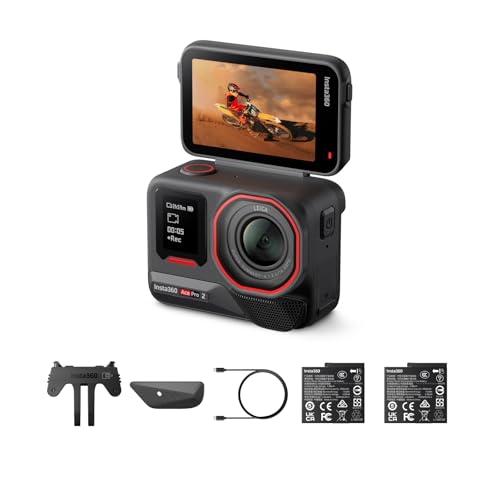
Insta360 Ace Pro 2 — Best low light
The Ace Pro 2 is the action camera designed by a company that asked what presenters, rather than athletes, actually need — and the answer is written across its body in a 2.5-inch flip touchscreen. Where rivals give the vlogger a small fixed front display, Insta360 gives a proper articulating screen that faces the speaker at any angle, tilts for low and high shots, and turns the camera into something closer to a pocket vlogging machine that happens to be waterproof and shockproof. Behind it sits a 1/1.3-inch sensor capable of 8K recording, a Leica SUMMARIT lens, and a dual-AI-chip design whose night modes produce the cleanest low-light action footage in this guide.
The bundle listed here includes dual batteries, a practical mercy for a camera whose screen and processing invite heavy use. Its AI editing ecosystem — automatic highlight assembly in the companion app — serves the creator whose bottleneck is the edit rather than the shoot, and its gesture and voice controls suit the mounted, hands-busy moments. Stabilisation is strong, the build shrugs at weather, and the microphone story includes wind-guard thinking in the design. What it lacks against GoPro is, again, the ecosystem: mounts exist, mods are fewer, and the action world’s shared language is not yet Insta360’s.
Judge it as the presenter’s action camera and it wins its category comfortably. Night markets, evening rides, neon streets — the footage holds together where rivals smear — and the flip screen makes every one of those scenes self-filmable without a phone as a monitor. For the vlogger whose action happens after dark or whose style is face-first with the world as backdrop, the Ace Pro 2 is not the alternative choice. It is the considered one, and its presence in this guide is the proof that the GoPro shelf now has to argue for its crown rather than assume it.
- Sensor: 1/1.3-inch, 8K-capable
- Lens: Leica SUMMARIT
- Screen: 2.5-inch flip touchscreen
- Photos: 50MP stills
- Bundle: dual batteries in this listing
- Extras: AI editing and highlight tools
Strengths
- Flip screen is the best presenter interface here
- Low-light footage leads the action class
- AI editing shortens the path to publishing
Trade-offs
- Mount and mod ecosystem still maturing
- Flip hinge asks for more care than fixed screens
- 8K is a special-occasion mode, not a daily one
Best for: face-first vloggers filming evenings, cities and night rides.
Not suited for: heavy mount-swapping production styles built on GoPro hardware.
DJI Osmo Action 4 — Previous-generation route (prose-only)
The Osmo Action 4 earns its place in this guide on merit and loses its link on logistics, and both facts deserve plain statement. On merit: its 1/1.3-inch sensor, 4K recording at up to 120 frames per second, excellent stabilisation, dual screens and cold-weather battery manners made it the action camera that first forced the GoPro comparison to become a real argument, and it remains a thoroughly capable vlogging tool — the direct predecessor whose strengths the Action 5 Pro above inherited and extended. Thousands of channels film on it today without a single apology in the footage.
On logistics: when we checked the listings for this guide, no clean Amazon listing for the Action 4 came up, so this guide will not invent one or route you through a marketplace listing it cannot verify. The sensible routes are the manufacturer’s own store and established camera retailers, where the camera continues to sell as DJI’s previous-generation option, frequently as the value entry into the DJI ecosystem — sharing mounts and the wireless microphone pairing that make the Action 5 Pro attractive, at a previous generation’s positioning. Check the seller’s identity and the warranty terms as you would with any previous-generation purchase, and confirm whether the unit is new stock through that channel.
For the buyer, the calculus is honest. If the Action 5 Pro’s tracking, screens and storage justify their premium, buy the current camera through the link above. If the Action 4’s specification covers your filming — and for most action vlogging it does — buying it through DJI or a trusted retailer is a rational, even shrewd route into the same ecosystem, with the same mounts waiting for whichever DJI body comes next. What this guide will not do is pretend a listing exists where its own verification found none; the camera is recommended, the route is explained, and the link is absent on purpose.
- Sensor: 1/1.3-inch
- Video: 4K up to 120fps
- Screens: dual touchscreens, front and rear
- Stabilisation: DJI RockSteady generation of its year
- Status: prose-only — no clean listing was available at the time of writing
- Route: DJI’s own store and established retailers
Strengths
- Previous-generation flagship ability
- Shares the DJI mount and microphone ecosystem
- Proven by a full generation of working channels
Trade-offs
- No verified listing to link from this guide
- Screens and tracking a step behind the Action 5 Pro
- Previous-generation support horizon
Best for: value-minded creators entering the DJI ecosystem through official channels.
Not suited for: anyone who wants this guide to hand them a one-click purchase.
The Action Shelf Compared: Screens, Sensors and Ecosystems
| Camera | Top video | Self-framing | Stabilisation | Audio path | Ecosystem |
|---|---|---|---|---|---|
| HERO13 Black | 5.3K 60fps | Front screen | HyperSmooth | Media Mod, external options | GoPro, deepest |
| HERO13 Creator Edition | 5.3K 60fps | Front screen, grip handling | HyperSmooth | Media Mod included | GoPro, pre-assembled |
| HERO12 Black | 5.3K 60fps, HDR | Front screen | HyperSmooth | Media Mod compatible | GoPro, full |
| Osmo Action 5 Pro | 4K 120fps | Front touchscreen | DJI stabilisation | Native wireless mic pairing | DJI, growing |
| Ace Pro 2 | 8K capable | Flip touchscreen | FlowState-class | Wind-guarded internal, accessories | Insta360, maturing |
| Osmo Action 4 | 4K 120fps | Front touchscreen | DJI stabilisation | Wireless mic pairing | DJI (prose-only here) |
The table’s story is convergence with different accents. Every camera stabilises superbly, every camera frames its owner somehow, and every camera records more resolution than a phone screen can display. The differences that survive are the front interface — fixed screen, touchscreen or flip screen — and the ecosystem column, which is really a prediction about your next five years of accessories. Choose the interface your filming style touches hourly and the ecosystem your drawer will thank you for, and the camera attached to both will be the right one almost regardless of its badge.
How Do You Keep a Voice Audible Over Wind and Motion?
Action footage fails on audio more than on any other axis, because the activities that justify an action camera generate the wind that destroys speech. The hierarchy of rescue is consistent across all three brands. First, position: a camera on a chest mount in the body’s wind shadow records a kinder voice than one on a helmet in the full blast, and a presenter who turns their back to the wind for the piece to camera performs a free audio upgrade. Second, the wind protection: foam and furry covers over the microphones, or the Media Mod’s directional capsule on the GoPro side, tame the buffeting that no software fully removes. Third, the wireless lavalier: DJI’s native pairing makes it the easiest here, GoPro routes it through the Media Mod, and Insta360 through its accessories — in every case, a microphone on the chest ends the wind argument more decisively than any camera setting.
One more audio reality deserves print: the camera’s own sounds. Buttons, mounts and cases all speak on an action recording — the click of a latch, the creak of a chest strap, the rattle of a loose mount — and they are loudest exactly when the activity is quietest. A thirty-second test at each new setup, listened to on headphones rather than assumed, catches the rattle while it is still a five-minute fix instead of a ruined day’s narration track.
Set expectations with the same honesty. An action camera’s internal microphones, however good, are ambience-and-commentary tools; the vlogger whose format is continuous narration at speed should budget the microphone solution with the camera, not after the first ruined ride. Conversely, the creator whose format is activity first and commentary at rests will find the internal audio of every camera here perfectly serviceable. Match the audio plan to the format before the purchase, and the wind becomes a texture in the footage rather than the reason it was deleted.
What Mounting Strategy Should a New Action Vlogger Start With?
Begin with the three mounts that cover ninety percent of vlogging: a handle or grip for presenting — the Volta in the Creator Edition’s case — a chest or head mount for point-of-view, and a small tripod or clamp for the static pieces to camera. That trio, plus the camera, is a complete vlogging studio that fits in a bottle pocket. Resist the catalogue’s deeper pages until your footage asks a specific question: the suction mount when the channel acquires a vehicle, the extension pole when the framing needs altitude, the dive housing when the depth rating’s honest limit approaches.
Label the mounts as the kit grows — a strip of tape and a marker on each base — because three black mounts in a dark bag at dawn are a puzzle nobody solves cheerfully. The labelled kit gets used; the anonymous kit gets left. It is the smallest sentence in this guide and, on the evidence of a hundred dawn starts, one of the most valuable.
The mounting discipline that matters is rehearsal. Every mount changes the angle, the audio distance and the stabilisation’s behaviour, and the creator who tests a new mount on a throwaway ride keeps the real ride. Magnetic systems — GoPro’s latch, DJI’s quick-release thinking — shorten the swap between mounts to seconds, which encourages the multi-angle filming that separates edited vlogs from single-take diaries. Whatever the brand, buy mounts for the shots you already film, in the order you film them, and the drawer will contain a working kit rather than a museum of intentions.
Which Action-Camera Mistakes Ruin the Most Vlogs?
The first is filming everything at maximum settings — highest resolution, highest frame rate — and discovering the tax in heat, battery and card space before the day is half filmed. Action cameras are sprinters; the vlogger’s craft is spending their stamina on the moments that matter and cruising at sensible settings between them. The second is the forgotten front element: a fingerprint, a raindrop or a salt crust on the lens cover softens every frame, and the ten-second cloth ritual before each session is the cheapest image-quality upgrade in this entire guide.
A related error is mounting the camera once and filming the entire day from a single viewpoint, because the mount was effortful to fit. Variety of angle is the action genre’s editing oxygen — the same descent from chest, helmet and a trailside tripod becomes a sequence, while any one of them alone becomes a screensaver. The magnetic and quick-release systems in this guide exist to make the variety cheap; use them as the invitation they are, changing the camera’s seat at every natural stop.
The third mistake is trusting stabilisation to fix composition — pointing the camera vaguely at the day and hoping the crop will find the story. Stabilisation smooths motion; it does not choose subjects, and the front screens on every camera here exist precisely so the choice gets made deliberately. The fourth is neglecting the boring firmware and app updates that quietly improve battery reporting, thermal behaviour and connectivity across all three brands. None of these mistakes is about talent. All of them are about rituals, and rituals are free.
How Do Batteries Behave at the Summit, the Shore and the Desk?
Action cameras live harder lives than any other class in this series, and their batteries report the conditions honestly. Cold is the historic enemy — capacity shrinks as temperature falls, which is why the Enduro-class batteries in the current GoPro generation and DJI’s cold-tolerant designs matter to skiers and winter riders rather than merely appearing in their brochures. Heat taxes from the other direction: a camera recording maximum settings in direct summer sun is cooking itself from inside and out, and the experienced action vlogger films the midday segment at sensible settings or in shade breaks, saving the sprint modes for the moments that justify them.
Recording settings are a battery decision as much as a quality one, a connection inexperienced owners miss until a card-and-battery audit teaches it. The flagship resolutions and frame rates are for the descent, the jump and the interview at the top — the minutes that carry the video — while the walk to the lift and the drive to the trail can be filmed a class lower without a single viewer noticing. Budgeting pixels like petrol, generously where the road is beautiful and frugally where it is not, is the unglamorous skill underneath every long action channel.
The working system is unglamorous and universal. Carry batteries by the day’s filming pattern rather than by hope — two for a typical outing, more for a summit attempt — keep them warm in an inside pocket in winter, and rotate them so no single battery ages alone. At the desk end of the life, these cameras double as webcams and streaming sources on mains power, where the battery question evaporates. The Ace Pro 2’s dual-battery bundle acknowledges the arithmetic in its box; every other owner here should replicate the logic in their first accessory order, because the summit does not sell spares.
What Does the Edit Ask of an Action Vlogger?
Action footage arrives in the edit with two gifts and one demand. The gifts are stabilisation that survives the timeline and resolutions — 5.3K, 8K, high-rate 4K — that let an editor crop, reframe and slow the footage without it falling apart, effectively directing the shot after the day has ended. Insta360’s app-driven highlight assembly and the brands’ auto-edit tools shorten the path for creators whose bottleneck is time at the desk. The demand is volume: an action day generates footage the way weather generates rain, and the creator without a selection ritual drowns in their own archive.
File discipline deserves its sentence inside the ritual: name the day’s folder by date and place before anything is copied, because action archives become unsearchable faster than any other kind — a thousand wide-angle clips of blue sky and handlebars, identical until the metadata saves them. The ten minutes spent naming on the evening of the shoot are the cheapest production insurance in the genre.
The ritual that works is ruthless and early. Mark the keepers on the day, while memory can still name them; back up once, properly, before the card is wiped; and cut the long version before the short ones, because the day’s story is easier to find at full length than in fragments. High frame rates deserve a specific warning: slow motion is a spice, and the channel that slows everything teaches its audience to feel nothing at the moments that deserved it. Film the day at honest speed, slow the three seconds that earned it, and the action camera’s gifts will read as craft rather than as effects.
How Should You Film Yourself When the Camera Is the Size of a Matchbox?
Self-framing on an action camera is a discipline of angles rather than of screens alone. The ultra-wide lenses here forgive a great deal — a chest mount at a slight upward tilt, a grip extended to arm’s length, a helmet mount checked once in the front screen before the descent — but forgiveness is not composition. The presenters whose footage looks intentional share three habits: they check the frame at the start of each new setup rather than trusting yesterday’s angle, they keep their own face out of the frame’s distorted edges where wide lenses stretch features, and they let the environment occupy most of the picture, because the wide view of a place with a person in it is the action camera’s native masterpiece.
There is a presenter’s trick specific to the wide lens worth passing on: address the camera from slightly closer than feels natural, because the wide view shrinks a person within their landscape and the voice must reclaim the intimacy the framing surrenders. The front screens here let you verify the balance in the first take rather than the edit — face large enough to read, world large enough to justify the journey. When that balance is right, the action vlog achieves the thing no other format can: the audience feels accompanied rather than addressed.
Voice completes the self-filming craft. Speak toward the camera’s actual position rather than toward the horizon, raise the volume a notch above conversational without shouting — wind and distance will tax it back down — and record a ten-second test at each new mount, because a chest strap’s audio and a helmet’s audio are different instruments wearing the same camera. The creators who build these checks into the day’s rhythm stop reshooting summits. The ones who rely on hope develop strong legs and quiet footage.
When Should an Action Camera Hand Over to a Conventional One?
The mature action channel owns a boundary, and knowing it saves both footage and money. Action cameras own the moving, wet, mounted and dangerous hours; conventional cameras own the seated interview, the dim venue, the product table and the shallow-depth portrait. The crossover test is simple: if the shot needs the camera to survive the environment, send the action camera; if it needs the environment to flatter the subject, send the conventional one. Channels that respect the boundary stop asking either tool to apologise for its nature, and their action cameras live longer for being spared the desk.
There is a budget logic to the boundary as well. Every hour an action camera spends on desk duty is an hour its seals, doors and lens cover are being consumed by the safest work in the building, while the conventional camera that should own that work sits idle. Assigning each tool its native hours is not fussiness; it is how a two-camera channel keeps both cameras alive until the work, rather than the wear, retires them.
The partnership is easier than it sounds because the footage cuts together better than purists expect. Match the colour intent in each camera’s settings — the flatter profiles where editing time exists, the vivid ones where it does not — keep the frame rates consistent between the pair, and let the action camera’s wide establishing shots introduce scenes the conventional camera then inhabits. Many of the strongest travel and adventure channels are built on exactly this marriage, and the action half of it is any of the six cameras in this guide, chosen by ecosystem and interface rather than by fear of choosing wrong.
How Long Does an Action Camera Stay Current?
Longer than its launch cycle suggests, because the class’s core virtues plateaued early: stabilisation that fools the eye, waterproofing that shrugs at weather, and resolution beyond the screens it plays on. The HERO12’s presence in this guide as a first-class recommendation is the evidence — a previous flagship whose footage remains publishable anywhere. What genuinely ages is the support ring around the camera: batteries stop being stocked, apps move on, mounts standardise around newer latches. Buying the current or immediately previous generation, as this guide’s six all are, keeps a camera inside that support ring for years.
Firmware belongs in the longevity ledger too. All three brands in this guide continue refining their recent cameras after launch — thermal behaviour, battery reporting, app reliability — and the owner who updates on a quiet evening rather than at a trailhead owns a measurably better camera by spring than the one bought in autumn. Check for updates when a new season’s filming begins, never on the morning of an unrepeatable day, and read the notes before applying: the discipline is five minutes, the dividend is a camera that keeps improving while it ages.
The owner’s contribution to longevity is maintenance suited to a hard-used tool. Rinse salt and grit from seals, dry the camera before opening its doors, inspect the lens cover the way a diver inspects a mask, and store batteries half-charged between seasons. An action camera treated this way does not merely survive its adventures; it accumulates the scratches of a documented life, which its owner tends to read, correctly, as the channel’s own history written on the equipment.
What Safety Habits Belong in an Action Vlogger’s Routine?
A camera that films from helmets, handlebars and boards inherits the safety logic of the activities themselves, and the guide would be negligent to skip it. Mounts on a person should use the breakaway and tether habits the manufacturers intend: a secondary tether on any mount whose failure would drop the camera into traffic, water or a piste, and chest or helmet placements that never compromise the protective equipment they attach to. A camera is replaceable in a way its owner is not, and no shot in this guide’s imagination justifies modifying a helmet’s integrity or a harness’s function.
A third habit protects the footage rather than the filmer: check the lens cover at every stop, because the action day’s enemies — spray, dust, sunscreen, a glove’s swipe — accumulate invisibly and announce themselves only in the evening’s review. The cloth lives in the same pocket as the spare battery, and the two rituals, power and glass, are performed together until they are one gesture. Channels are rarely ruined by dramatic failures; they are eroded by a season of slightly fogged lenses, and the erosion is entirely optional.
The second habit is attention budgeting. Filming while moving divides the mind, and the creators who last in this genre automate the division: voice control for the record command, angles set before the movement starts, and a personal rule that the camera is operated only at stops. The footage improves under the same rule, because a camera started deliberately frames better than one fumbled into life mid-descent. Treat the action camera as a passenger with opinions — consulted at rests, trusted during the action — and it will document a longer, safer career than the alternative arrangement ever allows.
How Do the Three Ecosystems Treat an Additional Camera?
Success on an action channel usually means filming from two viewpoints, and the ecosystems price that ambition differently. GoPro’s world is the most forgiving: a HERO12 and a HERO13 share mounts, mods and batteries’ neighbourhood, so the value pick in this guide doubles naturally as the flagship’s B-camera. DJI’s pair behaves similarly inside its own mount and microphone system, which is why the prose-only Action 4 remains strategically interesting even unlinked — bought through DJI, it is a spare viewpoint and a backup body in one. Insta360’s ecosystem is the youngest, and its multi-camera story leans on the app’s editing intelligence to blend viewpoints rather than on hardware commonality.
Second-hand action cameras deserve a buyer’s paragraph of their own, since this class changes hands constantly. Inspect the lens cover for scratches — it is the image — test every door’s seal, cycle the battery through a real recording rather than trusting its percentage, and confirm the camera pairs with the current app, because an action camera orphaned from its software loses half its workflow. A previous-generation body like the HERO12 or the Action 4, bought this carefully from a seller who answers questions, is among the rational purchases in this entire series of guides.
The practical advice is to choose the first camera as if the second were already planned, because in a growing channel it is. Buy into the ecosystem whose mounts you would happily own twice, keep the first camera when the second arrives rather than selling it into the upgrade, and mark the pair’s settings to match — frame rate, colour intent, stabilisation behaviour — so the edit treats them as one instrument with two viewpoints. The channels that look professionally crewed are usually one person, two small cameras and this paragraph’s worth of foresight.
Final Recommendation
The HERO13 Black is the action vlogging benchmark — the camera, the lenses and the ecosystem a channel can grow inside for years — and its Creator Edition is the same answer pre-assembled for presenters. The HERO12 delivers most of the experience to the value-minded without leaving the ecosystem. DJI’s Action 5 Pro is the strongest defection case ever made, with the screens and microphone pairing a fresh starter should weigh seriously, while the Action 4 remains its sensible previous-generation route through DJI and retailers, unlinked here for the stated reason. The Ace Pro 2 owns the night and the flip screen. Choose by the days you actually film — water, wheels, streets or summits — and the right badge will already be attached to the camera that survives them.
Frequently Asked Questions
Can an action camera really serve as a main vlogging camera?
For outdoor, travel and activity-led channels, yes — many do exactly that, because the format values presence and durability over shallow depth of field. The front screens on every pick here make self-framing practical, and the audio paths, properly planned, carry a voice. Desk-led and low-light-led channels will still prefer a conventional camera’s sensor and lens choices, which is a format decision rather than a quality verdict.
Is the Creator Edition worth choosing over the bare HERO13?
If you will present to camera — talk, demonstrate, hold the rig — then yes: the Volta grip, Media Mod and light are the accessories that format buys anyway, gathered in one box with a case that fits them. If your camera will live on mounts and never be held, the bare HERO13 plus your chosen mounts is the leaner purchase. The camera inside is identical; the question is purely which filming life it will lead.
Why is the DJI Osmo Action 4 not linked?
Because, as of our latest check, no clean Amazon listing for it could be verified, and this guide links only what it can verify. The camera itself is recommended on its merits as DJI’s previous-generation option, available through DJI’s own store and established retailers. Buy it there with the usual checks on seller and warranty, and you join the same mount and microphone ecosystem as the Action 5 Pro.
Which of these handles low light best?
The Insta360 Ace Pro 2, whose sensor, lens and night processing were designed with after-dark filming as a headline rather than a footnote. The DJI pair follow with their large sensors, and the GoPros trail slightly while remaining usable in lit streets. No action camera repeals physics — all of them prefer a lit face — but the Ace Pro 2’s margin in the dark is real and repeatable.
Do I need a separate microphone for action vlogging?
Only your format knows. Activity-led filming with commentary at rest works well on internal microphones, especially with wind protection fitted. Continuous narration at speed — cycling, skiing, boating — needs a microphone near the mouth: DJI’s wireless pairing is the most seamless route here, GoPro’s Media Mod the most established, and either will transform the footage more than any camera upgrade at the same money.
How waterproof are these cameras in real use?
All five linked cameras are waterproof to their rated depths without a housing, which covers swimming, surfing, rain and snow as vlogging realities. Read the rating for your specific model, rinse salt water off after ocean days, and treat the housing as the tool for genuine diving depths rather than for the pool. The ratings assume intact seals and closed doors — check both before the camera meets the water, every time.
Can these cameras replace a phone for travel vlogging?
For the filming itself, comfortably — they are tougher, steadier and better mounted than any phone, and their wide views suit travel’s scale. The phone remains the better editor, publisher and backup, which is why most travel creators run the pair as a system: action camera for the day, phone for the evening’s cut and upload. The rivalry is a false one; the partnership is the professional arrangement.
Which pick suits a cycling or riding channel best?
The HERO13 for its mounting depth and magnetic swaps between bike, chest and helmet, with the Action 5 Pro as the screen-and-microphone alternative for riders who narrate continuously. Both want the wind strategy from this guide’s audio section, and both reward the tether habit from the safety section. The HERO12 serves the same channel gladly when the budget prefers accessories to novelty.
Related Guides
Round out the kit with lightweight cameras for vlogging beyond the action class, beginner vlog cameras for calmer filming lives and autofocus-led vlogging cameras for desk and studio work.
Related guides
- Best Canon Point and Shoot Digital Cameras: PowerShot Picks From Pocket Compacts to Travel Zooms
- Best Balancing Stabilizers for Mirrorless Cameras: Payload, Balancing and Native Vertical Shooting
- Best Basic Phones Camera Buyers Can Trust: Flip Phones and Simple Handsets That Still Take a Photograph
- Best Sony Full Frame Cameras for Astrophotography: Sensitivity vs Resolution


