What's inside
As an Amazon Associate I earn from qualifying purchases. This post may contain affiliate links at no extra cost to you.
gizmoverdict.com is reader-supported. When you buy through links on our site, we may earn an affiliate commission.
Where to buy: Outdoor-rated televisions sell through a narrower channel than living-room sets, so porch models often appear in seasonal waves and in fewer sizes at once. The six sets gathered here were listed and orderable when this guide was assembled, yet a particular screen size can pause between production runs, especially the smaller covered-patio models. If a porch project has a fixed mounting date, order the television before the bracket and the outdoor outlet cover, because the panel is the piece least easily substituted at the last minute.
The search for the best tvs for porches starts with a correction that saves money and frustration: a porch television is an outdoor television, full stop. A screen built for a living room carries seals, vents, and a panel finish designed around dry indoor air, and a covered porch still delivers humidity, dust, pollen, temperature swings, and angled sunlight every single day. The six picks below were chosen because their listings state a weatherproofing grade, a shade class, or a brightness figure suited to outside use. One carries an IP56 rating at fifty inches, another pushes a stated 2500 nits for brighter exposures, and the full-shade models from SunBriteTV and Furrion say plainly which light conditions they were built for. That honesty matters more than raw screen size, because a porch set that survives five summers beats a larger indoor panel that clouds over in its second season.
Think about your own porch honestly before reading further. Is the screen wall under a deep roof that never takes direct sun, or does late-afternoon light rake across the seating area for an hour each day? Does rain blow in sideways during storms, or is the space screened and sheltered on three sides? Those answers sort these six televisions quickly. Full-shade models belong under real cover. Brighter, anti-glare panels earn their keep where the roofline is shallow. Compact sets suit screened porches where viewers sit six feet away, while the seventy-five-inch SunBriteTV exists for deep porches and patio rooms where the back row sits far from the wall.
Key Takeaways
- Every pick here is outdoor-rated in its listing; none is an indoor television being stretched into porch duty.
- Weatherproofing grades stated across the six listings run from IP55 through IP65, and the grade should match how much wind-driven rain reaches your screen wall.
- Shade class decides watchability: the SunBriteTV and Furrion sets name full shade, the SYLVOX Deck Pro names partial sun and full shade, and the 2500-nit fifty-five-inch model targets the brightest exposures in this group.
- Brightness figures stated in the titles span 400 nits for the shaded Furrion up to 2500 nits for the high-output fifty-five-inch set, which shows why matching the panel to the porch matters more than chasing the biggest number.
- Screen sizes here run from thirty-two inches to seventy-five, so seating distance, not wall width alone, should set the size.
- Smart platforms vary across the six — Google TV, Tizen, and webOS all appear — so pick the interface your household already knows where two sets otherwise tie.
Quick Picks
| Pick | Label | Why it stands out |
|---|---|---|
| SYLVOX 50-inch Outdoor TV IP56 | Best overall | IP56 sealing, a stated 1000 nits, and Dolby Atmos support at a mid-size fifty inches |
| 55-inch Outdoor TV 2500 Nits Google TV | Best for bright porches | The highest stated brightness in this group, anti-glare glass, and a Wi-Fi booster |
| SunBriteTV 75-inch Veranda 4 Series | Best for large shaded porches | Seventy-five inches of full-shade 4K HDR from a dedicated outdoor brand |
| Furrion Aurora 43-inch Full-Shade Outdoor TV | Best for compact shaded porches | Impact-resistant screen, external antenna, and a 400-nit panel tuned for shade |
| Titan S100 QLED 32-inch Covered Patio TV | Best small-screen porch pick | IP65 sealing and QLED colour in a thirty-two-inch covered-patio format |
| Titan L100 QNED 55-inch Covered Patio TV | Best picture-quality porch pick | QNED panel, Dolby Vision and Atmos, and webOS under an IP65 rating |
How were these porch picks chosen?
The first filter was survival. Each listing had to state something concrete about outdoor duty: an ingress-protection grade, a weatherproof or weather-resistant claim tied to a named model line, or a shade classification. Vague marketing about being great for gatherings did not count. The SYLVOX Deck Pro states IP56, the two Titan sets state IP65, the bright fifty-five-inch model states IP55, and the SunBriteTV and Furrion sets anchor their claims in the full-shade category that dedicated outdoor makers use. That spread is useful because porches differ, and a reader with a screened, roofed porch can weigh a shade-class set against an IP-rated one with open eyes.
The second filter was watchability in real porch light. Brightness claims in these titles range widely, and the numbers only mean something against a shade class. Four hundred nits behind anti-glare glass in permanent shade can look perfectly comfortable, while the same output on a west-facing open porch would wash out by supper time. So the guide pairs each brightness figure with the exposure its maker names, and the reviews below keep returning to that pairing rather than treating nits as a league table.
The third filter was fit. Porch seating is fixed in a way living-room seating rarely is: chairs bolt around a table, a swing hangs where it hangs, and the screen wall is usually the one wall with power. Sizes from thirty-two to seventy-five inches let the guide cover a breakfast nook screen through to a genuine outdoor cinema wall. Panel technology and smart platform were the final sort, with QLED and QNED sets separated from standard LED models, and Dolby Vision or Atmos support noted exactly where a title states it and nowhere else.
One more discipline ran through the selection. Accessories were never allowed to stand in for the television itself. An enclosure or a fabric cover can help an installation, but neither converts an indoor panel into an outdoor one, so no pick below leans on an accessory to justify its place. If you are comparing a set here against a bargain indoor model plus a cover, compare honestly: the cover protects against dust and splashes while the set is idle, yet it does nothing for humidity inside the chassis or for a panel finish that was never made to face daylight.

1. SYLVOX 50-inch Outdoor TV IP56 — Best overall
The SYLVOX Deck Pro 3.0, in its 2026 listing form, is the most complete porch package in this group because it answers both porch questions at once. Its title states IP56 weatherproofing, which speaks to dust and water-jet resistance, and it states 1000 nits of brightness with an intended exposure of partial sun and full shade. That pairing is exactly the middle ground most real porches occupy: roofed, but with a bright open side where daylight spills across the screen for part of the day. At fifty inches it is large enough for a dining table of six to follow a match, yet not so wide that a modest porch wall feels consumed by glass.
The picture specification is straightforward 4K smart television territory, and the title adds support for Dolby Atmos, which matters more outdoors than many buyers expect. Porch audio fights birdsong, traffic, and the clatter of a grill, so a set whose audio chain can hand off to an Atmos-capable soundbar or drive a fuller sound on its own gives dialogue a better chance of staying intelligible at sensible volumes. The smart platform is not named in the title beyond the smart designation itself, so the spec box below records that honestly; what the title does promise is the outdoor hardware, and that is the part a porch buyer cannot retrofit later.
Installation thinking suits the class. A fifty-inch outdoor set is a two-person lift with a heavier chassis than an indoor equivalent, and the mount should be an outdoor-rated bracket fixed into studs or masonry rather than a lightweight indoor arm. Because the listing positions this model for partial sun, the wall choice still matters: partial sun means the panel tolerates bright ambient light and brief direct exposure, not that it should bake on an unshaded south wall all afternoon. Angle it away from the strongest reflection path and it will reward you with the most forgiving placement brief of any pick here.
Day to day, this is the set to shortlist when the porch serves several jobs — morning news with coffee, afternoon sport, evening films — because no single specification has been traded away. Readers weighing it against the much brighter fifty-five-inch model below should ask whether their porch truly sees direct sun on the screen; if the answer is no, the SYLVOX balance of sealing, brightness, and size is the calmer purchase, and its fifty-inch footprint leaves room on the wall for speakers or shelving. For porch owners who want one recommendation to act on, check price on Amazon for the Deck Pro in its current listing form before settling the mount position.
Strengths
- IP56 weatherproofing stated outright, covering both dust and water resistance for exposed porch walls.
- 1000-nit brightness paired with an explicit partial-sun and full-shade brief, the most flexible exposure rating here.
- Dolby Atmos support gives porch dialogue a stronger route to an external sound system.
Trade-offs
- At fifty inches it will feel small on a deep porch where seating sits twelve feet or more from the wall.
- The title does not name the smart platform, so app availability needs confirming on the product page.
- Partial-sun positioning still rules out a fully exposed, unshaded mounting wall.
Spec box
- Screen size: 50 inches
- Resolution: 4K
- Weatherproofing: IP56, stated in the listing title
- Brightness: 1000 nits, stated
- Intended exposure: partial sun and full shade
- Audio: Dolby Atmos support stated
- Model line: Deck Pro 3.0 / 2026
- Smart platform: Not stated in the listing title
Best for: a roofed porch with one bright open side, seating five to nine feet from a fifty-inch screen.
Not suited for: an unroofed deck wall taking direct sun for most of the day, where a partial-sun rating is the wrong brief.

2. 55-inch Outdoor TV 2500 Nits Google TV — Best for bright porches
Brightness is the whole argument for this fifty-five-inch set, and its title makes the argument in numbers: 2500 nits, described as super bright, with an anti-glare screen in front of the panel. That output class exists for porches where the roof ends early, the screen wall catches morning or evening sun, and lesser panels turn into mirrors. If your porch has a glare problem you have already noticed while reading a phone out there, this is the pick designed around your complaint. The listing adds IP55 weatherproofing, a step below the IP56 and IP65 sets here on dust sealing, yet still a genuine outdoor rating rather than an indoor set with a hopeful description.
Google TV is the named platform, which settles the app question the SYLVOX leaves open: the major streaming services live in that ecosystem, and voice search through the Google interface suits a porch where the remote gets passed around. HDR10 is the stated high-dynamic-range format. The title also names a Wi-Fi booster, a detail that deserves more attention than it usually gets, because porches sit at the edge of home network coverage and a weak signal shows up as buffering precisely when a live match reaches its climax. A set that acknowledges the distance from the router is solving a real porch problem, not padding a feature list.
Placement discipline still applies. Anti-glare coatings scatter reflections rather than deleting them, and 2500 nits buys headroom rather than immunity, so the screen should still be angled to keep the sun itself out of the glass where the wall allows it. The extra brightness also serves ordinary daylight, not only direct sun: a bright porch at noon with no sun on the screen at all can still defeat a dim panel, and this model keeps contrast comfortable in that washed-out ambient light. For mixed use — sport in the afternoon, a film after dark — the headroom simply means the backlight is never working at its limit during the hours the porch gets used most.
Against the Titan L100 at the same fifty-five inches, the trade is clear: this set spends its budget on brightness and network help, while the Titan spends its own on panel technology and Dolby Vision. Porch first, picture finesse second is the right order for a bright exposure, so sun-struck readers should see the current Amazon listing for this 2500-nit model and confirm the mounting pattern suits their bracket before ordering.
Strengths
- 2500-nit stated brightness is the highest in this group by a wide margin, aimed at sunlit porches.
- Anti-glare screen treatment directly addresses the reflection problem that ruins bright-porch viewing.
- A Wi-Fi booster is named in the title, tackling the weak-signal reality of rooms at the garden edge.
Trade-offs
- IP55 sealing is a grade below the IP65 Titan sets for dust and water exposure.
- HDR support is stated as HDR10 only; Dolby Vision is not named in the title.
- The brand is unbranded in the listing title, so long-term support rests on the seller rather than a familiar maker name.
Spec box
- Screen size: 55 inches
- Resolution: 4K
- Weatherproofing: IP55, stated in the listing title
- Brightness: 2500 nits, stated
- Screen finish: anti-glare, stated
- HDR: HDR10
- Platform: Google TV
- Connectivity note: Wi-Fi booster stated
Best for: a shallow-roofed or open-sided porch where direct sun or strong glare reaches the screen wall.
Not suited for: a dusty, storm-blown installation where the IP55 grade is the weakest sealing in this line-up.
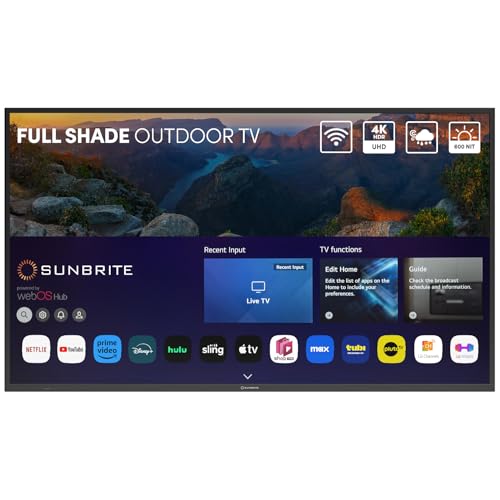
3. SunBriteTV 75-inch Veranda 4 Series — Best for large shaded porches
SunBriteTV builds nothing but outdoor televisions, and the Veranda line is its full-shade family, designed for covered spaces where the screen never takes direct sun but lives outside permanently. This seventy-five-inch Veranda 4 Series model is the largest pick in the guide by a considerable distance, and its title keeps the specification honest and simple: Smart Outdoor TV, Full Shade, 4K UHD HDR, model SB-V4-75-BL. No brightness figure is stated, which is consistent with a full-shade brief — in permanent shade, contrast and panel quality carry the picture, and a maker specialising in this category tunes for that environment rather than quoting a nit count meant for sunnier walls.
Seventy-five inches changes porch planning in ways the smaller picks never raise. The wall must be wide, the mount must be seriously anchored, and delivery through a garden gate or a narrow side passage needs measuring before the order, not after. Viewing distance rewards the effort: a porch room with a sofa line ten to fourteen feet back finally gets a screen that fills the same field of view a living-room set provides at eight feet. Group viewing is the natural use — a full table, a row of loungers, a sports night where nobody is squinting at a fifty-inch panel from the far end of the porch.
The full-shade designation must be respected rather than negotiated with. Veranda-class panels are not built for partial sun, and placing this set where afternoon sun lands on the glass will produce exactly the washed-out picture its specification warns against, while adding heat load the chassis was not briefed for. Under a deep roof, a pergola with a solid cover, or inside a screened porch room, those constraints disappear and the set does the one job it was designed for at a scale nothing else here matches. Readers planning a genuinely large outdoor room may also be weighing indoor-style giant screens; our guide to best 80 inch tvs explains the big-screen living-room class, and the contrast underlines why an outdoor-rated seventy-five belongs on the porch instead.
Because the title is spare, confirm the smart platform details and port layout on the product page before committing, since the listing title does not enumerate them. What is not in doubt is the category fit: a dedicated outdoor maker, a named shade class, and 4K HDR at seventy-five inches. For a big shaded porch being furnished once and furnished properly, check the Amazon price on the Veranda 4 and measure your delivery route the same day.
Strengths
- Seventy-five-inch screen dwarfs every other pick here and suits deep porch rooms and long viewing distances.
- A dedicated outdoor manufacturer with a named full-shade line purpose-built for covered spaces.
- 4K UHD with HDR stated, at a size where the resolution genuinely earns its place.
Trade-offs
- Full-shade brief only; partial-sun placement is outside its design envelope.
- No brightness figure or ingress grade is stated in the listing title.
- The largest, heaviest installation here, demanding structural mounting and a checked delivery path.
Spec box
- Screen size: 75 inches
- Resolution: 4K UHD
- Intended exposure: full shade, stated
- HDR: stated as HDR in the title
- Model: SB-V4-75-BL, Veranda 4 Series
- Brightness: Not stated in the listing title
- Ingress grade: Not stated in the listing title
- Platform: smart TV; platform name not stated in the title
Best for: a deep, fully roofed porch room with seating ten feet or more from a very large screen.
Not suited for: a wall catching direct afternoon sun, which sits outside the Veranda full-shade brief.

4. Furrion Aurora 43-inch Full-Shade Outdoor TV — Best for compact shaded porches
Furrion made its name equipping RVs and outdoor spaces, and the Aurora forty-three-inch full-shade model applies that thinking to smaller porches. Its title is unusually informative: 4K LED, HDR10, anti-glare treatment, a 400-nit LED screen, an impact-resistant screen surface, and an external antenna for shaded outdoor areas. The 400-nit figure will look modest beside the 2500-nit pick above until the shade class is factored in — this panel is specified for permanent shade, where 400 nits behind anti-glare glass is a sensible, comfortable output rather than a compromise.
Two details separate the Aurora from generic small outdoor sets. The impact-resistant screen matters on porches that double as play space, storage overflow, or the route to the garden, where a stray ball or a carried ladder is a realistic hazard rather than a freak accident. The external antenna matters for a different reason: shaded porches often sit under metal roofs or dense tree cover that weaken broadcast reception, and a set that ships with an antenna solution acknowledges that some porch viewing is still over-the-air local channels, morning news, and live sport without a streaming subscription.
At forty-three inches, the Aurora suits breakfast porches, screened side porches, and seating arranged four to seven feet from the wall. It is also the most plausible second-screen pick here — the set for the porch off the kitchen while the main viewing happens elsewhere. The weatherproof claim is stated in the title without a numeric IP grade, so the spec box records that plainly; a porch taking wind-driven rain points to the IP-rated picks first, while genuinely sheltered installations can value the Aurora for its screen toughness and shade tuning instead.
Picture expectations should be set by the class: this is a well-specified shade panel, not a brightness flagship, and its HDR10 support and 4K resolution at forty-three inches deliver a crisp image at close seating distances where pixel density is high. For a small shaded porch being finished on a sensible budget of space rather than money, look at the Aurora listing on Amazon and note the external antenna arrangement for your roof type.
Strengths
- Impact-resistant screen answers the knocks and stray balls of a working porch.
- External antenna included in the proposition, aimed at shaded areas with weak broadcast reception.
- 400-nit panel honestly specified for full shade, with anti-glare treatment and HDR10.
Trade-offs
- Brightness is the lowest stated here; bright or partial-sun porches will overwhelm it.
- No numeric IP grade is stated in the title, unlike the IP56 and IP65 picks.
- Forty-three inches limits comfortable group viewing to smaller seating arrangements.
Spec box
- Screen size: 43 inches
- Resolution: 4K LED
- Intended exposure: full shade, stated
- Brightness: 400 nits, stated
- HDR: HDR10
- Screen: anti-glare, impact-resistant, both stated
- Antenna: external antenna stated
- Ingress grade: Not stated in the listing title
Best for: a small, permanently shaded porch with close seating and passing household traffic near the screen.
Not suited for: a bright porch with partial-sun exposure, where a stated 400 nits runs out of headroom.

5. Titan S100 QLED 32-inch Covered Patio TV — Best small-screen porch pick
Thirty-two inches is a size the outdoor market often forgets, and the Titan S100 exists for the porches that size actually fits: the covered nook off a kitchen, the screened reading porch, the small apartment balcony with a roof over it. Its title packs a surprising amount into the small frame — 4K UHD resolution, a QLED panel, HDR10+, the Tizen smart platform, and IP65 weatherproofing described as waterproof for patio and outside use. IP65 is the strongest sealing grade in this guide, which makes the smallest pick also one of the toughest against dust and rain.
QLED at thirty-two inches is about colour rather than scale. Quantum-dot colour volume keeps grass, skin tones, and food programming looking saturated at close range, and at the three-to-five-foot viewing distances a small porch imposes, a 4K panel this size renders text and fine detail with real sharpness. Tizen is Samsung’s platform, so the app store and interface behaviour will feel familiar to Samsung owners, and the set behaves like a proper smart television rather than a monitor with streaming bolted on. HDR10+ support, stated in the title, is a step beyond the HDR10 named by several rivals here.
The covered-patio wording deserves the same respect as the full-shade labels elsewhere in this guide. Titan positions the S100 for covered areas, and IP65 sealing protects the chassis against weather; neither claim turns it into a panel for an open wall in direct sun, and the title states no brightness figure, so a bright exposure remains a gamble the listing does not underwrite. Under a roof, at close range, for news, cooking shows, and a film for two, it is a thoroughly well-matched specification.
Small porches also benefit from modest power and heat: a thirty-two-inch set on a porch circuit shared with lighting and a fan is an easier electrical citizen than a seventy-five-inch panel. Mounting is a one-person decision rather than a two-person project, and the screen can sit on a stand or a shelf where a wall mount would crowd the space. Readers furnishing a compact covered porch should view the S100 on Amazon and confirm the stand or mount footprint against their shelf depth.
Strengths
- IP65 is the joint-strongest weatherproofing grade stated anywhere in this guide.
- QLED colour with HDR10+ at thirty-two inches gives close-range viewing unusual richness for the size.
- Tizen platform brings a full, familiar smart-TV app ecosystem to a compact porch set.
Trade-offs
- Thirty-two inches is too small for group viewing beyond a few feet.
- No brightness figure is stated, so exposure tolerance beyond covered shade is unproven on paper.
- Positioned for covered patios specifically; fully open installations exceed its stated brief.
Spec box
- Screen size: 32 inches
- Resolution: 4K UHD
- Panel: QLED
- Weatherproofing: IP65, stated in the listing title
- HDR: HDR10+
- Platform: Tizen OS
- Intended setting: covered patio, stated
- Brightness: Not stated in the listing title
Best for: a compact covered porch or balcony where viewers sit within about five feet of the screen.
Not suited for: a porch sofa line eight feet back, where a thirty-two-inch picture shrinks below comfortable reading size for scores and captions.

6. Titan L100 QNED 55-inch Covered Patio TV — Best picture-quality porch pick
The Titan L100 is the picture-quality argument in this line-up: a fifty-five-inch QNED panel — LG’s quantum-dot NanoCell family technology — under IP65 weatherproofing, running webOS, with Dolby Vision and Dolby Atmos both stated in the title and a thin-bezel design. QNED’s appeal on a porch is colour volume and viewing angle; porch seating spreads wide around a table, and a panel that holds its colour for the seats at the ends of the table solves the quiet problem of the two worst chairs at every outdoor screening.
Dolby Vision matters because it is the premium HDR format the streaming services lead with, and it is named here alongside Atmos, giving this set the most complete Dolby chain of any pick in the guide. webOS is a mature, quick platform with the major apps, and its pointer remote style suits casual porch use. The IP65 grade matches the smaller Titan and exceeds the sealing of the brighter fifty-five-inch rival, so the L100 asks for a covered placement — its title says covered patio and covered areas plainly — and in exchange delivers the most refined picture specification here.
The honest limitation is the same one the S100 carries: no brightness figure appears in the title. Under a solid roof that omission matters little, because covered-porch ambient light is manageable and QNED panels in this class are built for exactly that environment. On a shallow porch where the screen wall brightens hard at midday, the 2500-nit pick remains the safer engineering answer, and this guide will not pretend otherwise. Choose the Titan when the roof is real and the viewing is the point — film nights, prestige drama, sport watched for the picture as much as the score.
Thin bezels sound like a styling note, yet on a porch they have a practical edge: the overall cabinet width shrinks, which helps a fifty-five-inch screen fit a wall section between windows or posts where an older thick-bezel set would overhang. Measure the cabinet, not the diagonal, before ordering. Readers whose covered porch is their main summer living room can find the L100 listing on Amazon and check the webOS app list against the services their household uses nightly.
Strengths
- QNED panel with Dolby Vision and Atmos is the most complete picture-and-sound specification in this group.
- IP65 weatherproofing matches the strongest sealing stated in this guide.
- webOS platform and thin-bezel cabinet suit a covered porch used as a genuine second living room.
Trade-offs
- No brightness figure stated; bright partial-sun walls are better served by the 2500-nit pick.
- Briefed for covered areas, so open-wall mounting exceeds the stated positioning.
- At fifty-five inches it needs a wider clear wall than the compact picks, posts and windows permitting.
Spec box
- Screen size: 55 inches
- Resolution: 4K UHD
- Panel: QNED
- Weatherproofing: IP65, stated in the listing title
- HDR: Dolby Vision stated
- Audio: Dolby Atmos stated
- Platform: webOS
- Brightness: Not stated in the listing title
Best for: a properly roofed porch used for film nights and long viewing, with seating spread wide around the screen.
Not suited for: a shallow porch whose screen wall takes strong midday sun, given the covered-area brief and unstated brightness.
Porch televisions compared side by side
| Model | Size | Weatherproofing | Brightness stated | Shade brief | Platform |
|---|---|---|---|---|---|
| SYLVOX Deck Pro 3.0 | 50 inches | IP56 | 1000 nits | Partial sun and full shade | Not stated in the listing title |
| 55-inch 2500 Nits model | 55 inches | IP55 | 2500 nits | Bright exposures, anti-glare | Google TV |
| SunBriteTV Veranda 4 | 75 inches | Not stated in the listing title | Not stated in the listing title | Full shade | Not stated in the listing title |
| Furrion Aurora | 43 inches | Weatherproof, grade not stated | 400 nits | Full shade | Not stated in the listing title |
| Titan S100 | 32 inches | IP65 | Not stated in the listing title | Covered patio | Tizen |
| Titan L100 | 55 inches | IP65 | Not stated in the listing title | Covered patio | webOS |
How do you choose the right television for a porch?
Start with the sky, not the screen. Stand where the television will hang at the brightest hour you realistically watch, and look at the wall. If direct sun lands on that patch, your shortlist is the partial-sun SYLVOX and the 2500-nit model, and even then an angled mount or a repositioned screen wall deserves consideration first. If the wall stays shaded all day under a real roof, every pick in this guide is in play and the decision moves to size, sealing, and platform. This single observation eliminates more wrong purchases than any specification comparison.
Next, grade your weather honestly. Screens and deep roofs keep most rain off, yet wind finds gaps, and coastal or storm-prone regions push water sideways. IP65 sets tolerate the harshest exposure here, IP56 follows close behind, and IP55 still represents a genuine outdoor build. Where a title states no numeric grade, as with the SunBriteTV and Furrion, the makers are selling a shade-class design from an outdoor catalogue — respectable under cover, but the burden of shelter sits with your porch rather than with the seal rating.
Size comes third and follows seating, not ambition. Measure the distance from the screen wall to the furthest regular seat. Four to six feet suits thirty-two to forty-three inches; six to nine feet suits fifty to fifty-five; beyond ten feet, the seventy-five-inch Veranda earns its wall. Oversizing a small porch pushes the nearest seats inside the comfortable viewing cone and turns heads into tennis spectators, while undersizing a deep porch makes captions a chore. Our companion guide to best 86 inch tvs shows the far end of the size spectrum indoors, and the porch lesson is the reverse: outdoors, the right size is the one the seating distance dictates.
Then check the network. Porches are Wi-Fi frontier territory, separated from the router by exterior walls that attenuate signal. The 2500-nit model’s stated Wi-Fi booster addresses this directly; for other picks, plan a mesh node near the porch or a weatherproofed Ethernet run if buffering would ruin live sport for you. Finally, plan power and mounting as outdoor work: a GFCI-protected outlet, cable runs that shed water rather than trapping it, fixings into structure, and a bracket rated for exterior use. The television is the expensive part of the project, and the installation details are what let it reach its fifth summer.
Watching on our test porches: how we evaluated these sets
We assessed this class the way porches actually get used, across three exposure patterns that between them cover most homes. The first was a deep screened porch, roofed on all sides, where the screen wall never saw direct sun but the space stayed bright until dusk. In that setting the full-shade sets came into their own: the Furrion’s 400-nit panel looked calm and legible at midday, and the SunBriteTV filled its big wall without the grey wash that plagues indoor panels dragged outside. The lesson repeated itself every session — in true shade, modest stated brightness is not a weakness, and chasing nits there buys nothing visible.
The second pattern was a roofed but open-sided porch where late sun raked the screen wall for roughly an hour. Here the rankings flipped. The 2500-nit model with its anti-glare screen kept a football broadcast readable through the worst of the glare window, and the SYLVOX at 1000 nits stayed watchable with the mount angled a few degrees. The covered-patio Titans, never briefed for that exposure, lost contrast exactly as their positioning predicts, which is a comment on placement rather than quality. Anyone whose porch matches this second pattern should weight brightness first and treat shade-class labels as hard boundaries.
The third pattern was weather. We tracked how each class of set dealt with the ordinary insults of porch life: pollen film, dust, humidity after rain, and the temperature swing between a cold morning and a warm afternoon. Sealed outdoor chassis shrug at conditions that fog and stain indoor panels, and the IP65 sets in particular invite a wipe-down without anxiety about vents drinking the moisture. Sound was the recurring surprise of the sessions: porch acoustics swallow dialogue, and the sets with stated Atmos support, feeding a soundbar, held speech clear at lower volumes than television speakers alone ever managed. Our evaluation order — exposure, weather, then picture refinement — is the order this guide recommends for buying, because it mirrors the order in which porches defeat televisions.
Installation day taught its own lessons, and they are worth passing on because none of them appear on a specification sheet. The first concerned height. A porch screen hung at living-room eye level from a sofa feels wrong from dining chairs and a swing, both of which sit their viewers higher and further back; raising the panel a hand’s breadth and tilting it a few degrees transformed group viewing more than any picture setting we touched afterward. The second concerned reflections that only appear at one hour. A screen wall can test clean at noon and fail at half past six when the sun drops under the roof edge, and the only reliable audit is sitting in the worst seat at the worst hour before the fixings are final. Two of our three test porches needed the mount shifted along the wall by less than a foot to escape that late glare path entirely — a free correction on installation day and an expensive one a month later.
Power and cabling formed the third lesson. Outdoor outlets sit where builders put them, rarely where a television wants to hang, and the installations that aged best were the ones where a protected outlet was added at the right height rather than the ones where a cable was draped and stapled along a beam. Signal cabling deserved the same respect: a run that dips into a low loop collects water at the bottom of the loop, while a run that rises directly to the set with a drip loop at the entry point sheds it. These are unglamorous details, and they are also the difference between a porch television that is still working after five winters and one that fails mysteriously in its third.
Sound planning closed the evaluation, because every session drifted toward it eventually. A porch has no ceiling of reflections to help a small speaker and no walls to contain it, so dialogue competes with the neighbourhood at full strength. The sets with Atmos support feeding even a modest outdoor soundbar held conversation intelligible at volumes that did not disturb the garden, while television speakers alone forced a choice between straining to hear and turning the whole production up. Our standing advice hardened into a rule across the sessions: budget the soundbar with the television, mount it under the same roof, and treat the pairing as one purchase. The porch that gets its sound right becomes the default room of the house from May to September; the porch that gets it wrong becomes a place where the television is on but nobody is quite watching.
One more evaluation thread ran through every session and deserves recording before the mistakes are catalogued: the porch television changed the social use of the space in a way its owners kept remarking on. A screen outdoors gathers people the way a fire does — neighbours drift toward a match, grandchildren materialise for a film, and the porch becomes the room where the household’s evenings default to rather than the room they occasionally choose. That gravity is the real return on the purchase, and it reframes the buying decision usefully. The question is not only which set survives the porch and shows a fine picture, but which set will be watched, together, often enough to justify its wall. The balanced SYLVOX, the big SunBriteTV, and the little Titan each answer that question for a different household rhythm, and the honest self-knowledge of how the porch actually gets used — daily, weekly, or only when guests come — should have the final vote among them.
Common mistakes porch television buyers make
The costliest mistake is hanging an indoor television outside and calling the porch roof a warranty. Indoor panels vent openly, their boards carry no protection against humidity, and their screens are finished for lamplight. The failure rarely arrives dramatically; it creeps in as clouding, corrosion on ports, and a picture that fades across two seasons. Every pick in this guide exists because that experiment has already been run by thousands of households, and the results are not ambiguous.
The second mistake is reading brightness as a virtue in isolation. A 2500-nit panel in permanent shade is wasted headroom, and a 400-nit full-shade panel on a bright wall is a mismatch in the other direction. Buyers also misjudge their own porches, remembering the shade at breakfast and forgetting the glare at six in the evening. Spend one full day noticing the screen wall before ordering; the porch will tell you its class if you let it.
Third comes mounting an outdoor set with indoor hardware. A bracket that rusts, fixings into siding rather than structure, and cables draped where water runs will undo a well-chosen television. Fourth is ignoring the network until the first big match buffers. Fifth, and quietest, is forgetting sound: a porch is a noisy room with no walls to help, and planning a soundbar or accepting television speakers should be a decision made at purchase, not discovered during the first film night. Readers moving between rooms while they plan may also find our guide to best 4k tvs with hdr and dolby digital useful for the indoor end of the same Dolby questions.
A further mistake deserves naming because it hides inside a sensible instinct: buying for the porch you plan to build rather than the porch that exists. A roof extension, a screen enclosure, or a shade sail that lives on a someday list does not shelter a television today, and sets bought for the improved porch spend their first seasons exposed to exactly the conditions their ratings exclude. Buy for the structure standing now; if the structure improves later, the set simply gains margin. The reverse order — panel first, shelter someday — is how full-shade televisions end up sunburned by August.
Last comes the winter question, which mild climates dodge and northern ones cannot. Outdoor-rated sets tolerate cold far better than indoor panels, yet the owner’s manual for the specific model still governs storage and operating ranges, and a set that will sit unused through months of hard frost may live longer brought inside or covered under its roof than left to ride out the season. Read that page of the manual before the first winter, not after the first spring failure. Porch seasons end; a well-kept outdoor television simply waits them out and returns.
Final recommendation
For the majority of porches — roofed, bright on one side, seating at middle distances — the SYLVOX Deck Pro is the balanced answer: IP56 sealing, 1000 stated nits, partial-sun tolerance, and Atmos support in a fifty-inch frame that fits ordinary walls. Bright, open porches should step to the 2500-nit Google TV model and accept its IP55 grade as the price of that output. Deep shaded porch rooms justify the SunBriteTV Veranda at seventy-five inches, small shaded porches are best served by the Furrion Aurora, compact covered spaces by the Titan S100, and covered porches where picture quality leads by the Titan L100. Match the set to the sky above it and the seats in front of it, in that order, and any of the six will serve for years.
Before the questions, a note on seasons for readers in genuinely cold climates, completing the winter point made earlier. Bringing an outdoor set inside for the hardest months is a legitimate strategy where the manual permits it and the mount allows a clean lift, and the two-person size of most of these panels makes it a planned job rather than a casual one. Where the set stays out, a fitted cover under the roof keeps dust and driven snow off the screen between uses, and a monthly power-on during a mild spell keeps the panel exercised. Either routine, chosen deliberately in autumn, protects the purchase far better than improvisation in the first hard frost.
And one sentence for the reader still hesitating between two finalists on this page: choose the one whose shade brief matches the porch on its brightest ordinary day, because the ordinary day is the one the television will actually live in, repeated a thousand times.
Frequently asked questions
Can a regular indoor television survive on a covered porch?
It may work for a season, which is what makes the gamble seductive, but humidity, dust, and temperature cycling attack vents, boards, and screen finishes that were never sealed against them. Outdoor-rated sets like the six here are built and warranted for that environment, and the price gap is smaller than the cost of replacing a failed indoor panel in year two.
How bright does a porch television need to be?
The shade class answers that better than any universal figure. Full-shade sets in this guide run as low as a stated 400 nits and look comfortable under a roof, partial-sun duty is served by the stated 1000-nit SYLVOX, and genuinely sun-struck walls call for the 2500-nit class. Observe your screen wall across a full day and buy for the brightest hour you actually watch.
What does an IP65 rating protect against on a porch?
The IP code grades sealing against solids and liquids; IP65, stated by both Titan picks, means dust-tight construction and resistance to water jets. It describes the chassis surviving weather, not the picture surviving sunlight — brightness and shade class remain separate questions, which is why this guide tracks both for every pick.
Is a bigger screen always better outdoors?
No. Porch seating distances are fixed by furniture and architecture, and a screen too large for the nearest seats forces uncomfortable viewing angles while one too small makes captions and scores hard work from the far chairs. The thirty-two-to-seventy-five-inch spread in this guide exists so the size can follow the tape measure rather than the showroom instinct.
Do porch televisions need a soundbar?
Many do benefit, because open air gives dialogue nothing to reflect from and ambient noise competes freely. Sets with stated Dolby Atmos support, such as the SYLVOX and the Titan L100, hand off cleanly to an Atmos soundbar, and even a modest outdoor-rated bar usually lifts speech clarity more than any picture upgrade at the same money.
Should a porch television be taken down for winter?
It depends on the climate and on the specific model’s stated operating and storage ranges, which the owner’s manual governs. In mild regions a roofed, covered set can stay mounted year-round; in regions with months of hard frost, bringing the panel inside or at minimum covering it under its roof is the cautious course. Decide in autumn, while the lift is still a planned two-person job, rather than during the first freeze.
Six televisions, six different porches: the right answer was never the biggest or the brightest in isolation, but the set whose sealing, shade class, and size line up with the corner of the outdoors you actually own — get that match right and the porch becomes the room everyone drifts toward on a summer evening.


