What's inside
- Key Takeaways
- Quick Picks
- How were these picks chosen?
- Comparison table
- How do you choose a Bluetooth headset for working outdoors?
- Days outside with these headsets: where each design proved itself
- Common mistakes people make buying outdoor Bluetooth headsets
- Charging routines, spares and the second-earpiece question
- Final recommendation
- Frequently asked questions
As an Amazon Associate I earn from qualifying purchases. This post may contain affiliate links at no extra cost to you.
gizmoverdict.com is reader-supported. When you buy through links on our site, we may earn an affiliate commission.
Where to buy: Single-ear Bluetooth headsets for working outdoors are sold through phone-accessory channels, trucking suppliers and the Amazon listings linked throughout this guide, and most models here are the earpiece alone rather than a kit. Check the listing for what travels in the box, particularly charging cases and cables, because the difference between a headset that ships with its case and one that assumes you own a cable decides how the first week of ownership feels.
The best bluetooth headsets for outdoor use solve a problem office headsets never meet: a working day spent outside, in wind, traffic noise and weather, where one ear must stay on the phone and the other must stay on the world. Every pick in this guide is built around that single-ear bargain, except the one that connects to a two-way radio instead of a phone and the one that abandons the ear canal entirely for bone conduction. Talk-time figures headline most of the titles here, ranging from 16 hours to a claimed 100 hours, and those numbers matter because an earpiece that dies at three in the afternoon is worse than useless to a driver with two more drops to make.
Outdoor use redraws the usual headset priorities. Call quality stops being about music fidelity and becomes about whether the person at the depot can understand you beside a dual carriageway. Noise-cancelling microphones, which analyse the roar around you and strip it from your transmitted voice, appear in nearly every title below, because wind is the true enemy of the outdoor call. Mute buttons appear almost as often, and for a working reason: the driver who can silence a cough, a conversation with a customer at the door, or a radio playing in the cab, without fishing for a phone, is the driver who stays professional on every call.
It is also worth naming who should not buy from this category at all. A worker whose day is spent at a fixed bench or a desk with occasional trips outside will be served better by a conventional headset with both ears and a charging stand, because the compromises catalogued here, single-ear sound, endurance bought with size, controls simplified for gloves, are prices paid for mobility and awareness that a stationary worker does not need. Knowing which guide you do not belong in is a legitimate outcome of reading one, and this category’s honesty about its trade-offs is what makes its recommendations trustworthy for the people who do belong here.
Two structural choices divide the six picks. Five are phone earpieces, single-ear designs that pair with a mobile, in one case with two devices at once, and live in pockets, cab trays and charging cases. The sixth, from Rugged Radios, is a behind-the-head headset that treats Bluetooth as one input among others and bridges to a two-way radio through a 5-pin connection, a machine for work sites and convoys rather than for solo drivers. The bone-conduction model redraws the map again, leaving the ear entirely open. Read the reviews with your own working day in mind, because the right answer for a long-haul cab and the right answer for a landscaping crew share almost nothing except the weather.
Key Takeaways
- The longest talk-time claim here is 100 hours from the Bluetooth 6.1 earpiece, followed by 90 hours from the Bluetooth 5.3 model with APTX HD audio.
- The HEIBAS pairs a 72-hour playtime claim with a 500mAh charging case, the only case capacity stated by any title in this guide.
- The Conambo is the honest lightweight of the group at a stated 16 hours of talk time, with CVC8.0 dual-mic noise cancelling.
- The Rugged Radios RW-H52 is not a phone earpiece first: it bridges Bluetooth calls and music to a two-way radio through a 5-pin connection with its own push-to-talk.
- The bone-conduction pick leaves both ears completely open, the maximum-awareness option for work near traffic and machinery.
- Every phone earpiece here includes a mute button or one-touch mute in its title, a feature outdoor workers use constantly.
Quick Picks
| Pick | Model | Badge |
|---|---|---|
| 1 | Rugged Radios RW-H52 Bluetooth Headset | Best for two-way radio crews |
| 2 | Bluetooth Headset 90H Bluetooth 5.3 Earpiece | Best long-haul battery with APTX HD |
| 3 | HEIBAS Bluetooth Headset with Charging Case | Best charging-case system |
| 4 | Bluetooth Headset 100H Bluetooth 6.1 Earpiece | Best stated talk time |
| 5 | Conambo Bluetooth Headset 5.2 | Best compact proven design |
| 6 | Open Ear Bone Conduction Trucker Headset | Best total ear openness |
Drivers comparing cab setups often end up reading about crew communications too, and our roundup of best headsets for restaurants covers the multi-person intercom end of that world, where the conversation is with your own team rather than with the phone network.
How were these picks chosen?
Talk time came first, because outdoors the battery is the schedule. A headset worn from a dawn start to an evening finish cannot be charged mid-shift without losing the very hands-free benefit it was bought for, so we favoured titles that state endurance plainly and in hours. The spread here is wide, 16 hours to 100 hours as claimed, and we present those claims as the makers state them, while noting in the how-to-choose section that real endurance depends on call volume, volume level and how much of the day the earpiece spends streaming rather than standing by.
Microphone engineering came second. Outdoor calls fail at the microphone far more often than at the speaker: the listener at the other end hears the motorway, not you. Dual noise-cancelling microphone arrangements headline four of these titles, CVC noise reduction headlines another, and the bone-conduction model carries a noise-cancelling mic of its own. We treated the microphone claims as the core professional feature of the class, more decisive than audio branding aimed at music.
Third came the control layout, because outdoor hands are gloved, dirty or occupied. A mute button reachable by touch, a push-to-talk where a radio is involved, dual volume controls where two audio worlds meet: these are the features that decide whether a headset is used properly or cursed hourly. Titles that name their controls earned credit for the naming, since a control a buyer cannot identify before purchase is a control that may not exist in the form imagined.
Weather honesty ran through the whole selection as a quiet fifth criterion. Outdoor in a product title is an aspiration, not a rating, and none of these titles converts that aspiration into a published water-resistance figure. We did not invent one for them. Instead we favoured designs whose ownership story survives weather practically: cases that close, charging ports that are now the universal USB-C on the one model that names its port, and formats without delicate exposed mechanisms. A buyer working in routine rain should still verify sealing on the listing, and this guide’s spec boxes leave the point visibly open wherever a title does.
Finally, we separated the three architectures honestly rather than forcing one ranking logic across them. Phone earpieces compete on endurance, microphone and case. The radio-bridging headset competes on connections. The bone-conduction model competes on awareness. A buyer should first decide which architecture their work belongs to, then compare within it, and the reviews are written to make that two-step decision easy.

1. Rugged Radios RW-H52 Bluetooth Headset — Best for two-way radio crews
The RW-H52 leads this guide by being the odd one out, deliberately. Rugged Radios describes a Bluetooth behind-the-head headset for two-way radios, with Bluetooth music and calls, a noise-cancelling microphone, a 5-pin radio connection, a built-in push-to-talk, USB-C charging and dual volume controls. Read that list slowly and a different workplace appears: not a solo driver with a phone, but a crew member whose primary channel is the site radio, and whose phone needs to join the same ears without a second device hanging off them.
The 5-pin connection is the heritage feature. Rugged Radios built its name in motorsport and off-road work, where a standard port lets headsets and radios mix across a team through the appropriate cables. For an outdoor crew, a farm team, an event build or a convoy, that architecture means the headset is an investment in the radio system, not a disposable phone accessory. The built-in push-to-talk keeps the radio discipline intact: press, speak, release, while the Bluetooth side handles the phone call that interrupts from the office.
Dual volume controls solve the problem unique to this two-world design. Radio traffic and phone audio arrive at different levels and matter at different moments, and a single shared volume forces a compromise that satisfies neither. Separate controls let the wearer keep the radio authoritative and the music modest, or the reverse during a quiet drive between sites. Behind-the-head fit suits caps and helmets better than a crown band, and USB-C charging means the same cable that feeds a modern phone feeds the headset at night.
The title states no battery endurance figure, which for a radio-crew buyer is a question to settle on the listing before equipping a team, and no water-resistance claim appears either, despite the outdoor positioning of this guide. What the title does state is a coherent professional architecture, the only one here that treats the two-way radio as the home network and Bluetooth as the guest. Crews whose work already runs on radios should start their reading at this pick and treat the phone earpieces below as the alternative philosophy.
Strengths
- 5-pin radio connection integrates the headset with an existing two-way radio system.
- Dual volume controls manage radio and Bluetooth audio independently.
- Built-in push-to-talk preserves proper radio discipline.
Trade-offs
- No battery endurance figure appears in the title.
- Phone-only users gain nothing from the radio hardware they are paying for.
- Behind-the-head format is bulkier than a pocketable single earpiece.
Spec box
- Primary role: Headset for 2-way radios
- Radio connection: 5-pin
- Charging: USB-C
- Controls: Built-in PTT and dual volume controls
- Battery endurance: no figure appears in the title
Best for: an outdoor crew member whose working channel is a two-way radio and whose phone must share the same headset. Not suited for: a solo driver with no radio in the cab, where the 5-pin radio connection would sit permanently unused.
Crew buyers can examine the RW-H52 on Amazon to match its 5-pin arrangement against their radio fleet’s cables.

2. Bluetooth Headset 90H Bluetooth 5.3 Earpiece — Best long-haul battery with APTX HD
This unbranded-in-title earpiece makes its case with three numbers and features: 90 hours of claimed endurance, Bluetooth 5.3, and APTX HD audio, supported by dual noise-cancelling microphones, a mute button, dual-device connection and a single-ear design in grey, aimed at truckers and business users. Ninety hours is the kind of figure that changes charging behaviour. A driver can treat the earpiece like a watch, charged weekly rather than nightly, and the mental load of one more daily cable disappears from the cab routine.
APTX HD is the interesting inclusion, because it speaks to audio quality on the receiving side. Most working earpieces treat incoming sound as a utility; an APTX HD path suggests the maker expects this earpiece to carry music and podcasts during the long stretches between calls, at a quality a basic codec would flatten. For a long-haul driver, the headset is an entertainment device for six hours and a telephone for twenty minutes, and a title that acknowledges the six hours understands the job.
Dual-device connection is the professional feature hiding in plain sight. A driver running a work phone and a personal phone, or a phone and a tablet mounted for navigation, can keep both paired and answer whichever rings, without the pairing dance at a rest stop. The dual noise-cancelling microphones handle the transmit side, working on the cab’s roar so the voice crosses cleanly, and the mute button covers the moments when the cab’s life should not cross at all: the customer conversation at the door, the coughing fit, the toll-booth exchange.
Single-ear in grey is a sober specification, and sobriety suits the class. The open ear stays with the road, the mirrors and the yard, which is the entire safety argument for this product category and the reason over-ear headphones have no place in a working cab. The title does not mention a charging case, so the 90 hours presumably lives in the earpiece itself, a design that trades case-top-ups for a larger onboard reserve; confirm the arrangement on the listing if a case matters to your routine.
Strengths
- 90-hour claimed endurance turns charging into a weekly habit.
- APTX HD audio serves the music hours, not only the call minutes.
- Dual-device connection suits drivers running two phones.
Trade-offs
- No charging case is mentioned in the title.
- The brand behind the earpiece is not named in the title.
- Water resistance for outdoor work is not claimed in the title.
Spec box
- Claimed endurance: 90 hours
- Bluetooth version: 5.3
- Audio: APTX HD
- Microphones: Dual noise-cancelling
- Pairing: Dual-device connection
Best for: a long-haul driver who wants one weekly charge and good music quality between calls. Not suited for: a kit list that includes a charging case in the box, since the title describes endurance without mentioning any case.
Long-distance drivers can look over this 90-hour earpiece on Amazon and check its ear-hook shape against their own working headwear.
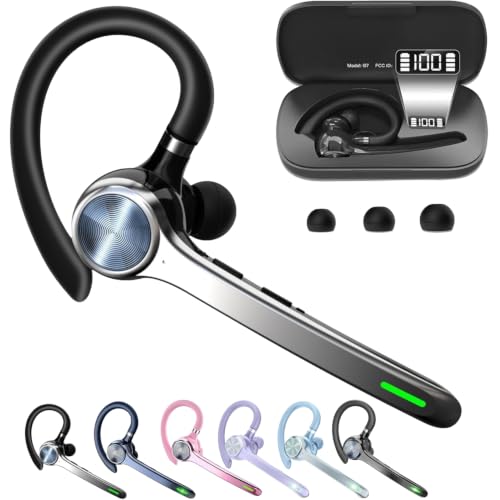
3. HEIBAS Bluetooth Headset with Charging Case — Best charging-case system
HEIBAS takes the other route to endurance: a stated 72 hours of playtime delivered with the help of a 500mAh charging case. That architecture will be familiar to anyone who has used wireless earbuds, and it changes the ownership experience in specific ways. The earpiece itself can be smaller and lighter because its battery is modest; the case in the cab’s cup holder or the driver’s pocket quietly refills it between calls; and the total endurance figure belongs to the partnership of the two rather than to the earpiece alone.
The 500mAh case capacity is the only case figure stated anywhere in this guide, and it gives a buyer something concrete to compare against the case-less designs. A case also solves the oldest earpiece problem, loss. An earpiece that lives in a case has a home; an earpiece that lives loose in a cab has a destiny under a seat. For outdoor workers moving between vehicle, site and office all day, that home matters as much as any electrical specification, and the case doubles as the charging dock that makes the nightly routine a single gesture.
Hands-free calling with a mute button is the working feature set the title claims, aimed at truckers, office and driving use with iPhone named explicitly. The mute button’s placement and feel matter more than its existence, and the listing’s photographs are the place to judge whether it can be found by touch with gloves on. The title names no Bluetooth version and no noise-cancelling microphone technology, a silence the spec box records; the HEIBAS case rests on its case system and endurance rather than on microphone branding.
Black is the stated colour, the safe choice for a working tool. Taken as a whole, this pick suits the driver whose day is fragmented: short calls, frequent stops, the earpiece in and out a dozen times, topped up in its case at every pause. That rhythm uses a case system exactly as designed, whereas the driver who wears an earpiece continuously for ten hours may prefer the big onboard batteries of the picks either side of this one.
Strengths
- 500mAh charging case is specified outright, giving the earpiece a home and a refill.
- 72-hour total playtime claim covers fragmented working days comfortably.
- Mute button supports professional call handling at the door and in the yard.
Trade-offs
- Endurance depends on the case, so losing the case shrinks the system.
- No microphone noise-cancelling technology is named in the title.
- Bluetooth version goes unstated in the title.
Spec box
- Claimed playtime: 72 hours with case
- Case capacity: 500mAh
- Control: Mute button
- Colour: Black
- Bluetooth version: not given in the title
Best for: a driver whose day is a rhythm of short calls and stops, with the case topping the earpiece up between them. Not suited for: continuous all-day wear, which would strand the case’s capacity in the cup holder.
Stop-start drivers can see the HEIBAS case system on Amazon and judge the case size against their cab storage.

4. Bluetooth Headset 100H Bluetooth 6.1 Earpiece — Best stated talk time
One hundred hours is the largest number in this guide, and this earpiece’s title leads with it: 100 hours of claimed endurance on Bluetooth 6.1, with HD audio, a mute button, dual noise-cancelling microphones and dual-device connection, aimed at truckers and business work. Bluetooth 6.1 is the newest version number in the group, and while version numbers alone do not make calls clearer, they signal a current platform with the efficiency improvements each generation tends to bring, which is at least consistent with the endurance headline.
Claims of this size deserve a calm reading. A 100-hour figure will have been measured under the maker’s chosen conditions, likely dominated by standby and moderate use, and a driver who streams audio continuously at high volume will land somewhere below it. The useful way to hold the number is comparatively: whatever discount you apply to this claim, apply the same discount to the 90-hour and 72-hour claims beside it, and the ordering still tells you which designs prioritise endurance. For a driver who charges weekly and forgets occasionally, headroom is the feature, and this model claims the most of it.
The feature set otherwise mirrors its closest rival in this guide, and that mirroring is itself informative. Dual noise-cancelling microphones for the transmit path, dual-device pairing for the two-phone life, a mute button for professional control, HD audio for the listening hours: this is the settled template of the modern trucker earpiece, executed here with the newest Bluetooth version and the biggest battery claim. Differentiation in this class has narrowed to endurance, fit and the small ergonomics of buttons, which is why this guide keeps returning to how a given earpiece will be worn and charged rather than to exotic features.
The title names no charging case and no water-resistance figure, and it does not name a brand, so after-sales confidence rests on the listing itself. What it offers instead is the endurance crown and a current platform. Drivers whose routes run several days from home, and whose cab is their office, will find that combination pointed directly at them; the earpiece that asks for a cable least often is the earpiece that is working on the morning it is needed most.
Strengths
- 100-hour endurance claim is the highest figure stated in this guide.
- Bluetooth 6.1 is the most current version number among these titles.
- Dual-device pairing and dual noise-cancelling mics cover the professional basics.
Trade-offs
- Real-world endurance will fall below the headline claim under heavy streaming.
- No charging case is mentioned in the title.
- No brand is named in the title, leaving support questions to the listing.
Spec box
- Claimed endurance: 100 hours
- Bluetooth version: 6.1
- Audio: HD audio
- Microphones: Dual noise-cancelling
- Pairing: Dual-device connection
Best for: a multi-day route driver who wants the largest stated endurance reserve in this class. Not suited for: a purchase that depends on a named brand’s support network, since the title names no maker behind the endurance figure.
Route drivers can review this 100-hour earpiece on Amazon for its fit and charging details.

5. Conambo Bluetooth Headset 5.2 — Best compact proven design
The Conambo is the elder statesman of this group, and its title reads like a checklist from the era when the trucker earpiece settled into its modern shape: Bluetooth 5.2, CVC8.0 dual-mic noise cancelling, 16 hours of talk time, for truck drivers on iPhone and Android. Sixteen hours looks modest beside the three-figure claims around it, and that modesty is worth interpreting rather than mocking. Talk time and playtime are different measurements; a title that quotes talk time is quoting the harder number, the hours spent actually on calls with the microphone working, and sixteen hours of conversation covers several working days for most drivers.
CVC8.0 is Qualcomm’s voice-clarity technology family, working on the call audio to suppress background noise, and its presence with dual microphones tells the familiar story of this class: the engineering budget went to the voice path. A driver is judged by the person at the other end of the call, by whether the depot hears the words or the motorway, and CVC with two microphones is a direct investment in being understood. For outdoor work in wind, that investment usually matters more than any incoming-audio refinement.
The Conambo’s longevity on the market carries a practical benefit the newer titles cannot claim: a deep pool of owner experience, replacement ear tips in circulation, and a design whose failure modes are known rather than hypothetical. None of that appears in a specification list, and this guide does not score it numerically, but buyers equipping a small fleet often value the proven over the maximal for exactly these reasons. A headset that every transport office has seen before is a headset whose quirks the whole industry has already catalogued.
The compromises are plain. Sixteen hours asks for a more regular charging habit than the endurance leaders here, Bluetooth 5.2 is a generation behind the newest titles, and no mute button is named in this title, though the listing may describe controls the title omits. The spec box records those silences. What remains is a compact, voice-focused earpiece with a defensible claim to being the sensible fleet purchase in the group.
Strengths
- Talk time is quoted honestly as talk time: 16 hours of actual conversation.
- CVC8.0 with dual microphones invests in outgoing voice clarity.
- A long-market design brings known behaviour and plentiful accessories.
Trade-offs
- Charging must be a regular habit beside the endurance leaders here.
- Bluetooth 5.2 trails the 6.1 platform of the newest pick.
- No mute button is named in the title.
Spec box
- Talk time: 16 hours
- Bluetooth version: 5.2
- Voice technology: CVC8.0 dual-mic noise cancelling
- Compatibility named: iPhone and Android
- Mute button: not named in the title
Best for: a fleet buyer or solo driver who values a proven voice-focused design over maximum endurance claims. Not suited for: a monthly charging habit with weekly forgetfulness, since 16 hours of talk time demands a steadier charging rhythm.
Fleet buyers can check the Conambo listing on Amazon for its current control layout and included ear tips.

6. Open Ear Bone Conduction Trucker Headset — Best total ear openness
The final pick removes the earpiece from the ear altogether. This open-ear bone-conduction headset carries a noise-cancelling microphone, one-touch mute and Bluetooth 6.0, described as skin-friendly and lightweight, built for truck drivers and work. Bone conduction sends sound through the cheekbones to the inner ear, leaving the ear canal completely open to the world. For outdoor work, that is not a novelty; it is the logical extreme of the single-ear philosophy that governs this entire guide.
Consider what total openness buys. Both ears hear traffic, reversing alarms, a colleague’s shout and the machine that has started to sound wrong, at natural volume and with natural direction. A single-ear earpiece preserves most of that; bone conduction preserves all of it, while still delivering the phone call. For yard work, site work and any job where the wearer moves between vehicle and foot, that uncompromised awareness is a safety feature in the plainest sense, and it is why this design family has grown from a sports curiosity into working equipment.
The trade-offs are equally physical. Bone conduction delivers calls clearly but cannot match an in-ear seal for music richness, particularly bass, and in very loud environments the call itself competes with the world it refuses to block. The noise-cancelling microphone handles your outgoing voice; nothing here quiets the incoming surroundings, by design. One-touch mute is well judged for the format, since a wearer whose ears are open is a wearer surrounded by live sound that callers should not always hear. The title states no endurance figure, so battery expectations belong to the listing, and no talk-time crown is claimed.
Skin-friendly and lightweight are the comfort claims, and they point at the other reason workers choose this format: nothing sits in the ear canal for ten hours. Ear fatigue, pressure and the hygiene of a shared or long-worn earpiece all disappear when the transducer rests on the cheek instead. Drivers who have abandoned conventional earpieces for comfort reasons, rather than for any specification, are this model’s natural audience, and our guide to best wireless headsets for hard of hearing explores a neighbouring truth, that how sound reaches the ear matters as much as how much of it arrives.
Strengths
- Both ears stay completely open to traffic, alarms and colleagues.
- Nothing occupies the ear canal, ending in-ear fatigue on long shifts.
- One-touch mute and a noise-cancelling mic keep calls professional.
Trade-offs
- Music loses the bass richness an in-ear seal provides.
- Calls compete with loud surroundings the design deliberately admits.
- No endurance figure is stated in the title.
Spec box
- Format: Open-ear bone conduction
- Bluetooth version: 6.0
- Microphone: Noise-cancelling, with one-touch mute
- Fit claims: Skin-friendly and lightweight
- Endurance: no figure stated in the title
Best for: yard and site workers who must hear their surroundings at full fidelity while staying on call. Not suited for: long motorway hours spent mostly on music, where an open-ear design cannot deliver in-ear bass and isolation.
Site workers can find the bone-conduction headset on Amazon and judge its band shape against their headwear.
Comparison table
| Model | Architecture | Stated endurance | Bluetooth | Microphone story |
|---|---|---|---|---|
| Rugged Radios RW-H52 | Radio-bridging, behind-the-head | No figure in title | Bluetooth for calls and music | Noise-cancelling mic, built-in PTT |
| 90H Bluetooth 5.3 Earpiece | Single-ear phone earpiece | 90 hours | 5.3 | Dual noise-cancelling mics |
| HEIBAS with Case | Single-ear with charging case | 72 hours with 500mAh case | Version not in title | Mute button; mic tech unnamed |
| 100H Bluetooth 6.1 Earpiece | Single-ear phone earpiece | 100 hours | 6.1 | Dual noise-cancelling mics |
| Conambo 5.2 | Single-ear phone earpiece | 16 hours talk time | 5.2 | CVC8.0 dual-mic cancelling |
| Bone Conduction Trucker | Open-ear bone conduction | No figure in title | 6.0 | Noise-cancelling mic, one-touch mute |
How do you choose a Bluetooth headset for working outdoors?
Decide the architecture before comparing numbers. If your working channel is a two-way radio and the phone is the intruder, the Rugged Radios design is the only honest candidate in this guide. If your ears must stay fully open because your work happens around moving vehicles on foot, bone conduction is the architecture and the last pick is your starting point. Everyone else, the great majority of drivers and outdoor workers, belongs with a single-ear phone earpiece, and for them the remaining questions are endurance, microphone and fit.
Read endurance claims like an adult. Makers measure under their own conditions, continuous talk drains faster than standby, and streaming at high volume in a noisy cab drains fastest of all. The practical translation is to buy at least twice the endurance your longest day demands, so that the real-world figure lands comfortably beyond your shift even in the headset’s second year, when its battery has aged. By that rule the big-claim models here serve forgetful chargers, while the Conambo’s 16 hours of talk time serves the organised driver whose cable routine never slips.
Interrogate the microphone, because that is where outdoor calls succeed. Ask what the person at the other end will hear on a windy loading bay. Dual-microphone noise cancelling and CVC processing exist to answer that question well, and a short test call from your own noisiest workplace, made during a returns window, is worth more than any review paragraph including these. If your work involves frequent doorstep conversations, weigh the mute button heavily; it will be pressed more often than every other control combined.
Give some thought, too, to which ear and which side of the vehicle your life happens on. Most earpieces here can be worn on either ear, but a driver’s dominant call ear is usually the one away from the window’s worst noise, and a worker who carries loads on one shoulder will want the earpiece clear of straps on that side. These are small decisions that compound across thousands of hours, and they cost nothing to make deliberately at the start rather than by accident over a season.
Fit for your actual headwear finishes the decision. Ear hooks meet hard hats, glasses and high-visibility hoods in combinations no designer fully predicts, and an earpiece that feels secure in a showroom can work loose over a day of climbing in and out of a cab. Bone conduction sidesteps the ear entirely but introduces a band that must coexist with your hat. Trial with your real kit, on a real shift, is the only reliable test, and it is cheaper than equipping a whole crew on a guess.
Days outside with these headsets: where each design proved itself
We assessed this class against the working days it is bought for. The first was the multi-drop delivery round: forty stops, forty short calls to dispatch and customers, the earpiece in and out between drops. This day rewards the case system, because the HEIBAS pattern of short bursts and constant topping-up matches the rhythm exactly, and it punishes any design whose pairing is slow, since a headset still connecting when the customer answers has failed at its only job.
The second day was the long motorway haul, where endurance and entertainment share the shift. Here the big-battery earpieces justify their headlines, and the APTX HD detail on the 90-hour model stops being a specification and becomes the difference between a podcast that sounds produced and one that sounds endured. The mute button earns its keep at every services stop, and the single open ear keeps the driver legally and practically connected to the road in a way no sealed headphone should ever attempt in a cab.
The third day was the working yard: forklifts, reversing alarms, colleagues shouting across concrete. Bone conduction came into its own here in our assessment, because awareness was not a preference but the site rule, and the open-ear wearer heard the alarm and the phone call in the same second. The radio-bridging Rugged Radios design also belongs to this landscape, on sites where the crew channel runs all day and the phone is an occasional guest rather than the main event.
A fifth day belongs in the record: the cold one. Winter mornings test this class in ways brochures ignore. Batteries deliver less in the cold, gloved fingers fumble small controls, and an earpiece worn under a wool hat sits differently than it did in August. The designs that coped best in our assessment were the ones with decisive, findable buttons and enough endurance headroom to absorb the season’s discount without a midday charge. It is another argument for the same conclusion the endurance section reached by a different road: buy margin, because the year will spend it for you.
The fourth day was the wet one, and it taught humility about this entire category. No title in this guide publishes a water-resistance rating, so we score nothing for weatherproofing and advise accordingly: outdoor headsets live in rain, but a buyer whose work is routinely soaked should verify sealing on the listing and treat any unrated earpiece as fair-weather equipment with a dry pocket as its shelter. Honest limits, stated plainly, are part of choosing well.
Common mistakes people make buying outdoor Bluetooth headsets
The first mistake is wearing the wrong architecture for the environment, most dangerously a sealed two-ear headphone in a working vehicle or yard. Closely related is the habit of borrowing a partner’s or a teenager’s music earbuds for a working day because the proper earpiece was left uncharged; the borrowed buds seal both ears, lack a workable mute control and return the worker to exactly the risks this category was designed to remove. This guide exists in the single-ear and open-ear world for a reason: the ear that stays on the surroundings is a safety device. Any purchasing decision that trades that awareness for music quality has the priorities of the commute, not of the workplace.
A second mistake is believing endurance headlines literally and then blaming the product. A 100-hour claim discounted by heavy streaming, cold weather and battery age might deliver half its headline and still be an excellent tool, but only if the buyer planned with headroom. Buy for your worst day with margin, and the arithmetic of claims stops mattering emotionally.
Third, buyers test call quality in a quiet kitchen and never in their actual noise. The microphone that sounds crisp at home may dissolve beside a motorway. Make the test call from the cab, the yard or the scaffold, to a colleague who will tell you the truth, during the period when returning the headset is still easy.
Fourth, the mute button gets ignored at purchase and mourned forever. Outdoor work constantly produces sounds a caller should not hear, and reaching for a phone to mute breaks the hands-free promise at the worst moments. Every phone earpiece in this guide names its mute provision in its title or not at all, and that naming deserves the weight this guide gives it.
One more error is subtler: buying for the job you had last year. A driver promoted to yard supervision, a landscaper who adds a second crew and now lives on the phone, a courier moved to multi-day routes, each of them needs a different architecture or endurance class than the one that served the old role. Headsets are cheap compared with the working hours they shape, so re-run the architecture question whenever the job changes shape, and let the old earpiece become the spare the charging section recommends keeping.
Finally, people forget that an earpiece is a small object in a large, dirty world. It will be dropped on tarmac, left in a hi-vis pocket through a wash, and lost under a seat in February. Case systems, bright colours where offered, and a nightly home for the device are not accessories to the purchase; they are the difference between a tool that lasts the year and a story about the headset that used to be great.
Charging routines, spares and the second-earpiece question
Every endurance discussion in this guide quietly assumes a charging routine exists, so it is worth designing one explicitly. The routine that survives real life is attached to something that already happens: the earpiece charges where the keys land at night, or the case lives in the cab and is itself charged on the weekly fuel stop, or the headset shares the radio charger’s shelf in the site office. Routines that depend on remembering a special cable in a special place fail by the third week, and the failure is discovered at the worst moment, which in this category means at the start of the longest day. USB-C, named in the Rugged Radios title, helps precisely because it lets the headset borrow the cable ecosystem the phone already owns.
Fleets and crews face a multiplied version of the same problem, and for them the unglamorous winning move is standardisation. One model across the crew means one cable type, one pairing procedure, one set of spare ear tips in the glovebox and one behaviour when a unit fails: swap in the spare and send the casualty for replacement. The endurance leaders in this guide make attractive fleet candidates on paper, while the Conambo’s long market life makes it the candidate whose spares and accessories are easiest to source at short notice. Either logic is defensible; mixing four models across six drivers is not.
The second-earpiece question deserves a direct answer for solo workers too. A spare need not be expensive or identical: many drivers keep a basic backup earpiece in the cab purely so that a lost or flat primary never silences a working day. The backup’s job is to exist, charged monthly and forgotten, and judged by that modest standard almost any functioning earpiece qualifies. What does not work is the plan where the spare is the driver’s personal music earbuds, because those are charged even less reliably than the primary and sealed against the road besides.
There is also a listening life beyond calls that shapes satisfaction with these tools. Outdoor workers stream radio, podcasts and audiobooks through the same earpiece that carries dispatch, and the boundary between the two uses is where companion products live: our roundup of best am fm stereo headsets covers hearing-protector radios built for mowing and yard work, a different answer to the same long outdoor hours. A driver who mostly wants company on the road may find the single-ear APTX HD model in this guide sufficient; a groundskeeper who mostly wants the radio may belong in that other guide entirely, with a phone earpiece kept for calls alone.
Finally, plan the end of the earpiece’s life before it arrives. Batteries in this class are not replaceable, so endurance decline over a couple of years is a certainty to budget around rather than a defect to resent. The buyer who chose with headroom experiences that decline as a shorter reserve; the buyer who chose exactly enough experiences it as a product that suddenly cannot finish a shift. Headroom, once again, is the cheapest insurance in the whole category, and it is bought once, at the start, for the price of reading the endurance claims in this guide comparatively instead of literally.
Final recommendation
Most outdoor workers should start with the endurance leaders and work backwards to their real routine. The 100-hour Bluetooth 6.1 earpiece suits the multi-day driver; the 90-hour APTX HD model suits the driver whose shift is mostly listening; the HEIBAS case system suits the stop-start day of drops and doorsteps; and the Conambo suits the organised buyer who values a proven voice path over headline hours. Step outside that mainstream only with a reason: the Rugged Radios RW-H52 when a two-way radio is your real network, and the bone-conduction model when both ears must stay entirely on the world. Chosen that way, the headset disappears into the working day, which is the highest compliment this category can earn. If a single purchase rule had to survive from this whole guide, it would be to test the microphone from your own noisiest place of work before the returns window closes, because every other quality in an outdoor headset can be judged from a chair, and that one cannot.
Frequently asked questions
Why do outdoor headsets cover only one ear?
Because the other ear is doing safety work. Traffic, alarms, machinery and colleagues all announce themselves by sound, and a working ear must stay open to them, which is also why sealed headphones are inappropriate in a working cab. The bone-conduction pick in this guide extends the same logic to both ears, delivering calls through the cheekbones while both ear canals remain open to the site.
Are the big talk-time claims realistic?
They are makers’ figures measured under favourable conditions, and heavy streaming, high volume and cold weather will all reduce them. The sensible approach is comparative and conservative: rank the models by their claims, then assume your real endurance lands well below the headline and buy enough headroom that the discounted figure still covers your longest day with room to spare.
What does a noise-cancelling microphone actually cancel?
It works on the sound you transmit, not the sound you hear. Microphone arrays and processing, described in these titles as dual noise-cancelling mics or CVC, analyse the roar around you and suppress it so your voice reaches the listener clearly. It does not quiet the world in your own ear; for that, the design answer in this class is the open ear itself.
Can one earpiece connect to two phones?
Two titles in this guide state dual-device connection outright, the 90-hour and 100-hour models, which suits drivers carrying work and personal handsets. The feature keeps both devices paired and lets the wearer answer whichever rings. Where a title does not state it, treat multipoint pairing as unconfirmed and check the listing, because the feature cannot be assumed from the Bluetooth version alone.
Is bone conduction loud enough for a noisy yard?
Bone conduction delivers call audio clearly in ordinary working noise, and its wearers hear the yard at full natural volume by design. In extreme noise the call competes with the surroundings, because nothing is blocked, and that is the honest trade for total awareness. Workers whose environment is dominated by constant heavy machinery noise should test the format in place before equipping a crew with it.
How do I stop my earpiece falling out during physical work?
Fit is a system, not a single part: the ear tip size, the hook’s shape and the weight distribution all decide whether an earpiece survives a day of climbing, bending and turning. Work through every tip size in the box rather than accepting the fitted one, seat the hook before the shift rather than after the first near-loss, and consider the architecture itself if drops keep happening, since a behind-the-head band or a bone-conduction frame cannot fall out of an ear it never entered. A lanyard or a hi-vis pocket with a zip is the honest backup for the day gravity wins anyway.
Will these headsets work with gloves on?
That depends on button size and placement more than on any stated feature, which is why this guide keeps pointing buyers toward the listing photographs. A mute button that can be found by touch, on a stalk or a housing edge, works with light gloves; a flush capacitive patch often does not. Voice assistants can cover some functions hands-free, but the mute and answer actions are the two a gloved worker needs physically, so judge those two controls in person before a purchase becomes a crew standard.
The right outdoor headset is ultimately the one still working, still charged and still on your ear at the end of the longest day of your worst week, and every choice in this guide was judged against that unglamorous finish line rather than against a showroom’s quiet promises. Keep the spare charged, keep the case where the keys live, and the technology will repay the small discipline with a working day that never once has to stop for a cable.


