What's inside
- Key Takeaways
- Quick Picks
- How were these picks chosen?
- Comparison table
- How do you choose an airsoft headset that fits your game?
- Game days with these headsets: what we listened for
- Common mistakes players make with tactical headsets
- Building the rest of the head around your headset
- Final recommendation
- Frequently asked questions
As an Amazon Associate I earn from qualifying purchases. This post may contain affiliate links at no extra cost to you.
gizmoverdict.com is reader-supported. When you buy through links on our site, we may earn an affiliate commission.
Where to buy: Tactical headsets and electronic ear muffs reach airsoft players through a mix of shooting-sports retailers, radio suppliers and the Amazon listings linked below, and the same model can appear in several colours or bundle shapes under one listing. Buy the headset itself from the listing that matches the connector and colour described for each pick, and treat helmets, radios and push-to-talk cables shown in photographs as separate equipment unless the listing text includes them.
Choosing the best over teh ear headsets for airsoft means holding two jobs in your head at once, and this guide will keep them separate even when product marketing blurs them. Job one is communication and awareness: hearing your squad’s radio calls, hearing the player creeping through the brush behind you, and having your own voice carried clearly when you answer. Job two is hearing protection: electronic muffs that let ordinary sound through, amplify it when useful, and clamp down instantly when something loud happens nearby. The six products below divide those jobs differently, and the honest differences matter more than any single specification.
Now the sentence that outranks every other sentence in this article. None of these headsets is impact-rated eye or face protection, and wearing one does not protect your eyes or your teeth from a BB. A headset never replaces properly rated goggles or a mesh mask, full stop. Fields require rated eye protection because eyes cannot be repaired, and any player who treats an ear muff as part of that protection has misunderstood what the equipment is. Buy the headset for your ears and your radio. Buy rated eye and face protection separately, wear both, and be suspicious of any product page that encourages you to blur the two.
With that boundary fixed, the class makes sense. Most of these designs began life at shooting ranges or in hunting fields, where electronic ear protection is a mature category: microphones on the cups pass ambient sound to speakers inside, amplification raises quiet sounds like speech or movement, and compression reacts to a sudden loud report by cutting the feed before it can hurt. Airsoft borrows that technology gratefully, because a skirmish is a soundscape of whispers, movement and shouted calls, punctuated at some sites by pyrotechnics loud enough to make impulse protection genuinely relevant. Layer a radio connection onto the muff, through a push-to-talk lead and a microphone boom, and the hearing protector becomes the squad’s communications hub as well.
Key Takeaways
- No headset in this guide is eye or face protection; rated goggles or mesh remain mandatory and separate, always.
- The Rugged Radios H41 states the highest noise figure here, 24dB NRR, with a behind-the-head fit built for wear under headgear.
- The EARMOR M32 Plus combines an NRR of 22dB with a microphone and a military-helmet-ready design, the closest thing here to a complete comms muff.
- The Hearangel is the radio-first pick, built around sound pickup, noise reduction and a K 2-pin push-to-talk connection.
- The Walker’s Razor Slim states a 0.02-second sound-activated compression reaction, the fastest-sounding claim in the group, in a low-profile shell.
- The PROHEAR states NRR 23dB with 4X sound amplification, favouring hearing the field over radio integration.
Quick Picks
| Pick | Model | Badge |
|---|---|---|
| 1 | Hearangel Tactical Headset | Best radio-first headset |
| 2 | EARMOR M32 Plus Tactical Headset | Best helmet-ready comms muff |
| 3 | Retevis EHK007 Tactical Headset | Best for Baofeng radio owners |
| 4 | PROHEAR Electronic Ear Protection | Best amplification focus |
| 5 | Walker’s Razor Slim Electronic Muff | Best low-profile muff |
| 6 | Rugged Radios H41 Behind-the-Head Headset | Best stated NRR with radio port |
Notice how the badges divide along the radio question. Three of these products are communication headsets that protect hearing; three are electronic muffs that protect hearing and amplify the field, with radio duties varying or absent. Players building a loadout around team coordination might cross-read our guide to best headsets for restaurants, where full-duplex crew intercoms solve a civilian version of the same problem, though nothing there belongs on a skirmish field.
How were these picks chosen?
We required every candidate to earn its place on at least one of two grounds: a stated hearing-protection figure or mechanism, or a stated radio-communication feature an airsoft player can actually use. NRR figures appear in three titles, 22dB, 23dB and 24dB, and we quote them exactly as published while reminding readers that NRR is a laboratory rating for hearing protection, gathered under test conditions, and that fit over a real ear decides how much of it arrives on the field. Compression speed, amplification and microphone arrangement fill out the protection picture where titles state them.
Radio compatibility was judged with equal strictness. A connector name is a promise: K 2-pin in the Hearangel title, a universal 5-pin port in the Rugged Radios title, explicit Baofeng model compatibility in the Retevis title. Those specifics decide whether a headset plugs into the radio already in your pouch or starts an argument with it, so we treated named compatibility as a first-class feature and vague tactical styling as no feature at all. A headset that merely looks military while offering neither protection figures nor a named radio interface had no route into this guide.
Fit under real loadouts formed the third filter. Airsoft players wear these devices over or under helmets, alongside goggle straps and mesh masks, for hours at a time, often in summer heat. Behind-the-head bands, low-profile cups and helmet-ready language in titles all speak to that reality, and we weighted them accordingly. A muff that sounds superb on a bench but fights every strap on your head will be left in the safe zone by the third game of the day.
Finally, we kept the safety framing non-negotiable throughout the selection. Products were assessed as hearing and communication equipment only. Nothing in this guide’s judgements should be read as implying impact protection for eyes or face, because none of these titles claims it and no headset provides it. That discipline also shaped the reviews: where a title’s language drifts toward general protection, we translate it back into the specific hearing terms the product actually addresses.
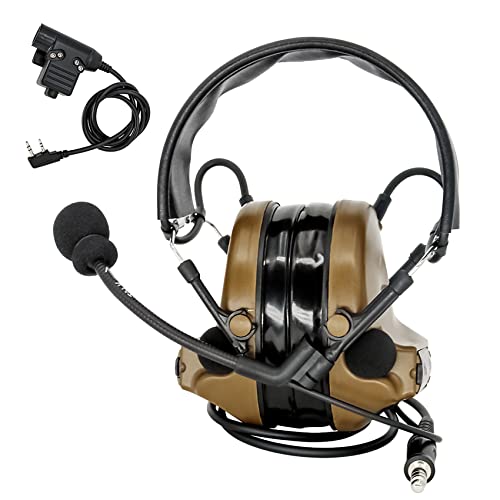
1. Hearangel Tactical Headset — Best radio-first headset
The Hearangel leads this guide because it starts from the communication end of the problem. Its title promises sound pickup with noise reduction and a K 2-pin push-to-talk connection, in Coyote Brown, built for airsoft activities. Translate that into field language: the headset listens to the world around you, manages the noise in what it passes to your ears, and connects to the large family of radios that use the Kenwood-style K 2-pin accessory plug, with a push-to-talk button putting your voice on the squad channel when you choose to speak.
The K 2-pin detail is the one to verify before anything else, because connector compatibility is binary. If your radio carries the matching two-pin socket, this headset joins your existing kit in seconds. If your radio uses a different accessory standard, no amount of tactical styling will save the pairing, and an adapter hunt begins. Experienced players treat the connector as the first specification on any comms purchase, ahead of colour, ahead of brand, and this title does the courteous thing by naming its plug outright.
Sound pickup matters in airsoft for a subtle reason: the game is quiet far more often than it is loud. Footsteps on gravel, a branch moved carelessly, a whispered direction from a teammate two metres away, these are the sounds that decide ambushes. A headset that picks up ambient sound and presents it cleanly, while reducing the noise that would otherwise wash it out, gives a patient player real information. The title does not publish an NRR figure or an amplification multiple for the Hearangel, and the spec box says so plainly; its case rests on the pickup-and-radio combination rather than on a laboratory protection number.
Coyote Brown is more than a colour choice at most fields, where earth tones disappear into woodland and black equipment outlines itself against foliage. It also signals the intended wearer: this is a headset styled and specified for the skirmish field first, with range and hunting uses secondary. What the title does not discuss is helmet mounting, battery arrangements or how the boom microphone is configured, so players building a helmet-integrated setup should study the listing photographs carefully before assuming the Hearangel dissolves into their rig.
Strengths
- K 2-pin push-to-talk connection is named outright, simplifying radio matching.
- Sound pickup with noise reduction targets the quiet-information game airsoft rewards.
- Coyote Brown finish suits woodland fields where black gear stands out.
Trade-offs
- No NRR figure appears in the title, so hearing protection is unquantified.
- Radios without a K-type two-pin socket will not connect directly.
- Helmet-mounting details are not described in the title.
Spec box
- Connection: K 2-pin, with push-to-talk lead
- Sound handling: Sound pickup with noise reduction
- Finish: Coyote Brown
- NRR figure: no figure appears in the title
- Amplification: not quantified in the title
Best for: a squad player whose radio uses the K two-pin standard and whose priority is hearing calls and field sounds together. Not suited for: a radio fitted with a different accessory plug standard, since the named K 2-pin connection will not mate with it.
Squad communicators can check the Hearangel listing on Amazon against a photograph of their own radio’s accessory socket.

2. EARMOR M32 Plus Tactical Headset — Best helmet-ready comms muff
The EARMOR M32 Plus is where the two halves of this guide’s subject meet most completely. The title describes a tactical headset with electronic ear protection rated at NRR 22dB, noise-cancelling ear muffs for shooting, the gun range, hunting and airsoft, and a military-helmet-ready design with a microphone. That is the full comms-muff recipe: protection with a number attached, ambient sound management, a voice path for radio work, and a physical form intended to live alongside a helmet rather than underneath a headband argument.
Helmet-ready deserves unpacking, because it is the feature helmet-wearing players feel most. A conventional headband and a helmet compete for the same real estate on a skull, and the loser is usually comfort by mid-afternoon. Designs described as helmet ready typically offer rail mounting or a band shaped to coexist with the helmet’s own suspension, and either way the intent is a single integrated rig: goggles, helmet, muff and boom mic arranged once, in the safe zone, and then forgotten until the game ends. The title does not specify the mounting hardware arrangement, so the listing’s photographs carry that answer.
The microphone completes the picture. A muff with a mic can serve a radio through the appropriate push-to-talk lead, turning hearing protection into the squad’s voice endpoint. The title does not name the radio connector standard for the M32 Plus, and that omission matters enough that we flag it prominently: before purchase, establish exactly which lead and plug your radio needs and whether this headset’s arrangement matches. The protection side, by contrast, is quantified: NRR 22dB sits one decibel below the PROHEAR figure and two below the Rugged Radios figure later in this guide, differences small enough that fit on your own head will likely matter more than the arithmetic.
Noise cancelling in the title refers to the muff’s handling of sound, and readers should hold it apart from the noise-cancelling language used for music headphones. Here it describes electronic ear protection behaviour: managing what reaches the ear, keeping harmful levels down while letting the wearer stay aware. In an airsoft context that awareness is the product. A player who cannot hear a marshal’s call or a teammate’s warning is not protected; they are isolated, which is a different and worse condition on a field.
Strengths
- NRR 22dB protection is stated outright in the title.
- Microphone included, giving the muff a voice path for radio work.
- Helmet-ready design addresses the loadout integration problem directly.
Trade-offs
- Radio connector standard is not named in the title, requiring listing checks.
- Mounting hardware specifics are left to the listing photographs.
- Its 22dB figure is the lowest of the three NRR numbers in this guide.
Spec box
- Protection rating: NRR 22dB
- Design: Electronic ear protection muffs
- Microphone: Included, per the title
- Fit: Military helmet ready
- Radio connector: the title does not name a connector standard
Best for: a helmet-wearing player who wants protection, awareness and a microphone in one integrated rig. Not suited for: a radio lead already purchased to a specific plug standard, until the headset’s connection arrangement is confirmed to match it.
Helmet users can study the M32 Plus on Amazon to see how its mounting arrangement meets their own helmet rails.

3. Retevis EHK007 Tactical Headset — Best for Baofeng radio owners
Retevis comes to airsoft from the radio industry, and the EHK007 title reads like it: a tactical headset for radio, described as airsoft ear protection in a single pack, with ENC, an adjustable headband, a well-fitting design, and explicit compatibility with the Baofeng UV-5R, BF-F8HP PRO and AR-5RM. That compatibility list is the most useful sentence in the title, because the UV-5R family is the radio an enormous share of airsoft players actually carry. Naming the models removes the connector guessing game entirely for those owners.
ENC, environmental noise cancellation in Retevis’s usage, works on the outgoing voice rather than the incoming sound. Its purpose is to keep your transmitted speech intelligible when the environment is not: wind across an open field, a generator near the safe zone, the general roar of a milsim event’s staging area. Incoming protection and outgoing clarity are different engineering problems, and a headset that addresses the transmit side earns its place in a squad where garbled calls cause real confusion. Captains and medics, the players whose messages must land first time, feel this benefit most.
The adjustable headband and well-fitting language point at long-wear practicality. Airsoft game days run long, and a headset worn for six hours over a cap or under a helmet brim needs adjustment range more than it needs styling. One pack is also stated plainly, worth noting for teams equipping several players: the box holds a single headset, so squad purchases multiply accordingly, and the title makes no NRR claim, which the spec box records. Ear protection is claimed in words; the laboratory number is not published here.
Retevis describing the EHK007 as a racing headset as well hints at its broader motorsport-style design heritage, where a boom mic and a secure band matter in noisy, moving environments. For airsoft the transferable virtues are the same: voice clarity out, a band that stays where it was adjusted, and a plug that meets the radio in your pouch without ceremony. Players running radios outside the named Baofeng family should treat compatibility as unconfirmed and check the connector before ordering, because the title’s promise is specific rather than universal.
Strengths
- Named compatibility with Baofeng UV-5R, BF-F8HP PRO and AR-5RM removes plug doubt.
- ENC targets outgoing voice clarity in noisy staging areas.
- Adjustable headband suits long game days and varied headgear.
Trade-offs
- No NRR number is published in the title for the protection claim.
- Sold as one pack, so equipping a squad means multiple purchases.
- Radios outside the named Baofeng models have unconfirmed compatibility.
Spec box
- Stated compatibility: Baofeng UV-5R, BF-F8HP PRO, AR-5RM
- Voice feature: ENC
- Band: Adjustable headband
- Pack quantity: 1 headset
- NRR figure: none published in the title
Best for: a player already carrying one of the named Baofeng radios who wants a headset that simply plugs into it. Not suited for: a squad buying in bulk on a single-box assumption, since each pack contains exactly one headset.
Baofeng carriers can open the EHK007 listing on Amazon and match their radio model against the compatibility list in full.
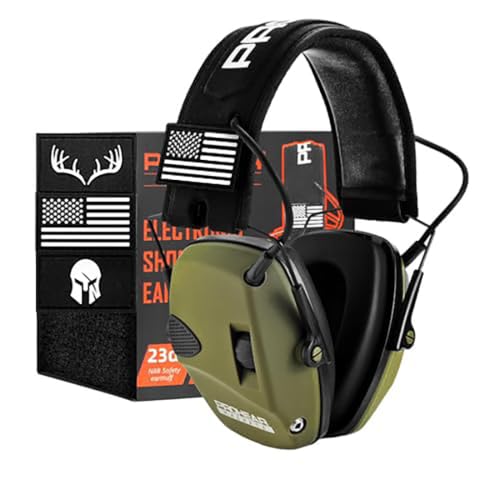
4. PROHEAR Electronic Ear Protection — Best amplification focus
The PROHEAR entry strips the concept back to hearing itself. Its title describes electronic ear protection for shooting with 4X sound amplification, gun-range hearing protection muffs rated NRR 23dB for hunting, in green. There is no radio connector in that sentence, no microphone boom, no tactical plug standard. What there is, stated in numbers, is the amplification figure, and amplification is the feature that changes how a skirmish feels for a patient player.
Four-times amplification of ambient sound means the quiet field gets louder in your ears while the protection ceiling stays in place. Leaves shifting, a boot rolling on gravel, low conversation from an opposing position: these are the cues positional play is built on, and raising them without raising the dangerous sounds is a genuine tactical advantage within the rules of hearing safety. The compression side of electronic muffs, the part that cuts loud impulses, is implied by the category even though this title does not quote a reaction time; the Walker’s title further down does, and the comparison between the two titles is instructive about how differently makers choose to describe the same underlying behaviour.
NRR 23dB places this muff in the middle of the guide’s three published figures. As with every rating in this article, that number describes hearing protection performance under test conditions and says nothing whatsoever about impact protection for eyes or face, a distinction this guide repeats deliberately because the consequences of confusing the two are severe. Green is the stated colour, a field-friendly tone that sits comfortably with woodland kit.
The honest limitation is communication. A player whose game revolves around radio coordination will need to solve the voice problem separately, perhaps with an earpiece-and-mic arrangement under or alongside the muff, and the compromises begin to stack. A player whose game is positional, listening, moving quietly and taking few shots, may find the PROHEAR’s simplicity ideal: nothing to pair, nothing to plug, just the field made audible and the loud moments trimmed. The title mentions neither batteries nor controls, so endurance and adjustment details live on the listing rather than in this review.
Strengths
- 4X sound amplification is stated numerically, the only such figure here.
- NRR 23dB protection rating is published in the title.
- Simple muff format carries no radio compatibility questions at all.
Trade-offs
- No radio connection or microphone is described in the title.
- Battery arrangements are not covered by the title.
- Compression reaction speed goes unquoted in the title.
Spec box
- Protection rating: NRR 23dB
- Amplification: 4X sound amplification
- Colour: Green
- Radio connection: none described in the title
- Battery details: the title is silent on batteries
Best for: a positional player who plays by ear and wants the quiet field amplified inside a rated muff. Not suited for: a squad role built around transmitting on the radio, because no microphone or radio link appears in this title.
Listeners can read the PROHEAR details on Amazon to learn its battery and control arrangements from the listing.

5. Walker’s Razor Slim Electronic Muff — Best low-profile muff
Walker’s is a name shooting ranges know well, and the Razor Slim’s title is the most technically descriptive in this guide: a light teal electronic muff running on 2 AAA batteries, with 0.02-second sound-activated compression, full-range HD speakers, a low-profile design and omnidirectional microphones. Nearly every phrase maps to a field experience. Start with the profile. Slim cups interfere less with everything else on a player’s head and shoulders, and for airsoft that means less fighting with goggle straps, mask edges and the general scaffolding of a safe loadout.
The 0.02-second compression figure is the headline number. Electronic muffs react to a sudden loud sound by cutting the amplified feed, and the speed of that reaction is the difference between a pyro’s bang arriving trimmed and arriving whole. Two hundredths of a second, as Walker states it, is fast enough that the wearer experiences loud events as managed rather than shocking, while the quiet soundscape before and after flows through the omnidirectional microphones. Omnidirectional matters too: microphones that listen in all directions preserve a player’s sense of where a sound came from, and directional awareness is half the value of wearing electronic ears at all.
Full-range HD speakers describe the quality of what reaches the ear between loud events: speech that sounds like speech, movement cues with their texture intact. Two AAA batteries are a quietly practical choice for game days, because AAAs can be bought at any petrol station on the way to a site and swapped in the safe zone without a charging cable or a power bank. The title does not state an NRR figure for the Razor Slim, which surprises readers who know the range, but this guide quotes titles rather than reputations, and the spec box records the silence. Light teal, finally, is a colour that will divide the room: distinctive and easy to spot as your own kit in a pile, and entirely unbothered about woodland camouflage.
For airsoft specifically, the Razor Slim’s case is about coexistence. It must share a head with rated goggles, and we repeat the guide’s rule here because this slim, comfortable format tempts exactly the wrong shortcut: the muff protects hearing only, and the goggles it sits beside remain a separate, mandatory, rated purchase. Within its actual job, hearing, the combination of fast stated compression, ambient microphones and a shell designed to stay out of the way makes this the connoisseur’s muff in the group.
Strengths
- Stated 0.02-second sound-activated compression is the fastest reaction claim here.
- Low-profile cups coexist peacefully with goggles, masks and straps.
- AAA batteries swap anywhere, with no charging routine to manage.
Trade-offs
- No NRR figure is published in the title.
- No radio connector or microphone boom is described for squad voice work.
- Light teal abandons any pretence of woodland camouflage.
Spec box
- Compression: 0.02-second sound-activated, per the title
- Microphones: Omnidirectional
- Speakers: Full-range HD
- Power: 2 AAA batteries
- NRR figure: no figure in the title
Best for: a player whose loadout is crowded and whose priority is fast-reacting hearing protection in a slim shell. Not suited for: a shortlist ranked by published NRR alone, because this title publishes no NRR number.
Range regulars can view the Razor Slim on Amazon and weigh its colour options against their field’s terrain.

6. Rugged Radios H41 Behind-the-Head Headset — Best stated NRR with radio port
The H41 arrives from racing and industrial pits, and its title carries the strongest hearing number in this guide into that company: 24dB NRR, a dynamic noise-cancelling microphone, clear-hear speakers, volume control, a 3.5mm audio jack and a universal 5-pin port, all in a behind-the-head racing and industrial headset. Behind-the-head is the configuration to notice first. The band runs around the back of the skull rather than over the top, which is how pit crews wear headsets under caps and how airsoft players can wear one under a helmet or boonie without the crown pressure a top band creates.
The universal 5-pin port is the radio door. Rugged Radios built its business on motorsport and off-road communication, where a standardised port lets one headset serve many radios through the right cable, and that ecosystem thinking transfers directly to airsoft teams whose members carry mixed radio brands. The 3.5mm audio jack adds a second, humbler input: a phone or scanner feed can join the headset without disturbing the radio path. A volume control on the headset itself completes the practical trio, letting a player trim level with gloves on rather than digging for a radio knob mid-game.
The dynamic noise-cancelling microphone works on the transmit side, rejecting the ambient roar so your voice crosses the channel cleanly. On a windy ridge or beside a running generator at a milsim staging area, that rejection is the difference between a call sign understood and a call sign repeated three times. Clear-hear speakers are the receive-side counterpart in the title’s language. Taken together with the 24dB NRR, the highest figure published by any title here, the H41 makes the strongest paper case in the guide for a player whose day is equal parts radio traffic and loud surroundings.
Two honest caveats close the review. First, the NRR describes hearing protection under test conditions and, like every figure in this article, says nothing about impact protection; the H41 is not eye protection and does not pretend otherwise here. Second, the behind-the-head band’s comfort depends on what else occupies that space, including some helmet harnesses and high mask straps, so a fitting trial with your full loadout is worth more than any paragraph. Players interested in how this maker’s approach differs from phone earpieces can compare best bluetooth headsets for outdoor use, where Rugged Radios appears again in a very different role.
Strengths
- 24dB NRR is the highest protection figure stated in this guide.
- Universal 5-pin port plus a 3.5mm jack cover radio and auxiliary inputs.
- Behind-the-head band avoids crown pressure under helmets and caps.
Trade-offs
- Racing and industrial origins mean airsoft-specific mounting is not described.
- The right radio cable for the 5-pin port is a separate compatibility check.
- Behind-the-head fit can clash with some helmet harnesses and mask straps.
Spec box
- Protection rating: 24dB NRR
- Microphone: Dynamic noise-cancelling
- Ports: Universal 5-pin port and 3.5mm audio jack
- Control: Volume control on the headset
- Band style: Behind the head
Best for: a radio-heavy player under a helmet who wants the strongest stated NRR here plus flexible radio connections. Not suited for: a helmet harness that already occupies the back of the head, leaving no room for this band style.
Pit-crew converts can inspect the H41 headset on Amazon for the cable options that match their radio.
Comparison table
| Model | Stated NRR | Radio path | Amplification / reaction | Fit note |
|---|---|---|---|---|
| Hearangel Tactical | No figure in title | K two-pin PTT lead | Sound pickup, noise reduction | Coyote Brown field finish |
| EARMOR M32 Plus | 22dB | Microphone included; connector unnamed | Noise-cancelling muffs | Military helmet ready |
| Retevis EHK007 | No figure in title | Baofeng UV-5R family named | ENC on outgoing voice | Adjustable headband |
| PROHEAR Electronic | 23dB | None described in title | 4X amplification | Green muff |
| Walker’s Razor Slim | No figure in title | None described in title | 0.02-second compression | Low-profile cups |
| Rugged Radios H41 | 24dB | Universal 5-pin port, 3.5mm jack | Noise-cancelling mic, volume control | Behind-the-head band |
How do you choose an airsoft headset that fits your game?
Start with your radio, because the connector question eliminates candidates faster than any other. Photograph your radio’s accessory socket, learn its standard’s name, and shop only for headsets whose titles name that standard or your exact radio model. The Retevis title’s Baofeng list and the Hearangel’s K 2-pin naming are the models of clarity here. Every other virtue a headset offers is worthless on a field where it cannot plug into the radio in your pouch.
Next, be honest about how loud your site actually is. A woodland skirmish with spring and gas replicas is an awareness game, where amplification and clean ambient pickup, the PROHEAR and Walker’s virtues, change outcomes more than raw protection numbers. A site that runs pyrotechnics, blank-firing devices or indoor CQB with thunderous distraction devices adds a genuine impulse-protection requirement, and there the stated NRR figures and compression speeds earn their keep. Match the headset to the loudest thing your field honestly produces, not to an imaginary battlefield.
Then assemble your whole head, on paper at least. List everything that will share your skull: rated goggles, lower mesh, helmet or cap, and the headset. Check each candidate against that list. Behind-the-head bands, helmet-ready muffs and slim cups exist because this jigsaw defeats ordinary headbands, and the time to discover a clash is at the kitchen table, not in the safe zone with the first game briefing in ten minutes. Remember throughout that the goggles and mesh in that list are the impact protection; the headset, whichever you choose, protects hearing and carries voices, and those are the only two jobs it is hired for.
Weather and season deserve a vote as well. Summer woodland games soak headbands and ear cushions in sweat, and a headset that cannot be wiped down or whose cushions trap moisture will age a season in a month. Winter games add gloves, which punish tiny volume knobs and reward controls that can be found and turned by feel, like the headset-mounted volume control the H41 title describes. Rain sorts the field further, and while no title in this guide publishes a weather rating, the practical habit is universal: know how your chosen model is dried and stored after a wet game, because electronics left damp in a kit bag rarely forgive the oversight.
Budget sequencing matters for new players assembling everything at once. The correct order is rated eye protection first, then the radio if your team plays with one, then the headset that matches that radio, and only then the aesthetic extras that make a loadout photograph well. Players who reverse that order end up with a beautiful headset connected to nothing, worn over goggles bought as an afterthought, which is precisely backwards from every safety and gameplay standpoint this guide has argued.
Finally, think about the squad as a system. A team that standardises on one radio family and compatible headsets can swap batteries, cables and spare units across the whole group, and a marshal can troubleshoot a known setup in seconds. Mixed personal purchases can still work, but someone should own the compatibility chart. The best headset for a lone skirmisher and the best headset for a ten-player milsim team are often different products wearing similar camouflage.
Game days with these headsets: what we listened for
We evaluated this class around the rhythm of real game days rather than around a test bench. The first scenario was the safe-zone hour: kit being assembled, radios being checked, marshals briefing. This is where fit wars declare themselves early, as headsets go on over caps and come off for briefings, and where a boom microphone that swings where it is put earns quiet gratitude. Headsets that demanded constant readjustment during this low-stakes hour never stopped demanding it later.
The second scenario was the quiet approach, a slow movement phase where electronic ears justify their batteries. Amplified ambient sound changes a player’s posture: you stop to listen more often, because listening suddenly pays. The PROHEAR’s stated 4X amplification and the Walker’s omnidirectional microphones are built for exactly this phase, and in it the absence of a radio link on those models felt like a fair trade rather than a lack, because the information arriving through the cups was itself a form of intelligence about the field.
The third scenario was the loud moment: a pyro detonating in the next room of a CQB site, a distraction device rolling into a corridor. Compression speed and NRR stop being specifications here and become the felt difference between flinching and continuing. We weighted stated figures accordingly, while noting that no laboratory number substitutes for a muff sealed properly over your own ears, and that a headset worn loosely over a thick strap delivers a fraction of its rated self.
We also ran a heat scenario, because July games are where headsets go to be abandoned. Six hours in, the differences between bands and cushions stop being comfort trivia and become the whole story: the player still wearing their headset at the final game is the player whose ears were protected and whose radio stayed connected, while the player who peeled theirs off at lunch played the afternoon deaf to both. Designs that spread pressure, breathe a little and coexist with the rest of the headgear won this scenario quietly, and we adjusted our respect for the unglamorous fit details in every title accordingly.
The fourth scenario was the radio check that fails. Every experienced player has lived it: the game starts, the channel is chaos or silence, and one headset is not talking to one radio. The lesson our scenarios kept teaching is that connector certainty, established at purchase with named standards and named radio models, is worth more than any other single feature in this guide. The headsets that name their plugs are the headsets that survive scenario four.
Common mistakes players make with tactical headsets
The gravest mistake is treating a headset as protection for anything beyond hearing. Let this guide say it once more, in the plainest available words: an ear muff does not stop a BB from injuring an eye, and it does not protect teeth or skin. Rated goggles and appropriate face protection are separate purchases, worn alongside the headset at all times on the field. Any loadout plan that saves money by merging those categories is planning an injury.
A second mistake is buying the headset before the radio, or buying both without checking the plug. Connector standards look similar in photographs and differ in the hand, and game-day adapter hunts are a rite of passage nobody should repeat. Decide the radio, learn its accessory standard, and let that standard govern the headset shortlist, exactly as the how-to-choose section insists.
Third, players overvalue the NRR number and undervalue the seal. A muff rated a few decibels higher but worn over a thick goggle strap can easily protect less than a lower-rated muff sealed cleanly. Arrange your straps so the cup closes against skin or thin fabric, and treat every gap as a leak in the rating you paid for.
Fourth, amplification gets left at maximum because it feels powerful in the shop. On the field, maximum gain raises the noise floor along with the signals, tires the ears across a long day and can make your own movement sound like weather. Set gain for the quietest sound you genuinely need, usually a teammate’s low voice, and let the loud world look after itself through the protection side of the circuit.
Another common error is testing a new headset at home in a quiet room and declaring it comfortable. Quiet-room comfort tells you almost nothing about hour five on a field, with a helmet over the band, a mask strap under the cup and summer doing its worst. If a retailer allows returns, use the first game day as the real trial and keep the packaging until it is done; if not, at least wear the full head assembly around the house for an evening, because pressure points announce themselves on a sofa nearly as honestly as on a field, given enough hours.
Finally, squads neglect the boring kit: spare batteries in the right size, a backup earpiece for the day a boom mic dies, cables strain-relieved where they leave the pouch. The Walker’s AAA choice makes its spares easy to source at dawn from a petrol station; other models reward a charged spare kept in the team box. Reliability in this category is mostly logistics wearing a tactical costume.
Building the rest of the head around your headset
A headset never exists alone on an airsoft player’s head, so it is worth planning the whole assembly as one design problem. The foundation layer is always the rated eye protection, chosen for its rating and its seal against your face, and everything else negotiates with that foundation. Goggle straps want the same territory as muff cups; full-seal goggles with slim straps coexist best with electronic muffs, while bulky strap arrangements push cups outward and leak both sound and protection. Solve that interface at home, with patience, because it decides how much of your headset’s rated performance survives contact with your actual face.
Lower face protection comes next in the stack. A mesh lower mask guards teeth and cheeks, and its upper edge must meet the goggles without a gap while its straps avoid the headset’s band. Players who shoot with a cheek weld on a replica stock discover another interface here: a bulky muff cup can push the head off the stock line, which is one reason low-profile designs like the Razor Slim exist and why slim cups are prized by players who aim carefully rather than spraying hopefully. None of this is an argument against protection; it is an argument for assembling the full arrangement before the season, adjusting straps in a mirror, and playing a whole day in the exact configuration you intend to keep.
Helmets reorganise the problem again. A helmet can carry the headset on rails, carry the goggles on its own mounts and turn five separate straps into one rig that goes on as a unit, which is why the M32 Plus’s helmet-ready description matters to milsim players. The cost is weight and heat, and summer games punish both. Cap-and-muff arrangements run cooler and simpler, with the behind-the-head H41 band offering a middle path that keeps the crown clear. There is no universal winner in this stack, only the arrangement a given player will actually wear for six hours without fiddling, and that is the arrangement that protects them.
It is worth saying explicitly, because new players absorb mixed messages from photographs online: the order of importance on your head is eyes first, then teeth and face, then hearing and communication. Photographs reverse that order visually, because headsets are the photogenic part. Keep the real order in your purchasing and your habits, and let the headset be what it honestly is, the third layer of a system whose first layer is a rated lens you would trust with the only pair of eyes you get.
Players who also shoot real steel at ranges will recognise most of this equipment, and the crossover is legitimate for hearing protection, since the muffs in this guide largely began there. Our coverage of range-adjacent listening in best headsets for drummers makes an interesting comparison, because drummers solve a similar problem, loud impulse sound plus a need to hear a track, with isolation rather than electronics, and the two disciplines borrow ideas from each other more often than either admits.
Final recommendation
Choose by radio first, loudness second and headgear third, and the field narrows gracefully. Baofeng owners should look hard at the Retevis EHK007, whose title names their radios outright. Helmet wearers building an integrated rig belong with the EARMOR M32 Plus and its stated 22dB rating. The Rugged Radios H41 offers the strongest stated protection here at 24dB NRR with the most flexible radio connections, while the Hearangel serves K-plug squads who play by ear. The PROHEAR and the Walker’s Razor Slim are the listener’s muffs, amplification and speed respectively, for players whose radio needs are modest or already solved. And whichever name you choose, order the rated goggles in the same week, because the headset was never going to do their job. If the budget forces a sequence, delay the headset rather than the eye protection, borrow a radio earpiece for a game or two, and let the hearing upgrade arrive when it can be bought without raiding the part of the kit that guards against the injuries nobody can undo.
Frequently asked questions
Does an airsoft headset protect my eyes or face?
No, and this point cannot be repeated too often. These headsets protect hearing and carry radio communication. They carry no impact rating for eyes or face, and a BB strike to an unprotected eye can cause permanent injury. Always wear properly rated goggles, and lower face protection where your site requires or recommends it, alongside any headset in this guide.
What does NRR mean on an electronic muff?
NRR is a noise reduction rating for hearing protection, measured under laboratory conditions: higher numbers indicate more reduction of sound reaching the ear when the device is fitted correctly. Three titles in this guide publish figures, 22dB, 23dB and 24dB. Real-world protection depends heavily on the seal around your ears, and the rating says nothing about impact protection for any part of the head.
How do I know whether a headset fits my radio?
Match the named standards. The Hearangel title names a K 2-pin connection, the Retevis title names specific Baofeng models, and the Rugged Radios title names a universal 5-pin port with a 3.5mm jack. If your radio’s standard is not named in a headset’s title, treat compatibility as unconfirmed and verify the exact plug and any required cable on the listing before ordering.
Why amplify ambient sound if the goal is protection?
Because awareness is a safety and gameplay feature, not a contradiction. Electronic muffs pass quiet sounds through speakers and can raise them, so a wearer hears speech, movement and marshal calls, while the same circuit cuts sudden loud sounds down. A player sealed into silence misses warnings; a player wearing plain plugs hears the field muffled. Amplification with compression is the middle path this whole category exists to provide.
Can I wear these headsets under a helmet?
Some are designed with exactly that in mind. The EARMOR title describes a military-helmet-ready design, and the Rugged Radios H41 runs its band behind the head rather than over the crown, which suits wear under helmets and caps. Other models use conventional headbands that may compete with a helmet’s suspension, so assemble your full headgear at home and check for pressure points before a game day depends on the combination.
How long do electronic muffs run on a set of batteries?
The titles in this guide mostly leave endurance unstated, so any honest answer has to be practical rather than numerical. Electronic muffs sip power compared with radios, and a set of quality batteries typically covers many game days, but typically is doing heavy lifting in that sentence. The field habit that removes the question is simple: fresh batteries at the start of a big event, the used set demoted to a torch or a red-dot sight, and spares in the team box. The Walker’s AAA format makes that habit cheap to keep almost anywhere in the world.
Fields reward the player who hears the game properly: the call, the movement, the marshal, the moment everything goes loud and the circuit trims it flat, and that player is made long before the first whistle, at the moment a headset was matched carefully to a radio, a helmet and a pair of rated goggles that were never asked to be anything other than themselves. Choose the listening layer with the same seriousness as the seeing layer, and the whole head finally works as one honest system. Pack the spare batteries the night before, check the radio pairing while the kettle boils, and the first game of the day can start with your ears already doing the work they were bought for.


