What's inside
- Key Takeaways
- Quick Picks
- How were these picks chosen?
- Comparison table
- How do you choose the right AM/FM headset for your work?
- Long jobs with these muffs: what a season teaches
- Common mistakes buyers make with radio hearing protectors
- Owning a radio muff across the years
- Final recommendation
- Frequently asked questions
As an Amazon Associate I earn from qualifying purchases. This post may contain affiliate links at no extra cost to you.
gizmoverdict.com is reader-supported. When you buy through links on our site, we may earn an affiliate commission.
Where to buy: Radio hearing protectors are stocked by tool retailers, farm and garden suppliers and the Amazon listings linked below, and they are usually sold as a complete earmuff rather than as part of a kit. Because several of these models have been in catalogues for years under near-identical names, match the model number in each review against the listing before ordering, so the presets and battery arrangement you read about are the ones that arrive.
The best am fm stereo headsets belong to a gloriously unfashionable idea: an earmuff that protects your hearing and plays the radio, in stereo, while you work. No app, no account, no subscription, no pairing ceremony. You put the muff on, you turn a dial or press a tuning button, and the local station keeps you company across six hours of mowing, splitting, sanding or snow clearing, while the sealed cups hold the machine noise down to a level your ears can live with for decades. Every pick in this guide is that idea executed by a different maker, with stated noise ratings between 25dB and 30dB and with station presets, displays and battery arrangements separating them.
Stereo is not a decorative word in this category. A radio muff that collapses the broadcast into a thin mono trickle makes music sound like it is arriving from the next field, and talk radio loses the clarity that makes it followable over engine noise. Proper stereo reception keeps voices centred and intelligible and gives music its shape, which matters across the long, repetitive jobs these muffs are bought for. The radio is the entertainment system of the solitary worker, and its quality decides whether the muff feels like a companion or a punishment by the second hour.
The second input question divides the field. Two of these six add Bluetooth, letting a phone stream through the same cups when the radio palls, and two offer a 3.5mm auxiliary socket for a wired device. The rest are radio-only instruments, and there is no shame in that: a dedicated tool that cannot receive a notification has a peace about it that many gardeners actively prefer. What unites all six is the protection brief. These are hearing protectors first and radios second, sold for mowing, workshops, landscaping, construction and snow work, and the reviews judge them in that order. It is also worth drawing a distinction catalogue pages blur constantly: a radio muff is not a pair of music headphones with a tuner added as a novelty, and judging it by commuting standards misses its design entirely, since its controls are sized for gloves, its voicing favours clarity at modest levels inside a sealed cup, and its battery economy is arranged around a season of work rather than an evening of listening.
Key Takeaways
- The BJKing states the highest protection figure in this guide, 30dB, with a digital display for its AM/FM tuning.
- The 3M WorkTunes Connect + AM/FM pairs a 26dB noise reduction rating with Bluetooth, the biggest-brand interpretation of the radio muff.
- The PROTEAR claims up to 120 hours of AA battery life with 16 station presets, the endurance and memory leader here.
- The DEWALT DPG15 offers an LCD display, 8 presets and a 3.5mm auxiliary input at an NRR of 25dB.
- The PROHEAR 033 is rechargeable with a stated 48-hour playtime, Bluetooth 5.4 and an OSHA-compliant 25dB NRR description.
- The ZOHAN EM042 keeps the formula simple in yellow: digital display, AM/FM reception and 25dB NRR for mowing.
Quick Picks
| Pick | Model | Badge |
|---|---|---|
| 1 | 3M WorkTunes Connect + AM/FM | Best radio-plus-Bluetooth flagship |
| 2 | DEWALT DPG15 AM/FM Earmuffs | Best preset-and-display workhorse |
| 3 | ZOHAN EM042 AM/FM Radio Headphone | Best straightforward mowing muff |
| 4 | PROHEAR 033 Bluetooth AM/FM Headphones | Best rechargeable streaming option |
| 5 | BJKing AM/FM Radio Headphones | Best stated protection figure |
| 6 | PROTEAR Digital AM/FM Earmuffs | Best battery life and presets |
Workers who split their week between the mower and the road may also want our guide to best bluetooth headsets for outdoor use, where the single-ear call headsets for drivers live; the two categories share the outdoors and almost nothing else, which is precisely why both exist.
How were these picks chosen?
Protection came first, as it must in a category whose wearers stand beside running engines for hours. We recorded every stated rating exactly as its title publishes it: 26dB for the 3M, 25dB for the DEWALT, ZOHAN, PROHEAR and PROTEAR, and 30dB for the BJKing. Those figures are the makers’ published ratings for their designs, and we treat them as claims to compare cautiously rather than as laboratory verdicts of our own, because fit over a real ear, over glasses, over a cap, decides how much of any rating survives contact with a Saturday morning.
Radio usability came second, and it is more specific than it sounds. A good radio muff must find and hold a station while its wearer moves around a garden, changing orientation and distance from the transmitter constantly. Presets matter because nobody should be re-tuning with gloves on; the counts here run from 8 on the DEWALT to 16 on the PROTEAR. Displays matter because a muff is operated blind, by touch, and an LCD that confirms the frequency saves the wearer from removing the muff to check. We credited titles that state these features and recorded silence where they do not.
Power arrangements formed the third criterion, because a radio muff’s battery is its leash. The PROTEAR’s claim of up to 120 hours from AA batteries describes one philosophy: cheap, swappable, effectively unlimited with spares in the shed. The PROHEAR’s rechargeable 48-hour playtime describes the opposite: no battery purchases, a cable routine instead. The remaining titles leave their arrangements to their listings, and the spec boxes say so. Neither philosophy wins in the abstract; the shed you actually keep decides.
Comfort evidence was weighed in the only form titles can offer it: whether a maker bothers to claim it, and whether the design’s stated colour and format suggest long-wear thinking. A muff is worn longer in a single session than almost any other electronic device a household owns, and small ergonomic decisions compound across a season. We did not invent comfort scores; we noted the claims, flagged the silences, and left the final verdict to the trial every buyer should run with their own glasses, cap and gloves in place.
Finally, we kept the streaming question in proportion. Bluetooth appears in two titles and auxiliary sockets in two others, and both are conveniences layered over a radio product. A buyer who wants a streaming headphone with incidental radio should notice that the emphasis here runs the other way, and a buyer who wants the radio, the whole radio and nothing but the radio is this guide’s natural reader.

1. 3M WorkTunes Connect + AM/FM — Best radio-plus-Bluetooth flagship
3M essentially defined the modern work muff, and the WorkTunes Connect + AM/FM is the line’s fullest expression in this guide: a wireless hearing protector with AM/FM radio and Bluetooth, carrying a 26dB noise reduction rating. That combination covers both listening lives of the outdoor worker. The radio handles the long, solitary, phone-in-the-house hours, while Bluetooth admits the phone when it matters, a podcast series, an audiobook, a playlist, without surrendering the sealed protection the muff exists to provide.
The 26dB rating places the 3M one decibel above the cluster of 25dB rivals and four below the BJKing’s headline figure, a middle position that suits its flagship role: strong, credible and attached to the most recognisable name in hearing protection. 3M’s presence matters in this category beyond branding. Hearing protectors are safety equipment, and a maker whose industrial customers audit such products brings a seriousness to fit, sealing and honest rating that a novelty brand may not. The spec box records what the title does not state, including presets and battery arrangement, both of which a buyer should confirm on the listing.
Bluetooth in a work muff changes behaviour in one subtle way worth naming. A radio cannot interrupt you; a phone can, and the moment a muff becomes a phone accessory it inherits the phone’s demands, calls and alerts arriving inside the sealed quiet. Some workers love exactly that, remaining reachable to family while the mower runs. Others buy a radio muff precisely to be unreachable for an afternoon. The 3M serves the first group without apology, and this guide serves the second group further down the page.
WorkTunes as a name makes a promise about the listening experience, and the stereo radio reception at the heart of this category is where that promise is kept or broken across a season. Voices that stay intelligible over a mower’s drone, music that retains its shape at the modest volume a sealed muff needs, these are the daily tests. Set against rivals, the 3M asks to be judged as the complete, connected, big-maker answer, and buyers who value that combination will find its slightly higher rating and dual-source flexibility a coherent flagship case.
Strengths
- AM/FM radio and Bluetooth in one sealed protector covers both listening lives.
- 26dB noise reduction rating edges above the 25dB cluster.
- 3M’s hearing-protection pedigree suits safety-conscious buyers and crews.
Trade-offs
- Preset count is not stated in the title, so radio memory needs listing confirmation.
- Battery arrangement goes undescribed in the title.
- Bluetooth connectivity imports the phone’s interruptions into the muff.
Spec box
- Rating: 26dB noise reduction rating
- Sources: AM/FM radio and Bluetooth
- Presets: the listing title does not state a preset count
- Battery arrangement: not described in the title
- Maker: 3M
Best for: a worker who wants one flagship muff handling both broadcast radio and phone streaming under a strong stated rating. Not suited for: a gardener seeking an afternoon sealed away from the phone entirely, since this model’s Bluetooth keeps the handset present in the cups.
Flagship hunters can examine the WorkTunes Connect + AM/FM on Amazon for its preset and charging details.

2. DEWALT DPG15 AM/FM Earmuffs — Best preset-and-display workhorse
DEWALT builds for building sites, and the DPG15’s title is a specification written in that dialect: hearing protection earmuffs with AM/FM radio, an LCD display, 8 presets, a 3.5mm auxiliary input and an NRR of 25dB. Every element answers a site reality. The LCD tells a gloved wearer which frequency the muff has landed on without removing it. Eight presets cover the handful of stations any local worker actually rotates through. The auxiliary socket admits a phone or an old MP3 player by wire, no pairing, no Bluetooth menu, on a site where the radio itself may be older than the apprentice.
The auxiliary input deserves more respect than fashion gives it. A wired connection cannot drop, cannot pair to the wrong device and cannot be interrupted by a notification protocol; it simply plays. For workers whose phones live in a chest pocket and whose listening is a site radio stream or a downloaded programme, the aux socket is the reliable second source, and its presence here, in a title that also covers radio thoroughly, makes the DPG15 the most self-sufficient analogue design in this guide.
NRR 25dB matches the guide’s central cluster, and the honest reading is that the DEWALT competes on usability rather than on the rating headline. Its brand context cuts both ways: tool-brand accessories are built to survive being thrown in a van, and they are also built to a price the trade will accept. Nothing in the title speaks to battery type or endurance, so the power question belongs to the listing, and the spec box flags it plainly.
On a construction site the radio muff has a social dimension a garden never teaches. Crews share stations, argue about them and set the day’s rhythm by them, and a muff with presets becomes a small piece of personal territory: my eight stations, my volume, my sealed world inside the site’s noise. The DPG15’s specification seems to understand that worker, and its combination of display, memory and a wire for everything else is the most completely thought-through radio-first package here after the flagship.
Strengths
- LCD display plus 8 presets make blind, gloved tuning practical.
- 3.5mm auxiliary input adds a drop-proof wired second source.
- Tool-brand construction suits site and van life.
Trade-offs
- No Bluetooth is offered, so wireless streaming is off the table.
- Battery type and endurance are absent from the title.
- Its 25dB rating matches rivals rather than leading them.
Spec box
- Rating: NRR 25dB
- Display: LCD
- Presets: 8
- Second input: 3.5mm auxiliary
- Battery details: the title states none
Best for: a site worker who lives on a handful of stations and wants them one button away, with a wired socket for everything else. Not suited for: a listener determined to stream wirelessly from a phone, because this design’s second input is a cable by deliberate choice.
Site crews can view the DPG15 on Amazon to confirm its battery arrangement before adding it to the van.
3. ZOHAN EM042 AM/FM Radio Headphone — Best straightforward mowing muff
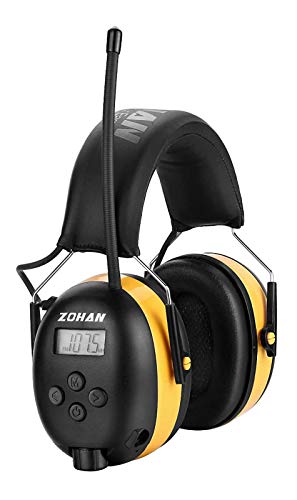
The ZOHAN EM042 is the guide’s reminder that a simple tool, clearly specified, has its own dignity. Its title offers an AM/FM radio headphone with a digital display, 25dB NRR, ear-protection noise-reduction earmuffs for mowing, described as a comfortable hearing protector, in yellow. That is the whole proposition, and for the enormous population of people whose requirement is exactly a mower, a radio and an afternoon, the proposition is complete.
Yellow is a considered colour in a garden. It is findable: on the bench, in the shed’s gloom, in the grass where the muff was set down during a break. Working equipment in camouflage colours gets lost with impressive regularity, and a bright muff is a small insurance policy against the most common failure mode in this category, which is not electronic at all but simply not being able to find the thing. Yellow also announces the wearer, a modest safety virtue around shared allotments, driveways and any space where a ride-on mower and a pedestrian might surprise each other.
The digital display covers the one piece of feedback a radio muff truly needs, the frequency, legible at a glance. Comfort is claimed in the title, and while this guide cannot verify a maker’s comfort claim from a title, its presence signals where ZOHAN spent its attention: on the headband and cushions that decide whether a muff is still being worn at hour three. NRR 25dB matches the category’s central cluster, so the EM042 competes on honesty and simplicity rather than on a ratings headline.
What the title withholds is the machinery underneath: no preset count is published, no battery arrangement is described, and no second input of any kind is mentioned. A buyer who rotates among many stations should confirm the memory situation on the listing, and a buyer who wants any source beyond broadcast radio should look at the picks either side of this one. Within its stated borders, though, the EM042 is the muff for the gardener who reads streaming feature lists the way they read weather forecasts for other counties: interesting, and entirely beside the point.
Strengths
- Digital display gives the one feedback a radio muff needs.
- High-visibility yellow is findable in sheds and visible around shared spaces.
- Simple radio-only design carries no pairing or account overhead.
Trade-offs
- No preset count is published in the title.
- No auxiliary or Bluetooth input is described.
- Battery arrangement is not covered by the title.
Spec box
- Rating: 25dB NRR
- Display: Digital display
- Colour: Yellow
- Stated use: Mowing
- Presets: no count published in the title
Best for: a home gardener whose brief begins and ends with the mower, the radio and a comfortable seal. Not suited for: a listening routine built around many memorised stations, since the title publishes no preset provision.
Gardeners can look at the EM042 on Amazon to settle its battery and preset details from the listing.

4. PROHEAR 033 Bluetooth AM/FM Headphones — Best rechargeable streaming option
The PROHEAR 033 is the most modern electrical design in this guide. Its title describes upgraded Bluetooth 5.4 hearing protection headphones with FM/AM radio, an OSHA-compliant 25dB NRR, rechargeable power with a 48-hour playtime, for mowing, workshops and snowblowing, in black. Nearly every phrase marks a deliberate update to the classic radio muff: current Bluetooth, a compliance reference in the rating, and a rechargeable battery sized for a working week of garden hours.
Rechargeable power reorganises ownership. There are no AA cells to buy, stock and discover dead in a drawer; instead the muff joins the nightly cable economy of phones and torches, and its 48-hour stated playtime means that economy is forgiving, since a forgotten charge still leaves days of reserve. The counter-argument belongs to the PROTEAR further down, whose AA claim reaches 120 hours and whose spares live in any shop. Between those poles the choice is about the household’s habits, not about which technology is superior in the abstract.
The OSHA-compliant phrasing in the title addresses the professional buyer directly. Compliance language signals that the maker expects this muff to be considered for workplaces where hearing protection is a regulated duty, not merely a comfort, and the 25dB NRR figure is the substance beneath the phrase. Snowblowing in the stated uses is a thoughtful inclusion: it is loud, solitary, seasonal work in cold air, where a sealed muff doubles as ear warmth and where radio company is genuinely welcome. Bluetooth 5.4, meanwhile, serves the streamer who wants the phone’s library under the same seal as the radio.
No preset count and no display description appear in this title, so the radio interface’s details live on the listing, and a station-hopper should verify them there. Black is the stated colour, the opposite choice from the ZOHAN’s yellow, suiting buyers who prefer their work gear anonymous. Taken together, the 033 is the pick for the worker whose life is already rechargeable and streamed, and who wants the radio muff to join that life rather than maintain a separate battery civilisation in the shed.
Strengths
- Rechargeable design with a stated 48-hour playtime ends battery purchases.
- Bluetooth 5.4 is the most current wireless version in this guide.
- OSHA-compliant 25dB NRR language speaks to regulated workplaces.
Trade-offs
- A flat rechargeable battery cannot be swapped in the field like AA cells.
- Preset provision is not described in the title.
- Display details are absent from the title.
Spec box
- Rating: 25dB NRR, described as OSHA-compliant
- Power: Rechargeable, 48-hour stated playtime
- Wireless: Bluetooth 5.4
- Stated uses: Mowing, workshops and snowblowing
- Presets: not described in the title
Best for: a worker whose tools already live on chargers and who wants radio and streaming in one modern muff. Not suited for: a remote site with no reliable charging point, where a swappable-cell design keeps working from a pocketful of AAs.
Rechargeable households can check the PROHEAR 033 on Amazon for its radio preset arrangement.
5. BJKing AM/FM Radio Headphones — Best stated protection figure
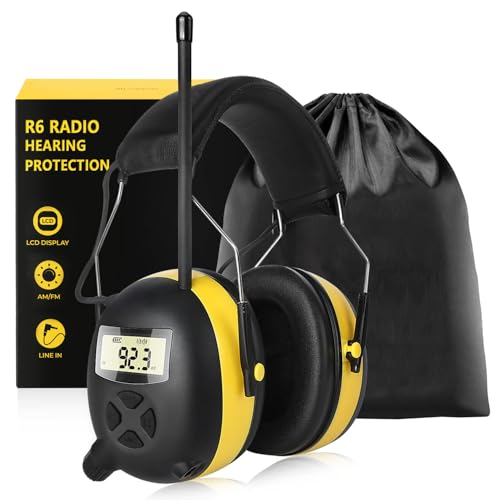
The BJKing walks into this guide carrying the biggest number: 30dB, stated in its title as the figure for its AM/FM hearing protection safety ear muff, alongside a digital display and a stated territory of mowing, landscaping, shooting and construction, in a black-and-yellow finish. Thirty decibels is a headline that demands both respect and calm. Respect, because if the figure holds on your head, this is the strongest barrier in the group. Calm, because ratings are gathered under each maker’s test conditions, and a 30dB claim from one catalogue and a 25dB claim from another are not measured with the same ruler.
That caution is not a dismissal; it is how this entire category should be read, and the BJKing’s case does not rest on the number alone. A digital display is stated, which covers the basic radio-feedback requirement. The stated uses are the broadest in this guide, spanning garden, site and range, suggesting a maker confident in the muff as general protective equipment rather than a single-purpose garden accessory. Black and yellow is the hi-vis compromise: visible enough to find, sober enough for a site.
Shooting in the use list deserves a clarifying sentence, because it appears in several titles across this batch of guides. A muff like this one protects hearing at a range in the same passive way it protects hearing beside a mower, by sealing the ear against loud sound. It is hearing equipment only, and nothing in its radio or its rating speaks to any other kind of protection, a distinction our companion guide to best over teh ear headsets for airsoft makes at length for its own category.
The title’s silences are the familiar ones: no presets are counted, no battery arrangement is described, and no second input is offered. The BJKing is therefore the specialist’s pick in this guide, bought for one towering specification by a worker whose environment is loud enough to justify chasing it, a contractor around plant machinery, a landscaper running the biggest equipment all day. For that buyer, verifying the fit carefully matters even more than usual, because a high claimed rating delivered through a poor seal is a promise the garden will not keep.
Strengths
- 30dB stated figure is the highest protection claim in this guide.
- Digital display covers essential tuning feedback.
- Broad stated uses span mowing, landscaping, shooting and construction.
Trade-offs
- Rating claims are not measured on a common ruler across brands.
- No preset count appears in the title.
- Battery arrangement and second inputs are undescribed in the title.
Spec box
- Rating: 30dB as stated in the title
- Display: Digital display
- Finish: Black-yellow
- Stated uses: Mowing, landscaping, shooting and construction
- Presets: no count appears in the title
Best for: a worker around the loudest plant and machinery who wants the strongest stated rating available here. Not suited for: a comparison that treats brand ratings as exact laboratory equivalents, because these figures were not produced under one shared test.
Heavy-equipment crews can review the BJKing muff on Amazon for its battery and memory provisions.

6. PROTEAR Digital AM/FM Earmuffs — Best battery life and presets
The PROTEAR closes the guide with the two numbers long-hour workers care about most: up to 120 hours of AA battery life, and 16 station presets, wrapped around digital AM/FM radio hearing protection earmuffs rated 25dB NRR, with an LCD display and a 3.5mm auxiliary input, for mowing. If the BJKing is the protection maximalist, the PROTEAR is the endurance maximalist, and its argument is aimed at the worker who measures a season in dozens of mowing hours and wants the radio to simply always work.
One hundred and twenty hours from AA cells is a philosophy as much as a figure. AAs are the world’s most available battery: sold everywhere, stockpiled in every shed, shared with torches and radios and remotes. A muff running on them can be revived in thirty seconds at any hour of any day, and its endurance claim means revival is a rare event anyway. Set against the rechargeable PROHEAR, the PROTEAR asks for a battery drawer and repays it with independence from cables, chargers and the nightly routine. For an allotment holder or a rural worker whose charging points are few, that independence is the feature.
Sixteen presets is double the DEWALT’s count and the richest memory in this guide, and it suits a particular listener: the one whose radio life spans news, sport, music and talk across both bands, and who crosses a large garden where the strongest station changes with geography. With an LCD confirming the choice, the PROTEAR’s radio side is the most completely specified in the group, and its auxiliary socket adds the wired second source for a phone or player, completing a package that wants for nothing except wireless streaming.
The rating, 25dB NRR, sits in the guide’s central cluster, and the PROTEAR does not pretend otherwise; its case is endurance and memory, not the protection headline. Nothing in the title addresses Bluetooth, and a streamer should look to the 3M or the PROHEAR instead. For the radio devotee, though, this is the most persuasive specification in the guide: the longest legs, the deepest memory, a display to steer by and a socket for everything else, in a muff built for the mower’s long companionship.
Strengths
- Up to 120 hours of AA battery life is the longest endurance claim here.
- 16 station presets double the nearest rival’s memory.
- LCD display and a 3.5mm auxiliary socket complete the radio-first package.
Trade-offs
- AA cells are an ongoing purchase the rechargeable rival avoids.
- No Bluetooth is offered for wireless streaming.
- Its 25dB rating matches the cluster rather than leading it.
Spec box
- Rating: 25dB NRR
- Battery: AA cells, up to 120 hours claimed
- Presets: 16 station presets
- Display: LCD
- Second input: 3.5mm AUX
Best for: a high-hour mower or allotment worker who wants the radio always ready across a whole season. Not suited for: a shed that has retired AA batteries entirely, since this design’s endurance is built on them.
Season-long gardeners can find the PROTEAR earmuffs on Amazon and confirm the pack’s included accessories.
Comparison table
| Model | Stated rating | Presets | Power story | Second input |
|---|---|---|---|---|
| 3M WorkTunes Connect + AM/FM | 26dB | Not stated in title | Not stated in title | Bluetooth |
| DEWALT DPG15 | NRR 25dB | 8 | Not stated in title | 3.5mm aux |
| ZOHAN EM042 | 25dB NRR | No count in title | Not stated in title | None described |
| PROHEAR 033 | 25dB NRR | Not described in title | Rechargeable, 48 hours | Bluetooth 5.4 |
| BJKing | 30dB | No count in title | Not stated in title | None described |
| PROTEAR Digital | 25dB NRR | 16 | AA, up to 120 hours | 3.5mm AUX |
How do you choose the right AM/FM headset for your work?
Begin with the noise, honestly assessed. A push mower on a suburban lawn, a ride-on on an acre, a chainsaw, a snow blower and a site compressor do not present the same acoustic problem, and the rating you need follows the loudest regular hour of your week. The cluster of 25dB designs covers the mainstream garden faithfully; the worker whose days run beside the heaviest plant has a stated reason to look at the 26dB flagship or the 30dB BJKing claim, while remembering that seal quality on your own head can move real protection further than the gap between those numbers.
Next, count your stations. Be truthful: most listeners rotate through three or four, and for them 8 presets are a lifetime’s supply. The genuine multi-station listener, news at breakfast, sport through the afternoon, music for the long evening jobs, is the buyer the PROTEAR’s 16 memories were designed for. A display matters to everyone, because tuning blind is guesswork, and every model here with a stated display earns that credit in its review.
Then settle the power question by looking at your shed rather than at specifications. If AA batteries already live there in a drawer, the PROTEAR’s 120-hour claim plugs into an existing civilisation. If your tools and torches already gather nightly around chargers, the PROHEAR’s rechargeable 48 hours will feel like home. The remaining titles leave their arrangements to their listings, so a buyer with a strong preference either way should confirm before ordering rather than discover at unboxing.
Reception geography deserves a practical word before the decision closes. Walk your own working ground with any radio you already own and note where the stations you love hold and where they dissolve, because a muff cannot invent signal that the valley withholds. On strong-signal ground the radio-only designs are complete in themselves; on marginal ground the auxiliary and Bluetooth models earn their place by letting a phone, with its different reception path or its downloaded programmes, fill the dead zones. Matching the muff to the map of your own acres is the last and most local step in choosing well.
Finally, decide what the radio is for. If it is company for solitary work and an escape from the phone, a radio-only muff protects that peace by design, and the DEWALT, ZOHAN, BJKing and PROTEAR all honour it. If the phone’s library is part of your working day, the Bluetooth models, the 3M and the PROHEAR, admit it under the same seal. Neither answer is more modern; they are different afternoons. Readers whose hearing needs go beyond protection into clarity may find our guide to best wireless headsets for hard of hearing a useful neighbouring read, since it covers listening systems built around the television rather than the mower.
Long jobs with these muffs: what a season teaches
We judged this class against the jobs that fill a season rather than a product demonstration. The first was the big mow: two hours on a ride-on, crossing a property where the signal geography changes from one end to the other. This job exposes tuning and memory, because a station that fades behind a hill must be replaceable with one button press, and it exposes the seal, because two hours is when a careless fit starts to ache. Preset-rich designs and displays earned their paragraphs here.
The second job was workshop time, bench work under extraction noise with talk radio for company. Intelligibility is the whole test: a voice programme must survive being heard through a sealed cup at modest volume, which is where stereo presentation stops being a brochure word and becomes the difference between following an argument and enduring a murmur. The radio-first designs, built entirely around that one source, tended to feel most at home in this scenario.
The third job was the seasonal worst: snow clearing at dawn in serious cold, and its summer mirror, a full day of strimming in heat. Cold punishes batteries and makes every control a gloved negotiation; heat punishes cushions and headbands. A season-minded buyer weights these extremes properly, because a muff bought in mild weather will meet both before the year is out, and the design that stays comfortable and alive in February and August alike is the one still in use next year.
A fourth scenario, the community one, rounds out the picture: the allotment on a Saturday morning, where half the plots seem to be wearing some version of this product and the other half are borrowing advice about it. Radio muffs are social objects in that setting in a way streaming headphones never become, because two neighbours wearing them are very likely listening to the same match. We noticed, assessing this class, how often the conversation about a muff is really a conversation about the listening life it protects, and how rarely it is about electronics at all.
Across all three jobs, one truth kept surfacing: the radio muff is a companion product, judged in hours and seasons rather than minutes. Specifications sort the field, but the winner is the muff whose company you still enjoy in month six, whose station is still your station, and whose seal you trust without thinking about it.
Common mistakes buyers make with radio hearing protectors
The first mistake is treating the rating as a score to maximise rather than a protection level to match. A worker beside a domestic mower gains little from chasing the largest number in the catalogue and may lose comfort, presets or battery life that would have served every single session. Buy the rating your loudest regular hour requires, then spend the rest of the decision on the features you will touch daily.
A second mistake is forgetting that the seal is the rating. Glasses arms, thick cap bands and hair under the cushion all leak sound past the cup, and a muff worn over them delivers a fraction of its published figure. Arrange headwear so the cushion meets skin or thin fabric, and if you wear glasses all day, favour the model whose cushions you can trial, because your real protection is decided at that interface.
Third, buyers discover the battery arrangement at the worst moment, usually the first flat morning. Know before the season whether your muff sips from AAs in the drawer or from a charger by the door, and keep the appropriate reserve ready. A radio muff that cannot play is just an earmuff, and the garden does not wait for a delivery of batteries.
Another quiet mistake is storing the muff in the damp corner of the shed where the mower lives, then blaming the electronics for a musty, perished seal two winters later. Cushions and headbands are organic materials living an outdoor life; a dry hook indoors is the difference between a five-year muff and a two-year one, and it costs nothing but the habit.
Fourth, volume creep undermines the entire purchase. The point of the seal is that the radio can stay modest while the machine is held at bay; turning the broadcast up to fight a poor seal recreates the exposure the muff was bought to prevent. Set the level where speech is clear at the start of the job and resist renegotiating it as your ears tire, because tired ears are poor judges and the seal has not changed.
A further mistake is buying a second muff for a partner or a crew without checking that its controls match the first one’s logic. Mixed fleets of protectors sound harmless until a worker in gloves, mid-job, meets a tuning system arranged opposite to the one their hands learned. Where several people work in the same muffs interchangeably, standardising the model pays for itself in un-fumbled afternoons, and where each worker keeps their own, the preset argument disappears because everyone’s stations are their own business.
Finally, shoppers confuse this category with streaming headphones and feel cheated by the radio’s simplicity, or the reverse, buying a connected flagship and resenting every notification that invades the garden. Both errors are cured by the same question, asked honestly before purchase: is the phone invited to this job, or is the whole point that it is not?
Owning a radio muff across the years
A radio hearing protector is one of the longest-lived electronic purchases a household makes, because its job changes slowly and its technology changes slower. That longevity rewards a few habits. The first is cushion care. Ear cushions are the seal, and the seal is the protection, so cushions that have flattened, cracked or absorbed a summer of sweat should be regarded as a maintenance item rather than as the muff’s death. A protector stored hanging in a dry shed, rather than crushed under tools in a van footwell, keeps its shape and its rating far longer, and the thirty seconds spent hanging it up is the cheapest insurance in this entire guide.
The second habit is a battery rhythm matched to the design you chose. AA households should rotate stock so the cells in the muff are never the oldest in the drawer, and should treat the first weak-volume morning as the signal to change them rather than as a mystery. Rechargeable households should charge on a rhythm tied to use rather than to anxiety, since a 48-hour reserve forgives a forgotten week entirely. Both habits share one principle: the muff should be ready at the moment the job appears, because a radio protector that needs attention before it will work is a protector that gets left behind on the busy morning it was needed most.
There is also a household politics to these muffs that nobody warns buyers about. A good radio muff gets borrowed: by the partner painting the fence, by the teenager clearing the drive, by the neighbour whose own protector is a pair of foam plugs and optimism. Borrowing is a compliment and a risk, because a shared muff needs its cushions wiped and its presets forgiven when they come back changed. Households with two regular outdoor workers often end the argument by owning two, and given the years these products serve, the second muff is rarely regretted. It also solves the genuine problem of one protector being in the van while the garden needs doing.
Fit across a life deserves a sentence too. Heads change less than hairstyles, glasses prescriptions and caps do, and each change touches the seal. A muff that was perfect with last year’s sunglasses may leak with this year’s thicker frames, and the fix is adjustment and cushion condition rather than replacement. Checking the seal at the start of each season, the way you check the mower’s oil, keeps the published rating honest in the only place it matters, which is around your own ears.
Finally, there is the question of what fills the hours, and it is not trivial. The radio muff is one of the last mass-market products built around broadcast radio, and its buyers are keeping a whole listening culture alive at the end of a mower. Stations shape the working day: news on the hour, sport through the afternoon, the phone-in that makes an hour of weeding pass like twenty minutes. Choosing a muff with the memory and reception to serve that culture well is a small, durable pleasure, and it is the reason this unfashionable category continues to earn its shed space long after smarter products have been replaced twice over.
Final recommendation
For most buyers the decision resolves into three honest profiles. The radio devotee with long hours should take the PROTEAR, whose 120-hour AA endurance and 16 presets make the strongest companionship case in this guide. The connected worker should take the 3M WorkTunes for its 26dB rating and Bluetooth breadth, or the rechargeable PROHEAR 033 for a modern power routine with streaming. The loud-environment specialist should examine the BJKing’s 30dB claim with a careful trial of its fit. The DEWALT remains the site’s dependable preset-and-aux workhorse, and the ZOHAN the uncomplicated gardener’s muff. All six protect first and entertain second, which is the correct order for equipment worn beside running engines. If the choice still feels open after those profiles, let the battery question close it, because the muff whose power system matches your shed’s existing habits is the muff that will be charged, stocked and ready on the one morning a year when the whole garden must be done before the rain arrives.
Frequently asked questions
Do these headsets play the radio in real stereo?
That is the category’s founding promise and the reason this guide’s title carries the word. A stereo broadcast received and reproduced in stereo keeps voices centred and music properly shaped inside the cups, which is what makes talk programmes followable over engine noise. Where a model’s title emphasises its radio and display, stereo reception is the service being sold; a buyer for whom music quality is paramount should favour the designs whose titles stress their audio presentation.
What does the NRR figure on a radio muff mean?
It is the maker’s published noise reduction rating for the hearing protector, measured under test conditions: higher figures indicate more reduction of the sound reaching the ear when the muff is fitted correctly. Real protection depends on the seal, which glasses and headwear can compromise. The figures in this guide range from 25dB to a stated 30dB and were not produced under one shared test, so compare them as leagues rather than as exact equivalents.
Can I listen to my phone through these muffs?
Through two of them wirelessly and two more by wire. The 3M and the PROHEAR carry Bluetooth in their titles, while the DEWALT and the PROTEAR offer a 3.5mm auxiliary socket for a cabled device. The ZOHAN and BJKing titles describe radio-only designs. No title here promises streaming features beyond what it names, so match the second-input question to the pick rather than assuming it.
AA batteries or rechargeable: which is better for a work muff?
Each suits a different household. AA power, headlined by the PROTEAR’s claim of up to 120 hours, offers instant revival anywhere batteries are sold and independence from chargers. The PROHEAR’s rechargeable 48-hour playtime ends battery purchases and fits homes where everything already charges nightly. The better system is the one whose reserve you will actually maintain in February, not the one with the larger number in June.
How loud can I safely run the radio inside the muff?
Run it at the lowest level where speech stays clear against the machine noise leaking through the seal, and set that level at the start of the job. The protector’s job is to lower the total sound reaching your ears; raising the broadcast to overpower a poor seal defeats it. If clarity demands ever more volume, stop and fix the fit first, because the seal, not the station, is what has changed.
Will a radio muff work where I live if reception is weak?
Reception is the one performance area no title in this guide can promise for your postcode, because it depends on your distance from transmitters and the terrain between. The practical defences are the ones these designs offer: a muff whose tuning is precise and whose stations can be memorised lets you capture the strongest version of each signal once and return to it instantly, and working patterns help too, since most gardeners learn which end of the plot loses the station and plan the noisy jobs for the strong-signal ground. If broadcast reception is genuinely poor where you work, the Bluetooth and auxiliary models in this guide give the phone a route into the same protection.
Can I wear a radio muff over a cap or with glasses?
You can, and most wearers do, but arrange the layers so the cushion seals against as little interruption as possible. Thin cap bands under the cushion disturb the seal least, glasses with slim arms are kinder than thick ones, and some wearers put the muff on first and rest glasses over it. However you arrange it, treat any visible gap as a leak in the published rating and check the result with the engine running, because the seal you can hear is the only seal that counts.
There is a particular pleasure, known to everyone who has ever mowed a large lawn to a Test match or a favourite station’s afternoon programme, in work that passes inside a sealed and musical world of its own, and the right muff in this guide is simply the one that keeps that world intact from the first cut of spring to the last leaf of autumn. Buy it for the seal, keep it for the station, and let it be the rare modern device that asks nothing of you all season except a pair of batteries or a place by the charger. The garden will supply the hours; the muff’s job is simply to make every one of them sound like company rather than noise.


