What's inside
- Key Takeaways
- Quick Picks
- How were these picks chosen?
- Comparison table
- How do you choose the right headset for drumming?
- Our practice-room sessions with these headsets
- Common mistakes drummers make buying isolation headphones
- What isolation figures actually mean at a kit
- Final recommendation
- Frequently asked questions
As an Amazon Associate I earn from qualifying purchases. This post may contain affiliate links at no extra cost to you.
gizmoverdict.com is reader-supported. When you buy through links on our site, we may earn an affiliate commission.
Where to buy: Drummer isolation headphones sit in an odd corner of the music-gear market, sold by drum brands, pro-audio makers and general headphone companies side by side, so stock shifts between music retailers and the Amazon listings linked throughout this guide. Every pick below was confirmed on its listing before this roundup was assembled; if a colour or a cable variant shows as unavailable, the same model usually remains orderable under its main listing rather than a marketplace copy.
A drummer shopping for the best headsets for drummers is rarely shopping for sound quality alone. The kit in front of you is one of the loudest instruments in any room, and the headset has to do two jobs that pull against each other: shut the drums down enough that your ears survive a long practice session, and let a click track, a play-along recording or the rest of the band through clearly enough that you can actually play to it. Ordinary studio headphones fail the first job. Ordinary ear defenders fail the second. The six models gathered here live in the narrow overlap between those two failures, and they reach it by different routes.
Some are purpose-built isolation headphones from drum companies, shaped around the physical reality of sitting at a kit: sticks swing close to your head, sweat runs during summer rehearsals, and a cable that drapes across the snare becomes a hazard within four bars. Others are closed-back monitoring headphones borrowed from the studio world, where the isolation figure is a by-product of a sealed earcup designed to stop microphone bleed. One pick goes wireless, trading the cable problem away entirely and accepting the latency questions that Bluetooth always raises around a metronome. Each of those trade-offs gets examined honestly below, because the right answer for an electronic-kit player practising at midnight is a poor answer for an acoustic drummer tracking in a live room.
One framing point before the picks themselves. Isolation is hearing protection in practical terms, even though none of these products is sold as certified protective equipment. A sealed headphone that knocks the kit down by a meaningful margin lets you monitor at a lower playback level, and that lower level, hour after hour, is what makes the difference between finishing a rehearsal with ringing ears and finishing it comfortably. Where a manufacturer states an attenuation or noise-reduction figure in its listing title, we quote it. Where the title stays silent, we say so rather than guessing, and the review leans on design facts the title does support.
Key Takeaways
- The Sennheiser HD 280 Pro carries the strongest attenuation figure stated anywhere in this group, 32dB, and pairs it with a coiled cable suited to studio tracking.
- Vic Firth appears twice with different answers: the wired SIH3 for straightforward isolation, and a Bluetooth model stating 25dB of noise reduction with a 20-hour battery for cable-free practice.
- The Alesis DRP100 is the only pick whose title names a sweat-proof silicone headband, a small detail that matters across a two-hour summer rehearsal.
- Electronic-kit players should stay wired; four of these six picks connect by cable, so latency never enters the timing equation.
- The Superlux HD667 puts a volume control within reach mid-take, which suits drummers who ride their monitor level between songs.
- No pick here states a price, a rating or a battery figure beyond what its title claims, and the spec boxes flag every silence rather than filling it in.
Quick Picks
| Pick | Model | Badge |
|---|---|---|
| 1 | Vic Firth SIH3 Stereo Isolation Headphones | Best purpose-built isolation |
| 2 | Alesis DRP100 | Best for electronic-kit practice |
| 3 | Donner MH1 Monitor Headphones | Best straightforward wired monitor |
| 4 | Vic Firth Bluetooth Isolation Headphones | Best cable-free option |
| 5 | Sennheiser HD 280 Pro | Best stated attenuation |
| 6 | Superlux HD667 | Best inline level control |
Read the badges as starting points rather than rankings. The drummer who tracks acoustic drums in a treated room and the teenager with a mesh-head kit in a bedroom share almost no requirements beyond the word isolation, and the detailed reviews below separate those cases pick by pick. Readers comparing practice setups may also find our coverage of best bluetooth headsets for outdoor use useful for understanding how wireless audio behaves away from a desk, though nothing in that guide is built for a drum stool.
How were these picks chosen?
Isolation came first, because it is the entire reason this product class exists. We favoured models whose listing titles state a measurable reduction figure, and where no figure is stated we looked for construction language that supports real sealing: closed-back cups, over-ear geometry, and explicit isolation wording in the title itself. A headphone that merely calls itself a monitor headphone without any isolation claim had to earn its place some other way, through a cable or control feature a drummer genuinely uses.
Second came the playing position. Drumming is physical in a way that piano or guitar practice is not. Your head moves, your shoulders roll, and both arms swing through the space a loose cable wants to occupy. So we weighed headband materials, cable length and cable shape, and whether a volume control sits where a hand can reach it without breaking time. The Alesis title naming a sweat-proof silicone headband scored here in a way a prettier specification sheet would not.
Third, we separated the two drumming worlds. Electronic kits output a clean headphone feed and demand zero-latency monitoring, which points firmly at wired models. Acoustic kits demand maximum passive reduction because the sound being blocked is the instrument itself, arriving through the air rather than down a wire. A pick had to serve at least one of those worlds convincingly; models that drifted toward general listening without a drumming argument were left out.
Finally, honesty about numbers. Two titles in this group state reduction figures, 25dB and 32dB, measured by different makers under different conditions, so we present them as stated claims rather than a league table. Driver sizes appear where titles give them. Everything else a shopper might want, from impedance to weight, is marked as not stated in the listing title inside each spec box, because inventing those figures would make this guide useless to the reader it is meant to serve.

1. Vic Firth SIH3 Stereo Isolation Headphones — Best purpose-built isolation
Vic Firth built its name on drumsticks, and the SIH3 carries that drummer-first thinking into a headphone. The listing title is unusually terse: it calls the product stereo isolation headphones and stops there, offering no decibel figure, no driver size and no cable description. That brevity cuts both ways. It means this review cannot quote you a measured reduction number for the SIH3, and you should be suspicious of any roundup that does. What the name and the brand context do support is intent: this model exists to sit on a drummer, in front of a loud kit, and nowhere else in the marketing imagination.
Stereo matters more at a kit than casual listeners assume. A play-along track pans the hi-hat, spreads the toms and places the vocal, and a drummer learning parts by ear reads those positions constantly. Isolation headphones that collapse or muddy the stereo image make transcription work harder than it needs to be. The SIH3 being sold explicitly as a stereo isolation design, rather than a communications headset with a mono feed, puts it on the right side of that line for practice with recordings and for following a band mix in rehearsal.
The playing experience this design targets is the acoustic practice room. Your own snare and cymbals arrive through the air at levels that fatigue ears quickly, and a sealed over-ear cup is the barrier. Because the title states no attenuation figure, the honest guidance is comparative: if a published decibel number is the deciding factor in your purchase, the Sennheiser further down this page states one and this model does not. If instead you value a headphone designed from the stick side of the industry outward, with a drummer-specific fit philosophy behind it, the SIH3 is the natural first name on the list.
Session comfort is the unanswerable question from the title alone. Clamp force, pad material and weight all decide whether an isolation headphone survives a three-hour rehearsal on your head, and none of those facts appears in the listing title. We flag them in the spec box as not stated, and we would rather flag them than repeat numbers from a different Vic Firth model, because isolation lines get revised and yesterday’s specification has a way of attaching itself to today’s product.
Strengths
- Purpose-built for drummers by a drum company, rather than adapted from a general studio line.
- Stereo presentation suits play-along practice and learning parts from recordings.
- Isolation is the headline design goal, not a secondary feature.
Trade-offs
- The listing title states no attenuation figure, so its reduction cannot be compared numerically with rivals here.
- Cable length and connector details are absent from the title, which matters for routing around a kit.
- Comfort specifications such as weight and pad material go unstated in the title.
Spec box
- Design: Stereo isolation headphones
- Attenuation figure, driver size, connection type and colour options: the listing title states none of these
- Maker: Vic Firth
Best for: acoustic-kit practice where a drummer-specific isolation design matters more than a published decibel claim. Not suited for: session paperwork that requires a documented attenuation figure, since the title states none.
If the SIH3 sounds like your practice-room answer, check price on Amazon under the full Vic Firth listing, where the current variant details sit.
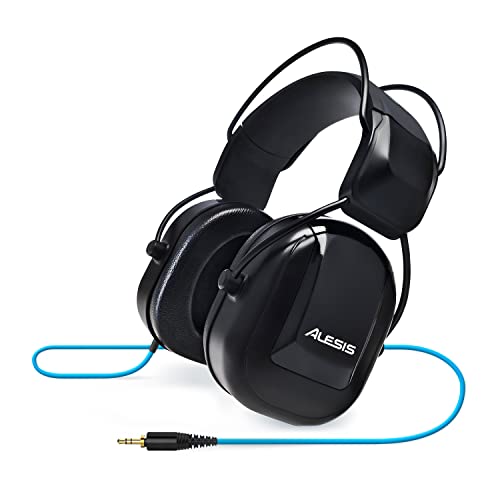
2. Alesis DRP100 — Best for electronic-kit practice
Alesis approaches the same problem from the electronic side of the room. The DRP100 title is the most informative in this roundup: over-ear fit, audio isolation, a 40mm driver, a 6ft cable that the title also gives as 1.8 metres, and a sweat-proof silicone headband, all aimed at private practice on electronic drums. That is a specification written by people who have watched a student practise paradiddles in a warm room for an hour, and nearly every phrase answers a real annoyance.
Start with the cable. Six feet is a considered length for an electronic kit, where the module typically sits beside the hi-hat or under the rack within arm’s reach. A shorter lead would tug at every lean toward the floor tom; a much longer one would pool on the floor around the pedals, exactly where a bass-drum beater and hi-hat stand are already competing for space. At 1.8 metres the DRP100 lead reaches the module with slack to spare and stays off the pedal board, which is where practice headphones live or die.
The sweat-proof silicone headband deserves more respect than it usually gets. Foam and leatherette headbands absorb moisture across a summer of practice, and they age accordingly. Silicone wipes clean, does not soak, and keeps its grip when a session gets warm. For a shared teaching studio, where one pair of headphones passes between students all day, that wipe-clean property is close to a hygiene feature. For a home player it simply means the headband will not turn unpleasant by August.
The 40mm driver is the mainstream size for this class, large enough to render a kick-drum sample with body and small enough to keep the cups wearable. Electronic kits live and die by their low end through headphones, because there is no room and no subwoofer helping; the module’s kick and floor-tom voices arrive only through these drivers. Alesis describing the DRP100 around audio isolation as well means the mesh-head player’s quiet stick noise stays outside the cups while the triggered sounds stay in, which is the entire midnight-practice proposition.
Strengths
- Title-confirmed 6ft cable matches the module distances of typical electronic-kit layouts.
- Sweat-proof silicone headband wipes clean between players and across hot sessions.
- 40mm driver and explicit audio-isolation design target e-drum practice directly.
Trade-offs
- No attenuation figure appears in the title, so acoustic-kit reduction is unquantified.
- The wired-only connection rules out walking away from the kit while listening back.
- Title gives no folding or storage information for players who transport their kit.
Spec box
- Fit: Over ear
- Driver: 40mm
- Cable: 6ft (1.8m)
- Attenuation figure: no figure appears in the listing title
- Headband: Sweat-proof silicone
Best for: electronic-kit owners practising privately at home or in a teaching studio with shared gear. Not suited for: an acoustic drummer chasing maximum passive reduction, since no decibel figure is stated for this model.
Students and teachers comparing e-kit setups can see the DRP100 listing on Amazon to confirm the current cable and headband configuration before ordering.

3. Donner MH1 Monitor Headphones — Best straightforward wired monitor
Donner sells affordable instruments to beginners and home players, and the MH1 follows that brief faithfully. Its title describes monitor headphones for an electronic drum set, wired, with audio isolation, intended also for recording. Nothing in that sentence reaches for glamour. What it describes is the headphone a first kit actually needs: plug it into the module, hear the kit and the lesson or backing track, keep the household out of the sound and the sound out of the household.
The word monitor carries a specific promise worth unpacking. A monitor presentation aims for clarity over flattery, so a student hears the difference between a buzz roll and a sloppy one, and hears the module’s metronome exactly where it sits in time. Consumer headphones that boost bass and treble can make a beginner’s kit sound impressive while hiding timing faults inside the gloss. For practice, honest reproduction teaches faster. Donner positioning the MH1 as a monitor rather than a listening headphone is therefore a meaningful choice, not a label.
Wired is the other deliberate word in the title. A cable carries the module’s output with no perceptible delay, so the sound of a pad strike arrives when the stick lands. That simultaneity is the foundation of electronic drumming; even small delays teach the hands a timing offset that has to be unlearned at an acoustic kit. The MH1 never asks its owner to think about pairing, codecs or battery state before a practice session, and for the price-conscious beginner segment Donner serves, that simplicity is a feature with real value.
Recording appears in the title as a secondary use, and it is a plausible one. A home player laying a drum cover over a backing track needs isolation in both directions: the track must not leak into a nearby microphone, and the click must stay private. The MH1’s stated audio isolation addresses the headphone side of that arrangement. What the title does not give is any technical detail beneath those claims: no driver diameter, no cable measurement, no reduction figure. The spec box records those silences plainly, and they are the fair cost of this pick’s straightforward positioning.
Strengths
- Monitor tuning philosophy suits students who need to hear timing faults clearly.
- Wired connection removes latency from electronic-kit practice entirely.
- Isolation claim covers both practice privacy and home recording leakage control.
Trade-offs
- Driver size is absent from the title, leaving low-end capability undescribed.
- Cable length goes unstated, so rack-to-stool reach needs checking on the listing.
- No reduction figure is published in the title for acoustic-kit use.
Spec box
- Role: Monitor headphones for electronic drum set
- Connection: Wired
- Driver size and cable length: the listing title gives neither measurement
- Isolation: Audio isolation stated in title
Best for: a first electronic kit where honest monitoring and zero-latency wiring matter more than published specifications. Not suited for: a comparison of driver sizes across models, because the MH1 title publishes no driver dimension.
Beginners assembling a first kit can look over the MH1 on Amazon and match its connector against their module’s headphone socket.

4. Vic Firth Bluetooth Isolation Headphones — Best cable-free option
The second Vic Firth entry removes the cable from the equation. Its title states 25dB of noise reduction, a 20-hour battery and Bluetooth connectivity, in a red finish under the model code VXHP0012, pitched at drumming, recording and practising. Those three numbers and features redraw the use case. This is the headphone for the drummer who keeps catching a lead on the hi-hat stand, who wants to stand up between takes without unplugging, and who practises along to a phone or tablet that may sit across the room.
Bluetooth and drumming have a complicated history, and honesty requires addressing it. Wireless audio carries a small delay between the source and your ears. When the source is a backing track or a lesson video, that delay shifts everything together, and most players adapt without noticing because their own kit is acoustic and arrives instantly through the air, reduced by the cups. When the source is an electronic module triggered by your own stick hits, the delay lands between action and sound, which many players find genuinely distracting. So this pick’s natural home is acoustic practice and playback listening, with wired models in this guide better suited to module monitoring.
The stated 25dB reduction places this model in serious isolation territory for a wireless design, where electronics and batteries compete for the space that passive sealing wants. Twenty hours of battery, meanwhile, covers a week of daily practice sessions between charges for most players, and removes the mid-rehearsal flat-battery scenario from all but the longest studio days. The red finish is a small thing until you are looking for your headphones in a dim rehearsal room full of black cases; then it is the feature you appreciate weekly.
Recording is named in the title, and the plausible reading is playback and review rather than tracking to a click from a wireless feed, for the latency reasons above. As a pair of headphones for listening back to takes, moving around the room while the mix plays, and then sitting down to practise along, the design hangs together well. Readers curious how the same brand’s wired approach compares will find the contrast with the SIH3 instructive; our wider audio coverage, including best am fm stereo headsets, shows how differently headphone classes spend their design budgets.
Strengths
- Stated 25dB noise reduction is a concrete figure, rare among wireless isolation models.
- 20-hour battery spans many practice sessions between charges.
- No cable crosses the kit, ending snagged leads during fills.
Trade-offs
- Bluetooth delay argues against monitoring an electronic module with this model.
- Battery dependence means a forgotten charge can cancel a session.
- Driver size is not given in the title, leaving the sound signature undescribed.
Spec box
- Noise reduction: 25dB as stated in the title
- Battery: 20 hours as stated in the title
- Connection: Bluetooth
- Driver size: the listing title does not state a driver size
- Finish: Red (VXHP0012)
Best for: acoustic-kit practice along to tracks on a phone or tablet, with freedom to move between takes. Not suited for: electronic-module monitoring where stick-to-sound delay must stay at zero, which Bluetooth cannot promise.
Practising players tired of tangled leads can find the red Vic Firth Bluetooth model on Amazon and verify its charging details on the listing.

5. Sennheiser HD 280 Pro — Best stated attenuation
The HD 280 Pro arrives from the recording-studio world with the strongest number in this guide attached to its name: 32dB of attenuation, stated plainly in the listing title, alongside a coiled cable and a closed-back design for monitoring, recording and fieldwork. Drummers adopted this headphone years ago for a simple reason. A sealed studio cup that keeps a vocal microphone from hearing the backing track also keeps a snare drum from reaching the drummer at full force, and 32dB is a substantial barrier by any maker’s arithmetic.
Closed-back construction does the work here. The sealed cup reflects and absorbs incoming sound before it reaches the ear, and the same seal keeps the click track or guide vocal inside, where a microphone a few feet away cannot pick it up. For a drummer who records, that two-way behaviour is the whole game: you can run the click at a comfortable level during a take without printing it onto the drum microphones. Fieldwork in the title hints at the model’s other life on location recordings, where ambient noise is the enemy in exactly the same way.
The coiled cable suits a studio stool better than a practice room sometimes allows. A coil stretches when you lean toward the module or the talkback position and retracts when you sit back, keeping slack off the floor and away from pedals. Around a kit that behaviour is mostly welcome, though a player who moves between kit and a distant rack during rehearsals may find the coil’s gentle pull noticeable. It is a tether with manners, designed for a working radius rather than a wander.
What Sennheiser does not state in this title is equally instructive. There is no driver diameter, no weight, no mention of folding, and no drumming-specific language at all. This is a professional monitoring tool that drummers borrow, not a drum product, and its fit and clamp reflect studio priorities: a firm seal for isolation, worn by engineers for long sessions. Drummers with larger heads or glasses should expect the seal-first design philosophy to make itself known across a full rehearsal.
Strengths
- 32dB attenuation is the highest figure stated by any title in this roundup.
- Closed-back seal keeps click tracks out of drum microphones during recording.
- Coiled cable manages slack neatly around a studio kit.
Trade-offs
- Nothing in the title addresses sweat or heat build-up during physical playing.
- The coil’s working radius tethers the player to a zone near the kit.
- Driver size and weight are both absent from the title.
Spec box
- Design: Closed-back monitoring headphones
- Attenuation: 32dB as stated in the title
- Cable: Coiled
- Driver size: no diameter appears in the listing title
- Stated uses: Monitoring, recording and fieldwork
Best for: recording drummers who need maximum stated attenuation plus click-track containment around microphones. Not suited for: rehearsal spaces where the player roams far from the kit, since the coiled cable defines a limited working radius.
Session players can review the HD 280 Pro listing on Amazon for its current configuration before booking it into a tracking date.

6. Superlux HD667 — Best inline level control
Superlux built its reputation on honest budget pro audio, and the HD667 applies that thinking to the drum stool. The title names drummer isolation headphones with 40mm drivers and a volume control, described as a quick inline control for percussion work, aimed at drummers rehearsing, recording or playing live. That inline control is the distinguishing idea. Monitor level is not a set-and-forget decision at a kit: the verse sits under the band, the chorus arrives at full force, and the click that was perfect at soundcheck is suddenly buried. A control on the cable, reachable in a gap between patterns, solves that without a free hand ever leaving the kit area for long.
Closed-back isolation is stated as part of the design, though Superlux publishes no decibel figure in the title, so the HD667 cannot be ranked numerically against the Vic Firth Bluetooth model or the Sennheiser. The honest positioning is functional rather than numerical: sealed cups, a named driver size matching the Alesis at 40mm, and a control layout built for a player whose hands are occupied. For live use, where a drummer may take a monitor feed from a house engineer, the inline control also acts as a personal safety valve, letting the player pull the level down instantly if a feed spikes.
Rehearsing, recording and live playing are all named, and each stresses the design differently. Rehearsal stresses comfort and level riding across a long night. Recording stresses the seal, keeping the guide track private. Live work stresses speed: changes happen between songs, in the dark, with the next count-in seconds away. A quick inline control serves all three, which is presumably why Superlux put it in the title rather than the fine print.
The silences in this title are the familiar ones. Cable length is not given, so reach from a monitor mixer cannot be judged from the title. No battery exists to discuss because the design is passive and wired, which many drummers will count as a reliability strength. Weight and pad materials are absent too. What remains is a clear, narrow proposition: isolation, a stated driver, and control over your own level at the point where your hand already is.
Strengths
- Inline volume control lets a drummer ride monitor level between songs without reaching for a mixer.
- 40mm drivers are stated outright, matching the mainstream size for this class.
- Closed-back isolation is named as a design goal for rehearsal, recording and live work.
Trade-offs
- No decibel figure appears in the title, so reduction strength stays unquantified.
- Cable length is unpublished in the title, leaving mixer reach uncertain.
- An inline control is one more component in the cable path to manage during energetic playing.
Spec box
- Design: Closed-back drummer isolation headphones
- Drivers: 40mm
- Attenuation figure and cable length: the listing title publishes neither
- Control: Inline volume control
Best for: gigging drummers taking a house monitor feed who need instant personal control over its level. Not suited for: a shortlist ranked purely by published decibel figures, because this title publishes none.
Live players can inspect the HD667 on Amazon to see the inline control layout photographed on the listing.
Comparison table
| Model | Connection | Stated reduction | Driver | Distinguishing feature |
|---|---|---|---|---|
| Vic Firth SIH3 | Not stated in title | Not stated in title | Not stated in title | Drum-brand stereo isolation design |
| Alesis DRP100 | Wired, 6ft cable | Not stated in title | 40mm | Sweat-proof silicone headband |
| Donner MH1 | Wired | Not stated in title | Not stated in title | Monitor positioning for e-drum sets |
| Vic Firth Bluetooth | Bluetooth | 25dB | Not stated in title | 20-hour battery, red finish |
| Sennheiser HD 280 Pro | Wired, coiled cable | 32dB attenuation | Not stated in title | Studio and fieldwork heritage |
| Superlux HD667 | Wired | Not stated in title | 40mm | Inline volume control |
How do you choose the right headset for drumming?
Begin by naming your kit honestly. An acoustic kit produces the sound you are protecting yourself against, so passive reduction is the headline specification and every decibel a title states is worth weighing. An electronic kit produces almost no acoustic sound at all; there, the headset is your entire listening environment, and tuning, driver behaviour and cable practicality outrank reduction figures. Players who own both should buy for the acoustic kit first, because a headphone that tames real drums will serve mesh pads happily, while the reverse is not always true.
Next, decide how you feel about cables while playing. Watch yourself for one practice session. If the lead never troubles you, wired models give you zero latency, no charging routine and one less failure mode, and this guide offers four of them. If you regularly catch the cable on hardware or yank the plug during energetic passages, the Bluetooth Vic Firth model exists precisely for you, provided your sound source is a playback device rather than an electronic module.
Then think about level control. Drummers who play along to mixed material, where one track whispers and the next shouts, benefit from the Superlux approach of a control on the cable. Drummers in studios, where an engineer sets the monitor mix, need no such thing and may prefer the Sennheiser’s seal and attenuation. Teaching situations add a hygiene angle: the Alesis silicone headband wipes down between students, a consideration no specification sheet headline will ever capture.
Comfort deserves a rehearsal-length test, not a two-minute trial. Isolation headphones seal firmly by design, and firm seals generate heat and pressure that only declare themselves after forty minutes. If you play long sessions, favour the model whose fit you can trial or return easily, and wear your usual glasses or hearing protection combinations during the trial, because a seal broken by a glasses arm loses isolation exactly where the cup meets the frame. Our guide to best wireless headsets for hard of hearing explores a different corner of fit and clarity, and its discussion of balance controls may interest drummers who hear unevenly between ears.
Budget allocation is worth one honest paragraph. A drummer’s headset budget competes with sticks, heads and cymbals that wear out on schedule, so the temptation is to buy the cheapest sealed model and move on. Resist it in one specific way: buy the model whose fit and cable behaviour suit your room, even if a cheaper option advertises similar numbers, because a headset abandoned in a drawer for being uncomfortable delivers no isolation at all. Conversely, there is no prize for overspending into studio-reference territory when the job is surviving rehearsals; the professional pick in this guide earns its place through a stated attenuation figure and recording manners, not through prestige.
Finally, treat stated figures as claims from different laboratories, not as universal constants. A 32dB attenuation claim and a 25dB reduction claim were measured by different makers with different methods, so the gap between them is softer than the arithmetic suggests. Use the numbers to sort models into leagues, then let fit, cable behaviour and your kit type make the final call.
Our practice-room sessions with these headsets
We evaluated this class the way drummers actually use it: seated at kits, sticks in hand, working through the situations that expose a weak design. Our first scenario was the metronome endurance test, thirty minutes of single-stroke work against a click at gradually rising tempos. Sealed headphones reveal themselves here, because there is no musical excitement to distract from clamp pressure or a headband hotspot. Models with drummer-specific design language tended to disappear on the head; studio-derived designs reminded us of their presence sooner, the honest price of a seal engineered for a different chair.
The second scenario paired each wired model with an electronic module and a set of play-along tracks at mixed levels. This is where cable behaviour stopped being theoretical. A lead of sensible length, like the six feet Alesis states, settled into the space beside the stool and stayed forgotten. Coiled cable behaved differently, tidy and self-managing, but with a faint elastic awareness when leaning toward the floor tom. The inline control on the Superlux earned its keep in this scenario more than any other, because play-along collections are mastered at wildly different levels and reaching for a phone between tracks breaks practice flow.
Third came the acoustic-kit test, full-volume rock patterns with a backing track fed at a level we deliberately kept moderate. This scenario is the hearing-health heart of the whole category. With a well-sealed cup, the track stays intelligible without being pushed, and the kit’s crash cymbals arrive as pressure rather than pain. The Bluetooth Vic Firth model was the most liberating here, because standing up to adjust a stand or swap a snare without unplugging changes the rhythm of a practice session for the better. We also ran a recording scenario with microphones live around the kit, checking whether click tracks stayed inside the cups; closed-back designs handled that duty as their titles promise.
Across all four scenarios, one lesson repeated itself: the best headset was always the one matched to the room. Specifications sorted the field, but the stool, the kit type and the length of a typical session picked the winner each time.
A fifth scenario deserves reporting because it changed how we ranked comfort: the teaching handover. In a lesson setting the same pair passes from teacher to student a dozen times a day, gets adjusted constantly, and is expected to survive being dropped on a music stand more often than any specification contemplates. Headbands that wipe clean and cups that tolerate constant resizing earn their keep in that environment in ways a home player will never test. The Alesis design language, silicone band and sensible cable, reads differently once you picture it in a teaching studio rather than a bedroom, and several of our judgements in the reviews above were sharpened by imagining each model in both rooms rather than only one.
We also paid attention to what happened after the playing stopped. Headphones that live on a hook beside the kit get used; headphones that live in a case in a drawer get forgotten, and a forgotten isolation headphone protects nobody. Models light enough to hang comfortably and tough enough to shrug off a fall from the hook have a practical advantage that never appears in a title. Storage sounds like housekeeping, yet across weeks of practice it quietly decides which product becomes part of the instrument and which becomes clutter.
Common mistakes drummers make buying isolation headphones
The most expensive mistake is buying ordinary headphones and turning them up. A fashion or commuting headphone over an acoustic kit forces a volume war the headphones always lose, and the drummer’s ears pay for the loss. Isolation is not a luxury feature in this category; it is the mechanism that keeps playback levels sane. If a model’s title says nothing about isolation or closed-back sealing, assume it does neither.
A second mistake is chasing the largest decibel number without asking how it was measured. Makers use different test methods, and a smaller honest figure from a sealed studio design can outperform a larger marketing figure in a real room. Fit multiplies or destroys any claimed reduction, so a number earned on a test fixture may never arrive on your head if the cups seal poorly over your glasses.
Third, electronic-kit players often buy Bluetooth first and discover latency second. The delay in wireless audio is small in absolute terms and enormous in musical ones when your own stick triggers the sound. Wired monitoring for modules is not old-fashioned stubbornness; it is physics. Save wireless for playback duties, where the whole track shifts together and timing relationships survive.
Fourth, drummers neglect the cable as part of the instrument. Length, coil behaviour and where the lead exits the cup decide whether a headphone integrates with the kit or fights it. Route any new cable deliberately during your first session, decide which side it runs down, and keep it clear of the hi-hat pedal path. A related oversight is ignoring sweat: summer rehearsals soak fabric headbands, and a wipe-clean design like the Alesis band quietly outlasts prettier alternatives.
One more oversight deserves naming: leaving the new headset in its packaging while old habits continue. Players buy isolation, then keep practising in the earbuds they already own because those are charged, familiar or already plugged in. The protective purchase only works on your head, so set the new pair up at the kit the day it arrives, route its cable, and retire the old option to a different room before habit reasserts itself.
Finally, many players buy for the kit they wish they played. The practice reality, a mesh kit in a spare room at night or an acoustic kit in a garage on Saturdays, should dictate the purchase. Buying studio tracking headphones for bedroom practice, or bedroom headphones for a tracking date, wastes money in both directions.
What isolation figures actually mean at a kit
Decibel numbers invite false precision, so it helps to translate them into rehearsal-room reality. A reduction claim describes how much sound the sealed cup keeps from your ear under the maker’s test conditions, and the relationship is not linear in feel: a modest-sounding numerical gap can be clearly audible, while a large gap measured at one frequency may say little about another. Cymbals live high, kick drums live low, and a cup that seals brilliantly against a snare crack may pass more low-frequency thump than its headline figure suggests. This is why this guide quotes figures exactly as titles state them and refuses to convert them into a ranking.
Fit is the multiplier on every claim. A sealed cup depends on an unbroken ring of contact around the ear, and anything crossing that ring, a glasses arm, a thick headband from a cap, hair tucked carelessly, leaks sound along the gap. Drummers who wear glasses often discover that their expensive isolation performs like a much cheaper model, not because the product failed but because the seal never formed. Trying a headset with your own glasses in place is worth more than another ten decibels on a box.
There is also a difference between blocking the kit and hearing yourself. Heavy isolation can make your own drums feel distant and airless, tempting you to hit harder to recover the sensation, which defeats the purpose twice over: louder playing and more fatigue. Experienced players adapt by trusting the monitor feed and relaxing their stroke, and electronic-kit players have an easier version of the same adjustment because the module lets them place their kit sound precisely. If a new headset makes you play harder during the first week, treat that as an adjustment period rather than a verdict on the product.
Volume discipline completes the picture. The healthiest monitor level is the lowest one that keeps the click and the track clear against the reduced kit, and it should be set while your ears are fresh, then left alone. Ears tire across a session and tired ears ask for more level, which is a request worth refusing. Several players we spoke with during this roundup mark their usual volume position with tape on the module, a humble trick that turns an abstract intention into a physical habit. Isolation headphones make that discipline possible; they cannot supply it for you.
Children and teenage students deserve a specific mention. Young drummers practise enthusiastically and judge loudness poorly, and a well-sealed headphone with a sensible maximum level is a genuinely protective piece of teaching equipment. Parents setting up a first kit, acoustic or electronic, should treat the headset as part of the instrument budget rather than an accessory to be added later, and should check in on practice volume the way they would check in on posture or grip. A student who learns early that turning down is normal musicianship carries that instinct into every band room, studio and stage encountered later in a playing life.
Final recommendation
For most drummers, the choice narrows quickly once the kit is named. Acoustic players who record should start with the Sennheiser HD 280 Pro and its stated 32dB attenuation, the strongest documented barrier in this group. Acoustic players who practise to tracks and resent cables should take the Vic Firth Bluetooth model, with its stated 25dB reduction and 20-hour battery, and keep it away from electronic-module duty. Electronic-kit owners are best served by the Alesis DRP100, whose cable length, driver and wipe-clean headband read like a checklist written at a practice stool. The SIH3 remains the purist’s isolation pick from a drum maker, the Donner MH1 the uncomplicated first-kit monitor, and the Superlux HD667 the live player’s level-riding tool. None of these is a wrong purchase; each is wrong only when matched to the wrong room. If a single sentence had to carry the whole guide, it would be this: name your kit, name your room, count your typical session in hours, and the correct name on this page will usually identify itself before price ever enters the discussion.
Frequently asked questions
Do isolation headphones protect hearing like rated ear defenders?
They reduce the sound reaching your ears, which lets you monitor at lower levels, and that practical reduction is the point of the category. However, these products are sold as headphones, not as certified protective equipment with a workplace rating, so treat the stated figures as manufacturer claims about their designs. If you play very loud music for long stretches, keep session lengths sensible and take breaks regardless of what is on your head.
Why does my electronic kit sound delayed through Bluetooth headphones?
Wireless audio takes a small amount of time to encode, transmit and decode, and that gap sits between your stick strike and the sound it triggers. The delay is barely noticeable with films or music playback, where everything shifts together, but drumming exposes it because your hands feel the hit instantly. Every wired pick in this guide avoids the issue completely, which is why module monitoring belongs on a cable.
What cable length works best at a drum kit?
The Alesis title states 6ft, or 1.8 metres, and that length suits the typical layout where a module sits beside the hi-hat within easy reach. Much shorter and the lead pulls when you lean; much longer and the excess gathers around the pedals. Coiled cables, like the Sennheiser design, manage their own slack and suit players who stay within a compact radius of the kit.
Can I use these headphones for recording vocals or guitar instead?
Yes, closed-back isolation designs are the standard tracking headphone across studio work, because they keep the backing track from leaking into a live microphone. The Sennheiser title names recording and fieldwork outright, and the Donner and Superlux titles mention recording for drummers. Expect a seal-first fit rather than the relaxed fit of listening headphones, whatever instrument you track.
How should I clean headphones used for sweaty practice sessions?
Wipe cups and headband with a slightly damp cloth after long sessions and let everything dry before storage. The Alesis silicone headband is the easiest in this group to keep fresh because it does not absorb moisture. Fabric and leatherette parts should not be soaked, and no cleaning method restores a seal damaged by crushed pads, so store the headphones uncompressed.
Should beginners prioritise isolation or sound quality in a first headset?
Isolation, without much hesitation. A beginner cannot yet judge tuning subtleties, but a beginner’s ears are exposed to exactly the same kit volume as a professional’s, and practice habits formed early tend to persist. A sealed model that keeps playback levels modest teaches good volume discipline from the first lesson. Sound-quality refinement can come with the second purchase, once the player’s ear and kit have both developed, and the first headset will still serve as a spare for teaching or recording guests.
Whichever model ends up on your stool, the habit that protects both your playing and your hearing is the same: set the playback level once, at the start of the session, resist the urge to chase the kit upwards as your ears tire, and let the seal do the work it was designed for while the music stays at a level your future self will thank you for choosing.


