What's inside
- Key Takeaways
- Quick Picks
- How Did We Rank for Loud Without a Single Decibel to Stand On?
- Why Does the Fairing Change Everything About Loud?
- How Do the Six Compare Side by Side?
- How Do You Install Fairing and Bag Audio Without Regrets?
- What Mistakes Do Street Glide Owners Make Chasing Loud?
- What Should You Diagnose on Your Glide Before Choosing?
- How Do You Judge Loud Honestly Once It Is Fitted?
- How Do Screens, Helmets and Speed Rewrite the Verdict?
- What Does a Season With a Stage Kit or a Pair Teach?
- How Do You Read These Six Titles Like an Installer Would?
- What About the Rest of the Electrical Story?
- Should You Add Sound Treatment Inside the Fairing?
- What Does Two-Up Touring Ask That Solo Riding Does Not?
- What About the Factory Infotainment Behind the Speakers?
- How Does Winter Storage Treat a Fitted System?
- Final Recommendation
- Frequently Asked Questions
- Related Guides
As an Amazon Associate I earn from qualifying purchases. This post may contain affiliate links at no extra cost to you.
gizmoverdict.com is reader-supported. When you buy through links on our site, we may earn an affiliate commission.
Where to buy: Amazon carries every kit and pair in this guide. Names in the Quick Picks table and in the review headings link to the exact listings whose titles supplied the fitment years, sizes and stage names quoted here, so match your Street Glide’s model year against the listing you open before anything else.
The best loudest speakers for Harley Davidson Street Glide riders begin with a confession this guide will not bury: no listing in this pool states a loudness figure. There is not a decibel in any of the six titles, so there will not be a decibel in any of the six reviews — loud, here, is an architecture, not a measurement. It is the difference between a complete amplified kit built for the 2014–2023 Street Glide and a pair of fairing speakers asked to shout on factory power. The two Rockford Fosgate Stage kits sit at the top of that architecture, the fairing replacement pairs from Rockford, Hogtunes and NVX occupy the honest middle, and the BOSS saddlebag kit attacks the problem from behind the rider entirely. Choose by how much system you are willing to install, and the loudness will follow the engineering.
The Street Glide’s batwing fairing is both the opportunity and the trap. It gives speakers a home, a power supply and a rider sitting in a pocket of managed air — the best listening position in touring motorcycling — and it tempts owners into believing a speaker swap alone can fill that pocket at eighty miles an hour over an exhaust. Sometimes it can, when the factory speakers were the only tired link. Often the honest answer is amplification, which is why the stage kits exist and why this guide gives them the top of the page without apologising to the pairs below.
Key Takeaways
- No title here states a loudness or decibel figure, so this guide ranks by architecture — amplified kit versus replacement pair — and never invents a volume number.
- The Rockford Fosgate Stage 3 and Stage 2 kits are titled for 2014–2023 Harley-Davidson models and represent the complete-system route to loud.
- Three picks are 6.5-inch fairing or front speaker pairs: the Rockford TMS6SG, the Hogtunes 462F-RM with grills, and the NVX pair titled for Harley-Davidson Touring 2014-up.
- The Hogtunes title is the most specific about its audience, naming fitment for 2014-current Harley-Davidson front locations and including grills in the box.
- The BOSS BHD14 is a 6 x 9-inch saddlebag speaker kit — a different location and a different installation, since saddlebag lids are part of the job.
- Model year is the first fitment fact: every amplified kit here speaks to the 2014-and-later generation, so earlier Street Glides must read the titles with care.
Quick Picks
| Pick | Badge | Why it is here |
|---|---|---|
| Rockford Fosgate HD14RGSG-STAGE3 Audio Kit for 2014-2023 Harley-Davidson | Loudest architecture | The Stage 3 kit — the most complete system in the guide, built for the 2014–2023 generation and named for Road Glide and Street Glide applications in its own code. |
| Rockford Fosgate HD14RGSG-STAGE2 Audio Kit for 2014-2023 Harley-Davidson | Amplified middle step | The Stage 2 kit for the same year range — the amplified route for riders who want the system’s core without the top tier’s full scope. |
| Rockford Fosgate TMS6SG 6.5 Fairing Speaker Replacements (Pair) | Fairing pair, same family | 6.5-inch fairing speaker replacements carrying the SG suffix — Street Glide fairing speakers from the same house as the kits. |
| Hogtunes 462F-RM 6.5 Front Speakers with Grills (2 Pack), Fits 2014-Current Harley-Davidson | Harley-specialist pair | A 6.5-inch front pair with grills included, titled for 2014-current Harley-Davidson, from a brand that builds only for these bikes. |
| NVX 6.5 Motorcycle Speakers for Harley-Davidson Touring 2014 up (Pair) | Touring-titled pair | A 6.5-inch pair whose title names Harley-Davidson Touring 2014-up outright — the clearest application sentence among the pairs. |
| BOSS Audio Systems BHD14 Harley Davidson 6 x 9 Inch Saddlebag Speaker Kit | Saddlebag expansion | A 6 x 9-inch saddlebag speaker kit for select Harley-Davidson models — rear-fill volume from the bags, with lid work as part of the deal. |
How Did We Rank for Loud Without a Single Decibel to Stand On?
By ranking the machinery that produces loud, in the order a rider experiences it. Amplified complete kits lead because they replace the system’s weakest links together — source power and speakers, designed for each other and for this fairing — and a system engineered as a whole sustains clean volume at speed in a way no component swap can promise. The fairing pairs follow, ranked by the specificity of their titles: NVX names the application and years, Hogtunes names years and includes grills, Rockford’s TMS6SG names the fairing and the model family in its suffix. The saddlebag kit closes the guide not as the least but as the lateral move — additional speakers in a second location, answering a different question from the fairing’s.
We also refused two easy dishonesties. The first is converting stage numbers into volume claims: Stage 3 is a bigger system than Stage 2 by the maker’s own architecture, and this guide says exactly that and no more. The second is treating the pairs as quiet because they lack amplifiers in their titles; a sensitive, well-made fairing pair on a healthy factory system can satisfy a great many riders, and the guide’s job is to match expectations, not to upsell. Loud is a relationship among power, speakers, wind and ears. This ranking orders the relationships honestly.
Why Does the Fairing Change Everything About Loud?
Because the batwing gives the sound somewhere to live. A handlebar speaker fires into open weather; a fairing speaker fires into a shaped pocket, from an enclosure-ish home, at a rider whose torso and screen have already negotiated with the wind. That pocket is why Street Glide audio can aspire to genuine fidelity at speed while naked-bike audio aspires to intelligibility. It is also why the fairing’s limits are electrical and thermal rather than architectural: the pocket rewards power fed cleanly, and punishes power fed badly with distortion that has nowhere to hide.
The practical translation is the spine of this guide. If your Glide’s factory system is healthy but tame, a fairing pair may unlock exactly the presence you miss. If it is tame because the whole chain is tired — source, amplification and speakers ageing together, as 2014-era systems now are — then pairs alone will polish the last link of a weak chain, and the stage kits’ whole-system logic is the honest recommendation. Diagnose which Glide you own before choosing which of those sentences you are in.

Rockford Fosgate HD14RGSG-STAGE3 Audio Kit for 2014-2023 Harley-Davidson — Loudest architecture
Stage 3 is Rockford Fosgate’s fullest answer to the question this keyword asks. The title frames it precisely: an audio kit, HD14 generation, for 2014–2023 Harley-Davidson, with the RGSG code speaking to the Road Glide and Street Glide fairing applications. A kit at this tier is not a speaker purchase; it is a system replacement in which amplification and speakers arrive designed for each other and for the fairing they will inhabit, and that wholeness is precisely what loud, clean and sustained at highway speed is made of. Riders cross-shop this against the pairs below and sometimes flinch at the scope — fairing off, system in, an installation measured in hours rather than minutes — but the scope is the product. Nobody buys Stage 3 by accident, and nobody who needed it was ever satisfied by a pair.
The year range deserves its bold type. 2014–2023 spans the Rushmore-era generation of Harley touring, the bikes whose fairings and electrical architecture these kits were engineered around. A Street Glide inside those years is the kit’s home ground; a Glide outside them — earlier or later — is a different conversation that this title does not claim to settle, and riders should let the printed years arbitrate rather than the badge’s general glow.
Within its ground, the Stage 3 proposition is completeness as a feature: one manufacturer, one design intent, one warranty story, and a fairing that finally sounds like the flagship room of the Harley line rather than its apology. If the diagnosis says the whole chain is tired, this is where the guide stops negotiating.
- Fitment years: 2014–2023 Harley-Davidson, per the listing title
- Format: complete audio kit, Stage 3 tier
- Application code: HD14RGSG (Road Glide / Street Glide family, per the title code)
- Individual speaker sizes: Not stated in the listing title — verify with Rockford Fosgate documentation
- Loudness figure: Not stated in the listing title — no decibel claim is made anywhere in this guide
Strengths
- The most complete system architecture in the guide, engineered for this fairing generation
- Amplification and speakers designed together rather than matched by hope
- Year range printed in the title, settling the generation question at a glance
Trade-offs
- The largest installation in the guide — a system job, not a speaker swap
- Overshoots the need when only the factory speakers have actually failed
- Bounded strictly by its 2014–2023 title years
Best for: a 2014–2023 Street Glide whose whole audio chain is tired and whose rider wants the definitive single purchase. Not suited for: earlier or later Glides, or a single failed fairing speaker.

Rockford Fosgate HD14RGSG-STAGE2 Audio Kit for 2014-2023 Harley-Davidson — Amplified middle step
Stage 2 is the same idea at a deliberate step down in scope: an audio kit for the same 2014–2023 Harley-Davidson generation, carrying the same RGSG application code, built on the same whole-system logic — amplification and speakers designed together for the fairing — at the tier Rockford positions beneath its flagship. For a great many Street Glides, this is the correct ceiling. The factory system’s core weakness is addressed as a system, the installation remains a single coherent project, and the rider is not paying for the top tier’s additional scope when their riding — screen height, typical speed, typical journey — would never interrogate the difference.
Choosing between Stage 2 and Stage 3 is the guide’s most honest fork, and it should be decided by diagnosis rather than by appetite. A Glide whose complaint is general tameness — music present but thin at speed, a system that runs out of composure before it runs out of dial — is Stage 2’s home address. A Glide being built as a long-term flagship, or one whose rider knows from experience that half-measures become full measures within a season, belongs at Stage 3. Both kits share the years, the family and the philosophy; the difference is how much of the motorcycle’s audio future you intend to settle in one purchase.
What Stage 2 is not is a compromise in the apologetic sense. It is a complete, amplified, fairing-specific system from the category’s defining manufacturer, and for the rider it fits, it will be the last audio decision the bike requires for years.
- Fitment years: 2014–2023 Harley-Davidson, per the listing title
- Format: complete audio kit, Stage 2 tier
- Application code: HD14RGSG (Road Glide / Street Glide family, per the title code)
- Individual speaker sizes: Not stated in the listing title — verify with Rockford Fosgate documentation
- Loudness figure: Not stated in the listing title — no decibel claim is made anywhere in this guide
Strengths
- Whole-system amplified logic at a step below the flagship’s scope
- Same printed year range and application family as the Stage 3 kit
- The correct ceiling for the majority of tired factory systems
Trade-offs
- Still a system installation, with the fairing work that implies
- Riders building a flagship may outgrow it and wish they had stepped up
- Confined to the 2014–2023 generation its title names
Best for: a 2014–2023 Street Glide with a generally tame factory system needing a complete amplified answer. Not suited for: a single-location repair, or a flagship build that will settle for nothing top-tier.
Rockford Fosgate TMS6SG 6.5 Fairing Speaker Replacements (Pair) — Fairing pair, same family
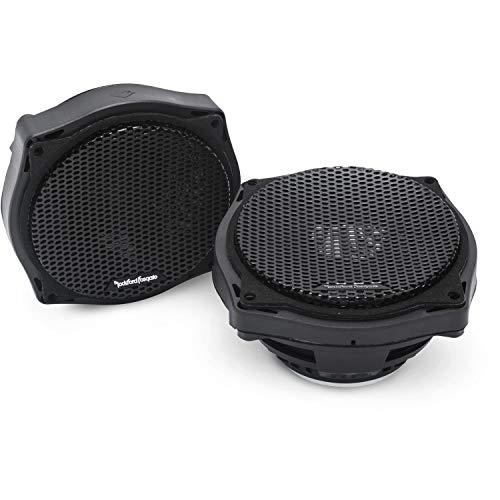
The TMS6SG is the pairs’ representative from the kits’ own house: 6.5-inch fairing speaker replacements, sold as a pair, with the SG in its name declaring its Street Glide fairing allegiance. That suffix does the work a paragraph of marketing could not — these are not universal 6.5-inch speakers adapted to a Harley; they are fairing speakers drawn for this motorcycle’s front room, by the manufacturer whose stage kits define the category’s ceiling. For a Glide whose amplification and source remain healthy, this pair is the surgical strike: the fairing’s tired voices replaced, the rest of the system left respectfully alone.
The surgical logic deserves its due. Factory speakers are the component that physically decays — surrounds, cones, the materials that meet the weather at the fairing’s edges — while the electronics behind them often retain their health. Replacing the decaying part first is not frugality; it is diagnosis honoured. And because the pair shares a family with the stage kits, a rider who later decides the whole system deserves renewal has not bought into a dead end: the fairing story continues in the same house voice.
Its title states no years and no power figure, so the standing verifications apply — confirm the generation fit on the detail page against your Glide’s year before ordering, particularly at the edges of the 2014–2023 span the kits have made familiar. Within its confirmed ground, the TMS6SG is the pair for the rider who wants Rockford’s fairing expertise without Rockford’s full-system commitment.
- Speaker size: 6.5 inches, per the listing title
- Location: fairing
- Format: pair of speaker replacements (no amplifier in the title)
- Fitment years: Not stated in the listing title — verify with Rockford Fosgate documentation
- Power handling: Not stated in the listing title — verify with Rockford Fosgate documentation
Strengths
- Fairing-specific design from the stage kits’ own manufacturer
- The surgical option when only the speakers have decayed
- Keeps the bike inside one brand family if a full kit comes later
Trade-offs
- Speakers alone cannot repair a system whose weakness is amplification
- Years unstated in the title — generation fit must be confirmed on the listing
- No printed power figure for number-led comparison
Best for: a Street Glide with a healthy factory system behind tired fairing speakers. Not suited for: a Glide whose whole audio chain is weak, where a stage kit is the honest spend.

Hogtunes 462F-RM 6.5 Front Speakers with Grills (2 Pack), Fits 2014-Current Harley-Davidson — Harley-specialist pair
Hogtunes builds speakers for Harley-Davidson touring bikes and for nothing else, and the 462F-RM title carries that specialisation proudly: 6.5-inch front speakers, grills included, in a two-pack, fitting 2014-current Harley-Davidson. The grills deserve their mention — in a fairing, the grill is not packaging, it is the visible furniture of the cockpit and a protective layer for the cone behind it, and a pair that arrives with its grills in the box arrives as a finished installation rather than as components awaiting cosmetics. The open-ended year claim — 2014 to current — is also the broadest in this guide, and riders at the newest edge of it should still confirm their exact year on the detail page, because current is a moving word in any catalogue.
The specialist’s argument is focus. A company that voices speakers for one fairing family, ridden in one posture, behind one screen, accumulates a kind of knowledge that generalists rent rather than own — where the rider’s ears sit relative to the pockets, how the fairing’s shape colours the top end, what a Harley’s electrical system is really like at a charging idle. Whether that focus outweighs the stage kits’ system logic depends entirely on your diagnosis: Hogtunes sells the pair, superbly aimed, for the bike whose system behind the speakers still earns its keep.
As with the TMS6SG, no amplifier rides in this title and no power figure is printed, so the pair’s promise is fitment and voicing rather than system transformation. For the 2014-and-later Glide with healthy bones, that is not a limitation. It is the correct prescription, written by the specialist.
- Speaker size: 6.5 inches, per the listing title
- Location: front (fairing)
- Fitment years: 2014-current Harley-Davidson, per the listing title
- Grills: included, per the listing title
- Power handling: Not stated in the listing title — verify with Hogtunes documentation
Strengths
- Harley-only specialist voicing for exactly this fairing family
- Grills included — the installation arrives cosmetically complete
- The broadest stated year span in the guide, from 2014 to current
Trade-offs
- A pair cannot cure a system whose amplification is the weak link
- The open-ended current in the title still asks newest-model owners to confirm
- No stated power figure for specification-led shoppers
Best for: a 2014-and-later Street Glide with a healthy system that needs specialist fairing speakers. Not suited for: a full-system renewal, where the stage kits’ scope is the point.

NVX 6.5 Motorcycle Speakers for Harley-Davidson Touring 2014 up (Pair) — Touring-titled pair
The NVX pair owns the clearest application sentence among the replacement pairs: 6.5-inch motorcycle speakers for Harley-Davidson Touring, 2014-up, sold as a pair. No suffixes to decode, no family codes to interpret — the title simply tells a Street Glide owner, in plain words, that this product was made for their line of motorcycles from 2014 onward. In a category where fitment so often hides inside model numbers, that plainness is a feature, and it earns the NVX its place in the guide’s middle with no apology.
NVX arrives from the broader car-audio world rather than from the Harley-only shelf, and its proposition is the generalist’s classic one: sound engineering applied to a named application, at a tier that leaves room in the budget for the rest of the bike’s life. For a rider whose Glide needs its fairing voices renewed and whose priorities are declared fit and honest value, the NVX pair is the straightforward instrument — no grills are mentioned in its title, no power figure is printed, and this guide marks both silences plainly rather than filling them from the brand’s wider catalogue.
The open-ended 2014-up span carries the same footnote as Hogtunes’ current: the newest model years deserve a confirmation glance at the detail page, because touring generations turn over and titles age more slowly than motorcycles do. Confirm, and the NVX becomes what its title promises — the pair that said what it was for.
- Speaker size: 6.5 inches, per the listing title
- Application: Harley-Davidson Touring, per the listing title
- Fitment years: 2014-up, per the listing title
- Format: pair
- Power handling: Not stated in the listing title — verify with NVX documentation
Strengths
- The plainest application statement among the pairs — model line and years in words
- Declared 6.5-inch size matched to the fairing’s expectation
- A value-conscious route from an established audio brand
Trade-offs
- No grills or power figures mentioned in the title
- Generalist brand rather than a Harley-only specialist
- Newest model years still warrant a detail-page confirmation
Best for: a 2014-up Touring rider who wants declared fit and honest value in a fairing pair. Not suited for: a rider seeking a complete amplified system in one box.
BOSS Audio Systems BHD14 Harley Davidson 6 x 9 Inch Saddlebag Speaker Kit — Saddlebag expansion
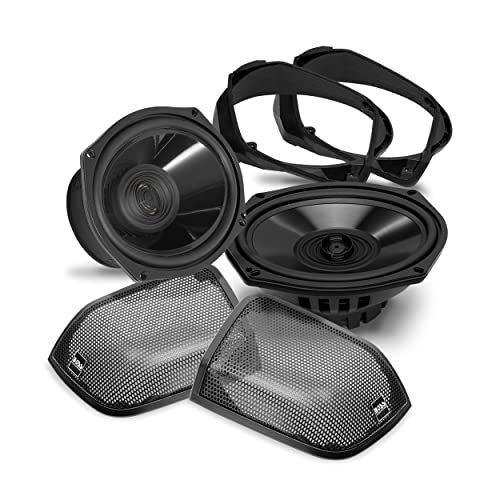
Every other pick in this guide speaks from the fairing. The BHD14 speaks from the saddlebags, and that change of address is its entire thesis: a 6 x 9-inch saddlebag speaker kit for select Harley-Davidson models, adding a second sound location behind the rider. The 6 x 9 oval is a larger cone than any fairing pair here carries, and rear-mounted speakers change the music’s geometry — the soundfield gains a rear wall, passengers gain their own near source, and the system stops being a solo instrument aimed at one helmet. For the two-up touring Glide, that geometry is not garnish. It is the difference between a passenger who hears the ride’s soundtrack and one who hears its rumour.
The installation honesty must be equally direct: saddlebag speakers live in the lids, and fitting a kit like this means working on the lids themselves — measuring, marking and, in the nature of such kits, cutting to the manufacturer’s template. That is a permanent modification to painted parts, and it should be undertaken with the template respected, the paint protected and the decision fully owned. Riders who flinch at cutting lids have learned something valuable about their priorities, and the fairing pairs above will welcome them back without judgement.
The title’s select-models framing also deserves respect: BHD14 names a generation family in its code and a selective fit in its words, so the detail page’s model list is the authority, not the headline. Confirm your Glide’s year there, weigh the lid work honestly, and the kit offers what nothing else in this guide can — a second room for the music, in the bags the Street Glide already carries everywhere it goes.
- Speaker size: 6 x 9 inches, per the listing title
- Location: saddlebags (lid-mounted kit)
- Fitment: select Harley-Davidson models, per the listing title — confirm your year with BOSS Audio Systems documentation
- Format: saddlebag speaker kit
- Power handling: Not stated in the listing title — verify with BOSS Audio Systems documentation
Strengths
- Adds a second sound location no fairing pair can provide
- Larger 6 x 9 cones serve passengers as well as the rider
- Built for Harley-Davidson bags under a dedicated BHD model line
Trade-offs
- Lid work is part of the installation — a permanent modification to painted parts
- Select-models fitment demands a careful year check on the listing
- An addition to a system, not a repair for a tired fairing
Best for: a two-up touring Street Glide whose rider wants rear-fill volume from the bags. Not suited for: a rider unwilling to modify saddlebag lids, or a fairing-first repair.
How Do the Six Compare Side by Side?
| Pick | Architecture | Location | Years in title |
|---|---|---|---|
| Rockford Stage 3 Kit | Complete amplified kit | Fairing system | 2014–2023 |
| Rockford Stage 2 Kit | Complete amplified kit | Fairing system | 2014–2023 |
| Rockford TMS6SG | Replacement pair | Fairing, 6.5 in | Not stated |
| Hogtunes 462F-RM | Replacement pair with grills | Front, 6.5 in | 2014–current |
| NVX Pair | Replacement pair | Touring, 6.5 in | 2014-up |
| BOSS BHD14 | Saddlebag kit | Bags, 6 x 9 in | Select models |
Two kits, three pairs, one lateral expansion. The table is the guide’s argument in miniature: loud is bought as architecture, and the right architecture is the one your diagnosis — not your appetite — selects.
How Do You Install Fairing and Bag Audio Without Regrets?
The fairing comes off like a secret the bike keeps politely: fasteners in known places, a shell that lifts away with patience, and a wiring loom that rewards photographs before a single connector parts. Work on a blanket, keep every fastener accounted for, and disconnect the battery before the loom is disturbed — a touring Harley’s fairing carries far more than audio, and the audio is the only part of it you are authorised to improvise near. Whether the job is a pair or a full stage kit, test the system with the fairing shell still off: voices centred, both sides even, every control answering. A fault found with the shell off is a ten-minute correction; the same fault found after reassembly is an afternoon with a moral attached.
For the saddlebag kit, add the painter’s disciplines to the electrician’s. Templates flat and verified twice, paint masked beyond the cut line, edges finished so moisture and vibration meet a sealed boundary rather than a raw one. Route the bag wiring so the bags remain removable as Harley intended, with connectors that part cleanly — a saddlebag kit that traps the bags on the bike has traded a feature for a feature, and the exchange rate is poor. Finish every format the same way: a road test in layers, kerb to town to highway, before the tools go away for good.
What Mistakes Do Street Glide Owners Make Chasing Loud?
The founding mistake is believing loud is a product. It is a system property, and the owner who buys the most aggressive pair for a system whose amplification is exhausted has purchased disappointment with excellent speakers attached. Diagnose first: if the fairing voices are the decayed link, a pair is the cure; if the whole chain is tired, the stage kits exist precisely for you, and their price is the honest cost of the outcome the keyword describes. The second mistake is its twin — buying a full kit to cure one blown speaker, then resenting the installation that a ten-minute diagnosis would have prevented.
Third, year blindness. This guide’s amplified kits speak to 2014–2023 in print; the pairs speak in suffixes, spans and select-model lists. Every one of those dialects must be translated against your Glide’s actual year before money moves, because Harley’s touring generations share silhouettes more readily than they share fairing hardware. Fourth, treating the saddlebag kit as a fairing alternative rather than as the addition it is — bags do not repair a tired front stage, they accompany a healthy one. Fifth, judging the result in the garage. A Street Glide system earns its verdict at cruising speed, in the pocket, over the exhaust; a garage audition flatters everything and acquits nothing.
What Should You Diagnose on Your Glide Before Choosing?
Listen to the system as it stands, at a standstill and then at speed, with material you know. Note where it fails: distortion that arrives early suggests the chain is out of composure; a thin, distant quality with clean manners suggests the speakers alone have faded; one side weaker or silent suggests a local failure that no kit should be bought to avenge. Check the fairing speakers’ physical state when the shell is next off — the surrounds live at the weather’s edge and their condition is the single most predictive fact in the whole diagnosis.
Then decide what your riding asks. Solo miles behind a tall screen forgive more than two-up motorway hours; a passenger’s ears are a second constituency with its own geography, and the saddlebag kit exists for the household where that constituency votes. Name the constituency, name the failure, name the year — three sentences, honestly spoken, choose among these six products more reliably than any specification table, because they describe the motorcycle and the life it actually leads.
How Do You Judge Loud Honestly Once It Is Fitted?
By intelligibility at your real cruising speed, in your real configuration — screen where you set it, helmet as you wear it, exhaust as it stands. The test material should include a voice, because voices confess distortion before music does, and one familiar recording whose quiet passages you know by heart, because a system that stays composed in the quiet parts at speed is a system with genuine headroom rather than mere aggression. Louder is only better when it arrives clean; volume that climbs by distorting is just the old system’s failure wearing a new price tag.
Give the verdict a month of roads. Ears recalibrate, expectations settle, and the true signature of a good Street Glide system emerges in the negative space: the presenter followed without effort at seventy, the passenger who stops tapping your shoulder about the music, the favourite album that survives the motorway intact. When those things stop being noteworthy, the purchase has done what the keyword asked — not a number on a meter, but a fairing that finally sounds the way the motorcycle looks.
How Do Screens, Helmets and Speed Rewrite the Verdict?
A Street Glide is not one listening room but several, depending on how its rider configures it. The stock screen, a taller touring screen and a low profile screen produce three different wind regimes at the rider’s helmet, and the same audio system is three different systems inside them. A taller screen stills the pocket, dropping the noise floor the music must climb over, and can make a fairing pair sound like an upgrade tier it did not purchase. A short screen at motorway speed does the opposite, taxing even a stage kit. Helmets filter the result again: a full-face admits a shaped slice of the spectrum, a half helmet admits the weather along with the music. None of this is a reason to distrust the shortlist; it is a reason to audition and judge in your own configuration, and to treat any universal ranking — including this one — as a map of architectures rather than a prophecy about your ears.
Speed is the final editor. Every system in this guide will sound generous at forty and honest at eighty, and the distance between those two judgements is the product you are actually buying. The stage kits exist to narrow that distance; the pairs narrow it where the factory chain behind them is healthy; the saddlebag kit narrows it for the passenger, whose listening position the fairing was never aimed at. Choose the narrowing your riding needs, and distrust any audition conducted entirely below it.
What Does a Season With a Stage Kit or a Pair Teach?
The first month is calibration: levels, balance between fairing and any bag speakers, the discovery of which recordings the new system flatters and which it exposes. Riders who fitted pairs into a healthy system usually report a quiet, complete satisfaction by week three — the fairing simply sounds like itself again, restored. Riders who fitted stage kits report a longer honeymoon of rediscovery, because a system change alters every familiar recording at once. Both groups meet the same second lesson around the first storm or the first thousand miles: installation quality is destiny. A connector that was seated hopefully works loose in the fairing’s vibration; a wiring run that chafes announces itself on a schedule set by the road, not by the calendar.
By season’s end, the successful systems share a biography — fitted with the shell off and tested before it returned, wired along the factory’s own routes, and then left alone. The unsuccessful ones share the opposite: repeated openings, speculative adjustments, faults chased in circles because the original installation was never documented. Photograph your work, keep the instructions with the bike’s papers, and let the system become furniture. On a touring Harley, furniture is the highest rank audio can hold.
How Do You Read These Six Titles Like an Installer Would?
Architecture first, because it decides the job’s size and the outcome’s ceiling: kit or pair or bag kit, in the title’s own nouns. Years second, because the touring generations share silhouettes and not much else — 2014–2023 in print for the kits, 2014-current and 2014-up for two pairs, silence for the third, and select models for the bags, each dialect requiring translation against the motorcycle in your garage. Location third: fairing, front, bags — three different rooms with three different audiences. Only then the brand, and last of all the absence this guide began with: no loudness figure anywhere, which is not a gap in the listings but a fact about the category, to be honoured rather than papered over with invented numbers.
Read in that order, the six products stop competing and start matching — against a diagnosis, a model year, a passenger policy and an appetite for installation. That matching, done carefully, is the whole craft of buying motorcycle audio, and it is why two riders with identical Street Glides can read this same guide and correctly buy different products.
What About the Rest of the Electrical Story?
A stage kit joins a motorcycle that already runs heated grips, auxiliary lights, a charging phone and a battery with opinions. The touring Harley’s electrical system is generous by motorcycle standards, but generosity is not infinity, and an audio installation fitted with the whole picture in mind — fused feeds, sensible routing, connectors chosen for service — will coexist with the bike’s other appetites for a decade. Fitted carelessly, it becomes the first suspect in every future electrical mystery, fairly or not. The discipline costs an hour during installation and buys innocence for years.
There is a handover dimension too. A Street Glide with a documented stage kit, fitted cleanly and demonstrably working, carries its audio as provenance; a Glide with a mysterious loom and a silent fairing carries its audio as a question. Keep the receipts with the service history, keep the removed factory speakers until the verdict settles, and the system you bought for loud becomes, in the fullness of time, part of why the next rider chose your motorcycle.
Should You Add Sound Treatment Inside the Fairing?
With the shell off, ambition stirs in the fairing just as it does in a car door: damping material, foam, a general campaign. The fairing’s case is narrower than the doors’ were. Its inner surfaces can buzz against the shell at particular engine speeds, and a targeted piece of damping at the proven contact point cures that specific complaint elegantly. A blanket campaign, though, adds weight high on the motorcycle — the least welcome place for it — traps heat around electronics that prefer air, and entombs the wiring you will want to reach at the next service. Fit the audio plainly, ride the bike, let the fairing name its own rattles one by one, and treat only the offenders. A touring motorcycle rewards the same one-variable discipline as every other machine in this batch, with the added argument that its fairing comes off often enough over a lifetime that anything you bury inside it will be met again, by you, in a worse mood.
What Does Two-Up Touring Ask That Solo Riding Does Not?
A second constituency with its own geography, as the diagnosis section put it — and the point deserves expansion, because it decides real purchases. The passenger sits higher, further back, in a wind regime the fairing was not shaped around, and hears the front system as spill: present, pleasant at moderate speed, and increasingly theoretical as the pace climbs. Couples who tour seriously discover their household’s answer within a season. Some find the spill sufficient and the fairing’s business their own; some adopt the saddlebag kit as the passenger’s dedicated voice, accepting the lid work as the price of a shared soundtrack; some conclude that the passenger’s music belongs in the passenger’s helmet and leave the bike’s system to the rider. All three are respectable settlements. The only failure is buying as though the question did not exist — fitting a flagship fairing system for two people’s benefit and aiming it, as physics insists, at one.
The same logic governs the order of operations for a two-up build. Fairing first, because the rider’s stage is the system’s foundation and because the diagnosis lives there; bags second, once the foundation is healthy and the passenger’s deficit has been measured on real tours rather than imagined in the garage. Reversed, the order produces a bike that is loud behind and tired in front, which is a fair description of a party and a poor description of a motorcycle.
What About the Factory Infotainment Behind the Speakers?
The 2014–2023 Street Glides carry factory infotainment of successive generations, and the system behind the fairing speakers is a partner in every outcome this guide discusses. A healthy factory source feeding fresh speakers is the pairs’ home ground; a source with its own ageing — tired outputs, a screen on its last seasons, software the world has moved past — caps what any speaker or kit can express, because a chain performs at the level of its weakest link and the source is a link. Riders should therefore fold the head unit’s health into the original diagnosis honestly: if the source is failing, replacing speakers first still makes sense as an experiment — speakers are the component that physically decays fastest — but expectations should be set knowing a second chapter may follow.
The stage kits reframe the partnership rather than abolishing it: amplification and speakers designed together take the factory source’s signal and give it the strength and the voices it always deserved. That is why a kit can transform a Glide whose source seemed unremarkable — the source was never the whole problem, only the unamplified one. Reading your own Glide’s chain correctly, link by link, remains the master skill of this entire category, and it is cheaper than every product in this guide combined.
How Does Winter Storage Treat a Fitted System?
Kindly, if the installation was honest. A system fitted with sealed connections, factory-style routing and a fused feed asks nothing of winter but a battery tender connected with the same care as the audio was — the two systems share a battery and should share a tidy corner of the frame rather than competing for it. Spring’s duties are inspection, not resurrection: connectors seated, the fairing’s fasteners honest, a short audition at the kerb before the first long ride grades the system for the season. Systems that fail in April almost always failed in October, at the moment a hurried connector met its first cold night; the calendar merely delivers the news. Fit for the seasons and the seasons become a formality, here as everywhere else in this batch.
Final Recommendation
If your 2014–2023 Street Glide’s whole system is tired, buy the architecture, not the accessory: Stage 3 for the flagship intent, Stage 2 for the complete answer at a saner scope. If the speakers alone have decayed, the fairing pairs — Rockford’s TMS6SG for the family connection, Hogtunes for the specialist’s touch and included grills, NVX for the plainest fitment promise — will restore the pocket honestly. Add the BOSS saddlebag kit when a passenger’s ears deserve their own source and the lids are yours to modify. Fit the choice your diagnosis named, test it at the speed you actually ride, and the batwing will finally deliver the soundtrack its silhouette has been promising since the day it rolled home.
Frequently Asked Questions
Which pick is actually the loudest?
No title in this pool states a loudness figure, so this guide ranks by architecture instead of inventing numbers. The amplified Stage 3 and Stage 2 kits are built to sustain clean volume at speed as complete systems; the fairing pairs depend on the health of the factory system behind them. Loud, honestly bought, is a system property.
Will the Stage kits fit my 2012 Street Glide?
Their titles state 2014–2023, so a 2012 falls outside the printed claim and this guide will not stretch it. Owners of earlier Glides should look to the pairs whose fitment they can confirm for their year on the detail pages, or to kits titled for their generation.
Stage 2 or Stage 3 — how do I decide?
By diagnosis and intent. A generally tame system needing a complete amplified answer is Stage 2’s home ground. A flagship build, or a rider who knows half-measures become full measures within a season, belongs at Stage 3. Both share the same years and philosophy.
Do the fairing pairs need an amplifier?
Their titles describe speaker replacements, not amplifier packages, and they are designed for the factory system’s power. If your Glide’s underlying system is healthy, a pair is a complete answer; if it is weak, the stage kits address the weakness at its source.
Does the saddlebag kit replace my fairing speakers?
No — it adds a second location in the bags rather than repairing the fairing. It also involves fitting speakers into the saddlebag lids, a permanent modification to painted parts, so weigh it as an expansion for a healthy system, ideally where a passenger’s listening matters.
What years do the Hogtunes and NVX pairs cover?
As titled: the Hogtunes 462F-RM states 2014-current and the NVX pair states Harley-Davidson Touring 2014-up. Open-ended spans deserve a confirmation for the newest model years on each detail page, since catalogues age more slowly than motorcycles.
How long does a stage kit take to install?
Plan a full, unhurried day rather than an ambitious afternoon. The fairing work itself is methodical rather than difficult, but a complete system touches power, signal and speakers in sequence, and each stage deserves its own test before the next begins. Riders who schedule the job honestly — shell off in the morning, system proven by lunch, shell back for an evening road test — finish with a motorcycle and a verdict on the same day, which is the correct unit of satisfaction for work of this scope.
Should I fit the saddlebag kit at the same time as a fairing upgrade?
This guide advises against stacking the changes. Fit the fairing solution first, live with it across real tours, and let the passenger’s remaining deficit — measured, not imagined — decide whether the bags earn their lid work. Two installations at once teach you nothing about either, and if the combination disappoints, neither can be acquitted or convicted on the evidence.
What should I keep from the factory system?
The removed speakers, boxed and labelled, until a full season has passed — they are your diagnostic control group and your evidence of reversible, careful work. Keep the kit’s documentation with the motorcycle’s service history as well; on a touring Harley, a paper trail is part of the machine’s value, and a documented audio system is worth more at handover than an undocumented one of twice the specification.
Can a fairing pair and a saddlebag kit share one plan?
Yes — as stages of one plan rather than as a single afternoon. The pair restores the front stage, the kit later gives the passenger a dedicated source, and because both decisions were sequenced, each can be judged on its own evidence. Riders who stage the work this way also spread the installation risk sensibly: the fairing’s lessons are learned before the lids are ever marked, which is exactly the order a careful owner would choose if the two jobs were strangers.
Is louder always better on a touring bike?
No — cleaner is better, and louder is only welcome when it arrives clean. A system that sustains intelligible, undistorted sound at your cruising speed serves a ten-hour day better than a louder system that fatigues by the second hour, which is why this guide ranks architectures by their ability to stay composed rather than by any figure none of the titles print.
Related Guides
The fairing is one end of Harley audio; the bars are the other. Between them runs the same discipline this whole batch has preached in six different cabins: diagnose before you spend, let the title’s printed years and locations arbitrate fitment, refuse to invent the figure the manufacturer declined to print, and judge the finished work at the speed and in the company the machine actually travels. A Street Glide rewards that discipline more visibly than most, because its fairing makes the improvement impossible to miss — the pocket fills, the voices centre, and the motorcycle’s soundtrack finally occupies the same class as its silhouette, at every speed the law allows and in every state of weather the tour happens to serve, from the first cold start of spring to the last long evening of the riding year, on highways, in harbour towns, and along every ridge road in between, for as long as the motorcycle and its rider keep choosing each other, season after season, tour after tour, without either of them running out of road, or out of songs worth hearing properly at speed, with the fairing full and the road rolling out ahead. See best handle bar speakers for Harley-Davidson, best plug and play speakers for Jeep Wrangler and best replacement speakers for 2008 Mustang GT for fitment-first audio thinking in three more wind-shaped cabins.


