What's inside
- Key Takeaways
- Quick Picks
- How Did We Assemble This Rugged Shortlist?
- Which Rugged Phones Earn a Closer Look?
- How Do the Six Rugged Picks Compare Side by Side?
- What Do IP Ratings and Military Language Actually Tell You?
- How Should You Set Up a Rugged Phone for Field Work?
- Which Mistakes Do Buyers Make in the Rugged Category?
- What Does a Working Week Look Like on Each Kind of Pick?
- How Do Night Vision and Thermal Imaging Differ in Practice?
- What Should a Crew Leader Check Before Issuing Rugged Phones?
- How Does Weight Change the Way a Rugged Phone Gets Carried?
- How Should You Care for Seals, Ports and Screens So the Ratings Survive?
- What Does a Long Trip Away From Mains Power Demand From These Phones?
- How Do Loud Speakers and Second Screens Earn Their Place on a Work Phone?
- Final Recommendation
- Frequently Asked Questions
- Related Guides
As an Amazon Associate I earn from qualifying purchases. This post may contain affiliate links at no extra cost to you.
gizmoverdict.com is reader-supported. When you buy through links on our site, we may earn an affiliate commission.
Where to buy: each of the six handsets below links to its Amazon listing from the Quick Picks table and again from its own detailed section. Rugged phones are sold in several memory configurations under near-identical names, so confirm the exact variant on the listing page before ordering.
The search for the best military grade smartphones with artificial intelligence joins two ideas that deserve to be separated before any money moves. The first idea is durability: sealed bodies, reinforced corners and water resistance measured against published standards. The second idea is the “AI” label, which the rugged-phone market now prints generously and defines loosely. This guide keeps the two apart on purpose. A pick earns an artificial-intelligence claim here only where its own listing title states one — that is the DOOGEE Blade20 Pro and the DOOGEENEXT S200 — and every other pick is marked plainly as silent on the subject, however modern its processor may be.
What unites the six is the durability axis, and even there the titles must be read line by line. The Ulefone Armor X32 states IP68/69K waterproofing outright. The DOOGEENEXT S200 states IP68. The Samsung Galaxy XCover7 Pro states IP68 and carries the enterprise pedigree of Samsung’s rugged line. The two big-battery Ulefones and the Blade20 Pro build their case on capacity, screens and cameras, with their titles quieter about certification — and where a title is quiet, this guide’s spec boxes say “not stated” rather than borrowing a rating from a sibling model. That discipline is the difference between a rugged phone and a phone merely described as rugged.
Expect a different kind of handset from a mainstream flagship. These are thick, heavy tools with batteries that can run to 25,500mAh, speakers built to be heard across a yard, night-vision cameras that see in darkness ordinary phones cannot use, and in one case a thermal imaging sensor that reads heat. The reader who needs a phone to survive a scaffold, a fishing boat or a winter road crew will find the trade-offs familiar and mostly welcome. The reader who wants a slim pocket companion should stop here and buy something else.
Key Takeaways
- Only two titles in this set claim AI directly — the DOOGEE Blade20 Pro and the DOOGEENEXT S200; the other four are marked not-stated on AI throughout this guide.
- Stated water resistance runs from IP68 on the S200 and the Samsung XCover7 Pro to IP68/69K on the Ulefone Armor X32.
- Battery capacity is the rugged class’s loudest spec: the Armor 33 Pro carries 25,500mAh, and three other picks exceed 10,000mAh.
- The Armor 27T Pro Plus adds thermal imaging, a tool none of the other five offers.
- Samsung’s XCover7 Pro is the enterprise option: 2025 US version, unlocked across the major US carriers named in its title, with dual SIM by nano SIM plus eSIM.
- Certification claims in this guide come only from listing titles; anything a title omits is labelled not stated.
Quick Picks
| Pick | Badge | Why it earns its place |
|---|---|---|
| Ulefone Armor X32 | Stated IP68/69K | The clearest durability claim in the set, paired with night-vision cameras and a glare flashlight in a 5.65-inch body. |
| Ulefone Armor 33 Pro | Largest battery | A 25,500mAh cell, dual screens and a 118dB speaker make it the endurance centrepiece of the roundup. |
| Ulefone Armor 27T Pro Plus | Thermal imaging | A heat-reading camera suite on a 5G rugged frame, aimed at inspection and trade work. |
| DOOGEE Blade20 Pro | AI stated in title | Its title claims a 50MP AI camera, backed by an 11,000mAh battery and storage expansion to 2TB. |
| DOOGEENEXT S200 | AI plus rear display | A 5G AI rugged phone with a 1.32-inch AMOLED rear screen and IP68 stated in the title. |
| Samsung Galaxy XCover7 Pro | Enterprise rugged | Samsung’s 2025 US rugged model, IP68 rated, unlocked for the carriers its title names, with Wi-Fi 6E. |
How Did We Assemble This Rugged Shortlist?
The first pass was a title audit. Every candidate’s listing title was read for three things: a durability statement, an AI statement, and the basics of battery, screen and memory. Picks were then arranged so the set covers the real shapes of rugged demand — a compact IP68/69K handset, a maximum-battery dual-screen model, a thermal-imaging specialist, two phones whose titles actually claim AI, and one enterprise device from a mainstream manufacturer. A set of six near-identical slabs would have been easier to write and useless to read.
The second pass was an honesty pass. Rugged marketing borrows ratings across model lines with abandon, so each pick’s claims in this guide are fenced to its own title. Where the Armor X32’s title states IP68/69K, the guide says so. Where the Armor 33 Pro’s title spends its words on battery and screens instead, the guide reports battery and screens and leaves certification unstated. Readers comparing picks should hold the same fence: a rating belongs to the exact model in the exact listing, not to the brand’s brochure.
The third pass weighed the working details that decide whether a rugged phone is carried or abandoned: battery capacity against weight, speaker output for noisy sites, camera tools that do a job — night vision for dark spaces, thermal imaging for faults and insulation — and network fit, with unlocked status and carrier names checked in each title. The result is a set where every pick is the right answer to a slightly different working day.
Which Rugged Phones Earn a Closer Look?
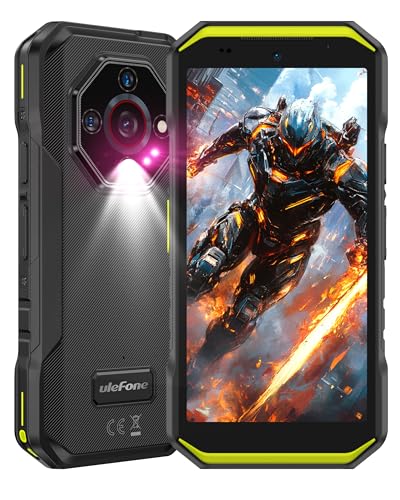
Ulefone Armor X32 — Stated IP68/69K
The Armor X32 makes the roundup’s most explicit durability promise: IP68/69K waterproofing printed in its own title, wrapped around a 5.65-inch Corning Gorilla screen. That pairing matters. The IP69K half of the rating speaks to high-pressure, high-temperature water jets — the washdown end of the working world — while the compact screen keeps the phone one-handable in a way the giants below are not. For a phone that will live on a belt or in a chest pocket rather than a rucksack, the X32’s size is a feature, not a compromise.
The camera pairing is built for dark places: a 48MP main camera beside a 20MP night-vision unit, with a glare flashlight for the spaces in between. Think inspection work under floorboards, night checks around a property, or a campsite where the torch and the phone being the same object simplifies the packing. The Helio G91 processor, 12GB of memory figure and 128GB of storage in the title place it as a Dual 4G handset rather than a 5G one, and its 5,500mAh battery is the smallest here — still generous by mainstream standards, modest by this company. Buy it for the certification and the size, and the rest of the package holds up its end.
- Durability: IP68/69K waterproof, stated in the listing title
- Display: 5.65-inch Corning Gorilla screen
- Cameras: 48MP main, 20MP night vision
- Battery: 5,500mAh
- Memory and storage: 12GB, 128GB; MTK Helio G91
- Artificial intelligence features: Not stated in the listing title — verify with Ulefone documentation
Strengths
- The strongest stated water-resistance rating in this set.
- Compact enough for belt and pocket carry on site.
- Night-vision camera and glare flashlight suit dark working spaces.
Trade-offs
- Dual 4G only, in a set where several rivals carry 5G.
- The 5,500mAh battery is the smallest of the six.
- Title makes no AI claim, so none should be assumed.
Best for: site and outdoor work wanting certified sealing in a compact body.
Not suited for: multi-day trips away from charging, or 5G-dependent use.

Ulefone Armor 33 Pro — Largest battery
Some phones are built around a screen or a camera. The Armor 33 Pro is built around a number: 25,500mAh. That is roughly five ordinary phone batteries in one armoured case, charged at 66W per the title, and it redefines the phone’s role from daily device to expedition power reserve. Around that cell, Ulefone hangs a 6.95-inch FHD main display running at 120Hz, a second 3.4-inch screen, a camera array listed as 50MP plus 50MP plus 64MP plus 32MP, an “Infinite Halo” feature and a speaker rated at 118dB — loud enough to function as a site radio substitute — with an Armor Molle holster in the package.
The honest costs are weight and bulk, which a battery this size cannot escape, and a title that spends none of its words on an IP or military certification. This guide therefore treats the 33 Pro’s durability as unstated and judges it as an endurance and media machine in rugged dress. Carried in its holster on a multi-day trek, a boat or a remote worksite, that judgement flatters it: days of navigation, photography and light, with charge to spare for companions’ devices in spirit if not by cable. Slipped into a trouser pocket for a commute, the same phone is an anchor. Context is everything with this pick, more than with any other in the set.
- Battery: 25,500mAh, 66W charging per the listing title
- Displays: 6.95-inch FHD 120Hz main screen plus 3.4-inch second screen
- Memory and storage: 32GB, 512GB as listed in the title
- Cameras: 50MP + 50MP + 64MP + 32MP array as listed
- Audio: 118dB speaker; package includes Armor Molle holster
- Durability certification: Not stated in the listing title — verify with Ulefone documentation
Strengths
- Battery endurance in a class of its own within this roundup.
- Second screen handles notifications and framing without waking the big display.
- Very loud speaker suits yards, decks and workshops.
Trade-offs
- Size and weight follow the battery; pocket carry is unrealistic.
- No certification is stated in the title, so sealing claims stay unverified here.
- A specialist’s tool that general users will find excessive.
Best for: expeditions, boats and remote sites where charging is scarce.
Not suited for: light everyday carry, or certified-sealing requirements.

Ulefone Armor 27T Pro Plus — Thermal imaging
Thermal imaging is the one capability in this roundup that changes what a phone is for. The Armor 27T Pro Plus pairs its thermal camera with a 64MP plus 50MP camera system on a 5G rugged frame, and the working uses arrive quickly once the tool is in hand: tracing a hot spot in a consumer unit, finding the cold bridge in a wall, checking a bearing that runs warmer than its neighbour, locating a pet or a person in darkness by heat rather than light. Electricians, plumbers, building inspectors and farmers will each write their own list within a week of owning it.
The supporting hardware is serious. A Dimensity 6300 runs the 5G side, the title lists 24GB of memory figure and 256GB of storage, the battery is 10,600mAh with 33W charging and 30W wireless charging — a rarity in the rugged class — and the 6.78-inch FHD+ screen runs at 120Hz behind Corning Gorilla glass, on Android 16. As with its stablemate above, the title does not state an IP or military rating, so this guide leaves certification unstated and lets the phone’s case rest on its tools. For the trades reader, that trade is often acceptable: the thermal camera is the headline, and it is a headline no mainstream phone at any price currently matches in an integrated body.
- Specialist tool: Thermal imaging camera
- Cameras: 64MP + 50MP system as listed in the title
- Battery: 10,600mAh, 33W wired and 30W wireless charging
- Display: 6.78-inch FHD+ 120Hz, Corning Gorilla screen
- Platform: 5G, MTK Dimensity 6300, Android 16
- Durability certification: Not stated in the listing title — verify with Ulefone documentation
Strengths
- Thermal imaging opens inspection jobs no ordinary phone can attempt.
- Wireless charging is unusual and welcome in the rugged class.
- Large battery and 120Hz screen make it a complete daily tool.
Trade-offs
- Certification unstated in the title, despite the rugged framing.
- Thermal hardware is wasted money for readers without a use for it.
- Big battery means big handset, as throughout this category.
Best for: trades and inspection work that can use heat vision daily.
Not suited for: casual use, or roles demanding a stated certification.

DOOGEE Blade20 Pro — AI stated in title
The Blade20 Pro is one of only two picks whose title actually claims artificial intelligence, and it pins that claim to the camera: a 50MP AI main camera beside a 20MP night-vision unit. This guide takes the title at its word and goes no further — the listing does not specify which AI functions are included, so scene recognition, enhancement pipelines and assistant features all stay unclaimed here. What can be said is that the claim exists, is attached to the camera system, and is paired with hardware that gives it room to work: a 24GB memory figure, 256GB of storage expandable to 2TB, and an 11,000mAh battery.
The rest of the title describes a thoroughly modern rugged handset: a 6.6-inch HD+ display, Android 16, a loud speaker listed at 35W, dual 4G SIM with NFC and OTG. The HD+ resolution is the visible compromise against the FHD+ screens elsewhere in this set, traded for battery life and cost. NFC matters more than it might appear, bringing contactless payment and pairing to a class that sometimes omits it. Certification, once again, is not stated in the title, so the Blade20 Pro is best understood as a feature-rich, AI-claiming handset in rugged form — judged on its camera claim, its storage headroom and its battery, rather than on a sealing rating it does not print.
- Artificial intelligence: 50MP AI camera, stated in the listing title
- Cameras: 50MP AI main, 20MP night vision
- Battery: 11,000mAh
- Memory and storage: 24GB, 256GB, expandable to 2TB as listed
- Display: 6.6-inch HD+
- Durability certification: Not stated in the listing title — verify with DOOGEE documentation
Strengths
- An explicit AI camera claim, one of only two in this set.
- Storage expansion to 2TB swallows media-heavy field work.
- NFC and OTG widen its usefulness beyond the building site.
Trade-offs
- HD+ screen resolution trails the FHD+ rivals here.
- Dual 4G rather than 5G connectivity.
- No durability certification stated in the title.
Best for: readers who want the AI camera claim with huge storage headroom.
Not suited for: certified-sealing roles or the sharpest screen in the set.

DOOGEENEXT S200 — AI plus rear display
The S200 carries the roundup’s most complete title: 5G, an explicit AI designation in the model name itself, IP68 stated outright, and a 1.32-inch AMOLED rear display that gives the phone a second face. That rear screen is more than a styling flourish. It can frame selfies with the main cameras, show time and notifications face-down on a bench, and keep the big 6.72-inch FHD+ 120Hz display dark when a glance is all that is needed — a small mercy for the 10,100mAh battery, which also charges at 33W.
Camera figures lead the rest of the specification: 100MP plus 20MP, with a 32GB memory figure and 256GB of storage expandable to 2TB, NFC, and Android 16. The S200 is SIM-free unlocked, which suits buyers who move between networks or travel. Against the Blade20 Pro, it trades a little battery for a sharper screen, a stated IP68 rating and 5G; against the Armor X32, it trades the IP69K high-pressure rating for connectivity and display quality. It is, in short, the pick that asks the fewest apologies — the rugged phone in this set that most resembles a mainstream handset that happens to be armoured and AI-labelled.
- Artificial intelligence: AI designation stated in the listing title
- Durability: IP68, stated in the listing title
- Displays: 6.72-inch FHD+ 120Hz main, 1.32-inch AMOLED rear display
- Cameras: 100MP + 20MP as listed
- Battery: 10,100mAh, 33W charging
- Network position: 5G, SIM-free unlocked
Strengths
- Combines a stated AI claim with a stated IP68 rating — unique here.
- Rear AMOLED display is genuinely useful, not decorative.
- 5G and unlocked status give it the widest modern fit.
Trade-offs
- Battery is large but not in the 33 Pro’s expedition class.
- Rear screen is another glass surface to protect.
- Title does not state a military-standard certification.
Best for: a rugged daily phone wanting AI features, 5G and stated sealing.
Not suited for: maximum battery life or high-pressure washdown duty.

Samsung Galaxy XCover7 Pro — Enterprise rugged
Samsung’s XCover line answers to a different customer: the organisation that issues phones by the hundred to warehouse staff, delivery fleets, field engineers and retail floors. The XCover7 Pro’s title reads accordingly — 2025 US version, 128GB, unlocked across Verizon, AT&T, T-Mobile and US Cellular, dual SIM by one nano SIM plus eSIM, IP68 rated, with 5G and Wi-Fi 6E. Every phrase is about deployment: carrier breadth for mixed fleets, eSIM for remote provisioning, Wi-Fi 6E for warehouse networks.
The contrast with the Chinese rugged brands is instructive. Samsung does not compete on battery size or camera megapixels here; the title does not even quote a battery figure, and this guide will not invent one. The XCover’s case rests on manageability, accessories, service networks and a software-support culture that enterprise buyers price into a contract. Its title makes no AI claim, so none is made here. For an individual reader, the XCover7 Pro is the conservative pick: the least exotic hardware in the set, wrapped in the most predictable ownership experience, and the only one whose maker will sell you a fleet of them with a straight face.
- Durability: IP68 rated, stated in the listing title
- Network position: Unlocked for Verizon, AT&T, T-Mobile and US Cellular, per the title
- SIM: Dual SIM — 1 nano SIM plus 1 eSIM
- Connectivity: 5G and Wi-Fi 6E
- Storage: 128GB
- Artificial intelligence features: Not stated in the listing title — verify with Samsung documentation
Strengths
- Enterprise deployment story: eSIM, carrier breadth, Wi-Fi 6E.
- Stated IP68 rating from a mainstream manufacturer.
- Predictable support and accessory ecosystem for fleets.
Trade-offs
- No battery or camera figures stated in the title to rival the specialists.
- No AI claim in the title, despite the keyword’s framing.
- Conservative hardware for readers chasing maximum specifications.
Best for: fleet issue and enterprise field work on US carriers.
Not suited for: specification-led buying or expedition battery life.
How Do the Six Rugged Picks Compare Side by Side?
| Pick | Battery | Stated sealing | AI in title | Defining tool |
|---|---|---|---|---|
| Ulefone Armor X32 | 5,500mAh | IP68/69K | Not stated | Night vision, compact body |
| Ulefone Armor 33 Pro | 25,500mAh | Not stated | Not stated | Dual screens, 118dB speaker |
| Ulefone Armor 27T Pro Plus | 10,600mAh | Not stated | Not stated | Thermal imaging |
| DOOGEE Blade20 Pro | 11,000mAh | Not stated | Yes — AI camera | 2TB expansion, NFC |
| DOOGEENEXT S200 | 10,100mAh | IP68 | Yes — model designation | AMOLED rear display |
| Samsung Galaxy XCover7 Pro | Not stated | IP68 | Not stated | eSIM fleet deployment |
What Do IP Ratings and Military Language Actually Tell You?
An IP rating is a test result, not a mood. The first digit grades dust ingress, the second grades water, and the K suffix on the Armor X32’s IP68/69K speaks to high-pressure, high-temperature jets used in washdown environments. IP68 on the S200 and the XCover7 Pro certifies immersion behaviour under the manufacturer’s stated conditions. What none of these ratings promises is immortality: seals age, ports wear, and a phone dropped onto concrete can open a path for water that no rating covers afterwards. Treat a rating as a description of the phone when new and intact, and rinse and dry the handset after dirty work rather than assuming the certificate does the cleaning.
Military language needs even more care. The phrase in the keyword echoes a family of drop and environment tests, but a listing title that does not state a specific certification has not claimed one, and this guide has marked those cases as not stated throughout. When a role genuinely depends on certification — a contract specification, an insurer’s requirement, a safety officer’s checklist — the title is not enough anyway: ask the manufacturer for the test documentation for the exact model, and file it. A screenshot of a marketing page will not satisfy an auditor, and should not satisfy a careful private buyer either.
Battery figures, by contrast, are printed plainly in most of these titles and reward simple arithmetic. Capacity in milliamp-hours translates roughly into days when the phone is a tool rather than a toy: the 25,500mAh Armor 33 Pro is a multi-day device by design, the 10,000mAh class is a comfortable two-day class under field use, and the X32’s 5,500mAh is a full working day with margin. Screen brightness and 5G hunting in weak signal areas eat capacity faster than any other habit, so a field routine — brightness managed, offline maps downloaded, aeroplane mode in dead zones — extends every pick in this set.
How Should You Set Up a Rugged Phone for Field Work?
Begin with the unglamorous essentials while the phone is still on a desk. Fit the SIM, sign in, and let updates complete over Wi-Fi before the handset ever meets weather. Download the offline maps for the regions the work actually covers, because a rugged phone’s natural habitat is exactly where signal goes to die. Set the lock screen to show an emergency contact and any critical information the crew needs, and test the speaker at full volume in a noisy room — several picks here are bought partly for their voice, and a quiet unit should be discovered at home, not on a roof.
Next, arrange the phone around gloves and haste. Enlarge text, move the half-dozen working apps to the first home screen, and assign the camera and torch to the fastest shortcuts the software allows. Night-vision and thermal models deserve a practice session in a dark cupboard and around the house’s pipes and windows respectively; the first time a thermal camera is used should not be on a customer’s ceiling with an audience. Photograph the phone’s IMEI screen and keep the shot somewhere other than the phone itself.
Finish with the charging routine. Big batteries forgive irregular charging, but a fleet or a sole trader’s tool deserves a fixed habit: a charger at the base, a cable in the vehicle, and a rule that the phone sleeps plugged in. Check port covers are seated after every charge — the seal that the IP rating depends on is only real when the flap is closed — and wipe grit from the charging port with a dry brush weekly. Rugged phones rarely die from one dramatic accident; they fade from a hundred small neglects, and a routine is the cheapest armour of all.
Which Mistakes Do Buyers Make in the Rugged Category?
The first mistake is importing a rating across a range. A brand’s flagship may carry IP69K while its stablemate states nothing, and the difference is printed in the titles for every careful reader to see. The second is treating the AI label as a specification. Two titles here claim it, four do not, and even the claiming titles attach it loosely — to a camera in one case, to the model name in the other. A reader who needs a specific AI function should verify that exact function with the manufacturer, not purchase the letters.
The third mistake is buying battery by the headline without pricing the weight. A 25,500mAh phone is a wonderful expedition tool and a miserable pocket phone, and both truths live in the same number. Fourth, buyers forget the network check: 5G models, dual-4G models and carrier-specific histories all appear in this set, and the unlocked claims in each title should be matched against the intended SIM before ordering. Finally, do not skip the accessory reality — holsters, vehicle mounts and spare chargers are part of a rugged phone’s working kit, and the Armor 33 Pro’s included Molle holster is a reminder that carry is a design problem in this class, not an afterthought.
What Does a Working Week Look Like on Each Kind of Pick?
Picture the X32 on a building inspector’s belt: up ladders, into roof voids, photographing joists by its own flashlight, reading messages with wet hands. Its week is measured in small survivals, and its compact body is why it is still being carried on Friday. Picture the 33 Pro instead on a fishing vessel or a survey trek, where it is the crew’s shared lantern, camera, chart screen and evening radio, charged twice a week and thought about hardly at all. The same category, two different definitions of useful.
There is also the volunteer’s week to consider — the mountain-rescue auxiliary, the flood-response helper, the event marshal standing in rain for six hours with a radio in one hand. For those roles the calculus favours stated sealing and a torch over raw camera figures, and it favours a phone whose battery anxiety is zero by the second day of a deployment. The X32 and the S200 answer that brief from opposite ends of the size scale, and either will still be working when lighter, sleeker handsets have retired to a charging tent.
The 27T Pro Plus lives in a tool bag between a multimeter and a torque wrench, produced when something is hotter, colder or wetter than it should be. The Blade20 Pro and the S200 split the modern middle: phones for couriers, site managers and outdoor instructors who want current software, camera claims with AI attached, and a body that shrugs at rain. The XCover7 Pro’s week is the most regimented — issued Monday, scanned, tracked and docked nightly, its value measured in fleet uptime rather than in any single dramatic save. Choosing among the six is really choosing which week sounds like yours.
How Do Night Vision and Thermal Imaging Differ in Practice?
Two picks in this set see in the dark, and they do it by entirely different physics, which is why they suit different jobs. The night-vision cameras on the Armor X32 and the Blade20 Pro work with infrared light: an IR illuminator floods the scene with light the eye cannot see, and a sensitive sensor reads the reflection. The result is a monochrome image of a dark space — a loft, a yard, a hold, a hedgerow — clear enough to navigate, identify shapes and photograph evidence of what was found there. Range is set by the illuminator’s strength, and reflective surfaces can flare, but the picture reads like a photograph, which makes it intuitive for anyone to interpret.
Thermal imaging ignores visible and infrared illumination entirely and reads heat itself. Every object radiates according to its temperature, and the sensor paints those differences as an image where a warm pipe glows against a cold wall and a person stands out from a night field by body heat alone. The picture is lower in detail and stranger to read at first — edges are soft, colours are assigned by palette rather than by reality — but it reveals things no ordinary camera can show at all: the overloaded connection warming inside a board, the missing insulation panel in a ceiling, the recently run engine, the damp patch cooling a wall by evaporation.
Choosing between them is a matter of questions. If the working question is “what is in this dark space?”, night vision answers it directly and cheaply, and it appears on two picks here at very different sizes. If the question is “where is the heat going, coming from, or building up?”, only the thermal camera on the Armor 27T Pro Plus answers, and for trades built around that question the feature justifies the entire purchase. A third question — “can I simply see to work?” — belongs to neither camera, and it is answered by the unglamorous flashlight and torch functions that rugged phones like the X32 build in as first-class tools rather than software afterthoughts.
There is a discipline to using both well. Night-vision images should be checked against a lit photograph of the same scene whenever a record matters, because monochrome IR flattens depth and can mislead about distances. Thermal readings should be treated as comparative rather than absolute unless the tool is calibrated for measurement: the camera shows where the anomaly is, and a contact probe or a dedicated instrument confirms what it is. Used with that humility, both technologies turn a phone from a communication device into a sensing instrument, which is the deepest reason the rugged category exists.
What Should a Crew Leader Check Before Issuing Rugged Phones?
Issuing phones to a crew is a logistics exercise disguised as a purchase, and the checks that matter happen before the first handset is unboxed. Start with the network audit: list the carriers the crews actually use across their territories, then match the handsets against that list using the unlocked claims in each title. The XCover7 Pro’s title names four US carriers, which is why fleet buyers gravitate to it; the dual-4G models in this set need a harder look where routes run through 5G-served areas, and the SIM-free S200 suits mixed or changing arrangements. A phone that cannot join the local network is not rugged, it is absent.
Next comes the carry and charging plan. Handsets in this class range from the belt-friendly X32 to the holster-carried 33 Pro, and the right answer depends on whether the phone rides on a person, in a vehicle cab or in a tool bag. Decide the carry first and the model second. Charging deserves the same forethought: a depot dock, a vehicle cable per cab, and a named person responsible for the Friday check that every unit is charged and present. Big batteries forgive a missed night; they do not forgive a missed week, and the crew that treats charging as a rota rather than a hope keeps its phones alive.
Provisioning is the third check, and eSIM is where the set divides most sharply. The XCover7 Pro’s nano SIM plus eSIM pairing lets an administrator push profiles to handsets without touching them, which transforms a fifty-phone rollout. Physical-SIM models ask for a afternoon of tray work and label discipline instead — entirely manageable at crew scale, painful at fleet scale. Either way, record each handset’s IMEI against the name of its holder on day one, photograph the record, and keep it somewhere that is not itself a phone. Loss, theft and damage are certainties across a long enough season; the paperwork decides whether they are inconveniences or crises.
Insurance and warranty paperwork belong in the same conversation. Note what each maker’s warranty actually covers before the fleet depends on it, keep purchase records with the IMEI log, and photograph each handset’s condition on the day it is issued. When a claim eventually arrives — and across a fleet, one always does — the side with the tidier records settles it faster and argues less.
Finally, agree the damage story before it happens. Rugged phones reduce breakage; they do not abolish it, and seals compromised by a hard drop quietly retire the water resistance the rating promised. A sane issue policy therefore includes a spare unit or two, a rule that a dropped-and-cracked phone gets swapped rather than trusted, and a small stock of the consumables — cables, port covers, holster clips — that actually fail in service. Crews respect equipment that is maintained as a system, and they use it harder and better than equipment issued with a shrug.
How Does Weight Change the Way a Rugged Phone Gets Carried?
Weight is the specification that rugged marketing quotes least and owners feel most. A mainstream phone disappears into a pocket; a 10,000mAh rugged handset announces itself at every step, and a 25,500mAh model like the Armor 33 Pro is, by any honest measure, carried equipment rather than clothing. This is not a defect to apologise for — it is the physical price of the battery and the armour, paid knowingly — but it reorganises the owner’s habits in ways worth planning for before the purchase rather than discovering after it.
The first reorganisation is the carry method. Belt holsters, chest rigs, vehicle mounts and tool-bag pockets all beat the trouser pocket for this class, and the 33 Pro’s included Molle holster acknowledges the fact in the box. A phone carried securely gets used; a phone left behind because it drags at a waistband might as well have a dead battery. The second reorganisation is the hand itself: big rugged phones are two-handed devices for typing and many camera tasks, and owners who accept that rhythm stop fighting the hardware and start valuing the screen size that comes with it.
The third is subtler — weight changes what the phone is asked to be. A handset heavy enough to notice becomes a deliberate tool, taken on jobs rather than carried by default, and several owners of expedition-class phones keep a light everyday handset for town and take the armour out only when the work or the landscape justifies it. There is no shame in that two-device pattern; it is the same logic that keeps a heavy torque wrench in the van rather than on a belt. Judge each pick here by the carry it implies, and the right choice usually names itself.
How Should You Care for Seals, Ports and Screens So the Ratings Survive?
A water-resistance rating describes a phone whose seals are intact, and seals are maintained, not owned. The routine begins with the port covers: every flap that guards a charging port or a SIM tray must sit fully home, because a cover resting a millimetre proud is an open door wearing a closed door’s costume. Check them with a fingertip after charging and after any SIM swap, and make the check a reflex. Grit is the enemy at exactly this point — a single grain of sand trapped under a flap can hold it open against a seal — so a dry brush kept with the charger earns its place in the kit.
Washing the phone is the second habit, and it should be as deliberate as washing hands after site work. Rinse under a gentle tap, never a pressure jet aimed at the seals, and never while the phone is charging. Mud, cement dust and salt water all attack rubber and corrode contacts slowly; salt in particular deserves a freshwater rinse the same day, because it keeps working long after the shift ends. Dry the handset with a cloth, shake water from the speaker and microphone openings, and let it air before a cable goes back in. A phone that sounds muffled after a soaking is usually just holding water in its speaker mesh, and patience fixes what panic might break. Resist the old rice ritual and the hairdryer with equal firmness: moving air at room temperature, time, and an upright rest on a cloth do the job without cooking seals or driving moisture deeper into the body. If the handset offers a speaker water-ejection tone, run it once the worst has drained; the vibration walks droplets out of the mesh surprisingly well.
The screen and body ask for less, but not nothing. Gorilla glass of the kind named in the Ulefone titles resists scratches well and cracks like any glass when the wrong corner meets concrete, so a tempered protector remains cheap insurance even on an armoured handset. Inspect the frame monthly for the small tragedies of working life — a bent corner, a hairline crack near a port, a SIM tray that no longer sits flush — because each one quietly amends the durability story the rating told. A rugged phone maintained this way keeps its promises for years; one treated as indestructible usually teaches the difference within a season.
What Does a Long Trip Away From Mains Power Demand From These Phones?
Expedition use rearranges priorities until battery is nearly the whole list, which is why the Armor 33 Pro exists. A 25,500mAh cell changes planning arithmetic: navigation all day, photography at every stop, a hotspot shared in the evening and a torch after dark can run for days rather than hours, and the phone stops being the device the itinerary is planned around. The discipline that remains is about signal, not charge — a handset hunting a absent network burns energy on the search, so aeroplane mode with GPS left available, offline maps downloaded in advance, and scheduled check-in windows at high ground or known coverage points stretch any battery in this set further than its capacity alone suggests.
The 10,000mAh class — the 27T Pro Plus, the Blade20 Pro and the S200 — plays the same trip at a lighter weight, asking for a charge every second or third day under field discipline and pairing naturally with a vehicle supply or a shared solar panel at camp. The X32, at 5,500mAh, is the honest day phone of the group: superb on the belt during the working day, in need of the evening cable like any mainstream handset. None of these is a criticism. The trip simply votes, and it votes for capacity first, screen second and everything else after — which is why reading the battery line of each title matters more on expedition eve than any camera figure.
Cold deserves a final word, because it taxes batteries and touchscreens together. Lithium cells deliver less in deep cold and recover as they warm, so the field habit is to carry the phone in an inside pocket against the body, use it briefly, and return it to the warmth — a rhythm expedition users learn in the first week. Touchscreens under gloves reward the physical buttons and generous touch targets these rugged designs tend to offer, and a capacitive stylus in the kit weighs nothing and saves frozen fingers. Plan for the cold, and the phones in this set will do the rest.
How Do Loud Speakers and Second Screens Earn Their Place on a Work Phone?
Two features recur in these titles that a mainstream buyer might file as novelties: the very loud speaker, headlined by the Armor 33 Pro’s 118dB unit and echoed in the Blade20 Pro’s loud-speaker wording, and the second screen, found on the 33 Pro’s back and in miniature AMOLED form on the S200. Both earn their keep in the environments these phones are built for, and both deserve a fair hearing before they are dismissed as spec-sheet decoration.
Volume first. A phone on a working site competes with plant, traffic, wind and hearing protection, and a ringtone that is polite in an office is inaudible beside a compressor. A genuinely loud speaker changes the phone’s role: calls get answered, alarms get heard, a podcast or radio keeps a lone worker company across a yard, and a navigation instruction survives a van cab at motorway speed. The same volume serves safety — an SOS tone or a shouted instruction relayed by speakerphone carries across a space where a standard handset would be mouthing silently. Owners do learn restraint with it around the public, but on site the loud speaker is not a party trick; it is the difference between a phone that participates in the work and one that waits in a pocket.
The second screen solves a quieter problem. On the 33 Pro, the 3.4-inch rear display handles the glances — time, notifications, a selfie framed with the main cameras, music controls — without waking the enormous main screen and its power draw. On the S200, the little AMOLED does similar duty in a fraction of the space. In both cases the benefit compounds across a day of dozens of small checks, each one cheaper than lighting the full display, and each one keeping the phone face-down and protected on a bench rather than face-up and exposed. It is an engineer’s feature rather than a stylist’s, and it suits this category precisely.
Together, these details mark the honest divide in the rugged market. The serious work phones spend their specification budget on things the job can feel — volume, endurance, a screen for glances, a torch that matters — while the decorative end of the market spends it on thinner cases and borrowed ratings. Reading these six titles with that divide in mind makes the set sort itself: every pick here spends on at least one working feature, and the best of them spend on several.
Final Recommendation
Start from the claim you can verify. For stated sealing in a carryable body, the Armor X32 leads; for stated sealing with modern breadth, the S200 and the XCover7 Pro divide the private and enterprise cases between them. For a tool that does new work, the 27T Pro Plus and its thermal camera stand alone. For endurance above all, the 33 Pro is untouchable. And for the AI claim the keyword asks about, only the Blade20 Pro and the S200 make it in their own titles — so let the titles, not the marketing weather around them, have the last word on what these phones promise.
Frequently Asked Questions
Which of these phones actually claim AI features?
Two, in their listing titles: the DOOGEE Blade20 Pro, which names a 50MP AI camera, and the DOOGEENEXT S200, which carries AI in its model designation. The other four titles are silent on artificial intelligence, so this guide marks the feature as not stated for them and claims nothing on their behalf.
What is the difference between IP68 and IP68/69K?
IP68 certifies dust sealing and immersion under the manufacturer’s stated conditions. The additional 9K element addresses high-pressure, high-temperature water jets of the kind used in washdown cleaning. In this set, only the Ulefone Armor X32’s title states the combined IP68/69K rating.
Which pick has the biggest battery?
The Ulefone Armor 33 Pro, at 25,500mAh per its title — well beyond the 11,000mAh Blade20 Pro and the roughly 10,000mAh class of the 27T Pro Plus and the S200. The Armor X32 carries the smallest cell here at 5,500mAh, traded for its compact size.
Does the thermal camera on the 27T Pro Plus replace a dedicated thermal tool?
For finding hot spots, cold bridges, moisture patterns and overheating components, an integrated thermal camera covers a large share of everyday inspection work. Certified measurement for reports and compliance belongs to calibrated dedicated instruments. The phone’s advantage is presence: it is in the bag on every job, including the ones where the dedicated tool was left behind.
Are these phones unlocked?
The titles say so for most of the set: the Armor X32 is listed as unlocked, the S200 as SIM-free unlocked, and the XCover7 Pro as unlocked for the four US carriers its title names. Check each listing’s current wording against your intended network before ordering, especially for 5G band fit.
Can a rugged phone be too heavy for everyday use?
Yes, and the battery figure predicts it. Handsets around the 10,000mAh class are already deliberate carries, and the 25,500mAh Armor 33 Pro is holster equipment rather than a pocket phone. Readers who commute lightly often keep the rugged handset for work and travel and use a slimmer phone in town — a two-device pattern this guide considers sensible rather than indulgent.
Do these phones work with gloves?
Rugged handsets are generally designed with outdoor handling in mind, and their large touch targets help, but glove performance varies by model and glove type and is not stated in these titles. The practical test is simple: try the intended work gloves on the exact model during the return window, and lean on voice controls and physical buttons where the screen refuses to cooperate.
Why do some spec boxes say a certification is not stated?
Because the listing title for that model does not print the certification, and this guide only claims what a title states. The manufacturer may publish more detail in its own documentation — the spec boxes point there — but a rating borrowed from a sibling model would be a guess, and guesses are how buyers end up with the wrong phone in the rain.
Related Guides
Readers comparing rugged hardware with other specialised handsets may also value our look at leftover flagship phones still on sale, the guide to large-battery handsets for travel, and the roundup of simple phones chosen for older users.
Related guides
- Best Balancing Stabilizers for Mirrorless Cameras: Payload, Balancing and Native Vertical Shooting
- Best Canon Point and Shoot Digital Cameras: PowerShot Picks From Pocket Compacts to Travel Zooms
- Best Basic Phones Camera Buyers Can Trust: Flip Phones and Simple Handsets That Still Take a Photograph
- Best Sony Full Frame Cameras for Astrophotography: Sensitivity vs Resolution


