What's inside
- Where to Buy a Dash Camera That Keeps Watch After You Walk Away
- Key Takeaways
- Quick Picks
- How Did We Weigh Parking Modes Against Driving Specs?
- How Does Parking Mode Actually Work, and What Feeds It?
- Which Parking Setup Fits Your Car’s Rhythm?
- How Do You Hardwire a Dash Camera Without Regretting It?
- Why Do Sensors Matter More Parked Than Driving?
- How Do the Six Compare on the Parked Shift?
- What Should You Check in the First Month of Parked Recording?
- What Mistakes Do Parking-Mode Buyers Keep Making?
- Final Recommendation
- Frequently Asked Questions
- Related Guides
As an Amazon Associate I earn from qualifying purchases. This post may contain affiliate links at no extra cost to you.
gizmoverdict.com is reader-supported. When you buy through links on our site, we may earn an affiliate commission.
Where to Buy a Dash Camera That Keeps Watch After You Walk Away
The best dual dash cameras with parking mode are bought for the hours their owners are not in the car. A driving camera has an easy life: engine on, power plentiful, incidents unfolding in front of a wide-awake lens. A parking camera works the hard shift — the supermarket trolley that drifts, the neighbour’s bumper in the night, the figure who tries a door handle at 3 a.m. — and it must do so on a trickle of power, from a car that is switched off, locked, and expected to start in the morning. That tension between vigilance and the car battery is the whole subject of this guide. The six cameras here all record front and rear (or front and cabin) while driving, and all offer some form of parking surveillance, but they differ in the details that decide whether the feature is real: whether the parking mode is buffered, so the seconds before an impact are captured too; whether the camera sips or gulps from the battery; and whether the hardwiring kit that parking mode requires is in the box, an accessory, or — as one listing states with refreshing bluntness — needed and not included.
Read the parking claims in these listings the way an electrician would. A camera on a standard 12-volt socket usually loses power when the ignition dies, so genuine parking surveillance means a hardwire connection to the fuse box, a voltage cut-off to protect the battery, or a dedicated battery pack. The listings here name their arrangements with varying candour: one includes the hardwiring cable and a memory card in the box, another states the hardwire requirement in its title, several name buffered parking modes measured in hours of vigilance. This guide repeats those statements exactly, flags the silences where they occur — one pick’s listing does not mention parking mode at all, and it is included for its cabin-watching design with that gap declared — and treats the sensor story, dual STARVIS 2 chips in four of the six titles, as the night-shift equipment it is.
It is worth pausing on why this category exists at all, because the answer disciplines every choice in it. Most vehicle damage is not cinematic. It is the slow scrape in the supermarket row, the delivery van’s optimistic reverse, the wing mirror collected by a passing car that did not stop — incidents whose other party is gone before the owner returns with the shopping, leaving a dent, a note-shaped absence, and an insurance conversation conducted entirely from memory. A parking camera converts that conversation into a document. It does not need to be cinematic either; it needs to be awake, aimed, and possessed of the seconds before the scrape as well as the scrape itself. Everything in the six listings below — the buffers, the sensors, the hardwire cables, the supercapacitors — is engineering in service of that single unglamorous conversion, and the guide judges them by it without apology.
Key Takeaways
- Buffered parking mode is the feature that separates witnesses from souvenirs in this category: the VIOFO A229 Pro, A229 Plus, and Vantrue N4 Pro S all name buffered parking in their listings, meaning the camera keeps the seconds before a trigger, not just the aftermath and a figure already walking away.
- Hardwiring is the hidden half of every parking mode in this guide: the THINKWARE F200 PRO includes the hardwiring cable in its listing, while the REDTIGER F7NP states in its title that a hardwire kit is needed — the same feature, two very different shopping baskets, and the difference decides whether parking mode works on the first night or the second order.
- Dual STARVIS 2 sensors appear in both VIOFO titles and the Vantrue’s, and the REDTIGER names a STARVIS 2 sensor too — night legibility is the parking camera’s real examination, taken in unlit car parks at the hours when nobody is watching in person.
- The Garmin Dash Cam Tandem is the odd shape in the guide: its second lens faces the cabin, not the rear window, and its listing does not state a parking mode — it earns its place for rideshare-style interior watching, labelled as such everywhere it appears in this guide.
- Three channels change the argument entirely: the Vantrue records front, rear, and cabin simultaneously, so the parked car is watched from inside as well as out, and an intruder who reaches the cabin is already on film.
- A supercapacitor, named in the A229 Plus’s listing, is the durability choice for cameras that bake on windscreens through summer, freeze through winter, and are expected to keep doing both for years without a swollen battery ending the story early.
Quick Picks
| Pick | Badge | Why it earns its place |
|---|---|---|
| VIOFO A229 Pro | The buffered-parking flagship | 4K front and 2K rear on dual STARVIS 2 sensors, with buffered 24-hour parking mode and voice control for the driving hours and the parked ones alike. |
| VIOFO A229 Plus | The durable dual 2K | 1440P at both ends on STARVIS 2 sensors, a built-in supercapacitor for the windscreen’s hard seasons, and 24-hour parking modes in a slightly gentler package overall. |
| REDTIGER F7NP | The value 4K pair | 4K front and rear recording with a card included in the box, stating its hardwire requirement for parking mode right in the title for anyone to plan around. |
| Garmin Dash Cam Tandem | The cabin watcher | Two 180-degree lenses covering road and interior from one small body, with interior night vision for drivers whose passengers are the story of the shift. |
| THINKWARE F200 PRO | The ready-to-hardwire kit | 1080p front and rear with the hardwiring cable, GPS cradle, and a 32GB card all named in the listing — parking mode working without a second order ever being placed. |
| Vantrue N4 Pro S | The three-channel guardian | 4K front, 2.5K rear, and a cabin channel with infrared night vision, buffered parking around the clock, and support for cards up to 1TB for the longest archives. |
How Did We Weigh Parking Modes Against Driving Specs?
The judging began where the keyword does: with the car parked. A pick had to offer a parking surveillance mode that a reasonable owner could actually enable — which meant reading for the unglamorous companions of the feature: hardwire provisions, buffering, and low-power behaviour. Buffered modes scored highest because they answer the parked car’s defining problem, that the interesting second is the one before the impact, when a motion sensor has not yet woken. A camera that begins recording at the thud gives you a stranger walking away; a buffered camera gives you the approach, the act, and the departure.
Driving specifications were judged second but not lightly, because a dual camera earns its keep daily, not only in incidents. Resolution was read per channel from the titles — the A229 Pro’s 4K front and 2K rear are different cameras in one housing, and this guide treats them so. Sensor generation mattered most at night, where STARVIS 2’s presence in a title was counted as the listing’s own claim about low-light competence. Cabin channels were judged as their own discipline: the Garmin Tandem and the Vantrue’s interior lens serve rideshare drivers, parents, and anyone whose risk sits inside the car, and they were not marked down for failing at a rear-window job they never applied for — though the Tandem’s listing silence on parking mode is recorded plainly wherever the camera appears.
The last test was basket honesty. Parking mode’s true price is the camera plus whatever it needs to run parked: a hardwire kit, possibly a battery pack, a card with endurance for constant writing. Listings that include those pieces, or state the need for them in the title, were credited with the candour; buyers should do the same arithmetic the guide did, because the cheapest camera here can become the dearest once its parking mode is fully provisioned, and the dearest can be the bargain that arrived complete.
A note on duplication, since an attentive reader of this site may recognise two names: the A229 Pro and the N4 Pro S also anchor our broader dash-camera coverage, and they appear here again because a guide specifically about parking mode that omitted the two strongest buffered-parking systems on the market would be lying by shelving. What differs is the examination — there, the cameras were judged as all-round witnesses; here, every paragraph has been about the parked hours, the power that feeds them, and the evidence they produce in the dark. Same cameras, different shift, and the verdicts were reached by the second shift’s standards alone.
How Does Parking Mode Actually Work, and What Feeds It?
Three mechanisms hide under the one name, and knowing them apart is most of parking-mode literacy. Motion-detection parking wakes the camera when its sensor or its eye sees movement, records an event, and sleeps again; it is frugal and can miss the first instant. Impact-detection parking sleeps deeper and wakes on a G-sensor jolt, which is excellent for collisions and useless for the figure who scratched the door gently and left. Buffered parking, the kind named by the VIOFO pair and the Vantrue, keeps a rolling memory of recent seconds so that when a trigger fires, the saved clip includes the run-up — the mechanism that turns aftermath into evidence. Some cameras also offer time-lapse parking, condensing the night into a silent film; the listings here do not emphasise it, so this guide does not pretend otherwise.
Power is the other half of the mechanism, and it is where installations succeed or quietly fail. A hardwire kit connects the camera to the fuse box with a voltage cut-off that stops the parking vigil before the car’s battery is too weak to start the engine — the single most important accessory in this entire category, because a camera that strands its owner has committed the one unforgivable sin. Settings govern appetite: a buffered dual-channel system watches harder and drinks deeper than a sleeping impact sensor, so the honest question at fitting time is how long the car typically sits. A daily-driven car recharges its battery on every commute and can feed an ambitious parking mode indefinitely. An airport car, parked for a fortnight, needs either a frugal mode, a dedicated dash-cam battery pack, or modest expectations — and any installer who does not ask about the car’s rhythm before choosing settings is guessing with your battery.
Placement completes the system. The rear camera’s cable run — along the headlining, through the boot hinge grommet on a hatchback — is the fiddly hour of the install, and the rear lens must sit within the wiped area of the rear screen or its night view is a smear. The front unit wants to hide behind the mirror, high and central, with its cable tucked into the headlining and down the pillar, mindful of the airbags that live in pillars on modern cars. None of this is beyond a careful owner with a trim tool and a free afternoon, and all of it is the difference between a parking mode that watches the car and one that watches a rain-streaked corner of it.
One setting deserves its own sentence because owners consistently misjudge it: the delay and sensitivity with which the camera enters and leaves parking mode. Set the transition too eagerly and the camera drops into its parked behaviour at long traffic lights, fragmenting the driving record; too reluctantly and the first unguarded minutes in the car park — often the busiest, most incident-rich minutes of the park — go unwatched. The listings’ makers each handle the handover differently, and the documentation is the authority, but the principle is portable: test the handover in your own car park, at your own pace, and adjust until the camera’s idea of parked matches yours. A security system whose definition of the working day differs from its owner’s will always miss the same five minutes, and those minutes have a way of mattering.
Which Parking Setup Fits Your Car’s Rhythm?
The daily commuter’s car is the easy parish. Driven every weekday, its battery is topped up by the rhythm of life, and it can feed an ambitious parking configuration — the Vantrue’s three buffered channels, or the A229 Pro’s dual STARVIS vigilance — through every night and weekend without complaint. This car’s owner should spend their worry on settings quality rather than power quantity: buffered mode on, cut-off set sensibly, card endurance-rated and large. The car that sits at the airport for a fortnight is the opposite parish. Its battery begins the vigil full and spends it in the dark, and the honest configurations are a frugal impact-and-motion mode, a dedicated dash-cam battery pack that takes the parking load off the car’s own battery entirely, or the humility to accept a few nights of watching rather than fourteen. Fitting a thirsty buffered system to this car without a pack is how owners meet the jump-start service in the long-stay car park.
The street-parked second car and the teenager’s first car form a third parish: modest value, maximum exposure, drivers who will not maintain anything. Here the THINKWARE’s completeness argues for itself — everything in the box, fitted once, alerts and parking mode live from the first night — or the A229 Plus, whose supercapacitor forgives the thermal neglect of a car that lives outdoors in all seasons. The work vehicle is a fourth parish and the Vantrue’s home ground: tools in the back, parked at sites and depots, its cabin channel and rear view both earning their keep, its power appetite fed by daily hard driving. Notice that in every parish the deciding facts were the car’s calendar and the owner’s temperament, and the cameras sorted themselves once those were admitted. The showroom question — which is best — dissolves into the diary question, which is the one this guide has been asking all along.
One more rhythm deserves naming, because it is increasingly common: the electric car and the hybrid, whose 12-volt systems behave differently from a conventional car’s and whose makers have opinions about accessories drawing on them. The principles in this guide still hold — buffered evidence is best, cut-offs protect starting, appetite must match rhythm — but the hardwire conversation for these vehicles belongs with the maker’s documentation and, ideally, an installer who knows the model. The cameras are ready when the wiring is; it is the one parish where this guide prescribes professional help without embarrassment.
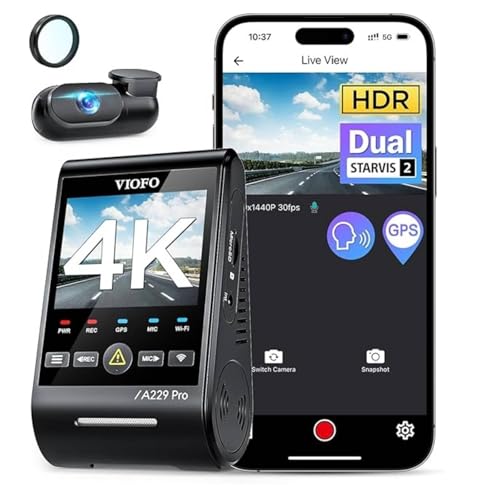
VIOFO A229 Pro — The buffered-parking flagship
The A229 Pro’s listing is a study in per-channel honesty: 4K HDR at the front on a STARVIS 2 IMX678 sensor, 2K at the rear on an IMX675, 5GHz Wi-Fi, GPS, voice control, and a buffered 24-hour parking mode. For parking duty, that specification reads beautifully. The buffered mode keeps the approach in frame, the rear sensor’s night pedigree matters in unlit car parks where most parking incidents live, and the front camera’s 4K eye reads the plate of the vehicle that arrives, hesitates, and leaves its mark. Voice control, a driving-hours luxury, lets the driver lock a clip or command the camera without hands leaving the wheel — small, and exactly the kind of small that gets used.
Plan the install as a system, because this flagship assumes one. Parking vigilance at this level wants the hardwire connection with its voltage protection, a high-endurance card sized for two channels of high-resolution writing, and settings matched to how long the car sleeps between drives. Do that work and the A229 Pro is the most complete parked-car witness in this guide: two modern sensors, a buffer that remembers the run-up, and resolution that survives cross-examination. Skip the hardwire and you have bought an excellent driving camera whose headline feature never wakes up — the commonest tragedy in this category, and entirely avoidable at ordering time.
- Channels: front and rear, per the listing title
- Resolution: 4K front, 2K rear, stated per channel in the title
- Sensors: STARVIS 2 IMX678 front and IMX675 rear, named in the listing
- Parking: buffered 24-hour parking mode stated in the title
- Extras: 5GHz Wi-Fi, GPS, voice control, Night Vision 2.0 named in the listing
- Power for parking: hardwire arrangement required for parked recording — confirm the kit for your vehicle with the maker’s documentation
Strengths
- Buffered parking captures the seconds before contact, which is where parking evidence actually lives.
- Two named STARVIS 2 sensors give the night shift the best low-light equipment in this guide.
- Per-channel resolution is stated honestly, so the rear camera’s abilities are never oversold.
Trade-offs
- The parking mode’s promise depends on a hardwire install the buyer must arrange and provision.
- Two high-resolution channels write cards hard; endurance-rated storage is a necessity, not an upgrade.
- Its capabilities are wasted on a car that is garaged nightly and never parks in public.
Best for: a car that sleeps on streets and in public car parks, whose owner wants the strongest parked evidence two channels can produce.
Not suited for: a garaged weekend classic that leaves its locked barn six times a year.

VIOFO A229 Plus — The durable dual 2K
The A229 Plus steps the resolution down to 1440P at both ends and spends the savings on symmetry and toughness. Its listing names dual STARVIS 2 sensors with HDR, 5GHz Wi-Fi, voice control, precise GPS, 24-hour parking modes — and a built-in supercapacitor, the detail durability-minded buyers circle first. A supercapacitor shrugs off the windscreen’s brutal thermal life, the summer bake and winter freeze that age ordinary camera batteries, and it never swells. For a camera expected to live on glass for years, guarding the car in all seasons, that is not a footnote; it is the longevity specification.
Matched 2K channels suit the parking job particularly well, because parked incidents happen at both ends of the car with complete impartiality, and the rear camera here is no poor relation. The parking modes are plural in the listing, giving the owner the choice of vigilance styles to match the car’s rhythm and the battery’s budget. Choose the Plus over the Pro when the car lives outdoors year-round, when the climate swings hard, or when balanced channels matter more than a 4K front — and choose it knowing the family’s buffered-parking philosophy and sensor pedigree came along intact.
- Channels: front and rear, per the listing title
- Resolution: 1440P front and 1440P rear, stated in the title
- Sensors: dual STARVIS 2 with HDR named in the listing
- Parking: 24-hour parking modes stated in the title
- Power design: built-in supercapacitor named in the listing
- Extras: 5GHz Wi-Fi, smart voice control, ultra-precise GPS per the title
Strengths
- The supercapacitor is the right power design for a camera that lives on glass through every season.
- Equal 2K channels mean the rear view — half of all parking incidents — is recorded as seriously as the front.
- Parking modes in the plural let the owner tune vigilance to the car’s actual parking rhythm.
Trade-offs
- The front channel gives up the Pro’s 4K, so distant plates while driving are a harder read.
- Parking still requires the hardwire provisioning common to the whole category.
- Voice control and connected features assume a driver who will actually set them up once.
Best for: an outdoor-living car in a hard climate, where the camera must survive the windscreen’s weather as well as watch through it.
Not suited for: a motorway commuter whose priority is maximum front resolution for high-speed plate capture.

REDTIGER F7NP — The value 4K pair
The F7NP’s listing earns trust in an unusual way: inside a title full of strengths — 4K front and rear recording, a STARVIS 2 sensor, a free card included, fast 5.8GHz Wi-Fi downloads, WDR night vision, a wide angle, G-sensor incident detection — sits the plain admission that its 24-hour parking mode needs a hardwire kit. That is the sentence this entire category should be required to print, and REDTIGER prints it in the headline. A buyer can plan around a stated requirement; it is the unstated ones that generate the one-star reviews and the returned boxes.
With the kit budgeted, the package is compelling: 4K at the rear as well as the front is a specification the flagships do not all match, the included card removes the first accessory purchase, and the G-sensor’s incident detection locks the moments that matter against the loop’s overwriting. The wide angle watches the car park’s chaos generously. This is the pick for the owner who wants flagship-shaped numbers and an honest basket: camera, card in the box, hardwire kit ordered alongside, and a parked car watched in 4K at both ends by the weekend. Its demands are simply that you read its title as carefully as its maker wrote it.
- Channels: front and rear, per the listing title
- Resolution: 4K front and rear stated in the title
- Sensor: STARVIS 2 named in the listing
- Parking: 24-hour parking mode, with hardwire kit needed — stated in the title
- Included: memory card included per the listing
- Extras: 5.8GHz Wi-Fi, WDR night vision, G-sensor incident detection named in the title
Strengths
- 4K at both ends gives the rear channel flagship resolution, where parking incidents are as common as at the front.
- The hardwire requirement is declared in the title, letting buyers provision parking mode correctly from the start.
- A card in the box means the camera records from its first journey, not its second order.
Trade-offs
- The hardwire kit is a genuine extra purchase, and the parking mode is dormant until it is fitted.
- Dual 4K channels are demanding of cards and of the car’s battery in parking service.
- The wide angle that covers a car park also bends its edges, which purists dislike in driving footage.
Best for: a value-minded owner who reads titles carefully and wants 4K watching both ends of a street-parked car.
Not suited for: installation limited to plugging into a socket, since this parking mode begins at the fuse box.

Garmin Dash Cam Tandem — The cabin watcher
Every other pick in this guide points its second lens at the rear window. The Tandem points its inward, and its listing is clear about the design: a front-facing lens at 1440p and an interior-facing lens at 720p, both with 180-degree fields of view, and interior night vision for the cabin after dark. This is the camera for the driver whose risk sits inside the car — the rideshare driver whose passengers are strangers, the instructor, the parent lending a car to a new driver and wanting the full picture. Two 180-degree lenses in one compact body cover road and cabin with a simplicity no three-box system matches, from a brand whose navigation heritage shows in the polish of the concept.
The disclosure this guide owes you is in the listing’s silence: the Tandem’s title does not state a parking mode. Garmin’s ecosystem offers vehicle-away features on some models, but they are not claimed in this listing, and this guide does not award features a title does not mention. Buy the Tandem as the finest cabin-watching dual camera here, with its away-from-car capabilities to be confirmed in the maker’s documentation if they matter to you — and if parked surveillance is your primary purpose, choose from the five picks whose listings promise it outright. Included with its difference declared, the Tandem is the right answer to a question the other five never ask.
There is also a privacy texture to a cabin camera that the rear-window picks never raise. The Tandem’s interior lens watches the people you carry — family, colleagues, fares — and its night vision means it watches them in the dark as faithfully as at noon. Households and drivers who choose it should treat the announcement as part of the installation, a sentence spoken as naturally as offering a seatbelt, because a cabin camera discovered by a passenger mid-journey starts a conversation no driver wants. Handled openly, it is mutual protection: the rideshare passenger is as exonerated by that footage, in a disputed moment, as the driver is. That symmetry is the Tandem’s real selling point, and it only works when everyone in the car knows the lens is there.
- Channels: front road view and interior cabin view, per the listing title
- Resolution: 1440p front-facing, 720p interior-facing, stated in the title
- Fields of view: two 180-degree lenses named in the listing
- Night: interior night vision stated in the title
- Parking: not stated in the listing title — verify with the maker’s documentation
- Form: single compact unit covering both views
Strengths
- Cabin coverage in the same unit answers the rideshare and family-lending cases no rear camera can.
- 180-degree lenses at both ends leave almost no blind angle inside or ahead of the car.
- One body, one mount, one cable — the simplest dual installation in this guide.
Trade-offs
- No rear-window channel, so the classic parking knock from behind is outside its view.
- Parking mode is not claimed in the listing, making it the weakest fit for this guide’s headline purpose.
- The cabin channel records your own passengers and family, which carries consent and courtesy questions to settle in advance.
Best for: a rideshare or driving-school car where the cabin is half the story and a single tidy unit must tell both halves.
Not suited for: an owner whose whole purpose is catching whoever bumps the car in the night, bumper first, from behind.

THINKWARE F200 PRO — The ready-to-hardwire kit
The F200 PRO’s listing solves the category’s basket problem by simply including the basket: a 1080p front and rear dash cam with Wi-Fi and a G-sensor, a 32GB card, a GPS cradle, and the hardwiring cable, with speed and red-light camera alerts and parking mode in a compact design. Read that again as a shopper: the card is there, the cable that parking mode needs is there, the GPS mount is there. The most common reason parking modes never get used — the second order nobody placed — is designed out of the purchase entirely.
The resolution is the honest trade: 1080p at both ends, in a guide where rivals offer 2K and 4K. At parking distances, in the car park’s ordinary light, 1080p with a competent sensor identifies vehicles and people respectably; what it surrenders is the long read, the plate across the aisle. THINKWARE’s background in this category shows in the completeness rather than the numbers — alerts for cameras ahead, a cradle that carries the GPS, a body that disappears behind the mirror. For the owner who wants parking surveillance working this weekend, fitted once and finished, this is the lowest-friction route in the guide, and the kit’s completeness is a feature as real as any resolution figure.
- Channels: front and rear, per the listing title
- Resolution: 1080p front and rear stated in the title
- Included: 32GB card, GPS cradle, and hardwiring cable named in the listing
- Parking: parking mode stated in the title, provisioned by the included cable
- Alerts: speed and red-light camera alerts named in the listing
- Extras: Wi-Fi and G-sensor per the title; compact design
Strengths
- Everything parking mode needs is in the box, so the feature can be live the day the camera is fitted.
- Camera alerts add a driving-hours benefit the spec-sheet rivals do not emphasise.
- A compact body and a GPS-carrying cradle make for a tidy, mirror-hidden installation.
Trade-offs
- 1080p is the guide’s lowest resolution, and distant plates will test it while driving.
- The included 32GB card is a starter size for dual-channel loop recording and will want upgrading.
- Alert features depend on database coverage for your region, which the listing cannot guarantee street by street.
Best for: an owner who wants parking surveillance fitted once, completely, this weekend — with no second order standing between them and it.
Not suited for: a detail-hungry driver who reviews footage for distant plates and expects 4K clarity at both ends.

Vantrue N4 Pro S — The three-channel guardian
The N4 Pro S refuses to choose between the guide’s two second-lens philosophies and takes both: its listing describes a three-channel system with 4K at the front, 1080P in the cabin, and 2.5K at the rear, triple STARVIS 2 sensors with HDR, infrared night vision for the interior, GPS, Wi-Fi, support for cards up to 1TB — and a 24/7 buffered parking mode. A parked car watched by this system is watched comprehensively: the approach from the street, the departure behind, and the cabin itself, where the infrared eyes see in darkness that defeats ordinary interior cameras. For a vehicle that carries valuables, tools, or passengers for a living, that completeness is the argument.
Comprehensiveness has a power bill, and it should be planned rather than discovered. Three channels in buffered parking service draw more than a sleeping single camera, so the hardwire’s voltage cut-off settings and the car’s usage rhythm matter more here than anywhere in the guide; a daily-driven car feeds it happily, a seldom-driven one argues for a battery pack or a thriftier parking configuration. The 1TB card ceiling is the storage counterpart of the same philosophy — room for three channels’ worth of history instead of a weekend of it. Buy this camera when the car itself is the asset being guarded and the fullest possible account of any night is worth provisioning properly.
- Channels: front, cabin, and rear — three channels per the listing title
- Resolution: 4K front, 1080P cabin, 2.5K rear, stated per channel in the title
- Sensors: triple STARVIS 2 with HDR named in the listing
- Parking: 24/7 buffered parking mode stated in the title
- Night: infrared night vision for the cabin named in the listing
- Storage: support for cards up to 1TB per the title; GPS and Wi-Fi included
Strengths
- Three channels leave no side of an incident unwatched, including the cabin that two-channel systems ignore.
- Buffered parking applies the guide’s gold-standard mechanism to the fullest camera array here.
- The 1TB card ceiling gives three hungry channels an archive measured in weeks, not days.
Trade-offs
- Three buffered channels are the thirstiest parking load in the guide, demanding honest power planning.
- The installation runs two extra cables’ worth of care, including the rear run and the cabin unit’s placement.
- For a simple street-parked hatchback, its comprehensiveness may simply be more camera than the risk requires.
Best for: a work vehicle, a high-value car, or a rideshare that parks in public — where any incident, from any direction, must be fully accounted for.
Not suited for: a second car driven twice a month, whose battery cannot feed three vigilant channels through long idle weeks.
How Do You Hardwire a Dash Camera Without Regretting It?
The job divides into three honest stages. First, the front camera: mount it behind the mirror where the driver’s view is unobstructed and the lens sees through the wipers’ cleanest arc, route its cable into the headlining with fingertips or a trim tool, and down the A-pillar — behind the trim, never across an airbag’s deployment path, which on modern cars means following the existing wiring loom’s route. Second, the fuse box: the hardwire kit needs a permanent live feed for parking duty and a switched feed so the camera knows the engine’s state, found with the kit’s instructions and the car’s fuse diagram, connected with add-a-circuit taps that leave the original fuses intact. Set the voltage cut-off at this stage, conservatively, while the instructions are open — it is the setting that guarantees the camera can never strand you. Third, the rear camera: its cable runs along the headlining’s edge to the back of the car, through the flexible grommet into the hatch or boot lid where fitted, and the lens mounts inside the rear screen’s wiped area, centred, with the picture checked on the camera’s screen before the adhesive is trusted.
Then test the system as a system, in the order incidents will. Drive around the block and review both channels. Park, switch off, wait for the parking mode to arm, and walk past the car; then review what it kept, including whether the buffered seconds show your approach. Bump nothing — a firm rock of the car on its suspension is enough to learn whether impact detection is awake and how sensitive it is. Finally, live with it a week and check the car’s starting and the card’s contents once, on a quiet morning, before declaring the install finished. That week of verification is the difference between a parking mode and a parking hope, and it costs nothing but attention — the same currency, readers of this guide’s sibling chapters will notice, that every honest security product charges instead of a subscription.
Why Do Sensors Matter More Parked Than Driving?
A driving camera works in headlights — its own car’s, the street’s, the traffic’s. A parked camera works in whatever light a car park bothers to provide, which is often a single sodium lamp and the moon. That is why the sensor generation named in a listing is this guide’s most-quoted specification after the parking mode itself. STARVIS 2, the sensor family appearing in the VIOFO pair, the Vantrue, and the REDTIGER’s title, represents the current state of the low-light art for this class: larger effective sensitivity, cleaner shadows, and plates that stay legible at the distances a car park imposes. HDR, named alongside it in several titles, manages the car park’s other curse — contrast, the black car against the bright lamp — by balancing exposures so detail survives at both ends of the scene.
The practical consequence is a buying rule: for parking duty, spend on sensors before resolution. A 2K channel on a modern sensor will identify the midnight bumper more reliably than a 4K channel on an older one, because identification at night is a light problem before it is a pixel problem. Resolution reclaims its importance in daylight driving, at speed, across distances — which is why the flagships that combine both, the A229 Pro above all, sit where they sit in this guide. But the owner whose fear is specifically the parked night should read the sensor line of each title first and the resolution line second, and will find the VIOFO Plus’s matched STARVIS 2 pair a more persuasive specification than its modest 1440P suggests.
How Do the Six Compare on the Parked Shift?
| Pick | Channels | Front / other resolution | Parking mode per listing | In the box for parking |
|---|---|---|---|---|
| VIOFO A229 Pro | Front + rear | 4K / 2K rear | Buffered 24H | Hardwire to arrange |
| VIOFO A229 Plus | Front + rear | 1440P / 1440P rear | 24H parking modes | Hardwire to arrange |
| REDTIGER F7NP | Front + rear | 4K / 4K rear | 24H, hardwire kit needed | Card included; kit separate |
| Garmin Tandem | Front + cabin | 1440p / 720p cabin | Not stated in title | — |
| THINKWARE F200 PRO | Front + rear | 1080p / 1080p rear | Parking mode stated | Hardwire cable + 32GB card + GPS cradle |
| Vantrue N4 Pro S | Front + cabin + rear | 4K / 2.5K rear | 24/7 buffered | Hardwire to arrange |
Two columns decide most purchases. The parking column separates the buffered systems — VIOFO’s pair and the Vantrue — from the field, and the box column separates the THINKWARE, which arrives ready to hardwire, from cameras whose parking mode begins with a second purchase. The Garmin row is the reminder to read for what a camera is rather than what the guide’s title wishes it were: a cabin watcher of real distinction, and not a parking specialist by its own listing’s account.
What Should You Check in the First Month of Parked Recording?
The first month is when a parking system tells you its truths, if you ask. Ask about appetite: note how the car starts after its longest park, and whether the cut-off has ended any vigils early, which shows up as a parking archive that stops before morning. Ask about aim: review one night clip from each channel and look, really look, at what the lenses see in the dark — the rear camera behind glass the wiper misses, the front camera watching a bonnet and a streetlamp’s glare while the doors go unwatched. Small re-aims in week one are worth more than resolution upgrades in year two. Ask about sensitivity: count the events a windy night generated, and tune until a storm produces a handful of clips rather than a hundred, because an owner drowning in false events stops reviewing real ones.
Ask, finally, about the human arrangements. If your camera watches a shared drive or a workplace car park, the courtesy of telling the people it watches is worth the small awkwardness — a camera discovered is a grievance, while a camera announced is a deterrent everyone benefits from. If a cabin channel records passengers, settle the announcement habit before the first fare or the first lift to a friend: rideshare platforms and local rules may each have their word on this, and the driver’s own sentence — just so you know, the car records inside as well as out — costs nothing and prevents the only conversations about cameras that nobody enjoys. The technology in this guide is mature; it is these small human calibrations that decide whether it ages into trust or into resentment.
What Mistakes Do Parking-Mode Buyers Keep Making?
The first and commonest is buying the camera and never provisioning the parking mode: no hardwire, no voltage protection, a camera that sleeps with the ignition while its owner believes it watches. If you take one sentence from this guide, take the arithmetic — camera plus hardwire plus endurance card equals the product; the camera alone is two-thirds of it. The second mistake is the opposite enthusiasm: maximum vigilance settings on a car driven twice a week, until the battery’s slow decline becomes a non-starting morning and the camera is blamed for a configuration its owner chose. Match the mode to the car’s rhythm, and let the cut-off voltage be set by someone who respects it.
The third mistake is aiming the rear camera carelessly — outside the rear wiper’s arc, or behind tinted glass so dark the night view is murk — and discovering it over the footage of the one knock that mattered. The fourth is neglecting the card: parking modes write constantly, consumer cards wear, and a tired card fails silently in exactly the hours nobody checks. Endurance-rated cards, replaced on a schedule rather than on a failure, are the consumable this category runs on. Treat the whole system — camera, cable, card, and settings — as the purchase, and the parked hours will be as well witnessed as the driven ones.
A fifth mistake deserves its own warning because it is made in the first hour and paid for all year: leaving every sensitivity at its factory maximum. Motion detection at full stretch in a tree-lined street records the trees; impact detection at full stretch records every passing lorry’s pressure wave as a collision. The archive fills with weather, the owner stops reviewing, and the system’s real events drown in its imaginary ones. Twenty minutes of tuning in the first week — sensitivity down a step at a time until a normal night produces a normal handful of clips — is what separates a witness from a diarist of wind. The cameras in this guide all provide the adjustment; the mistake is assuming the factory already made it for your street.
Final Recommendation
For the fullest parked protection, the Vantrue N4 Pro S watches three directions with a buffered mode and room for an enormous archive, provided its power appetite is planned. For two-channel excellence, the VIOFO A229 Pro is the flagship, its Plus sibling the climate-proofed alternative with matched 2K channels and a supercapacitor’s patience. The REDTIGER F7NP delivers 4K at both ends to the buyer who heeds its printed hardwire warning, the THINKWARE F200 PRO is the complete-in-one-box route to a working parking mode this weekend, and the Garmin Tandem serves the cabin-watching driver with its limitation declared. Whichever you choose, finish the job the listing started: hardwire it properly, set the cut-off with respect for the battery, tune the sensitivities against a real week of nights, and review one parked clip before you ever need one in anger. A parked car is a trusting thing, sitting dark and silent in the world’s weather; the right camera is simply the one still awake beside it at 3 a.m., with the seconds before anything happens already safely in its memory.
Frequently Asked Questions
Will parking mode drain my car battery?
It draws from the battery by design, which is why hardwire kits include a voltage cut-off that ends the vigil before the battery is too weak to start the car. How long a system can watch depends on the mode’s appetite and the battery’s health; a daily-driven car replenishes what parking spends, while a seldom-driven car needs a frugal mode or a dedicated battery pack.
What does buffered parking mode actually add?
The seconds before the trigger. A buffered camera keeps a rolling store of recent video, so when motion or impact fires, the saved clip starts before the event — showing the approach and the act, not merely a figure leaving the scene. The VIOFO A229 Pro, A229 Plus, and Vantrue N4 Pro S all name buffered parking in their listings.
Do I really need a hardwire kit?
For genuine parking surveillance, in most cars, yes: a socket-powered camera usually dies with the ignition. The listings reflect this — the THINKWARE includes the hardwiring cable, the REDTIGER states the kit is needed. Treat the hardwire as part of the product’s price wherever parking mode is the reason for buying.
Is a cabin camera useful, or just a rear camera by another name?
A different tool entirely. Cabin channels — the Garmin Tandem’s interior lens and the Vantrue’s inside channel with infrared — record passengers, break-in attempts through a window, and the driver’s own conduct. They answer rideshare and family questions that a rear-window camera cannot see, and they complement rather than replace the rear view.
What memory card should a parking-mode camera use?
A high-endurance card rated for constant writing, sized for your channels and resolution — three-channel and dual-4K systems consume space fastest, which is why the Vantrue’s support for cards up to 1TB matters. Replace cards on a schedule; a worn card is the silent failure this category knows best.
Does parking mode record sound as well as video?
Many dash cameras record audio with their video, and in a parked incident the sound of contact can be evidence in itself. It is also the feature most likely to need a deliberate decision: cabin audio records your own passengers and conversations, so most owners set audio intentionally rather than by default, and rideshare drivers should follow their platform’s and region’s rules on in-car recording.
What if my car is an EV or hybrid?
The cameras and parking principles are the same, but the 12-volt wiring conversation deserves the vehicle maker’s documentation and, ideally, an installer familiar with the model, because these cars manage their low-voltage systems differently. A dedicated dash-cam battery pack is often the cleanest answer, keeping the parking vigil entirely off the car’s own electrical budget.
Can I install a dual dash cam myself?
Most owners can: the front unit mounts behind the mirror, the rear cable tucks along the headlining, and the hardwire connects at the fuse box with add-a-circuit taps. The cautions are pillar airbags, the rear wiper’s arc for the rear lens, and the voltage cut-off setting. If the fuse box intimidates you, an installer will fit the whole system in about an hour, and the parking mode will thank you for correct wiring every night.
Related Guides
Riders get the same two-direction thinking, and the same buffered honesty about what a camera can promise, from our bike helmet cameras guide, where one pick watches front and rear from the helmet itself. At home, the security cameras that do not need internet access roundup covers parked-car thinking for whole properties, and the security cameras that don’t require a subscription guide keeps the footage fee-free once it is recorded and stored.


