What's inside
- Key Takeaways
- Quick Picks
- How Was This Industrial Pool Assembled?
- How Do the Six Heavy-Duty Chargers Compare?
- What Do Engine-Start and Cranking-Assist Figures Actually Mean?
- How Are Traction Batteries Charged Differently From Starting Batteries?
- How Should a Shop Set Up Its 24V Charging Corner?
- How Do Cold Weather and Hot Yards Change 24V Charging?
- What Should a Buyer Measure in the First Month of Ownership?
- Which Mistakes Shorten Industrial Battery Life?
- How Do Rental Fleets Handle Charging Differently?
- Final Recommendation
- Frequently Asked Questions
- Related Guides
As an Amazon Associate I earn from qualifying purchases. This post may contain affiliate links at no extra cost to you.
gizmoverdict.com is reader-supported. When you buy through links on our site, we may earn an affiliate commission.
Where to buy: Every charger in this guide was drawn from this site’s verified pool and links to its own listing. This category’s titles mix three different kinds of amp figure — charge rate, engine-start rating and cranking assist — and this guide keeps them separated on every line, because confusing them is how chargers get bought wrong.
The best heavy duty 24v chargers serve a world that domestic battery chargers never meet: forklifts that move a warehouse’s worth of weight on a traction battery, scissor lifts that must be ready at height, floor machines, tugs, and the diesel trucks and equipment whose 24V starting systems demand real current when they are asked to turn over. Twenty-four volts is the working voltage of that world — heavy vehicles, industrial equipment, series-paired battery banks — and heavy duty is its service condition: daily deep discharge, nightly recovery, in buildings where a flat battery is not an inconvenience but a stopped operation.
The six picks divide into two philosophies. The wheeled shop chargers — Schumacher, Associated and Stark — are multi-voltage instruments built around starting and service work, with engine-start or cranking-assist figures in their titles and 24V among their stated voltages. The dedicated industrial chargers — the 24V 30A forklift unit, the Lester Summit Series II and the FORM — are built to live with traction batteries, charging the same bank every night as part of the equipment’s own infrastructure. A fleet’s real answer often includes both philosophies, and the picks below are arranged so the boundary between them stays visible.
One clarification belongs at the front, because the category attracts confusion from below: small maintainer-class chargers — the few-amp units sold for mobility equipment and stored batteries — are not heavy duty 24V charging in any sense this guide recognises, whatever voltage they share. Heavy duty here means traction banks, starting systems and shop service, measured in tens of amps and nightly cycles. Every pick below clears that bar on its title’s evidence, and the smallest figures in the pool are read in that industrial context rather than against a trickle charger’s frame.
Key Takeaways
- Three amp figures circulate in these titles — charge rate, engine start and cranking assist — and only the first describes charging; the Schumacher’s 200A is an engine-start figure against a stated 10A charge rate.
- The Associated 6006AGM prints the fullest hand: 6/12/24V with 70/65/30A in matching sequence — 30A at 24V — plus AGM support and a 280 Amp cranking assist.
- Dedicated traction charging is represented by the 24V 30A forklift charger and the FORM unit titled for Genie, Skyjack and JLG lifts and forklifts.
- The Lester Summit Series II is the pool’s multi-voltage industrial: 1050W across 24V/36V/48V with Bluetooth, aimed at golf, lift and utility fleets.
- The Stark pairs the pool’s largest plainly stated charge figure — 55 Amp — with fully automatic operation across 12V/24V.
- Fitment to named equipment appears in exactly one title (FORM’s Genie, Skyjack, JLG); every other compatibility is a documentation question.
Quick Picks
| Pick | Badge | Why it earns the slot |
|---|---|---|
| Schumacher Electric 10A Battery Charger, 200A Engine Start, 12/24V – DSR140 | Best starting rescue | A stated 200A engine-start reserve behind a 10A charger, for the 24V vehicle that must turn over now. |
| Associated Equipment 6006AGM Charger, 6/12/24V 70/65/30A, Agm, 280 Amp Cranking Assist | Best professional shop unit | The fullest stated specification in the pool, on wheels, from a maker whose trade is fleet service. |
| 24V 30A Forklift Battery Charger, 24V 30A Smart Trickle Charger | Best dedicated forklift charging | Thirty stated amps aimed at one job — the 24V forklift bank, charged nightly as infrastructure. |
| Lester Electrical Summit Series II Battery Charger, 1050W, 24V/36V/48V, Bluetooth | Best multi-voltage industrial | 1050W across three industrial voltages with Bluetooth oversight, from a traction-charging specialist. |
| FORM 24 Volt Battery Charger for Genie Skyjack, JLG Scissor Lift, Forklift, Electric Pallet | Best lift-equipment fitment | The only title that names its machines — Genie, Skyjack and JLG lifts, forklifts and pallet equipment. |
| Stark USA 55 Amp Fully Automatic Battery Charger & Engine Starter, 12V/24V Heavy Duty | Best stated-amp value | Fifty-five stated amps, fully automatic, heavy duty in the title — the pool’s biggest plain charge figure. |
How Was This Industrial Pool Assembled?
The first filter was the 24V claim itself, stated in every title here — as a sole voltage (the forklift charger, the FORM), as one of a pair (Schumacher and Stark at 12/24V), as part of a triple (Associated at 6/12/24V, Lester at 24V/36V/48V). Chargers that merely tolerate 24V in a footnote of their documentation were not admitted; the keyword promises 24V as a headline capability, and the pool holds titles to that promise.
The second filter separated the two philosophies honestly rather than ranking one above the other. Shop chargers were judged on the completeness of their stated service figures — charge rates per voltage, starting reserves, wheel-and-handle practicality implied by their class. Dedicated traction chargers were judged on their stated fitment and their suitability to the nightly-cycle duty that defines industrial charging. A guide that forced both philosophies into one ranking would mislead both audiences; the comparison table below therefore reports the figures without pretending the jobs are identical.
Evidence discipline did its usual work on the numbers. Where a title assigns amps to voltages in sequence, the guide reads the sequence as printed — the Associated’s 30A at 24V — and says that is what it is doing. Where a title prints one figure for a multi-voltage unit, as the Stark’s 55 Amp, the guide reports the figure without inventing a per-voltage split. Where a title prints watts instead of amps, as the Lester’s 1050W, the guide discusses watts and does not convert them into an amp figure the maker never stated.
The final filter was the heavy-duty threshold itself. The pool contains no maintainer-class lightweights and no mobility-equipment chargers wearing an industrial costume; the smallest stated charge rate in the set, the Schumacher’s 10A, arrives attached to a 200A engine-start reserve and a professional model line. That is the category’s honest floor, and stating it protects readers at both ends — the shop that needs real current, and the small-equipment owner who needs a different guide entirely.

Schumacher Electric 10A Battery Charger, 200A Engine Start, 12/24V – DSR140 — Best starting rescue
The DSR140’s title contains the category’s most instructive pair of numbers: 10A and 200A, printed side by side, describing entirely different jobs. The 10A is the charge rate — the pace at which the unit returns energy to a 12V or 24V battery across hours. The 200A is the engine-start reserve — the brief, enormous current the unit can contribute when a starter motor turns and the battery alone cannot answer. A reader who merges those figures into “a 200A charger” has misunderstood the product in the way its marketing quietly permits; a reader who separates them owns a clear-eyed tool: a mid-rate shop charger with a powerful rescue function.
That rescue function is the pick. Twenty-four-volt starting systems live on trucks, agricultural machines and heavy equipment whose failure mode is theatrical — a diesel that will not turn over on the morning it is needed, in the yard, with work waiting. An engine-start charger answers that morning in minutes rather than after an overnight charge or a jump from another machine. Schumacher’s DSR line is the maker’s professional series, and the 140’s brief — charge at a working rate, start at a serious one — matches the service yard’s actual distribution of needs, which is nine maintenance days for every one emergency.
The 10A charge rate deserves neither apology nor inflation. Across a night it restores a starting battery completely and maintains it correctly; against a deeply discharged traction bank it would be the wrong instrument, and this pool contains the right ones below. The DSR140’s honesty is in its title’s proportions — the big number belongs to the brief job, the small number to the long one — and owners who read it that way will place it correctly: on the shop wall near the door, where starting emergencies arrive, rather than at the forklift row where nightly traction duty rules.
Schumacher’s longevity in this category is part of the pick’s substance. Battery service equipment is bought for decades, passed between mechanics, and judged by whether support and documentation still exist when the second decade asks questions. A maker that has supplied the trade across generations carries that continuity as a specification no title can print, and the DSR140’s professional framing invites exactly that long view.
- Stated charge rate: 10A, per the title
- Engine start: 200A, stated in the title — a starting reserve, not a charge rate
- Voltages as titled: 12/24V
- Line: DSR140, the maker’s professional series designation in the title
- Traction-bank duty: not the title’s brief — see the dedicated picks below
- Charge profile specifics: not enumerated in the title — confirm in Schumacher documentation
Strengths
- A stated 200A engine-start reserve answers the dead-diesel morning in minutes.
- Both figures are printed with their jobs distinguishable — 10A to charge, 200A to start.
- 12/24V coverage spans the yard’s cars and its heavy equipment in one unit.
Trade-offs
- 10A is a service rate, not a traction recovery rate — forklift banks belong to other picks.
- The headline number invites misreading; the owner must keep the two jobs separate.
- Profile and chemistry specifics require the maker’s documentation.
Best for: a service yard or farm shop where 24V starting emergencies punctuate ordinary battery maintenance.
Not suited for: nightly charging of a forklift traction bank, or any duty planned around the 200A figure as if it were a charge rate.

Associated Equipment 6006AGM Charger, 6/12/24V 70/65/30A, Agm, 280 Amp Cranking Assist — Best professional shop unit
Associated Equipment sells to the trade — fleet shops, dealerships, service departments — and the 6006AGM’s title reads like a specification sheet because its readers are professionals who buy from specification sheets. The voltages and rates arrive in matched sequence: 6/12/24V against 70/65/30A, which assigns 30A to 24V work — a serious charge rate for heavy starting batteries and moderate traction duty alike. AGM support is named outright, a cranking assist of 280 Amp is stated separately from the charge rates, and the listing’s full text adds the wheeled format that shop chargers of this class wear. Every figure has its label, and every label its job.
The AGM detail is worth dwelling on, because it marks the difference between a charger that predates modern battery fleets and one built for them. Absorbed glass-mat batteries have spread through heavy vehicles and equipment for their vibration tolerance and sealed construction, and they ask for charging profiles that respect their chemistry. A title that prints AGM is a title that has answered the fleet manager’s second question before it was asked — the first being the rates, the second being whether the expensive sealed batteries in the yard are safe on the unit.
The cranking assist figure observes the same discipline as the Schumacher’s engine start, at a higher register: 280 Amp of stated assist is the unit’s contribution to turning over a reluctant heavy engine, distinct from its 30A of 24V charging and far beyond it. In a professional shop the two functions share one housing and one set of wheels, and the unit earns its floor space by covering the bay’s whole electrical day — the morning’s no-start, the afternoon’s battery service, the evening’s fleet check — without a second instrument being fetched.
This is the pick against which the pool’s other shop units are measured, and its premium positioning is the honest cost of the completeness. A one-vehicle household gains little from a fleet instrument; a shop that services 24V equipment daily gains the thing it actually buys with professional equipment, which is not the first year of service but the tenth — the documentation, the parts, the maker’s continued existence. Associated’s title promises figures; the company’s trade history promises the decade behind them.
- Voltages and rates as titled: 6/12/24V with 70/65/30A in sequence — 30A assigned to 24V
- Cranking assist: 280 Amp, stated in the title — a starting figure, not a charge rate
- Chemistry: AGM named in the title
- Format: wheeled shop charger, per the listing’s full title
- Model: 6006AGM, per the title
- Additional profiles: not enumerated beyond AGM in the title — confirm in Associated Equipment documentation
Strengths
- The pool’s fullest stated hand — per-voltage rates, chemistry and assist, all labelled.
- 30A at 24V is a genuine working rate for heavy starting batteries.
- A trade maker’s instrument, built and documented for professional service life.
Trade-offs
- Fleet-grade completeness is wasted on a single-vehicle household.
- A wheeled shop unit is infrastructure, not a portable — it serves one building.
- The sequence reading of its rates should still be confirmed against the maker’s plate data.
Best for: a professional shop or fleet operation servicing 6, 12 and 24V batteries daily, with AGM batteries in the yard.
Not suited for: a home garage with one truck, or a dedicated forklift row needing nightly traction cycling.

24V 30A Forklift Battery Charger, 24V 30A Smart Trickle Charger — Best dedicated forklift charging
This pick’s title is a job description repeated twice for emphasis: 24V, 30A, forklift battery charger — and then the same figures again under the words smart trickle charger. Strip the repetition away and the proposition is the pool’s most focused: a dedicated 24V charger at a stated 30A, built for the nightly recovery of a forklift’s traction bank. No voltage menu, no engine-start theatre, no brand mythology — a single-voltage instrument for the single most common heavy-duty charging duty in industry, the warehouse truck that works all day and must be whole again by the morning shift.
Thirty amps against a traction bank is a figure to read in duty terms. A 24V forklift battery stores serious energy, and its nightly question is whether the charger can return a day’s work inside the hours between shifts — the arithmetic the buying-guide section formalises. A stated 30A is a working answer for the smaller and mid-sized 24V trucks this charger class serves, and the title’s trickle language addresses the other end of the cycle: holding the bank correctly once full, across weekends and slow weeks, rather than cooking it at charge rate indefinitely. Charge and hold, sized for one voltage — the whole philosophy of dedicated industrial charging in one unglamorous title.
The absence of a marquee brand cuts both ways and should be weighed without snobbery in either direction. The unit’s value rests on its stated figures and its fit to the truck’s connector and battery — facts established from the listing’s documentation and the truck’s own plate, not from a logo. Buyers of dedicated chargers in this class should verify the connector match and the battery chemistry profile with particular care, since a forklift charger and its bank are effectively married; the documentation errand that this guide assigns to every pick is, for this pick, the entire purchase process.
Its natural comparison is the FORM below, which names its machines, and the Lester, which spans more voltages with a specialist’s pedigree. The forklift charger here is the generalist of the dedicated three — any 24V forklift bank within its rate — and for the single-truck warehouse or the small fleet whose trucks share a voltage and a charging corner, that focused generality is exactly the right shape of product.
- Stated output: 24V 30A — a single-voltage, single-figure title
- Duty as titled: forklift battery charging
- Hold behaviour: smart trickle, the title’s own words for its maintenance phase
- Brand: unbranded listing — documentation and connector verification carry the purchase
- Connector type: Not stated in the listing title — verify with the seller’s documentation
- Chemistry profiles: no figures in the title — the seller’s documentation carries them
Strengths
- The pool’s most focused brief — one voltage, one stated rate, one job.
- 30A is a real nightly-recovery rate for small and mid-sized 24V trucks.
- Trickle holding covers the weekend gap that dedicated chargers must bridge.
Trade-offs
- Connector and chemistry must be verified from documentation; nothing can be assumed.
- Single-voltage dedication is inflexibility the day a 36V truck joins the fleet.
- An unbranded listing places the full weight of diligence on the buyer.
Best for: a warehouse running 24V forklifts on a nightly charge rhythm, with the connector and chemistry confirmed before ordering.
Not suited for: a mixed-voltage fleet, or a buyer unwilling to do the documentation work an unbranded listing demands.
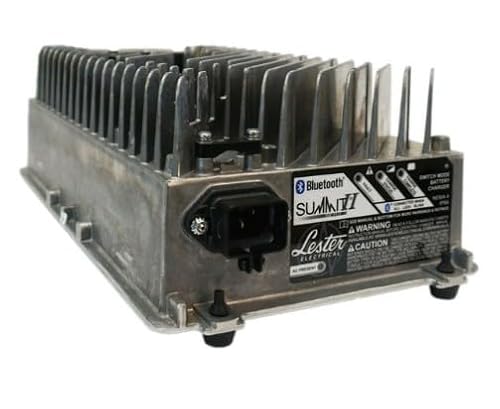
Lester Electrical Summit Series II Battery Charger, 1050W, 24V/36V/48V, Bluetooth — Best multi-voltage industrial
Lester Electrical has built industrial battery chargers for the better part of a century, and the Summit Series II is its modern statement: 1050W of stated output spanning 24V, 36V and 48V, with Bluetooth named in the title and a golf-and-utility constituency in the listing’s full text. The wattage figure deserves respect as a way of stating capacity, because watts describe the charger’s total power honestly across its voltage range — the current it delivers depends on which of the three voltages it is serving, and this guide reports the 1050W as printed rather than converting it into amp figures the title never claimed at each voltage.
The three-voltage span is the pick’s fleet argument. Industrial and utility fleets are rarely one voltage: the golf cars at one figure, the lifts and utility vehicles at others, accumulated across years of purchasing. A charger family that spans 24/36/48V lets a facility standardise on one instrument, one documentation set and one set of habits across that mixed fleet — an operational virtue that never appears in a spec box and dominates real purchasing decisions in maintenance departments. The Summit’s pick rests substantially on that standardisation value.
Bluetooth, in an industrial charger, is not the lifestyle feature it is in consumer electronics. It is how a technician configures profiles, reads charge history and diagnoses a bank’s behaviour without a cable and a laptop at the machine — the difference between a fleet whose charging is observable and one whose charging is folklore. Lester’s implementation details live in its documentation rather than the title, and facilities should confirm the configuration workflow there; but the title’s inclusion of the radio signals the intended relationship: this charger expects to be managed, across a fleet, by people who measure.
Against the dedicated forklift pick, the Summit trades single-duty focus for span and oversight; against the shop chargers, it trades starting functions for traction seriousness. Its home is the facility — the resort, the campus, the warehouse with several voltages of equipment — where charging is a system to be administered rather than a chore to be survived, and where a specialist maker’s documentation culture repays the administrators who read it.
- Stated output: 1050W, per the title — expressed in watts across the voltage range
- Voltages as titled: 24V/36V/48V — the pool’s widest industrial span
- Oversight: Bluetooth, stated in the title — configuration and history per Lester documentation
- Series: Summit Series II, per the title
- Amp figures per voltage: Not stated in the listing title — verify with Lester Electrical documentation
- Constituency: golf, lift and utility fleets, per the listing’s full title
Strengths
- Three industrial voltages under one instrument — a fleet standardisation play.
- A specialist maker with a century-scale history in exactly this equipment class.
- Bluetooth oversight suits facilities that manage charging as a system.
Trade-offs
- Per-voltage amp figures require documentation; the wattage alone does not size a nightly cycle.
- No engine-start function — starting emergencies belong to the shop picks.
- Its fleet virtues are wasted on a single machine with a single voltage.
Best for: a facility running mixed 24/36/48V industrial equipment that wants one managed charger family across the fleet.
Not suited for: a single 24V truck served more simply by a dedicated unit, or a shop whose first need is engine starting.

FORM 24 Volt Battery Charger for Genie Skyjack, JLG Scissor Lift, Forklift, Electric Pallet — Best lift-equipment fitment
Every other title in this pool describes a charger; the FORM’s title describes a charger and its machines. Genie, Skyjack and JLG are the names that dominate the scissor-lift and boom world, and a charger titled for their 24V lifts — plus forklifts and electric pallet equipment — is making the claim that matters most in rental and construction fleets: fitment. Aerial lifts live a punishing electrical life, charged in yards and on sites, expected to rise at dawn with a worker’s day depending on the platform. A charger bought by named fitment removes the compatibility guessing that generic 24V units leave behind.
The title’s discipline is also its limit: it prints no amp figure. The rate lives in the seller’s documentation, and for lift duty the rate question has a specific shape — the bank must recover inside the off-hours the site allows, which in rental service can be a single night between customers. The FORM’s buyer should therefore run the nightly arithmetic from the documented figure before purchase, and confirm the connector and profile against the specific lift models in the yard, since “for Genie, Skyjack, JLG” in a title is a claim to be verified per machine, not a blanket to be trusted across every model those makers have ever shipped.
Electric pallet equipment in the title widens the pick’s yard coverage intelligently. The pallet jack and the scissor lift share a world — warehouses and sites where both charge in the same corner — and a 24V charger fluent in both is the kind of unglamorous consolidation that equipment managers value out of proportion to its glamour. One charger, one corner, one set of habits, several machine families served: the FORM’s title is a small essay in fleet practicality.
Its pick also carries the pool’s clearest verification assignment, and that should be read as respect rather than suspicion. Named-fitment products invite a specific diligence — model years, connector variants, battery chemistries across a mixed rental fleet — and the seller’s documentation is where that diligence happens. Completing it earns the rarest thing in this category: a charger whose compatibility was a stated claim, checked against their own machines, rather than a hope attached to a voltage.
- Voltage as titled: 24 Volt
- Fitment as titled: Genie, Skyjack and JLG scissor lifts; forklifts; electric pallet equipment
- Stated charge rate: the title prints none — the seller’s documentation holds the figure
- Connector: Not stated in the listing title — verify against the specific machines in the seller’s documentation
- Chemistry profiles: unaddressed by the title — a seller documentation check per machine
- Duty: aerial lift and materials-handling fleets, per the title’s machine list
Strengths
- Named fitment for the lift industry’s dominant makers — compatibility as a stated claim.
- Covers lifts, forklifts and pallet equipment in one 24V instrument.
- Aimed at rental and construction duty, where overnight recovery is contractual.
Trade-offs
- No rate in the title — nightly arithmetic waits on the documented figure.
- Fitment must be verified per model; the makers’ ranges are wide and long-lived.
- Machines outside the named families gain nothing from the specialisation.
Best for: a rental yard or contractor running Genie, Skyjack or JLG 24V lifts alongside pallet equipment, verified model by model.
Not suited for: machines falling outside the named families, or a charge rate that must be settled by the title alone.

Stark USA 55 Amp Fully Automatic Battery Charger & Engine Starter, 12V/24V Heavy Duty — Best stated-amp value
The Stark’s title leads with the largest plain charge figure in the pool: 55 Amp, fully automatic, an engine starter as well as a charger, across 12V/24V, with the words heavy duty printed where the keyword can see them. The reading discipline this guide has practised applies at full strength here. The 55 Amp is a single figure for a two-voltage unit, and the title does not split it by voltage — so the guide reports 55 Amp as the unit’s stated headline and assigns the per-voltage rates to Stark’s documentation, where a buyer planning 24V work should confirm the figure that applies to their voltage before the nightly arithmetic begins.
Fully automatic is the title’s second claim and the one that shapes daily life with the unit. An automatic charger manages its own stages and its own stopping, which in a busy yard is the difference between a charger that can be connected and left, and one that must be attended by somebody who remembers. Paired with the engine-starter function, the Stark’s brief is the general-service yard unit: charge the fleet’s batteries unattended, start the reluctant machine when the morning demands it, and cover both 12V and 24V territories from one set of wheels’ worth of equipment.
The value proposition is written across the title’s proportions. The professional Associated prints more figures and carries a trade pedigree; the Stark prints the biggest single number and the automatic convenience, at the positioning its listing offers. For a farm, a small fleet or a busy home workshop with heavy equipment, that trade — documentation depth exchanged for stated muscle and simplicity — can be the rational one, provided the buyer performs the one verification the title demands: the 24V rate, in writing, from the maker’s documents.
Heavy duty is the maker’s phrase and this guide repeats it as such, grading it the way it graded every adjective in this series of guides: as a claim of intent whose substance is the figures around it. The figures here — 55 Amp stated, engine starting stated, two voltages stated — give the phrase more support than adjectives usually receive. What remains unproven by any title is longevity, and on that question the Stark asks to be judged as the pool’s value instrument: bought for its stated capabilities, verified once, and worked.
- Stated output: 55 Amp, per the title — the pool’s largest plain charge figure, not split by voltage in the title
- Operation: fully automatic, stated in the title
- Second function: engine starter, stated in the title — its rating is a documentation figure
- Voltages as titled: 12V/24V
- Per-voltage rates: the title does not split them — Stark documentation is the source
- Positioning: heavy duty, the maker’s own words in the title
Strengths
- The biggest stated charge figure in the pool, with automatic operation for unattended duty.
- Charger and engine starter in one unit covers the yard’s two recurring emergencies.
- 12/24V coverage spans light vehicles and heavy equipment alike.
Trade-offs
- The 55 Amp is not assigned per voltage in the title — 24V planning needs the documented split.
- Engine-start rating is unstated in the title, unlike the Schumacher’s printed 200A.
- Value positioning means documentation depth must be confirmed rather than assumed.
Best for: a farm, small fleet or heavy home workshop wanting maximum stated amps and automatic manners across 12V and 24V.
Not suited for: a professional shop needing per-voltage figures printed on the title, or traction duty cycled nightly.
How Do the Six Heavy-Duty Chargers Compare?
| Pick | Voltages | Stated charge figure | Starting figure | Philosophy |
|---|---|---|---|---|
| Schumacher DSR140 | 12/24V | 10A | 200A engine start | Shop service + rescue |
| Associated 6006AGM | 6/12/24V | 70/65/30A by sequence | 280A cranking assist | Professional fleet shop |
| Forklift Charger | 24V | 30A | None stated | Dedicated traction |
| Lester Summit II | 24/36/48V | 1050W | None stated | Managed industrial fleet |
| FORM | 24V | Not stated | None stated | Named lift fitment |
| Stark | 12/24V | 55A (unsplit) | Engine starter, rating unstated | General yard value |
Read across the philosophies rather than down a single column. The shop units compete on labelled figures and starting reserves; the dedicated units compete on fitment and duty fit. The table’s honest message is that “best” in this category is a matching exercise — charger to bank, rate to night, fitment to machine — and the figures are the vocabulary the matching is done in.
What Do Engine-Start and Cranking-Assist Figures Actually Mean?
A starter motor is the most violent electrical load on a vehicle: for a few seconds it demands current in the hundreds of amps, and a battery that is discharged, cold or old may not have it. Engine-start and cranking-assist functions exist for those seconds. The charger, connected and set to its start mode, contributes a large stated current alongside the battery’s own effort — 200A in the Schumacher’s title, 280 Amp of assist in the Associated’s — enough, in the common case, to turn a reluctant engine over without waiting for a charge cycle or fetching a second machine.
The discipline is in what these figures are not. They are not charge rates, and a unit’s starting figure says nothing about how fast it charges; the DSR140 charges at its stated 10A however dramatic its 200A headline. Nor are they jump-pack ratings or guarantees — the outcome depends on the battery’s remaining health, the engine’s condition and the cold. They are reserves for a defined emergency, and the professional titles in this pool print them beside, never instead of, the charge rates. Any listing that blurs the two numbers into one impression should be read the way this guide read the Schumacher: slowly, and with the jobs separated.
Used correctly, the start function also has a diagnostic dividend. An engine that starts readily with assistance but not without it is telling its owner the battery or its connections are the problem; an engine that refuses even with 280 Amp of help is pointing at the starter, the cabling or the engine itself. The shop picks in this pool thus earn part of their keep as instruments of elimination — a role no specification table captures and every working mechanic recognises.
How Are Traction Batteries Charged Differently From Starting Batteries?
A starting battery is a sprinter: it delivers enormous current briefly and spends its life nearly full, recharged by the alternator minutes after each effort. A traction battery is a marathon runner on a daily course: discharged deeply across a shift, then restored across the night, hundreds of times across its life. The charging each wants follows from the biography. Starting batteries need correctness and maintenance; traction batteries need a full, properly staged cycle completed inside the available hours, every night, without fail — because a traction bank that begins a shift at ninety percent begins its decline that same day.
The arithmetic of the night is the traction charger’s real specification. Bank capacity, depth of the day’s discharge and the charger’s delivered rate at the bank’s voltage divide into the hours available, and the answer must fit with margin for the slower finishing stage that every lead-acid cycle includes. This is why the dedicated picks’ figures matter in their documented precision — the forklift charger’s stated 30A can be planned from its title, while the FORM’s rate must be retrieved before the same arithmetic can run. A charger one size too small does not fail loudly; it fails by inches, a bank slightly less full each week, until the truck dies at the far end of the warehouse in the third month.
Chemistry and temperature complete the traction picture. Industrial banks are commonly flooded lead-acid with watering and equalisation duties that belong to the battery’s own maintenance regime, and the charger’s profile must match the bank’s construction — a confirmation that lives in documentation for every pick in this pool. Facilities that treat charger and bank as a married system, specified together and inspected together, measure battery life in years beyond the fleets that buy the two separately and introduce them in the dark.
How Should a Shop Set Up Its 24V Charging Corner?
Begin with power and placement. Chargers of this class draw serious current on the AC side as well, and the corner’s circuit should be assessed by an electrician rather than inherited from whichever outlet was free. The chargers themselves want ventilation, a home out of the traffic path and the pressure washer’s arc, and cable runs short enough that voltage drop does not tax the charge — the same DC discipline the inverter guide in this series preached, at industrial scale. Wheels, where fitted, are for repositioning within the corner, not for touring the county.
Organise the corner by duty. Starting-service chargers live near the door where emergencies arrive; traction chargers live at the machines’ parking row, connected by habit the moment a truck parks. The two philosophies in this pool map onto those two geographies exactly, and a shop that houses them accordingly finds that the nightly routine runs itself: trucks plugged in by the parking reflex, batteries tended by the chargers’ automation, and the morning’s first check reduced to a walk past a row of indicators.
Finish with records. A card or a board at the corner noting each bank’s size, its charger’s settings, its watering and inspection dates, converts the corner from equipment into a system. Industrial batteries are expensive enough that their care should be legible to the next shift and the next hire; the facilities with the longest battery life are invariably the ones where the knowledge is written down where the charging happens.
How Do Cold Weather and Hot Yards Change 24V Charging?
Cold is the starting battery’s examination day. A 24V diesel system that turns over cheerfully in October may refuse in January, because cold thickens oil, slows chemistry and raises the current the starter demands while lowering the current the battery can give. The shop chargers in this pool earn their winters in that gap — the Schumacher’s stated 200A engine start and the Associated’s 280 Amp assist exist for the morning the yard is white and the schedule is not. Facilities in cold climates should also expect charge acceptance to fall with temperature: a bank that recovers by midnight in summer may need the whole night in January, and the nightly arithmetic should be run at winter’s figures, not at the brochure season’s.
Heat attacks from the other side, aging batteries in storage and punishing chargers asked to work in sun-baked corners. A traction bank charged in a hot building finishes its cycle warmer, and warmth held across years is lifespan spent. Ventilation at the charging corner, shade where the building allows it, and schedules that let banks cool before charging where the operation permits are the unglamorous countermeasures. The chargers’ own electronics share the preference: a unit mounted out of direct sun and away from the building’s heat sources will outlive its twin in the furnace corner, whatever either title promised.
Seasonal fleets feel both ends in sequence — the lift fleet that winters in an unheated yard, the agricultural machines that sleep cold and wake to harvest heat. For those operations the inspection rhythm matters more than any single specification: connections checked as seasons turn, electrolyte and terminals attended to, chargers’ indicators read by a human who knows what last season’s readings were. The equipment in this pool is built for the industrial calendar; the calendar still has to be kept by somebody.
What Should a Buyer Measure in the First Month of Ownership?
Industrial charging rewards verification, and the first month is when the verification is cheapest. For a traction installation, the measurement is the morning itself: state of charge at shift start, across several ordinary weeks, compared against the plan the purchase was made on. A bank that begins every morning genuinely full confirms the charger’s sizing; a bank that drifts downward across the month is announcing an undersized rate, a failing cell or a shift pattern that has outgrown the plan — three diagnoses with three different cures, all cheaper in month one than in month six.
For a shop charger, the first month’s measurement is coverage: did the unit’s stated voltages and rates in fact span the yard’s batteries, did its starting reserve answer the emergencies that actually occurred, did its automatic or manual habits fit the crew’s rhythm. Professional equipment reveals its fit in use rather than in specifications, and a shop that pays attention in the first month learns whether it bought an instrument or an ornament while the learning is still free.
Close the month by writing the system’s facts where the charging happens — bank sizes, charger settings, the documented per-voltage figures retrieved during purchase, the inspection dates. This guide has assigned documentation homework to every pick in the pool; the first month is when the homework becomes the operation’s own records, and the facilities that keep those records are the ones whose batteries, years later, are still the originals.
Which Mistakes Shorten Industrial Battery Life?
The chronic mistake is the shallow night: a charger undersized for the bank, or a shift pattern that steals charging hours, leaving the bank to begin work underfilled day after day. Sulphation collects the debt quietly and presents it as a bank that aged in two years instead of five. The second mistake is its opposite — a charger whose profile does not match the bank’s chemistry, pushing a sealed or AGM bank through a flooded battery’s programme, or the reverse, with damage measured in seasons rather than days.
Third is figure confusion at purchase: the engine-start headline mistaken for a charge rate, the unsplit multi-voltage figure assumed to apply at 24V, the wattage never converted into a nightly plan. This guide’s evidence discipline exists because each of those confusions has a purchase attached to it somewhere. Fourth is connector improvisation — clamps and adapters substituted for the machine’s proper connector, heating under load and teaching operators that charging is a fiddly, unreliable ritual best skipped.
The fifth mistake is treating the charger as the system. Banks need water where their design asks for it, terminals need cleaning, cables need inspection, and the charger’s indicators need a human glance on a rhythm. The best heavy duty 24v chargers automate the electrical half of battery care completely; the mechanical and observational half remains a human job, and fleets that staff it keep their batteries, while fleets that automate and forget replace them.
How Do Rental Fleets Handle Charging Differently?
Rental service is the harshest teacher in this category, because the equipment’s users change daily and its charging happens wherever the machine sleeps. A lift that goes out on Friday must return, be charged by hands that did not discharge it, and go out again on Monday at full height — a cycle that punishes any weakness in the charging arrangement without appeal. Rental yards therefore value exactly the qualities the FORM pick is titled for: fitment that is known rather than hoped, connectors that cannot be improvised wrongly, and chargers robust enough to be treated as yard furniture by people in a hurry.
The rental lens also clarifies the value of the automatic and managed picks. A charger that terminates correctly without supervision suits a yard where the person plugging in at midnight is not the person who specified the equipment; a charger with readable history, in the Lester’s Bluetooth manner, suits a fleet manager investigating why one machine’s battery aged faster than its sisters’. Consumer reviews rarely price these virtues, because households charge one machine with one pair of hands. Fleets should price them first, because their charging is done by everyone and therefore, without systems, by no one.
The lesson generalises beyond rental. Any operation where charging is a shared duty — a farm with seasonal help, a warehouse across three shifts, a family business with a yard — is a small rental fleet in its failure modes, and should buy and organise accordingly: fitment verified, corners organised, records written, and chargers whose correctness does not depend on the memory of the person holding the plug.
Final Recommendation
Divide the shortlist by philosophy and the answer usually names itself. For the shop: the Associated 6006AGM where professional completeness justifies itself daily, the Schumacher DSR140 where starting rescue is the recurring emergency, the Stark where stated amps and automatic simplicity serve a general yard. For the machines themselves: the dedicated 30A forklift charger for the single-voltage warehouse, the FORM for lift fleets that can verify its named fitment, and the Lester Summit II where several industrial voltages want one managed family. Many real facilities will land on one from each column, and should — the philosophies are complements wearing similar paint.
Whichever names survive, let the purchase close the way this guide opened: with the figures separated and the documents open. Charge rate for the night, starting reserve for the morning, fitment for the machine, profile for the chemistry — four facts, each available, each decisive. A 24V charger bought on those four facts disappears into the operation’s rhythm, and the batteries it tends simply keep showing up for work, season after season, which is the only applause heavy equipment ever gives.
Frequently Asked Questions
Is the Schumacher’s 200A its charging rate?
No — and the distinction is this category’s most important reading skill. The DSR140’s title states a 10A battery charger with a 200A engine start: 10A is the rate at which it charges across hours, and 200A is the brief reserve it contributes while a starter motor turns. The Associated observes the same separation, stating 70/65/30A charge rates by voltage and a distinct 280 Amp cranking assist. Any figure labelled start or assist belongs to seconds, not to the nightly cycle.
How long will a 30A charger take to recharge a forklift battery?
It depends on the bank’s capacity and how deeply the shift discharged it — the two figures the nightly arithmetic needs. The method: divide the amp-hours to be replaced by the charger’s delivered rate, then add margin for the slower finishing stage. The dedicated forklift pick states its 30A in the title, so its planning can begin immediately; the FORM’s rate must be taken from its documentation first. A charger that cannot complete the cycle inside the off-hours will underfill the bank nightly, whatever its other virtues.
Can one charger serve 24V, 36V and 48V equipment?
One pick here is titled for exactly that: the Lester Summit Series II spans 24V/36V/48V at a stated 1050W. Stating output in watts suits a multi-voltage unit, since the current delivered varies with the voltage served — per-voltage amp figures are in Lester’s documentation. For a mixed-voltage facility, one managed charger family across all three is an operational simplification worth real money in training, documentation and spares.
What should be verified before buying a charger for a scissor lift?
Fitment against the specific model, the connector, the charge rate against the site’s off-hours, and the profile against the lift’s battery chemistry. The FORM’s title names Genie, Skyjack and JLG lifts, which makes it the natural starting point — but named fitment is a claim to verify per machine from the seller’s documentation, since each maker’s range spans decades of models and battery arrangements.
Are these chargers suitable for mobility equipment or small 24V batteries?
They are the wrong instruments for that duty. This pool is industrial: traction banks, heavy starting systems and shop service, at rates from a stated 10A upward with starting reserves in the hundreds of amps. Small 24V batteries in mobility and standby service want maintainer-class chargers sized in low single amps, whose gentle profiles match small banks. Matching the charger’s class to the battery’s size matters in both directions — oversizing is not a harmless form of generosity.
What does fully automatic mean on the Stark, and why does it matter?
It is the maker’s stated claim that the charger manages its own charge stages and termination without attendance. In a working yard that matters because the alternative — a charger that must be watched, adjusted or disconnected on time — depends on the scarcest resource in any operation, which is somebody remembering. Automatic operation is what lets a charger be connected at parking and trusted until morning, the habit on which all nightly charging systems are built.
Related Guides
Readers equipping the rest of a fleet operation may also find our guide to industrial battery maintenance and watering useful, alongside the roundup of shop battery chargers for mixed-voltage fleets and the guide to forklift battery sizing and shift planning that the dedicated picks above plug into. Together they follow the industrial battery through its whole life — sized for the shift, charged through the night, maintained across the seasons — which is the only life in which a heavy-duty charger’s quality is ever truly measured.
Related guides
- Best 3rd Party MacBook Chargers: 96W-Class Alternatives, the 100W Cable Rule, and the Apple Benchmark
- Best 400 FPS High Speed Cameras: The Honest Truth About Burst Slow Motion
- Best Kids Smartwatches for Texting and Calling: Six Watch-Phones Under Parent Control
- Best Fast Charge Qi Wireless Chargers: Qi2 at 15W and Qi2.2 at 25W


