What's inside
- Key Takeaways
- Quick Picks
- How Did We Choose These Chinese Handsets?
- Which Chinese Phones Carry the Big-Screen Idea Best?
- How Do the Six Picks Compare Side by Side?
- What Does a Tall Screen Actually Change in Daily Use?
- How Should You Check Carrier Fit for a Chinese-Market Phone?
- Which Mistakes Do Import-Phone Buyers Make Most Often?
- How Did the Phone Screen Grow Tall? A Short History in Six Handsets
- What Should a Buyer Understand About Global ROM Software Before Ordering?
- How Should the Camera Figures in These Titles Be Read?
- What Is It Like to Live With a Screen This Large?
- How Do Battery Size and Charging Speed Divide the Set?
- Which of These Phones Travels Best?
- How Do You Protect a Phone That Is Mostly Glass Front?
- What Should the First Week With One of These Phones Include?
- Final Recommendation
- Frequently Asked Questions
- Related Guides
As an Amazon Associate I earn from qualifying purchases. This post may contain affiliate links at no extra cost to you.
gizmoverdict.com is reader-supported. When you buy through links on our site, we may earn an affiliate commission.
Where to buy: every handset below links to its Amazon listing from the Quick Picks table and again from its detailed section. Chinese-market phones are sold in several regional variants, so confirm the exact model code and the carrier wording on the listing page before ordering.
The best chinese bezel less smartphones begin with a phrase that needs honest handling. “Bezel-less” is a direction of travel, not a destination any phone has reached: every handset here has some frame around its screen, and most of these listing titles do not use the term at all. So this guide judges the idea the phrase points at — how much of the phone’s face is screen, how tall the display’s proportions run, how large the panel is — using only what each title states: screen sizes, refresh rates, and in one honourable case an 18:9 FullView ratio printed outright. Where a title makes no thin-bezel claim, the spec boxes say not stated, and the review discusses the screen that is actually described.
What the set genuinely offers is a tour of the Chinese industry’s front line across nearly a decade. At one end sits the Honor 7X, the phone that carried the tall-screen, slim-frame idea into the budget class years ago with its 18:9 FullView display. At the other end stand current flagships and near-flagships — a Xiaomi 17T Pro with a Leica-named camera system, a OnePlus 15 on the newest Snapdragon silicon, Redmi’s Note 15 pair with enormous camera figures, and a realme 16 Pro wearing a 144Hz AMOLED and a 7,000mAh battery. Between them, the story of the modern phone screen is told in six titles.
A second honesty note concerns networks, because it will decide more purchases than any bezel measurement. The Xiaomi titles state compatibility with T-Mobile, Mint and Tello and describe global use; they do not name Verizon or AT&T. These are phones to buy for the networks their titles name, checked against the carrier’s own compatibility list, not phones to buy on hope. The OnePlus, realme and Honor titles describe unlocked handsets in broader terms, but the same discipline applies: match the exact model to the exact carrier before money moves.
Our Top Picks
Key Takeaways
- Most titles here never claim “bezel-less”; this guide marks the thin-bezel claim as not stated for those picks and judges the screens by size, ratio and refresh rate instead.
- The Honor 7X is the exception with a printed screen story: an 18:9 ratio and a 5.93-inch FullView display.
- Xiaomi’s titles name T-Mobile, Mint and Tello compatibility — not Verizon or AT&T — so carrier fit must be checked before purchase.
- Camera figures run high in this set: 200MP on the Redmi Note 15 Pro+ and the realme 16 Pro’s listed pairing, 108MP on the Redmi Note 15.
- The OnePlus 15 pairs 16GB of RAM and 512GB of storage with a 7,300mAh battery and Snapdragon 8 Elite Gen 5 silicon.
- Large batteries are a theme: 7,300mAh in the OnePlus, 7,000mAh in the realme, against the Honor 7X’s unstated figure.
Quick Picks
| Pick | Badge | Why it earns its place |
|---|---|---|
| Xiaomi 17T Pro | Leica camera flagship | A 6.83-inch high-refresh screen, 512GB of storage and a 50MP triple Leica camera system, unlocked on a global ROM. |
| OnePlus 15 | Most powerful | Snapdragon 8 Elite Gen 5, 16GB of RAM, 512GB of storage and a 7,300mAh battery in an unlocked dual-SIM body. |
| Xiaomi Redmi Note 15 5G | Value screen size | A 6.77-inch 120Hz display and a 108MP triple camera with 256GB of storage. |
| Xiaomi Redmi Note 15 Pro+ | 200MP camera | A 6.83-inch 120Hz screen and a 200MP ultra camera headline the Pro+ specification. |
| realme 16 Pro 5G | 144Hz AMOLED | A 144Hz AMOLED display, 7,000mAh battery with 80W SuperVOOC charging and an IP69 rating. |
| Honor 7X | The original FullView | The 18:9, 5.93-inch FullView pioneer that brought the tall slim-frame screen to the budget class. |
How Did We Choose These Chinese Handsets?
The selection began with the keyword’s own terms and immediately ran into the market’s honesty problem, which became the guide’s organising principle. Rather than rewarding whichever listing shouted “bezel-less” loudest, the shortlist was built from phones whose titles state a screen story worth examining — size, ratio, refresh rate, panel type — and whose makers represent the Chinese industry’s real spread: Xiaomi twice over across its flagship and Redmi lines, OnePlus, realme, and Honor as the historical anchor. The result reads as a small history of the idea as much as a ranking of its current carriers.
Carrier wording acted as the second filter, in the reader’s interest. Global-ROM Xiaomi models live in a particular network world — T-Mobile and its flanker brands in the US, broad GSM compatibility abroad — and the guide keeps that wording in front of the reader in every relevant section rather than letting “unlocked” do vague, misleading work. Unlocked describes the phone’s freedom from a contract; it has never guaranteed that every carrier’s network will welcome the hardware, and confusing the two is the commonest way these purchases go wrong.
The third pass balanced eras. Five of these phones are current-generation devices whose screens, cameras and batteries compete with anything in the global market; the sixth is a veteran whose inclusion is the guide’s way of keeping the keyword honest, because the 7X’s FullView display is where the mass-market version of this design idea actually began. Judged together, they let a reader choose between the idea’s origin, its current flagship expressions, and its value forms — with the bezel claim itself, throughout, fenced to what titles state.
Which Chinese Phones Carry the Big-Screen Idea Best?

Xiaomi 17T Pro — Leica camera flagship
The 17T Pro is Xiaomi’s flagship expression in this set, and its title is a dense little manifesto: 5G with an AI designation, compatibility with T-Mobile, Mint and Tello plus global use, 512GB of storage with 12GB of RAM, NFC, a global ROM in unlocked form, a 50MP triple camera system carrying the Leica name, eSIM, and a 6.83-inch display with a high refresh rate. That screen size places it at the large end of the modern class — a phone whose face is given over to display in the way the keyword imagines, even though the title itself never prints the word bezel-less, and this guide therefore marks that specific claim as not stated.
The Leica partnership is the phone’s second argument: Xiaomi’s recent flagships have built their photographic identity around it, and a triple 50MP system signals a camera taken seriously rather than padded with decorative lenses. The practical cautions live elsewhere. The carrier list is explicit and bounded — this is a T-Mobile-world phone in the US, full stop — and the global ROM wording means software and update rhythms follow Xiaomi’s international track rather than a US carrier’s. For a reader on the named networks who wants the flagship screen-and-camera package, the 17T Pro is the set’s most complete single answer.
- Display: 6.83 inches, high refresh rate as listed in the title
- Cameras: 50MP triple pro camera system with Leica naming
- Memory and storage: 12GB RAM, 512GB storage
- Network position: Unlocked global ROM; compatible with T-Mobile, Mint, Tello and global use, per the title
- Extras: NFC, eSIM
- Bezel-less claim: Not stated in the listing title — verify with Xiaomi documentation
Strengths
- Flagship screen size paired with a serious Leica-named camera system.
- 512GB of storage removes library anxiety entirely.
- eSIM and NFC complete the modern convenience set.
Trade-offs
- US carrier fit is bounded to the T-Mobile family named in the title.
- Global ROM software rhythm differs from US carrier models.
- The bezel-less claim itself is not stated in the title.
Best for: T-Mobile-network readers wanting the flagship screen and camera.
Not suited for: Verizon or AT&T lines, or a stated bezel claim as a requirement.

OnePlus 15 — Most powerful
The OnePlus 15’s title is the most economical in the set and, pound for pound, the most powerful: 16GB of RAM, 512GB of storage, dual-SIM, unlocked, Snapdragon 8 Elite Gen 5, a 7,300mAh battery, Infinite Black. No screen size is printed, so this guide will not invent one — the display details sit with OnePlus’s own documentation, and the bezel claim is marked not stated accordingly. What the title does establish is the performance ceiling of the roundup: the newest flagship silicon named here, the joint-largest memory and storage figures, and the largest battery of the six.
That combination suits a particular reader precisely — the one who keeps a phone for years and wants the headroom to prove it. Sixteen gigabytes of RAM and half a terabyte of storage do not merely speed up today’s tasks; they postpone the day the phone feels full or slow, which is the day most handsets are replaced. The 7,300mAh battery extends the same logic to endurance. OnePlus built its name on exactly this formula of flagship force without flagship ceremony, and the 15’s title suggests the formula intact. Carrier checking remains the buyer’s homework, as with every unlocked import-adjacent handset, but the hardware case needs no assistance from this guide.
- Platform: Snapdragon 8 Elite Gen 5, per the listing title
- Memory and storage: 16GB RAM, 512GB storage
- Battery: 7,300mAh
- SIM: Dual-SIM
- Network position: Unlocked
- Display size and bezel claim: Not stated in the listing title — verify with OnePlus documentation
Strengths
- The strongest stated performance package in the set.
- 7,300mAh battery leads the roundup alongside its storage figures.
- Dual-SIM unlocked flexibility for travel and second lines.
Trade-offs
- Title omits screen size, so display comparisons rest on documentation.
- Power this ample is surplus for a calls-and-photos brief.
- Carrier band fit still needs confirming for the exact model.
Best for: long-keeping power users who want maximum headroom.
Not suited for: readers who choose screens by stated dimensions alone.

Xiaomi Redmi Note 15 5G — Value screen size
Redmi is Xiaomi’s value line, and the Note 15’s title shows the formula working at full strength: a 6.77-inch display at 120Hz, a 108MP triple camera, 256GB of storage with 8GB of RAM, NFC, dual SIM, unlocked — with the same T-Mobile, Mint, Tello and global compatibility wording as its flagship cousin. The screen is within a whisker of the 17T Pro’s size, which is the Redmi argument in one line: the big-screen experience, democratised. The bezel-less term is again absent from the title and again marked not stated; the phone’s claim rests on the panel’s size and smoothness, which are stated and considerable.
The AI designation in the model name deserves the same discipline applied elsewhere in this batch: the title attaches “Ai” to the phone’s name without specifying features, so this guide records the designation and claims nothing further. What can be judged is the balance — a large, fast screen, a high-megapixel triple camera, generous storage — aimed at readers whose networks are the named ones and whose priorities are media, photography and value. The Note line has been the default recommendation in its class for years precisely because that balance rarely misfires, and nothing in this title suggests an exception.
- Display: 6.77 inches, 120Hz
- Camera: 108MP triple camera
- Memory and storage: 8GB RAM, 256GB storage
- Network position: Unlocked dual SIM; T-Mobile, Mint, Tello and global compatibility, per the title
- Extras: NFC; AI designation in the model name
- Bezel-less claim: Not stated in the listing title — verify with Xiaomi documentation
Strengths
- Near-flagship screen size and refresh rate at Redmi positioning.
- 108MP triple camera and 256GB storage cover media habits well.
- Dual SIM with NFC at a value tier.
Trade-offs
- US carrier fit bounded to the named T-Mobile family.
- AI designation is a name, not a specified feature list.
- Value-line materials and support differ from the flagship tier.
Best for: media-and-photos readers on T-Mobile-family networks.
Not suited for: other US carriers, or flagship-tier expectations.

Xiaomi Redmi Note 15 Pro+ — 200MP camera
The Pro+ takes the Note formula and pushes its two headline numbers: a 6.83-inch 120Hz display — matching the flagship 17T Pro’s stated size — and a 200MP ultra camera, the largest megapixel figure in this entire batch of guides. Storage and memory mirror the standard Note 15 at 256GB and 8GB, NFC is aboard, and the network wording repeats the family pattern of T-Mobile, Mint, Tello and global compatibility in unlocked dual-SIM form. The Plus in the name, on this evidence, buys camera resolution and screen parity with the flagship line.
Two hundred megapixels deserves its usual translation. In everyday use such sensors combine pixels for sensitivity and detail rather than delivering poster-sized files, and their real gifts are cropping freedom and fine detail in good light. A traveller photographing a distant temple, a parent catching a stage performance from the back row — these are the moments the figure serves. The rest of the phone is the Note balance already praised above, so the Pro+ becomes the set’s photography-led value pick: the largest stated screen in the Redmi pair, the largest camera number in the guide, and the same carrier homework as every Xiaomi here.
- Display: 6.83 inches, 120Hz
- Camera: 200MP ultra camera
- Memory and storage: 8GB RAM, 256GB storage
- Network position: Unlocked dual SIM; T-Mobile, Mint, Tello and global compatibility, per the title
- Extras: NFC
- Bezel-less claim: Not stated in the listing title — verify with Xiaomi documentation
Strengths
- 200MP camera is the headline figure of the whole roundup.
- 6.83-inch 120Hz screen matches the flagship’s stated size.
- Redmi value positioning under the flagship tier.
Trade-offs
- Same bounded US carrier list as the other Xiaomi picks.
- Megapixel count alone does not settle low-light quality.
- Memory matches the standard Note rather than exceeding it.
Best for: photography-led readers wanting maximum stated detail.
Not suited for: networks outside the named T-Mobile family.
realme 16 Pro 5G — 144Hz AMOLED
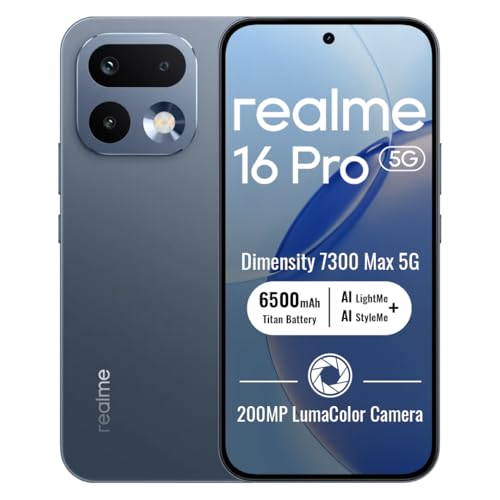
realme’s 16 Pro makes its screen argument in the panel technology and the refresh rate rather than in a stated size: a 144Hz AMOLED display, the fastest refresh figure in this set, on an unlocked 5G handset. AMOLED brings the deep blacks and contrast that make a tall screen feel boundless in a dark room, and 144Hz gives scrolling and motion a fluidity that, once lived with, makes lesser rates feel like a stutter. The title does not print the panel’s dimensions, so size comparisons rest with realme’s documentation and the bezel claim is marked not stated — but the quality signals that are stated are the strongest screen signals in the roundup after the Honor’s ratio.
The supporting cast is formidable: a 7,000mAh battery with 80W SuperVOOC charging, a camera pairing listed as 50 plus 200MP, a Dimensity 7300 Max 5G chipset, 8GB of RAM with 256GB of storage, and an IP69 rating that gives this nominally screen-led phone a durability footnote none of its Xiaomi rivals state. realme has always competed by stacking specifications a tier above its price’s expectations, and the 16 Pro’s title is that strategy in miniature. For a reader whose carrier fit checks out and whose priorities run screen, battery and charging speed in that order, it is arguably the set’s most complete value handset.
- Display: AMOLED, 144Hz refresh rate; size not stated in the title
- Cameras: 50 + 200MP pairing, as listed in the title
- Battery: 7,000mAh, 80W SuperVOOC charging
- Platform: MediaTek Dimensity 7300 Max 5G
- Durability: IP69 rating, stated in the listing title
- Bezel-less claim: Not stated in the listing title — verify with realme documentation
Strengths
- 144Hz AMOLED is the set’s most advanced stated screen technology.
- 80W charging and a 7,000mAh battery solve endurance twice over.
- IP69 rating adds unusual durability for the class.
Trade-offs
- Screen size is not stated in the title.
- realme’s US carrier fit needs careful confirmation per model.
- Brand support networks are thinner than the biggest makers’.
Best for: screen-quality devotees who also want battery and fast charging.
Not suited for: readers who shop by stated dimensions before anything else.
Honor 7X — The original FullView
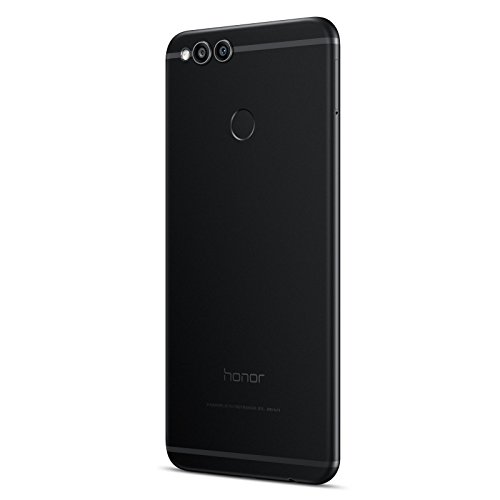
Every trend has a patient zero, and for the tall, slim-framed screen in the mass market it is this phone. The Honor 7X’s title states its story with a clarity the modern listings might envy: an 18:9 screen ratio, a 5.93-inch FullView display, a dual-lens camera, unlocked, with 4GB of RAM and 64GB of storage. FullView was Honor’s name for the design idea the keyword chases — a taller panel filling more of the phone’s face — and in its era the 7X carried that idea into a price class that had been stuck with small, squarish screens. It is included here as the honest ancestor: the one pick whose title actually describes the bezel-shrinking design in so many words.
Judged as a purchase today, the 7X must be read as a veteran. Its storage and memory are a fraction of the modern picks’, its camera belongs to its generation, and its software story is long finished. What it offers now is charm, simplicity and a place in design history — a light-duty handset for calls, texts and basic tasks, or a collector’s working example of the moment the phone screen grew tall. A reader who needs a daily phone for the next three years should buy any of the other five. A reader who wants to understand where those five came from should start here, because the 7X is the root of the family tree this whole guide describes.
- Display: 5.93-inch FullView, 18:9 screen ratio — stated in the listing title
- Camera: Dual-lens camera
- Memory and storage: 4GB RAM, 64GB storage
- Network position: Unlocked
- Finish: Black
- Battery: Not stated in the listing title — verify with Honor documentation
Strengths
- The only title here that states its tall-screen design outright.
- A historically important design at a simple, light-duty specification.
- Unlocked, with a dual-lens camera for basic photography.
Trade-offs
- Hardware of its era — modest memory, storage and camera by current standards.
- Software support belongs to its generation and has run its course.
- Not a rational primary phone for a demanding modern user.
Best for: design-history interest and genuinely light duty.
Not suited for: a primary handset expected to serve for years.
How Do the Six Picks Compare Side by Side?
| Pick | Screen per title | Camera headline | Battery | Network note |
|---|---|---|---|---|
| Xiaomi 17T Pro | 6.83-inch, high refresh | 50MP triple, Leica | Not stated in title | T-Mobile, Mint, Tello, global |
| OnePlus 15 | Size not stated | Not stated in title | 7,300mAh | Unlocked dual-SIM |
| Redmi Note 15 | 6.77-inch, 120Hz | 108MP triple | Not stated in title | T-Mobile, Mint, Tello, global |
| Redmi Note 15 Pro+ | 6.83-inch, 120Hz | 200MP ultra | Not stated in title | T-Mobile, Mint, Tello, global |
| realme 16 Pro | AMOLED, 144Hz; size not stated | 50 + 200MP | 7,000mAh | Unlocked 5G |
| Honor 7X | 5.93-inch FullView, 18:9 | Dual-lens | Not stated in title | Unlocked |
What Does a Tall Screen Actually Change in Daily Use?
The tall screen — the honest substance behind the bezel-less slogan — changed the phone’s proportions rather than merely its looks. An 18:9 or taller panel holds more of a conversation, a document or a map in one view, so the thumb scrolls less and reading flows longer between interruptions. Video, shot mostly in wide formats, letterboxes less awkwardly than it did on the squarish screens the 7X’s generation replaced. And the tall shape keeps a large display narrow enough to hold, which is why screen sizes could climb past six inches without phones becoming tablets in the hand.
The refresh rate is the tall screen’s modern partner. The 120Hz figures on the Redmi pair and the 144Hz on the realme describe how many times a second the panel redraws, and the felt difference is in motion: scrolling text stays legible instead of smearing, maps glide, and the whole interface acquires a liquid quality that owners notice most when they briefly return to a slower screen. None of this requires the word bezel-less to be true, which is rather the point of this guide’s discipline — the experiences are real, stated in hertz and inches, and they do not need a slogan to justify them.
There are costs worth naming. Tall screens put the top of the display beyond a thumb’s honest reach, so one-handed modes and deliberate home-screen layouts matter more than they did. Cases and screen protectors must match the exact model’s curves, since edge designs vary. And a larger panel spends battery faster at full brightness, which is one reason the modern picks pair their screens with 7,000mAh-class batteries. The tall screen won the industry’s argument years ago; the mature way to buy one is by its stated size, rate and panel type, exactly as this set presents them.
How Should You Check Carrier Fit for a Chinese-Market Phone?
Begin with the title’s own words and take them literally. When Xiaomi’s titles name T-Mobile, Mint and Tello, they are describing the US networks the global model is offered for; the absence of Verizon and AT&T from that list is information, not an oversight. Mint and Tello themselves run on T-Mobile’s network, which is why the three names travel together. A reader on one of the named networks can proceed with reasonable confidence; a reader on any other US network should stop and choose differently, however attractive the screen.
Next, use the carrier’s own compatibility checker with the exact model code from the listing, not the marketing name. Model families split into regional variants with different band support, and the checker exists precisely to arbitrate those differences. Dual-SIM and eSIM details matter at this stage too: the 17T Pro lists eSIM, the Redmi pair list dual SIM, and the OnePlus lists dual-SIM — arrangements that suit travellers and two-line users, provided the primary line’s carrier accepts the handset in the first place.
Finally, plan the first week as a verification window. Make calls from the places coverage is doubted, watch how the phone holds signal in the building where it will live, and confirm that features the household depends on — Wi-Fi calling, visual voicemail, hotspot duty — behave as expected on that carrier with that model. Global phones reward this diligence generously and punish its absence completely, and the return window is the cheapest place to learn which side of that bargain a particular purchase sits on.
Which Mistakes Do Import-Phone Buyers Make Most Often?
The first mistake is reading “unlocked” as “works everywhere”. Unlocked means the phone is not tied to a seller’s contract; network compatibility is a separate, physical question of bands and carrier policy, and this set’s Xiaomi titles answer it narrowly and honestly. The second mistake is shopping the slogan instead of the screen: “bezel-less” appears in almost none of these titles, while sizes, ratios and refresh rates appear in most — the stated figures are the purchase, the slogan is weather.
The third mistake is ignoring the software track. A global ROM follows its maker’s international update rhythm and regional service arrangements, which differ from a US carrier model’s in ways that matter over a three-year ownership. The fourth is neglecting accessories and support geography: cases, protectors and service for these models are thinner on the ground in the US than for domestic flagships, and a reader far from a service network should weight that reality. The fifth, finally, is buying the veteran 7X as a modern phone; it is a piece of design history that still makes calls, and it should be bought as exactly that.
How Did the Phone Screen Grow Tall? A Short History in Six Handsets
For the first decade of the smartphone, screens grew wider and taller together, keeping the proportions of a small television. The constraint was never desire — it was the furniture around the panel: speaker grilles, home buttons, fingerprint readers, camera modules and the brand’s own logo all claimed strips of the phone’s face, and the display lived in the space left over. The design idea behind this entire guide is the eviction of that furniture. Move the fingerprint reader to the back or under the glass, shrink the speaker to a slit, hide the camera in a notch or a punch-hole, and the screen inherits the whole face.
The Honor 7X marks the moment that eviction reached the budget class. Its 18:9 ratio — taller than the 16:9 widescreen standard it replaced — let a 5.93-inch display live in a body sized like the smaller phones around it, and Honor’s FullView name told buyers exactly what had happened. Rivals followed within a season, because the advantage was visible across a shop: two phones of the same footprint, one mostly screen, one visibly framed. From that season onward, the frame’s retreat never reversed, and the modern picks in this set are its grandchildren.
The retreat continued on several fronts at once. Ratios stretched from 18:9 toward 19.5:9 and beyond, which is why today’s 6.8-inch phones remain holdable. Refresh rates climbed from the universal 60Hz through the 120Hz figures on the Redmi pair to the realme’s 144Hz, trading the static idea of a screen for a fluid one. Panel technology consolidated around AMOLED at the ambitious end, its per-pixel lighting making dark interfaces glow against true black and letting always-on displays sip power. Even the camera’s last foothold on the face shrank to a punch-hole the size of a lentil.
What remains of the bezel in 2026 is mostly engineering honesty: a millimetre or two of structure, antenna clearance and drop protection that no marketing department has yet repealed. That residue is why this guide refuses the literal slogan while honouring the idea. The phones here are not bezel-less; they are bezel-minimal to a degree the 7X’s designers would recognise as their idea completed. Reading the set in order — veteran to flagships — is the fastest way to see both how far the retreat has come and why the last millimetre is the hardest.
What Should a Buyer Understand About Global ROM Software Before Ordering?
Three of these titles carry the words global ROM, and the phrase deserves translation, because it shapes ownership quietly for years. A global ROM is the maker’s international software build: the phone ships with the maker’s global services, language set and update channel rather than a version prepared for one country’s carriers. For many buyers that is a positive — a clean, internationally supported build without a single US carrier’s app bundle — and Xiaomi’s flagships have plenty of devoted global-ROM owners. But it is a different track from a US retail model, and the differences deserve daylight.
Updates arrive on the maker’s schedule for the global channel, which can lag or lead the carrier-channel equivalents depending on the season. Warranty and service run through the seller and the maker’s international arrangements rather than through a carrier shop on the high street, so a buyer should read the listing’s warranty wording with the same care given to the screen figures. Certain carrier-specific services — the exact behaviour of Wi-Fi calling, visual voicemail and network-specific messaging features — should be treated as unverified until the first week’s testing confirms them on the actual network, which is one more reason the verification window in this guide is a procedure rather than a suggestion.
None of this is a warning against the phones; it is a description of the ownership being purchased. A reader who travels, who holds a T-Mobile-family line, who is comfortable buying technology on its merits rather than its retail channel, will find the global-ROM arrangement entirely congenial — the 17T Pro’s eSIM and NFC, the Redmi pair’s dual SIMs, are traveller’s features placed there deliberately. A reader who values walking into a shop when something breaks should weight the support geography as heavily as the screen, and may find the OnePlus’s broader retail presence the calmer purchase. Informed either way, the buyer gets the phone they expected, which is the whole purpose of reading titles closely.
How Should the Camera Figures in These Titles Be Read?
This set carries the largest camera numbers in the batch — 200MP twice over, 108MP, a Leica-named triple system — and they reward the same scepticism applied to bezels. A megapixel figure states the sensor’s resolution, nothing more. It does not state the lens quality, the processing taste, or the low-light behaviour, and in daily use these sensors spend most of their time combining neighbouring pixels into smaller, cleaner images. The figure’s genuine gifts are detail in good light and the freedom to crop aggressively — the distant sign made legible, the group photograph reframed around its best corner.
The Leica name on the 17T Pro signals a different kind of claim: not resolution but rendering — colour science and lens design developed with a camera house whose reputation rests on exactly those qualities. Such partnerships cannot be reduced to a number, which is why the flagship’s camera can be the connoisseur’s choice in this set while carrying the smallest headline figure of the modern five. The honest hierarchy for a photography-led buyer runs: processing and lenses first, sensor size and craft second, megapixels third — almost exactly the reverse of the order the titles advertise, and exactly why guides like this one exist.
Practically, the set divides by photographic temperament. The Redmi Note 15 Pro+ and the realme offer resolution to burn for travellers and croppers. The 17T Pro offers the considered rendering of the Leica collaboration. The standard Note 15 splits the difference at 108MP with the value line’s balance intact. And the Honor 7X’s dual-lens camera belongs to its era — a reminder that in its day, two lenses were the headline, before resolution resumed its climb. Choose the temperament that matches the photographs actually taken, and ignore the arithmetic contest the titles are having among themselves.
What Is It Like to Live With a Screen This Large?
The modern picks cluster around 6.8 inches, and that size reorganises daily life in ways worth rehearsing before the purchase. Reading is the clear winner: articles, messages and documents present more lines at a comfortable type size, so the eyes travel less and the thumb rests more. Maps become genuinely consultable rather than merely glanceable, and a photograph taken on the phone can be judged on the phone, at a size where focus errors and blinked eyes announce themselves before the moment has passed. Two-handed typing grows fast and accurate, and split-screen duty — a document beside a message thread — stops being a party trick and becomes a working posture.
The costs arrive in the pockets and the hands. A 6.8-inch phone is a deliberate carry: it wants a jacket pocket, a bag, or a confident grip, and it will be set down on tables rather than forgotten in a jeans pocket. One-handed reach is a negotiation conducted through software — reachability modes, keyboards shrunk to one side, home screens arranged in the thumb’s lower arc. Owners adapt within a fortnight and then defend the size fiercely, because the reading and viewing gains are daily while the carrying costs are momentary. But the adaptation is real, and a reader with small hands or a pocket-based life should handle a phone of this class in a shop before committing to any of the modern five.
The Honor 7X throws the contrast into relief. Its 5.93-inch FullView screen was the large display of its moment, yet it reads today as the compact option — the one that disappears into a pocket and answers to one hand. That inversion is the history section’s lesson made physical: yesterday’s big screen is today’s small phone, and the definition of normal has been carried upward by exactly the design retreat this guide describes. A reader who finds the modern class overwhelming is not behind the times; they are simply shopping at the 7X’s end of a spectrum the industry keeps stretching.
How Do Battery Size and Charging Speed Divide the Set?
Only three titles in this set state a battery figure, and the three that do make a statement of intent: 7,300mAh in the OnePlus 15, 7,000mAh in the realme 16 Pro. These are capacities a generation of phones ago would have required a ruggedised brick, now living inside slim big-screen handsets thanks to denser cell chemistry. The practical meaning is a phone that treats a heavy day — navigation, photography, hotspot duty, a bright screen outdoors — as an ordinary day, and reaches the evening with margin rather than apology. For travellers and field workers, that margin is worth more than any camera figure in this guide.
Charging is the other half of the endurance story, and here the realme stands alone in the titles with its 80W SuperVOOC figure. Fast charging at that level changes behaviour: the overnight charge stops being a ritual, replaced by short top-ups — while coffee brews, while a bag is packed — that restore hours of use. The discipline it asks in return is modest: use the maker’s own charger and cable for the full rate, and expect third-party plugs to feed the phone more slowly. The other titles’ silence on charging wattage is marked here as exactly that — silence — and a buyer for whom charging speed matters should confirm the figure in the maker’s documentation for the exact model.
The three unstated batteries — both Xiaomi flagships of the set and the Honor — should not be read as small by default; flagship-class phones of this era carry substantial cells as a matter of course. They are simply unquoted in their titles, and this guide’s rule is to build no argument on a number it cannot point to. The reader’s takeaway is procedural: where endurance is the deciding factor, the OnePlus and the realme have stated their cases in print, and the others ask for one verification step in the maker’s documentation before the decision hardens.
Which of These Phones Travels Best?
Travel is where this set’s global DNA stops being a caveat and becomes the point. Dual-SIM arrangements run through the titles — the OnePlus, both Redmi models — and the 17T Pro adds eSIM, which between them cover the traveller’s two classic manoeuvres: keep the home number alive on one line while a local SIM carries data, or land and activate a travel eSIM before the aircraft door opens. A big screen earns its size at exactly these moments, when the phone is simultaneously map, boarding pass, phrasebook, camera and hotel key, and the tall display lets each of those jobs breathe.
The Xiaomi titles’ global wording deserves a traveller’s reading in particular. Compatibility described as global, on a global ROM, is a phone designed to be at home in many countries’ networks — the opposite of a carrier model built for one nation’s bands and one shop’s shelves. The verification habit still applies, country by country, since band support is a physical fact that no adjective overrides; but the starting position is breadth, and a reader whose life crosses borders will feel the difference in every arrival hall. Pair that breadth with the OnePlus and realme’s stated batteries, and the set offers two distinct travel philosophies: Xiaomi’s network cosmopolitanism, and the endurance pair’s ability to simply outlast the longest day of transit.
Practical travel discipline closes the section. Download the destination’s maps and translation packs before departure, while bandwidth is free and unhurried. Photograph the phone’s IMEI and the hotel’s address in the local script, for taxi drivers and for luck. Carry the charging cable in the cabin bag, not the hold, and note which of these phones’ fast-charging figures depend on the maker’s own plug — a small universal adapter plus the original charger is the combination that survives every socket on earth. A big-screen phone, prepared this way, is the best travel companion the category has ever produced; unprepared, it is merely a large object to worry about in airports.
How Do You Protect a Phone That Is Mostly Glass Front?
A phone whose face is nearly all screen has made a bargain: it traded the old frame’s sacrificial border for display area, and the owner inherits the consequences. The classic drop that once dented a bezel now lands on the panel itself, so protection stops being an accessory preference and becomes part of the purchase. A case with raised corners and a lip that stands proud of the glass is the single most valuable companion any of the modern five can have, and it should be ordered in the same basket as the phone, fitted in the same hour the phone is unboxed.
Screen protectors follow the same logic, with a fit caveat specific to this class: models vary in edge curvature, and a protector cut for a sibling model will lift at the corners and collect pocket lint in the gap. Match the protector to the exact model code, as with the carrier check — this set rewards exact-model discipline in every department. Tempered glass protectors sacrifice themselves in drops that might otherwise mark the panel, and a multipack turns that sacrifice into a routine rather than a regret.
The support geography returns here in practical form. A cracked panel on a mainstream domestic flagship is a same-week errand in most cities; on a global-market model it can become a correspondence, which argues for prevention over cure and for handling the phone, from day one, like the mostly-glass object it is. None of this should frighten a careful owner — millions carry these phones unbroken for years — but the category’s beauty and its fragility are the same fact viewed from two sides, and the honest guide names both.
What Should the First Week With One of These Phones Include?
Day one is for the network verdict: SIM in, calls made from the house’s weak corners, data tested on the commute, and the carrier features the household depends on confirmed one by one. A global phone that passes its home territory in week one will generally serve for years; one that struggles should be exchanged inside the return window rather than apologised for. Day two belongs to the screen — brightness in sunlight, the refresh rate set as intended, text size and one-handed aids arranged — because the display is the reason this category exists and it should be tuned like it matters.
The rest of the week is for the camera and the battery, tested on real life rather than on charts: the family group in evening light, the distant view cropped afterwards, a full day out with navigation running and no charger in the bag. By day seven the owner will know the phone’s true character — its signal manners, its screen in weather, its endurance under their own habits — and the purchase will rest on evidence. That week, patiently used, is worth more than any single figure in any title in this guide.
One administrative task belongs in that week as well: register the purchase, keep the order record with the phone’s model code and IMEI photographed, and note the seller’s warranty terms somewhere the household can find them in a year. Global-market phones reward tidy paperwork exactly as they reward exact carrier checking, and the owner who files both in week one has quietly completed the purchase rather than merely made it. Add the maker’s support page to the browser’s bookmarks while the paperwork is open, since the exact-model documentation this guide keeps pointing to will answer, in minutes, the questions that forums argue about for days. While the bookmarks are being set, download the full manual as well; its network and band tables are the authoritative companion to the carrier checker, and having them offline turns a future support call from a fishing expedition into a short, factual conversation. That small folder of records — order, IMEI, manual, warranty — is the least glamorous purchase in this entire guide and, across a three-year ownership, very often the most valuable one. Keep a copy of the folder in cloud storage too, so the records survive even if the phone itself, one day, does not. It takes ten minutes, once, and it closes the purchase properly, permanently, and for good.
Final Recommendation
On T-Mobile-family networks, the Redmi Note 15 Pro+ is the set’s sweet spot — the flagship-sized 6.83-inch screen, the 200MP camera, the value line’s positioning — with the standard Note 15 a step behind it and the 17T Pro above it for the Leica camera and the storage. For screen technology above all, the realme 16 Pro’s 144Hz AMOLED stands out, and for raw power and endurance the OnePlus 15 leads the six outright. The Honor 7X closes the set as the idea’s origin, worth its place for the FullView story its title still tells plainly. Choose by carrier first, screen second and slogan never — the titles, read carefully, were the spec sheet all along.
Frequently Asked Questions
Are any of these phones literally bezel-less?
No phone is. Every handset has some frame, and most of these titles do not claim otherwise — which is why this guide marks the bezel-less claim as not stated where a title omits it and judges screens by their stated size, ratio, refresh rate and panel type. The Honor 7X comes closest to claiming the design, with its 18:9 FullView wording printed in the title.
Will the Xiaomi phones work on Verizon or AT&T?
Their titles name T-Mobile, Mint and Tello, plus global use — not Verizon or AT&T. Treat that list as the answer and check the exact model code in your carrier’s compatibility checker before ordering. An unlocked phone is not automatically a compatible phone, and this distinction is the commonest source of disappointment with global models.
Which pick has the best screen on stated evidence?
By stated technology, the realme 16 Pro’s 144Hz AMOLED leads on refresh rate and panel type, though its size is not printed in the title. By stated size, the 17T Pro and the Redmi Note 15 Pro+ tie at 6.83 inches. The Honor 7X holds the only stated ratio, at 18:9.
What does a 200MP camera actually deliver?
In ordinary shooting, very high-resolution sensors combine pixels to improve detail and light handling, and they offer unusual freedom to crop into a scene afterwards. The figure in the Redmi Note 15 Pro+ and the realme’s pairing signals that photographic ambition; it does not by itself guarantee low-light results, which depend on processing and lenses as much as arithmetic.
Is the Honor 7X still a sensible purchase?
As a light-duty handset or a working piece of design history, yes — its FullView screen genuinely started the tall-screen era in its class. As a primary phone for modern apps and years of service, no; the other five picks exist for that job, and the 7X’s own modest memory and storage figures say so plainly.
What does the AI in the Xiaomi model names refer to?
The titles attach an AI designation to the 17T Pro and the Redmi Note 15 models without itemising features, so this guide records the designation and claims nothing specific on its behalf. Camera assistance and system features are the usual territory for such labels, but the exact list belongs to Xiaomi’s documentation for each model, and readers needing a particular AI function should confirm that function by name before ordering.
Are these phones a good fit for gaming?
On stated evidence, the ingredients are present in the modern five: large high-refresh screens — 144Hz on the realme, 120Hz on the Redmi pair — flagship or strong mid-range silicon, and batteries in the 7,000mAh class on the OnePlus and realme. Sustained gaming also depends on cooling and software tuning that titles do not describe, so a dedicated gaming buyer should treat these as strong all-rounders with gaming-friendly screens rather than as specialist gaming handsets.
Do these phones support eSIM?
The Xiaomi 17T Pro’s title lists eSIM explicitly. The other titles emphasise dual-SIM arrangements or stay silent on the point, so treat eSIM as confirmed only where a title states it and check the maker’s documentation for the exact model otherwise.
Related Guides
Readers comparing these screens with other specialised handsets may also value our look at rugged phones with stated durability ratings, the guide to unlocked phones chosen for camera and messaging, and the roundup of simple smartphones chosen for older users.


