What's inside
- Key Takeaways
- Quick Picks
- What Did We Demand Before a Camera Earned a Place Here?
- How Far Does Optical Zoom Actually Reach Outdoors?
- Infrared Yards, Floodlight Colour: What Does Night Vision Really Promise?
- PoE, Plug-In or Floodlight Wiring: Which Power Route Suits the Property?
- The Six Outdoor PTZ Cameras, Examined in Turn
- How Does Auto Tracking Behave Once the Novelty Wears Off?
- Where Does the Footage Live, and Who Else Can See It?
- How Do You Set Up a Patrol and Zones in the First Week?
- What Does a Year of Weather Do to a Moving Camera?
- How Do the Six Compare on the Numbers Their Titles Actually State?
- Which Installation Mistakes Undo a Good PTZ Camera?
- Final Recommendation
- Frequently Asked Questions
- Related Guides
As an Amazon Associate I earn from qualifying purchases. This post may contain affiliate links at no extra cost to you.
gizmoverdict.com is reader-supported. When you buy through links on our site, we may earn an affiliate commission.
Where to buy: all six cameras below are sold through their Amazon listings, and the listing page is where you confirm the power arrangement — PoE injector, plug-in adapter or hardwired floodlight — because the same model family often ships in more than one power variant.
The best pan tilt motion detecting waterproof outdoor zoom cameras solve a geometry problem that defeats fixed cameras: a yard, a gate and a driveway rarely fit inside one still frame, and the interesting event never happens where you happened to point the lens. A motorised head that pans, tilts and follows movement turns one mounting point into a patrol route, and optical zoom decides whether the figure at the fence is a neighbour, a fox or a stranger reading your number plate. This guide reads the six strongest current listings the way an installer would — by zoom reach, infrared range and weather sealing exactly as their titles state them, with no figure upgraded and no rating assumed.
That last discipline matters more in this category than in most. PTZ listings are written by marketers who know that big numbers sell domes, and the gap between a title’s claims and a camera’s honest working envelope is where disappointed buyers are made. So the reviews below hold each camera to its own printed words. Where a title names an IP rating, we use it. Where it names an infrared distance, we treat that as the outer edge of useful night identification, not a guarantee. Where a title stays silent — and several here stay silent about weather sealing entirely — the spec box says so in plain language, and the verdict weighs the silence.
Key Takeaways
- Optical zoom is the honest divide in this list: the SV3C reaches 36X and two cameras reach 30X, while the Reolink E1 Outdoor Pro stops at 3X and is judged here as a near-field camera, never as a long-range one.
- Power splits the field into three camps — PoE domes that demand a compatible NVR or injector (the Jennov works only with an Onvif PoE NVR, per its title), Wi-Fi cameras that still need a cable for electricity, and the eufy E340, a wired floodlight fitting that replaces an existing light.
- Only one listing in the six, the HXVIEW, prints an ingress rating (IP66) in its title; for the other five, weather sealing is a fact to confirm in the maker’s documentation before the camera goes up a pole.
- Infrared claims run from the Jennov’s stated 320ft to a stated 1000ft on the HXVIEW and SUNBA — figures that describe illumination reach, not the distance at which a face becomes identifiable.
- Auto tracking appears in every title here, but what gets tracked differs: people only on the Jennov, people, vehicles and pets on the HXVIEW, humanoid and vehicle shapes on the SV3C.
Quick Picks
| Pick | Badge | Why it made the cut |
|---|---|---|
| Jennov 4K PTZ PoE (20X) | NVR-yard dome | A 20X optical zoom speed dome with a stated 320ft of infrared, built to live inside an Onvif PoE recorder system rather than beside an app. |
| HXVIEW 4K WiFi PTZ (30X) | Long-reach Wi-Fi | 30X optical zoom, an IP66 rating printed in the title and person, vehicle and pet detection for properties too spread out for a cable run. |
| SUNBA 4K PTZ PoE+ (30X) | Farm and warehouse pick | PoE+ power, a full 360° pan with 90° tilt and two-way audio, aimed by its own title at farms, warehouses and business yards. |
| SV3C 4K PTZ (36X) | Deepest zoom here | The longest optical reach in the guide at 36X, plus floodlight colour night vision and dual-band Wi-Fi for a single-camera property watch. |
| REOLINK 4K PTZ WiFi (3X) | Near-field all-rounder | A modest 3X zoom traded for local storage with no subscription, Wi-Fi 6 and colour night vision over a porch, drive or garden. |
| eufy Floodlight Camera E340 | Light-first security | A 2000-lumen floodlight with a dual-lens camera, 360° coverage and pan-and-tilt tracking that mounts where a security light already lives. |
What Did We Demand Before a Camera Earned a Place Here?
Three title-stated credentials, in descending order of how often they are exaggerated. First, genuine optical zoom — a lens that physically moves, quoted as a multiplier in the listing — because digital zoom is cropping with better marketing, and a PTZ camera’s entire purpose is to inspect things far from its pole. Every pick here names an optical figure, from the Reolink’s honest 3X to the SV3C’s 36X, and the reviews judge each camera inside the envelope that figure creates rather than borrowing credibility from its longer-legged rivals.
Second, a night story told in numbers. Infrared range is printed for four of the six, floodlight-assisted colour vision headlines two others, and the distinction shapes what the footage looks like at 2 a.m.: monochrome IR detail at distance, or colour evidence near the house where a floodlight’s throw actually lands. Third, a detection vocabulary specific enough to be testable. “Motion detection” alone is a 2015 claim; the titles here name humans, vehicles, pets and humanoid shapes, and a camera that can tell a person from a swaying branch generates alerts a owner might still be reading in month six.
We also weighted the unglamorous axis of how the camera eats. PoE cameras move power and data down one cable and belong to recorder-based systems with real storage; Wi-Fi cameras still drink electricity from somewhere, which means an outdoor socket, a plug-in adapter run or a floodlight junction box. Two of the six make a virtue of refusing subscriptions, storing locally instead. None of that appears in the zoom figures, and all of it decides whether the camera is still running in its second winter.
How Far Does Optical Zoom Actually Reach Outdoors?
Shorter than the multiplier suggests, and in a predictable way. A zoom figure describes how much narrower the view becomes, not how far identification survives. At 3X, the Reolink frames a porch, a parked car and the path between them — a near-field instrument, and this guide will not pretend otherwise. At 20X, the Jennov can hold a gate at the end of a long drive in frame and read the scene around it. At 30X and 36X, the HXVIEW, SUNBA and SV3C are watching boundaries, outbuildings and livestock fencing from a single elevated mount, trading a wide everyday view for a telescope they can aim.
The discipline is to match the multiplier to the longest sightline on your own property, measured honestly. Stand at the mounting point and pace to the farthest thing you genuinely need to inspect — not the farthest thing you can see. Most suburban plots are fully served somewhere between 3X and 20X; the 30X-class cameras earn their price on acreage, yards with outbuildings, and commercial lots where one pole must cover what would otherwise be three fixed cameras. Overshooting costs you twice: the wide view you live with daily gets narrower and twitchier, and every gust of pole-sway is magnified by the same factor as the intruder.
Remember, too, that zoom and tracking pull against each other. A camera zoomed deep sees a letterbox of the world, and a subject crossing that letterbox at walking pace exits it in seconds; several of these cameras answer by tracking at wider angles and zooming on approach, behaviour you can observe in your first week of test footage. Buy the reach your longest sightline demands, then let the camera work wide most of the time — the zoom is a tool for answering alerts, not a posture for standing guard.
Infrared Yards, Floodlight Colour: What Does Night Vision Really Promise?
The infrared figures in these titles — 320ft on the Jennov, 1000ft on the HXVIEW and the SUNBA — describe how far the camera’s own IR illuminators throw usable light. They do not describe faces. Identification distance is a fraction of illumination distance, shrinking with rain, fog, dust on the dome and the reflectivity of whatever the subject wears. Treat the printed number as the radius inside which the camera sees something clearly, and expect recognisable detail well inside it. A camera claiming 1000ft that watches a 120ft yard is not lying to you; it is simply specified for a larger property than yours, and its surplus throw becomes even, shadow-free coverage of the ground you actually own.
The two floodlight designs argue a different philosophy. The eufy E340 pairs its camera with a stated 2000 lumens of light, and the SV3C adds floodlight colour night vision to its IR-free colour claim: when motion trips the light, the recording turns colour, and colour is evidence — jacket, vehicle, hair — that monochrome infrared cannot supply. The trade is range and manners. Floodlights serve the ground near the fitting, they announce themselves to the whole street, and a camera that lights up for every moth will train its owner to ignore it. IR domes stay covert and far-reaching but hand you a grey world.
Placement mediates both. Infrared reflects off nearby walls, spider webs and rain, blooming the image exactly where the camera sits; a dome mounted a metre further from the wall it guards often sees better at midnight than a stronger dome mounted flush. Whichever night system you choose, spend one evening walking your own boundary with a phone torch while someone watches the feed. The dead spots you find that night are the ones an intruder would find in a month.
PoE, Plug-In or Floodlight Wiring: Which Power Route Suits the Property?
PoE is the professional answer and the least forgiving. The Jennov’s title states it works only with an Onvif PoE NVR, and the SUNBA runs on PoE+ — both assume a recorder, a switch or injector, and a cable run planned like infrastructure. In exchange you get a camera indifferent to Wi-Fi weather, powered through storms of interference, recording to a box in a cupboard rather than to a card on a pole a thief can reach. If your property already runs a recorder system, these two are the natural citizens of it. If it does not, their true price includes the recorder ecosystem, and the honest comparison is system against system.
Wi-Fi changes the labour rather than removing it. The HXVIEW, SV3C and Reolink all still need mains electricity at the mount; what they save is the data cable and the recorder, paying instead in dependence on your router’s reach to the far fence. Dual-band radios — the SV3C and Reolink both state dual-band Wi-Fi, the Reolink naming Wi-Fi 6 — help, because the 5GHz band is faster and the 2.4GHz band travels further through walls, but no radio spec repeals distance. The eufy takes the third road: it wires into the junction box of the floodlight it replaces, which makes its power the most permanent of all and its installation the one most likely to involve an electrician’s ladder.
Decide by asking where the electricity already is. A barn with a recorder cabinet wants PoE. A house with an outdoor socket near the eaves wants Wi-Fi and a short cable. A dark side-path with an ageing security light wants the eufy, because the fitting, the wiring and the mounting holes are already there waiting for it.
The Six Outdoor PTZ Cameras, Examined in Turn
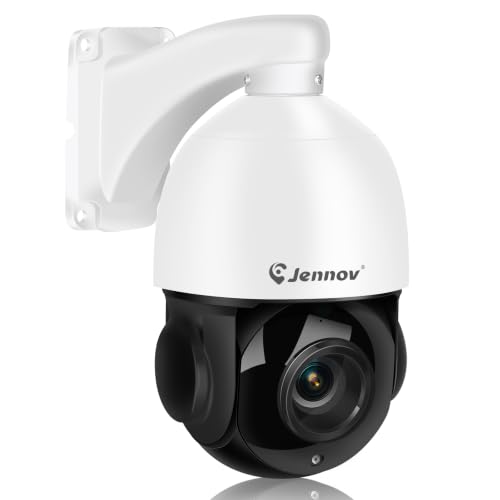
Jennov 4K PTZ PoE (20X) — NVR-yard dome
The Jennov is the system camera of this group, and its title says the quiet part out loud: it works only with an Onvif PoE NVR. That single clause sorts its buyers before any specification does. Inside a recorder-based setup, everything else in the title falls into place — a 4K 8MP sensor behind a 20X optical zoom, speed-dome mechanics for fast repositioning, a stated 320ft of infrared night vision, auto tracking and human detection. This is a camera designed to be one disciplined eye among several on a property with a recording hub, and judged on those terms it is the most conventionally professional tool here.
The 20X figure sits at the sensible middle of the zoom range: long enough to inspect a gate, a fuel tank or a parked trailer across a yard, restrained enough that its everyday wide view remains usable. Human-only detection is the honest limitation to note — the title promises no vehicle or pet classification, so a yard shared with animals will generate person-shaped questions the camera cannot answer by itself. Its Amazon listing is the place to confirm which recorder pairings the seller currently supports, since the Onvif-only condition makes compatibility the whole purchase.
- Sensor stated: 4K, 8MP
- Zoom stated: 20X optical, pan and tilt speed dome
- Night vision stated: 320ft infrared
- Detection stated: human detection, auto tracking
- System condition stated: works only with an Onvif PoE NVR
- IP rating: not stated in the listing title — verify with the maker’s documentation
Strengths
- A 20X optical zoom matched to yard-scale sightlines rather than headline-chasing reach.
- PoE single-cable installation with recorder storage keeps footage off the pole and indoors.
- Stated 320ft infrared throw covers long drives without a floodlight’s glare.
Trade-offs
- The Onvif-NVR-only condition makes it unusable as a standalone app camera.
- Detection names humans only — no vehicle or pet sorting in the title.
- No ingress rating is printed in the title, so sealing must be verified before exposed mounting.
Best for: a property already running an Onvif PoE recorder that needs one long-reach dome over a yard or gate. Not suited for: standalone operation with only a phone app and no recorder anywhere in the system — the NVR requirement is absolute in the listing. Confirm the Jennov’s NVR compatibility on Amazon before ordering it for an existing recorder.
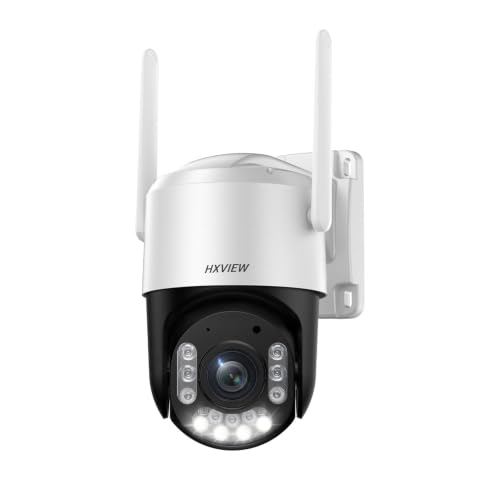
HXVIEW 4K WiFi PTZ (30X) — Long-reach Wi-Fi
Where the Jennov assumes infrastructure, the HXVIEW assumes distance. Its title stacks the far-property credentials: 30X optical zoom, a stated 1000FT of night vision, 24/7 recording, auto tracking, RTSP for feeding other software, and — alone in this guide — an IP66 rating printed where buyers can see it. Add smart detection that separates people, vehicles and pets, and a red-blue strobe alarm for the moments when watching is not enough, and the BU-H810 reads as a camera specified by someone with a long fence line and no intention of cabling it.
Wi-Fi is both its freedom and its exam question. A 30X camera at the far end of a large plot is useful only if the wireless link survives weather, foliage and the wall of the house; the sensible installation tests the signal at the pole before the mount is drilled. The strobe alarm deserves a thought about neighbours, too — on a rural plot it is a deterrent, on a tight suburban boundary it is a relationship decision. The HXVIEW listing carries the current radio and storage details, worth a read because Wi-Fi PTZ models revise their internals quietly.
- Zoom stated: 30X optical
- Night vision stated: 1000FT
- Weather sealing stated: IP66 — the only rating printed in this guide’s titles
- Detection stated: person, vehicle and pet, with auto tracking
- Recording stated: 24/7, with RTSP support
- Deterrent stated: red-blue strobe alarm
Strengths
- 30X reach plus a printed IP66 rating makes it the far-fence specialist of the six.
- Three-way detection sorting keeps alerts readable on properties with animals and vehicles.
- RTSP support lets the feed join recorder or software setups later, despite the Wi-Fi start.
Trade-offs
- Its value collapses if the Wi-Fi link to a distant mount is weak — signal must be proven on site.
- The strobe alarm is a deterrent that close neighbours will experience as their own.
- 24/7 recording over Wi-Fi demands dependable local storage arrangements the title leaves to you.
Best for: acreage, long boundaries and outbuildings where a cable run is impractical but mains power exists. Not suited for: a metal-clad building or a mount far beyond the router’s honest reach, where its wireless link becomes the failure point. Read the HXVIEW listing on Amazon for its current storage and radio specifications.

SUNBA 4K PTZ PoE+ (30X) — Farm and warehouse pick
The SUNBA names its workplaces in its own title — farm, warehouse and business security — and the specification follows the brief those places set. A 30X optical zoom on PoE+ power, a full 360° pan against a 90° tilt, a stated 1000ft of IR night vision, ONVIF compatibility and two-way audio: this is a camera for yards where the person watching may also need to speak, telling a delivery driver where to set a pallet down or a trespasser that the yard is attended. The continuous pan matters more than it sounds; a dome that rotates without a hard stop can follow a vehicle across a whole yard in one unbroken track.
PoE+ is the detail to respect in planning. The plus denotes a hungrier power budget than standard PoE, drawn by the motors and illuminators of a large dome, so the switch or injector at the cable’s other end must be rated for it — a mismatch shows up as a camera that reboots when its IR fires at night. Two-way audio through a yard camera also wants a test at working distance: a speaker that is conversational at ten metres is a rumour at sixty, and farmyards are measured in the larger unit. Amazon’s SUNBA page lists the present power and mounting particulars for the current revision.
- Zoom stated: 30X optical
- Movement stated: 360° pan, 90° tilt
- Power stated: PoE+ IP camera
- Night vision stated: 1000ft infrared
- Audio stated: two-way
- Compatibility stated: ONVIF, aimed at farm, warehouse and business security
- IP rating: not stated in the listing title — verify with the maker’s documentation
Strengths
- Endless 360° pan follows vehicles and people across a yard without a mechanical dead zone.
- Two-way audio turns surveillance into attendance on working sites.
- PoE+ single-cable power suits permanent commercial mounting.
Trade-offs
- PoE+ demands a switch or injector rated for it; plain PoE ports may starve the dome at night.
- No ingress rating is printed in the title, so exposed-mount sealing needs documentary proof.
- Its scale and commercial brief are more camera than a small home plot can usefully employ.
Best for: farms, depots and business yards on a wired system, served by one speaking, far-seeing dome. Not suited for: a home already invested in app-only Wi-Fi cameras, where its recorder-and-cable assumptions fight the existing setup. Check the SUNBA’s PoE+ requirements on Amazon against your switch before it joins the basket.

SV3C 4K PTZ (36X) — Deepest zoom here
The SV3C carries the longest lens in this guide — 36X optical zoom on an 8MP sensor — and pairs it with the night approach the other long-reach cameras decline: floodlight colour night vision. Where the IR domes hand you a grey world at distance, the SV3C lights its near ground and records in colour, while its zoom handles the far ground in the ordinary way. Add 360° auto tracking, detection that names humanoid and vehicle shapes, two-way audio, RTSP and 24/7 recording over dual-band Wi-Fi, and the design reads as one camera asked to do an entire small property’s work, near and far, from a single mount.
That breadth is also its cross-examination. A 36X camera lives or dies by mount rigidity — at full reach, a flexing bracket turns every breeze into weather on screen — and by the discipline of its tracking, since a camera that chases every humanoid shape in a busy scene will spend its life looking the wrong way. The floodlight’s colour evidence is genuinely valuable for the near field, but it shares the floodlight family’s manners: light spills, neighbours notice, and moths apply for starring roles. The SV3C’s listing sets out the current floodlight and storage arrangement, which sellers adjust between revisions.
- Zoom stated: 36X — the longest optical reach in this guide
- Sensor stated: 4K, 8MP
- Night vision stated: floodlight colour night vision
- Detection stated: humanoid and vehicle detection, 360° auto tracking
- Radio stated: dual-band Wi-Fi
- Recording stated: 24/7, RTSP supported, two-way audio
- IP rating: not stated in the listing title — verify with the maker’s documentation
Strengths
- 36X optical zoom inspects boundaries and outbuildings no other pick here can frame as tightly.
- Floodlight colour recording captures clothing and vehicle colours IR cannot.
- Dual-band Wi-Fi plus RTSP keeps both app viewing and later system integration open.
Trade-offs
- Full-zoom stability demands a rigid mount; a light pole or thin bracket wastes the lens.
- Floodlight behaviour is public — light spill and insect attention come with the colour evidence.
- No printed IP rating in the title leaves weather sealing to be proven from documentation.
Best for: a single-camera property with one long sightline and a near field worth lighting, on a solid mount. Not suited for: a wobbly extension pole or a shaded mount, where 36X magnification turns small movements into constant image shake. See the SV3C’s current specification on Amazon before planning the mount around it.

REOLINK 4K PTZ WiFi (3X) — Near-field all-rounder
Honesty first, because this guide promised it: the Reolink E1 Outdoor Pro’s 3X optical zoom is not a long-range instrument, and nothing in this review will dress it as one. What 3X buys is a porch, a drive, a garden and the path between them, watched by a camera whose remaining specification is aimed squarely at ordinary houses — plug-in power, dual-band Wi-Fi 6, smart AI detection, auto tracking, colour night vision, and local storage with no subscription attached. For the majority of homes, whose longest sightline is the length of a front garden, that is not a compromise list. It is the correct one.
The no-subscription local storage deserves emphasis because it changes the camera’s lifetime cost and its privacy shape at once: footage lives in the house, not in a rented cloud, and the camera keeps working if a service tier changes its terms. Colour night vision at near distances gives recognisable clothing and vehicle colours where a floodlight would be antisocial. The constraint to plan around is the plug-in power cord — the mount must live within cable reach of a socket, which quietly decides more placements than the zoom ever will. Reolink’s listing details the storage media the current E1 Outdoor Pro ships with.
- Zoom stated: 3X optical — a near-field figure, judged as such
- Power stated: Wi-Fi plug-in
- Radio stated: dual-band Wi-Fi 6
- Storage stated: local, no subscription
- Detection stated: smart AI detection with auto tracking
- Night vision stated: colour night vision
- IP rating: not stated in the listing title — verify with the maker’s documentation
Strengths
- Local storage with no subscription keeps lifetime cost flat and footage in the house.
- Wi-Fi 6 and dual-band radio suit modern home networks better than older single-band rivals.
- Colour night vision at porch distance records evidence a monochrome image loses.
Trade-offs
- 3X zoom cannot inspect a distant gate or boundary — reach ends at the near field.
- Plug-in power tethers placement to cable distance from an outdoor socket.
- No ingress rating is printed in the title, so sheltered mounting is the prudent default.
Best for: a porch, drive and garden watch zone, with colour footage throughout and no subscription of any kind. Not suited for: any sightline longer than a modest garden, where its 3X lens simply cannot frame the subject. Look over the Reolink E1 Outdoor Pro on Amazon for its current storage options.

eufy Floodlight Camera E340 — Light-first security
The E340 begins from a different piece of hardware entirely: the security light already screwed to your wall. Eufy’s dual-lens camera builds 360° coverage, pan-and-tilt AI tracking, 24/7 recording and a stated 2000 lumens of floodlight into that fitting, with an 8X zoom from its dual-lens arrangement, dual-band Wi-Fi 6 and no monthly fee. The dual-lens idea is the elegant part — one lens holds the wide scene while the other reaches, so the camera can watch a whole side of a house and still lean in on the figure crossing it, a trick single-lens PTZ cameras perform more slowly with their motors.
Because it replaces a light, its installation is the most architectural here: the junction box, the wiring and the mounting height are inherited from the fitting it succeeds, which is a gift when the old light was well placed and a constraint when it was not. Wired power means no batteries to fade in February, and the no-fee local approach keeps the running cost at the price of electricity. What it cannot do is wander — a floodlight camera guards the ground its light can reach, and properties needing a second viewpoint need a second device. The E340’s Amazon page confirms the current lens and storage configuration.
- Optics stated: dual-lens, 8X zoom
- Coverage stated: 360°, pan and tilt with AI detection and tracking
- Light stated: 2000 lumens
- Recording stated: 24/7, no monthly fee
- Radio stated: dual-band Wi-Fi 6
- Installation class: wired outdoor floodlight fitting
- IP rating: not stated in the listing title — verify with the maker’s documentation
Strengths
- Dual lenses watch wide and zoomed views together, without waiting for a motor to swing.
- A 2000-lumen floodlight delivers colour evidence and deterrence from one fitting.
- Wired power and no monthly fee make its running cost the most predictable here.
Trade-offs
- Placement is inherited from the old light fitting — it cannot be repositioned like a pole camera.
- Its guarded zone ends where its light ends; long boundaries are beyond its design.
- Hardwired installation may need an electrician where the existing fitting is not suitable.
Best for: a dark side of the house where a security light already lives and its coverage is the ground that matters. Not suited for: watching a distant boundary or gate, where neither its light nor its 8X zoom is built to reach. Review the eufy E340 fitting details on Amazon before booking the ladder work.
How Does Auto Tracking Behave Once the Novelty Wears Off?
Every title in this guide promises some form of tracking, and the first week with any of them is delightful: the camera notices a walker, turns its head and follows like a spectator at tennis. The third month is the honest test. By then the owner has learned the camera’s habits — which shadows it chases at dusk, whether it returns to its home position or stays staring at wherever the last event ended, and how it treats the boundary between your property and the public pavement. A tracking camera that ends each event facing a wall is worse than a fixed camera, because its absence from the home view is silent; nobody notices the gap until the night something happens inside it.
The detection vocabulary in the titles predicts much of this behaviour. Human-only detection, as on the Jennov, is the conservative setting for a yard where the cast is people and weather; the camera ignores the cat, the fox and the wheelie bin, and its alerts stay meaningful. The HXVIEW’s person, vehicle and pet sorting suits properties where all three categories carry different meanings — a pet out at night is a household event, a vehicle at night is a security one. The SV3C’s humanoid wording is the loosest here, a shape-based claim that will occasionally promote a coat on a line to personhood, and its owners should expect a tuning week. None of these is a defect; they are temperaments, and the right one is the one that matches the population of your own plot.
Two habits separate a well-kept tracking camera from a neglected one. First, a defined home position that the camera returns to after every excursion, aimed at the single most valuable view — usually the gate or the main approach. Second, boundaries on the tracking itself: zones that tell the camera where its attention is allowed to wander, so the street’s traffic does not tow it away from the property it guards. Set both in the first week, revisit them when the seasons change the light, and the tracking stays a servant. Skip them, and the camera develops a personality you did not hire.
Where Does the Footage Live, and Who Else Can See It?
A PTZ camera generates more footage than a fixed one because it goes looking for events, and where that footage sleeps is a design decision with legal and practical weight. The recorder route — the Jennov on its Onvif NVR, the SUNBA on an ONVIF setup — keeps video on a hard drive inside the building, behind your own locks, viewable on your own network. That is the arrangement businesses with yards already understand, and it survives the camera being stolen: the thief takes the dome, not the evidence. The card-and-local route taken by the Reolink and eufy keeps footage at the camera or its home base, with no subscription rent, but asks what happens when the device itself is the thing taken.
Continuous recording changes the arithmetic again. The HXVIEW, SV3C and eufy all state 24/7 recording, which is the difference between a camera that shows you what it noticed and one that shows you what happened — including the thirty seconds before the alert, which is usually where the story is. Continuous footage eats storage at a rate motion-only recording never approaches, so the 24/7 claim should trigger a storage question on the listing page: what media, how much of it, and how many days of your property’s life fit before the oldest hour is overwritten. A week is a sane minimum for a house; a business yard with delivery disputes may want a month.
There is also the question of manners toward everyone the camera sees. A tracking dome on a boundary films neighbours’ gardens and the public street as surely as your own gate, and in many places that carries obligations about signage, retention and sharing. The practical courtesies are simple: angle patrols to spend their time on your ground, mask or avoid a neighbour’s windows where the software allows, and think before posting a tracked clip of a stranger to a neighbourhood group. The cameras here are sold as security tools; using them with a little restraint keeps them that, rather than a neighbourhood dispute with a lens.
How Do You Set Up a Patrol and Zones in the First Week?
Day one is for the home position. Mount the camera, power it, and before touching any smart feature, aim the resting view at the approach that matters most — the gate, the drive entrance, the yard door — with the frame composed so a person crossing it is large enough to recognise. Photograph that view on your phone. Every later setting is judged against whether the camera faithfully returns to this frame, and the photograph is your evidence when a storm or a curious bird argues otherwise.
Days two and three are for boundaries. Walk the property’s edges at the hours the camera will work, and note where its view spills onto the street or a neighbour’s plot. Set detection zones to cover your ground and exclude the public strip, then trigger the camera yourself from every direction a stranger could approach: the side path, the back fence, over the low wall by the bins. Each approach should produce one alert and a track that keeps you framed until you leave the zone. Approaches that produce no alert mark blind geometry — a hedge, a corner, a height problem — to fix with aim before it is fixed by experience.
The rest of the week is for temperament. Turn the sensitivity down one notch at a time on any day that brought more than a handful of false alerts, because an owner who receives thirty notifications on Tuesday reads none of them on Friday. Decide the camera’s night personality — infrared discretion or floodlight announcement — by standing in the yard at midnight and being watched, which teaches more about light spill and glare than any menu description. By day seven the camera should be boring: present at its post, quiet unless spoken to by events, and trusted. That boredom is the product you actually bought.
What Does a Year of Weather Do to a Moving Camera?
A fixed camera outdoors has one enemy, the elements. A PTZ camera has two, because it also moves, thousands of times a year, in the rain it is sealed against. The motors and belts that make tracking delightful in September are wear parts by the third winter, and the dome or lens window they look through collects the year’s grime in a film that no specification sheet mentions. This is the unglamorous truth behind the IP question that runs through this guide: only the HXVIEW prints an ingress rating, and while a missing printed rating proves nothing about a camera’s sealing, it does mean the buyer carries the research burden for a device whose failure mode is water in a motor housing.
The practical defences are cheap and mostly calendrical. Once a season, wipe the lens window with a microfibre cloth — infrared footage degrades first, turning milky at night weeks before the daytime image admits a problem, so a camera whose nights have gone soft is usually asking for a cloth rather than a replacement. Check the mount’s fixings at the same visit, because a dome that has crept two degrees off its marks has quietly redrawn every zone and patrol you set. After any storm strong enough to move garden furniture, glance at the home-position view against the photograph you took in week one; a shifted camera discovered by you is a chore, while the same shift discovered after an incident is a regret.
Cabling ages too, and it ages at the connectors. PoE runs to the Jennov and SUNBA should enter their housings with a drip loop so rain runs off the cable instead of along it into the socket, and any outdoor junction deserves a look each spring for the green creep of corrosion that announces itself first as intermittent night-time reboots — the camera starving exactly when its infrared draws hardest. Wi-Fi cameras dodge the data cable but not the power lead, and the plug-in Reolink’s adapter connection is its weather frontier. None of this maintenance is skilled work. All of it is the difference between a camera that serves one dramatic year and one that serves five ordinary ones, and ordinary years are the point of the purchase.
Heat deserves a sentence of its own, because a black dome in August sun on a south wall lives in an oven of its own making, and electronics aged by heat fail in ways that look like software faults — missed tracks, wandering home positions, recordings with gaps. Where a choice of mounting wall exists, the shaded one is a reliability feature no title prints. The cameras in this guide are specified in zooms and lumens, but they survive on cloth, screws and shade.
How Do the Six Compare on the Numbers Their Titles Actually State?
| Pick | Optical zoom | Night claim in title | Power route | Detection named |
|---|---|---|---|---|
| Jennov 4K PTZ PoE (20X) | 20X | 320ft infrared | PoE, Onvif NVR only | Human |
| HXVIEW 4K WiFi PTZ (30X) | 30X | 1000FT night vision | Wi-Fi, mains powered | Person, vehicle, pet |
| SUNBA 4K PTZ PoE+ (30X) | 30X | 1000ft infrared | PoE+ | Not specified beyond business security brief |
| SV3C 4K PTZ (36X) | 36X | Floodlight colour | Dual-band Wi-Fi | Humanoid, vehicle |
| REOLINK 4K PTZ WiFi (3X) | 3X | Colour night vision | Plug-in Wi-Fi | Smart AI detection |
| eufy Floodlight Camera E340 | 8X dual-lens | 2000-lumen floodlight | Wired floodlight fitting | AI detection and tracking |
Which Installation Mistakes Undo a Good PTZ Camera?
Mounting too low is the classic. A PTZ camera at head height is a camera a visitor can wave at, adjust or steal, and its zoom looks along a flat plane where every fence and hedge becomes a wall. Height buys the downward angle that turns a 2D yard into a readable map — but height also magnifies the cost of a flimsy bracket, so the mount and the camera must be specified as one decision, especially at 30X and beyond.
Skipping the signal or cable test is the second. Wi-Fi cameras should meet their router’s real range at the pole before holes are drilled, and PoE cameras should meet their recorder’s compatibility list before the cable is buried — the Jennov’s Onvif-only condition and the SUNBA’s PoE+ appetite are both printed in their titles precisely so this homework happens first. Discovering either fact from a ladder is the expensive way to read a listing.
A quieter mistake is forgetting the camera in the picture it takes of itself. A dome mounted where its own infrared reflects off a soffit, a gutter or the wall beside it will halo every night image, and a floodlight camera aimed across a white-painted wall spends its lumens on the wall. Before the fixings are final, view one night frame from the exact proposed position — a phone held at the mounting point, recording in the dark, tells most of this story for free.
The third mistake is aiming the patrol at the street instead of the property. A tracking camera that spends its nights following passing cars is a camera looking away from your gate at the moment your gate matters, and it generates the alert flood that teaches owners to mute the app. Set detection zones and tracking boundaries on your own ground during the first week, while patience is high — the camera you tune in week one is the one still trusted in year two.
Final Recommendation
One last filter before the shortlist logic: buy for the property you have this year, not the one in the estate agent’s description of your ambitions. A camera bought for a future barn watches the present garden badly, and the reverse error — a near-field camera asked to guard a field — fails louder and sooner. Every pick in this guide is the right answer to a real layout: the recorder yard, the long fence, the working farm, the single all-purpose mount, the ordinary porch, the dark side wall. Naming your own layout honestly is the whole of the selection skill here; the six reviews simply hand you the vocabulary to do it with.
Choose by the longest sightline and the nearest power source, in that order. Recorder-based properties should take the Jennov for yard-scale work or the SUNBA when the yard is a workplace that needs a voice. Cable-shy properties with real distance to cover belong to the HXVIEW or the SV3C, split by whether infrared reach or floodlit colour matters more at the near ground. Ordinary houses should resist the big multipliers entirely: the Reolink covers the near field without a subscription, and the eufy turns an existing light fitting into the hardest-working camera of the six. A PTZ camera earns its keep in the third month, when the novelty is gone and the alerts are still worth opening — buy the one whose numbers describe your property, and it will still be on duty when the fence it watches needs painting again.
Frequently Asked Questions
Is a higher zoom number always better on an outdoor PTZ camera?
No — it is better only across the distance you actually need to inspect. Zoom narrows the everyday view and magnifies mount shake, so a 36X camera on a 15-metre garden is worse at its job than a 3X camera framed for that garden. Match the multiplier to your longest real sightline, measured from the mounting point.
Do Wi-Fi PTZ cameras still need a power cable?
Yes. Wi-Fi removes the data cable, not the electricity. Every Wi-Fi pick here is mains powered — by plug-in adapter or, in the eufy’s case, by the floodlight wiring it replaces — so an outdoor power source near the mount is part of every installation plan in this guide.
What does an IP66 rating actually promise?
It is a tested sealing grade: dust-tight construction and resistance to powerful water jets from any direction. Only the HXVIEW prints an ingress rating in its title among these six. For the others, the absence of a printed rating is not proof of weakness — but it does mean weather sealing should be confirmed in the maker’s documentation before an exposed mounting.
Can one PTZ camera replace several fixed cameras?
Partly. A PTZ covers many viewpoints but observes one at a time, and while it tracks a visitor at the gate it is not watching the side path. The honest summary is that a PTZ replaces several cameras’ coverage but never their simultaneity, and properties should be audited for how often two places genuinely matter at the same moment before the fixed cameras are taken down. Properties where two places matter simultaneously still need two cameras; properties where one place matters at a time are where a single PTZ genuinely replaces a row of fixed units.
Why do infrared ranges in listings look so much larger than real identification distance?
Because they measure illumination throw — how far the camera’s IR light reaches — rather than the distance at which a face or plate becomes recognisable, which is always shorter and shrinks further in rain or fog. Read the printed figure as the outer boundary of useful vision, and expect evidence-grade detail well inside it.
How high should an outdoor PTZ camera be mounted?
High enough that a standing adult cannot reach it and low enough that faces are not reduced to the tops of heads — in practice, somewhere around three to four metres on most houses, adjusted for the ground it watches. Height buys the downward map-view that makes a yard readable and keeps the camera out of casual reach, but every extra metre of pole also amplifies sway at long zoom, so tall mounts and deep zoom figures should be specified together, with rigidity treated as part of the camera’s optical system rather than as scaffolding.
Will a PTZ camera work during an internet outage?
Mostly, yes — with an asterisk shaped like your storage route. Cameras recording to an NVR or to local storage, as the recorder-based and no-subscription picks here do, keep capturing through an outage because their recording path never leaves the property; what the outage takes is remote viewing and push alerts, not the footage itself. App-dependent cameras lean harder on the connection for their everyday functions, which is one more reason the storage question on the listing page matters as much as the zoom figure beside it.
Related Guides
PTZ cameras sit inside a wider outdoor-watch toolkit. Properties building a gate-focused setup should read our best license plate recognition cameras guide next, since plate capture is the one job a general PTZ does unevenly, while evidence-minded owners will find the best date time stamp cameras roundup relevant for footage that must prove when it was taken. For fixed-camera alternatives, the best 4k security cameras guide covers the static end of the market, and the best 24 7 security cameras selection suits readers whose priority is continuous recording above all else.


