What's inside
- Key Takeaways
- Quick Picks
- How did we choose these picks?
- How do all six cards compare side by side?
- How does the dual-slot layout change how you should buy cards?
- What do V30, V60 and the U ratings actually promise a stills shooter?
- How should you set up the two slots for a real shooting day?
- What mistakes do people make with these cards?
- Final Recommendation
- How do you actually test a card in this camera before trusting it?
- What does a sensible 7D Mark II card kit look like at three budgets?
- How should you handle cards on a long trip with this body?
- What happens inside the camera during a long burst, minute by minute?
- How do weather, age and handling change card behaviour in the field?
- What should you check on a second-hand or inherited 7D Mark II card kit?
- Which accessories genuinely help this camera’s cards, and which are theatre?
- What is the one-page checklist to tape inside the camera bag?
- Frequently Asked Questions
- Related Guides
As an Amazon Associate I earn from qualifying purchases. This post may contain affiliate links at no extra cost to you.
gizmoverdict.com is reader-supported. When you buy through links on our site, we may earn an affiliate commission.
Where to buy: All six picks below are sold through Amazon listings checked against this site’s verified product pool, in full-size SD format to fit the camera’s SD slot directly with no adapter involved.
The search for the best sd cards for canon 7d mark ii starts with a fact about the camera itself that card marketing quietly ignores. The 7D Mark II is a dual-slot body: its primary slot takes CompactFlash, and its SD slot is a UHS-I slot. That single detail governs everything in this guide. A UHS-II card physically fits the SD slot and works perfectly well in it, because UHS-II cards are backwards compatible, but inside this particular camera it can only ever run at UHS-I speeds. The extra row of contacts on a UHS-II card has nothing to talk to inside a 7D Mark II, so the camera negotiates the older, slower interface and writes at UHS-I rates no matter what the card could do elsewhere.
Why does that matter in practice? The 7D Mark II is a sports and wildlife body built around a ten-frames-per-second burst and a deep buffer, and its owners shoot long sequences of RAW files at football matches, airshows and bird hides. What clears that buffer is sustained write speed through the slot you actually use, and on the SD side that ceiling is set by the camera, not by the card. A fast UHS-I card with a strong sustained write figure will keep pace with this body about as well as anything can through that slot, while a premium UHS-II card earns its keep only when you also own a UHS-II reader or a newer UHS-II camera that can exploit it at the desk or in a second body.
This guide therefore ranks six cards honestly for this one camera. Two are UHS-I cards chosen because their write behaviour suits the 7D Mark II exactly as it is. Three are UHS-II cards included for owners who split time between this body and newer gear, or who offload through a UHS-II reader and feel the difference every evening. The last is a large, inexpensive UHS-I card for long days where capacity matters more than buffer clearing. Every verdict below repeats the slot truth wherever it changes what you should expect, because paying for speed a camera cannot use is the most common waste in this entire category.
Key Takeaways
- The SD slot on this Canon body is UHS-I only, even though the camera also carries a faster CompactFlash slot.
- UHS-II cards work in the camera but run at UHS-I pace inside it, full stop.
- Sustained write speed, not the big read number on the packet, decides how quickly a burst clears.
- Serious burst work belongs on CompactFlash in this body; treat SD as overflow, backup or JPEG duty.
- A UHS-II reader at your desk is where a UHS-II card repays its price with this camera kit.
- Capacity planning follows the shoot: a long wildlife morning eats cards faster than a portrait session.
Quick Picks
| Pick | Badge | Why this one made the cut |
|---|---|---|
| SANDISK 128GB Extreme PRO SD Memory Card, Up to 250MB/s Read Speeds, UHS-I | Best match for the slot | Its V30 UHS-I write behaviour is exactly what this camera’s SD slot can actually use. |
| SANDISK 64GB Extreme PRO SDXC UHS-I Memory Card | Compact burst partner | A smaller, cheaper card that suits short outings and keeps a spare in the bag. |
| Lexar 128GB Professional 1667x SD Card, UHS-II, C10, U3, V60, Full HD, 4K, Up To 250MB/s R | Future-proof first choice | Runs at UHS-I pace here, then flies in a UHS-II reader or newer body. |
| Lexar 128GB SILVER PRO SD Memory Card, 280MB/s Read, 4K, V60, U3, UHS-II | Fastest offload in the set | The 280MB/s read figure shows up at the computer, not inside this camera. |
| Kingston Canvas React Plus V60 SD 128GB SDXC UHS-II 280R/100W U3 V60 for Full HD/4K | Balanced UHS-II value | Strong read speed and a sensible write rating for mixed camera kits. |
| Kingston 256GB Canvas Select Plus SD Card | Biggest bucket, lowest fuss | A quarter terabyte of uncomplicated storage for travel and event overflow. |
How did we choose these picks?
Selection began with the camera’s manual rather than with card rankings. Canon rates the SD slot for UHS-I media, so any card whose entire selling point is UHS-II throughput had to justify itself some other way before it earned a place: reader speed, usefulness in a second body, or a price close enough to UHS-I alternatives that the unused headroom costs little. Cards that could not clear that bar, however impressive their packaging, were left out entirely.
Within the UHS-I tier we favoured cards whose published write figures and video-class ratings suggest they can sustain a burst rather than merely start one. A card that writes the first dozen frames quickly and then sags will stall a ten-frame-per-second sequence exactly when the action peaks. We also weighed capacity against the way this body is actually used: 64GB suits a spare or a JPEG card, 128GB is the working photographer’s everyday size for RAW bursts, and 256GB belongs to travel and all-day events where swapping mid-action is a genuine risk.
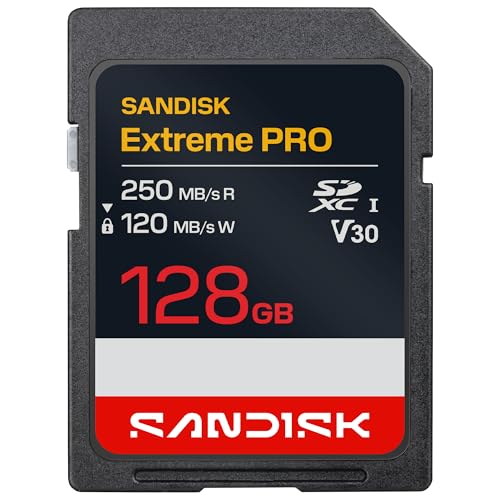
SANDISK 128GB Extreme PRO SD Memory Card, Up to 250MB/s Read Speeds, UHS-I — Best match for the slot
Of the six cards here, this SanDisk Extreme PRO is the one whose specification reads as if it were written for the 7D Mark II’s SD slot. It is a UHS-I card rated V30 with a U3 floor, which guarantees sustained writing comfortably above what Full HD video needs and, more importantly for this body, gives RAW bursts a steady drain rate instead of a fast start followed by a fade. Its headline read figure of up to 250MB/s belongs to the offload stage: through a fast reader, a morning of burst sequences lands on your hard drive noticeably sooner than it would from an older generation of UHS-I media.
Capacity deserves a word of its own here. At 128GB this card swallows several thousand RAW files from the 7D’s 20-megapixel sensor, which translates into a full match, a complete airshow programme or a long hide session without a swap. Pair it with a CompactFlash card in the main slot, write RAW to the CF card and JPEGs or backup copies to this one, and the dual-slot design of the camera finally works the way Canon intended: speed where speed lives, dependable volume riding alongside.
- Format: full-size SDXC, UHS-I bus
- Rating: V30 video class, U3, Class 10
- Size in this listing: 128GB
- Packet read figure: up to 250MB/s as printed on the listing
- Role in this camera: main SD card for backup, JPEG or overflow writing
Strengths
- Steady V30 floor suits long bursts better than peaky rivals
- 128GB matches a full day of RAW shooting on this sensor
- Fast reads shorten the evening import after a big shoot
Trade-offs
- It cannot make the SD slot faster than UHS-I, because nothing can
- Serious sports shooters will still prefer CompactFlash for primary writing
- The very fastest UHS-I alternatives occasionally undercut it on price
Best for: a 7D Mark II owner who wants one SD card that simply fits the camera’s real limits and gets on with the job
Not suited for: shooting where the SD card must be the primary high-speed medium, since this body’s SD slot was never built for that role

SANDISK 64GB Extreme PRO SDXC UHS-I Memory Card — Compact burst partner
Think of this 64GB Extreme PRO as the same idea in a smaller bucket. The UHS-I interface, the V30 rating and the U3 floor all carry over from its 128GB sibling, so burst behaviour through the 7D Mark II’s SD slot feels identical frame for frame; the difference is purely how soon the card fills. For a portrait afternoon, a family event or a training session where you shoot deliberately rather than in long chains, 64GB is honestly enough, and the lower capacity makes it painless to keep two of them rotating so one is always formatted and waiting in the bag.
There is also a discipline argument for the smaller card. Photographers who shoot on 64GB media tend to offload and back up more often, simply because the card demands it, and that habit protects work better than any recovery software. Used as the JPEG partner to a CompactFlash card holding the RAW files, this size rarely fills at all during a normal assignment, because JPEGs from this sensor are modest files. It is the card in this guide most likely to live permanently in the camera as the quiet second slot that nobody thinks about until the day it saves the shoot.
- Format: full-size SDXC, UHS-I bus
- Rating: V30 video class, U3, Class 10
- Size in this listing: 64GB
- Listing family: Extreme PRO UHS-I line
- Role in this camera: spare, JPEG partner or short-session main card
Strengths
- Identical speed character to the larger Extreme PRO above
- Easy size to own in pairs for rotation and backup discipline
- Plenty for JPEG overflow duty beside a CompactFlash card
Trade-offs
- Fills quickly during a full RAW sports day
- Cost per gigabyte is worse than the 128GB version
- No headroom advantage if you later move to a hungrier camera
Best for: an owner who shoots shorter sessions, or who wants a dependable second card living in the SD slot full time
Not suited for: an all-day tournament shot entirely in RAW to SD alone, where this size forces a mid-game swap

Lexar 128GB Professional 1667x SD Card, UHS-II, C10, U3, V60, Full HD, 4K, Up To 250MB/s R — Future-proof first choice
Here is the first UHS-II card in the guide, and it comes with the guide’s central warning printed plainly: inside the 7D Mark II, this Lexar 1667x runs at UHS-I speeds, because the camera’s SD slot has no UHS-II contacts. Nothing about the card is broken and nothing about the camera is at fault; the two simply negotiate the fastest language they share. If the 7D Mark II were your only camera and you offloaded through a basic reader, this card’s extra capability would be money spent on a conversation nobody in your kit can hold.
So why include it? Because many 7D Mark II owners also run a newer mirrorless body, or plan to, and because offload speed is a real cost in a working week. In a UHS-II reader this card reads at up to 250MB/s, and in a UHS-II camera its V60 rating sustains serious 4K video and fast bursts. Bought once, it serves the old body at UHS-I pace today and the new body at full pace tomorrow, which is a rational purchase as long as you make it with open eyes. Buy it for the kit you are building, never for speed you imagine it will unlock in the Canon.
- Format: full-size SDXC, UHS-II bus, backwards compatible
- Rating: V60 video class, U3, Class 10
- Size in this listing: 128GB
- Packet read figure: up to 250MB/s with a UHS-II reader
- Role in this camera: UHS-I pace in-body, full pace elsewhere in the kit
Strengths
- V60 floor is generous headroom for future cameras
- Fast offload through any UHS-II reader you own
- One card can serve both an old DSLR and a new mirrorless body
Trade-offs
- The 7D Mark II cannot use its UHS-II speed at all
- Costs more than UHS-I cards that perform identically in this body
- Its advantages vanish if your readers are all basic UHS-I models
Best for: a photographer mid-transition between this DSLR and a newer UHS-II body who wants one shared card pool
Not suited for: a single-camera 7D Mark II kit with a basic reader, where every advantage this card offers stays locked

Lexar 128GB SILVER PRO SD Memory Card, 280MB/s Read, 4K, V60, U3, UHS-II — Fastest offload in the set
The Lexar SILVER PRO pushes the same UHS-II argument one step further. Its read figure rises to 280MB/s, its rating stays at V60, and inside the 7D Mark II it still, unavoidably, writes and reads at UHS-I pace. We will keep saying this in every UHS-II entry because the entire honesty of this guide rests on it: the camera is the ceiling, and no card, however advanced, raises a ceiling built into the slot. What the extra money buys here is time at the desk and capability in other bodies, and for some working photographers that trade is genuinely worth making.
Consider the wedding or tournament workflow. You shoot the Canon all day, the SD card filling with backup copies, then you import through a UHS-II reader while an assistant starts culling. Shaving the import of a full 128GB card from the UHS-I crawl to a few brisk minutes changes how an evening feels, especially multiplied across a season. In a modern mirrorless body the same card records 4K video under its V60 guarantee without drama. Judged as a 7D Mark II card alone it is overqualified; judged as shared infrastructure across a changing kit, it starts to look shrewd.
- Format: full-size SDXC, UHS-II bus, backwards compatible
- Rating: V60 video class, U3
- Size in this listing: 128GB
- Packet read figure: up to 280MB/s with suitable hardware
- Role in this camera: backup writing at UHS-I pace, rapid desk offload
Strengths
- Quickest import speed available anywhere in this line-up
- V60 rating covers demanding video in newer cameras
- 128GB is the sweet spot for a shared cross-body card
Trade-offs
- Premium pricing buys nothing extra inside this particular Canon
- Needs a UHS-II reader before the read speed exists at all
- Overkill as a simple JPEG overflow card
Best for: a working photographer whose import speed at the desk is worth real money across a season of shoots
Not suited for: a hobbyist kit built only around the 7D Mark II, where this card behaves exactly like cheaper UHS-I media

Kingston Canvas React Plus V60 SD 128GB SDXC UHS-II 280R/100W U3 V60 for Full HD/4K — Balanced UHS-II value
Kingston’s Canvas React Plus occupies the sensible middle of the UHS-II trio in this guide. Its listing quotes read speeds up to 280MB/s and a write figure around 100MB/s under UHS-II conditions, with a V60 rating underneath, which is a calmer specification than the flagship cards chasing V90 bragging rights. In the 7D Mark II, predictably, it settles to UHS-I behaviour the moment it slides into the SD slot, and it does that job without fuss: bursts drain steadily, video records cleanly, and the card never becomes the reason a sequence stalls.
The case for choosing it over the two Lexar UHS-II cards above is mostly about temperament and price discipline. Kingston’s Canvas line is the card many photographers already trust from the UHS-I era, the React Plus is frequently the gentlest-priced route into V60 media, and its moderate write ceiling matters little in a kit where the fastest body still writes through UHS-II slots only some of the time. If your transition plan involves one newer body rather than a full professional video rig, this is the UHS-II card that matches that scale of ambition without charging you for a tier you will not visit.
- Format: full-size SDXC, UHS-II bus, backwards compatible
- Rating: V60 video class, U3
- Size in this listing: 128GB
- Listing figures: up to 280MB/s read, around 100MB/s write, UHS-II conditions
- Role in this camera: steady UHS-I writing plus shared duty in newer bodies
Strengths
- Usually the calmest price among credible V60 UHS-II cards
- Write behaviour feels composed rather than peaky
- A familiar line for photographers upgrading from Canvas UHS-I media
Trade-offs
- Slower UHS-II write ceiling than the flagship V60 and V90 cards
- Still capped at UHS-I pace inside the 7D Mark II
- Less attractive if heavy 4K video on a new body is the main plan
Best for: an owner adding one modern body to the bag who wants shared V60 media without flagship pricing
Not suited for: a videographer whose next camera will demand sustained V90-class writing all day

Kingston 256GB Canvas Select Plus SD Card — Biggest bucket, lowest fuss
Every line-up needs one card that answers a different question, and the Kingston Canvas Select Plus answers the capacity question. At 256GB it is the largest card here, it is plainly a UHS-I, U1, V10 product, and those modest ratings need interpreting rather than sneering at. V10 guarantees a sustained floor fine for Full HD video and ordinary stills writing; it does not promise the eager burst draining of the Extreme PRO cards above. In the 7D Mark II that makes this a volume card: travel days, conferences, school events, time-lapse sequences and long JPEG sessions where the shutter fires steadily rather than in ten-frame chains.
Used with understanding, it is genuinely useful. Set the camera to write overflow or backup copies here while CompactFlash takes the serious bursts, and 256GB quietly removes card anxiety from a three-day trip. Its read speed, quoted up to 150MB/s on the listing, keeps imports civilised too. The failure mode to avoid is role confusion: buy this expecting it to be your primary RAW burst card and the first long sequence will teach you the difference between a floor rating and a performance card. Buy it as the big, calm bucket in a two-card system and it earns its place without ever pretending to be something else.
- Format: full-size SDXC, UHS-I bus
- Rating: V10 video class, U1, Class 10
- Size in this listing: 256GB, the largest here
- Packet read figure: up to 150MB/s as printed on the listing
- Role in this camera: overflow, backup, travel and long-session volume
Strengths
- Huge capacity removes swapping from long, steady shoots
- Simple, proven UHS-I design with nothing to configure
- Read speed keeps big imports from dragging
Trade-offs
- V10 floor is not built for sustained RAW burst draining
- Costs little less than far faster cards when on promotion
- Easy to overload with a whole trip before backing up
Best for: a travelling 7D Mark II owner who wants one vast overflow and backup card beside a faster main card
Not suited for: a sports shooter expecting primary-card burst performance from the SD slot
How do all six cards compare side by side?
Read this table with the slot warning in mind: every UHS-II entry performs at UHS-I pace inside this camera, so the comparison that matters here is sustained rating, capacity and what each card does elsewhere in your kit.
| Card | Size and shape | Rating on the packet | Where it earns its keep |
|---|---|---|---|
| SanDisk Extreme PRO 128GB | 128GB full-size SDXC, UHS-I | V30, U3 | Primary SD card matched exactly to the slot |
| SanDisk Extreme PRO 64GB | 64GB full-size SDXC, UHS-I | V30, U3 | Rotating spare and JPEG partner |
| Lexar Professional 1667x 128GB | 128GB full-size SDXC, UHS-II | V60, U3 | Shared card for a kit adding a newer body |
| Lexar SILVER PRO 128GB | 128GB full-size SDXC, UHS-II | V60, U3 | Fastest desk offload through a UHS-II reader |
| Kingston Canvas React Plus 128GB | 128GB full-size SDXC, UHS-II | V60, U3 | Calmer-priced V60 for mixed old and new bodies |
| Kingston Canvas Select Plus 256GB | 256GB full-size SDXC, UHS-I | V10, U1 | Maximum volume for overflow and travel |
How does the dual-slot layout change how you should buy cards?
Most card guides treat every slot in a camera as equal, and the 7D Mark II punishes that assumption. Its CompactFlash slot is the performance path: CF media of the UDMA 7 generation writes far faster than anything the SD slot can manage, which is why Canon aimed the ten-frame burst and the deep buffer at that slot. The SD slot was designed as the flexible partner, accepting the cheaper, more universal format for backup copies, JPEG separation, overflow when the CF card fills, or Eye-Fi-era convenience features that now belong to history.
Buying with that hierarchy in mind changes the basket completely. Spend the serious money once, on a fast, trustworthy CompactFlash card, because that card decides how the camera feels at the moment of action. Then buy the SD card for the job it will actually do. If it will hold backup RAW copies, choose steady V30 UHS-I media like the first two picks. If it will mostly catch JPEGs while you travel, the big Kingston bucket makes sense. Only reach for UHS-II when the card has a second life planned outside this body, in a reader or a newer camera, because inside this one it is simply a well-built UHS-I card wearing a more expensive coat.
What do V30, V60 and the U ratings actually promise a stills shooter?
Card markings look like alphabet soup until you separate the three different promises being made. The U number, U1 or U3, guarantees a minimum sustained write speed of 10 or 30 megabytes per second respectively, measured under standardised conditions. The V number does the same job for video-era ratings: V10, V30, V60 and V90 guarantee 10, 30, 60 or 90 megabytes per second of sustained writing. Class 10, the oldest mark, simply promises 10 megabytes per second and survives mostly as a familiar logo. None of these numbers describes read speed, and none describes the brief peak a card can hit for the first seconds of a burst.
For a stills shooter on this Canon, the guarantee matters more than the peak. A burst writes a river of data, not a splash, and the camera’s buffer drains at whatever rate the card can sustain once its internal cache is full. That is why the V30 UHS-I cards in this guide serve the 7D Mark II so well despite their modest headlines: their guaranteed floor sits near what the UHS-I slot can pass anyway. A V60 card cannot push its guarantee through a slot that speaks only UHS-I, which is the technical heart of this guide’s repeated warning, and also why chasing ever-higher V numbers for this specific camera is spending on a promise the hardware cannot collect.
How should you set up the two slots for a real shooting day?
Open the camera’s recording menu and decide what each slot is for before the day begins, because mid-action is no time to discover the camera switched cards silently. The most protective arrangement for important work sends the same files to both slots, giving you an instant backup of every frame; it costs buffer speed on the SD side, so action shooters often prefer RAW files flowing to CompactFlash alone, with JPEGs landing on SD for immediate sharing or review. A third arrangement treats SD purely as overflow, continuing the sequence when the CF card fills during a long event.
Whatever you choose, format both cards in the camera at the start of the assignment, not on a computer, so the file structure is exactly what the body expects. Keep the SD card’s job consistent across a shoot; swapping roles mid-day is how files end up in unexpected folders and imports turn into archaeology. Finally, remember that the backup arrangement only protects you until both cards go into the same bag, so the evening offload to two separate drives remains the real safety net, with the dual-slot copy guarding against the single most common disaster, one card failing or being lost during the day itself.
What mistakes do people make with these cards?
The classic error with this camera is buying a flagship UHS-II card, fitting it, shooting a burst, and concluding the card is faulty because the buffer clears no faster than before. The card is fine and the camera is fine; the slot simply speaks UHS-I. Diagnose speed complaints against the slot specification first, and spend upgrade money on the CompactFlash side, where this body can actually reward it.
A second mistake is mixing roles carelessly: pulling the SD card out to use in another device mid-assignment, formatting it in a laptop, then returning it and expecting the camera’s folder structure and file numbering to continue serenely. Format in-camera, dedicate the card for the whole assignment, and let the offload happen in one clean step at the end of the day.
Third, photographers routinely fill a single enormous card with an entire trip and carry the whole holiday in one pocket. Capacity is convenience, not safety. Two mid-size cards rotated daily, each backed up every evening, lose you at most a day to theft or failure, while one giant card can lose you everything at once. The 256GB pick in this guide is an overflow tool inside a backed-up system, not a substitute for one.
Finally, beware bargain listings for famous card names from unfamiliar sellers. Counterfeit media is endemic in this category, and a fake usually reveals itself only when it corrupts files under sustained writing, which is precisely how this camera writes. Buy from reputable channels, test any new card with a full write-and-verify pass before trusting it with paid work, and retire without sentimentality any card that has ever thrown an error in the body.
Final Recommendation
So the recommendation resolves into a simple order of operations. Equip the CompactFlash slot properly first, because that is where this camera’s speed lives. For the SD slot, most owners should stop at the first pick: the 128GB SanDisk Extreme PRO UHS-I card matches the slot exactly, sustains bursts at the best rate the slot allows, and wastes nothing. Add the 64GB version as a rotating spare if your sessions are shorter or your backup habits need a nudge.
Choose a UHS-II card from the middle of this guide only when you can name its second job: the reader on your desk, the mirrorless body beside the Canon, the purchase planned for next season. Choose the big Kingston when the problem is volume rather than velocity. Follow that logic and the 7D Mark II’s SD slot stops being a disappointment people discover after spending money, and becomes what Canon designed it to be, a dependable partner to a fast main slot in a camera that still earns its keep at the side of a pitch.
How do you actually test a card in this camera before trusting it?
Testing a new card in the 7D Mark II takes ten unglamorous minutes and repays them for years. Start with the card formatted in the camera, then set the body to its fastest continuous drive, RAW quality, and the SD slot as the recording destination for the test. Hold the shutter down and listen: a healthy pairing fires its burst, slows gracefully to the card’s sustained pace, and keeps writing without the rhythm stuttering or the camera complaining. Note roughly how many frames arrive before the slowdown and how long the access lamp burns after you release the shutter, because those two numbers are your personal baseline for this card in this body, worth more than any figure printed on retail packaging.
Follow the burst test with the opposite discipline: a long, boring write. Record the longest video clip the camera allows, or shoot a time-lapse sequence of several hundred frames, and then play and scroll through the results checking the final files as carefully as the first. Sustained faults hide late, in heat and fullness, so a card that passes a sprint can still fail a marathon. Finally, offload the whole card to a computer and open a sample of files from the beginning, middle and end of the set. A card that passes all three examinations in your own camera has earned the right to carry work you care about, and a card that falters anywhere in the sequence has told you its truth while the truth was still cheap.
Repeat a shortened version of the test whenever a card returns from loan, from another device, or from a long drawer exile, and retire immediately any card whose behaviour changes between tests. Cards rarely announce their decline politely; they whisper it first as a slightly longer lamp time, a single corrupt frame in a thousand, a format the camera asks for twice. Owners who test on a rhythm catch the whisper. Owners who never test meet the shout, usually during the one assignment of the season that cannot be repeated for love or money.
What does a sensible 7D Mark II card kit look like at three budgets?
At the modest end, the kit is one fast CompactFlash card for the main slot and the 128GB SanDisk Extreme PRO from this guide riding in the SD slot as backup and overflow. That pairing covers the overwhelming majority of what this camera is asked to do, from Saturday league football to family weddings, and it spends money exactly where the body can feel it. Add nothing until a real shoot exposes a real shortage, because card kits grow best by evidence rather than by anticipation, and an unused spare teaches you less than a diary of the days that actually strained your storage.
The working middle tier adds rotation: a second Extreme PRO or its 64GB sibling, so one SD card is always formatted and waiting while the other works, plus a UHS-II reader for the desk even if every card in the bag is UHS-I, because readers outlive card generations and the next body will thank you for it. This is also the tier where one UHS-II card from the middle of this guide can enter honestly, bought for the mirrorless body that shares weekend duty, serving the Canon at UHS-I pace without apology and the newer camera at full stretch.
At the committed end, the kit becomes a small system: matched pairs for backup-mode shooting, a labelled case with numbered cards, the big Kingston bucket for travel overflow, and a written rotation so no card carries two important days back to back. The money difference between the tiers is smaller than the discipline difference, and that is the real lesson of building a kit for this camera. The 7D Mark II forgives modest media bought thoughtfully; it punishes, eventually, even excellent media managed carelessly, because its dual slots were designed for a system and reward the owner who treats them as one.
How should you handle cards on a long trip with this body?
Travel rearranges card priorities, because the desk disappears and the bag becomes the studio. Before departure, format every card in the camera, number them with a paint pen on the label edge, and decide the rotation in writing: which pair shoots Monday, which pair rests and gets backed up Monday night, and which single card is the emergency reserve that only a genuine crisis may touch. A portable drive or a laptop, however modest, is worth its weight on any trip longer than a weekend, because the two-copy rule does not stop applying merely because the scenery improved.
During each day, resist the traveller’s temptation to review and delete aggressively in the field. Deleting on the camera fragments the card’s free space, burns battery, and destroys the safety that an untouched card provides when a later file turns out to matter. Shoot, let the card fill or the day end, offload everything, verify the copies open, and only then format for the next day. The big Kingston pick in this guide earns its travel keep precisely here, as the overflow volume that lets a delayed offload stay calm rather than become a midnight emergency in a hotel room.
Finally, split the physical risk the way you split the data risk. Cards that hold the only copy of a day’s shooting should not all ride in the same pocket, the same bag, or ideally even the same vehicle leg as the camera itself. One set stays in the camera bag, the day’s finished cards travel on your person, and the backups live wherever you sleep. It sounds elaborate in an armchair and feels like simple prudence at an airport, which is where most travel card losses actually happen, in the shuffle of trays, pockets and tired hands at the end of a long day.
What happens inside the camera during a long burst, minute by minute?
Understanding a burst from the card’s point of view explains nearly every behaviour this camera shows. When the shutter opens the sequence, frames land first in the camera’s internal buffer, a pool of fast memory that accepts images far quicker than any card can. For the first second or two, the card is almost irrelevant; the buffer is doing the heroics, and the frame rate you hear is the buffer’s rate, not the card’s. Underneath the noise, though, the camera has already begun draining the buffer onto the card at the fastest pace the slot and card together allow, and the whole future of the sequence is being decided by that quieter number.
As the burst continues, the two rates meet. If the card drains nearly as fast as new frames arrive, the sequence can run far beyond its rated depth, slowing only gently. If the card drains slowly, the buffer fills to its ceiling and the camera must ration: each new frame waits for an old frame to leave, and the frame rate settles onto the card’s sustained write speed like a car settling onto a road’s real limit. This is the moment photographers describe as the camera choking, but nothing is broken; the system has simply handed control from its fastest component to its slowest, and on the SD side of a 7D Mark II that component is bounded by UHS-I no matter whose name is on the card.
When you release the shutter, the story continues in the access lamp’s glow. The buffer empties its remaining frames at the same sustained pace, and until it finishes, the camera is partly busy: menus lag, review is limited, and a hasty card removal would be catastrophic. The practical habits all descend from this minute of physics. Shoot bursts in deliberate chains rather than one endless hold, and the buffer recovers between chains. Watch the lamp rather than the clock before touching a card. And when you judge a card for this body, judge it by how the sequence felt at frame forty and how long the lamp burned afterwards, because those are the measurements your hands can actually make.
How do weather, age and handling change card behaviour in the field?
Cards are specified on laboratory benches and used on touchlines, and the gap between those places explains a share of field failures that owners blame on brands. Cold is the gentlest variable: a card in a frosty camera writes a touch more slowly until the body warms with work, and a card brought suddenly from a warm pocket into freezing air can gather condensation on its contacts. The field habit is simple acclimatisation, letting camera and cards share the same temperature gradually inside the bag, and keeping the working card in the camera rather than rotating media with numb fingers over snow, mud or water.
Heat is the sterner test, because a body shooting bursts in summer sun warms its cards as surely as it warms its own sensor, and memory controllers protect themselves by easing their pace as temperatures climb. A sequence that cleared briskly at nine in the morning may drain more lazily at two in the afternoon, with the same card in the same camera, and recognising that rhythm prevents both panic and misdiagnosis. Shade the bag, let a hot card rest when its slot-mate takes over, and treat any sudden change in a card’s manners on a hot day as information about temperature before treating it as evidence of death.
Age and handling write the longest chapter. Every card has a finite budget of write cycles, spent fastest by photographers who fill and format daily, and contacts wear microscopically with every insertion, which is one more argument for the card that lives in its slot and the reader that stays on the desk. Store cards cased, dry and away from the magnetic and mechanical chaos of a working bag’s bottom. None of this asks for reverence; it asks for the same unglamorous respect you give a lens cloth and a battery rotation, and cards repaid with that respect routinely outlive the cameras they were bought for.
What should you check on a second-hand or inherited 7D Mark II card kit?
Cameras like this one change hands with their media included, and an inherited card kit deserves the same sceptical welcome as a used lens. Begin by reading the cards themselves: genuine media carries crisp printing, consistent labelling and a maker’s marks that match across the set, while a kit salted with counterfeits usually reveals itself in one card whose typography, weight or contact finish differs subtly from its siblings. Capacity claims deserve arithmetic, because a card reporting a heroic size at a peasant price is reporting a fiction that will collapse at the worst possible fill level.
Test before you trust, using the routine this guide described earlier, and test every card rather than sampling the fleet. A card that passes a full write-and-verify cycle on a computer and a burst-and-video examination in the camera can be adopted with a clear conscience, whatever its age. A card that fails anywhere, or that the camera formats reluctantly, should leave the kit the same day, because media is the cheapest component in the entire system and the only one whose failure takes the photographs with it. Sentimentality about a previous owner’s cards is a luxury paid for in future images.
Finally, rebuild the kit around your own shooting rather than preserving the inherited pattern. The previous owner may have shot JPEGs at garden parties while you shoot RAW at athletics meetings, and a kit correct for one life is quietly wrong for the other. Keep the cards that pass testing and match your tiers, retire or demote the rest to household duties, and add the one or two cards your own habits actually demand. A second-hand 7D Mark II with a freshly reasoned card kit is not a compromise purchase at all; it is one of the great bargains of enthusiast photography, ready for another decade of Saturdays.
Which accessories genuinely help this camera’s cards, and which are theatre?
Three accessories earn their place in a 7D Mark II bag on evidence. The first is a rigid, labelled card case, because the leading cause of card loss in the field is not electronic failure but the small rectangle slipping from a pocket, a tray or a tired hand, and a case with a fixed order turns the fleet into something countable at a glance. The second is a fast reader for the desk, UHS-II capable even in a UHS-I card fleet, because readers outlive card generations and the evening import is the one part of the system every owner uses every single shoot. The third is a second storage destination that travels separately from the camera bag, whether a portable drive or a laptop, because copies that share a bag share its fate with perfect fidelity.
The theatre department is equally easy to stock. Gold-plated contact cleaners, magnetic card organisers, and miracle recovery subscriptions bought in a panic all address anxieties that the boring accessories already solved. Recovery software itself belongs in the honest column, but as a free or bundled tool kept on the computer for emergencies, not as a talisman that licenses careless habits; the SanDisk ecosystem’s bundled offers in this market are a reasonable example of the genre, useful on the worst day and irrelevant on every other. Spend on the case, the reader and the second destination first, and let the theatre wait until those three are in the bag.
One habit outranks every accessory, and it is free: the end-of-day verification glance. Before any card is formatted, open a handful of its files on the second destination, including one from the day’s final sequence. That ten-second ceremony catches failed copies, failing cards and wrong-card formats while every remedy is still available, and it converts the accessories from storage into a system. The 7D Mark II was built for photographers who work in sequences and deadlines; its media deserve the same professionalism, expressed not in expense but in a routine repeated so often it becomes invisible.
What is the one-page checklist to tape inside the camera bag?
Distilled from everything above, the working checklist for this camera fits on a card of its own. Before the shoot: both slots filled with tested, formatted media, CompactFlash carrying the speed role and the SD card carrying its assigned partner role, a formatted spare in the case, and the recording menu confirmed rather than assumed. During the shoot: bursts in deliberate chains, the access lamp respected before any card moves, and no mid-day role swaps between slots. After the shoot: offload everything before anything is formatted, verify a sample from the start, middle and end of the day, and copy to a second destination that does not sleep in the same bag.
None of those lines mentions a brand, a rating or a price, and that is the checklist’s quiet argument. The cards recommended in this guide matter — the Extreme PRO’s sustained manners genuinely flatter this body, and the UHS-II entries genuinely serve the wider kit — but they matter inside a routine, and the routine is what separates the photographers who lose frames from the photographers who merely own the same risks. Tape the checklist inside the bag, let it become invisible through repetition, and the 7D Mark II’s media will behave the way the camera’s designers hoped their dual slots would be treated: as a system, run by someone who has decided, in advance, how every card’s day begins and ends.
Frequently Asked Questions
Will a UHS-II card damage or confuse the 7D Mark II?
No. UHS-II cards are designed to fall back to UHS-I operation in older slots, and the camera simply uses the interface it knows. The card works normally in every respect; it just cannot use its extra contacts, so its speed inside this body equals a good UHS-I card.
Which slot should hold the card I care about most?
The CompactFlash slot, for anything involving bursts or speed. Canon built the performance path around CF media in this body, so your fastest, most trusted card belongs there, with the SD card handling backup copies, JPEGs or overflow according to how you configure the recording menu.
How large a card does a full sports day need?
A heavy RAW shooter at a tournament can fill 128GB across both slots without trying, especially shooting ten-frame sequences. Most owners find 128GB of SD capacity beside a large CF card comfortable for a day, with the 256GB option suiting multi-day travel where evening offloads are not guaranteed.
Does the V rating matter for stills, or only for video?
It matters for stills more than most people realise, because the V number guarantees sustained write speed, and sustained writing is exactly what drains a buffer during a long burst. Peak read figures printed largest on the packet describe importing your files afterwards, not capturing them.
Can I use microSD cards in an adapter in this camera?
Physically yes, and for casual overflow it works, but adapters add a failure point and microSD media is rarely the fastest sustained writer in its class. For a body bought for action photography, full-size cards are the dependable choice, with adapted microSD reserved for emergencies.
Can I mix a UHS-II card in the SD slot with CompactFlash recording at the same time?
Yes. The two slots work independently, and the camera writes to each at the speed that slot supports: fast CompactFlash behaviour on one side, UHS-I behaviour on the SD side regardless of the card’s higher rating. In backup mode the slower path shapes the experience, which is another reason action shooters usually give the CF slot the primary role.
How often should cards for this camera be replaced?
There is no fixed calendar, because cards age by data written rather than by birthdays. A card used weekly for bursts earns retirement sooner than a drawer spare. Replace on behaviour — errors, slowing, formatting complaints — rather than on age, and demote veterans to low-stakes duty before retiring them completely.
Related Guides
Best SD cards for Nikon D7200 shooting Choosing CompactFlash cards for older pro DSLRs How to set up dual-slot backup on Canon bodies


