What's inside
- Where to buy
- Key Takeaways
- Quick Picks
- How Did We Shortlist Cameras for Watching Wildlife?
- What Actually Happens at the Tree: Trigger, Detection, and Glow
- How Do You Read a Trail Camera Listing Without Being Fooled?
- Which Card-Based Cameras Earn the First Trees?
- What Do the Step-Up Cameras Add — Flash Craft, 4K, and a Phone Line?
- How Do the Six Compare on the Figures That Matter?
- What Mistakes Empty a Trail Camera’s Card?
- How Should You Place a Trail Camera for Watching Rather Than Hunting?
- What Should You Budget Around the Camera: Cards, Batteries, and Mounts?
- Final Recommendation
- Frequently Asked Questions
- Related Guides
As an Amazon Associate I earn from qualifying purchases. This post may contain affiliate links at no extra cost to you.
gizmoverdict.com is reader-supported. When you buy through links on our site, we may earn an affiliate commission.
Where to buy
The best trail cameras for wildlife viewing are bought on evidence, not on the megapixel number shouted largest on the box. A trail camera works alone in the dark for weeks, deciding in a fraction of a second whether a movement is a deer, a raccoon, or a branch in the wind, and the specifications that predict success are the unglamorous ones: how fast it wakes and fires, how far its sensor honestly detects, whether its night flash spooks the animals it exists to watch, and how the photographs reach you afterwards. Five of the six cameras below are card-based models whose images you collect on foot; the sixth is a cellular camera that sends its photographs to your phone. Every figure quoted in this guide comes from a verified listing title, and where a title stays silent — on detection range, for instance — the spec boxes say so rather than borrowing a number from a different model in the same brand’s catalogue.
Wildlife viewing is a kinder brief than hunting, and it changes the buying maths. You are not patterning one animal for one season; you are running a small, patient observatory. The camera will photograph squirrels with the same enthusiasm as the bobcat you actually want, it will sit through storms, and its real product is the slow accumulation of knowledge about who uses your land and when. That argues for reliability, honest night performance, and a workflow you will actually keep up — because a camera whose card you dread collecting becomes garden furniture by the second month. Read the six picks below against your own ground: the size of the property, the distance from your door to the farthest tree you would strap a camera to, and whether a photograph is worth more to you tonight or next weekend. Keep one more distinction in mind as you read, because the whole guide hangs on it: five of these cameras keep their silence until you visit them, and one speaks the moment something happens — and which of those temperaments suits you depends less on the animals than on the distance between your kitchen and the tree, a distance no specification in any listing can measure for you.
Key Takeaways
- Only one of the six picks is cellular: the SPYPOINT Flex G-36, whose listing names it an outdoor cellular trail camera. The other five are card-based, and the WOSPORTS listing states non-cellular and non-WiFi outright.
- Trigger speeds in the listings cluster tightly — 0.1s for both GardePro models, 0.2s for the WOSPORTS and the Stealth Cam, 0.3s for the SPYPOINT — so night flash type and detection honesty separate these cameras more than wake speed does.
- Both GardePro listings and the SPYPOINT state a 100ft-class figure for night vision or detection; the Browning and Stealth Cam listings leave range unstated, which the spec boxes below flag rather than fill in.
- Video divides the field: the GardePro pair record 1296P with sound, the WOSPORTS and Stealth Cam record 4K-class video, the Browning is a Full HD 1080 camera, and the SPYPOINT sends 1080p video with sound over its cellular link.
- No-glow night illumination appears in the GardePro and WOSPORTS listings — the flash type wildlife watchers prefer, because animals that cannot see the flash behave naturally in front of the lens, night after night, season after season, without learning to avoid the tree where your camera hangs.
Quick Picks
| Pick | Badge | Why it earns its place |
|---|---|---|
| GardePro A3S Trail Camera | The fast, quiet starter | A 0.1s trigger and 100ft no-glow night vision in a non-cellular body that asks nothing but batteries and a card. |
| GardePro E5S Trail Camera | The twin with the same quick draw | Matches the A3S on trigger, photo, and video figures, giving GardePro fans a second route to the same woods performance. |
| WOSPORTS 4K Trail Camera | The wide-eyed 4K option | 4K video, a 120-degree view, and a built-in screen for aiming and review right at the tree. |
| Browning Strike Force Pro X 1080 | The flash specialist | Radiant 6 flash technology and Illuma-Smart exposure logic from a brand built around trail cameras alone. |
| Stealth Cam DS4K Ultimate | The 4K stills-and-video step-up | 32MP stills and 4K recording at 30 frames per second, with room for cards up to 128GB per its listing. |
| SPYPOINT Flex G-36 Cellular Trail Camera | The camera that reports back | Cellular delivery of 1080p video with sound and 36MP photos, so the woods send their news to your phone while the animal is still nearby. |
How Did We Shortlist Cameras for Watching Wildlife?
We began with the listing titles and treated them as the contract: a camera earned consideration on what its own verified listing states, not on what a review site remembered about a sibling model. Trigger speed was the first screen, because a trail camera that wakes slowly photographs the rear half of animals — the classic beginner’s album of tails. Night illumination came second, with no-glow infrared favoured for viewing work, since the entire point is animals behaving as if nobody is watching. Detection and flash range came third, and here we applied the rule this guide repeats everywhere: a stated figure beats an assumed one, so cameras whose listings name a range are described with it, and cameras whose listings do not are described honestly without one.
The workflow split — cellular against card-based — was treated as a genuine fork rather than a ladder. Cellular delivery is wonderful and costs money every month forever; card collection is free and costs shoe leather every week forever. Neither is the correct answer for every property, so this guide carries five card-based cameras across the price and capability range and one cellular camera as the representative of its kind, rather than pretending the subscription model is an upgrade everyone should climb toward. We also favoured cameras whose video modes suit watching rather than scouting alone: sound matters when the animal is a barred owl calling off-frame, and frame rate matters when the animal is an otter who refuses to sit still.
What Actually Happens at the Tree: Trigger, Detection, and Glow
A trail camera photograph is a small race run in the dark. The passive infrared sensor notices a heat difference moving across its zones; the camera wakes from sleep; the exposure is calculated; the shutter fires. An animal walking a trail at an angle crosses the detection zone in perhaps a second, which is why the trigger figures in these listings — a tenth of a second here, two or three tenths there — are not spec-sheet trivia. They are the difference between a full broadside portrait and an empty frame with a departing hoof at its edge. Detection geometry matters as much as raw speed: a camera aimed squarely across a trail gives the sensor the longest crossing time to work with, while a camera aimed along the trail photographs approaching animals for several frames. Placement, covered later in this guide, can rescue a modest trigger; nothing can rescue a camera pointed at a sun-warmed bush that fires four hundred frames of moving shadow.
Night is when the flash decision shows. Low-glow infrared emitters produce a faint red shimmer that many animals notice and some learn to avoid; no-glow emitters, the kind the GardePro and WOSPORTS listings name, push their light beyond what deer and most other wildlife can see, so behaviour in front of the lens stays honest. The trade is usually a little effective range and a grainier image, because the invisible wavelengths carry less usable light. For viewing — where the photograph of an animal ignoring the camera is the entire prize — no-glow is the right default, and it is no accident that the two clearest no-glow claims in this guide sit on its most affordable cameras. Flash range and detection range, finally, are different numbers that marketing loves to blur: one is how far the light reaches at night, the other how far the sensor notices movement, and a camera is only as good at midnight as the shorter of the two.
Temperature writes the footnotes to every one of these specifications. A passive infrared sensor reads contrast — warm animal against cooler ground — and on a hot afternoon when the ground approaches body temperature, detection shrinks and even good cameras go quiet; on a frosty night the same sensor sees like a prophet. Batteries follow their own weather, losing heart in deep cold unless they are lithium. None of this is a reason to distrust the figures in this guide; it is a reason to site cameras so the physics helps rather than fights. Shade the housing from direct afternoon sun, aim away from the sunrise, and expect your most honest detection performance in the cool hours when most wildlife is moving anyway. The woods and the specifications agree more often than marketing admits — both reward the watcher who thinks in seasons.
How Do You Read a Trail Camera Listing Without Being Fooled?
Trail camera marketing runs on three soft numbers, and a careful reader discounts each in a different way. The first is photo resolution. Unlike the camera industry proper, trail camera makers routinely quote figures achieved by interpolation — the sensor captures one resolution and the processor inflates it — so the number on the box describes the file size more than the detail inside it. The honest response is not cynicism but reordering: treat resolution as a rough class marker, and let trigger speed, flash type, and video specification carry the decision, because those are harder to inflate and easier to verify in the field during a return window.
The second soft number is range. A detection figure may describe the sensor’s best day with a large, warm, fast-moving subject crossing at the perfect angle, while a flash figure may describe the distance at which something is faintly visible rather than well lit. Both numbers shrink in cold weather, with small animals, and at the frame’s edges. The third soft area is battery life, usually quoted in months of standby that assume a quiet site; a busy crossing firing video all night writes a different story. None of this makes the listings dishonest — it makes them headlines, written to be read the way this guide reads them: as the maker’s opening claim, to be weighed against the specifications that cannot be spun, like a stated frame rate, a stated card ceiling, or the presence of a screen you can aim through.
One more reading skill matters for this category specifically: knowing what silence means. When a listing names its flash technology proudly, as Browning’s does, flash is that camera’s craft. When a listing repeats its non-cellular nature twice, as the WOSPORTS title does, the maker is telling you the camera’s philosophy and its price logic at once. And when a listing omits a figure its rivals state — a trigger speed, a range — the omission is itself data about where that model sits. Read the six listings in this guide with those ears and the spec boxes below will feel less like tables and more like character references.
Which Card-Based Cameras Earn the First Trees?
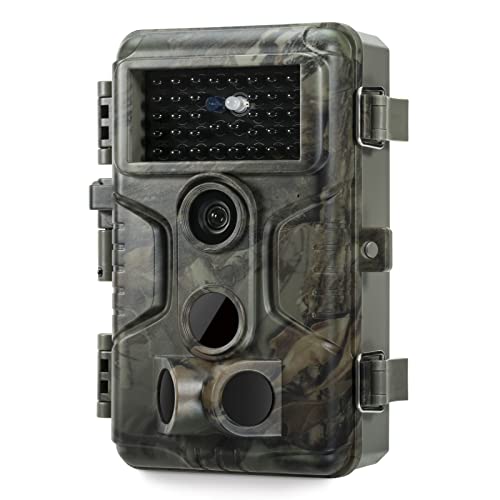
GardePro A3S Trail Camera — The fast, quiet starter
The A3S states its case in one breath of its listing: non-cellular, 1296P HD video with sound, 64MP photos, a 0.1s trigger, and 100ft no-glow night vision. That is a remarkably complete sentence for a starter camera, and each clause answers a beginner’s real question. Non-cellular means no subscription and no signal anxiety — the camera works in the hollow where your phone gives up. The tenth-of-a-second trigger is the fastest figure in this guide, shared only with its E5S sibling, and it is the specification that decides whether the fox is in the frame or merely implied by it. The no-glow flash at a stated 100ft means the night shift runs invisibly, which for wildlife viewing is not a luxury but the method itself.
What the A3S asks in return is the card-based ritual: walk out, swap the card, walk home, read the woods at your kitchen table. For a garden, a smallholding, or a woodlot behind the house, that ritual is a pleasure rather than a chore, and it carries a hidden benefit — you learn the ground on foot, noticing tracks, scat, and browse lines that no camera reports. The 1296P video with sound suits viewing well, because so much wildlife announces itself acoustically before it steps into frame. Buyers should hold the 64MP photo figure with the light grip this guide recommends for all trail camera resolutions — treat it as the maker’s headline rather than a lab measurement, and judge the camera by its trigger, flash, and detection honesty, which are the numbers that will actually fill or empty your album.
Seasoned watchers often end up running an A3S-class camera as the second or third unit even after buying dearer models, because its combination of speed and invisibility covers the close, busy spots — the bird bath, the log crossing, the gap in the hedge — where animal traffic is dense and a missed tenth of a second is a missed otter. It is also the camera to lend: simple enough that a neighbour or a grandchild can run it, cheap enough in spirit that lending it does not require a contract. A first camera that remains useful after you upgrade is the definition of a good first camera.
Its video-with-sound deserves one more word, because sound is the sense that trail cameras added last and watchers undervalue most. A rutting grunt off-frame, a tawny owl’s kewick answered from the next tree, the splash sequence that says otter rather than heron — audio turns a sighting into an identification and a clip into a scene. At a viewing station near water or a roost, run the A3S in video mode with generous clip lengths and review with headphones once; most watchers who try it never go back to silent stills at that station again.
- Connection: non-cellular, card-based retrieval
- Trigger: 0.1s, as stated in the listing
- Night vision: no-glow, with a 100ft figure in the title
- Video: 1296P HD with sound
- Photo resolution: 64MP per the listing headline
Strengths
- The joint-fastest trigger in this guide, which is the spec that decides whether quick animals are photographed or missed.
- No-glow night vision at a stated 100ft keeps subjects behaving naturally after dark.
- No subscription, no signal requirement — it works in dead zones where cellular cameras cannot.
Trade-offs
- Photographs wait on the card until you walk out and collect them.
- Video tops out at 1296P where two rivals here record 4K-class footage.
- The headline photo resolution should be read as a maker figure, not a measured one.
Best for: first-time watchers and garden or near-woods setups where the walk to the camera is part of the pleasure.
Not suited for: distant properties you visit monthly, where photographs age on the card for weeks.
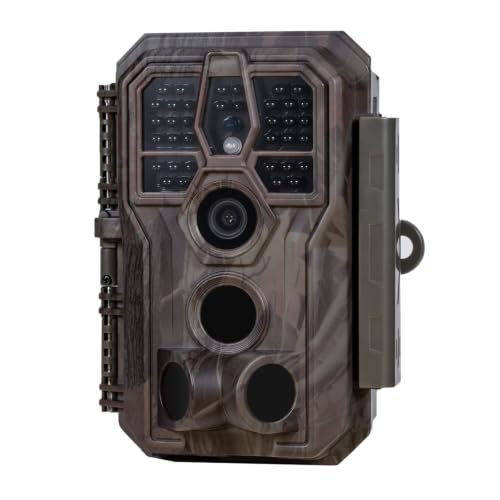
GardePro E5S Trail Camera — The twin with the same quick draw
The E5S listing reads like a sibling’s: non-cellular, 64MP photos and 1296P HD video, a 0.1s trigger, and 100ft no-glow night vision. Two cameras from one maker with near-identical headline figures raise an obvious question — why does this guide carry both? Because availability and price drift between sibling models constantly, and because a watcher building a small network of cameras benefits from a second route to the same proven specification set. If one listing is out of stock or priced oddly on the week you buy, the other is the honest substitute, and a pair of either model shares batteries, cards, and habits, which simplifies life in the field more than a spec sheet can express.
In the woods, the E5S does the same work as its sibling: fast wake, invisible flash, sound with its video, and a card that fills with whatever the trail provides. The practical differences between near-twin models usually live in details the titles do not state — housing tweaks, screen arrangements, menu habits — and this guide will not invent them. That restraint is worth explaining once, because it shapes how you should shop between the twins: open both listing pages, compare the photographs of the housings, the stated contents of each box, and the current availability, and let those concrete, checkable facts break the tie. A spec the maker will not print in a title is a spec you should verify rather than assume, and with the E5S and A3S the verified headlines already agree on everything that decides success in the woods. What can be said truthfully is that the E5S’s stated figures put it in the strongest class of card-based viewing cameras: quick enough for trail crossings, dark enough in its flash for wary species, and simple enough to run several at once. Watchers who graduate from one camera to three often discover that uniformity is a feature; every unit behaves alike at dusk, in menus, and in battery appetite.
There is also a portfolio logic to the E5S. Wildlife viewing rewards coverage over perfection — three good cameras on three trails will out-photograph one superb camera on one trail, because animals choose their routes without consulting you. A model at this level, bought in pairs across a season, builds that coverage without the budget pain of flagship units, and its no-glow flash means the network stays invisible as it grows. Start with one on the busiest sign you can find — a worn trail junction, a creek crossing, a fence gap — and let its first month of photographs tell you where the second camera belongs.
- Connection: non-cellular, card-based retrieval
- Trigger: 0.1s, per the listing title
- Night vision: no-glow, 100ft figure stated
- Video: 1296P HD (sound per the A3S listing; this title does not repeat the word — check the listing page)
- Photo resolution: 64MP per the listing headline
Strengths
- Repeats the A3S’s winning figures, giving buyers a second listing route to the same capability.
- Fast trigger and invisible flash suit wary, quick species at close and middle range.
- Uniformity with its sibling simplifies running a multi-camera network.
Trade-offs
- Card collection is the only way its photographs reach you.
- Near-twin status means little reason to own one of each rather than a matched pair.
- Video resolution sits below the 4K-class rivals in this guide.
Best for: watchers building a small network of matched cameras across several trails or a larger garden.
Not suited for: anyone expecting one camera to do everything, including instant delivery to a phone.

WOSPORTS 4K Trail Camera — The wide-eyed 4K option
The WOSPORTS listing is the most emphatic in this guide about what the camera is not: non-cellular, non-WiFi, stated twice in the title as if to settle arguments in advance. What it is, per the same title, is a 64MP camera recording 4K video with a 0.2s trigger, no-glow night vision, a 2.0-inch LCD, and a 120-degree wide view. That built-in screen is a genuinely useful difference for viewing work. It also changes who can enjoy this hobby: a grandparent who will never pair an app, a child on a school project, a watcher whose phone is deliberately left at home on woodland walks — all of them can aim, trigger a test frame, and review the night’s visitors standing at the tree with the WOSPORTS, no account, no pairing ritual, no software update standing between them and the animals. Aiming a trail camera is guesswork with most models — you strap, you leave, you discover a fortnight later that the frame held a magnificent view of a fern. A screen at the tree lets you check the composition and review the first test frames standing in the woods, which shortens the learning loop from weeks to minutes.
The 120-degree view cuts both ways, and the honest guide says so. A wide field gathers more of a clearing, a pond edge, or a bait-free natural crossing, and it forgives imperfect aim. It also makes animals smaller in the frame and can exaggerate the sense of distance, so the WOSPORTS earns its keep placed closer to the action than a narrow-view camera would sit — at the log, the burrow mouth, the shallow ford. Its 4K video is the headline for watchers who screen their footage on a television, where the GardePro pair’s 1296P looks softer; its 0.2s trigger is a step behind the GardePro twins and a step that matters mainly for animals crossing at speed rather than browsing into frame.
Treat the WOSPORTS as the set-and-check camera of the group: the one you mount, aim with its own screen, and revisit on foot with confidence that the framing was right from day one. For a school nature project, a community woodland, or a watcher who simply enjoys the review ritual at the tree itself, that screen changes the character of the hobby. The listing’s insistence on its offline nature is, in that light, a philosophy rather than a limitation — this camera keeps the woods and the internet in separate compartments, and some watchers will read that as the most relaxing sentence in this entire guide.
- Connection: non-cellular and non-WiFi, both stated in the title
- Trigger: 0.2s per the listing
- View: 120-degree wide angle
- Screen: 2.0-inch LCD built in
- Video: 4K; photo headline 64MP; night vision no-glow
Strengths
- The built-in screen makes aiming and field review immediate instead of a fortnight’s guess.
- 4K video leads the card-based group here for watchers who review footage on a big screen.
- The wide 120-degree view covers clearings, ponds, and crossings generously.
Trade-offs
- A wide view shrinks distant animals in the frame; it rewards close placement.
- The 0.2s trigger concedes a step to the GardePro pair on fast crossings.
- No connectivity of any kind — every image travels home in your pocket, on the card.
Best for: watchers who value aiming certainty and big-screen video, and who enjoy reviewing footage at the tree.
Not suited for: anyone hoping to check the camera from home between visits.
What Do the Step-Up Cameras Add — Flash Craft, 4K, and a Phone Line?

Browning Strike Force Pro X 1080 — The flash specialist
Browning builds nothing but trail cameras, and the Strike Force Pro X 1080 listing leans on the two technologies the company talks about most: Radiant 6 flash technology and Illuma-Smart exposure logic, wrapped around Full HD 1080 video in a camo body. Translate the branding and the ideas are sound ones for viewing. The flash system is about spreading infrared light evenly so the centre of the night frame is not a blown white circle with darkness at the corners — the classic cheap-camera failure that turns a deer into a ghost with legs. Illuma-Smart is the camera adjusting its flash output to the subject’s distance, which matters enormously for watchers, because wildlife at a feeder or a crossing works at three metres as often as at fifteen, and a flash that cannot throttle itself ruins the close work.
The Browning’s honest limits are written in its name: this is a 1080 camera in a guide where two rivals record 4K-class video and the GardePro pair record 1296P. For stills-led watching and phone-screen review, Full HD remains entirely respectable; for television review of night footage, it is the softest video here. Its listing also leaves trigger speed and detection range unstated, and this guide will not fill those blanks from other Browning models — the spec box below leaves those cells honestly blank, and the listing page is where a careful buyer confirms the current figures. What you are buying with the Browning is flash craft and a specialist maker’s tuning, which are real things that titles struggle to quantify; the night frames from a well-tuned flash system simply look more natural, and natural is the whole aesthetic of wildlife viewing.
Placement advice for this camera writes itself from its strengths: put it where subjects come close and stay a while. A mineral site, a water trough, a well-used rub tree, a gap in a stone wall — stations where animals linger let the exposure logic work across a sequence of frames, and the even flash renders coats and markings instead of silhouettes. On a fast crossing trail its unstated trigger figure is a gamble the GardePro pair do not ask you to take; at a lingering station, the gamble hardly matters and the flash quality pays out nightly.
Browning’s long focus on this single product category also shows in the ecosystem around the camera: the brand’s mounts, security boxes, and card readers are built by people who think about woods work full-time, and a watcher who standardises on the Strike Force gains that support quietly over years. It will not appear in any single photograph. It appears in the third season, when the strap perishes or a bear rearranges the housing and the replacement part exists, fits, and ships — the unglamorous continuity that separates a tool from a gadget.
- Video: Full HD 1080, per the model name and listing
- Flash: Radiant 6 flash technology, named in the title
- Exposure: Illuma-Smart technology, named in the title
- Trigger speed: the title publishes no figure — see the maker’s documentation
- Detection and flash range: not stated in the listing title
Strengths
- Even, distance-aware night flash is the viewing-specific craft most rivals treat as an afterthought.
- A specialist maker’s tuning shows in natural-looking night frames at close and middle range.
- Camo housing and a mature model line make fieldcraft support and accessories easy to find.
Trade-offs
- 1080 video is the softest in this guide for big-screen review.
- Key figures — trigger and range — are absent from the listing title and must be confirmed on the listing page.
- Card-based retrieval only; nothing about this camera reaches you remotely.
Best for: stills-led watchers who place cameras at lingering stations and care how night frames look.
Not suited for: footage-first watchers who review night video on a television.

Stealth Cam DS4K Ultimate — The 4K stills-and-video step-up
The DS4K Ultimate’s listing is brief and confident: 32MP stills, 4K video at 30 frames per second, a 0.2 trigger figure, and support for SD cards up to 128GB. The 32MP headline deserves a moment of appreciation in a category addicted to inflation — it is the most modest photo figure in this guide, and modesty in a trail camera resolution claim usually signals a maker describing something closer to the sensor’s real output. Paired with genuine 4K video at a stated frame rate, the Stealth Cam’s proposition is clarity over theatre: footage with enough resolution to crop into a bird’s visit or a fawn’s first steps, and stills that hold up when a watcher zooms into markings to identify an individual animal.
That identification work is where the DS4K earns the word Ultimate for viewing purposes. Wildlife watchers increasingly keep individual records — the doe with the torn ear, the buck whose antler broke in October — and resolution spent on detail is what makes those records possible. The 128GB card support in the listing matters for the same reason: 4K footage eats storage at a rate that turns a small card into a weekend’s capacity, and a camera that accepts a large card can be left through a whole rut, a whole nesting season, a whole migration window, without the watcher trampling the site to swap storage. Its 0.2s trigger matches the WOSPORTS and trails the GardePro pair by a step, which argues for placing it across trails rather than along them, at stations where subjects arrive and pause.
Stealth Cam’s listing leaves night flash type and range unstated, so the same honesty rule applies: confirm the illumination details on the listing page if night work is your priority, and do not import figures from the brand’s other models. Judged on what its title does promise — 4K at a stated frame rate, a credible stills figure, fast-enough trigger, and big-card stamina — the DS4K Ultimate is the connoisseur’s card-based pick here, the camera for the watcher who reviews footage carefully and keeps a season’s archive.
- Stills: 32MP per the listing
- Video: 4K at 30 frames per second, as stated
- Trigger: 0.2s figure in the listing title
- Storage: SD cards up to 128GB supported
- Night flash type and range: absent from the title — confirm on the listing page
Strengths
- 4K video at a stated frame rate gives footage that survives cropping and big screens.
- The restrained 32MP stills claim reads as the most credible resolution figure in this guide.
- Large-card support suits long, undisturbed deployments through a whole season.
Trade-offs
- Flash type and range are not in the title, so night buyers must verify before ordering.
- Trigger speed matches rather than leads the field.
- 4K footage fills cards and drains batteries faster than the 1296P cameras’ video does.
Best for: detail-keepers who identify individual animals and archive a season of footage.
Not suited for: a watcher who needs confirmed no-glow flash figures from the title before spending.

SPYPOINT Flex G-36 Cellular Trail Camera — The camera that reports back
The Flex G-36 is the one camera here that changes the hobby’s rhythm. Its listing names it an outdoor cellular trail camera delivering 1080p video with sound and 36MP photos, with a 0.3s trigger and a 100 figure covering both flash and detection range, plus improved battery life. Cellular delivery means the photograph of the black bear at the feeder arrives while the bear is, give or take the network’s mood, still in the neighbourhood. For a watcher whose land is an hour away, that immediacy is transformative: visits become responses to news rather than expeditions of hope, and a camera can be checked after every storm without a round trip. It also means the camera needs cellular signal at the tree — a requirement the five card-based picks never impose — and a photo plan whose ongoing cost belongs in the buying decision even though this guide prints no prices.
Judged purely as a camera, the G-36’s stated figures sit mid-field: its 0.3s trigger is the slowest in this guide, its video is 1080p rather than 4K, and its 36MP headline is credible in scale. Judged as a system, it offers the one capability nothing else here can imitate. The honest framing is that you are not buying a better camera; you are buying a shorter distance between the woods and yourself. Watchers on small, near land gain little from that — the GardePro pair will out-trigger it for a fraction of the commitment. Watchers on distant land, or watching a den, a nest, or a feeder whose moment cannot wait a week, gain the thing itself.
Two practical cautions complete the picture. First, test signal at the exact tree before committing: a property can have strong coverage at the gate and a dead hollow at the creek, and a cellular camera in a dead hollow is an expensive card camera with an antenna. Second, plan the subscription as part of the camera, the way batteries are part of every camera here — the listing’s promise of improved battery life helps, but transmission is thirsty work, and remote cameras reward generous power arrangements. Set up thoughtfully, the Flex G-36 turns trail watching from a weekly reveal into a daily correspondence, and for the right watcher that correspondence is worth every compromise in its spec box.
There is a subtler gift in the cellular workflow that only appears after a month: restraint. A watcher who already knows what last night held visits the site less, disturbs it less, and lets shy species settle into patterns that weekly card-pullers never see. The camera’s photographs improve because the human appears in the woods less often — a paradox the card-based picks cannot offer, and one worth weighing alongside the trigger figures when a station holds something genuinely wary, like a nesting raptor or a pine marten working a new territory.
- Connection: cellular — photos and video delivered to your phone (plan required; see the listing)
- Trigger: 0.3s per the listing title
- Range: 100 flash and detection range figure stated in the title
- Video: 1080p with sound; stills 36MP per the listing
- Power note: listing claims improved battery life
Strengths
- Photographs arrive remotely, turning a distant property into a daily wildlife briefing.
- Video with sound delivered over the air suits nest, den, and feeder watching whose moments cannot wait.
- Stated range figures for both flash and detection make night performance predictable on paper.
Trade-offs
- Needs cellular signal at the tree and an ongoing photo plan — the only pick with a subscription in its life.
- The 0.3s trigger is the slowest figure in this guide.
- Video resolution is 1080p where two card-based rivals record 4K-class footage.
Best for: watchers with distant land, or a nest or den whose story they want told the day it happens.
Not suited for: signal-poor hollows, or anyone unwilling to carry a monthly plan for a camera.
How Do the Six Compare on the Figures That Matter?
| Camera | Delivery | Trigger (per title) | Video (per title) | Night note |
|---|---|---|---|---|
| GardePro A3S | Card | 0.1s | 1296P with sound | No-glow, 100ft stated |
| GardePro E5S | Card | 0.1s | 1296P | No-glow, 100ft stated |
| WOSPORTS 4K | Card | 0.2s | 4K | No-glow; 120-degree view, built-in screen |
| Browning Strike Force Pro X 1080 | Card | Not stated in title | Full HD 1080 | Radiant 6 flash with Illuma-Smart exposure |
| Stealth Cam DS4K Ultimate | Card | 0.2s | 4K at 30 fps | Flash type not stated in title |
| SPYPOINT Flex G-36 | Cellular | 0.3s | 1080p with sound | 100 flash and detection range stated |
The table’s empty cells are information too. A maker who states a trigger speed is inviting comparison; a maker who omits it from the title is asking you to dig, and the digging is worth doing on the listing page before money moves. Notice also how the delivery column splits the guide cleanly — five cameras that keep their photographs on a card in the woods, one that sends them through the air — and how little that split correlates with capability: the fastest triggers and the only built-in screen sit on the card side of the line.
What Mistakes Empty a Trail Camera’s Card?
The classic failure is aiming at the horizon’s prettiest gap instead of the animals’ actual path. Cameras belong at knee-to-waist height for deer-sized subjects, lower for small mammals, angled squarely across the line of travel so the sensor gets the longest possible crossing. A camera aimed along the trail or tilted at the sky produces the standard beginner’s harvest: ears, sky, and four hundred frames of a sunlit branch rehearsing its dance. Clear the foreground ruthlessly — every grass stem inside the detection zone is a false trigger waiting for a warm breeze — and remember that the sun rising directly into the lens writes a morning of blank, flared frames.
The second family of mistakes is logistical. Cards that are never formatted in the camera corrupt at the worst moments; batteries mixed old and new die as a committee; a camera checked too often at a wary species’ station teaches the animal to route around it. The third mistake is interpretive: judging a site after one quiet week. Wildlife traffic runs on weather, mast, water, and season, and a crossing that is empty in a dry August may be a highway in November. Give every new station a month before you grade it, and move the camera rather than your expectations when the evidence finally speaks.
How Should You Place a Trail Camera for Watching Rather Than Hunting?
Start by reading sign instead of scenery. Tracks in mud, droppings, hair on a fence wire, a worn gap under a hedge, a creek bank polished by crossings — these are the stations where a camera earns its batteries. Mount solidly: a tree that sways fires the camera at the weather, so choose trunks with some mass, strap tightly, and wedge the housing to the exact angle with a stick behind the top edge rather than trusting the strap’s memory. Aim across the travel line at the height of the animal’s body, not its head, and take test photographs of yourself crawling or walking the line at the speed of your quarry — undignified, indispensable.
Then practise the watcher’s patience. Set video lengths long enough to hold behaviour, not just presence: a badger’s ten seconds at a latrine tells a story a single frame cannot. Visit on a rhythm the animals can absorb — same path, same hour, minimal scent and noise — and keep a simple log of what each card held, because after three months the log becomes the real product: a map of who uses your ground, in which weather, in which season. That log, more than any camera upgrade, is what turns photographs into knowledge, and it is available to the owner of the humblest camera in this guide as fully as to the owner of the dearest.
Ethics deserve a paragraph in any viewing guide, because the camera’s patience can become the animal’s burden if the watcher is careless. Keep stations away from dens and nests during the breeding season unless local rules and the species’ tolerance clearly allow it, and never let a camera’s appetite for footage justify baiting that changes an animal’s behaviour or draws predators to a vulnerable site. Check your local rules on cameras on public land, label your equipment with a name and number, and angle every lens away from paths, roads, and neighbours’ ground. The watcher who practises this restraint is welcome back in the woods year after year, which is the longest game this hobby offers.
What Should You Budget Around the Camera: Cards, Batteries, and Mounts?
A trail camera’s purchase price is the beginning of its cost, and planning the supporting kit honestly prevents the standard disappointment of a fine camera idled by a dead card. Storage comes first: run two cards per camera and swap rather than download in the field, so the camera is live again in under a minute and the full card travels home safely in a pocket. Size the cards to the mode — stills-led stations forgive small cards, while the 4K cameras here can drink a modest card in a busy week — and format every card in the camera that will use it, every time, without exception. That single habit prevents more lost footage than any other practice in this hobby.
Power is the second budget line. Lithium cells are the field standard for a reason: they hold voltage in frost, leak far less in storage, and run the long night shifts that alkaline cells abandon halfway. A camera at a distant station, above all the cellular SPYPOINT, deserves the largest power arrangement its housing and the maker’s accessories allow, because a remote camera that dies silently is worse than no camera — it reports nothing while you assume the woods are quiet. Mounts come third and cost least: a proper tree mount or a simple screw-in bracket aims more precisely than a strap alone and resists the curiosity of cattle, deer, and bears, all of whom will eventually test whatever you hang. Add a python lock where people pass, a silica packet inside the housing where condensation haunts, and a pencil for the logbook, and the kit around any of these six cameras is complete for a season.
Final Recommendation
For most wildlife watchers, the GardePro pair are the sensible centre of this guide: pick the A3S for its complete stated package of speed, invisible flash, and sound, or the E5S as the same capability through a second listing, and spend the savings on a second camera and good batteries. Choose the WOSPORTS when you want 4K footage and the certainty of aiming through its own screen, the Browning when night-frame quality at close stations matters more than video resolution, and the Stealth Cam DS4K Ultimate when you keep individual-animal records and archive whole seasons. Take the SPYPOINT Flex G-36 when the land is far or the moment cannot wait, having first confirmed signal at the tree. Whatever you choose, mount it on sign, aim it across the trail, and give it a month of nights — because the woods keep their own schedule, and the camera that is still out there, patient and unblinking, when the shy one finally steps into the clearing is the one that was worth buying. Start with a single camera even if a network is the dream, and let its first season teach you your ground’s true geography of movement; the second camera, bought with that knowledge in hand, will be placed better than any pair bought blind on the same day, and the album you build across those seasons will end up saying less about the cameras in this guide than about the watcher you became by using them.
Frequently Asked Questions
Is a cellular trail camera worth it for wildlife viewing?
It is worth it when distance or timing makes card collection fail you — land you reach monthly, a nest whose fledging you refuse to miss. On near land you walk weekly, a card camera like the GardePro pair triggers faster and costs nothing per month, so the cellular premium buys convenience you may never use.
What does no-glow night vision actually change?
No-glow infrared emits light beyond the range most wildlife can see, so animals behave as if unobserved — feeding, playing, and lingering naturally. Low-glow flash shows a faint red shimmer that wary species can learn to avoid. For viewing, where natural behaviour is the product, no-glow is the safer default, at a small cost in night range.
Should I believe the megapixel figures on trail cameras?
Hold them lightly across the whole category. Makers commonly quote processed or interpolated figures, so a 64MP headline and a 32MP headline do not mean one camera resolves twice the detail. Judge by trigger speed, flash honesty, video resolution, and sample footage; the Stealth Cam’s modest 32MP claim is a reminder that restraint can signal candour.
How high should I mount a camera for deer and smaller wildlife?
Waist height suits deer-sized animals on level ground; drop toward knee height for foxes, badgers, and smaller quarry, and angle the camera to meet the animal’s body at the centre of its path. On slopes, mount on the downhill side at the height the animal’s torso will occupy as it crosses the frame.
How long will a card-based camera run before I must visit?
It depends on traffic, video length, and temperature more than on the camera. A busy crossing with long video clips can fill a card in weeks; a quiet station can run a season. Large-card support like the Stealth Cam’s 128GB ceiling, fresh lithium batteries, and modest clip lengths stretch the interval furthest.
Can these cameras watch a garden without disturbing the neighbours?
Yes, and no-glow models are the considerate choice: no visible flash, no shutter spectacle, just a quiet box on a post. Aim it at your own ground — the pond, the feeder, the hedge gap — and most gardens discover a night population their owners never suspected.
Related Guides
Round out the outdoor kit: see our guide to cameras for garden wildlife and bird feeders, compare the best budget cameras for nature watching at home, or step up to our roundup of long-range spotting and observation gear.
Related guides
- Best Doorbell Cameras No Subscription: Local Storage Picks, and the Ring/Blink Truth
- Best AC Powered Wireless Security Cameras: Wi-Fi Data, Mains Power, Zero Sleep
- Best 400 FPS High Speed Cameras: The Honest Truth About Burst Slow Motion
- Best 4K HDR Projectors: Tone Mapping, Color and the Rooms They Deserve


