What's inside
As an Amazon Associate I earn from qualifying purchases. This post may contain affiliate links at no extra cost to you.
gizmoverdict.com is reader-supported. When you buy through links on our site, we may earn an affiliate commission.
Where to Buy These Cameras
The six cameras reviewed here are all sold through Amazon, and their listings carry the current check-price details. Read those listings the way an installer would: confirm whether the price covers the camera alone or a bundle, check the stated night-vision distance and lens angle against your site, and remember that no PoE camera in this article includes the recorder or switch that powers it unless the listing says so in plain words. The camera is the visible half of a PoE system; budget for the invisible half — recorder, PoE switch or injectors, cable and a hard drive — before comparing totals against wireless kits. If a listing bundles cable or a recorder, value the bundle by whether those exact components match the plan in the guide below, not by the sum of their separate prices. Patience at this stage is repaid for years afterwards, in footage that is simply there whenever it is needed. Read slowly, buy once. It matters.
The best 1080p ip cameras share a philosophy that battery cameras reject: run one Ethernet cable to each camera, carry power and picture on it, record everything to a box you own, and stop thinking about charging, Wi-Fi dead zones or subscriptions. That is the world of PoE — Power over Ethernet — and the six cameras here are its foot soldiers: domes, turrets and bullets from Anpviz’s workhorse range, one uncompromising turret that refuses to work without a recorder, a long-range PTZ for big properties, and a vandal-resistant dome for places where cameras get touched.
A note on resolution before the reviews: this category has drifted upward, and most current IP cameras record at 4MP or beyond even when buyers search by the older 1080p label. The picks below state their true sensor sizes openly rather than pretending to be 1080p models. What unites them is the job — wired network surveillance at household and small-business scale — and the Full HD baseline is treated as a floor, not a ceiling. If your recorder or bandwidth genuinely caps you at 1080p, every camera here can be configured down to that stream; the reverse upgrade is the one that costs money later. What has not changed is the underlying bargain: an afternoon of cable work buys years of cameras that never ask for a battery, never drop off a congested network, and never present a subscription screen between you and your own recordings.
Key Takeaways
- PoE cameras draw power through the same Ethernet cable that carries their video, so each camera needs a PoE-capable recorder, a PoE switch or an injector between it and an ordinary network.
- The Anpviz 5MP turret states ‘NOT work independently’ in its own listing: it has no app life of its own and exists purely as an eye for a compatible recorder — a feature for system builders, a trap for casual buyers.
- Turret (eyeball) cameras resist the infrared reflections and spider-web glare that plague domes outdoors, which is why two of the six picks wear that shape.
- The Jennov PTZ’s 20x optical zoom and 320-foot infrared reach belong to farms, yards and car parks, not to porches; buying it for a front door is paying for a telescope to read a doorbell.
- Resolution across this list runs 4MP to 8MP because the market moved past 1080p; all of them can stream a 1080p sub-stream for phones and older recorders.
- Cable is the real installation budget: outdoor-rated Ethernet, a drill, and an afternoon on a ladder are part of every honest PoE quote.
Quick Picks: Best 1080p IP Cameras
| Camera | Badge | Why it earns its place |
|---|---|---|
| Anpviz 4MP PoE IP Dome Camera with Microphone | Discreet ceiling dome with audio | A 4MP dome with a built-in microphone and 98ft infrared, made for porches, soffits and shop ceilings where a camera should blend in. |
| Anpviz 4MP PoE IP Turret Camera with Audio | The sensible default turret | An eyeball turret with microphone and 50ft night vision: the shape experienced installers reach for on eaves and exterior walls. |
| Anpviz 4MP PoE IP Bullet Camera with Microphone | Visible deterrent with reach | A classic bullet with 100ft night vision, a wide 110-degree view and human detection — the camera that wants to be seen. |
| Anpviz 5MP PoE Turret Camera (Recorder Required) | The honest system component | A 5MP turret with smart colour night vision whose listing warns in capitals that it needs an NVR and will not work independently. |
| Jennov 4K 8MP Outdoor PTZ PoE Camera with 20X Optical Zoom | Long-range PTZ for large premises | An 8MP speed dome that pans, tilts and zooms 20x optically with 320ft infrared — built for farms, yards and car parks. |
| 4MP PoE IP Vandal Dome Camera, 2.8mm Wide Angle | Built to be grabbed and survive | An impact-resistant dome with a wide 2.8mm lens and 65ft night vision for low, reachable, knock-prone mounting positions. |
How We Chose These Picks
Selection began with the recorder question, because an IP camera is a component, not a product. Each pick had to speak the common languages of the category — PoE power, ONVIF-style compatibility with mainstream recorders, and a browser or app path for configuration — so that a buyer is not locked into one brand’s box forever. The shortlist then balances the four physical shapes a real property needs: a discreet dome for ceilings and porches, turrets for eaves and walls, a bullet whose visible presence deters, and a PTZ for the one wide area where fixed lenses waste pixels.
Night behaviour carried unusual weight in the judging, because surveillance cameras earn their keep after dark and their failures cluster there: infrared reflecting off dome bubbles, spiders building across lenses, exposure systems blinded by a nearby wall. Manufacturers’ night-vision distances were treated as fair-weather figures and discounted accordingly in the reviews. Audio was the other differentiator — several Anpviz models carry microphones, which changes both the evidence a camera gathers and the legal care its owner should take — and build quality, from IP66 sealing to vandal-resistant housings, decided the final places. Ease of aiming after installation was scored as a genuine feature rather than a convenience, because real installers work on ladders in weather, and a camera that can be fine-tuned from the ground via its app preview — or forgivingly by hand in a ball mount — ends up aimed where it should be instead of where the drill happened to finish.

Anpviz 4MP PoE IP Dome Camera with Microphone — Discreet ceiling dome with audio
The dome is surveillance’s diplomat: a smooth hemisphere that gives away neither its aim nor its presence, equally at home above a porch, under a soffit or on a café ceiling. This Anpviz version records at 4MP, carries a microphone in the housing — still uncommon enough at this level to be worth underlining — and throws infrared light a claimed 98 feet for night coverage of a drive or a small car park. Power and video share one Ethernet run, and the IP66 shell shrugs off the weather that a porch roof does not quite block.
Dome ownership has a known tax, and honesty requires naming it: the clear bubble that makes the camera discreet also gives infrared light something to bounce off after dark, and a dirty or dew-misted bubble can haze a night picture that looked perfect at noon. Mounting discipline is the cure — keep the dome away from walls that reflect IR back into it, clean the bubble seasonally, and prefer turret shapes for fully exposed outdoor walls. Indoors and under cover, where this camera is aimed, those issues shrink and the dome’s tidiness wins: no dangling pigtail cables, no obvious lens direction for a shoplifter to dodge.
The microphone deserves a paragraph of its own because it changes the camera’s legal and practical character. A dome that hears as well as sees settles disputes about what was said at a till or a doorstep, and it also records conversations its owner may have obligations about, depending on local law. Treat audio as a feature to configure deliberately — enable it where it protects you, disable it where it merely accumulates other people’s words — and the Anpviz becomes the most complete witness in this roundup for entrances, counters and reception spaces.
Configuration is where this dome quietly outclasses cheaper rivals: motion zones can be drawn to ignore the road beyond the porch, sensitivity can be scheduled so the recording is generous at night and relaxed by day, and the sub-stream lets a phone peek at a gentle 1080p feed while the recorder keeps the full-resolution evidence. Spend the first evening in those menus rather than remounting the hardware, because most ‘bad camera’ verdicts in this class are actually bad default settings wearing a good camera’s housing.
Shops will value one more trait: the dome’s direction is genuinely hard to read from the floor, so staff and customers behave naturally while the lens covers the till. That ambiguity, used lawfully and with proper notices, prevents the corridor-dodging behaviour that obvious bullets provoke indoors. It is the rare case where a camera gathers better evidence by being less certain about where it is looking, and why domes remain the default ceiling camera of retail worldwide.
Tenants change the dome’s value calculation in rentals: a landlord fitting cameras to shared entrances needs hardware that survives tenants, cleaners and the occasional moving-day ladder, and this discreet unit asks for almost no management between tenancies. Its microphone, though, should be configured with the tenancy in mind — entrances yes, anything approaching private space no — because the legal warmth of audio in shared housing cools quickly.
The dome also suits nurseries and care settings in their public areas — entrances, waiting rooms, collection points — where a visible-but-gentle camera reassures without looming. In such rooms the microphone question resolves differently again: safeguarding policies, not technology, should dictate whether sound is recorded, and the camera’s virtue is that the choice exists in its settings rather than being made for you by its price.
- Resolution: 4MP (above the 1080p baseline)
- Audio: built-in microphone
- Night vision: infrared, rated to 98ft
- Housing: IP66 weather-resistant dome
- Power: PoE, single Ethernet cable
Strengths
- Microphone adds spoken evidence most rivals in this list omit
- Discreet profile suits porches, shops and rental properties
- Generous infrared rating covers a drive or small forecourt
Trade-offs
- Dome bubble can reflect infrared and haze night images if sited carelessly
- Fixed lens direction is set at installation; repositioning means remounting
- Needs a PoE source and recorder ecosystem bought separately
Best for: porches, shop ceilings, rental entrances and anywhere audio matters.
Not suited for: exposed exterior walls where a turret’s open face handles night better.
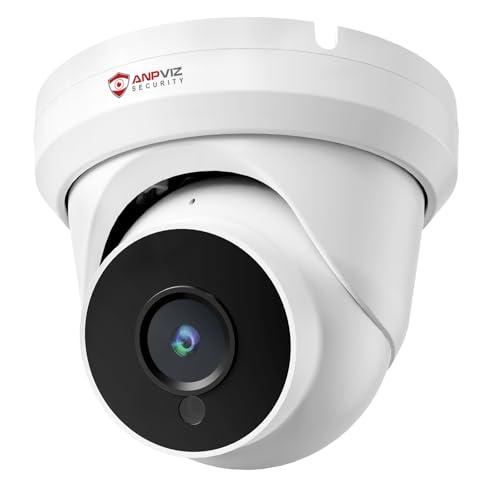
Anpviz 4MP PoE IP Turret Camera with Audio — The sensible default turret
Ask installers which camera shape they fit when nobody is watching the budget meeting and most say the turret. The eyeball design puts the lens and infrared LEDs on a ball that aims freely inside its socket, with no dome bubble to reflect light and a flat face that spiders find less inviting to web across — a mundane detail that decides how many night pictures stay usable in September. This Anpviz turret records 4MP, includes the range’s signature built-in microphone, and rates its night vision at a modest 50 feet, a figure that reads as honest rather than heroic and matches the eaves-and-garden distances it will actually serve.
That honesty is the camera’s character. It does not promise to read plates across a field; it promises a clear, well-exposed picture of your side wall, your bins, your gate and the approach to your back door, with sound. The ball mount forgives imperfect drilling because final aiming happens after the screws are in, and the compact body disappears under an eave line where a bullet would announce itself. For the majority of houses, whose security questions are who came down the path and when, this is the correct amount of camera.
Limits follow from the same modesty. Fifty feet of infrared will not supervise a long driveway, the fixed lens cannot zoom to a distant gate, and like every camera here it is a component awaiting a recorder and a PoE source rather than a system in itself. Buy it as the default brick of a wired system — several of these, placed with overlapping views, outperform one exotic camera guarding a whole property from a single corner — and its unglamorous competence becomes the point.
A word about pairs: two turrets mounted at opposite corners of a house, views overlapping at the doors, will outperform any single premium camera at the same spend, because an intruder cannot be behind both lenses at once and each camera covers the other’s vandalism blind spot. The turret’s modest price is what makes that geometry affordable, and it is why this unglamorous model, bought in multiples, secures more real homes than every exotic flagship in the catalogue combined.
Maintenance could hardly be simpler: a soft cloth across the face twice a year, a check that the ball has not crept from its aim after storm season, and a glance at the recorder’s timeline to confirm the night’s pictures are clean. Turrets forgive neglect better than domes because there is no bubble to mist, and better than bullets because there is no bracket to work loose — the shape is, in the end, an argument about how little attention a camera should need.
Corner mounting is the turret’s party trick: tucked where two eaves meet, one unit surveys two walls and the corner itself, the geometry installers exploit to cover a house with half the cameras a novice would buy. If you take one idea from this review into your own installation, take that one, because camera count is the multiplier on every other cost in a wired system — cable, channels, drive space and your own weekends included.
One more scenario suits this turret precisely: the Airbnb or holiday-let entrance, where a camera must watch a door between guests, survive weather and cleaners, and never require a visit to change a battery. Wired power and recorder storage make it a landlord’s appliance rather than a gadget, and its unremarkable looks keep the welcome warmer than a bullet’s stare would at the same doorway.
- Resolution: 4MP (above the 1080p baseline)
- Audio: built-in microphone
- Night vision: infrared, rated to 50ft
- Design: turret/eyeball, freely aimable ball lens
- Power: PoE, single Ethernet cable
Strengths
- Turret face avoids dome glare and discourages spider webs
- Microphone included at a level where rivals often omit it
- Aim-after-mounting design forgives real-world installation
Trade-offs
- Night reach suits gardens and paths, not long driveways
- Fixed focal length; no optical zoom for distant subjects
- Requires recorder and PoE infrastructure to do anything at all
Best for: eaves, side walls, back doors and the general fabric of a home system.
Not suited for: long-range supervision or buyers wanting a standalone app camera.

Anpviz 4MP PoE IP Bullet Camera with Microphone — Visible deterrent with reach
The bullet is the extrovert of surveillance design: a tube on a bracket that points unambiguously at what it watches. That visibility is a security feature in itself, since a meaningful share of opportunistic crime simply relocates when a camera is obvious. Anpviz’s version backs the posture with substance — 4MP recording, infrared rated to 100 feet for driveway-length coverage, a wide 110-degree field of view that takes in a forecourt or a parking row, human-shaped motion detection to thin the alert stream, and the family microphone for sound at the scene.
A bullet’s weaknesses are the obverse of its shape. The bracket arm that makes aiming easy also gives a determined vandal something to grab or strike, and the sunshield-topped housing collects the weather it shrugs off, so exposed cliff-top installations should look at the vandal dome instead. Wide lenses also tax detail: 110 degrees across 4MP means faces at the far end of a long drive are suggestive rather than identifiable, a geometry lesson every wide-camera owner learns once. Position it to cover a defined zone — a gate line, a fuel store, a loading bay — rather than an entire landscape.
Within a system, the bullet earns its place as the perimeter voice: the camera over the driveway entrance, the workshop yard, the shop’s rear lane, where being seen matters and its longer infrared throw covers ground the turrets cannot. Pair it with discreet domes and turrets closer to the doors and the property gains both deterrence at the boundary and evidence at the threshold, which is how professional layouts have always divided the labour.
Deterrence deserves measuring rather than assuming. A bullet over a gate changes behaviour only if the people approaching believe it records and that someone reviews the recordings; pairing it with a small sign and genuinely checking the footage after incidents completes the circuit. The camera’s human detection helps that credibility, because alerts that correspond to actual people train the owner to respond, and a system whose owner responds is a system the neighbourhood learns to respect within a single season.
For farms and workshops the bullet’s tolerance of grime is a working virtue: the housing sheds dust, the lens sits behind a shield that a gloved hand can wipe, and the bracket survives being knocked by a ladder and re-aimed in seconds. Cameras in working yards live hard lives measured in seasons rather than product cycles, and the designs that endure there are the ones whose every part can be cleaned, tightened or replaced without a service visit.
The bullet also moonlights well as a wildlife witness on rural properties, its long infrared throw catching foxes, deer and the occasional two-legged visitor with equal indifference. Owners who bought it for the yard frequently report that the night menagerie becomes the footage they actually watch, a reminder that surveillance systems earn affection as well as their keep once the novelty of watching an empty driveway wears off.
Height is the bullet’s silent specification: mounted at three metres it sees over cars and hedges while staying beyond casual reach; mounted at two, it becomes a handle. The bracket allows either, and the choice is yours rather than the camera’s. Pair the higher mounting with the wide lens and one bullet supervises a parking row that would otherwise need two lesser cameras and twice the cable.
- Resolution: 4MP (above the 1080p baseline)
- Lens: wide view, rated 110 degrees
- Night vision: infrared, rated to 100ft
- Detection: human-shape motion alerts
- Audio: built-in microphone; Power: PoE
Strengths
- Longest fixed-camera infrared reach in the Anpviz group here
- Visible presence deters before it records
- Human detection reduces the nightly false-alert burden
Trade-offs
- Exposed bracket is the most vandal-friendly shape in the list
- Very wide view spreads pixels thin at distance
- Sun and rain sit on the housing; exposed sites need occasional cleaning
Best for: driveway entrances, yards, rear lanes and anywhere deterrence matters.
Not suited for: low, reachable mountings where a vandal dome belongs instead.

Anpviz 5MP PoE Turret Camera (Recorder Required) — The honest system component
Every category has a product whose listing tries to save buyers from themselves, and this is ours: the manufacturer states in capital letters that this 5MP turret requires an NVR and does NOT work independently. Translated from listing-speak, the camera has no standalone app life, no memory-card fallback and no intention of being your only purchase. It is an eye awaiting a brain — a network video recorder that powers it over the same Ethernet cable, records its stream, and gives your phone a single place to watch every camera at once. Buyers who understand that sentence get an excellent component; buyers who skim past it get a paperweight and a returns label.
What the recorder unlocks is worth the discipline. Five megapixels of turret imagery with smart colour night vision — the camera uses available light and its own illumination intelligently to keep night scenes in colour where older infrared designs fall back to grey — recorded continuously, searchable by motion events, and viewable as one timeline beside the rest of your system. The turret shape keeps the night picture free of dome reflections, and colour after dark is not a gimmick: the difference between reporting a grey coat and a red one is the difference between footage that decorates a hard drive and footage that identifies someone.
Compatibility is the homework this pick sets. It expects a PoE-capable recorder, ideally from a compatible ecosystem, with the right channel count and a hard drive sized for your retention hopes; pairing it with an existing recorder means checking protocol support before ordering, not after. Do that work and this is arguably the most future-facing fixed camera in the roundup — the one whose night pictures and resolution will still look current when the system around it gains its next recorder.
Before ordering this turret, perform the compatibility ritual its listing demands: find your recorder’s supported camera list, confirm 5MP streams and the colour-night features are handled, and check that a PoE port with sufficient budget is free. Ten minutes with a manual now is the entire difference between this camera’s two destinies — flagship of a growing system, or the most educational paperweight in the returns queue. The manufacturer has done the unusual favour of warning you in capital letters; honour it.
Retention planning pairs with this camera’s appetite: 5MP colour footage is the richest stream in a typical home system and will claim a generous share of any drive. Give its channel the retention it deserves by trimming a less critical camera’s schedule rather than shrinking this one’s quality, because the whole point of a flagship eye is that the night something happens at the main door, the recording is the best your system can produce.
Colour night vision has one dependency worth planning around: it needs some light to work with, whether from its own illumination, a porch light or a street lamp. In absolute darkness the camera falls back to infrared behaviour like everything else here. Properties that want colour evidence at the main door should give this turret a fighting chance with a modest light fitting, a pairing that costs little and transforms the midnight timeline.
There is also a fairness point in this turret’s favour: its listing’s bluntness about needing a recorder respects the buyer in a way the whole category should imitate. Too many system components are sold with standalone dreams in the photographs and standalone disappointment in the box. A manufacturer willing to lose a sale in capital letters rather than gain a return has told you something good about how it will behave when you need support.
- Resolution: 5MP (above the 1080p baseline)
- Requirement: PoE NVR required; does not work independently
- Night vision: smart colour night mode
- Design: turret/eyeball outdoor housing
- Storage: none onboard; records to the NVR
Strengths
- Colour night imagery carries identification detail infrared cannot
- Highest resolution of the fixed Anpviz picks in this list
- Purpose-built for recorder systems with continuous recording
Trade-offs
- Absolutely not a standalone camera; the NVR is a mandatory second purchase
- No onboard storage if the recorder or network fails
- Compatibility with third-party recorders must be verified in advance
Best for: system builders adding a premium eye to a PoE recorder setup.
Not suited for: first-time buyers wanting one camera and an app by tonight.
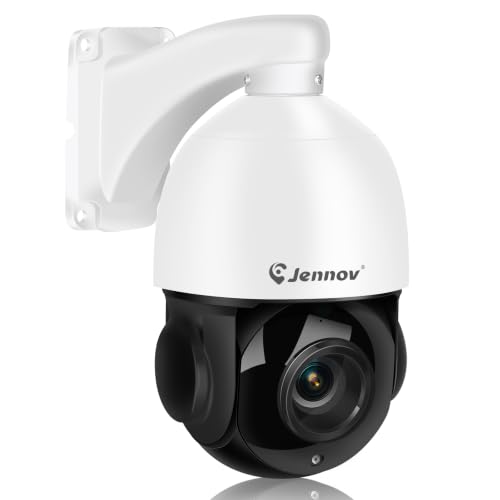
Jennov 4K 8MP Outdoor PTZ PoE Camera with 20X Optical Zoom — Long-range PTZ for large premises
Scale changes everything in surveillance, and the Jennov exists for properties where the Anpviz fixed cameras run out of geography. Its motorised head pans and tilts to sweep a yard, and the 20x optical zoom closes the distance to a far gate, a barn door or the end of a car park while keeping the full 8MP detail that digital zoom throws away. Infrared reach is rated at 320 feet, matching the zoom’s ambitions after dark. This is a speed dome in the professional tradition, shrunk in price rather than in intent, and it expects to be installed like one: high, firmly bracketed, cabled with PoE and enrolled into a recorder that can drive its movements.
The working pattern of a PTZ differs from fixed cameras in a way buyers must accept before purchase. A fixed camera watches its scene forever; a PTZ watches where it is pointed, and while it tours to the stables it is not watching the gate. Experienced operators handle this with preset patrols, motion-triggered tours and — most importantly — fixed cameras covering the critical points so the dome is free to investigate rather than obliged to be everywhere. Bought as the only camera on a large property, a PTZ guarantees beautifully zoomed footage of wherever trouble was not happening.
Running costs are the professional kind: the motors and heaters in a speed dome draw more power than a basic PoE budget, so confirm your switch or recorder’s per-port PoE capacity, and mount the bracket where its leverage in wind cannot worry the fixings. Do that, integrate it with fixed coverage, and the Jennov becomes the most capable single instrument in this article — the camera that reads a number plate at the far fence, follows a vehicle across the yard and still sweeps the whole property on its nightly patrol.
Operating a PTZ well is a craft with its own etiquette. Set a home position that covers the most valuable wide view, build patrols that linger where incidents would actually start, and resist the temptation to chase every passing car manually — the recorder’s timeline will show you a camera that was always looking somewhere else. Owners who treat the dome as an investigator dispatched by fixed cameras’ alerts, rather than as a sentry, extract several times the value from the same hardware.
The Jennov also makes a persuasive case at rural scale economics: one PTZ plus two fixed turrets can supervise a farmyard that would otherwise need six fixed cameras, six cable runs and six times the recorder channels. The saving is real money and real ladder time. The condition is the discipline described above — fixed eyes on the diesel tank and the barn door, the dome free to roam — and properties that accept that division get professional coverage at a hobbyist’s total cost.
Wind is the PTZ’s lifelong opponent: at full zoom, a gust that barely stirs the bracket becomes an earthquake in the picture, which is why professional mounts go on gable ends and steel posts rather than on fascia boards that flex. Budget the mount with the same seriousness as the camera, because a speed dome on a wobbling perch produces motion sickness at 20x and crisp evidence only in a flat calm.
Livestock owners extract a use from the Jennov that its designers may not have foregrounded: checking a lambing shed or a calving pen from the farmhouse at 3 a.m. without dressing for the yard. The zoom inspects an animal at the far end of a barn, the infrared works in the dark the animals prefer, and the farmer sleeps between checks. Agricultural word of mouth built this camera’s niche as surely as any specification sheet.
- Resolution: 8MP 4K (well above the 1080p baseline)
- Zoom: 20x optical, motorised pan and tilt
- Night vision: infrared rated to 320ft
- Power: PoE (check per-port budget; PTZ draws more)
- Use pattern: presets, patrols and recorder integration
Strengths
- Optical zoom preserves detail at distances fixed cameras cannot serve
- One instrument can survey a genuinely large property
- Long infrared reach matches the zoom after dark
Trade-offs
- Watches one direction at a time; needs fixed partners for critical points
- Higher PoE draw and serious mounting requirements
- Moving parts add maintenance a fixed camera never asks for
Best for: farms, depots, large yards, car parks and rural properties.
Not suited for: porches, small gardens or anyone seeking fit-and-forget simplicity.
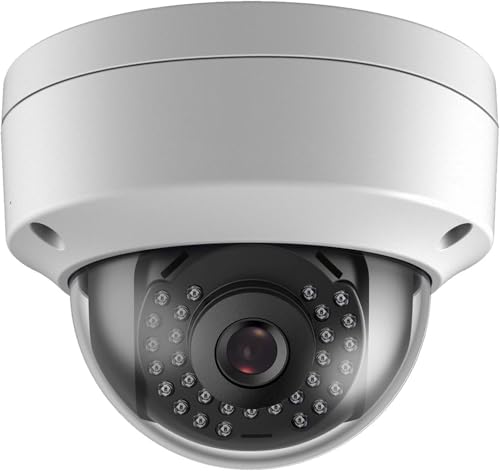
4MP PoE IP Vandal Dome Camera, 2.8mm Wide Angle — Built to be grabbed and survive
Some camera positions are simply within reach: the corridor ceiling at head height, the shopfront at shoulder level, the car-park pillar where trolleys and bumpers wander. The vandal dome is the answer the industry evolved for those spots — a reinforced housing and impact-resistant bubble designed to take a knock, a thrown object or a swipe from a broom handle and keep recording. This 4MP example pairs that armour with a wide 2.8mm lens for broad coverage of an entrance hall, a platform or a shop floor, infrared rated to 65 feet, and IP66 sealing against the weather and the pressure washer alike.
The wide lens defines its evidence style. At 2.8mm the camera sees a whole room or forecourt in one frame, superb for establishing who was where and in what order, less superb for identifying a face at the frame’s far edge. That trade is correct for its stations: vandal domes guard choke points where subjects pass close — doorways, tills, ticket barriers, stairwells — and closeness restores the detail the wide lens spends. Place it over a threshold rather than across a field and its pictures will name names.
It shares the dome family’s infrared manners, so keep the bubble clean and avoid mounting it where a nearby wall bounces IR back into the lens, and it shares the whole article’s dependency on a PoE source and recorder bought separately. What it adds is survival. In a roundup of cameras for careful positions, this is the one for careless environments, and any public-facing installation with a camera below three metres should start its shortlist here.
Public-space manners apply to this dome’s owners: its wide eye will inevitably include slices of neighbouring property or pavement, and masking tools in the camera’s settings exist precisely to blank those regions out. Use them on installation day. A camera that demonstrably respects the boundary it watches from is a camera neighbours defend rather than resent, and in the long politics of a street or a shopping parade, that goodwill is a security feature no housing can armour against complaints.
Stairwells and undercrofts are this camera’s natural parish: dim, echoing, frequently tagged and forever having their lights stolen. The vandal dome’s sealed, grippable-nothing design simply refuses the usual attacks, and its infrared handles the darkness that returns whenever a bulb goes missing. Facility managers buy these by the corridor rather than by the unit, which tells you everything about the niche and about how completely this design fills it.
Finally, a vandal dome’s presence in a stairwell changes the stairwell: tagging declines, loitering moves elsewhere, and the camera pays for itself in cleaning bills before it ever identifies anyone. That quiet behavioural dividend is the strongest argument for armour-plated cameras in public housing and schools, where the audience for the footage is usually a caretaker proving a pattern rather than a detective naming a face.
Transit and platform operators form another quiet constituency for this design: a wide, armoured eye over a shelter or a ticket machine gathers the pattern-of-life evidence that timetabling and safety decisions need, and it does so for years without a lens cap, a battery or a prayer. Reliability at that scale is a specification too, even if it never appears in a comparison table.
- Resolution: 4MP (above the 1080p baseline)
- Lens: 2.8mm wide angle
- Night vision: rated to 65ft
- Housing: vandal-resistant dome, IP66 sealed
- Power: PoE, single Ethernet cable
Strengths
- Impact-resistant build for low, public, knock-prone positions
- Wide lens covers entrances and halls in a single frame
- Strong sealing suits car parks, platforms and shopfronts
Trade-offs
- Wide view limits facial detail at longer distances
- Dome bubble needs cleaning and careful siting for night work
- No microphone listed, unlike the Anpviz dome in this roundup
Best for: corridors, shopfronts, car parks and any camera within arm’s reach.
Not suited for: long-range identification or discreet residential eaves.
Comparison Table
| Camera | Defining traits |
|---|---|
| Anpviz 4MP dome | 4MP dome, built-in microphone, 98ft IR night vision, IP66 housing, PoE powered, ceiling or wall mount. |
| Anpviz 4MP turret | 4MP turret, built-in mic, 50ft night vision, IP-rated housing, ball-and-socket aiming, PoE powered. |
| Anpviz 4MP bullet | 4MP bullet, 110° wide view, 100ft IR, human motion detection, built-in microphone, PoE powered. |
| Anpviz 5MP turret | 5MP turret, requires NVR — does not work independently, smart colour night vision, PoE powered, system camera. |
| Jennov 8MP PTZ | 8MP PTZ speed dome, 20x optical zoom, 320ft IR rating, pan and tilt patrol, PoE powered, recorder-oriented. |
| 4MP vandal dome | 4MP vandal-resistant dome, 2.8mm wide lens, 65ft night vision, IP66 sealing, PoE powered. |
What Does a PoE Camera System Actually Need to Work?
A PoE camera on its own is a lens with ambition. The system around it — power, recording, cable and configuration — decides whether you own a surveillance setup or a collection of housings. Work through these four components before ordering anything, in this order, and the cameras in this roundup will slot into a plan instead of a pile.
Start with the recorder, not the cameras
The NVR is the system’s brain and its power station in most home installations: its PoE ports feed the cameras, its hard drive holds the footage, and its software is what your phone actually talks to. Choose channel count for the property you will have in three years, not the one you are wiring this weekend, and size the drive by a simple rule — continuous recording from several multi-megapixel cameras consumes hundreds of gigabytes a week, so retention promises should be made with a calculator in hand. One Anpviz turret in this list refuses to work without this box, but in truth all six picks assume it.
Understand where the power comes from
PoE is a budget as well as a cable. Each port on a recorder or switch supplies a defined wattage; fixed cameras sip modestly, while the Jennov’s motors and heaters drink deeply enough to matter. If your recorder’s ports fall short, a midspan injector or a dedicated PoE switch between recorder and camera solves it, at the cost of another box and another plug. Map the power chain for every camera — recorder port, switch, or injector — on paper before the ladder comes out, because a camera that browns out at midnight when its infrared and motors engage is a riddle nobody enjoys solving in the rain.
Treat cable as a permanent decision
Ethernet cable outlives cameras by decades, so buy outdoor-rated, solid-core cable for runs, keep lengths within the standard’s hundred-metre envelope, and route through walls and eaves rather than across lawns and gutters. Every join outdoors is a future fault; every metre of slack coiled neatly at the recorder is a future kindness. Renters should note the honest corollary: PoE’s permanence is its one true inconvenience, and properties you cannot drill belong to the wireless systems in our companion guides instead.
Plan the views before the drill
Walk the property with a phone at the mounting height you intend, photographing the view each camera will own. Check for the classic saboteurs: a wall filling half the frame with infrared glare, a tree destined to swallow the lens by June, the sun rising straight into a east-facing camera every morning. Overlap views slightly at doorways so a subject is never in only one camera’s care, and angle cameras along paths rather than across them, because movement along the lens axis compresses distance and steals the seconds your recording needed.
Decide what happens when a camera fails
Wired systems fail differently from wireless ones: a camera that vanishes from the recorder usually indicts its cable, its connector or its power budget, in that order, and all three are findable with a methodical hour. Keep one spare camera or at least one spare cable run in the plan for the position you can least afford to lose, and label both ends of every run while the installation is fresh. The systems that survive a decade are not the ones that never fail; they are the ones whose failures are boring, diagnosable and cheap.
Choose retention before resolution
Every buyer asks how sharp the picture is; few ask how long it survives. A recorder cycling a small drive may keep four days of history from a multi-camera 4MP system, which is plenty for a weekend incident discovered on Monday and useless for a holiday absence discovered a fortnight later. Decide the absence you must survive — a weekend, a holiday, a month between site visits — and size the drive to it, lowering frame rates on unimportant channels before touching the resolution of the door cameras.
Leave the system documented for the next pair of hands
A wired system outlives its installer’s memory. A single page — recorder location, camera positions, cable routes, where the passwords are kept — taped inside the recorder’s cupboard turns a future fault from archaeology into maintenance. Professional installers leave exactly this; homeowners who imitate them discover its value the first time a camera fails while they are on holiday and a neighbour or tradesperson has to be talked through the cupboard by phone.
What Mistakes Do Buyers Keep Making Here?
Buying cameras before checking recorder compatibility
The most expensive sentence in this category is ‘it should work with my box.’ Protocol support, resolution ceilings and channel counts vary, and the 5MP turret in this roundup is explicit that a recorder is mandatory. List your recorder’s supported specifications first, then shop cameras against them, and a returns process becomes something other people do.
Believing the night-vision distance on the box
Infrared ratings are measured in friendly conditions against cooperative targets. Real yards contain dark clothing, wet surfaces and fog, all of which eat infrared. Treat the printed figure as a best case, position cameras so the subjects you care about pass well inside it, and add ordinary visible lighting where identification matters — a lit face beats a long infrared claim every night of the week.
Running indoor cable outdoors because it was in the drawer
Indoor Ethernet jackets crack under ultraviolet and admit water at the first nick, and the failure arrives months later as a camera that drops off the network in wet weather. Outdoor-rated cable costs little more and is the difference between a system installed once and a system installed annually. The same applies to connectors: weatherproof every join you cannot bring indoors.
Aiming every camera at the horizon
New installers frame for the view they would photograph, which puts faces at the bottom edge, backlit and small. Surveillance framing is uglier and more useful: lower the aim, fill the frame with the zone people must cross, and let the sky go. A camera that captures a hat brim in glorious detail and a face in shadow has documented a hat, expensively.
Leaving default passwords on a network camera
A camera on your network with factory credentials is a door left on the latch, and IP cameras have a long, sorry history of being recruited into other people’s botnets. Change every password during setup, disable services you do not use, and keep the recorder’s firmware current. The five minutes this takes is the cheapest security upgrade in the entire system, including the cameras themselves.
Final Recommendation
For a typical house building its first wired system, the Anpviz 4MP turret is the brick to build with, the matching dome covers porches and entrances where audio helps, and the bullet stands guard at the driveway where being seen is half the job. The 5MP turret upgrades the most important view with colour at night, the vandal dome takes the low public positions, and the Jennov watches the kind of acreage the others can only wave at. Small businesses should read the same list with tills and stockrooms in mind: dome over the counter, turret at the staff door, vandal dome wherever the public can reach, and the recorder sized for the retention their insurer expects rather than the minimum the budget allows. Every one of them assumes an owner willing to think in systems rather than gadgets, and rewards that owner with the least theatrical, most dependable surveillance in this entire group of guides.
Buy the recorder your property deserves, cable it like you mean to forget it, and these cameras will still be quietly testifying on the one bad night that justifies every quiet year they watched.
Frequently Asked Questions
Can I plug a PoE camera straight into my router?
Only if a PoE injector or switch sits between them supplying power, and even then the camera needs somewhere to record and software to view through. A plain router port provides data without the power PoE cameras expect. The standard home answer is a PoE NVR whose ports power the cameras and whose app serves your phone, which is why this article treats the recorder as the first purchase.
Do these cameras work with any brand of recorder?
Most speak standard network protocols and pair broadly, but ‘most’ is doing heavy lifting: resolution support, motion-event handling and audio channels vary by recorder. The Anpviz 5MP turret’s listing is admirably blunt that an NVR is required; with any camera here, verify your recorder’s supported list before ordering, especially when mixing brands or chasing the highest resolutions.
Why are so many ‘1080p’ cameras actually 4MP or more?
Because sensor production moved on, and the market kept the familiar search term. The practical effect is benign: you receive more detail than the label promises, and every camera here can be set to a 1080p stream if an older recorder, a phone sub-stream or a tight upload connection prefers it. Storage planning is the one place the upgrade costs you, since more pixels fill drives faster.
Is recording audio with these cameras legal?
It depends where you live and where the camera points, and the honest answer is that audio is regulated more strictly than video in many places. Several picks here include microphones. The prudent pattern is to record audio on your own premises where notices are posted, disable it where conversations of visitors or neighbours would be captured, and check local rules before enabling it in a workplace.
How many cameras can one recorder power?
As many as it has channels and PoE budget for, whichever runs out first. Count the watts as carefully as the ports: a system of fixed turrets and domes is modest, but adding the PTZ’s motors to a fully loaded recorder can exceed a port’s or the whole unit’s budget, at which point a separate PoE switch feeds the hungry cameras while the recorder keeps the pictures.
Can I watch these cameras on my phone without a recorder’s app?
In practice the recorder’s app or the camera maker’s viewer is the supported path, and it is the one that handles alerts, playback and talk features coherently. Generic viewer apps can often display a live stream from standard-protocol cameras, which suits a quick glance, but the moment you need last Tuesday’s footage or a motion alert at midnight, the recorder’s own software is where the system keeps those promises.
Related Guides
Compare philosophies in our guide to wireless cameras that connect straight to a phone, then work through the home NVR sizing and storage planner, and finish with the outdoor cable installation walkthrough before drilling anything.


