What's inside
- Key Takeaways
- Quick Picks
- How Did We Judge Bodies for the Fence Line?
- Why Is Panning the Skill That Decides Everything?
- What Does the Rest of a Trackside Kit Look Like?
- How Does the Discipline Change the Camera Choice?
- What Should You Check When Buying a Used Flagship?
- Frame Rates, Buffers and Tracking: How the Six Stack Up at the Fence
- How Should You Set These Bodies Up for a Race Day?
- What Happens When the Racing Goes Into the Night?
- What Do Trackside Photographers Most Often Get Wrong?
- Final Recommendation
- Frequently Asked Questions
- Related Guides
As an Amazon Associate I earn from qualifying purchases. This post may contain affiliate links at no extra cost to you.
gizmoverdict.com is reader-supported. When you buy through links on our site, we may earn an affiliate commission.
Where to buy: Professional DSLRs of this era reach Amazon through authorised dealers and reputable used specialists, and every linked recommendation that follows rests on a retail page confirmed in our check. One famous name is deliberately missing from the links: the Canon EOS 5DS R appears in this guide as a prose-only discussion, because the only listings our check found for it were renewed units — it is analysed honestly at the end, without a purchase route attached.
The best DSLR cameras for motorsports photography are, by the standards of the mirrorless age, antiques — and at a racetrack, that is close to a compliment. Motorsport rewards a specific set of virtues: an autofocus system that locks a car at 180 miles per hour and holds it through a pan, a buffer that swallows a full overtaking move without stalling, a viewfinder with zero lag and zero blackout ambiguity, and a body that treats rain, dust and a twelve-hour race day as working conditions rather than insults. The professional DSLRs below were engineered for exactly that contract, at the Olympics and the grands prix of their era, and the used and remaining-stock market now prices them within reach of the serious amateur.
This guide is written from the fence and the paddock, not from a specification table. Panning technique, buffer behaviour under a real burst, autofocus tracking through heat haze and catch fencing, battery life across a race weekend — those are the tests that decide whether a body comes home with the shot. Frame rates and AF point counts appear in every review, but they appear translated: what fourteen frames per second means at a braking zone, what a 153-point autofocus array does when a car crosses behind a marshal’s post, what a crop sensor’s reach is worth at a circuit where the fence keeps you honest about distance.
A word about why this guide exists in DSLR form at all, because readers reasonably ask. The professional DSLR’s era ended with its development budgets spent almost entirely on the problems motorsport poses: tracking, burst endurance, finder clarity and durability in weather. Mirrorless development since has spent its budgets more broadly — video, computational features, silent operation — and its best bodies are magnificent generalists that also shoot racing superbly. But a used flagship DSLR, bought at the prices its ended era now commands, concentrates more trackside-relevant engineering per pound or dollar than anything else on the market. That concentration, not nostalgia, is the argument of the next several thousand words.
Five bodies carry links and one carries a warning label of a different kind. The 5DS R discussion closes the reviews because its situation is instructive: a 50-megapixel stills monument that motorsport photographers keep asking about, available in our check only as renewed stock. It is treated here the way the market currently treats it — as a considered used purchase for specific work, not as a linked recommendation.
Key Takeaways
- Burst depth and buffer, not headline frame rate alone, decide motorsport work — a camera that stalls mid-overtake has failed at its only job.
- The Nikon D6 and Canon 1D X Mark III are the era’s twin flagships: 14 and 16 frames per second respectively, with tracking systems built for subjects at racing speed.
- The D500’s crop sensor is a reach tool, turning a 200mm lens into a 300mm view at circuits where fences dictate your distance.
- The D850 trades outright speed for 45.7MP files that survive the aggressive cropping distance often forces on you.
- The 5DS R is prose-only here — renewed listings only in our check — and its 5 fps burst makes it a paddock camera, not a trackside one.
- Every linked body here is a mature professional platform: grips, batteries, service knowledge and used lenses surround them in depth.
Quick Picks
| Pick | Badge | Why it earns its place |
|---|---|---|
| Nikon D6 | Best overall | 14 fps, an all-cross-type 105-point AF array and group-area tracking tuned for subjects that do not slow down. |
| Canon EOS-1D X Mark III | Best Canon flagship | 16 fps through the finder with deep-learning subject tracking and a buffer that effectively does not fill. |
| Nikon D5 | Best value flagship | The previous Nikon’s 12 fps and 153-point AF at used-market prices, with dual XQD speed for long bursts. |
| Nikon D500 | Best APS-C reach | The flagship’s autofocus brain in a crop body — 10 fps and a 1.5x reach multiplier for fenced circuits. |
| Nikon D850 | Best resolution and speed | 45.7MP at up to 9 fps with the grip — the cropping photographer’s answer to distance. |
| Canon EOS 5DS R | Prose-only: renewed listings only | 50.6MP of paddock and detail greatness, discussed without a link — 5 fps keeps it off the trackside list. |
How Did We Judge Bodies for the Fence Line?
Tracking came first, because motorsport autofocus is a prediction problem: the car crosses behind posts, fencing and other cars, and the system must hold its subject through occlusion and return still locked. We weighed each body’s tracking architecture — Nikon’s group-area and 3D systems, Canon’s deep-learning subject detection in the Mark III — by their established trackside reputations rather than their point counts. Burst sustainability came second: not the first second’s frame rate, but the fifth second’s, which is where buffers and card speeds separate flagships from pretenders during a genuine overtaking move.
Third was the viewfinder experience, the DSLR’s surviving structural advantage. An optical finder shows the car in real time with no lag, no blackout simulation and no battery anxiety, and panning — the genre’s core technique — is learned and executed through that finder. Photographers who pan at a tenth of a second know the difference in their wrists. Finally we weighed the weekend around the camera: battery endurance across a full race day, weather sealing for the rain that schedules seem to attract, and the depth of the used lens market behind each mount, because motorsport’s long telephotos are the real budget and both mounts here are rich in them.
Why Is Panning the Skill That Decides Everything?
The money shot in motorsport is a pan: a slow shutter speed, the camera swung in an arc that matches the car’s velocity, the machine rendered tack-sharp against a background smeared into speed. It is a physical skill executed through the viewfinder, and it explains several of this guide’s judgements. Frame rate matters less than the finder’s clarity and the autofocus’s composure while the whole world moves; buffer matters because a pan across a braking zone produces a sequence, and the keeper is rarely the first frame; and body ergonomics matter because the swing starts at the hips and the camera must feel like an extension of the turn, hour after hour.
Stabilisation has a panning mode on the lenses that matter here, and technique has a learning curve measured in race weekends rather than afternoons. The bodies below support the craft in different proportions — the flagships with tracking that forgives a developing pan, the D850 with resolution that rescues a slightly missed one in the crop — and each review names the proportion honestly. No camera in this guide pans for you; the best ones stay out of the skill’s way while insuring its failures.
What Does the Rest of a Trackside Kit Look Like?
Glass first, and it is not close: motorsport is a telephoto genre, and the 70-200mm, 100-400mm class zooms and the fast 300 and 400mm primes behind these mounts are where the budget honestly lives. Both systems here are surrounded by deep used markets in exactly those lenses, which is a structural reason this guide recommends into mature DSLR platforms. A monopod is the second purchase — long glass across a long day is a weight problem before it is an optics problem — and weather protection is the third, because circuits generate dust in the dry and horizontal rain in the wet, sometimes in the same afternoon.
Media and power close the kit list in flagship fashion: these bodies drink from professional batteries that last a race day and write to professional cards that cost accordingly. Budget both as part of the body purchase, and the season runs without the paddock scramble for a charger that every track photographer has witnessed and most have lived.
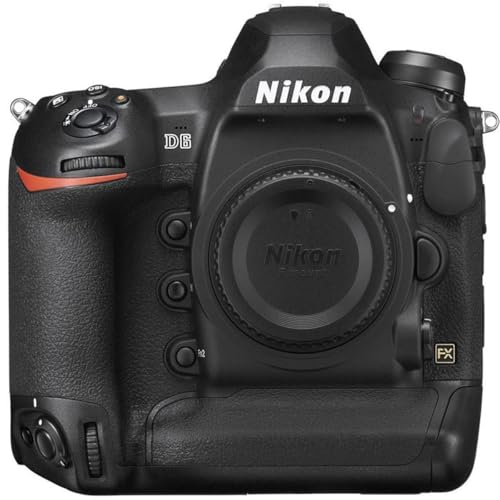
Nikon D6 — Best overall
The D6 is the last of Nikon’s flagship DSLR line and the most single-minded tracking instrument in this guide. Its autofocus array — 105 points, every one of them cross-type, arranged for coverage rather than a headline count — feeds a group-area system that trackside photographers describe with unusual unanimity: designate the group, put it on the car, and the camera holds through fence posts, spray and the car ahead. Fourteen frames per second through the optical finder, sustained by a buffer and twin CFexpress-or-XQD slots that treat a full overtaking sequence as a warm-up, complete the professional picture.
The sensor’s 20.8 megapixels are a deliberate professional choice that motorsport understands instinctively. Files are large enough for agency delivery and moderate cropping, small enough that a race day’s thousands of frames ingest, cull and transmit at pit-lane speed — and at a circuit, the photographer filing between sessions is racing the same clock as the cars. High-ISO behaviour serves the calendar’s edges: dawn qualifying, night endurance stints, and the floodlit final hour all sit comfortably inside this sensor’s working range, with grain that prints like intent rather than accident.
Everything else is flagship in the expedition sense: a shutter and chassis built for professional mileage, sealing that treats a wet race as a scheduling detail, and a battery that covers a day rather than a session. Its video is a footnote and its live-view manners belong to its era — irrelevant at the fence, where the finder is the instrument. For the photographer whose season is circuits, the D6 is not the nostalgic choice; it is the correct one, and its position at the top of this guide is the least argued-over judgement in it.
- Sensor: 20.8MP full-frame, tuned for speed and high-ISO work
- Burst: 14 fps through the optical viewfinder with AF tracking
- Autofocus: 105 points, all cross-type, with group-area AF modes
- Media: dual slots accepting CFexpress and XQD
- Battery: professional pack rated for a full race day
- Build: sealed flagship chassis for weather and dust
Strengths
- Tracking composure through occlusion is the best in this guide.
- Buffer and media sustain bursts across entire overtaking moves.
- File size keeps a race day’s cull and delivery at professional speed.
Trade-offs
- 20.8MP limits how hard distance-forced crops can be pushed.
- Video and live view are period footnotes, not features.
- Flagship weight across a twelve-hour day demands a monopod habit.
Best for: professional and serious amateur trackside photographers whose income or portfolio rides on tracking that never lets go. Not suited for: detail-led paddock work or heavy croppers, where the D850’s resolution is the sharper tool.
Endurance weekends reveal the quality owners mention last and value most: the D6 simply never becomes the story. It starts in the cold, tracks in the rain, files at midnight and is ready again at dawn, across three days, without a menu surprise or a thermal sulk. Photographers build seasons on that invisibility. In a guide full of measurable virtues, dependability at hour thirty is the one that renews contracts — and it is the deepest reason this body, the final flagship of its line, closes its era at the top of lists like this one.

Canon EOS-1D X Mark III — Best Canon flagship
Canon’s final flagship DSLR answers the D6 with the guide’s highest viewfinder frame rate — sixteen frames per second with autofocus, twenty in live view — and an autofocus brain of a different philosophy. Where Nikon asks the photographer to designate a group, the Mark III’s deep-learning system recognises subjects, including heads and helmets, and pursues them with a persistence that feels less like tracking and more like intent. At a circuit, that means a rider’s helmet held through a corner sequence, a car’s nose kept as the pan develops, with the photographer’s attention freed for composition and timing.
The buffer deserves its own sentence because it rewrites behaviour: with fast CFexpress media, raw bursts run so deep that the practical limit becomes the photographer’s discipline rather than the camera’s memory. A full braking-zone duel, a crash sequence, a podium champagne moment — the camera does not stall, clear or ask for patience, and that absence of interruption changes what a photographer attempts. Dual CFexpress slots, a sensor of 20.1 megapixels with strong high-ISO manners, and Canon’s colour for skin and livery complete the working specification.
It is also the most video-capable body here, with serious motion specifications that serve the hybrid shooter filming pit-lane content between stills sessions — a genuine secondary career the Nikons do not contest. The costs are the flagship constants: weight, price, and media priced like the professional era. For Canon-system trackside photographers, this is the summit of the DSLR line and the natural end of its upgrade path; nothing in the mount’s DSLR history stands above it.
- Sensor: 20.1MP full-frame with Dual Pixel architecture
- Burst: 16 fps through the finder, 20 fps in live view
- Autofocus: 191 points with deep-learning head and subject detection
- Buffer: effectively bottomless raw bursts on CFexpress media
- Media: dual CFexpress slots
- Video: the strongest motion specification in this guide
Strengths
- Deep-learning tracking holds helmets and cars with uncanny persistence.
- The buffer removes burst anxiety from every sequence you will ever shoot.
- Hybrid video strength serves pit-lane and paddock content work.
Trade-offs
- CFexpress media and flagship pricing make running costs the highest here.
- Resolution is speed-tuned; heavy cropping is not its game.
- The heaviest commitment in the guide for a full race weekend’s carry.
Best for: Canon-system professionals and hybrid shooters who want the mount’s ultimate tracking body and pit-lane video in one chassis. Not suited for: photographers who crop hard from distance — resolution lives further down this list, wearing a Nikon badge.
One trackside behaviour deserves recording because spec sheets hide it: the Mark III’s finder experience during a pan is the calmest here. The combination of the optical view, the frame rate’s density and the tracking display’s confidence lets a photographer stay on a car through a long corner sequence without the micro-corrections that lesser systems provoke — and a calm pan is a sharp pan. Riders’ photographers add their own testimony about the helmet detection holding through leathers, gravel traps and spray. It is the most modern brain in this guide, wearing the most traditional body, and the pairing works better than nostalgia has any right to expect.

Nikon D5 — Best value flagship
The D5 is the value flagship because time has done the buyer a favour: a body that anchored professional coverage of two Olympic cycles now trades at used-market prices, while its core motorsport specification — twelve frames per second, the 153-point Multi-CAM 20K autofocus array, a 20.8-megapixel sensor with legendary high-ISO reach — has not diminished by a single frame. Its tracking was the benchmark the D6 refined rather than replaced, and at a circuit it still holds a car through a pan with the authority that made it the default Nikon of its era.
This listing’s dual XQD configuration matters to the burst story. XQD media of the period writes fast enough to sustain the D5’s deep buffer — around two hundred raw frames in a continuous run — which in trackside terms is an entire incident sequence, start to finish, with frames to spare. The body’s low-light fame is equally practical: night races, tunnel-dark grandstands and floodlit winter testing are this sensor’s home ground, and its files at sensitivities that frighten newer cameras remain agency-clean.
Buy it with a professional’s checklist rather than a bargain-hunter’s hope: shutter count against its rated life, both slots tested, the condition of the mount and the mirror box inspected. A well-kept D5 from a working photographer’s kit is among the great value instruments in modern photography; a neglected one is a repair estimate. Judged on the right example, nothing at its market level tracks, bursts and endures like it — the flagship experience, one generation removed, at a price that funds the telephoto the sport actually runs on.
- Sensor: 20.8MP full-frame with renowned high-ISO performance
- Burst: 12 fps with a buffer around 200 raw frames on XQD
- Autofocus: 153-point Multi-CAM 20K array with 99 cross-type points
- Media: dual XQD slots on this listing
- Night work: floodlit and endurance-race sessions are its speciality
- Market position: flagship capability at used-market pricing
Strengths
- Professional tracking and burst depth at a fraction of flagship cost.
- High-ISO files suit night racing better than anything else here.
- The deep buffer swallows incident sequences whole.
Trade-offs
- Buying used demands condition diligence — shutter count above all.
- XQD is a legacy format; media sourcing takes a little planning.
- A generation behind in video, live view and connectivity.
Best for: serious amateurs and working photographers who want genuine flagship trackside performance and can buy a used body with a professional’s care. Not suited for: anyone whose purchase must carry a warranty and a new-body guarantee — the D6 holds that assurance at its price.
Night racing is where this body’s legend was actually written, and it bears one more telling: at floodlit circuits and through the small hours of an endurance race, the D5’s files hold colour and detail at sensitivities where its contemporaries turned to watercolour. Photographers who specialise in the after-dark hours — a growing speciality as calendars add night races — describe it the way landscape photographers describe a favourite lens. If your season’s signature images happen after midnight, the value flagship may not be the compromise choice at all; it may simply be the choice.

Nikon D500 — Best APS-C reach
The D500’s trick is arithmetic that circuit fences make precious. Its DX sensor crops the view by 1.5x, so a 200mm lens frames like a 300mm and a 300 like a 450 — reach bought without the price, weight or monopod commitment of the longer glass. At circuits where the fence, the gravel trap and the grandstand conspire to keep photographers at a fixed, honest distance, that multiplier is not a compromise; it is the difference between a car that fills the frame and a car that fills a crop. And the body delivering it is no consumer shell: the D500 carries the same 153-point autofocus system as the D5 flagship, with coverage that spans its smaller frame almost edge to edge.
Ten frames per second with a buffer around two hundred raw frames keeps it honest in the burst column, and its autofocus tracking — the flagship’s brain, remember — holds subjects with an authority no other crop body of its era approached. The smaller files move fast through a race day’s workflow, the body is weather-sealed and built like a professional tool in miniature, and the whole package with a 70-300mm-class lens forms the most attainable serious motorsport kit in this guide.
Its limits are the crop sensor’s physics: high-ISO files a step behind the full-frame flagships when night races call, and a shallower pool of ultimate low-light telephoto combinations. Daylight and floodlit club racing, national series and the long Sunday of a support paddock are its kingdom. For the photographer whose budget must cover body and glass together, the D500 is not the stepping stone to the real thing — at most circuits, on most weekends, it is the real thing, wearing a smaller sensor as a strategy rather than an apology.
- Sensor: 20.9MP DX (APS-C) — a 1.5x reach multiplier on every lens
- Burst: 10 fps with a buffer around 200 raw frames
- Autofocus: the flagship 153-point Multi-CAM 20K system
- Frame coverage: AF points span nearly the whole DX frame
- Build: weather-sealed professional-grade body
- Kit logic: pairs with mid telephotos for an attainable full system
Strengths
- Reach multiplication that fenced circuits reward every single lap.
- Flagship autofocus tracking in a body at a fraction of flagship cost.
- Fast files and a deep buffer suit high-volume race days.
Trade-offs
- High-ISO quality trails the full-frame bodies under floodlights.
- The crop that grants reach takes away wide paddock flexibility.
- Pro glass in DX-specific form is limited — it borrows the FX bench.
Best for: club and national-series photographers, and any shooter whose circuit keeps them far from the action and whose budget covers glass as well as body. Not suited for: night endurance specialists, whose floodlit hours belong to the full-frame sensors’ sensitivity.
Amateur series photographers add a workflow virtue the flagship reviews cannot claim: the D500’s kit — body, mid telephoto, monopod — fits a single backpack and a train journey, which matters in a sport where the photographer’s travel is unpaid and the circuit is three counties away. More serious work has been produced by the camera that made the trip than by the flagship that stayed home for want of a sensible way to carry it. Reach, in every sense, is this body’s thesis.

Nikon D850 — Best resolution and speed
The D850 enters this guide from a different direction than its batch-21 appearances elsewhere: not as a resolution monument, but as the answer to motorsport’s distance problem. Trackside reality is that you cannot always get closer — the fence is the fence — and the photograph that results is a crop waiting to happen. At 45.7 megapixels, the D850’s files survive that crop with their detail and their dignity: a car framed at two-thirds distance becomes a full-frame composition in post, with resolution left over for print. Resolution, at a circuit, is a telephoto you do not have to carry.
Its speed is honest rather than flagship: seven frames per second natively, rising to nine with the MB-D18 grip and the larger EN-EL18 battery fitted — the configuration trackside owners actually run, and the one to budget for. The autofocus is the 153-point flagship array of its generation, tracking with genuine authority through a pan, a step behind the D6’s group-area refinement and entirely sufficient for cars, which are, after all, large, contrast-rich and predictable in their trajectories compared with the birds and athletes these systems also serve.
The paddock is its second home and the reason many owners choose it over a flagship: 45.7 megapixels render a car’s carbon weave, a driver’s portrait and a garage’s detail with a richness the 20-megapixel bodies cannot approach, and its dynamic range pulls shadow detail from under awnings and inside cockpits. Buy the grip, accept the larger files and the slower cull, and the D850 becomes the one-body answer for the photographer who shoots the whole race weekend — action, atmosphere and detail — rather than the racing alone.
- Sensor: 45.7MP full-frame backside-illuminated CMOS
- Burst: 7 fps, or 9 fps with the MB-D18 grip and EN-EL18 battery
- Autofocus: 153-point flagship array with strong tracking
- Cropping: resolution headroom that substitutes for longer glass
- Dynamic range: serves paddock shadow and cockpit detail
- Role: the whole-weekend body — action plus atmosphere
Strengths
- Crop survival turns distance from a failure into a workflow.
- Paddock, portrait and detail work at a resolution flagships cannot touch.
- Tracking and build remain genuinely professional for trackside use.
Trade-offs
- Full speed needs the grip and battery bought separately.
- Large files slow the cull after a high-volume race day.
- Buffer depth trails the true flagships in long sequences.
Best for: photographers who cover the entire race weekend — action at distance, paddock stories, detail and portraits — with one body. Not suited for: pure action specialists filing at volume, for whom the D6’s speed and smaller files are the professional fit.
A practical paddock note: this is the body whose files sponsors and teams ask for by name, because a 45-megapixel paddock portrait or a machinery study prints at exhibition size for the hospitality wall and the season’s annual. The action specialists may own the covers, but the D850’s weekend — the car as object, the team as people, the circuit as a place — is the body of work that fills books. Photographers building a portfolio rather than a wire feed will recognise their camera in that sentence.
Canon EOS 5DS R — Prose-only: renewed listings only
This pick carries no purchase link, for the reason stated at the top of the guide: our check found only renewed listings for the 5DS R, so it is discussed here as market guidance rather than sold as a recommendation. The camera itself remains a fascinating instrument — 50.6 megapixels behind a low-pass-cancellation filter that extracts the sensor’s maximum detail, in the 5D family’s beloved handling, with a 61-point autofocus system that was professional grade in its day.
Motorsport’s verdict on it must be equally plain. Five frames per second and a modest buffer exclude it from trackside action work in any serious sense; a braking-zone sequence outruns it before the second car arrives. Where it earns its mention is everywhere else at a race weekend: static machinery studies where its detail renders engineering beautifully, paddock and portrait work, archival documentation of cars whose value is in their surfaces, and the slow, deliberate photography of a circuit at dawn before the engines start. In those genres its resolution still embarrasses most cameras ever made.
The renewed-only market status cuts both ways and should be weighed whole. Renewed stock from a reputable programme can be excellent value with inspected mechanics and a warranty of some form; it can also mean unknown shutter history on a body whose previous life is unrecorded. A buyer considering one should demand the shutter count, the renewing programme’s terms and a return window — and should buy it as the specialist stills instrument it is, not as the trackside bargain it is not. This guide links what it can verify; for the 5DS R, verification currently ends at renewed, and so does the recommendation.
- Sensor: 50.6MP full-frame with low-pass filter cancellation
- Burst: 5 fps — a stills pace, not a trackside one
- Autofocus: 61-point system of its professional era
- Best subjects: static machinery, paddock detail, portraits, archives
- Market status: renewed listings only in our check — no link attached
- Buying discipline: shutter count, programme terms and returns are essential
Strengths
- Detail resolution that still leads this entire guide’s table.
- Superb for the static, deliberate photography of cars and paddocks.
- The 5D family’s handling and lens bench come with it.
Trade-offs
- 5 fps and a shallow buffer rule out action sequences.
- Renewed-only availability means condition varies by unit.
- No verified new listing — the purchase requires extra diligence.
Best for: detail-led photographers — machinery studies, archives, paddock portraits — who find a well-verified renewed example. Not suited for: trackside action of any kind, or anyone for whom the certainty of a new body with a full warranty is non-negotiable.
Collectors and historians of the sport form this camera’s final constituency, and their use is legitimate photography rather than nostalgia: documenting historic machinery at the resolution its engineers deserve, building archives of cars that will not be seen together again, and printing them at sizes where a rivet is a landscape. A renewed 5DS R, verified and warrantied by its programme, serves that archive better than any linked body in this guide — a sentence this article can print precisely because it refused to sell the camera for the racing.
How Does the Discipline Change the Camera Choice?
Circuit racing. The guide’s home ground: fixed positions, predictable trajectories, pans across braking zones. Every linked body serves it, differentiated by the table below — tracking flagships for the professional, reach and resolution for the fenced and the distant. Rallying inverts the problem: the car appears once, briefly, from behind a crest or between trees, and the virtues that matter are readiness, a finder that never sleeps, and autofocus that locks in the second the car exists. The flagships’ instant manners and the D500’s reach on a forest stage are the rally photographer’s shortlist, and weather sealing stops being a specification and becomes the day.
Drag racing is a burst problem in its purest form: four seconds of total event, most of it in the first sixty feet. Buffer depth and the discipline to pre-focus and pre-frame outweigh tracking entirely, which rehabilitates even the D850’s pace and makes the flagships’ bottomless bursts feel designed for the strip. Endurance racing adds the night: six, twelve, twenty-four hours in which the light cycles from noon glare to floodlit darkness to dawn, and the bodies divide by high-ISO character — the D5 and D6 own the dark hours, the D850 owns the golden ones, and a two-body weekend is the professional’s honest answer.
Motorcycle racing deserves its own sentence because it breaks car-tuned habits: the subject is smaller, leans, and presents a helmet rather than a windscreen to the autofocus. The 1D X Mark III’s head-and-helmet detection was practically specified by this discipline, and its review above should be read with a rider in mind. Karting and club racing, finally, are the D500’s natural habitat — close fences, modest speeds by professional standards, daylight hours, and budgets that must stretch to glass.
What Should You Check When Buying a Used Flagship?
These bodies were built for professionals who maintain equipment, and the used market rewards buyers who verify like professionals. Shutter count against rated life is the headline check — a flagship with a quarter of its rated actuations consumed is a decade of club racing; one near its rating is a negotiation. Inspect the mirror box and sensor at a narrow aperture against a plain sky, test both card slots at a genuine burst, and work every dial, because a worn command dial is the trackside annoyance that never heals. Batteries deserve scrutiny too: professional packs age by cycles, and a body sold with two tired packs carries a hidden cost the listing rarely mentions.
Provenance is the final check and the most valuable. A body from a working photographer’s maintained kit, with service history and honest cosmetic wear, is a better instrument than a cosmetically perfect body of unknown life — motorsport bodies earn their scratches honourably, and the ones in this guide were engineered to collect them without consequence. Buy the history as much as the hardware, keep the fast media budget separate, and a used flagship will out-shoot newer cameras for seasons.
Frame Rates, Buffers and Tracking: How the Six Stack Up at the Fence
| Camera | Sensor | Burst | Autofocus character | Trackside role |
|---|---|---|---|---|
| Nikon D6 | 20.8MP full-frame | 14 fps | 105 all-cross-type points, group-area | The tracking reference |
| Canon EOS-1D X Mark III | 20.1MP full-frame | 16 fps | Deep-learning head and subject detection | Fastest finder burst here |
| Nikon D5 | 20.8MP full-frame | 12 fps | 153-point flagship array | Value flagship, night strength |
| Nikon D500 | 20.9MP DX | 10 fps | 153-point flagship array | Reach through the crop |
| Nikon D850 | 45.7MP full-frame | 7–9 fps | 153-point flagship array | Resolution as a telephoto |
| Canon EOS 5DS R (prose-only) | 50.6MP full-frame | 5 fps | 61-point era system | Static and paddock detail only |
Read the burst column against the role column and the guide’s shape explains itself: the two flagships own outright speed, the D5 rents it cheaply, the D500 trades sensor size for reach at a professional pace, the D850 trades pace for the crop, and the 5DS R declines the race entirely while winning the detail contest nobody else entered. Motorsport has room for all six philosophies — at different fences.
How Should You Set These Bodies Up for a Race Day?
Configuration is where the flagships repay an hour of August homework. Assign the autofocus to the back button so the shutter release fires without re-arguing focus, and set the tracking case — every system here has one — to the blocked-shot, ignore-obstacles end of its range, because fences and posts are this genre’s native occlusions. Choose the group or zone mode whose shape matches a car rather than a face, and rehearse switching to single-point for the grid and paddock, where precision beats coverage. Metering belongs on the evaluative setting for action and on your own judgement for backlit corners, where a car’s livery against a bright sky defeats automation in a predictable direction you can compensate once and forget.
File discipline is the second setup. Raw for the action you will crop or print, with the buffer-friendly settings your media supports; a second slot configured as backup for the professional, or overflow for the prolific. Customise the buttons you will actually touch at speed — ISO, AF mode, drive — and tape over nothing, because these bodies were laid out by people who also work in gloves and rain. Finally, build the between-session ritual into the day: cards out and copied before the next race, batteries rotated, the sensor checked against the sky for the dust that circuits manufacture. The photographers whose archives are complete are the ones whose rituals survived their tiredness, and a race day tests tiredness professionally.
What Happens When the Racing Goes Into the Night?
Night racing reorders this guide’s hierarchy more than any other condition. Sensitivity becomes the first specification: the D5’s and D6’s sensors, tuned for exactly this, produce files at floodlit meetings that the higher-resolution bodies cannot match frame for frame, because a 45-megapixel sensor gathering the same light across smaller photosites pays for its detail in noise. The D850 remains the dawn and dusk champion — the golden hours are its native light — and the D500, honestly, becomes the support body after dark rather than the lead.
Technique changes with the light too. Pans lengthen as shutter speeds fall, floodlights create pools of exposure that a car crosses like stage lighting, and headlights and brake discs become compositional elements rather than details. Autofocus works harder against lower contrast, which is where the flagships’ tracking investment visibly pays its season ticket in a single stint. A photographer whose calendar leans toward night and endurance racing should weight the D5 and D6 paragraphs of this guide accordingly — they were written by their reputations in exactly those hours.
What Do Trackside Photographers Most Often Get Wrong?
The classic beginner error is shutter speed greed: shooting every pass at the fastest speed the light allows, freezing the car into a parked-looking object with static wheels and a sharp background that kills all sense of velocity. The craft runs the other way — pan at the slowest speed your technique can hold, let the wheels blur and the background streak, and accept a keeper rate that improves across weekends rather than within one. The bodies here support that craft with finders that show the pan honestly and tracking that holds focus while the world moves; none of them can supply the patience, which is the actual equipment.
The second error is bursting without a plan. Fourteen frames per second across a whole race produces a culling debt no evening survives, and the professionals’ discipline — short, intentional sequences at the moments that matter, at corners and overtakes chosen in advance — is a workflow choice, not a camera setting. Third is neglecting the unglamorous kit: a monopod forgotten, a rain cover improvised from a bin liner, media too slow for the body’s buffer. The flagships forgive many things; a card that throttles the burst during the season’s one real incident is not among them.
A fourth mistake is shooting the whole meeting from the one comfortable corner. Circuits reveal themselves slowly — the braking zone that catches evening light, the crest where cars unload their suspension, the slow corner where the pans drop to a twentieth and the backgrounds turn to watercolour — and a photographer who walks the fence during the support races owns angles the grandstand never sees. The bodies in this guide are weather-sealed, long-batteried tools built for that walking; the only component that needs the exercise is the photographer.
Finally, respect the venue. Fences, marshals’ instructions and spectator safety define where a photographer may stand, and the shot is never worth the argument — the D500’s reach and the D850’s crop exist precisely so that distance imposed by safety can be answered with optics rather than trespass. The photographers with the longest trackside careers are, without exception, the ones the marshals are glad to see.
Final Recommendation
Choose the Nikon D6 if tracking is your religion — nothing in this guide holds a subject through chaos with more composure — and the Canon 1D X Mark III if you want that composure with the fastest finder burst and real video alongside. Take the D5 when the budget must also feed a telephoto, the D500 when the fence sets your distance and the crop can answer it, and the D850 when the whole weekend, paddock included, is the assignment. Let the 5DS R tempt you only for the still, detailed love of machinery, bought renewed with your eyes open. The mirrorless era will keep the headlines; at the fence, on a wet Sunday, these are the cameras still doing the oldest job in sports photography — and doing it superbly.
Frequently Asked Questions
Is a DSLR still competitive for motorsport against mirrorless?
At the fence, yes, for the reasons this guide is built on: lag-free optical finders for panning, tracking systems proven at the highest level, buffers and batteries sized for race days, and a used telephoto market that undercuts every newer mount. Mirrorless flagships counter with silent shooting, broader AF coverage and newer sensors. The honest summary is that the DSLRs here are no longer the future and remain entirely the present for a photographer who buys results rather than roadmaps.
What shutter speed should I pan at?
Start where success is possible — around 1/250s for fast cars — and slow down across the day as your swing smooths: 1/125s is the classic working pan for circuit speeds, and the keepers at 1/60s and below are the photographs that win the portfolio places. Match the speed to the car’s velocity and your distance, keep the swing moving through the exposure rather than stopping at the click, and expect the keeper rate to be a skill statistic, not a camera statistic.
How much do buffer and card speed really matter?
Decisively, in the five seconds that matter most. An overtaking move or an incident unfolds longer than a headline burst lasts, and a camera writing to slow media stalls exactly as the sequence peaks. The flagships’ deep buffers on fast CFexpress or XQD are not specification vanity; they are the difference between owning the whole move and owning its first second. Budget the fast cards as part of the body, as every review here repeats.
D500 crop reach or D850 cropping — which is better?
They answer the same distance problem with opposite trades. The D500 multiplies reach optically at capture, with smaller, faster files and a lighter kit, but its sensor gathers less light and its frames cannot be re-cropped. The D850 captures the wide scene at enormous resolution and lets you choose the crop at leisure, at the price of file size and a slower day. Photographers who know their fence position choose the D500; photographers whose positions vary choose the D850’s flexibility.
What is the one practice session before a race weekend that pays most?
An hour at a local road, a kart track or even a busy roundabout, spent doing nothing but pans at descending shutter speeds with your actual race-day lens. It calibrates the swing to the glass’s weight, exposes any stabilisation-mode confusion while the stakes are zero, and gives your hands a recent memory of the motion before the cars that matter arrive. Professionals do versions of this without embarrassment; the photographers who skip it spend Saturday morning relearning what Friday could have taught, at the price of the weekend’s best light.
Is silent shooting ever required at a circuit?
Rarely, and that rarity is part of the DSLR’s remaining charm in this sport: engines at racing volume make shutter noise a non-event for cars, bikes and crowds alike. The exceptions live at the quiet edges — electric series with their near-silent cars, podium ceremonies, and press conferences where a mirror’s slap draws looks. The flagships here offer quieter drive modes of varying conviction for those moments; photographers whose calendar is mostly electric racing should weigh the point honestly, because it is the one arena where the mirrorless alternative’s silence is a genuine tool rather than a preference.
How long will a flagship DSLR remain serviceable?
Longer than fashion suggests. Both manufacturers supported their professional DSLR lines with parts and service well beyond the models’ sales lives, independent specialists cover the common repairs, and the shutters in these bodies were rated for professional careers measured in hundreds of thousands of frames. The realistic limit is media and battery ecosystems, which remain widely available for every body here. A well-bought flagship today is a five-to-ten-year instrument for club and national work, which is a longer honest horizon than most electronics in this industry offer.
Do I need a media pass to use these cameras well?
No — and some of the strongest amateur motorsport portfolios are shot entirely from public areas, using exactly the reach and resolution strategies this guide describes. Accreditation changes your distance, not your discipline: the panning, the burst judgement and the corner selection are the same crafts at every fence. Buy the camera that serves the access you actually have; the D500 and D850 exist in this guide precisely because public-area distance is the common case, not the exception.
What lens should a first trackside kit start with?
The 70-200mm class is the apprenticeship lens — long enough for club circuits and support races, short enough to teach panning without punishing every error, and useful in the paddock the same afternoon. Add reach second: a 100-400mm-class zoom or a fast 300mm prime as your circuit and budget dictate, remembering the D500 multiplies whatever it wears and the D850 forgives a shorter lens with its crop. Buy the glass used with the same diligence as the bodies; this sport’s lenses live long, well-documented lives.
How many frames will I actually shoot at a race?
More than your first season’s storage plan assumes. A committed trackside day at a multi-race meeting runs into the thousands even with disciplined bursting, because the sport offers a scoring opportunity every ninety seconds for eight hours. That volume is the practical argument running through this guide — for the flagships’ manageable file sizes, for fast media, and for a culling workflow with the ruthlessness the sport itself practises. Photographers who survive their archives shoot fewer, better sequences by their second season.
Should I buy the renewed 5DS R for motorsport?
Not for the racing — its 5 fps burst and modest buffer are stills specifications, and no discount changes that. For the paddock, the machinery and the archive, a verified renewed example from a reputable programme can be a superb detail camera at a fair price. Read its prose-only review above for the checks to run, and buy it as the specialist it is.
Related Guides
Motorsport sits inside our wider sports and camera coverage. Action shooters comparing eras should read our guide to the best mirrorless cameras for sports photography for the modern counterpoint, glass shoppers should continue to our roundup of the best telephoto lenses for trackside work, and technique builders can finish with our masterclass on panning and motorsport camera craft before their next race weekend.


