What's inside
- Key Takeaways
- Quick Picks
- How Did We Choose Televisions for a Problem Most Guides Ignore?
- How Does a Matte Panel Actually Defeat a Window?
- Which Rooms Need This Guide, and Which Do Not?
- What Does Each Strategy Look Like Across a Real Day of Viewing?
- How Do You Test Your Room Before Spending Flagship Money?
- Mirrors, Matte and Raw Brightness: How the Six Sets Fight Your Windows
- What About the Rooms Nobody Mentions: Rentals, Offices and Holiday Homes?
- How Do You Finish the Job? Placement, Curtains and Settings That Multiply the Panel’s Work
- Which Anti-Glare Shopping Mistakes Should You Avoid?
- Final Recommendation
- Frequently Asked Questions
- Related Guides
As an Amazon Associate I earn from qualifying purchases. This post may contain affiliate links at no extra cost to you.
gizmoverdict.com is reader-supported. When you buy through links on our site, we may earn an affiliate commission.
Where to buy: Every pick below is a television with a factory anti-glare or matte panel, verified in this site’s product pool on 2026-11-26. A note on what this guide is not: search results for this topic are flooded with anti-glare films and screen protectors, which are accessories you stick onto a television you already own. They are not picks here, and the final section explains why a film is a compromise rather than a solution. Prices move constantly in this class, so check the price on Amazon when you are ready to buy.
The best anti glare tvs exist for one brutally common reason: the window is where it is. Most living rooms were not designed around a screen, and most screens are glossy mirrors with a picture behind them. Put a glossy television opposite a bright window and you do not watch the film; you watch the film and the window, superimposed, with the window winning every dark scene. Anti-glare televisions attack that problem at the panel itself, with matte or specially treated surfaces that scatter reflected light instead of returning it as a recognisable image of your room.
There are two philosophies in this guide, and understanding them is the whole purchase. The first is the true matte panel, Samsung’s Glare Free treatment on its OLED flagships and the matte display on The Frame, which breaks reflections up so thoroughly that a window becomes a soft, diffuse lift in brightness rather than a picture of a window. The second is the brightness strategy: a panel so luminous, like LG’s G4 or the Hisense U8QG, that the picture simply shouts over the reflections. Both work. They suit different rooms, different budgets and different tolerances, and the picks below are organised around that divide.
One honest trade must be stated at the start, because the rest of the guide will keep returning to it. A matte surface that scatters incoming light also scatters a little of the picture’s own contrast in a dark room, so the deepest blacks of a glare-free OLED in a blacked-out cinema are a fraction less abyssal than the same panel technology behind gloss. For the rooms these televisions are bought for, rooms with actual daylight in them, that trade is not close. But a buyer with a dedicated dark cinema should know they are reading the wrong guide, and our OLED roundup is the right one.
Key Takeaways
- Factory matte and Glare Free panels scatter reflections at the surface; no film or accessory added later does the job as cleanly.
- Samsung’s Glare Free OLEDs, the S95F, S95D and S90H, are the true anti-glare flagships, in current, previous-generation and value forms.
- The Frame’s matte art panel is the interior-design answer: a television that hangs like a picture and reflects like paper.
- Brightness is the alternative strategy, and the LG G4 and Hisense U8QG use panel luminance to overpower reflections instead of scattering them.
- Matte costs a whisper of dark-room contrast; in the bright rooms these sets are bought for, the exchange is overwhelmingly favourable.
- Placement still matters: no treatment fully rescues a screen with direct sun striking it, so curtains and angles remain part of the answer.
Quick Picks
| Pick | Badge | Why it earns its place |
|---|---|---|
| Samsung S95F OLED | Best overall (Glare Free) | Samsung’s flagship QD-OLED with the Glare Free panel: the strongest anti-reflection picture money currently buys. |
| Samsung S95D OLED | Previous-gen Glare Free | The 2024 original of the Glare Free idea, now the value route into the same matte OLED experience. |
| Samsung S90H OLED 65″ | Best value glare-free OLED | Glare Free with Real Black and Real Color in Samsung’s 2026 value OLED tier. |
| Samsung The Frame LS03F 65″ | Best matte art panel | A matte QLED that hangs flush like a framed print and turns into artwork when idle. |
| LG G4 OLED evo 65″ | Best bright-room OLED alternative | LG’s flagship panel fights reflections with sheer brightness and a gallery design. |
| Hisense U8QG 65″ | Best LED anti-glare value | Mini-LED brightness at flagship levels with a low-reflection panel, for less than the OLED route. |
How Did We Choose Televisions for a Problem Most Guides Ignore?
The first filter was the panel surface itself. A pick needed either a factory matte or anti-glare treatment named in its own listing, Samsung’s Glare Free on three OLEDs and The Frame’s matte art display, or brightness so exceptional that the set qualifies under the second philosophy, which admitted the LG G4 and the Hisense U8QG. Ordinary glossy sets with a marketing line about reflection handling were excluded, because in a bright room the difference between a treated panel and an untreated one is not subtle and cannot be talked away.
The second filter was that the television still had to be a good television. Anti-glare is a property, not a pardon: each pick needed current processing, proper HDR support and a panel worth watching after sunset. The third was range. Reflection problems exist at every budget, so the guide runs from the flagship S95F through the previous-generation S95D and the value S90H to an LED alternative, because a renter with a bright studio and a homeowner with a glass-walled family room have the same enemy at different prices.
A word about the accessory question, since the search results for this topic insist on it. Anti-glare films exist for existing televisions, and for a set you already own they can take the edge off a reflection. But a film softens the picture it covers, traps bubbles and dust at fitting, and never integrates with the panel the way a factory surface does. Nobody should buy a television in this guide and add a film; the panel is the film, done properly, at the factory.
How Does a Matte Panel Actually Defeat a Window?
A glossy screen is a mirror because its surface is smooth at the scale of light: reflections leave it in an orderly direction, preserving the image of whatever is bright in the room, which is usually the window and, at night, the lamp behind you. A matte anti-glare surface is microscopically rough. It takes the same reflected light and scatters it across many angles, so instead of a picture of the window you perceive a gentle, even haze. The reflection’s energy is still there; its information is destroyed. A bright scene in a film barely notices. A dark scene, which on gloss would show you your own sofa in negative, stays a dark scene.
There is a second, less obvious beneficiary of all this scattering: your eyes. A hard reflection is not just an aesthetic flaw; it is a bright object your visual system keeps trying to focus on through the picture, and over a long film or a day of sport it contributes to the tired, strained feeling viewers blame on screen size or brightness. Remove the reflection’s edges and the picture becomes restful in a way that is hard to attribute and easy to feel, rather like the difference between a room lit by a bare bulb and the same room lit through a shade.
Samsung’s Glare Free implementation on its OLEDs is the current state of this art, because it achieves the scattering with unusually little of the traditional matte penalty, the milky softening that older matte screens imposed. The Frame takes the same physics toward a different goal: its matte is tuned to make the screen read as paper or canvas, so the television can impersonate artwork convincingly in a lit room. The brightness-strategy sets work the other end of the equation. A reflection adds a fixed amount of stray light to the picture; a panel that can produce several times the luminance of an ordinary set reduces that stray light to a small percentage of the image, and the eye stops seeing it. Neither approach is magic, and direct sunlight striking the panel defeats both, which is why the setup section of this guide still talks about curtains without embarrassment.
Which Rooms Need This Guide, and Which Do Not?
You need it if your seating faces windows, if the television wall is perpendicular to a wall of glass, if the room is open-plan with light arriving from several directions, or if the set will be watched seriously during the day: sport, news, children, work-from-home lunches. You need it most of all if the room cannot be changed, the rented flat, the listed building, the family room whose layout is settled by furniture that predates the television. In those rooms anti-glare is not a feature; it is the difference between a television that works and one that apologises.
You do not need it if your viewing is a darkened room after eight in the evening, where a glossy flagship will give you the last degree of contrast the matte panel spends. And you only half need it in a room with one controllable window, where a curtain rail solves the problem for the price of a pizza. This guide’s picks are priced like the special tools they are; spend on the treatment when the room demands it, and spend on pure picture when it does not.

Samsung S95F OLED — Best overall (Glare Free)
The S95F is the flagship expression of the idea this guide exists to explain. It is Samsung’s 65-inch QD-OLED for 2025, with the NQ4 AI Gen3 processor, OLED HDR Pro, Dolby Atmos and the company’s Vision AI features, and its panel carries the Glare Free treatment that changes what an OLED can do in daylight. QD-OLED already brought colour volume that holds at brightness; Glare Free removes the mirror that used to make that brightness pointless opposite a window. The combination is, at the time of writing, the most complete bright-room picture available at any price.
Watch what happens in the scenario that defeats other flagships. Midday, curtains open, a film with a night sequence: on a glossy set the scene becomes a portrait of your living room with actors faintly inside it. On the S95F the window’s reflection is scattered into a soft ambient lift, the QD-OLED’s blacks stay recognisably black beneath it, and the scene reads as a scene. The listing quotes Motion Xcelerator at 164Hz, Samsung’s motion figure for a panel in the high-refresh class, and console and PC gaming are served accordingly, with the same low-latency behaviour the line is known for.
The standing Samsung conditions apply, and this guide repeats them because they are the price of admission: no Dolby Vision, with HDR10+ as the house format, and QD-OLED’s preference for not having direct sun parked on the panel for hours. Neither touches the S95F’s role. If your room is bright and your budget is flagship, this is the television the rest of the guide is measured against, and it is the pick we would install opposite our own worst window.
There is a psychological dividend to this set that reviewers under-report. A television that never shows you the room stops being a screen you manage and becomes a window you look through, and households relax around it: the midday film stops being a compromise event, the news at breakfast needs no curtain ritual, and the set earns its wall in every hour rather than only after dark. Flagships are usually bought for peaks; this one is bought for the whole day.
Ownership details support the flagship claim. The panel’s anti-glare behaviour does not depend on a mode you must remember to enable; it is the surface, working in every picture preset, which matters in a household where nobody should need a manual to watch television at noon. The set also carries Samsung’s current platform and gaming hub, so the bright room’s other uses, sport and cloud gaming included, are as considered as the film case.
- Panel: 65-inch QD-OLED, Glare Free surface, 4K
- Processor: NQ4 AI Gen3, Samsung Vision AI
- HDR: OLED HDR Pro; HDR10+ family, no Dolby Vision
- Motion: Motion Xcelerator 164Hz per listing
- Audio: Dolby Atmos
- Series: S95F, 2025 model
Strengths
- The Glare Free surface destroys window reflections while the QD-OLED underneath keeps colour and contrast in daylight.
- Flagship processing and gaming support mean the anti-glare hero is also simply a flagship television.
- The treatment is the panel itself, always on, in every mode, with nothing to configure or maintain.
Trade-offs
- No Dolby Vision, as with all Samsung sets; Dolby Vision libraries are shown in HDR10.
- In a fully dark room the matte surface concedes a trace of the absolute contrast a glossy OLED keeps.
- Flagship pricing, and direct sun on the panel remains unwise despite the treatment.
Best for: bright rooms and flagship budgets, especially seating that faces windows. Not suited for: dedicated dark cinemas, or Dolby Vision loyalists.

Samsung S95D OLED — Previous-gen Glare Free
The S95D is where Glare Free began, Samsung’s 2024 flagship QD-OLED, listed as the QN65S95D, with HDR Pro, Object Tracking Sound+, Real Depth Enhancer, 4K AI upscaling and Dolby Atmos. A model year later it occupies the most useful position in this guide: the previous flagship, carrying the same essential panel idea as the S95F, at the kind of pricing that happens to flagships when their successor arrives. For the anti-glare buyer, whose priority is the surface and the panel rather than the newest processor, that is a genuinely attractive trade.
What does the year actually cost you? The S95F’s processor is newer, its HDR tuning a generation fresher, and its gaming figures a touch higher. What it does not cost you is the experience this guide is about: a QD-OLED behind a Glare Free surface, scattering your window into haze while a film plays at noon. The S95D’s picture in a bright room remains in the top handful of televisions ever made for the purpose, because the physics of its panel did not expire when the model year turned.
The buying advice is therefore mostly about timing and stock. Previous-generation flagships sell through and do not return, so a reader who wants this exact trade should not treat the listing as permanent. Check the size and the seller on the listing carefully, as end-of-line stock attracts marketplace variety. Bought cleanly, the S95D is the connoisseur’s shortcut in this guide: flagship anti-glare OLED, one generation’s patience, a meaningful saving.
One more consideration flatters the S95D in family rooms: children and fingerprints. A matte surface hides the evidence of small hands and casual contact far better than a glossy one, and cleans without the streaking drama gloss invites. It is not a reason to buy a flagship by itself, but in the rooms these sets actually serve, the practicalities accumulate in the matte panel’s favour.
Its sound deserves the mention its listing gives it: Object Tracking Sound+ places effects with the action more convincingly than most television speakers manage, which in a bright family room, where a soundbar may not be welcome furniture, is a practical virtue rather than a spec-sheet ornament.
- Panel: 65-inch QD-OLED, Glare Free surface, 4K
- HDR: HDR Pro; HDR10+ family, no Dolby Vision
- Audio: Object Tracking Sound+, Dolby Atmos
- Features: Real Depth Enhancer, 4K AI upscaling
- Model: QN65S95D, 2024 series
Strengths
- The original Glare Free flagship, with the same reflection-defeating panel idea as its successor.
- Previous-generation pricing makes it the value route into matte QD-OLED.
- Built-in audio is a cut above the class norm, useful in rooms resisting a soundbar.
Trade-offs
- One generation behind in processing and gaming figures.
- End-of-line stock requires care about seller and availability on the listing.
- The same Samsung conditions: no Dolby Vision, and no direct sun parked on the panel.
Best for: bright-room buyers happy to trade the newest processor for flagship anti-glare at a friendlier price. Not suited for: buyers who want the longest support runway, or Dolby Vision households.

Samsung S90H OLED 65″ — Best value glare-free OLED
The S90H answers the obvious question the two flagships provoke: how far down the range does Glare Free reach? According to its listing, all the way to Samsung’s value OLED tier. The S90H is a 65-inch OLED of the 2026 model year with Samsung Vision AI, the NQ4 AI Gen3 processor, OLED HDR+, and the listing’s key phrase, Glare Free with Real Black and Real Color. That pairing is the story: the anti-glare surface, explicitly combined with the deep blacks and colour that are OLED’s reasons to exist, at the tier below the S95 line.
In the S-series tradition, the value tier shares the flagship’s essential panel character while trimming the extremes: the last increment of brightness, the fanciest audio, the highest gaming figures. For the anti-glare buyer those trims are well chosen, because the feature that solves their problem, the surface, is not among them. A bright room does not grade televisions on their final few per cent of peak luminance; it grades them on whether the window disappears, and the S90H’s Glare Free panel performs that trick with the same physics as its expensive siblings.
The 2026 model year also buys the longest runway in this guide: the freshest platform support, the newest processing generation in its tier, and availability that does not depend on end-of-line stock. For a household that keeps a television for many years and whose room has always fought the screen, the S90H is arguably the rational centre of this entire guide: the anti-glare problem solved properly, the OLED experience intact, the flagship tax declined.
The S90H also suits a specific and common architecture: the open-plan flat, where the television wall faces the kitchen’s brightness and the seating cannot be rearranged because there is nowhere else for it to go. In that floorplan the anti-glare surface is not competing with curtains or placement; it is the only variable the household controls. A value-tier set that solves the one problem the room cannot otherwise solve is not a compromise purchase at all.
As ever with Samsung, the format condition stands: HDR10+ rather than Dolby Vision. And as a value-tier set its sound and its peak output sit a rung below the S95 pair, so a soundbar remains a sensible companion. Neither reservation disturbs the pick’s logic, which is the strongest value argument on this page.
- Panel: 65-inch OLED, Glare Free surface, 4K
- Processor: NQ4 AI Gen3, Samsung Vision AI
- HDR: OLED HDR+; HDR10+ family, no Dolby Vision
- Positioning per listing: Glare Free with Real Black and Real Color
- Series: S90H, 2026 model
Strengths
- Factory Glare Free treatment at the value OLED tier, where rivals offer gloss and apologies.
- The newest model year in the guide, with the longest platform runway.
- Real OLED blacks and colour beneath the matte, so the bright-room fix costs nothing after dark.
Trade-offs
- Peak brightness and audio sit below the S95 flagships, as the tier intends.
- No Dolby Vision, per Samsung’s house policy.
- Value-tier gaming figures are strong rather than class-leading.
Best for: bright-room households wanting the genuine Glare Free OLED experience without flagship pricing. Not suited for: buyers chasing the absolute peak specification, or Dolby Vision-first film collectors.

Samsung The Frame LS03F 65″ — Best matte art panel
The Frame is the pick for the household where the argument was never really about picture quality. It is about the large black rectangle dominating the room for the twenty hours a day nobody watches it. Samsung’s answer is a 65-inch QLED with a matte display, a slim-fit wall mount in the listing, a modern frame design that sits flush to the wall, and Art Mode, which fills the screen with artwork when idle. The matte panel is the enabling technology twice over: it kills reflections for television, and it makes the displayed art read as a print rather than as a screen pretending.
That second role is where The Frame earns its place in an anti-glare guide rather than a design catalogue. A glossy panel showing a painting shows you the painting and the window; the matte surface shows you the painting. In a bright, design-conscious room, a gallery wall, a period interior, a minimalist space where a mirror-black slab would shout, The Frame simply dissolves into the decor. Guests routinely fail to identify it as a television, which is the entire point and a trick no other pick here attempts.
The art catalogue deserves a sentence of practical advice. The Frame’s illusion holds best with matte-textured artwork, landscapes, prints and photography with soft finishes, and weakest with glossy, dark, mirror-like images that no real framed print would have. Choose the art the way a gallery would, rotate it with the seasons, and the set will keep surprising guests. Choose it carelessly and the television reveals itself, which is the one failure mode entirely in the owner’s hands.
As a television it is a credible modern QLED: the NQ4 AI Gen2 processor, Samsung Vision AI features and the full smart platform, with picture quality tuned for lit-room viewing rather than for dark-room heroics. Its blacks are an LCD’s blacks, its HDR is good rather than flagship, and its sound is what a cabinet that thin can manage. Buy it as the design solution that is also a good television, not as a disguised flagship, and it will not disappoint. Buy it expecting OLED contrast and it will, which is a failure of expectation rather than of the product.
The listing includes the slim-fit wall mount, and the installation is part of the product: the set is designed to hang with a minimal gap, cables routed away, so the illusion holds from every angle in the room. Plan the cable path before the mount goes up; The Frame’s magic is unusually dependent on that unglamorous detail.
- Panel: 65-inch QLED, matte display, 4K
- Design: Modern Frame design, Slim Fit Wall Mount included per listing
- Mode: Art Mode with artful picture presentation
- Processor: NQ4 AI Gen2, Samsung Vision AI
- Series: LS03F, 2025 model
Strengths
- The matte surface makes Art Mode convincing in bright rooms, so the television disappears into the decor when idle.
- Reflections are handled for viewing too, with the same paper-like calm.
- Flush mounting and frame styling solve the black-rectangle problem no other set addresses.
Trade-offs
- Picture quality is good QLED, not flagship: dark-room contrast and HDR sit below the OLED picks.
- No Dolby Vision, in line with Samsung’s range.
- The art illusion depends on careful cable routing and the flush installation being done properly.
Best for: design-led bright rooms where the television must earn its wall space around the clock. Not suited for: dark-room film enthusiasts, or buyers who value pure picture-per-price above presence.
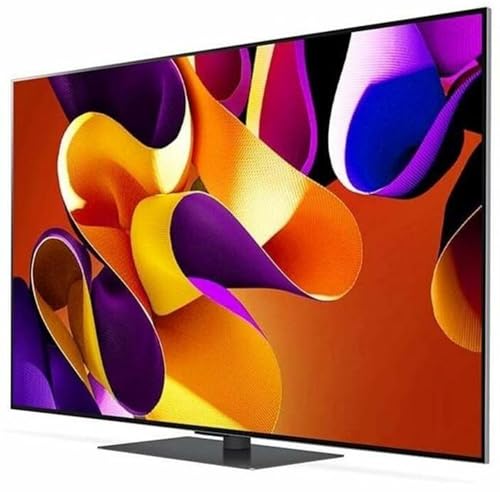
LG G4 OLED evo 65″ — Best bright-room OLED alternative
The G4 represents the other philosophy in this guide, and it represents it at flagship level. LG’s G-series is its gallery flagship, and the G4’s OLED evo panel is famous in this class for one thing above all: brightness, driven harder than LG’s mainstream OLEDs, with the panel technology and cooling to sustain it. A glossy panel this bright does not scatter the window’s reflection; it outshines it, keeping the picture’s own light so far above the reflected light that the eye follows the film. For buyers who want LG’s ecosystem, Dolby Vision and a flagship OLED, and whose problem is a bright room, this is the answer from the other direction.
One listing note, stated plainly as this guide’s pool records it: this G4 is sold through a marketplace listing under the LG Electronics storefront name, with webOS 24 and Dolby support in its title. Check the seller details and the exact model code on the listing before ordering, as flagship televisions attract varied marketplace offers, and confirm the set’s included accessories match the offer you choose. The television itself, the G4, is a known flagship quantity; the diligence is about the listing, not the product.
Judged as a television, the G4 is superb in the ways LG flagships are: Dolby Vision for the film library the Samsungs cannot serve, webOS, complete gaming support, and a gallery design that hangs flush and handsome. Judged as an anti-glare tool, its method has a boundary the matte sets do not share: in a truly dark scene, a bright window’s reflection can still ghost across a glossy surface, because brightness cannot help a pixel that is meant to be black. The G4 wins the bright scenes outright and draws the darkest ones. Know which scenes your room shows at midday, and you know whether this is your pick.
Gamers should register the G4’s credentials in passing, because a bright-room guide can undersell them: LG’s flagship gaming support is complete, with the high-refresh behaviour and low latency the G-series is known for, so the console corner loses nothing by choosing the brightness route. A set that is bought for a window problem and turns out to be a flagship for games as well is a pleasant form of over-delivery.
For the mixed household, bright afternoons of sport and dark evenings of film in the same room, the G4’s balance is arguably the most natural in this guide: flagship force when the sun is up, flagship OLED when it is down, with the reflection caveat confined to the narrow case of dark content in bright light.
- Panel: 65-inch OLED evo (G-series flagship), 4K
- Platform: webOS 24
- Formats: Dolby Vision and Atmos family per listing
- Design: gallery-style G-series
- Model: OLED65G4CUB; marketplace listing under LG Electronics storefront
Strengths
- Flagship OLED brightness that overpowers reflections through most content, with Dolby Vision included.
- Gallery design and webOS make it the complete LG flagship for a bright room.
- After dark it is simply one of the finest televisions in this entire guide.
Trade-offs
- A glossy surface can still ghost a bright window in the darkest scenes; it outshines reflections rather than scattering them.
- The listing is a marketplace offer under the LG storefront name, so verify seller and model code before ordering.
- Flagship pricing applies, as with the S95F.
Best for: bright rooms in Dolby Vision households wanting LG’s flagship, and mixed day-night viewing. Not suited for: rooms where dark content is watched in direct window light, where a matte panel is the correct tool.

Hisense U8QG 65″ — Best LED anti-glare value
The U8QG closes the guide with the brightness strategy in its most affordable serious form. Hisense’s flagship Mini-LED ULED pairs a low-reflection panel approach with the kind of backlight output that makes reflections a minority shareholder in the picture, and it does so at a price clearly below the OLED flagships above. The listing’s specification is by now familiar in this batch of guides, native 165Hz, deep local dimming, HDR10+, Dolby Vision IQ, Atmos and IMAX Enhanced, but the role here is different: this is the anti-glare pick for the buyer who wants an LED’s indifference to static images and all-day use, with brightness to spare.
Why does an LED belong in this guide at all? Because many bright rooms are also all-day rooms: news in the morning, sport in the afternoon, a dashboard or a game HUD for hours. An LCD panel shrugs at that duty in a way no OLED should be asked to, and the U8QG’s sheer luminance means the picture holds its colour and contrast while the room is at its brightest. Its reflection handling is the combination this guide described in the explainer: a panel surface that avoids the worst mirror behaviour, plus enough light of its own to swamp what remains.
The limits are the class’s limits. Its blacks, though backed by serious dimming, are a backlight’s blacks, and in a dark scene opposite a window the S95F’s matte OLED remains the finer instrument. The largest figures in the listing are the manufacturer’s claims and should be enjoyed as direction rather than audited as measurement. But as the LED answer to a bright room, at a value flagship’s price, with gaming and formats complete, the U8QG is the pick that lets a household solve the reflection problem and the all-day problem with one purchase.
There is a rental and resale angle to this pick as well. A bright LED set with no panel-care anxieties is the television you can lend a room to tenants, move to a holiday property or hand down without a briefing document. Its anti-glare case is about robustness as much as optics, and for households whose screens live hard lives, that robustness is the feature.
Hisense’s usual ownership advice applies and is repeated because it is practical: inspect the individual panel’s uniformity in the first days, while exchanges are easy, and settle the picture into its calmer modes for film. Do that, and this is the hardest-working screen in the guide.
- Panel: 65-inch Mini-LED ULED QLED, 4K, native 165Hz
- Gaming: VRR support, high-refresh game modes per listing
- Formats: HDR10+, Dolby Vision IQ, Dolby Atmos, IMAX Enhanced
- Audio: 4.1.2-channel per listing
- Platform: Google TV
Strengths
- Flagship LED brightness swamps reflections while the panel stays indifferent to all-day, static-image duty.
- Complete format support, Dolby Vision IQ included, which the Samsung matte flagships cannot offer.
- The strongest value route in this guide to a genuinely bright-room-capable screen.
Trade-offs
- Dark-scene finesse trails the matte OLEDs; its method is force, not subtlety.
- Headline figures in the listing are manufacturer claims rather than measurements.
- Check your individual panel’s uniformity during the returns window.
Best for: bright, all-day rooms, news-and-gaming households, and value-led buyers who need LED robustness. Not suited for: dark-scene purists, or rooms where a matte OLED’s finesse is affordable and appreciated.
What Does Each Strategy Look Like Across a Real Day of Viewing?
Run the day through both philosophies, because the difference is easier to feel in hours than in specifications. Morning news in a bright kitchen-adjacent room: the brightness sets are in their element, their pictures punching through ambient light with colour to spare, while the matte sets look calm and legible, the window reduced to a non-event. Neither household is suffering; they are suffering differently at most, and both are watching television that a glossy mid-range set would have turned into a negotiation with the curtains.
Midday sport is the brightness strategy’s showcase and the matte strategy’s competence test. A football pitch is bright material, so the G4 and U8QG simply outmuscle the room, while the Glare Free sets scatter the reflections and let their panels’ colour do the work. Both arrive at a watchable, enjoyable match. The divergence comes with the afternoon film, the dark thriller a household insists on watching before evening: here the matte OLEDs pull decisively ahead, because a night scene has no brightness of its own for the glossy sets to hide behind, and the window reappears on their surfaces exactly when the story goes quiet.
Evening reverses the field again. With the room’s own lamps lit, matte scatters their reflections and keeps its small, constant advantage, while in a properly darkened room the glossy G4 produces the deepest picture of the six, the one case where the brightness strategy also owns the night. The day, taken whole, is why this guide refuses to crown a single philosophy: it crowns households, and matches the strategy to the hours they actually keep.
How Do You Test Your Room Before Spending Flagship Money?
With the television you already own, or with a phone. Sit in the viewing seat at the worst hour of the day and look at the current screen while it shows something dark: what you see printed on it is the problem, measured in your own room rather than in a reviewer’s. Note which windows and lamps appear, and whether they fall on the screen’s centre or its edges. Then repeat after dark with the room lit as it is for viewing. Those two observations, ten minutes in total, tell you whether you need matte, brightness or merely a curtain, and they are worth more than any showroom visit, because showrooms are lit for selling televisions rather than for your life.
Photograph the result if you can. A phone picture of the dark screen at the worst hour gives you a record to compare against the new set on its first day, and it settles arguments about whether the treatment was worth it with evidence instead of memory.
If the test shows one window, at an angle, mostly in the morning, placement and a blind will likely solve it and the money belongs in pure picture quality. If it shows a wall of glass, a lamp you cannot move and reflections in both sessions, the panel treatment is not an upgrade; it is the purchase. Buy accordingly, and let the room, measured honestly, make the decision this guide has been circling.
Mirrors, Matte and Raw Brightness: How the Six Sets Fight Your Windows
| Pick | Strategy | Panel | Dolby Vision | Room it suits |
|---|---|---|---|---|
| Samsung S95F | Glare Free matte | QD-OLED | No | The brightest rooms, flagship budget |
| Samsung S95D | Glare Free matte | QD-OLED | No | Bright rooms, previous-gen value |
| Samsung S90H | Glare Free matte | OLED | No | Bright rooms, value tier |
| Samsung The Frame | Matte art panel | QLED | No | Design-led lit rooms |
| LG G4 | Brightness | OLED evo | Yes | Mixed bright days, dark nights |
| Hisense U8QG | Brightness | Mini-LED | Yes, IQ | All-day bright rooms |
Notice also what the table does not contain: a bad television. Every strategy here is executed on a panel worth owning after sunset, because the anti-glare buyer is still a television buyer, and a screen that solves the window while boring the household has solved the wrong problem.
The table’s shape tells the story of this market. Samsung owns the matte strategy outright, with three OLEDs and an art panel; the brightness strategy is where its rivals answer, and where Dolby Vision lives. Your format loyalties and your room’s hours will pick a column before any reviewer can, and the honest guide’s job is to make sure the pick within that column is the right one.
What About the Rooms Nobody Mentions: Rentals, Offices and Holiday Homes?
The anti-glare case quietly extends beyond the family living room. A rental property’s television faces windows the tenant did not choose and cannot curtain heavily, and a matte set is the difference between a screen that works in the letting photos and in life. A home office that doubles as a viewing room asks its screen to be legible across the whole working day, and the same scattering that saves a film saves a presentation or a video call’s shared screen. A holiday home, watched in at bright hours by people who did not come on holiday to draw curtains, is practically the design brief for this entire category.
In each of those rooms the value picks in this guide, the S90H and the U8QG, do the heavy lifting, because the budget there is rarely flagship and the problem is never smaller for being in a second property. The principle generalises: anywhere a screen must perform in light it does not control, the surface and the brightness stop being specifications and become the product. That is the thought to carry into the purchase, whichever room of yours prompted the search.
How Do You Finish the Job? Placement, Curtains and Settings That Multiply the Panel’s Work
Even the best anti-glare panel rewards a little cooperation. Where the room allows, angle the screen a few degrees away from the window’s direct line, or shift the seating rather than the set; reflections obey geometry, and small changes in angle produce large changes in what the surface has to scatter. Curtains or blinds for the worst hour of the day are not a defeat for the technology; they are the difference between the panel working comfortably and working at its limit, and every professional cinema in a bright building uses them without shame.
Sound placement interacts with bright rooms more than people expect, because the seating that avoids reflections is not always the seating centred on the speakers. If the room’s geometry pushes the sofa off-axis, a soundbar with a wide soundstage, or seating adjusted a fraction toward the centre, repays the effort; the anti-glare panel has freed you to choose seats for sound and company rather than for the window’s mercy, and that freedom is worth using deliberately.
Settings matter too. In a bright room, the accurate picture modes of these sets include light-adaptive variants, Dolby Vision IQ on the Hisense, Samsung’s adaptive features on its flagships, that raise the picture’s floor intelligently as ambient light rises; use them in the daytime and the reference modes after dark. Keep the eco ambient sensors from fighting those choices by setting the behaviour deliberately once. And clean the matte surface correctly when it needs it: a dry or barely damp microfibre cloth, no solvents, no paper towels, because a matte coating is a precision surface and household glass cleaner is not its friend.
Which Anti-Glare Shopping Mistakes Should You Avoid?
The most common is buying the accessory instead of the television: a film for a glossy set, fitted with bubbles, softening a picture the household then lives with for years, when a factory matte panel existed at the tier they were already shopping. The second is expecting any panel to defeat direct sunlight; if the sun itself strikes the screen at viewing hours, the answer is shading first and television second, in that order. The third is buying matte for a dark room out of fashion, spending the small dark-room contrast the treatment costs and receiving nothing, because the room never presents a reflection to scatter.
A fifth mistake is judging the treatment in the shop. Showrooms are lit evenly and brightly in a way that flatters glossy screens and hides the matte advantage, which only appears against a real window with real daylight and a dark scene. If a retailer has a set near natural light, that is where to stand; if not, weight the room test described earlier in this guide over anything the shop floor can show you.
The fourth mistake is forgetting the lamp. Reflections at night come from the room’s own lighting, a standard lamp behind the sofa prints on a glossy screen as faithfully as a window does at noon, and households that only tested their room in daylight discover it in the first evening. Walk the room at both hours before ordering, and the pick will be right at both hours too.
Final Recommendation
For the bright room that defeats ordinary televisions, the Samsung S95F is the complete answer and the flagship this category revolves around. The S95D buys the same idea a generation back, the S90H brings it to a value tier with a 2026 runway, and The Frame solves the room that cares about beauty as much as brightness. The LG G4 and Hisense U8QG prove the brightness strategy at flagship and value levels, and restore Dolby Vision to the conversation. Whichever route you take, the first afternoon you watch a dark scene at midday and see only the film, the window finally off the screen and out of the story, you will know the premium was never for a feature; it was for your room, given back to you.
Frequently Asked Questions
Does a matte anti-glare screen make the picture look dull?
Older matte screens could soften a picture, but the current Glare Free and matte implementations scatter reflections with very little effect on the image itself in a lit room. In a dark room there is a small cost to absolute contrast, which is why this guide steers dedicated cinema rooms toward glossy flagships instead. In the rooms these sets are for, the picture looks dramatically clearer, not duller, because the reflection competing with it is gone.
Can I just buy an anti-glare film for my current television?
You can, and for a set you already own it may take the edge off a problem reflection. But a film sits on top of the picture, softening it slightly, is difficult to fit without bubbles or trapped dust, and cannot match a factory surface engineered with the panel. It is a patch for an existing set, not a strategy for a new purchase, which is why no film appears among this guide’s picks.
Is brightness or a matte panel better for a bright room?
They solve different halves of the problem. Matte scatters the reflection itself, which is decisive in dark scenes where a glossy panel has no light of its own to fight with. Brightness overwhelms reflections in bright and mid-tone scenes, where most daytime content lives. A room that watches films at midday wants matte; a room that watches sport and news in daylight can be served superbly by brightness. The guide’s table separates the two strategies so you can choose by your content.
Why do the Samsung picks lack Dolby Vision, and should it stop me?
Samsung supports the rival HDR10+ format across its range instead. Its sets show Dolby Vision content in standard HDR10, which still looks strong, and HDR10+ titles in their intended form. It should stop you only if your library and subscriptions are built around Dolby Vision and you care about the difference; in that case the LG G4 and Hisense U8QG in this guide are the anti-glare answers that keep the format.
Will anti-glare help with lamps and ceiling lights at night?
Yes, and this is the underrated half of the technology. A matte surface scatters any bright source’s reflection, including the lamp behind your sofa and the kitchen lights in an open-plan room. Households often buy for the window and then discover the evening benefit is the one they use most.
Is The Frame’s matte screen as good for television as the Glare Free OLEDs?
For reflection control in a lit room, it is genuinely effective, and for its art role it is the best surface in this guide. As a television picture, though, it is a good QLED rather than an OLED: its blacks and HDR impact sit a class below the Samsung OLED picks. Buy it when the room and the decor are the problem; buy a Glare Free OLED when the picture itself is the priority.
How should I clean a matte or Glare Free screen?
Gently, and with almost nothing. Power the set off, use a clean microfibre cloth dry or barely dampened with water, and wipe without pressure. Avoid glass cleaners, solvents and paper-based cloths, which can mark or strip the anti-glare coating. The surface is doing optical work; treat it like a camera lens rather than a window.
Related Guides
For the rooms at the other extreme, explore our 65-inch OLED television guide for dark-room contrast, the QLED 4K roundup organised around backlight brightness, and our patio television picks for screens that live outdoors entirely.
Related guides
- Best Doorbell Cameras No Subscription: Local Storage Picks, and the Ring/Blink Truth
- Best AC Powered Wireless Security Cameras: Wi-Fi Data, Mains Power, Zero Sleep
- Best 4K HDR Projectors: Tone Mapping, Color and the Rooms They Deserve
- Best TVs for Viewing Sports: Motion, Daylight Brightness and Broadcast Upscaling


