What's inside
- Where to buy
- Key Takeaways
- Quick Picks: Three Tank Photo Printers, One Cartridge Guest, Two Classes
- How Did We Choose From Such a Short Honest Shelf?
- Which Photo Printer — Tank, Cartridge or Class — Fits Your Photography?
- Why Do Six Inks Matter So Much for Photographs?
- What Paper Should a Tank Photo Printer Actually Eat?
- How Do You Keep a Photo Printer Ready Between Shoots?
- How Do You Build a Home Printing Workflow From Shot to Wall?
- What Should You Know About Print Longevity at Home?
- How Do You Choose Between the ET-8550 and the ET-8500 Without Regret?
- How Do You Organise a Print Archive That Your Family Will Thank You For?
- What Does a Photographer Owe a New Paper Before Judging It?
- How Do You Choose a First Portfolio to Print at Home?
- How Do You Spend a First Season With a Photo Printer?
- What Is the Social Life of a Home-Printed Photograph?
- How Do the Photo Routes Compare Honestly?
- What Mistakes Do Photo Printer Buyers Regret Most?
- Final Recommendation
- Frequently Asked Questions
- Related Guides
As an Amazon Associate I earn from qualifying purchases. This post may contain affiliate links at no extra cost to you.
gizmoverdict.com is reader-supported. When you buy through links on our site, we may earn an affiliate commission.
Where to buy
Honesty has to open this guide, because the shelf does. Shoppers searching for the best ecotank photo printers imagine a crowded field, and the verified reality is narrower: only three true refillable tank photo printers anchor this category — Epson’s EcoTank Photo ET-8550 and ET-8500, and Canon’s PIXMA G620 MegaTank Photo. All three use six inks, all three refill from bottles, and all three print photographs that justify the word photo. Everything else in this guide is labelled for exactly what it is.
The fourth linked machine is Epson’s Expression Photo HD XP-15000, and it is not a tank printer. It runs on cartridges. It appears here — clearly badged as a cartridge printer every time it is named — because it prints photographs up to 13 by 19 inches with a six-colour system, and for some photographers its wide format matters more than its ink delivery method. If your reason for reading is specifically escaping cartridges, skip its profile with our blessing; the three tank machines above it are your entire honest shortlist.
Two further profiles are prose-only, describing photo printing routes that no verified listing in our pool covers: a pigment-ink professional photo printer class, and a compact snapshot printer class. They exist so the guide maps the whole territory a photo printer buyer actually considers, without inventing a single listing. Three tanks, one admitted cartridge guest, two described classes — that is the true shape of this shelf, and we would rather show you its shape than pad it.
Buying advice specific to this shelf: photo printers are frequently sold in bundles with paper and ink whose value varies enormously, so price the bare machine first using the exact model names in our profiles. Confirm whether a listing describes a tank model or the cartridge XP-15000 with particular care, because the two Epson wide-format machines are confused in marketplace listings with a regularity that cannot all be accidental. The ink system is the product in this category; a listing vague about it is a listing to leave.
Key Takeaways
- Only three true tank photo printers are verified here: Epson ET-8550, Epson ET-8500 and Canon PIXMA G620 — all six-ink, all refillable.
- The ET-8550 is the wide one, printing up to 13 by 19 inches; the ET-8500 and G620 top out at letter and A4 sizes.
- The XP-15000 is a cartridge printer, included and labelled as a wide-format cartridge alternative — never as an EcoTank.
- Six inks, including a grey or photo black, are what separate photo printers from four-ink all-in-ones: smoother gradients, better black-and-white.
- Two profiles are prose-only class descriptions, included so the category map is complete without invented listings.
Quick Picks: Three Tank Photo Printers, One Cartridge Guest, Two Classes
| Pick | Badge | Why it earns its place |
|---|---|---|
| Epson EcoTank Photo ET-8550 | Wide-Format Tank Photo Flagship | Six-colour EcoTank printing up to 13 by 19 inches — the tank photo printer for photographers who print big. |
| Epson EcoTank Photo ET-8500 | Letter-Size Tank Photo Specialist | The ET-8550’s six-ink philosophy at letter and A4 sizes, with USB and memory card routes for camera-first workflows. |
| Canon PIXMA G620 MegaTank Photo | Canon’s Six-Ink MegaTank Photo Answer | Canon counters with its own six-ink refillable photo all-in-one for photographers in the Canon ecosystem. |
| Epson Expression Photo HD XP-15000 | Cartridge Printer — Wide-Format Alternative, Not a Tank | Six-colour wide-format photo printing to 13 by 19 inches from cartridges — included as the labelled non-tank option. |
| Pigment-ink professional photo printer class | Prose-Only: The Gallery Pigment Route | Pigment-ink machines with eight or more inks for archival gallery prints, described as a class without a listing. |
| Compact snapshot printer class | Prose-Only: The Pocket Snapshot Route | Small dedicated snapshot printers for instant 4 by 6 prints from a phone, described as a class. |
How Did We Choose From Such a Short Honest Shelf?
The test for a tank photo printer had three gates, and most of the market fails the first: refillable reservoirs, a photo-grade ink set of six colours rather than the document four, and a listing we could verify. Epson’s two EcoTank Photo models and Canon’s G620 pass all three, and between them they span the category’s real decision — wide format or standard format, Epson’s ink behaviour or Canon’s. That shortness is not a flaw in the guide; it is the guide’s most useful finding, because it tells you the category is young and every buyer should choose between these three deliberately.
The XP-15000 was admitted under a disclosed exception: it fails the tank gate outright, running on cartridges, but passes the photo gates so convincingly — six colours, 13 by 19 inch output — that excluding it would have hidden the wide-format alternative many photographers actually cross-shop. It is badged as a cartridge printer in its table row, its heading and its profile. The two prose-only profiles then cover, without links, the pigment-ink professional class and the pocket snapshot class, because real buyers weigh those routes before deciding.
Which Photo Printer — Tank, Cartridge or Class — Fits Your Photography?
Start with print size, because it eliminates half the shelf. If your photographs want to live at 13 by 19 inches, only the ET-8550 among the tanks — and the cartridge XP-15000 — can take them there. If letter-size prints are your ceiling, all three tanks compete, and ink personality, software habits and brand loyalty become the deciders. The two class profiles close the guide for buyers whose ambitions point at gallery pigment prints or pocket snapshots instead.

Epson EcoTank Photo ET-8550 — Wide-Format Tank Photo Flagship
The ET-8550 exists for the photographer whose best work deserves wall space. It prints up to 13 by 19 inches from six refillable inks, scans and copies as an all-in-one, and carries a rated pace up to 16 ppm for the document work that shares a photographer’s desk. In one machine, Epson collapsed what used to be two devices — the wide photo printer and the home office all-in-one — and the collapse is convincing because the photo half never feels like the compromise.
Six inks change what photographs look like in ways four inks cannot imitate. The additional grey and photo black smooth the gradients where portraits and skies usually band, and black-and-white prints gain the tonal depth that makes photographers print monochrome on purpose rather than as an apology. Bottled refills then remove the old wide-format dread: a 13 by 19 print stops being a small financial event and becomes an ordinary Tuesday experiment.
Buy it at the size of your ambition, honestly assessed. If your prints live at letter size and smaller, the ET-8500 below delivers the same ink philosophy in a tidier body. If you have ever stood in front of a framed print of your own work and wished it larger, this is the tank machine that answers, and it answers without a cartridge in sight.
The wide tray changes studio furniture, and photographers should plan for it honestly: a 13 by 19 sheet needs feeding room behind or above the machine and a clear landing zone in front, because a large print curling off a cluttered desk onto the floor is a heartbreak measured in ink. Give the ET-8550 a dedicated surface and it repays the rent by making the large print a casual act — and casual large prints are how photographers learn what their work actually looks like, which is the education this machine exists to provide. Keep one ritual from the darkroom era: inspect each large print under the light it will live in, because a print judged under studio lamps and hung in a dim hallway is two different photographs wearing the same ink.
- Ink system: refillable six-colour EcoTank reservoirs
- Maximum print size: up to 13 by 19 inches
- Functions: photo print, scan and copy all-in-one
- Engine class: rated up to 16 ppm for documents
Strengths
- Wide format opens genuine wall-print territory
- Six inks render gradients and monochrome beautifully
- Bottled ink makes large prints emotionally affordable
Trade-offs
- Largest body and commitment among the tanks
- Wide paper stock costs more per sheet
- Oversized for photographers who print small
Best for: a photographer printing for walls, portfolios and exhibitions, who wants tank economics at 13 by 19 inches.
Not suited for: a snapshot printer of phone photos at small sizes — the ET-8500 or even a general tank all-in-one serves that life for less.

Epson EcoTank Photo ET-8500 — Letter-Size Tank Photo Specialist
Most photographs, honestly printed, live at letter size or below — and the ET-8500 is built precisely for that majority. It carries the same six-colour EcoTank Photo philosophy as its wide sibling, rated up to 16 ppm, in a body scaled for a home studio desk rather than a print station. Portfolios, proof sheets, framed 8 by 10s and the family archive all come off this machine with the gradient smoothness that six inks buy.
Its connectivity tells a workflow story: USB and memory card support sit alongside wireless, welcoming the camera-first photographer who walks in with a card rather than a cloud account. Print the contact sheet, mark it up with a pencil, print the keepers — a darkroom rhythm translated into tank hardware, at bottled-ink prices that make proofing generous instead of anxious.
Against the Canon G620 below, the choice is ecosystem and habit: Epson’s photo software lineage against Canon’s, near-identical paper ceilings, both six-ink and refillable. Against its own sibling, the question is only size. Photographers should answer the size question from their walls, not their wishes — measure the largest print you actually made last year.
The memory card slot shapes a workflow worth designing deliberately. Photographers who shoot, card-print a contact sheet, and then edit find that the physical sheet changes their editing: keepers announce themselves at arm’s length in a way thumbnails never do. Keep a pencil beside this machine and mark the contact sheets; the archive of marked sheets becomes, over years, a paper history of your own judgment improving. The ET-8500 also suits the household where photography is shared — one partner shooting, the other printing for the family walls — because its all-in-one manners and card routes let the printer serve both the art and the administration without either feeling like the compromise.
- Ink system: refillable six-colour EcoTank reservoirs
- Maximum print size: letter and A4 class
- Functions: photo print, scan and copy all-in-one
- Workflow: USB and memory card support alongside wireless
Strengths
- Six-ink photo quality without wide-format bulk
- Card and USB routes suit camera-first habits
- Tank refills keep proofing sessions generous
Trade-offs
- Cannot print the 13 by 19 poster size
- Still an all-in-one body, not a desktop miniature
- Photo paper stock remains a real running cost
Best for: a home-studio photographer whose prints live at letter size and whose workflow starts with a memory card.
Not suited for: an exhibitor printing above A4 — step up to the ET-8550 rather than cropping your ambitions to fit this tray.

Canon PIXMA G620 MegaTank Photo — Canon’s Six-Ink MegaTank Photo Answer
Canon’s G620 proves the tank photo idea is not an Epson monologue. Six inks refill from MegaTank bottles, photographs emerge with the smooth gradients and deep monochrome tones that the extra inks exist for, and the all-in-one body scans and copies between photo sessions. For photographers whose cameras, lenses and habits already run Canon, this is the machine that keeps the ecosystem unbroken from shutter to print.
Canon’s colour personality has long leaned warm and pleasing, and the G620 carries that house style into tank form. Family photographs, travel prints and portfolio proofs come out with skin tones that flatter rather than merely measure correctly — a distinction photographers argue about happily and that genuinely matters when the prints are of your own people. Wireless printing folds the phone camera roll into the same workflow without ceremony.
The G620’s ceiling is the standard format, like the ET-8500, and its contest with that machine is the closest in this guide. Choose by ecosystem, by which refill bottles your local shelves stock, and by which software you would rather live in. On output alone, at letter size, most photographers would need both machines side by side and a loupe to feel superior about either.
Canon shooters should exploit a quiet advantage of staying in one ecosystem: colour expectations transfer. The rendering instincts learned from Canon camera screens and Canon software carry into the G620’s output with fewer surprises than a brand switch imposes, and the photographer’s calibration effort — the test prints, the paper profiles, the learned corrections — compounds instead of resetting. One discipline completes the ownership: keep the G620’s photo work and the household’s document work in separate paper habits, with photo stocks stored sleeved and flat, because a six-ink photo printer fed bent, dusty paper will produce evidence of the insult at exactly the size where it cannot be ignored.
- Ink system: refillable six-ink MegaTank reservoirs
- Functions: photo print, copy and scan all-in-one
- Maximum print size: letter and A4 class
- Connectivity: wireless printing for cameras and phones
Strengths
- Six-ink photo output in Canon’s warm house style
- Keeps Canon photographers in one ecosystem
- Tank economics for generous proofing
Trade-offs
- No wide-format printing above standard sizes
- Smaller photo-printer lineage than Epson’s range
- Bottled ink still demands regular printing
Best for: a Canon-system photographer printing portraits and travel work at letter size, week in and week out.
Not suited for: a wide-format landscape printer — the ET-8550’s 13 by 19 tray is the honest answer to that portfolio.
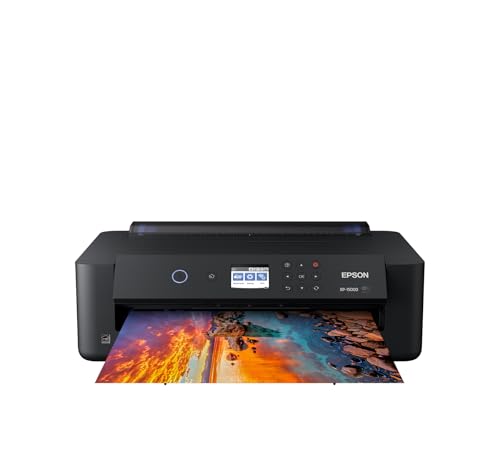
Epson Expression Photo HD XP-15000 — Cartridge Printer — Wide-Format Alternative, Not a Tank
The badge above is the most important sentence in this profile: the XP-15000 is a cartridge printer. It has no tanks, it refills nothing, and we include it in a tank guide for one disclosed reason — it prints six-colour photographs up to 13 by 19 inches, at a rated pace up to 9.2 ppm, with automatic two-sided printing for the documents between photo jobs. Photographers cross-shopping wide format will meet it on every shelf, and a guide that pretended otherwise would be protecting a definition at the cost of the reader.
Judged as a photo printer rather than as a tank apostate, it is a serious instrument. Epson’s six-colour Expression Photo HD line exists for photographers who print big and print carefully, and its output at poster sizes stands comparison with the ET-8550’s. The difference lives entirely in the ink economy: cartridges cost more per millilitre than bottled tank ink by a wide margin, and a heavy proofing habit will feel that difference monthly.
So the honest framing is a trade, plainly stated. Choose the XP-15000 if wide-format photo quality is the whole brief and your print volume is measured — exhibitions prepared deliberately, not contact sheets by the dozen. Choose the ET-8550 if the same size comes with volume, because at volume the tank’s ink economics stop being a preference and become arithmetic.
Cartridge ownership, chosen knowingly, has its own disciplines and this machine rewards them. Buy cartridges in the rhythm your printing actually follows — a full spare set is a significant shelf investment, and photographers who print in exhibition bursts often keep spares only for the colours their work drinks fastest, learning the set’s appetites from the first two exhibitions. The XP-15000’s automatic two-sided printing earns its keep between photo projects, handling the studio’s documents on the same desk. Above all, keep the cartridge decision honest at reorder time: the photographer who chose this machine for its output and volume should not drift into resenting an economy they selected with open eyes.
- Ink system: six-colour cartridges — NOT refillable tanks
- Maximum print size: up to 13 by 19 inches
- Engine class: rated up to 9.2 ppm
- Paper handling: automatic two-sided printing for documents
Strengths
- Wide-format six-colour photo output
- Established Expression Photo HD lineage
- Duplex printing covers between-photo documents
Trade-offs
- Cartridge ink costs far more per print than tank ink
- No refillable reservoirs of any kind
- Slower rated pace than the EcoTank Photo pair
Best for: a deliberate, low-volume wide-format photographer who values the output and accepts cartridge economics knowingly.
Not suited for: anyone whose actual goal is escaping cartridges — that is the ET-8550, and buying this instead would defeat the purpose of your search.
Pigment-ink professional photo printer class — Prose-Only: The Gallery Pigment Route
Above the tank photo machines sits a class this guide describes without linking: professional pigment-ink photo printers. Their ink sets run to eight, ten or more cartridges — multiple blacks, chromatic colours, sometimes a gloss optimiser — and their promise is archival permanence: prints rated to hold colour for generations under glass, on fine-art papers with names like baryta and cotton rag. Exhibition photographers and print-sellers live in this class, and its absence from our verified pool is a pool limitation, not a judgement on the machines.
The trade-offs are equally grand. Pigment ink costs more per print than any dye-based tank, the machines are large and deliberate, and the learning curve includes paper profiles, soft proofing and a relationship with test strips. For a photographer selling prints that must outlive the buyer, those costs are the profession. For a family archivist, they are theatre beyond the script.
Use this profile as a compass. If your ambitions include gallery walls, limited editions and paper that costs more per sheet than some printers cost whole, research this class with a specialist retailer and handle sample prints in person. If your ambitions are beautiful prints of your own life at home, the three tank machines above already exceed them.
Photographers researching this class should insist on handling prints before handling specifications. Specialist retailers and print studios will often produce a sample of your own file on the papers you are considering, and ten minutes with that sample under gallery light teaches more than a month of gamut diagrams. Ask also about the unglamorous infrastructure: paper profiles for the stocks you love, the local availability of every ink in the set, and what the machine demands in weekly exercise. The professional class rewards owners who treat printing as a craft discipline; it punishes, with remarkable consistency, owners who expected an appliance.
- Ink system: pigment cartridges, eight inks and upward
- Promise: archival print permanence for gallery work
- Media: fine-art and exhibition paper specialisation
- Status: class description only; no verified listing in this pool
Strengths
- Unmatched print permanence for sold work
- Fine-art paper handling is the design centre
- Widest colour gamut in home-reachable printing
Trade-offs
- Highest ink and paper costs in photo printing
- Large machines with a real learning curve
- Capability far beyond home printing needs
Best for: an exhibiting photographer selling prints whose permanence is part of the product being sold.
Not suited for: a home photographer — the tank trio prints your life beautifully for a fraction of this class’s running cost.
Compact snapshot printer class — Prose-Only: The Pocket Snapshot Route
The other direction from the tank machines is smaller, not bigger: compact snapshot printers that exist to turn a phone’s camera roll into 4 by 6 inch prints at parties, reunions and kitchen tables. This class is described without a link because our pool verified no listing for it, but real photo buyers weigh it constantly — often in the same basket as a tank printer — so the map should show it.
The class trades everything for immediacy. Prints are small, paper and ink arrive as combined packs or dye-sub ribbons, and the quality target is the fridge door and the wallet, not the frame shop. Judged on those terms the machines are delightful; judged as photo printers in the ET-8550 sense they are not playing the same sport, and a buyer expecting portfolio output from a pocket device has misread the class.
Plenty of households end up owning both routes: a tank photo printer for the considered print, a snapshot printer for the spontaneous one. If your photography is mostly the spontaneous kind, start with this class and let the tank wait until your walls start asking questions your pockets cannot answer.
The snapshot class has one purchasing trap worth naming: the printer is rarely the cost. Combined paper-and-colour packs price each print, and a delightful party can consume a month of sensible budget in an evening of generosity. Buyers should price their expected prints per month in the class’s own supplies before comparing machine prices, and households with teenagers should treat that arithmetic as a family conversation held in advance. Within its economics, the class is best bought for a named purpose — the wedding guest book, the reunion wall, the grandparent pipeline — because a purpose keeps both the machine and its supply shelf honestly sized.
- Output: small-format snapshots, typically 4 by 6 inches
- Input: phone-first wireless printing
- Supplies: combined paper and colour packs by class design
- Status: class description only; no verified listing in this pool
Strengths
- Instant prints where the moment happens
- Pocketable, party-friendly hardware
- Zero learning curve for phone photographers
Trade-offs
- Small prints only, forever
- Per-print supply cost is the highest here
- Not a portfolio or exhibition tool
Best for: a phone photographer whose prints are gifts, favours and fridge-door moments rather than framed work.
Not suited for: a photographer building a portfolio — begin with the ET-8500 or G620 and print at sizes your work deserves.
Why Do Six Inks Matter So Much for Photographs?
A four-ink printer builds every colour from cyan, magenta, yellow and black, and photographs expose the seams: skies band where gradients should glide, shadows block up into black pools, and black-and-white prints pick up colour casts from inks never designed for neutrality. The six-ink systems in this guide add a grey or photo black — and in some designs a red or lighter tones — whose entire job is the in-between: the gradient steps, the shadow detail, the neutral grey that stays neutral.
The difference announces itself most in the two hardest subjects. Skin tones live in narrow colour territory where a small error reads as illness or sunburn, and six inks give the printer more native steps through that territory. Monochrome prints are the second witness: with a dedicated grey path, a black-and-white photograph becomes a deliberate artistic choice with real tonal depth, rather than a colour print with the saturation apologised away.
What Paper Should a Tank Photo Printer Actually Eat?
Photo printers are only ever as good as the paper decision, and tank owners have a particular temptation to resist: printing photographs on the everyday plain paper used for documents, then blaming the ink. Plain paper drinks ink into its fibres and returns soft, muted images from any machine. A small library of proper stocks transforms the same printer — glossy for the punchy family print, lustre or satin for portraits that must survive fingerprints, matte for the fine-art mood — each selected in the driver so the machine meters ink for the surface it is actually meeting.
Buy paper the way photographers buy lenses: fewer types, learned deeply. One glossy and one matte you know well will produce better prints than a drawer of exotic stocks you have never profiled. And run the test-print ritual on any new paper — a small strip of your hardest image, sky and skin in one frame — before committing a full sheet at 13 by 19, where mistakes wear their full size.
How Do You Keep a Photo Printer Ready Between Shoots?
Photo printers suffer a particular neglect pattern: the photographic burst, then the silent month while life happens, then the urgent print met by a clogged nozzle and a ruined evening. The tank machines here share inkjet physiology with every ink printer — ink must move — but photographers feel the stakes higher because the print that fails is usually a gift or a deadline. A small colour print every week or two, even a phone snapshot on plain paper, keeps the whole system exercised at trivial cost.
Storage matters as much as exercise. Keep the printer in the room where you live, not the garage where temperatures swing, and keep paper flat, sleeved and out of sunlight, because paper ages before it ever meets ink. When a big print session approaches — the exhibition, the family archive weekend — run nozzle checks the day before, not the morning of, so any cleaning cycle happens on a day when it cannot hurt anyone’s plans.
How Do You Build a Home Printing Workflow From Shot to Wall?
Begin at the wall, not the camera. Decide the sizes your home actually displays — the frames you own, the portfolio you carry — and let those sizes choose the printer, which is how the ET-8550 and ET-8500 divide their buyers without either being better. Then build backwards: an editing screen you trust, one glossy and one matte paper you have tested, and a folder on the computer named for printing alone, into which only finished, print-ready files are allowed to live. That folder is the workflow’s heart; everything outside it is still photography, everything inside it is printing.
The printing session itself deserves a rhythm. Proof small before printing large, even on a tank machine whose ink invites generosity, because composition errors are cheaper at 4 by 6 than at 13 by 19. Print the keeper, leave it somewhere visible for a day before framing it, and let the overnight look catch the colour cast or the crooked horizon that enthusiasm missed. Photographers who adopt this unhurried loop find their walls filling with work that survives familiarity — the only review that ultimately matters.
What Should You Know About Print Longevity at Home?
Home prints live or die by their environment more than by their ink. Sunlight through a south-facing window is the great fader, and a print that would hold its colour for decades in an album can wash out in a few bright years on the wrong wall. Choose hanging places the way galleries do — out of direct sun, away from kitchen steam and bathroom humidity — and the dye-based prints from this guide’s tank machines will serve a family’s lifetime of looking without complaint.
Framing multiplies whatever care the wall began. A mount that keeps the print off the glass, a backing that is not acidic cardboard, and a frame hung where hands do not constantly adjust it — these modest choices protect the photograph’s second decade. For the prints that matter most, the archive rule is oldest and best: keep the file, keep a second print in a dark album, and let the framed copy be the one that lives in the light. Permanence at home is a system, not a specification.
How Do You Choose Between the ET-8550 and the ET-8500 Without Regret?
The two Epsons share an ink philosophy and divide on a single physical fact, so the decision method can be refreshingly concrete. Take the largest print you made in the last two years — actually made, not contemplated — and measure it. Take the largest frame in your home and measure that too. If either measurement reaches toward 13 by 19, the ET-8550 is your machine and its extra size is a tool you will use. If both live comfortably at letter size and below, the ET-8500 gives you the same six-ink quality in a body that leaves desk for the rest of your photographic life.
Then apply the honesty discount. Photographers systematically overestimate their future large printing by a factor that would embarrass a fisherman, because the wide printer is bought for the photographer we intend to become. Intentions deserve some credit — a new capability does change behaviour, and several ET-8550 owners print large precisely because they finally can. Weigh one season of intention, no more. If the wide work has not begun within a year of owning the smaller machine, it was never the printer that was missing.
How Do You Organise a Print Archive That Your Family Will Thank You For?
A photo printer changes a family’s relationship with its own history, because the archive stops being a phone’s camera roll — searchable by nobody, owned by a platform, one lost password from legend — and becomes objects. Organise the printed archive with the same date-and-subject naming the digital files should have, store prints in albums or boxes that keep them flat, dark and dry, and print the index: one contact sheet per year, filed at the front, so a grandchild can browse a decade in a minute without touching a screen.
The tank machines in this guide make that archive economically sane, which is their deepest virtue. Previous generations rationed prints; a family with bottled six-ink printing can print the archive generously — duplicates for siblings, enlargements for grandparents, replacements when a frame’s print fades — and generosity is what turns an archive from a hoard into a distribution system for memory. Print the photographs. That sentence, repeated across a childhood, is the entire argument for this category.
What Does a Photographer Owe a New Paper Before Judging It?
Every paper has a learning curve measured in sheets, and photographers who judge a stock by its first print abandon good papers for crimes of unfamiliarity. The fair trial is threefold: one reference photograph you know intimately, printed at a modest size; one photograph chosen to stress the paper — deep shadows for matte stocks, saturated colour for glossy; and one night of living with both prints where they will actually hang, because paper is a surface in a room, not a specification on a packet.
Record the settings that produced the best of the trial on the paper’s own packaging, in pencil, where future-you will find it mid-session. Photographers who keep these small records build, over a few papers, a personal library of known results — and known results are what separate printing as a craft from printing as a lottery. The machines in this guide are consistent enough to reward the record-keeping; inconsistency was never their habit, only their owners’.
How Do You Choose a First Portfolio to Print at Home?
A photographer’s first home-printed portfolio should be chosen as an argument, not as a greatest-hits album. Select photographs that converse — a single subject returned to across seasons, a place documented as it changed, a family member photographed yearly — because a portfolio printed at home can be revised as the argument sharpens, and that revisability is the home printer’s creative superpower over the lab. Print the first version generously on the tank machines, live with it in a folder for a month, and let the weak prints identify themselves by the simple test of which ones you stop turning to.
Then print the second version at final size, on the final paper, and stop. Home printing’s shadow side is the endless revision, the portfolio that is always one reprint from ready. The discipline that galleries impose by deadline, the home photographer must impose by decision — and the decision is easier when the first version was printed early, cheaply and honestly, because by the second version the argument has usually become clear enough to defend in public.
How Do You Spend a First Season With a Photo Printer?
Season one should be structured as generosity with a notebook. Print the family backlog first — the photographs that exist only as files and therefore, in the long run, barely exist at all — and let the machine’s early weeks be measured in albums filled rather than in test charts. Keep the notebook beside the printer for paper and setting notes, because the season’s lessons arrive disguised as individual prints: this matte stock flatters skin, that glossy eats shadow detail, the wide print needs its brightness lifted. Written down, they become the studio’s knowledge; trusted to memory, they become next season’s repeated experiments.
Mid-season, print one subject three ways — small on glossy, large on matte, monochrome at portfolio size — and live with all three in the room for a week. That single exercise teaches more about your own photographic intentions than any upgrade debate, because it reveals which version you actually look at. Photographers routinely discover their true format this way, and the discovery re-aims every later purchase, from paper stock to the next camera body, with a clarity no review can supply.
Close the season by printing the year’s best photograph at the machine’s full ambition and giving it away. A print given is a print judged by the only standard that survives: whether it holds a wall in someone else’s house, in someone else’s light, telling its story to people who were not there. Tank photo printing exists to make that gift inexpensive enough to be habitual — and a photographer whose best work habitually leaves the house in frames is a photographer whose next season needs no further justification.
What Is the Social Life of a Home-Printed Photograph?
A printed photograph does social work no file performs. It sits on a colleague’s desk making an introduction daily; it arrives in an envelope and changes the temperature of a family argument; it is found in a drawer twenty years later by someone who needed exactly that face on exactly that day. Home photo printing, at tank prices, multiplies those encounters by removing the deliberation that lab pricing imposed — the print is made because the moment suggested it, not because a batch justified the postage.
Photographers who print at home report a subtler effect on the photography itself. Knowing a photograph may become an object by evening changes the shooting: horizons straighten in camera, exposures are made with a wall in mind, and the casual frame is taken anyway because printing has made experimentation cheap in both directions. The three tank machines in this guide are, in that sense, camera accessories as much as printers — the half of the photographic process that happens after the shutter, finally living in the same house as the half that happens before it.
Guard the social life with one courtesy: print for people, and give the prints away promptly, while the occasion that prompted them is still warm. A drawer of unposted prints is a file by another name. The wall, the envelope and the fridge door are where this category’s entire value is realised, and every week a finished print spends reaching one of them is interest unpaid on a very good investment.
How Do the Photo Routes Compare Honestly?
The most honest column in this table is the ink system. Three refillable tanks, one admitted cartridge machine, and two classes described without listings — separated by print size and purpose, united only by the photographs they exist to make.
| Pick | Role | Defining trait |
|---|---|---|
| Epson EcoTank Photo ET-8550 | Wide-format tank photo | Six inks, prints up to 13 by 19 inches |
| Epson EcoTank Photo ET-8500 | Standard-format tank photo | Six inks at letter size with card-based workflow |
| Canon PIXMA G620 MegaTank Photo | Canon tank photo | Six MegaTank inks with Canon colour character |
| Epson Expression Photo HD XP-15000 | Cartridge wide-format | 13 by 19 six-colour printing; cartridges, not tanks |
| Pigment-ink professional photo printer class | Pro pigment class (prose) | Archival pigment printing beyond the tank category |
| Compact snapshot printer class | Snapshot class (prose) | Pocket 4 by 6 printing for spontaneous photos |
What Mistakes Do Photo Printer Buyers Regret Most?
Believing the label without reading it leads the list. A four-ink tank all-in-one is a fine machine and a mediocre photo printer, and buyers who purchase one expecting six-ink results feel cheated by arithmetic they never checked. Count the inks, confirm the reservoirs, and — in guides like this one — notice when a wide-format guest is badged as a cartridge printer, because that badge is the difference between a recommendation and a trap. The XP-15000 is a good machine; it is simply not the machine a cartridge refugee is looking for.
Printing photographs on plain paper runs second, followed closely by judging a photo printer by its first print on an unprofiled screen’s colours. Calibrate expectations in order: right paper, right driver setting, a monitor you have at least roughly matched to print output. Finally, photographers buy wide format for a fantasy and print letter size for a decade. The ET-8550 is magnificent and the ET-8500 exists; measure last year’s largest actual print before choosing between them, and let the tape measure, not the daydream, spend the money.
One more mistake, small and constant: printing the final large sheet first. Even with tank ink’s generosity, the disciplined order — small proof, judgment at arm’s length, then the large print — catches the crop that clips a hand, the shadow that swallows a face, the horizon tilted by a degree that only reveals itself at size. The proof is not a tax on confidence; it is how professionals in every darkroom era have spent a little paper to protect a lot of it.
Final Recommendation
The category, honestly told, offers three tank answers. The ET-8550 takes photographers to 13 by 19 inches with six refillable inks; the ET-8500 delivers the same ink philosophy at the sizes most prints actually live; the Canon G620 keeps Canon photographers inside their ecosystem with six MegaTank inks of its own. The XP-15000 stands beside them as a capable cartridge alternative for measured-volume wide-format work — chosen knowingly, it disappoints no one. The pigment and snapshot classes mark the gallery ceiling and the pocket floor of the territory.
Whichever route lands in your studio, feed it real photo paper, print something small every fortnight, and make one large print of your best photograph in the first month — because a photo printer justifies itself in a single moment, the moment a picture you took becomes an object on a wall, and every week of delay in reaching that moment is the only true waste of ink in this entire guide.
One closing assignment, offered in earnest: within a month of any machine in this guide arriving, print the best photograph you have ever taken at the largest size the machine allows, and hang it where you will see it daily. If it disappoints, you have learned something true about the photograph or the setup while every warranty and return window is still open. If it delights — as it should — the machine has justified itself in the only currency this category ultimately trades in.
If the shortlist still feels abstract, borrow the photographer’s oldest decision tool: the contact sheet. List the three tank machines, and beside each, the largest print you would make this month, the paper you would buy first, and the wall it would hang on. The machine whose column fills in fastest, with real photographs and real walls, is the machine your life is asking for — and it has been asking, in most cases, since long before this guide was opened.
The photographs are already taken. They are sitting in phones and drives, in their thousands, waiting for the machine that makes them objects. Whichever route in this guide you choose — tank, cartridge or class — choose it this season, and let the walls start their work.
Print the photograph. Hang it where the light is honest. Then take the next one better, because it now has somewhere to go.
The shelf was short, and honestly so. Three tanks, one admitted cartridge guest, two roads described without shops to sell them — and somewhere in that short list, the machine that turns your archive into objects is waiting to be filled, loaded and believed in.
Frequently Asked Questions
Is the XP-15000 an EcoTank printer?
No, and this guide labels it accordingly every time it appears. The XP-15000 is a six-colour cartridge printer with wide-format ability up to 13 by 19 inches. It is included as a disclosed alternative for photographers who prioritise wide format over ink delivery method. If escaping cartridges is your goal, your shortlist is the ET-8550, ET-8500 and Canon G620.
Can these printers print documents too, or only photos?
The three tank machines and the XP-15000 are all all-in-one or document-capable designs that print everyday text and colour documents happily — the ET-8550 is rated up to 16 ppm. Photo specialisation adds ink colours and paper handling; it does not subtract office ability. Many owners run one of these as the household’s only printer without a second thought.
How big can the Canon G620 print?
The G620 works at standard sizes up to letter and A4 class, like the ET-8500. Wide-format printing up to 13 by 19 inches is the territory of the ET-8550 among the tanks, and of the cartridge XP-15000. If your portfolio includes poster-size work, that single specification decides your shortlist before ink brands enter the conversation.
Do six-ink printers use more ink than four-ink ones?
They use ink differently rather than simply more: the extra grey or photo black replaces mixtures the four-ink system would build from several colours, often with better results at similar consumption. The real economy in this guide is delivery method — bottled tank ink against cartridges — and on that measure the three tank machines stand together, well ahead of any cartridge design.
What is the difference between dye ink and pigment ink for photos?
The tank and cartridge machines in this guide use dye-based inks, prized for glossy vibrancy and smooth gradients. Pigment inks, described in the prose-only professional profile, sit on the paper surface rather than soaking in, trading a little gloss pop for archival permanence and fine-art paper range. For home prints displayed indoors, dye output delights for decades of ordinary viewing.
Can I print directly from my camera or memory card?
The ET-8500 explicitly supports USB and memory card routes alongside wireless, suiting a card-first workflow, and wireless printing from phones and computers is standard across the linked machines. Photographers who edit on a computer first — the majority for serious work — will drive any of these from their editing software with full control over size, paper and colour settings.
Can the tank photo printers handle thick fine-art paper?
They handle a range of photo and matte papers through their feed paths, and photographers should consult each model’s stated media limits before buying exotic stock in quantity. One sheet, tested with a forgiving image, is the correct first purchase of any new paper. Pigment-class machines remain the specialists for the heaviest fine-art media, which is part of the territory their prose profile describes.
How do I stop my prints looking darker than my screen?
Screens glow and paper reflects, so prints nearly always read darker than the monitor promised. The remedies are cumulative: lower the screen’s brightness toward print levels, soft-proof in your editing software with the paper’s profile where available, and raise the image’s brightness modestly for print as a learned habit for your specific machine and paper. Two or three test prints on one reference photograph will calibrate your eye better than any forum thread.
Should I print my own photographs or use a lab?
Both have honest territories. A lab wins for the occasional very large print, unusual media, and volumes beyond a home session’s patience. Your own tank photo printer wins for immediacy, privacy, iteration — the proof, the adjustment, the reprint in one evening — and for the sheer volume of family printing a lab’s per-print pricing quietly discourages. Most serious home photographers end up citizens of both, sending the exceptional out and printing the beloved at home.
Do I need a special monitor to print photographs well at home?
A perfect monitor is a luxury; a consistent one is a necessity. Any decent screen, kept at a moderate brightness and always viewed in the same room light, can anchor a home printing workflow once you have calibrated your expectations with test prints on your chosen papers. Photographers printed superbly for decades with far less feedback than a modern screen provides — the test print, judged in daylight, remains the final authority, and it costs one sheet.
Related Guides
Guides for the neighbouring print decisions: best refillable ink tank printers for everyday colour all-in-ones best color duplex laser printers for office documents in colour best portable bluetooth printers for photographs and pages on the move



[…] guides for the other printer families: best ecotank photo printers for six-ink photo output best aio monochrome laser printers for bursty document lives best portable bluetooth printers for […]
[…] complete the small-business desk: best aio monochrome laser printers for invoices and paperwork best portable bluetooth printers for paperwork away from the office best refillable ink tank printers for colour labels’ paperwork […]