What's inside
- Where to buy a letter-size photo printer, and one exclusion to know about
- Key Takeaways
- Quick Picks
- How did we judge photo printers for this specific size?
- What actually makes a letter-size photo print look good?
- The six letter-size photo printers, examined one at a time
- How do the six compare for a letter-size life?
- Six colors, eight colors, or the household set — how much ink system do you actually need?
- Which paper should you feed a letter-size photo printer?
- How does a photograph travel from a phone to a frame in this house?
- How do you digitize the shoebox — scanning the family archive with an all-in-one?
- What does a year of home photo printing actually cost, in honest tiers?
- What about black-and-white photographs at home?
- How do you keep a photo printer printing like new?
- What mistakes do home photo printers keep making?
- When should a photograph be letter size at all — and when should it be smaller, or larger?
- Final Recommendation
- Frequently Asked Questions
- Related Guides
As an Amazon Associate I earn from qualifying purchases. This post may contain affiliate links at no extra cost to you.
gizmoverdict.com is reader-supported. When you buy through links on our site, we may earn an affiliate commission.
Where to buy a letter-size photo printer, and one exclusion to know about
Each linked name below opens the listing for that exact model, which matters in a category where near-identical names hide different ink systems. The best 8.5×11 photo printers share one defining ability: they print a full letter-size photograph, borderless, at home, at a quality a frame will not embarrass. That single sentence excludes some famous names on purpose. Compact snapshot printers such as Canon’s SELPHY line are delightful machines that physically cannot print larger than postcard size, so they do not appear as picks here — a guide that recommended one for letter-size work would be lying in its title. What remains are six machines that genuinely own the 8.5 by 11 inch format, from household all-in-ones to an eight-color specialist.
A word, too, about what this size asks of the photograph itself. At 8.5 by 11, a print is large enough to reveal a careless crop, a tilted horizon and the softness of a hurried phone shot — and small enough to forgive all three in a family context. That forgiving-but-honest character is why the format anchors home printing: it teaches standards without punishing beginners, which is the precise definition of a good household tool. It is large enough to frame and hang without apology, small enough that ink and paper costs stay sane, and it matches the document size every one of these machines also handles for daily life — school forms, recipes, boarding passes in the years when those were printed. The picks divide by ink philosophy: cartridge machines that ask little upfront and more per print, a tank machine that inverts the bargain, and dedicated photo machines whose extra inks buy tonal subtlety that family snapshots rarely need but portraits and landscapes visibly reward.
Key Takeaways
- True 8.5×11 photo printing means borderless letter output; postcard-only snapshot printers are excluded from this guide deliberately, however good they are at their own size.
- The HP Envy Photo 7975 is the household answer — photo printing designed into a family all-in-one — while the Canon PIXMA TS7720 covers the same desk in a smaller footprint.
- Epson’s EcoTank Photo ET-8500 inverts the economics: six-color photo quality from refillable tanks, for households that print photographs weekly rather than occasionally.
- Extra ink colors buy gradients, not sharpness: the XP-15000’s six colors and the PRO-200S’s eight colors show their worth in skies, skin and shadow, not in text or snapshots.
- Paper choice moves print quality more than printer choice at this level — the same machine produces a mediocre print on office stock and a frameable one on proper photo paper.
Quick Picks
| Pick | Badge | Why it earns its place |
|---|---|---|
| HP Envy Photo 7975 | The household photo printer | A family all-in-one whose photo path — tray, inks and app — was designed for pictures first and documents second. |
| Canon PIXMA TS7720 | Compact all-rounder | Letter-size borderless photos plus everyday printing and scanning in the smallest body in this guide. |
| Epson EcoTank Photo ET-8500 | Tank economics, photo quality | Six-color supertank printing for households whose photo output would make cartridges ache. |
| Epson Expression Photo HD XP-15000 | Six-color step-up | A wide-format machine whose finest work happens at letter size, with red and gray inks smoothing its gradients. |
| Canon PIXMA PRO-200S | The serious letter artist | Eight dye inks and a photographer’s workflow for prints destined for frames, portfolios and sale. |
| Epson Expression Premium XP-8800 class | The slim alternative (prose-only) | A compact six-color all-in-one class for photo households short on desk, described without a link where no verified listing anchors it. |
How did we judge photo printers for this specific size?
Every machine was judged printing the same imaginary assignment: a shoebox of family photographs, a season of phone pictures, a few portraits worth framing, and the ordinary documents of a household, all at letter size or below. That assignment exposes what spec sheets hide. A photo printer lives or dies by its paper handling at photo weights — whether the tray feeds glossy stock without skew, whether borderless letter printing is a headline feature or a buried setting, whether the driver remembers that photographs and documents are different jobs. Machines designed as document printers with photo ambitions were marked down for exactly the friction their owners report: fussy rear feeds, washed color on the wrong profile, prints that curl because the machine treats photo paper as an inconvenience.
One more judging lens deserves disclosure, because readers apply it instinctively: how the machine behaves in the hands of the household’s least patient member. Photo printing that requires a computer, a driver expedition and a profile seminar will simply not happen in most homes, whatever the hardware’s ceiling. So the phone-to-print path was walked mentally for every pick — photograph taken, photograph sent, photograph in hand — and machines were credited for each step they removed from that path. The specialists earn their exemptions honestly (their buyers bring computers and intent), but among the household machines, frictionlessness is a quality specification as real as any ink count.
Ink systems were weighed as philosophies rather than numbers, in line with this site’s rule against static prices and fixed yield claims. Cartridge machines concentrate cost at the moment of printing; tank machines move it to the purchase and reward volume; multi-color dye systems spend ink on tonal range that only certain photographs reveal. None is universally correct — each maps to a printing rhythm, and the pick essays below are written to match rhythms to readers rather than to crown a single winner. Finally, scan and copy functions counted where present, because the letter-size photo printer in a real home is also the machine that digitizes the grandparents’ albums.
What actually makes a letter-size photo print look good?
Resolution headlines mislead more in photo printing than anywhere else in this site’s coverage, because a photograph’s perceived quality at letter size is governed by tone long before it is governed by dots. The eye reads a portrait’s skin gradient, a sunset’s banding, a shadow’s slow fall into black — and those are ink-system and paper achievements. A six or eight-color dye printer lays down lighter dilutions of its colors, so highlights and mid-tones blend without the visible grain a four-color system must fake with sparser dots. That is the entire technical story behind this guide’s upper picks, and it is why their advantage appears in skies and faces rather than in a sharpness test chart.
Paper is the second half of the story, and the cheaper half to fix. Glossy stock gives photographs their punch and their fingerprints; luster — the semi-matte finish labs favor — keeps most of the punch and forgives handling; matte papers trade saturation for a fine-art softness that suits some images and flatters none of the family snapshots. Every printer here ships with profiles for its maker’s papers, and using the matched profile is the single largest quality step a home printer can take without spending anything: the same file, the same machine, the correct profile selected, and a print emerges that looks a class above the default. The third factor is the file itself — a phone photograph at full resolution prints beautifully at letter size, while a screenshot or a twice-compressed social-media download will show its scars at any quality setting. A fourth factor, light, is the one nobody budgets for: a print is judged where it hangs, and the same photograph reads warm and rich in evening lamplight, cooler and flatter under a north window. Photographers who print seriously learn to proof under the destination’s light — a thirty-second walk with a test print that saves more reprints than any setting in the driver.
The six letter-size photo printers, examined one at a time

HP Envy Photo 7975 — The household photo printer
HP builds the Envy line for the house where the printer sits in shared space and serves everyone, and the 7975 is that philosophy’s photo specialist: an all-in-one with print, scan and copy, a photo paper path that treats pictures as the main job, and mobile printing polished enough that a phone photograph can become a framed letter print without a computer ever waking up. The listing notes an Instant Ink trial is included, which frames the machine’s economy honestly — HP would like your ink to arrive by subscription, a model that suits households printing steadily every month and annoys households that print in bursts.
A note on the Envy’s place in a connected house: HP’s printing app ecosystem is the machine’s second interface, and for the phone-first households it targets, it is the primary one — relatives send photographs, the app queues them, the printer produces letter prints that go straight into the frames the household keeps in standard sizes. The 7975 also handles the unglamorous surround of family life (the scanned permission slip, the copied document) without complaint, which matters because a photo printer that cannot do Tuesday’s paperwork gets unplugged by Friday. Its design brief — shared space, shared users, photographs at the center — is executed with unusual coherence.
Print character is the Envy’s argument: warm, pleasing color tuned for faces and family scenes rather than for laboratory neutrality, which is the correct tuning for its audience. The honest limitations are the class’s usual ones. As a cartridge all-in-one it will never match a tank machine’s cost rhythm for a high-volume photo household, and its photographic ceiling sits below the six and eight-color specialists when a print is examined closely in raking light. But for the assignment this guide defined — the shoebox, the phone roll, the school project, the framed grandchild — the 7975 is the pick most households would choose again, because it never makes printing a photograph feel like a technical event.
- Functions: print, scan, copy all-in-one
- Photo role: designed as a home photo printer per the listing
- Printing path: wireless, mobile printing emphasized
- Ink model: cartridges, Instant Ink trial included in the listing
- Size ceiling: letter-size borderless is its home format
Strengths
- Photo printing treated as the primary job, with the app workflow to match.
- Color tuned for the family subjects most home prints actually contain.
- Scanning and copying cover the household’s digitizing projects in the same box.
Trade-offs
- Cartridge economics punish the household that discovers it prints photographs weekly.
- Gradient connoisseurs will see the gap to six-color machines in skies and skin.
- Subscription ink is a relationship some households prefer not to have with a printer.
Best for: families printing photographs regularly but not relentlessly, from phones above all.
Not suited for: high-volume photo producers, or purists chasing gallery gradients.

Canon PIXMA TS7720 — Compact all-rounder
The TS7720 is the letter-size photo printer for the desk that is also a kitchen counter, a dorm shelf or a corner of a bedroom. Canon packages print, copy and scan into a compact all-in-one with auto two-sided printing, a small touchscreen, and the PIXMA line’s long-standing photo competence: borderless letter prints with the saturated, lively color Canon tunes for snapshots. The listing quotes document speeds of 15 pages per minute in black and 10 in color, which matters to this machine’s double life — it must be the household’s document printer too, and it is specified like one.
There is a domestic realism to the TS7720’s design that deserves naming: it assumes the printer will be operated by whoever is nearest, including the household’s least technical member, at the moment a form or a photograph is needed. The touchscreen’s plain guidance, the easy setup the listing advertises, and Canon’s mature phone printing all serve that assumption. Photo printers earn their keep in families precisely when nobody has to be summoned to operate them, and this little Canon is engineered around the summoning never being necessary.
Its photographic character rewards the casual print most. Canon’s dye-based color at letter size produces the bright, clean snapshot look families want, and the machine’s modest footprint means it lives where printing actually happens rather than in exile. The compromises are scale and economy: a compact body means modest paper capacity and a cartridge rhythm that suits occasional-to-regular printing, and its four-ink-class output cannot chase the gradient specialists on a demanding portrait. Judged as the one printer a small household owns for everything, photographs emphatically included, the TS7720 is the most balanced box in this guide.
- Functions: print, copy, scan in a compact body
- Duplex: automatic two-sided document printing
- Document speed: 15 black / 10 color pages per minute per the listing
- Interface: 2.7-inch touchscreen per the listing
- Photo role: borderless letter prints, PIXMA dye color
Strengths
- The smallest footprint here, without surrendering borderless letter photos.
- Document credentials strong enough to be the household’s only printer.
- Canon snapshot color flatters the phone photographs most owners print.
Trade-offs
- Compact capacity means frequent paper attention in busy weeks.
- Cartridge costs accumulate for the household that prints albums at a sitting.
- Serious gradient work belongs to the multi-color machines below.
Best for: small households and small desks needing one machine for documents and photographs alike.
Not suited for: volume photo printing, or buyers chasing the finest tonal subtlety.

Epson EcoTank Photo ET-8500 — Tank economics, photo quality
The ET-8500 exists to answer the cartridge era’s central complaint, and it answers with six colors of ink in refillable tanks. Epson’s EcoTank Photo formula matters here in both halves: the tank system converts ink from a per-print anxiety into a stocked supply, and the six-color dye set — the listing confirms cartridge-free six-color photo printing with scan and copy, at up to 16 pages per minute on documents — gives the machine genuine photographic range rather than the four-color compromise of office tanks. For the household printing photographs weekly — the scrapbooker, the school-project parent, the grandparent maintaining a wall of frames — this is the machine whose economics finally match the habit.
The ET-8500 also quietly changes a household’s relationship with experimentation. When ink is a stocked supply rather than a metered cartridge, owners print the second version — the warmer crop, the brighter edit, the test at a different size — instead of agonizing over the single attempt. Scrapbookers and grandparents in particular describe a before and after: photographs that would have stayed on the phone, because each print felt like spending, become physical because printing feels like using the pantry. Any honest accounting of this machine must include the prints that exist because it made printing feel inexpensive to attempt.
Ownership texture differs from cartridge life in ways worth knowing. Refilling tanks is a clean, oddly satisfying ritual with keyed bottles, and the printer rewards owners who print regularly, since ink systems generally prefer exercise to idleness. The machine is a substantial desk resident, and its purchase tier asks the household to be sure of its printing rhythm — the tank bargain only completes if the volume actually arrives. USB and memory card support in the listing suit the camera-first workflow. If your photo printing is a practice rather than an event, the ET-8500 is this guide’s most consequential recommendation.
- Ink system: refillable tanks, six-color dye photo set
- Functions: print, scan, copy all-in-one
- Document speed: up to 16 pages per minute per the listing
- Inputs: USB and memory card support per the listing
- Economics: cost concentrated at purchase, ink as a stocked supply
Strengths
- Six-color photo quality without the cartridge-per-print meter running.
- Refills turn ink into a pantry staple, ending the empty-cartridge weekend crisis.
- All-in-one functions keep the family archive workflow in one machine.
Trade-offs
- The purchase tier only pays back for households that truly print in volume.
- A substantial footprint compared with the compact cartridge machines.
- Tank systems prefer regular use; a printer left idle for months serves nobody well.
Best for: photo households with a weekly rhythm — scrapbookers, frame-wall grandparents, project-heavy families.
Not suited for: occasional printers, for whom the tank premium never completes its payback.
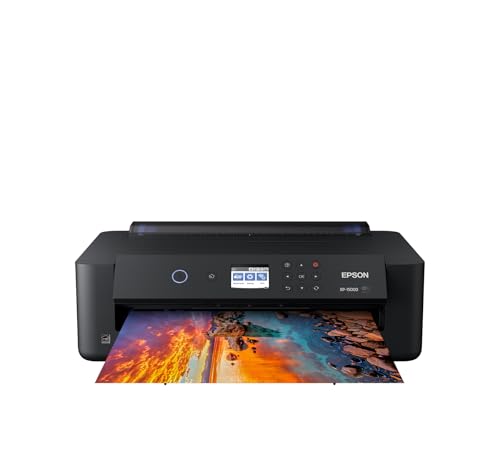
Epson Expression Photo HD XP-15000 — Six-color step-up
The XP-15000 is nominally a wide-format printer — the listing confirms output up to 13 by 19 inches — and it earns its place in a letter-size guide because machines built for larger work bring their best manners to smaller paper: a wide, confident paper path, six-color Claria-class dye inks including red and gray for smoother gradients and cleaner black-and-white, and auto two-sided printing for its document double life. A letter print from the XP-15000 is a big machine relaxing, and it shows in the evenness of skies and the neutrality of grays, the two places lesser photo printers confess their limits.
Letter size deserves a specific word in this machine’s case, because owners sometimes assume a wide-format printer treats smaller sheets as an afterthought. The opposite is true in practice: the paper path that must keep a 13 by 19 sheet straight and fed has margin to spare at letter width, the borderless letter mode is a headline feature rather than a hidden one, and the six-color engine’s gradient work is format-independent. Photographers who print letter weekly and large monthly get both behaviors from one box, which is the XP-15000’s real proposition — headroom without a second machine.
Its ownership bargain is the reverse of the ET-8500’s: cartridges keep the purchase approachable and the per-print meter visible, so this machine suits the photographer who prints selectively — the portfolio piece, the framed landscape, the competition entry — rather than the household printing albums. The wide body demands a desk that can host it, and owners should note its quoted document pace (up to 9.2 pages per minute in the listing) marks it as a photo machine that tolerates documents, not the reverse. For letter-size prints examined like photographs rather than glanced at like snapshots, it is the connoisseur’s value in this guide.
- Ink system: six-color dye, including red and gray
- Maximum size: up to 13 x 19 inches per the listing
- Duplex: automatic two-sided printing
- Document speed: up to 9.2 pages per minute per the listing
- Audience: photographers and home studios, per the listing
Strengths
- Six-color gradients and gray ink give letter prints a tonal calm four-color machines cannot fake.
- Wide-format headroom exists when a special print outgrows letter size.
- Black-and-white photographs benefit visibly from the dedicated gray.
Trade-offs
- A wide body that dominates the desks in smaller rooms.
- Cartridge rhythm penalizes the photographer who prints in long runs.
- Document speed confesses its priorities: photographs first, paperwork second.
Best for: photographers printing selectively at high quality, with occasional larger ambitions.
Not suited for: document-first households, or desks measured in centimeters to spare.

Canon PIXMA PRO-200S — The serious letter artist
The PRO-200S is the guide’s ceiling: a professional photo printer with an eight-color dye ink system, a 3-inch color LCD for managing the work at the machine, and a design brief that begins where the all-in-ones end. It prints up to 13 inches wide, but its inclusion here is for what that engine does at letter size — eight dye inks lay down the smoothest gradients and the richest, most deliberate color in this guide, the kind of output that goes into portfolios, client proofs and frames that hang in other people’s houses. This is the machine for the photographer who sells, exhibits or simply refuses compromise at the size they print most.
Working photographers add one more consideration in this machine’s favor: repeatability. A printer whose output holds steady across a session — the tenth letter print matching the first — is a production tool, and the PRO line’s owners buy exactly that steadiness for client proofs and editioned work. The onboard color screen shortens the loop between judgment and adjustment at the machine itself, without a trip back to the desk. In a guide full of household virtues, the PRO-200S represents a different one: professional calm, at the size where most professional work is actually proofed and much of it sold.
Everything about ownership is correspondingly deliberate. There is no scanner, no household double life; the PRO-200S is a single-purpose instrument that expects good files, matched paper profiles and an owner who prints with intent. Dye inks deliver their famous vibrancy on glossy and luster papers, while matte fine-art work is where pigment-based rivals (outside this guide’s scope) make their case. Buy it when your letter-size prints have an audience beyond the refrigerator door, and its seriousness stops being a cost and becomes the point.
- Ink system: eight-color dye, professional class
- Maximum size: 13-inch class per the listing
- Interface: 3-inch color LCD per the listing
- Functions: dedicated photo printer — no scan or copy
- Audience: photographers producing for frame, portfolio or sale
Strengths
- The finest gradients and color richness available at letter size in this guide.
- A photographer’s workflow — onboard screen, profile discipline, borderless control.
- Output that survives portfolio and client scrutiny, not just family approval.
Trade-offs
- Single-purpose: the household still needs another machine for scanning and forms.
- Eight cartridges make ink a considered budget line for active printers.
- Its talents are wasted on casual snapshots, which lesser machines flatter equally.
Best for: serious photographers whose letter-size work is shown, sold or exhibited.
Not suited for: households wanting one box for photographs, homework and scanning alike.
Epson Expression Premium XP-8800 class — The slim alternative (prose-only)
Between the compact all-in-ones and the wide-format specialists sits a class Epson has cultivated for years: the slim six-color home photo all-in-one, represented here by the Expression Premium XP-8800 class. The formula combines a space-conscious body with a six-color dye set — the extra colors serving photo gradients — plus scanning and the CD/DVD printing that was this line’s party trick. For the photo household whose desk cannot host an XP-15000 but whose standards exceed a four-color snapshot machine, this class is the natural compromise, and owner loyalty to it is long-standing.
Owners of this class tend to be quietly evangelical, and their testimony follows a pattern worth trusting: the machine disappears into a small home office, produces letter prints that guests assume came from a lab, and asks only the cartridge rhythm in return. For the apartment photographer — the renter with one desk and serious standards — this class may be the most precisely aimed in the entire guide, more so even than the headline picks, because it was designed around the constraint (space) that actually governs apartment printing.
It is presented prose-only with intent: this guide links only listings verified for the exact model, and the XP-8800 class’s current retail presentation is fluid enough that describing the class honestly serves the reader better than anchoring a link we cannot stand behind. If the formula appeals, shop it through established photo retailers, confirm the exact model and ink set on the box, and expect the class’s known character — handsome letter-size photographs, genuine gradient ability, cartridge economics, and a footprint that respects a small room. As the middle path of this guide, it deserves its place even without a button beneath it.
- Class: slim six-color photo all-in-one
- Functions: print with scan, in the class’s tradition
- Ink system: six-color dye, cartridges
- Availability: described as a class, prose-only in this guide
- Character: gradient ability in a room-friendly footprint
Strengths
- Six-color photo quality without the wide-format body’s desk demands.
- An all-in-one’s versatility for the household’s scanning and documents.
- A long-cultivated class with a deep base of owner knowledge.
Trade-offs
- No verified listing to link — the buyer must confirm model and ink set carefully.
- Cartridge economics, like every non-tank machine here.
- Its middle positioning means the extremes — tank value, pro ceiling — live elsewhere.
Best for: photo households balancing gradient quality against desk space.
Not suited for: buyers who want a one-click verified purchase, or volume printers.
How do the six compare for a letter-size life?
| Machine | Ink system | Colors | Also scans? | Size ceiling | Printing rhythm it suits |
|---|---|---|---|---|---|
| HP Envy Photo 7975 | Cartridge | Photo-tuned set | Yes | Letter borderless | Steady family use |
| Canon PIXMA TS7720 | Cartridge | Dye snapshot set | Yes | Letter borderless | Mixed documents and photos |
| Epson ET-8500 | Refillable tank | Six | Yes | Letter and above in class | Weekly photo volume |
| Epson XP-15000 | Cartridge | Six, with red and gray | No | 13 x 19 | Selective quality printing |
| Canon PRO-200S | Cartridge | Eight dye | No | 13-inch class | Intentional, audience-bound prints |
| Epson XP-8800 class | Cartridge | Six | Yes | Letter borderless | Compact photo households |
The rhythm column is the one to choose by. Note also what the table does not contain: a bad machine. Every pick prints letter-size photographs a household can be proud of — the differences that remain are economic, spatial and tonal, which is why this guide spends its length on rhythms and papers rather than on warning you away from any of the six. Ink systems are not good or bad in the abstract — they are matched or mismatched to how often the machine actually prints photographs, and every regret in this category is a rhythm mismatch wearing a technical disguise. Count your household’s photo prints in a typical month before you count ink colors, and the table will point at your machine.
Six colors, eight colors, or the household set — how much ink system do you actually need?
Walk the ladder with a photograph in mind: a portrait against a bright sky, printed at letter size. The household cartridge sets render it pleasingly — the face warm, the sky blue, the print gladly framed. The six-color machines smooth the two transitions the eye interrogates: the sky’s long fade, where sparse dots can grain, and the skin’s shadow side, where tone must step down without a visible stair. The eight-color PRO-200S refines further, in the reds and in the deepest shadow detail, differences that announce themselves in side-by-side examination and in the confidence of a photographer handing the print to a client. Each rung is real; each rung is also narrower than the one below it, which is why the ladder must be climbed by need rather than by appetite.
The deciding question is embarrassingly practical: how will the prints be looked at? Across a room, in an album, in the hand at arm’s length, under gallery attention at reading distance — the honest answer sorts most households onto the first two rungs and most working photographers onto the third. Buy the rung your looking distance demands, spend the difference on paper and frames, and the photographs themselves will never know what you saved.
Which paper should you feed a letter-size photo printer?
Buy paper with the same deliberateness as the printer, because at letter size the paper is half the product. Start with the maker’s own photo papers in two finishes: a glossy for the punchy family archive and a luster for anything destined for a frame, since luster’s soft sheen kills the reflections that make framed glossy prints unreadable under room light. Load photo paper in small stacks, fan it, and respect the printable side — every photo printer owner has produced one perfect print on the back of a glossy sheet, and the rite of passage needs no repeating. Store the stock flat, in its sleeve, away from the humidity that curls edges and defeats feed rollers.
Weight and thickness discipline matters at this size. Letter photo papers are substantially heavier than office stock, and each machine’s paper path has a temperament: tray feeding suits most, while the thickest fine-art sheets prefer whatever manual or rear path the design provides — consult the manual before forcing a board through a curved path. Finally, let prints dry as the maker directs before stacking, framing or sleeving them; dye prints in particular continue to set after they emerge, and the fingerprint pressed into a two-minute-old glossy print is permanent. None of this is fussiness — it is the difference between a print that looks homemade and one that looks home-printed, which are not the same compliment.
How does a photograph travel from a phone to a frame in this house?
The modern letter-size workflow is short enough to describe completely, and worth rehearsing once so it becomes habit. Choose the photograph at full resolution — from the camera roll’s original, not a messaging app’s compressed copy. Crop deliberately to the letter ratio rather than letting the printer’s default crop amputate a head or a horizon. In the print dialog, select the exact paper you loaded and the quality setting that matches it; this profile choice, as the earlier section argued, is where home prints are won. Print one copy, judge it under the light where it will live, and only then print the run.
Keep a small log beside the printer for the first month — paper loaded, profile used, result in a word or two. Photo printing’s variables are few enough that a month of notes permanently calibrates a household’s instincts: which paper flatters the baby’s skin, which setting the landscapes prefer, how the living-room light judges a print versus the kitchen’s. The log is the difference between a household that prints confidently and one that re-derives its settings at every session, and it costs nothing but the honesty to write down what the last print taught.
Framing finishes the discipline. A letter print behind glass wants a mat or at least a spacer keeping it off the glazing; a print for an album wants a sleeve; a print for the refrigerator wants no ceremony at all. Households that print photographs regularly develop a small station — paper stock, a few frames in the standard size, sleeves, a paper trimmer for the smaller sizes cut from letter sheets — and the station is what converts the printer from an appliance into a practice. The machines in this guide are all capable of feeding that practice; the station is the owner’s half of the bargain.
How do you digitize the shoebox — scanning the family archive with an all-in-one?
Three of this guide’s machines scan, and for many households the archive project justifies the purchase as surely as printing does. The workflow rewards method over speed. Work album by album or envelope by envelope, never as one undifferentiated pile. Clean the scanner glass, handle prints by their edges, and scan at a resolution that preserves the option of reprinting at the original size or modestly larger — the scanner’s honest optical setting rather than an interpolated fantasy number. Save masters in a lossless format in a folder named by year and event, and let the machine’s auto mode handle exposure for snapshots while reserving manual care for the few portraits that deserve it.
Labeling is the step households skip and archivists never do. On the back of each reprint, in pencil on the border or on the sleeve, write the names, the year and the occasion as the scanning session reveals them — spoken aloud by whoever remembers, captured while it is said. A photograph whose people are unnamed becomes anonymous within a generation, and the letter prints this guide exists to produce are exactly the artifacts grandchildren will interrogate. The printer produces the image; the household must produce the caption, and the scanning session is the last easy moment to do it.
Then close the loop the all-in-one was built for: the scanned grandparent portrait, restored by nothing more exotic than a careful crop and the printer’s own output, becomes a letter print for three siblings’ walls — the archive’s past converted into the household’s present by one machine. Households undertaking this project should pace it like the kit builders pace assembly: an envelope an evening, a folder a week, with the prints labeled as they are scanned, because the relative who remembers the names is a resource with its own expiry date. The photo printer, in this light, is not really a printer at all. It is the family’s memory infrastructure, and letter size is simply the size at which memory gets framed.
What does a year of home photo printing actually cost, in honest tiers?
This site does not print static prices, and photo printing is exactly why: the honest answer is a shape, not a figure. A cartridge household printing a few photographs a month spends its money in small, predictable cartridge events and a paper packet now and then — the gentlest tier, and the one the Envy and TS7720 serve. A tank household moves its spending to the purchase and then prints with the freedom of a stocked pantry; across a heavy year its per-print cost is the lowest of the three shapes, which is the entire ET-8500 argument. A multi-color photographer’s household spends on ink sets and serious paper in deliberate bursts, tied to projects — the cost of the PRO-200S and XP-15000 tier is best understood per finished, framed print rather than per sheet, because so much of their output is the final artifact rather than a snapshot.
Two hidden lines belong in every household’s mental ledger. The first is waste: the mis-fed sheet, the wrong profile, the print judged too dark — a small percentage of every paper packet, minimized by the test-print habit and never eliminated. The second is the alternative’s cost, which is not zero: lab prints carry their own per-print price plus travel and delay, and the photographs never printed at all — because the lab trip kept not happening — are the most expensive outcome in the whole comparison. A home printer’s deepest economic argument is behavioral: it converts intentions into objects at the moment the intention exists.
What about black-and-white photographs at home?
Monochrome is the connoisseur’s test of a home photo printer, because a black-and-white print exposes what color hides: a color cast sneaking into the grays, banding in the long tonal ramps, shadows that block into mud. The machines with dedicated gray ink — the XP-15000 in this guide — hold a structural advantage, building grays from gray rather than balancing them precariously from color inks, and their monochrome output has the neutrality that framed black-and-white demands. The eight-color PRO-200S answers with depth of palette and profile discipline; the household machines produce pleasant monochrome that a critical eye will catch tinting under some lights.
Practical counsel for the monochrome-curious: print the same portrait on luster and on matte, judge both under daylight after full drying, and let the paper decide — monochrome’s character changes more between papers than between any two printers in this guide. And convert deliberately: a photograph converted to black-and-white with intent, its tones shaped for print, outperforms a color print merely desaturated at the driver, on every machine here. Monochrome rewards the deliberate at every stage, which is precisely its appeal to the photographers who pursue it.
How do you keep a photo printer printing like new?
Photo printers ask for three forms of loyalty. Print something regularly — a small photograph every week or two keeps ink moving through heads that clog when abandoned, and the household that prints steadily performs most of its maintenance unconsciously. Keep the paper path clean and the stock stored properly, since dust and humidity are the twin authors of feed errors and mottled skies. And use the machine’s own alignment and cleaning utilities at the first symptom — a banded sky, a drifting color cast — rather than after a month of compensating in software, because head problems compound quietly and announce themselves on the print you cared about.
When a print degrades, diagnose in the order of cost: confirm the paper and profile first, run a nozzle check second, clean third, and only then suspect the ink or the machine. That sequence, which costs nothing but a test sheet, resolves the overwhelming majority of photo-printing complaints in every support forum for every brand in this guide. The owners who internalize it describe their printers as reliable for years; the owners who begin by replacing cartridges describe the same machines as temperamental. The difference is not luck. It is procedure.
What mistakes do home photo printers keep making?
Printing on the wrong paper with the wrong profile is the sovereign error — office stock selected by default, glossy results expected anyway. Its cousin is judging a printer by its first print on whatever paper was in the tray, then returning a good machine for a paper crime. A third error is economic: buying the professional eight-color machine for snapshots a compact all-in-one flatters identically, or buying the compact machine for a weekly album habit whose cartridge rhythm will teach the household to dread printing. Rhythm first, as the comparison section insists.
A subtler mistake deserves its own sentence because it wastes the best machines: printing every photograph at the driver’s highest quality setting regardless of subject. The top setting spends ink and time on micro-detail a snapshot cannot contain, while the standard photo setting — on the correct profile — is indistinguishable for most family images. Save the maximum setting for the prints that will be framed and examined; let the everyday archive print at the honest middle, and both the ink budget and the household’s patience last noticeably longer.
Handling errors fill the second rank. Prints stacked wet, prints framed against glass without a mat and found stuck a summer later, prints stored in the garage’s temperature swings. File errors follow: printing the screenshot instead of the original, printing the social-media download with its compression scars, wondering why the letter print looks tired. And the quietest error is never calibrating expectations about color — a print is reflected light, a screen is emitted light, and the photograph that looks slightly different on paper is not wrong; it is physical. Judge prints under daylight, allow the difference, and home photo printing becomes the satisfying craft it should be.
When should a photograph be letter size at all — and when should it be smaller, or larger?
Letter size earns its dominance honestly. It is the largest print that still feels like a photograph rather than a poster, the size at which a phone image’s resolution is comfortably sufficient, and the largest sheet every machine in a household can be assumed to handle. Below it, the smaller snapshot sizes serve the album, the wallet and the hand — prints meant to be held, passed around a table, and tucked into a card. Above it, the wide formats serve the wall’s focal points and the photographer’s best work, at paper and ink costs that properly make a household deliberate. A mature home printing practice uses all three registers: snapshots for sharing, letter for the everyday frame and the archive reprint, and the occasional large print when an image has earned the wall.
There is a compositional dividend to printing at letter size regularly: it teaches the household’s photographers to shoot for the frame. Images composed with a real print in mind — horizons leveled in the field, backgrounds considered, the subject given room — print well at any size, and the discipline arrives free with the habit of printing. Families who print often take better photographs within a year, not because the camera improved but because the feedback loop finally closed: a print on the wall comments on every subsequent photograph, silently, for years. That loop is the unadvertised product inside every box in this guide.
Final Recommendation
Let your household’s rhythm arbitrate. The Envy Photo 7975 is the default answer for a family that prints photographs as part of ordinary life, and the TS7720 is its equal for a smaller desk with documents to share the load. Cross to the ET-8500 the moment photo printing becomes a weekly practice and cartridges start to feel like a meter running. Choose the XP-15000 when your prints are examined like photographs and the XP-8800 class when they must be, but the desk is small. Reserve the PRO-200S for the photographer whose letter-size work leaves the house. Whichever you frame first, buy the good paper with it — at 8.5 by 11, the print you hang is always half machine, half sheet, and entirely a decision you got right.
Frequently Asked Questions
Can these printers really match a photo lab at letter size?
For the great majority of family photographs, yes — a modern dye photo printer on matched paper produces letter prints that sit comfortably beside lab output, with the home advantage of immediacy and reprints on demand. Labs retain an edge in consistency across huge runs and in the very largest sizes. The honest home advantage is creative control: you choose the crop, the paper and the moment, and a print judged under your own light beats a technically fine print of the wrong crop every time.
Why is the SELPHY and other snapshot printers not in this guide?
Because physics excludes them: compact snapshot printers print at postcard size and cannot produce an 8.5 by 11 inch photograph at any setting. They are excellent at their own format — fast, fun, party-friendly — and this guide recommends them happily for that job in other contexts. A buyer whose goal is letter-size prints must start from machines whose paper paths physically span the sheet, which is the six above.
Is a tank photo printer worth it for occasional printing?
Usually not. The tank bargain concentrates cost at purchase and repays it across volume; a household printing a few photographs a month may take years to complete the payback, and ink systems of every kind are happier exercised regularly than left idle. Occasional printers are better served by a good cartridge all-in-one like the Envy Photo or the TS7720, where the economics match a gentle rhythm from the first print.
What is the difference between dye and pigment ink for home photos?
Dye inks dissolve into the paper’s coating and deliver the vivid, glossy-friendly color every machine in this guide uses — ideal for family photographs and framed color work. Pigment inks sit on the surface as particles, trading some gloss vibrancy for matte-paper versatility and archival repute, which is why fine-art specialists often choose them. For letter-size home printing as most households practice it, dye is the correct default, and the choice only becomes live when matte exhibition work enters the picture.
Can one of these replace both a photo printer and an office printer?
Three of the six — the Envy Photo 7975, the TS7720 and the ET-8500 — are all-in-ones designed for exactly that double duty, with scanning, copying and duplex document printing beside their photo work; for most households they retire the office printer entirely. The specialists (XP-15000, PRO-200S) print documents competently but are bought for photographs, and the household that leans on them for daily paperwork is spending photo ink on homework. Match the box to the household’s true ratio of documents to photographs, and one machine usually does serve both masters well.
How do I stop my prints looking darker than my screen?
Expect some difference — screens emit light, prints reflect it — then close most of the gap with three habits: select the exact paper profile when printing, judge the print under the light where it will be displayed rather than under a desk lamp, and if your editor offers a brightness compensation for print, use a modest amount after a test print rather than guessing. One test print per paper type, kept as a reference, teaches your eye the translation permanently.
Related Guides
Continue with our wide-format 11×17 printer guide when letter size starts to feel small, our 6×4 photo printer roundup for the snapshot format this guide excluded, and our affordable printers overview for the household machines that share these desks.


