What's inside
- Key Takeaways
- Quick Picks
- What Does the Second Port Do to a Power Bank Routine?
- How Did We Judge a Category With Only Three Links?
- Which Pairings Work Best in Practice?
- What Happens to Speed When Both Ports Are Busy?
- How Should You Think About Heat in Something This Small?
- USB-C Plus USB-C, or USB-C Plus USB-A?
- What About Charging Etiquette in Shared Workspaces and Dorms?
- How Do the Six Two-Port Chargers Compare?
- How Do You Choose a Split That Matches Your Evenings?
- Why Did Two-Port Chargers Take So Long to Become Normal?
- Where Does a Two-Port Charger Beat a Bigger Station?
- How Does a Two-Port Brick Change Travel Packing?
- What Etiquette Governs a Shared Charger?
- How Do You Test a Two-Port Charger’s Split at Home?
- Which Two-Port Charger Makes the Best Gift?
- What Happens When One Port Eventually Fails?
- What Mistakes Define This Category?
- How Does a Two-Port Charger Serve a Home Office?
- What Should Parents Know About Two-Port Chargers and Teenagers?
- How Long Do Cables Last in a Two-Port Setup?
- A Note on Buying a Second Two-Port Charger Later
- Final Recommendation
- How Do You Keep a Two-Port Setup From Becoming a Tangle?
- Frequently Asked Questions
- Related Guides
As an Amazon Associate I earn from qualifying purchases. This post may contain affiliate links at no extra cost to you.
gizmoverdict.com is reader-supported. When you buy through links on our site, we may earn an affiliate commission.
Where to buy: three of the six chargers below carry Amazon links — two Anker models and one unbranded dual-port bundle — while the Samsung, Spigen and Apple entries are covered in prose because our pool holds no verified listing for them. That split is deliberate, and the prose entries are included because any honest map of this category has to show them.
Two is the most human number in charging. The best 2 port usb chargers exist because the modern pocket empties exactly two devices onto a nightstand: a phone and its companion — earbuds, a watch, a partner’s phone, a tablet that travels as a second screen. One port forces a queue and a small nightly negotiation. Three or more ports invite a station, a cable farm, a piece of furniture. Two ports is the size of a habit, small enough to live in a pocket and large enough to end the negotiation, and this guide treats that modest brief with the seriousness it deserves.
There is also a quiet environmental argument for the pair-sized charger that rarely gets made: one two-port brick replaces two single-port bricks over its life, which halves the plastic, the packaging and eventually the e-waste of serving the same two devices. It is a small virtue at household scale and a real one across millions of nightstands, and it costs the buyer nothing — if anything, the arithmetic runs the other way, since one good unit usually undercuts two decent ones.
Seriousness begins with the arithmetic every buyer must learn, because two-port marketing is where wattage goes to be misunderstood. The number on a two-port charger is its total. Plug in one device and that device may enjoy most or all of the total; plug in a second and the two divide it, according to a split the maker decides. A brick advertised at a healthy figure can hand each of two phones a distinctly ordinary portion, and a buyer who expected double speed twice will feel misled by what is actually just division. Throughout this guide we state totals as totals and describe the split wherever the design makes it relevant, and we suggest you read every listing in this category with that one question in mind: what does each port get when both are working?
It is worth pausing on who this category quietly serves best, because it is not only couples and travelers. It serves the person with one good outlet in an old apartment. It serves the nurse on night shifts whose locker has a single socket for a phone and a torch. It serves the parent in a hospital waiting room with a phone and a child’s tablet and a long afternoon. The two-port charger is infrastructure for constrained places, and constrained places are where charging matters most, because there is no second socket to retreat to when the first plan fails.
The six picks divide into two temperaments. The linked Anker models and the unbranded bundle can be bought through this page and cover the small-and-clever, the small-and-cheaper, and the long-cabled ends of the market. The prose trio — Samsung’s Duo, Spigen’s GaN model and Apple’s dual adapter — are the first-party and specialist reference points, the chargers many readers will cross-shop at a phone maker’s own store. A guide that pretended they did not exist would be tidier and less useful, so they are here, unlinked and plainly labeled.
Key Takeaways
- Every wattage in this guide is a household total: two devices plugged in together divide it, never duplicate it.
- Anker’s Nano is the strongest two-port design here, with a 47W ceiling shared between two USB-C sockets.
- Anker’s smaller 33W model trades ceiling for price and size, pairing a USB-C port with a legacy USB-A socket.
- The unbranded dual-port bundle sells ten-foot cables and a spare brick; judge it as reach and redundancy, not pedigree.
- Samsung’s Duo, Spigen’s 40W GaN and Apple’s dual adapter are the prose reference points — strong designs we simply do not link.
- Choose by the pair you actually charge: phone plus earbuds forgives any split, while phone plus tablet exposes a weak one.
Quick Picks
| Pick | Badge | Why it earns its place |
|---|---|---|
| Anker Nano Charger, 47W Max 2-Port GaN | Best Overall Pairing | The highest ceiling in the smallest folding body, built for a phone and its closest companion. |
| Anker 33W 2-Port Compact Charger, Foldable | Best Everyday Value | A USB-C and USB-A pairing that matches the mixed cables most drawers actually contain. |
| Super Fast Charger USB C, 45W Dual Port, 2-Pack with 10FT Cable | Best for Bad Outlets | Two bricks with rope-length cables for rooms where the socket hides behind the furniture. |
| Samsung 35W Power Adapter Duo | Galaxy Household Pick | Samsung’s own two-port answer, covered in prose for readers shopping the maker’s channel. |
| Spigen 40W 2-Port GaN Charger | Specialist Alternative | A case-maker’s tidy GaN design with a healthy total, likewise discussed without a link. |
| Apple 35W Dual USB-C Adapter | iPhone Purist’s Option | Apple’s own dual-socket adapter, the natural companion to a MacBook Air lifestyle. |
What Does the Second Port Do to a Power Bank Routine?
It rescues it. A power bank is only useful charged, and the classic failure is discovering it empty at the moment of need because refilling it always lost the nightly contest for the single port. A two-port household ends that contest: the phone takes its port, the power bank takes the other on the nights before travel, and the bank returns to the bag full without anyone planning anything. The same logic rehabilitates other occasional devices — the handheld console before a flight, the camera batteries before a weekend, the speaker before a garden party. Occasional devices are exactly the ones a single-port life starves, because the nightly phone always wins. Give the occasionals a port of their own, even a shared one, and a whole class of small disappointments quietly leaves your life. This, more than raw speed, is what owners praise about two-port chargers a year after buying them.
How Did We Judge a Category With Only Three Links?
By refusing to pretend the category is smaller than it is. We verified the three linked models against our pool, then mapped the three prose models from their makers’ established specifications and reputations, clearly separated so no reader mistakes a prose mention for a purchasable recommendation through this page. The criteria themselves were consistent across both groups: total output and how it divides, port types and what they imply for your cable drawer, size and prong design for travel, and the accountability standing behind the product. Where a prose model’s exact split behavior matters, we describe it in the general terms its maker publishes rather than inventing precision we cannot verify from a listing.
One more criterion deserves its own sentence, because owners feel it daily and listings never mention it: how a charger behaves at arm’s length in the dark. Ports that sit close together on a small face make the second cable a fumble at midnight; ports with a little breathing room, and a shell that does not rotate in a loose socket under two cables’ weight, make the same moment unremarkable. We favored designs whose geometry respects the fact that most charging happens by touch, half asleep, and we mention it here because no specification table ever will.
We also judged the category against its real rival, which is not other two-port chargers. The rival is the single-port brick you already own, times two. Two old singles occupy two sockets, charge without sharing, and cost nothing. A two-port charger must justify itself against that free alternative, and it does so on three grounds: it frees an outlet, it travels as one object instead of two, and it lets a single socket in a strange room serve a whole kit. Every pick below was asked whether it wins that argument, and the ones that win it narrowly are labeled as such.
Which Pairings Work Best in Practice?
Experience across households sorts pairings into three families. Phone plus sipping accessory — earbuds, watch, e-reader, torch — is the invisible pairing, where the split never announces itself and any pick in this guide feels like a single-port charger with a bonus. Phone plus phone is the diplomatic pairing, workable when both owners accept a shared pace overnight and occasionally tense when both need a fast morning turnaround; households in this family should weight total output and honest splits above all else. Phone plus tablet or console is the demanding pairing, where the companion is nearly a peer, and it is the pairing that exposes small totals and ungenerous splits within the first week. Naming your family before you shop is the whole secret of this category. The Nano flatters all three families. The 33W Anker flatters the first and serves the second. The generic pair flatters whichever family lives far from its outlets. The prose picks each flatter the family that shares their maker’s ecosystem.
What Happens to Speed When Both Ports Are Busy?
Division, in proportions the maker chose. Some designs protect the first port, letting a phone keep a strong share while the second port feeds whatever remains to a smaller device — the arrangement that suits phone-plus-earbuds life, where the companion sips so little that the split is invisible. Other designs divide more evenly, which suits two similar phones and disappoints a phone paired with a hungry tablet. The total also matters more than any single split: a 47W total split unevenly still gives the lead phone a genuinely fast session, while a small total split evenly gives two devices two modest ones. Read splits the way you would read a restaurant bill for two — the total is the meal, and the split is merely who ate what.
There is a subtlety in how devices join and leave. Many two-port chargers renegotiate when a second cable lands, briefly interrupting the first device’s session as the new division is agreed. A phone may flash its charging notice twice in a few seconds; a laptop may chime. This is normal behavior for the class, not a fault, though chargers differ in how gracefully they handle it and how stable the division remains as one device fills and tapers. A nearly full phone naturally releases its share, and a well-behaved charger lets the remaining device drink deeper — one of those invisible courtesies that separates thoughtful designs from merely adequate ones over years of nightly use.
How Should You Think About Heat in Something This Small?
A two-port brick working at its total will be warm to the touch, and warm is the correct temperature for electronics converting this much power in this little volume. What should concern you is a different vocabulary: too hot to hold comfortably, hot in one sharp spot, hot while doing nothing, or hot with a smell. Those are retirement symptoms for any charger in this guide, branded or not. Placement helps the honest warmth dissipate — a brick resting on a hard surface with air around it runs cooler than one buried in bedding or sealed in a drawer while it works, and a brick wedged behind a sofa cushion is being asked to fail eventually. GaN designs run cooler than the silicon generation they replaced at the same output, which is part of why this category can exist at pocket size at all, but no efficiency repeals the basic courtesy of airflow. Give the little brick its inch of air and it will repay you with years of unremarkable service, which is all anyone asks of it.
USB-C Plus USB-C, or USB-C Plus USB-A?
The port pairing is a fork in this category, and the right answer lives in your cable drawer. Two USB-C ports suit the modern kit: phones, tablets, earbuds and consoles have largely moved to the newer connector, and a C-plus-C brick speaks to all of them at full protocol. A C-plus-A pairing suits the transitional household, which is most households: somewhere there is a watch puck, a bike light, an older e-reader or a toy whose lead ends in the older connector, and a USB-A socket absorbs it without an adapter. Anker sells one of each philosophy in this guide, which makes the comparison easy. Choose C-plus-C if your drawer has already converted. Choose C-plus-A if it honestly has not, and be suspicious of any advice that assumes your drawer looks like a product photograph.
Cable implications follow. A C-plus-C brick needs two USB-C cables of appropriate rating; a C-plus-A brick lets an elderly cable keep working at elderly speeds on the legacy side while the C port does the serious work. Neither arrangement is a compromise when matched to the household; both are compromises when matched to an imaginary one.
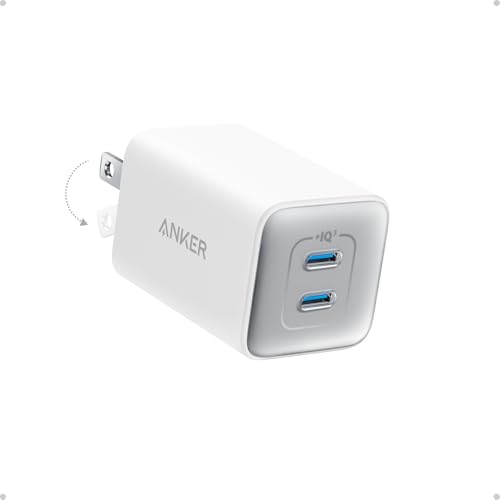
Anker Nano Charger, 47W Max 2-Port GaN — Best Overall Pairing
The Nano earns the lead spot in this guide the way it earned its place in our 45W coverage: by being the most considered small object in its class. Two USB-C ports share a 47W ceiling — the highest total among the linked picks — inside a folding GaN body that competes with single-port bricks for pocket space. A phone alone draws a properly brisk session. A phone with earbuds loses almost nothing, because earbuds sip. A phone with a tablet shares more honestly and both slow to a civilized pace that still fills both by morning.
What elevates it beyond arithmetic is the sense that Anker designed for the second year of ownership, not the first week: prongs that fold without wobble, a shell that shrugs off bag life, division behavior that favors the device that needs it. It is the charger we would pack if we could pack only one and the trip involved two devices, which is most trips and most devices. Readers who met it in the 45W guide will find the same virtues here, reframed around the pairing it was always really about.
- Ports: two USB-C sockets, modern kit only
- Total output: 47W maximum, divided when both ports work
- Plug: folding prongs, travel-first Nano body
- Technology: GaN construction, compact and cool-running
- Fit: phone plus earbuds, watch, tablet or second phone
Strengths
- The strongest total in the smallest linked body is a rare combination.
- Division behavior suits the phone-plus-accessory pattern most owners live.
- Build quality survives years of pockets, pouches and hotel sockets.
Trade-offs
- No USB-A socket, so legacy leads need an adapter or a different brick.
- Two hungry devices split the ceiling and both feel it.
- It asks a premium over the simpler 33W sibling below.
Best for: travelers and minimalists whose nightly pair is a phone and one companion. Not suited for: a drawer still full of USB-A cables that need a home.

Anker 33W 2-Port Compact Charger, Foldable — Best Everyday Value
This is the two-port charger as everyday appliance rather than flagship: a 33W total shared between a USB-C port and a USB-A port, in a folding body priced and sized for ordinary life. The C port handles the phone at a respectable pace; the A port handles the watch puck, the older tablet, the handheld console dock — the whole legacy bench — at the pace those devices were built for. Together they describe the actual contents of most bedside tables more accurately than any all-modern design.
Thirty-three watts is a total to respect rather than celebrate. A phone alone gets a good session; a phone and a tablet together get patient ones. But most two-device evenings are a phone and something small, and for those evenings this brick is not a compromise at all — it is the correct tool at a friendly price, from a maker who will answer the phone if it misbehaves. As a second charger for a guest room, a teenager’s desk or a workplace locker, it may be the most sensible purchase in this entire guide.
- Ports: one USB-C plus one USB-A, the transitional pairing
- Total output: 33W shared across both sockets
- Plug: folding design for travel and storage
- Fit: iPhone, Galaxy and mixed-device households
- Role: everyday and secondary charging posts
Strengths
- The mixed port pair matches real cable drawers better than C-only rivals.
- Anker accountability at an everyday price is a reassuring combination.
- Small and foldable enough to become the permanent spare in any bag.
Trade-offs
- The modest total shows when a phone and tablet arrive empty together.
- The USB-A side charges legacy devices at legacy speeds, by design.
- Flagship phones will not see their fastest tiers from this ceiling.
Best for: mixed-device households and anyone furnishing a second charging post sensibly. Not suited for: two flagship phones racing to full before a night out.

Super Fast Charger USB C, 45W Dual Port, 2-Pack with 10FT Cable — Best for Bad Outlets
Some products are bought for their specifications and some for their geography, and this unbranded pair is unapologetically the latter. Each brick carries two ports under a 45W-class total, each box carries two bricks, and the cables run to ten feet — a length that treats the outlet’s location as a suggestion. In a rental with one socket behind a wardrobe, in a workshop where the bench sits far from the wall, in a dorm where the bed is lofted away from the power, this kit simply reaches, and reaching is the feature.
The discipline from our 45W coverage applies unchanged: unbranded means unaccountable, so let these bricks earn trust in attended, lower-stakes posts, and do not read Samsung’s vocabulary in the listing as a promise of Samsung’s faster tier, which depends on PPS behavior and cable ratings a generic bundle cannot guarantee by adjective. The two-port split likewise means the headline pace belongs to a solo device. Bought as infrastructure for awkward rooms — with eyes open about what branding cannot promise — the pair solves problems the premium picks in this guide cannot reach. Literally.
- Bundle: two dual-port bricks per purchase
- Total output: 45W class per brick, shared across its two ports
- Cables: ten-foot leads included, longest in this guide
- Claimed fit: Galaxy generations and Apple devices, broadly stated
- Role: distant outlets, rentals, workshops and dorms
Strengths
- Ten-foot cables defeat outlet placement that defeats every rival here.
- Four total charging points across the pair cover a small home’s corners.
- Redundancy is built in: one brick can fail or travel without stranding you.
Trade-offs
- Shared ports divide speed, and generic listings rarely detail the split.
- No brand stands behind the internals if behavior ever disappoints.
- The faster Galaxy tier is a hope here, not a documented feature.
Best for: awkward rooms where distance, not wattage, is the binding constraint. Not suited for: a buyer who wants documented splits and a warranty desk.
Samsung 35W Power Adapter Duo — Galaxy Household Pick
Samsung’s Duo is the home-team entry in this category: a two-port adapter from the maker of the phones most likely to plug into it, with a total in the mid-thirties and a split designed around a Galaxy and its companion. Its appeal is the same first-party certainty that leads our 45W guide — profiles the phone’s engineers intended, behavior the support desk recognizes. We cover it in prose because our pool holds no verified listing for it; buy it through Samsung’s own channel or a retailer you trust.
Judged as a design, it suits the Galaxy household’s actual evening: a phone on the strong port, a watch or buds on the other, both full by morning without a queue. Owners of other brands will find it a perfectly civil PD source and nothing more, which is fine — first-party chargers are allowed to have a home crowd. If your household is Samsung through and through, this is the two-port brick your phones would choose for themselves.
- Role: Samsung’s first-party two-port adapter
- Availability: prose-only here; source via Samsung or trusted retail
- Total output: mid-thirties class, shared between its ports
- Fit: Galaxy phones paired with watches, buds or tablets
- Character: correctness for Samsung owners over universal flair
Strengths
- First-party profile matching removes doubt for Galaxy households.
- The split is tuned for a phone plus a Samsung accessory.
- Samsung’s retail channel guarantees the genuine article.
Trade-offs
- No link here means no verified listing or bundle guidance from us.
- Its total trails the linked Nano for two hungry devices.
- Other brands’ owners gain nothing over the linked Anker models.
Best for: Samsung households wanting the maker’s own two-port answer. Not suited for: shoppers who want to order from this page and be done.
Spigen 40W 2-Port GaN Charger — Specialist Alternative
Spigen built its name on cases and brought the same tidy industrial design to chargers, and its 40W-class two-port GaN model is the specialist alternative in this guide: a healthy total, two modern ports, and a compact shell from a brand accessory buyers already know. It sits between the linked Ankers in spirit — stronger than the 33W everyday model, shy of the Nano’s ceiling — and for owners who already trust the maker’s cases, it is a natural shortlist entry. Our pool holds no verified listing for it, so it stands here in prose; source it from the maker’s own storefront if it appeals.
The honest caveat is that prose coverage means we are describing a design and a reputation, not a verified listing with a bundle we have inspected. Check the port split and the cable situation at the point of purchase, as you should with any two-port unit, and confirm which devices the maker’s chart favors when both sockets are busy. Readers who value a single brand across case and charger will find that coherence worth the small extra effort.
- Role: case-maker’s two-port GaN design
- Availability: prose-only here; buy via the maker’s channel
- Total output: 40W class shared across two ports
- Fit: modern USB-C phones and accessories
- Character: design-led alternative to the linked Anker pair
Strengths
- A strong total in a compact GaN body from a known accessory brand.
- Matches the maker’s cases for owners who like a coherent kit.
- Two modern ports suit an already-converted cable drawer.
Trade-offs
- Prose-only status means the purchase happens outside our verification.
- Split details must be confirmed from the maker’s own documentation.
- It lacks the first-party phone matching of the Samsung and Apple entries.
Best for: Spigen loyalists building a matched case-and-charger kit. Not suited for: buyers who want every claim in this guide tied to a checked listing.
Apple 35W Dual USB-C Adapter — iPhone Purist’s Option
Apple arrived late to two-port chargers and arrived with characteristic restraint: a dual USB-C adapter in the mid-thirties total range, designed to divide its output intelligently between two Apple devices — an iPhone and a watch, a MacBook Air and an iPhone, two phones in a household that travels light. Its intelligence is the selling point: the adapter adjusts the split according to what is connected, favoring the hungrier device rather than enforcing a fixed division. We discuss it without a link, as our pool holds no verified listing; Apple’s own store is the obvious source.
For an all-Apple traveler this is a genuinely elegant answer, one brick in the bag where two used to ride, with none of the third-party guesswork some owners prefer to avoid. For everyone else it is an expensive way to buy a modest total, and its charms are ecosystem charms. Judge it as you would any first-party accessory: worth it if you live in the house it was built for, a curiosity if you do not.
- Role: Apple’s first-party dual USB-C adapter
- Availability: prose-only here; Apple’s store is the natural source
- Total output: mid-thirties class, adaptively divided
- Fit: iPhone, Apple Watch and MacBook Air combinations
- Character: adaptive splitting inside the Apple ecosystem
Strengths
- Adaptive division favors whichever connected device needs more.
- First-party fit and finish for an all-Apple travel kit.
- One brick replaces the phone and watch chargers in a bag.
Trade-offs
- The total is modest for a phone plus a tablet arriving empty.
- Its value concentrates entirely inside Apple’s ecosystem.
- Prose-only here, so pricing and bundles are Apple’s to state.
Best for: Apple households that travel with a phone, a watch and one small brick. Not suited for: mixed-platform homes, which the linked Anker models serve better.
What About Charging Etiquette in Shared Workspaces and Dorms?
Outside the home, a two-port charger becomes a small social instrument. In a shared office or a dorm common room, offering your second port to a stranger with a dying phone costs you a slower top-up and buys a disproportionate amount of goodwill; the split that feels like a compromise at home feels like generosity in public. The reverse etiquette matters too: a borrowed port is a loan, not a tenancy, and the borrower who leaves a phone on someone’s brick for three hours has misunderstood the instrument. Students learn these rules in a week. Offices learn them more slowly, which is why the office two-port charger so often ends up labeled with its owner’s name in marker — the same marker, observant readers will note, that our 45W coverage recommended for dorm rooms. Human beings and their chargers behave consistently across settings; only the furniture changes.
How Do the Six Two-Port Chargers Compare?
| Charger | Ports | Total | Link status | Defining trait |
|---|---|---|---|---|
| Anker Nano 47W | 2 × USB-C | 47W shared | Linked | Strongest small design |
| Anker 33W Compact | USB-C + USB-A | 33W shared | Linked | Everyday mixed-drawer value |
| Generic Dual-Port 2-Pack | 2 per brick | 45W class shared | Linked | Ten-foot cables, two bricks |
| Samsung 35W Duo | 2 | Mid-30s shared | Prose-only | Galaxy first-party match |
| Spigen 40W GaN | 2 | 40W class shared | Prose-only | Design-led specialist pick |
| Apple 35W Dual | 2 × USB-C | Mid-30s shared | Prose-only | Adaptive split for Apple kits |
The table’s most important column is the third: every total is shared. The second most important is the fourth, because it tells you which of these judgments rest on listings we verified and which rest on makers’ published designs. A reader who internalizes those two columns understands this category better than most of the marketing written about it.
How Do You Choose a Split That Matches Your Evenings?
Write down, literally if it helps, the two devices that will share this charger on an ordinary night, and the two that will share it on a bad night. Ordinary nights forgive everything: earbuds sip, watches sip, and any split in this guide leaves the phone nearly untouched. Bad nights are the specification: two phones after a day of travel, a phone and a tablet after a long flight, a phone and a handheld console before an early start. If your bad night involves two genuinely hungry devices, weight the total heavily and choose the Nano’s ceiling or accept the generic bundle’s reach with modest expectations. If your bad night is still phone-plus-small-thing, every pick here passes, and you are free to choose on size, ports and price of ownership instead. Most returns in this category happen because a buyer specified for the ordinary night and met the bad one within a fortnight.
Why Did Two-Port Chargers Take So Long to Become Normal?
For years the industry sold chargers the way phone makers bundled them: one port, modest output, an accessory rather than a product. Two forces changed that. Phones stopped shipping with chargers at all, which turned the adapter into a deliberate purchase and made buyers compare designs for the first time. And the accessory ecosystem — watches, buds, cases that charge, lights that charge — multiplied the devices on every nightstand beyond what one port could serve. The two-port charger is the market’s answer to that multiplication, sized to the pair rather than the crowd. First-party makers resisted longest, because a bundled single-port brick was cheaper to include; their eventual dual-port entries, two of which appear in this guide as prose picks, mark the moment the pair became the official unit of charging. The third-party makers in this guide simply arrived earlier, and their head start shows in the refinement of designs like the Nano.
Where Does a Two-Port Charger Beat a Bigger Station?
Anywhere the charger must move. Stations are furniture; two-port bricks are clothing. A station wins a family counter and loses every hotel room, hospital visit, work trip and overnight at a friend’s house where the kit reduces to what fits in a jacket. Two-port chargers also win the spare-drawer argument: one in the car, one in the office, one in the bag, each cheap enough that ubiquity beats capability. And they win the failure argument, because a failed two-port brick strands two devices while a failed station strands a household. The mature setup most households converge on is both: a station where the family gathers, and two-port bricks everywhere life actually happens. This guide covers the everywhere half of that settlement.
How Does a Two-Port Brick Change Travel Packing?
It deletes a decision. The old kit asked which chargers to bring; the two-port kit asks only where the one brick is. Phone and companion share it in the hotel, phone and power bank share it in the departure lounge, and the bag gains a pocket where a second adapter and its cable used to tangle. The weight saving is trivial and the cognitive saving is not: travelers consistently report that the chargers they forget are the ones they packed as an afterthought, while the single designated travel brick, living permanently in the bag, is simply always there. Every model in this guide with folding prongs was designed for that permanent residence. The two desk-bound philosophies — the generic long-cable pair and, arguably, the first-party adapters bought for home — argue for the opposite arrangement, a charger per post, and a household can rationally hold both philosophies at once: bricks that stay, and one brick that roams.
International travel sharpens the point. One brick needs one plug adapter; two bricks need two, or a multi-socket adapter that begins to resemble the station you left at home. A single two-port charger plus a single travel adapter is the smallest complete answer to a foreign hotel room, and it fits in the palm that also holds your passport. Add a power bank charged from the second port overnight and the kit covers even the day the room’s only outlet turns out to be behind the bed.
What Etiquette Governs a Shared Charger?
Small rules keep a shared brick from becoming a shared grievance. The lower battery wins the strong port; that is the whole law, and households that adopt it stop negotiating. Cables belong to ports, not people — a cable that lives on the second port stays there, so nobody’s lead migrates into a bag at the moment their partner needs it. Overnight, the charger belongs to whoever wakes earliest, since their phone must be full first; the other phone takes the long, gentle shift. And when a third device appears — a guest’s phone, a child’s tablet — it queues for the accessory port rather than evicting a resident. None of this requires a meeting. It requires one conversation, held once, ideally while reading a guide like this one and laughing slightly. The chargers in this category are cheap; the domestic peace they can either protect or erode is not.
How Do You Test a Two-Port Charger’s Split at Home?
Borrow the method from our larger-charger coverage and adapt it to a pair. Start with two devices at low battery — a phone and the hungriest companion you own. Charge the phone alone for a fixed window and note the gain. On another evening, repeat with both devices connected from the start and note the phone’s gain over the same window. The difference between those two numbers is your split, expressed in the only unit that matters: how much longer your evening takes. If the difference is small, your pair is well matched to the brick. If the phone’s progress collapses when the companion joins, your companion is hungrier than the design assumed, and the honest fixes are to stagger the pair, give the companion its own post, or step up to the highest-total model your budget allows. Testing beats speculating because splits interact with each device’s own charging curve in ways no chart fully predicts.
Which Two-Port Charger Makes the Best Gift?
The one that requires no knowledge of the recipient’s drawer: a C-plus-A model. A gift charger must work with whatever cable the recipient already owns, and the mixed-port Anker in this guide is the only linked design that accepts both generations of lead without an adapter. It is also the right price shape for a gift — clearly useful, clearly better than what it replaces, and not so expensive that it demands an occasion. For a recipient you know well, tailor harder: the Nano for the traveler, the long-cabled pair for the friend who just moved into an old apartment, the first-party adapters for the loyalist whose ecosystem you can name. A charger is an unusually honest gift, because it says you noticed something unglamorous about a person’s daily life and fixed it. People remember that longer than they remember most presents.
What Happens When One Port Eventually Fails?
Ports wear before electronics do. The socket that hosts the nightly phone loosens over years of insertions; a cable begins to sit at an angle; charging becomes intermittent in a way that swapping cables does not cure. A two-port charger degrades gracefully through this phase — the household migrates the phone to the surviving port and demotes the brick to single-device duty in a lesser room — which is another quiet argument for the category over a single-port design, whose first failure is total. When the second port follows, retire the unit without sentimentality. Chargers are consumables with long lives, not heirlooms, and the makers in this guide price their replacements accordingly. Keeping a known-good spare in a drawer, as the bundle picks encourage, converts every failure from an emergency into a shrug.
What Mistakes Define This Category?
Reading a total as a per-port promise is the founding error, and every other mistake is its child. Expecting a flagship’s fastest tier from a shared port is the second. Buying C-plus-C for a drawer full of legacy cables, or C-plus-A for a drawer that converted years ago, is the third. Choosing the smallest total for the hungriest pair is the fourth, and its mirror — buying a huge station for a life lived in hotel rooms — is the fifth. A quieter sixth: assuming prose-mentioned first-party chargers can be bought wherever a search leads, when the entire point of first-party is the channel. Buy Samsung from Samsung’s shelf, Apple from Apple’s, and let the linked picks here handle everything else.
How Does a Two-Port Charger Serve a Home Office?
The desk has its own pairings. A work phone and a personal phone are the classic desk couple, and a two-port brick under the monitor serves both without touching the laptop’s own supply. Add the rotating third citizen — earbuds for calls, a desk fan in summer, a small lamp — and the second port becomes a utility socket whose occupant changes by season while the phone’s port stays sacred. Home workers who take calls on a headset all day discover the two-port brick’s kindest use: the headset case lives on the spare port permanently, so the dead-headset-at-9-a.m. experience simply stops occurring. None of this needs a station’s capacity. It needs exactly two ports, exactly where the chair is, which is the brief this entire category was born to fill.
What Should Parents Know About Two-Port Chargers and Teenagers?
That the second port will be treated as public property and the first port as a birthright. A teenager’s phone occupies the strong port; a parent’s phone, a sibling’s tablet and the family earbuds rotate through the other. The workable family pattern mirrors the couple’s etiquette with one addition: the charger that lives in a shared space should be the household’s, bought for the space, while teenagers who want guaranteed speed get their own brick in their own room — ideally the matched, affordable kind, because it will be lost, lent and left in a locker at least once a year. The 33W Anker’s price and the generic pair’s redundancy both make sense through this lens. What does not survive contact with teenagers is the single shared flagship charger, which will migrate to a bedroom within the week and take the household’s peace with it.
How Long Do Cables Last in a Two-Port Setup?
Shorter than the charger, as always, and asymmetrically: the phone’s cable, plugged and unplugged twice a day and bent at the same angle every night, fails years before the companion’s cable, which may sit undisturbed for months. Buy the phone’s cable as a consumable and keep its replacement in the same drawer, because the failure always announces itself at bedtime. Braided jackets survive bag life better; plain jackets survive desk life perfectly well; and any cable that needs to be held at an angle to work has already told you its news. A two-port household that standardizes on one cable type for the phone port — same length, same rating, in both the bedroom and the bag — converts every cable failure into a thirty-second swap instead of a shopping trip.
A Note on Buying a Second Two-Port Charger Later
Many readers will return to this category within a year, not because the first charger failed but because the pattern spread: one by the bed worked, so now the desk, the car kit and the partner’s bag all want the same arrangement. When that moment comes, buy the same model again unless the first one taught you a specific lesson. Identical chargers make a household legible — every port behaves the same in every room, every cable is interchangeable, and nobody develops a theory about which charger is the good one. Variety is a tax on memory. The exception is the deliberate upgrade: if the first purchase exposed a split too weak for your pairing family, step up the range rather than sideways, and demote the original to the room whose pairing is gentler. Chargers, sensibly bought, form a small hierarchy in a home, and each purchase should know its place in it.
Final Recommendation
Start with the Nano unless your drawer argues otherwise: it is the strongest, smallest and most considered two-port design we can link, and it will satisfy the great majority of phone-plus-one households for years. Let a legacy cable drawer steer you to the 33W Anker instead, and let genuinely awkward rooms steer you to the long-cabled pair, bought with clear eyes about generic accountability. Galaxy and Apple loyalists have their home-team options described above, available through their makers’ channels, and Spigen’s design waits for readers who like their accessories from one house. Decide by your bad night, respect the shared total, and a two-port charger will do what the best tools do — disappear into the routine it improved.
How Do You Keep a Two-Port Setup From Becoming a Tangle?
Two cables is below the threshold where tangles become physics, but only just, and only with help. Give the pair different lengths on purpose: a short lead for the companion device that lives beside the brick, a longer one for the phone that travels to the pillow or the desk chair. Different lengths cannot wrap into the same knot, and each device gravitates to its own cable without thought. A small hook or the edge of a nightstand drawer gives the phone’s cable a home when it is unplugged, instead of the floor, where cables go to be stepped on and frayed at the connector. If the brick serves a desk, route both cables behind the monitor once and let them emerge like fixtures; a setup that looks installed behaves like furniture, and people stop borrowing pieces of it. The entire discipline takes ten minutes and pays out nightly, which is the best exchange rate in this whole guide.
Frequently Asked Questions
If both ports are busy, does each device get half the wattage?
Not necessarily half — the maker sets the division, and many designs favor the primary port so a phone keeps a strong share while a smaller device takes the remainder. The only certainty is that the two shares add up to the charger’s total. Check the maker’s split chart for the model you are considering if your second device is a hungry one like a tablet.
Is two ports enough for a couple?
For most couples, on most nights, yes — especially if the pair’s second devices are small. Two phones arriving empty together will share patiently rather than race, which both partners accept once expectations are set. Couples who both rely on a fast morning top-up sometimes graduate to two bricks, and the paired bundles in this category exist for exactly that graduation.
Why do some two-port chargers have a USB-A port in 2026?
Because drawers change more slowly than phones. Watch pucks, bike lights, older e-readers, kids’ gadgets and countless small accessories still end in the older connector, and a single USB-A socket absorbs them all without adapters. A household that has genuinely converted loses nothing by choosing two USB-C ports instead; a household that has not gains a daily convenience.
Can a two-port charger run a laptop?
A modest ultrabook, yes, as a ration: it will maintain or slowly charge a light laptop, especially if the second port is idle or feeding something tiny. A performance laptop under load will find any total in this guide insufficient as a primary supply. Treat two-port bricks as phone-first tools that can babysit a small laptop, not as laptop chargers with a spare port.
Should I buy the Samsung or Apple adapter even though this guide does not link them?
If you live inside one of those ecosystems and value first-party matching, yes — through the maker’s own store or a retailer you trust, where authenticity is guaranteed. They are included here because an honest category map includes them. Readers without that loyalty lose nothing by choosing the linked Anker models, which carry this guide’s verification.
Can I leave a two-port charger plugged in permanently?
Yes — these units are designed to live in an outlet, drawing very little when idle, and permanent residence is how most of them spend their lives. Keep the usual courtesies: a sound socket, a little air around the body, and a retirement plan the day a shell cracks or a port begins to grip loosely. A charger that lives in the wall for years is a success story, not a risk.
Related Guides
Readers who need more than two sockets should look at our roundup of four-port chargers for shared counters and desks, while those whose phones chase a specific fast tier will find the details in 45W USB-C chargers and the PPS question. If your problem is really a household of devices rather than a pair, start with six-port charging stations for family life.


