What's inside
- Key Takeaways
- Quick Picks: The Best AGM Chargers Worth Your Attention
- How Did We Judge Chargers for AGM Duty?
- What Does an AGM Mode Actually Change?
- How Do These AGM-Capable Chargers Compare?
- How Can You Tell Whether an AGM Battery Is Failing?
- What Mistakes Ruin AGM Batteries?
- How Should You Charge an AGM Battery Step by Step?
- Why Do Start-Stop Cars Depend on AGM Health?
- How Does AGM Behave in Boats and Recreational Vehicles?
- What Should You Know About AGM and Cold Weather?
- How Do You Choose Between AGM, Gel and Flooded When Replacing?
- What Does a Battery Registration or Reset Mean for AGM Owners?
- How Should You Store a Spare AGM Battery?
- Why Do Some AGM Batteries Cost So Much More Than Others?
- A Practical Routine for AGM Owners
- What Happens Inside an AGM Battery During a Charge?
- How Do You Verify a Charger Is Treating Your AGM Battery Well?
- One More Distinction: Starting AGM Versus Deep-Cycle AGM
- What Should You Do When an AGM Battery Has Sat Discharged?
- Final Recommendation
- Frequently Asked Questions
- Related Guides
As an Amazon Associate I earn from qualifying purchases. This post may contain affiliate links at no extra cost to you.
gizmoverdict.com is reader-supported. When you buy through links on our site, we may earn an affiliate commission.
Where to buy: the six chargers below link to their Amazon listings, where you can confirm that the current revision still offers the AGM profile described here before spending anything.
Honesty needs to open this guide, because the phrase best agm chargers implies a category that barely exists. There is effectively no such thing as a charger built only for AGM batteries, and any product marketed that way deserves suspicion. What actually exists, and what this guide compares, are smart chargers with a genuine AGM mode: a charging profile that respects how absorbed glass-mat batteries differ from ordinary flooded ones. Every pick below is such a charger, chosen because its AGM handling is real rather than decorative, and the differences between them lie in power, extra chemistries and how much other work each can do besides AGM duty.
Understanding the AGM difference explains why the mode matters at all. In an AGM battery the electrolyte is held in fibreglass mats between the plates rather than sloshing freely, which makes the battery spill-proof, vibration-resistant and able to deliver strong cranking current, but also less forgiving of charging abuse. An AGM battery cannot be topped up with water, so every millilitre lost to overcharging is lost forever. It also dislikes the equalisation stage that some chargers apply to flooded batteries, a deliberate overcharge that stirs electrolyte and would simply cook a sealed AGM. A proper AGM mode therefore caps absorption voltage slightly lower, never equalises, and floats gently.
Charge a AGM battery repeatedly on a careless flooded profile and nothing dramatic happens on day one. Instead the battery dries slowly, its capacity shrinks month by month, and a premium battery dies years early for reasons its owner never sees. That quiet failure is what this guide exists to prevent, and it reframes the buying question: not which charger is fastest, but which charger treats a sealed battery with the specific restraint its construction demands.
Key Takeaways
- Nobody needs an AGM-only charger; the correct purchase is a smart charger whose AGM profile lowers absorption voltage and skips equalisation entirely.
- Overcharging is the AGM killer, because lost water cannot be replaced in a sealed battery and capacity fades invisibly.
- Temperature sensing earns extra value on AGM duty, since a hot AGM battery needs its voltage trimmed even more carefully.
- All six picks also handle flooded batteries, so an AGM mode today does not strand you when the next vehicle arrives with a different battery.
- Repair and desulfation claims should be read cautiously on AGM batteries; gentle, correct charging beats aggressive revival programmes.
Quick Picks: The Best AGM Chargers Worth Your Attention
| Pick | Badge | Why it made the cut |
|---|---|---|
| NOCO GENIUS5 | Best AGM all-rounder | A distinct AGM profile, temperature compensation and lithium support in a five-amp package sized for car batteries. |
| 12-Amp Smart Battery Charger with Pulse Repair | Best high-output AGM option | Strong charging for larger AGM banks with explicit AGM, gel and lithium modes, from a lesser-known brand. |
| Schumacher SC1280 | Best for big AGM batteries | Fifteen amps for rapid recovery of large AGM units, with a gentle trickle waiting for storage duty afterwards. |
| TowerTop 2/10/25 Amp Smart Charger | Best multi-rate AGM choice | Selectable rates let one unit nurse a small AGM gently or charge a large one briskly, with start help besides. |
| Battery Tender 3 Amp | Best AGM maintainer | A trusted three-amp maintainer whose AGM support suits stored vehicles above all else. |
| NOCO GENIUS1 | Best for small AGM batteries | One careful amp for the motorcycle and powersport AGM batteries that powerful chargers would bully. |
How Did We Judge Chargers for AGM Duty?
The first test was whether the AGM offering amounted to more than a printed word. A qualifying charger had to alter its charging behaviour for AGM batteries, using an absorption voltage appropriate to sealed construction and omitting any equalisation stage in that mode. Chargers whose literature suggested the same flooded programme with an AGM sticker were not eligible for a guide built on this distinction.
Finishing behaviour came second, because AGM batteries live or die by their float. Each pick had to taper properly and hold a maintenance voltage that keeps an AGM full without gassing it, since most AGM batteries in cars, boats and backup service spend the overwhelming majority of their lives in exactly that state. A charger that charges beautifully and floats carelessly fails the real-world test.
We then checked the surrounding versatility, because few households run AGM exclusively. Flooded support was mandatory in practice, gel and lithium were counted as bonuses, and six-volt coverage mattered to the classic owners who have fitted AGM batteries to older machines. Output was spread deliberately from one amp to fifteen, reflecting the spread of AGM battery sizes from motorcycle units to deep-cycle banks.
Claims about repair were treated with open scepticism throughout. Sulfation affects AGM batteries as it does flooded ones, and a gentle recovery attempt can help, but aggressive pulse programmes marketed as restoration sit uneasily with sealed construction. Picks that offered recovery features were assessed on the restraint of those features, and this guide repeatedly advises testing a suspect AGM battery rather than trusting any programme to resurrect it.
What Does an AGM Mode Actually Change?
Voltage is the heart of it. A flooded battery’s absorption stage commonly runs at a higher voltage that an AGM battery tolerates poorly over time, because the sealed design recombines gases at a limited rate and vents whatever it cannot recombine. Venting is permanent loss: the hydrogen and oxygen that escape were water in the electrolyte, and an AGM battery carries a small, fixed supply. A correct AGM profile trims that absorption voltage, accepts a slightly slower finish, and preserves the battery’s finite moisture across hundreds of cycles.
The absent equalisation matters just as much. Flooded batteries benefit occasionally from a controlled overcharge that balances cells and stirs stratified electrolyte. An AGM battery has no free electrolyte to stir and no way to replace what equalisation boils off, so a charger that equalises in AGM mode is actively harming the battery it claims to serve. Checking that a charger’s AGM profile excludes equalisation is the single sharpest test separating genuine AGM support from marketing.
Float voltage follows the same philosophy downward. Held slightly lower and steadier, an AGM battery can sit on maintenance through a winter without drying, ready at full capacity in spring. Temperature compensation refines all three stages further, trimming voltage as the battery warms, which matters because AGM batteries in engine bays and boat compartments experience wider temperature swings than their owners usually appreciate.

NOCO GENIUS5 — Best AGM all-rounder
The GENIUS5 earns the lead position here for the completeness of its AGM thinking rather than for any single specification. Its AGM profile is a distinct mode the owner selects, its temperature sensing adjusts charging to the conditions around the battery, and its five-amp output matches the size of the AGM batteries most commonly fitted to modern cars, including the start-stop vehicles that made AGM standard equipment across much of the market. An owner replacing a flooded battery with AGM, or buying a car that arrived with one, can adopt this charger without a second thought about compatibility.
Around that core it carries the features that make it a household’s main charger rather than an AGM specialist. Flooded and gel profiles cover older vehicles, a lithium mode covers conversions and powersport machines, a repair mode offers a measured attempt on sulfated lead-acid batteries, and a force function begins charging batteries whose voltage has fallen below ordinary recognition thresholds. Each of those has been described elsewhere in this series; what matters for this guide is that none of them compromises the AGM restraint that justified its inclusion.
Ownership manners complete the picture. The unit is compact enough to live where the car lives, its indicators make the selected mode verifiable at a glance, which matters when the wrong mode is the hazard, and its maintenance stage can be trusted through long storage. Owners of very large AGM deep-cycle banks will want more amperage, and owners of tiny AGM motorcycle batteries may want less, but as the single charger for an AGM-equipped family car it is the most rounded answer available in this list.
- Format: compact portable smart charger
- Output: 5 amps across 6V and 12V batteries
- AGM handling: dedicated AGM profile with temperature compensation
- Other chemistries: flooded, gel and lithium modes included
- Recovery: repair attempt plus force start for very flat batteries
Strengths
- AGM mode is a genuine profile, backed by temperature sensing.
- Five amps suits the car-sized AGM batteries most owners actually have.
- Breadth beyond AGM means the same unit serves the whole garage.
Trade-offs
- Large deep-cycle AGM banks will keep it occupied for many hours.
- The owner must remember to select AGM mode for the benefit to apply.
- It offers no engine-start assistance for emergency mornings.
Best for: owners of AGM-equipped cars wanting one correct, versatile charger. Not suited for: rapid turnaround on big marine AGM banks or start-assist duties.

12-Amp Smart Battery Charger with Pulse Repair — Best high-output AGM option
This lesser-known charger enters the guide on specification rather than reputation, and it should be bought with that framing firmly in mind. Its appeal is a combination the established brands arrange differently: a strong charge rate in the ten-to-twelve-amp class for twelve-volt batteries, explicit modes for lithium and for lead-acid family chemistries including AGM, gel and sealed designs, and a pulse-repair programme aimed at tired batteries. For an owner with a large AGM battery in a camper, boat or backup system, that output shortens recovery from an overnight saga to an evening’s work.
The pulse-repair feature deserves the balanced treatment this guide promised. On a flooded battery, desulfation pulses have a plausible mechanism and a long anecdotal record. On an AGM battery the same caution applies as everywhere in this article: a gentle attempt on a sulfated but sound battery is reasonable, while expecting pulses to restore a dried or damaged sealed battery is not. Owners should use the function as a diagnostic attempt, then verify the result with a proper test rather than with hope.
Because the brand lacks a long public record, the sensible buying routine is inspection and verification. Check the housing, leads and clamps on arrival, confirm the AGM mode’s behaviour against the manual’s stated voltages if you own a meter, and keep the paperwork. Judged that way, as capable hardware to be verified rather than as a badge to be trusted, it fills a real gap in this list between the five-amp all-rounder and the fifteen-amp Schumacher.
- Format: portable smart charger with higher output
- Output: strong double-figure rate for 12V charging, lower for 24V
- AGM handling: explicit AGM, gel and sealed lead-acid modes
- Other chemistries: lithium profile included
- Recovery: pulse-repair programme for neglected batteries
Strengths
- Output genuinely shortens charging on large AGM batteries.
- Mode list covers AGM, gel, sealed and lithium in one unit.
- Useful middle ground between compact chargers and workshop units.
Trade-offs
- The brand’s track record is thin beside the established names here.
- Pulse-repair expectations need managing, especially on sealed batteries.
- Full output is far too strong for small powersport AGM batteries.
Best for: owners of large AGM batteries in leisure or backup service who verify their purchase. Not suited for: buyers who want a famous badge or who charge only tiny batteries.

Schumacher SC1280 — Best for big AGM batteries
Scale is the SC1280’s argument. AGM batteries are not all car-sized: deep-cycle AGM banks in recreational vehicles, marine house systems and home backup installations can hold several times a car battery’s capacity, and charging them at five amps turns every recovery into a diary event. Fifteen amps, managed by a microprocessor that still tapers and finishes properly, restores those banks in a working day while respecting the sealed construction that makes AGM attractive for indoor and marine use in the first place.
The charger’s second rate is what makes it a complete AGM tool rather than a blunt one. A three-amp trickle handles maintenance and smaller batteries, so the same unit that rescued a house bank in June can float a single AGM car battery through winter without abusing it. Owners of mixed AGM fleets, a common pattern wherever boats and vehicles share a garage, can therefore standardise on one model and learn one set of behaviours.
Schumacher adds a restoration function for batteries showing the effects of neglect, and the guidance from earlier in this guide applies unchanged: attempt it, then test. Dual-voltage coverage extends the unit’s reach to six-volt applications as well. What it does not offer is lithium support or start assistance, so households whose AGM battery shares space with lithium conversions should weigh the NOCO or the high-output generic above it in this list.
- Format: higher-output automatic charger and maintainer
- Output: 15 amps for charging, with a 3-amp maintenance rate
- AGM handling: automatic charging suited to AGM batteries
- Voltages: supports both 6V and 12V batteries
- Recovery: restoration programme for neglected units
Strengths
- Fifteen amps makes large AGM bank recovery a same-day job.
- The gentle second rate covers maintenance without a second charger.
- Established brand support stands behind a powerful unit.
Trade-offs
- Its full rate must never be unleashed on a small motorcycle AGM battery.
- Lithium batteries are outside its coverage.
- It is the bulkiest commitment among these picks.
Best for: RV, marine and backup owners running large AGM banks. Not suited for: small-battery care or lithium-equipped households.

TowerTop 2/10/25 Amp Smart Charger — Best multi-rate AGM choice
Flexibility is the TowerTop’s entire design brief, and AGM owners benefit from it in a specific way: rate selection. A charger with one fixed output forces a compromise between the small AGM in the motorcycle and the large one in the truck, while this unit’s selectable charging rates let the owner match current to battery size on each occasion. Set low, it treats a powersport AGM with appropriate gentleness; set at its ten-amp rate, it recovers a car or SUV AGM in an afternoon; its highest charging rate is there for the largest lead-acid work the household presents.
Its automatic programmes include the maintenance and repair functions expected in this class, together with a winter mode that adjusts behaviour for cold conditions, a detail AGM owners in unheated garages should appreciate since temperature shapes AGM charging voltages so directly. The engine-start function sits apart from all of this as a cranking aid, useful when the AGM battery is weak and the journey cannot wait, and it should be understood as a burst of assistance rather than as charging by another name.
The compromises are those of versatility everywhere. A unit that does many things asks its owner to choose correctly among them, and AGM mode discipline remains the owner’s responsibility on every connection. It is also a bench tool without weather sealing, so marine AGM banks in damp compartments belong to onboard hardware rather than to this portable design. Within a garage, though, few chargers cover as many AGM sizes with one purchase.
- Format: portable bench charger with selectable rates
- Output: low, 10-amp and higher charging rates for 12V work
- AGM handling: automatic programmes suitable for AGM batteries
- Extras: engine-start assistance, repair mode and winter setting
- Role: households whose AGM batteries vary widely in size
Strengths
- Rate choice protects small AGM batteries while still serving large ones.
- Start assistance adds emergency value no maintainer can offer.
- Winter behaviour suits unheated garages and cold climates.
Trade-offs
- Mode selection errors are possible in hurried hands.
- No sealing against damp marine environments.
- Owners seeking a dedicated lithium profile should check the NOCO picks.
Best for: mixed-size AGM fleets in a garage setting. Not suited for: permanent damp installations or set-and-forget minimalists.

Battery Tender 3 Amp — Best AGM maintainer
Most AGM batteries do not need rescuing; they need guarding, and guarding is the Battery Tender’s lifelong trade. This three-amp model supports AGM alongside flooded and gel batteries, charges at a rate appropriate to car-sized units, and then performs the float maintenance that keeps a stored AGM at full charge without the slow drying that careless holding voltages cause. For a start-stop car laid up for a season, a boat’s AGM house battery or a backup battery waiting for an outage, that float is the product.
The switchable voltage extends its usefulness to the six-volt machinery discussed elsewhere in this series, and a household can therefore guard an elderly tractor and a modern AGM-equipped SUV with the same trusted unit on rotation. Simplicity reinforces the trust: there are no start modes to confuse, no repair promises to evaluate, just a charger that fills a battery properly and then holds it there, season after season.
Its boundaries are clear and, for its intended owner, unimportant. It will not hurry a large discharged bank, offers no lithium profile for converted machines, and cannot help start an engine. Owners whose AGM life is about storage rather than emergencies will find those omissions irrelevant, and will value instead the confidence of a maintainer whose entire reputation rests on batteries surviving winter under its care.
- Format: switchable charger and maintainer
- Output: 3 amps at 6V or 12V as selected
- AGM handling: AGM support within its lead-acid chemistry range
- Behaviour: staged charging finishing in trusted float
- Role: storage care for AGM-equipped vehicles and equipment
Strengths
- Float behaviour is the heart of the design and of AGM longevity.
- Three amps charges car-size AGM batteries at a kind pace.
- Voltage switching broadens the fleet one unit can guard.
Trade-offs
- No lithium mode for households converting away from lead-acid.
- Large discharged AGM banks recover slowly at this rate.
- Emergency start help is not part of its brief.
Best for: stored AGM-equipped vehicles needing trustworthy maintenance. Not suited for: fast bank recovery or lithium conversions.
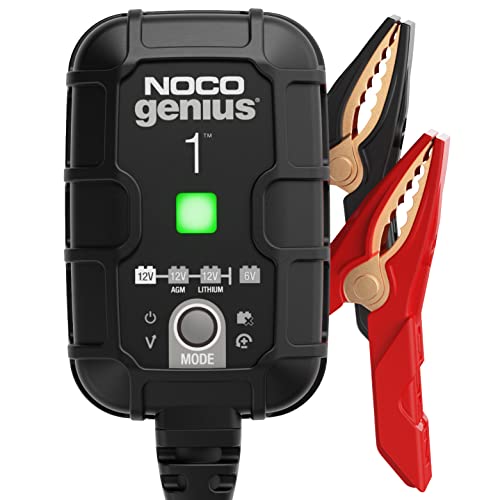
NOCO GENIUS1 — Best for small AGM batteries
Small AGM batteries are everywhere once you start looking: motorcycles, scooters, alarm and backup systems, ride-on toys, generators and mobility equipment all use sealed units whose modest capacity makes them the easiest batteries in this guide to damage with kindness from an oversized charger. The GENIUS1’s single amp is correctly scaled to them, and its AGM-aware automatic charging and maintenance give those batteries the same quality of care that the larger picks give car batteries.
The NOCO inheritance again matters more than the output figure suggests. Chemistry selection includes the profiles a small-battery household meets, temperature sensing adjusts for a battery stored in a cold shed or a hot garage, and the maintenance state can be trusted for the long connections that backup and seasonal batteries live on. A home’s alarm battery or a motorcycle’s AGM, floated by this unit, simply stops being a consumable that fails on its own schedule.
Nothing about the model pretends to serve larger work, and the guide will not pretend on its behalf. Car batteries are beyond its practical reach for recovery, and even maintenance of a large battery already full is a job better handed to a stronger sibling. Bought for the small sealed batteries it matches, though, it is the most proportionate AGM tool in this list and the one most likely to be left permanently, usefully connected.
- Format: dedicated compact maintainer
- Output: 1 amp for 6V and 12V batteries
- AGM handling: automatic AGM-suitable charging and float
- Chemistries: lead-acid profiles plus lithium support
- Sensing: temperature compensation for storage environments
Strengths
- Output is correctly scaled to small sealed batteries.
- Automatic float protects backup batteries indefinitely.
- Modern mode intelligence in the smallest package here.
Trade-offs
- Car-size AGM recovery is outside its realistic ability.
- One battery at a time limits households with many small units.
- Owners may underbuy and then blame its pace for their mismatch.
Best for: motorcycle, alarm and powersport AGM batteries in storage. Not suited for: vehicle batteries of any size that need recovery.
How Do These AGM-Capable Chargers Compare?
| Charger | Rate | AGM approach | Best role |
|---|---|---|---|
| NOCO GENIUS5 | 5A | Selectable AGM profile, temperature sensed | Everyday AGM car charging |
| 12-Amp Smart Charger | Strong 12V rate | Explicit AGM, gel and sealed modes | Large AGM recovery |
| Schumacher SC1280 | 15A plus 3A trickle | Automatic AGM-suitable charging | Big banks, then storage |
| TowerTop Smart Charger | Selectable rates | Automatic programmes, winter mode | Mixed AGM sizes |
| Battery Tender 3 Amp | 3A | AGM within lead-acid range | Trusted AGM maintenance |
| NOCO GENIUS1 | 1A | Automatic AGM-suitable care | Small sealed batteries |
Two philosophies divide the table. The NOCO and generic picks ask the owner to choose an AGM profile deliberately, rewarding attention with precision. The Schumacher, TowerTop and Battery Tender lean on automatic programmes, rewarding simplicity. Either philosophy serves an AGM battery well provided the owner understands which one they bought and follows its logic on every connection.
How Can You Tell Whether an AGM Battery Is Failing?
AGM batteries decline quietly, without the electrolyte clues a flooded battery offers, so owners must read behaviour instead. A battery that accepts a full charge yet cranks noticeably slower within days has lost capacity or gained internal resistance. One that grows warm during a modest charge, or whose case shows the faintest swelling at the sides, is reporting internal trouble that no charger should be asked to overpower. Resting voltage after a full charge and a night’s rest gives a rough report card, and a load test gives an honest one.
Charging times tell their own story over the seasons. A battery that once took an evening to refill and now finishes in an hour has less left to fill. Conversely, a charger that never quite reaches float on a battery that used to behave suggests energy leaking into heat and decay. Owners who charge with the same unit regularly are well placed to notice these drifts, which is an unadvertised benefit of standardising on one charger per battery.
When the evidence points to failure, replace rather than escalate. Stronger charging, repeated repair attempts and hopeful equalisation all punish a dying AGM further and can end in venting or leakage. The chargers in this guide prolong healthy batteries admirably; asking them to reverse internal decay misunderstands both the battery and the tool.
What Mistakes Ruin AGM Batteries?
Using a flooded-only charger with an equalisation habit is the first and worst, for the reasons this guide opened with. Every equalisation an AGM battery endures spends water it cannot recover, and the damage accumulates invisibly until capacity collapses. Owners upgrading a vehicle to AGM must audit the charger at the same time as the battery, a step easily forgotten when the new battery simply drops into the old tray.
Storing an AGM discharged is the second classic error, made more tempting by the battery’s reputation for toughness. AGM construction resists vibration and spilling superbly, yet its chemistry sulfates when left empty just as flooded chemistry does. The spill-proof case survives the winter; the plates inside may not. Maintenance charging remains non-negotiable.
Third comes oversizing the charger for small AGM batteries, particularly in motorcycles and backup systems, where a powerful unit’s early charge can heat a compact case. Match the rate to the battery, use the selectable or dedicated small chargers in this list, and treat a warm battery during charging as a signal to stop and reconsider rather than as a sign of vigorous progress.
Finally, owners misread sealed as immortal and skip testing for years. An AGM battery in a start-stop car works brutally hard and may need replacement sooner than a pampered flooded battery in a weekend car. Annual testing keeps that reality visible and prevents the particular misery of a sealed battery failing without ever having shown a symptom its owner recognised.
How Should You Charge an AGM Battery Step by Step?
Confirm the battery is AGM before choosing the mode, since a flooded battery in an AGM tray and an AGM in a flooded tray both exist in the wild, and their labels, not their locations, decide the profile. Select the AGM mode or confirm the automatic unit is appropriate, connect positive then negative with the charger unpowered, and only then switch on and verify the indicators agree with your intention.
During the charge, the expectations are calm ones: steady progress through the stages, a case that stays near ambient temperature, and a finish that arrives in hours proportionate to the battery’s size and emptiness. Heat, hissing or a charger that races to full on a battery known to be flat all justify pausing and investigating rather than celebrating efficiency.
Afterwards, let the battery rest before judging it, since surface charge flatters voltage readings taken immediately. A battery that holds its voltage overnight and then performs under load has been charged successfully. If the vehicle is entering storage, leave the maintainer connected in its AGM-appropriate float, and the battery will greet the next season in the condition this entire process was designed to preserve.
Why Do Start-Stop Cars Depend on AGM Health?
The spread of AGM batteries is largely the story of start-stop systems, which switch the engine off at every pause and restart it dozens of times per journey. That duty demands a battery that accepts charge rapidly from brief alternator windows, delivers repeated strong cranks and tolerates being held at partial charge, all of which AGM construction does better than ordinary flooded designs. It also means the battery in a modern family car is a harder-worked component than its ancestors, and its condition directly affects whether the start-stop system functions at all.
Owners often meet this reality through a dashboard message or a start-stop system that quietly stops participating, which is the car’s early warning that its battery is tiring. A correct AGM charge at home, completed fully rather than approximated by short trips, can restore the system’s enthusiasm when the cause is mere undercharging. When a full AGM-mode charge changes nothing, the battery itself is likely at the end of its harder life, and testing will confirm what the car has been hinting.
Replacement discipline matters here too. A start-stop vehicle specified for AGM should receive an AGM replacement, charged and registered according to the maker’s procedure where the car requires it. Substituting a cheaper flooded battery invites exactly the charging mismatch this guide warns about, this time performed by the car’s own alternator strategy, and the saving evaporates in early failure.
How Does AGM Behave in Boats and Recreational Vehicles?
Marine and leisure use explains much of AGM’s popularity beyond cars. A sealed battery can be mounted in a cabin or locker without venting corrosive fumes into living space, tolerates the pounding of a hull or a rough track without spilling, and can even be installed on its side where a compartment demands it. House batteries in boats and campers are also cycled far more deeply than a starting battery ever is, discharged through evenings of lights, pumps and refrigeration, then expected to recover completely on the next engine run or shore connection.
That cycling pattern raises the charging stakes in both directions. A charger that underfills an AGM bank night after night leaves it living at partial charge, the condition that sulfates plates fastest, while one that overcharges to compensate spends the battery’s irreplaceable water. The picks in this guide with higher outputs exist for these banks precisely because a full, correct charge must also be a timely one: a bank still absorbing when the boat leaves its mooring will spend another week underfilled, however virtuous the charger’s voltages are.
Owners of dual-purpose installations, where one AGM bank starts the engine and runs the cabin, should be especially careful about depth of discharge. Repeatedly draining a starting-oriented AGM into house service shortens its life in ways charging cannot undo, and the honest fix is capacity, either a larger bank or separate starting and house batteries, with the charger sized to the arrangement actually fitted rather than the one wished for.
What Should You Know About AGM and Cold Weather?
AGM batteries crank impressively in the cold, one reason they are favoured in northern vehicles and snow equipment, yet charging them in deep cold still requires the temperature awareness emphasised throughout this guide. A cold battery needs a somewhat higher voltage to charge fully, while a warm one needs less, and a fixed-voltage charger splits the difference by undercharging in January and overcharging in July. Temperature-compensated models adjust continuously, which is why they dominate the recommendations for batteries that live outdoors or in unheated spaces.
Cold also exposes weak AGM batteries the way it exposes all batteries, by demanding maximum cranking current at the moment the chemistry is least able to deliver it. A battery that sailed through autumn may fail its first frosty start despite a charger having done everything correctly, because capacity lost over years of service cannot be charged back into existence. Testing before winter, rather than after the first failure, is the habit that separates owners who read guides from owners who need rescue services.
Storage in cold climates adds one more rule: a fully charged AGM battery resists freezing far better than a discharged one, since discharged electrolyte approaches plain water in composition. Keeping the maintainer connected through a cold snap is therefore freeze protection as much as charge protection, and another reason the float behaviour of these chargers matters beyond convenience.
How Do You Choose Between AGM, Gel and Flooded When Replacing?
Owners meeting this guide at replacement time often ask whether AGM is automatically the upgrade, and the honest answer is that it depends on the vehicle’s charging system and the owner’s habits. A vehicle designed around a flooded battery, with charging voltages set accordingly, may overcharge an AGM replacement unless its system can be adjusted, repeating inside the car the very mismatch a smart home charger avoids. Vehicles specified for AGM should stay with AGM for the mirror-image reason.
Gel batteries occupy a narrower niche, prized in some deep-cycle and specialist applications but even more sensitive to charging voltage than AGM, and never interchangeable with it despite both being sealed. A charger with separate AGM and gel profiles, as several picks here provide, respects that distinction; an owner who treats the two chemistries as one will eventually damage whichever battery received the wrong profile.
Where the vehicle and its electrics allow a free choice, AGM suits owners who value low self-discharge, strong cranking and freedom from watering, and who will keep the battery on a correct maintainer. Flooded remains rational for owners who prefer lower purchase cost and tolerant, serviceable construction. The charger decision and the battery decision are really one decision, and making them together, with the profiles matched on both sides, is the theme this entire article has been circling.
What Does a Battery Registration or Reset Mean for AGM Owners?
Many modern cars manage their battery as a known component, tracking its age and adapting charging strategy as it wears. Replacing an AGM battery in such a vehicle may require registering the new unit through the car’s diagnostic system so the alternator charges it as a fresh battery rather than nursing an imaginary old one. Owners who skip that step sometimes conclude their new battery or their home charger is faulty, when in fact the car is applying yesterday’s strategy to today’s hardware.
The home charger’s role in this arrangement is complementary rather than competing. It maintains the battery to a standard the car’s short-trip life cannot, using the AGM profile the battery requires, while the car’s own system handles the road. When both are set up correctly after a replacement, registered in the car and matched in the garage, an AGM battery receives coherent treatment everywhere it goes, which is the closest modern motoring offers to a guarantee of long service.
How Should You Store a Spare AGM Battery?
Backup applications often involve a spare AGM kept for an alarm, a gate or a small solar buffer, and spares obey the same chemistry as fitted batteries. Store the spare charged, in a cool place, either on a small maintainer such as the GENIUS1 in this list or on a calendar of monthly top-ups recorded somewhere visible. A spare discovered flat during the outage it was bought for is a small tragedy of administration rather than of technology.
Rotate the spare into service if the application allows it, since batteries age in storage as well as in use and a rotation spreads the work across both units. Date every battery on its case with a marker when it arrives, a five-second habit that ends all arguments about age later, and test spares at the same annual check as the vehicle’s own battery.
Why Do Some AGM Batteries Cost So Much More Than Others?
Price differences among AGM batteries themselves confuse the charging question, so a brief explanation helps owners set expectations. Premium AGM units use purer lead, denser plate construction and better separators, buying genuinely longer cycle life and stronger cranking in the same case size. Budget AGM batteries meet the definition while using cheaper internals, and they still deserve correct charging, indeed they need it more, since their margins for abuse are thinner in every direction.
The charger’s job does not change with the battery’s price, but the cost of getting it wrong scales with it. Drying out a premium AGM through careless equalisation destroys an expensive asset slowly, while the same carelessness with a budget unit merely shortens a shorter life. Either way the arithmetic favours the modest extra spent once on a charger with a true AGM profile over repeated battery purchases made years early.
Owners should also resist judging an AGM battery by its first season. Correctly charged examples often deliver their best value in years three to five, when a mistreated battery would already have been replaced, and that long quiet tail of service is where the combination of good battery and good charger repays both purchase prices together.
A Practical Routine for AGM Owners
Distilled into a routine, AGM care asks for very little: a correct-profile charge after any deep discharge, a maintainer connection during any storage longer than a few weeks, an annual test before the season that stresses the battery most, and a glance at the case whenever the bonnet or locker is open for other reasons. None of those steps requires expertise, special tools beyond the charger itself, or more than minutes per month, yet together they routinely double the useful life owners report from the same batteries.
The routine also creates the familiarity that makes problems visible early. An owner who connects a charger monthly knows how long a healthy refill takes, notices when the case feels warmer than memory says it should, and hears the difference in cranking before a meter confirms it. That familiarity, more than any single product in this list, is what experienced owners actually rely on, and every pick here was chosen partly for how well it supports the routine rather than replacing it.
What Happens Inside an AGM Battery During a Charge?
A short tour of the chemistry clarifies every rule in this guide. During discharge, the plates react with the acid held in the glass mats and the electrolyte weakens as sulfate forms on the plates. Charging reverses that reaction, driving sulfate back into the electrolyte and restoring the acid’s strength, provided the voltage is high enough to complete the conversion yet low enough to avoid splitting water into gases faster than the battery can recombine them. That narrow corridor between incomplete charging and destructive gassing is the entire technical story of AGM care.
Oxygen recombination is the sealed battery’s clever trick: oxygen released at one plate migrates through the mats and recombines at the other, preserving the water balance as long as the rate of release stays within the design’s ability to cope. Push the voltage too high and gas production outruns recombination, the safety valve vents, and the loss becomes permanent. This is why the modest voltage differences between flooded and AGM profiles, which look trivial on paper, decide years of battery life in practice.
Heat accelerates every unwanted reaction in that system while also fooling simple chargers, since a warm battery’s voltage behaviour changes. Temperature compensation exists to keep the charging corridor centred as conditions move, and owners charging an AGM battery that has just come off a hot engine run should allow it to cool first where possible, giving both the battery and the charger an honest starting point.
How Do You Verify a Charger Is Treating Your AGM Battery Well?
Trust in a charger should be earned with evidence, and AGM owners can gather it with nothing more exotic than a multimeter and a notebook. Record the battery’s resting voltage a few hours after a completed charge, note how long the bulk stage took from a known state of discharge, and feel the case for unexpected warmth during the next session. A charger doing its job produces boring numbers: a full resting voltage in the expected range for AGM, predictable charge times, and a battery that stays cool while it works.
Repeat the notes across seasons and the notebook becomes a biography of the battery, in which decline appears as a trend long before it appears as a failure. Owners who keep such records, even casually, replace batteries on their own schedule and almost never meet the roadside version of the event. That, more than any headline feature, is the working definition of a good charger in this guide: one whose behaviour stays boring, measurably, for years.
One More Distinction: Starting AGM Versus Deep-Cycle AGM
Not every AGM battery wants the same life. Starting designs use thinner plates optimised for brief, enormous currents, while deep-cycle AGM batteries use thicker plates that tolerate repeated discharge and recovery. A charger serves both with the same profile, yet the owner’s expectations should differ: the starting battery should rarely be deeply discharged at all, while the deep-cycle unit earns its keep doing exactly that and then needs a prompt, complete recharge to stay healthy.
Mistaking one for the other in service causes more disappointment than any charger choice. A starting AGM pressed into house-bank duty fades early however correctly it is charged, and a deep-cycle AGM asked to crank a large engine may disappoint on a cold morning. Match the battery’s design to its job, charge it on the correct profile, and the combination delivers the long, dull reliability that AGM technology promises at its best.
What Should You Do When an AGM Battery Has Sat Discharged?
Act quickly and gently. Connect the correct AGM profile without delay, because every day spent discharged deepens the sulfation that decides whether the battery recovers, and then allow the charger its full programme without interrupting the attempt to test progress. A battery that accepts the charge, completes the cycle and holds its voltage across the following days has survived its neglect with a warning. One that heats, swells or collapses under a modest load has given its verdict, and replacement, however unwelcome, is the only remaining kindness.
None of this asks for obsession. It asks for the same minute of attention at the moment of connection that a pilot gives a checklist, repeated without exception, in exchange for which the battery simply stops being a topic of conversation in the household for years at a stretch.
Battery retailers see the results of both kinds of ownership every spring: the AGM batteries traded in young after careless charging, and the unremarkable ones still working after years of correct profiles and patient floats. Nothing separates those two piles except decisions their owners made in the first minute of every charging session.
The sealed battery’s bargain is simple to state at the end of a long guide: it asks never to be opened, watered or equalised, and in exchange it will work anywhere, in any position, for years, provided the charger respects the single condition on which all of that depends.
Final Recommendation
Choose by battery size and by how deliberately you like to work. The GENIUS5 is the natural default for an AGM-equipped car, precise in its profile and broad in everything else. Larger AGM banks justify the high-output generic or the SC1280, mixed sizes suit the TowerTop’s selectable rates, and storage duty belongs to the Battery Tender or, for small sealed batteries, the GENIUS1. In every case the winning feature is the same: a charger that lowers its voice for a sealed battery and never, ever equalises it.
Pair the purchase with the habit that makes it effective, which is checking the battery type and the charger mode together, every time, before the current flows. An AGM battery cared for that way should outlast the flooded battery it replaced, and its owner may never learn how quietly these batteries die when charged carelessly, which is exactly the ignorance this guide hopes to preserve.
Frequently Asked Questions
Can I charge an AGM battery with a regular charger?
A modern smart charger with an AGM mode is the safe answer. An older charger that charges at high voltage or applies equalisation can dry an AGM battery out over time, even if a single session appears harmless, so the charger’s profile matters more than its age or power.
What voltage should an AGM battery charge at?
AGM absorption charging runs slightly lower than flooded practice, commonly in the mid-fourteen-volt region depending on temperature and the battery maker’s specification, with float lower again. The practical route is to use a charger’s AGM profile and follow the battery maker’s printed limits where they differ.
Why must an AGM battery never be equalised?
Equalisation is a deliberate overcharge that stirs liquid electrolyte in flooded batteries. An AGM battery has no free liquid to stir and cannot replace the water that overcharging vents away, so equalisation only shortens its life.
How long does an AGM battery take to charge?
It depends on capacity, emptiness and the charger’s rate, exactly as with flooded batteries. A half-discharged car AGM on a five-amp charger is typically an overnight proposition once the slower finishing stage is included, and rushing that stage gains little.
Can an AGM battery be restored with a repair mode?
A gentle repair attempt may help an AGM battery suffering early sulfation, but sealed construction limits what any programme can achieve and aggressive treatment risks venting. Test the battery after any attempt and replace it if capacity has not genuinely returned.
Is AGM better than flooded for a stored vehicle?
AGM batteries self-discharge slowly and tolerate storage well, which suits stored vehicles, provided they are kept on a correct AGM-aware maintainer. Stored discharged, they sulfate like any lead-acid battery, so the maintainer matters more than the chemistry.
Related Guides
Keep reading with our complete roundup of the best 12 volt battery chargers, our guide to the best 6v and 12v battery chargers and our selection of the best 3 bank chargers for marine batteries.
Related guides
- Best Basic Phones Camera Buyers Can Trust: Flip Phones and Simple Handsets That Still Take a Photograph
- Best Sony Full Frame Cameras for Astrophotography: Sensitivity vs Resolution
- Best Affordable Android Tablets: Five True Android Slates and One Fire OS Specialist, Clearly Labelled
- Best 400 FPS High Speed Cameras: The Honest Truth About Burst Slow Motion


