What's inside
- Key Takeaways
- Quick Picks
- How Did We Sort These 45W Chargers?
- What Is PPS, and Why Does Samsung Care About It?
- What Should Galaxy Owners Check Before Anything Else?
- Is 45W the Right Size for Anything Besides a Phone?
- Why Do Phones Slow Down as They Fill Up?
- How Do the Six 45W Options Compare?
- How Do You Get the Fastest Charge From a 45W Brick?
- How Does a 45W Brick Behave in a Car, a Café or a Library?
- What About Charging a Laptop From a 45W Brick in a Pinch?
- How Do You Read a 45W Charger Listing Without Being Fooled?
- Which Devices Beyond Phones Love This Wattage?
- What Changes When Two People Share One Bedroom Outlet?
- How Should You Pack a 45W Kit for a Week Away?
- Which Mistakes Send Buyers Back to the Returns Window?
- What Does a Dorm Room Teach You About This Category?
- How Will You Know When It Is Time to Replace One?
- Final Recommendation
- Can a 45W Charger Hurt an Older Phone With a Small Battery?
- Frequently Asked Questions
- Related Guides
As an Amazon Associate I earn from qualifying purchases. This post may contain affiliate links at no extra cost to you.
gizmoverdict.com is reader-supported. When you buy through links on our site, we may earn an affiliate commission.
Where to buy: five of the six chargers below link to Amazon listings under the Samsung, Anker and unbranded names shown; the Google charger is discussed without a link because we could not verify a listing for it in our pool. Several picks are sold as two-packs with cables included, which changes their real value considerably, so read each entry’s bundle notes before comparing headline appeal.
Shoppers hunting the best 45w usb c chargers are usually chasing one specific badge on one specific phone screen: Samsung’s “Super Fast Charging 2.0” notice, the faster tier that Galaxy flagships unlock only when the charger, the cable and the phone all agree on a particular electrical dialect. That dialect is PPS — programmable power supply — and it is the dividing line running through this entire category. A 45W charger with PPS can speak it. A 45W charger with only fixed Power Delivery voltages cannot, no matter how large the number on its shell, and a Galaxy plugged into the latter charges at the older, slower super-fast tier while its owner wonders what went wrong.
Other phones want 45W for different reasons. A recent iPhone takes what it needs from any honest PD charger and peaks well below the ceiling. A Pixel asks for a respectable share. A small tablet or an ultrabook sipping through a workday finds 45W a comfortable ceiling for top-ups between meetings. So this guide judges each pick twice: once as a Samsung tool, where PPS and a properly rated cable decide everything, and once as a general USB-C brick for the rest of the drawer. Two of the six picks are unbranded multi-packs, and we treat them the way we would treat them in our own homes — as budget spares whose claims deserve a cooler eye than the big brands receive — rather than pretending a label we cannot verify is a pedigree.
It also helps to know what 45W is not competing with. It is not competing with the tiny legacy adapters in a kitchen drawer, which it outclasses in every way that matters. It is competing with the temptation to buy a much larger charger “just in case” — a temptation worth resisting when the laptop has its own adapter and the household’s real traffic is phones, tablets and accessories. Bigger bricks cost more, travel worse and spend their lives loafing. The right-sized brick, carried everywhere and used daily, is the one that changes habits.
One more truth belongs up front, because it decides purchases: Samsung’s faster tier also depends on the cable. The phone wants a lead rated for higher current, the 5-amp class, and the thin cable bundled with an older phone may quietly limit a brand-new charger to the slower tier. Charger, cable, phone: the chain is only as fast as its most modest link, and several entries below are sold as bundles precisely because the maker knows it.
Key Takeaways
- PPS is the feature that matters most at this wattage: without it, a Galaxy flagship never reaches its Super Fast Charging 2.0 tier.
- Samsung’s own 45W adapter is the reference point of the category, the charger the phone’s faster tier was designed around.
- Anker’s two-pack with an included five-foot cable is the household play: one brick for the kitchen, one for the bag.
- The Anker Nano actually offers 47W across two ports, so a phone and earbuds can share it without either going hungry.
- Both unbranded multi-packs here are judged as spares, not flagships; their long cables are their strongest argument.
- Google’s 45W charger is the natural home for Pixel owners, but buy it from a listing you trust, since we link none here.
Quick Picks
| Pick | Badge | Why it earns its place |
|---|---|---|
| Samsung 45W PD Super Fast Charger | The Reference | The maker’s own brick, built around the Galaxy fast tier and the safest first purchase for a Samsung household. |
| Anker 45W USB C Charger, 2-Pack with 5ft Cable | Best Household Bundle | Two compact bricks and a proper cable in one box, enough to seed two rooms at once. |
| 45W USB C Fast Charger, 2-Pack with 6Ft Cable | Budget Reach | An unbranded pair whose six-foot leads solve couch and bedside geometry at a spare-charger price point. |
| Super Fast Charger USB C, 45W Dual Port, 2-Pack with 10FT Cable | Longest Cables | Ten-foot leads and a second port per brick, sold as a pair; treat the branding as decoration and the reach as the point. |
| Anker Nano Charger, 47W Max 2-Port GaN | Best Two-Device Pick | A tiny folding brick that feeds a phone at speed while a second device shares the remaining output. |
| Google 45W USB-C Charger | Pixel Owners’ Choice | The first-party option for Google phones, discussed in prose because no verified listing sits in our pool. |
How Did We Sort These 45W Chargers?
Every candidate had to be a USB-C charger honestly in the 45W class with a listing we could verify, and from there we sorted by the questions buyers actually ask. Does it carry PPS, and does the listing say so plainly? Is a cable included, and if so, is that cable rated for the current Samsung’s faster tier demands? Is the unit sold singly or as a pair, and does the pairing reflect a real household pattern — two rooms, two bags, two cars — or just warehouse math? We also weighed the maker’s accountability. Samsung and Anker answer for their products with warranty desks and reputations; the unbranded pairs answer with price and cable length, and we scored them on exactly those terms rather than borrowing confidence they have not earned.
Price was deliberately kept out of the ranking, and not only because this site does not print fixed prices for products whose listings drift. At this wattage the spread between a generic pair and a first-party single is small enough that the deciding factors should be profiles, ports and accountability rather than a few units of currency. A charger is a five-year object bought for a two-year phone; optimizing its purchase price while ignoring its profile list is the category’s most expensive economy.
We deliberately included Google’s charger without a link. Pixel owners searching this category deserve to hear that the first-party option exists and suits their phones, and a guide that only mentions what it can link would be a poorer guide. It is presented as prose, clearly, and readers can source it from a retailer they trust. The same honesty applies in reverse to the generic pairs: they are here because their bundles answer real needs — long cables, spare bricks — at the budget end, not because we can vouch for their internals the way we can for the named brands.
What Is PPS, and Why Does Samsung Care About It?
Standard USB Power Delivery works in fixed steps: the charger offers set voltages and the phone picks one. PPS loosens that staircase into a ramp. The phone can request small, precise adjustments to voltage and current as it charges, which lets it feed the battery efficiently across the whole curve instead of stepping down early to manage heat. Samsung built its Super Fast Charging 2.0 tier on that ramp, which is why the tier is fussy: the charger must offer the PPS range, and the cable must carry the higher current the phone requests at the low-voltage end of the ramp.
The practical test is on the phone’s screen. A Galaxy on the right charger announces the faster tier by name; on a merely adequate charger it announces the older tier or nothing special at all. Owners who buy a 45W brick, plug in the cable from an old phone and see the lesser notice have usually found the cable bottleneck, not a defective charger. This is also why Samsung’s own adapter and the better bundles in this guide make a point of the cable: the system was designed as a system. If you take one idea from this entire article, take that one — at 45W, for Samsung owners, the cable is half the product.
For everyone else, PPS is a harmless bonus. iPhones and Pixels negotiate standard PD profiles and charge exactly as their makers intended, PPS or not. A charger with PPS is not better for them, merely more versatile for a mixed household where a Galaxy shares the kitchen brick with an iPhone. Mixed households are most households, which is why PPS support breaks ties throughout this guide even for readers who do not own a Samsung today.
What Should Galaxy Owners Check Before Anything Else?
Because Samsung’s faster tier is the most specification-sensitive feature in this category, Galaxy owners get a checklist of their own. Confirm the charger advertises PPS by name, in its specifications rather than only in its headline. Confirm the cable — bundled or bought separately — is rated for the higher current class the tier draws, since the cable from an older Galaxy may predate the requirement. Confirm on the first charge that the phone itself reports the faster tier, because the phone is the final authority and its lock screen does not grade on a curve. And keep the receipt until that first charge has happened, because a charger that cannot produce the notice is, for a Galaxy flagship owner, simply the wrong product, however well it charges everything else in the house. Owners of the largest Ultra models should be especially careful, since those are the phones whose charging ambitions this tier was built to satisfy, and the phones most visibly shortchanged by a near-miss charger.
Is 45W the Right Size for Anything Besides a Phone?
It is a more useful size than its phone-first marketing suggests. A 45W brick tops up a large tablet through a long afternoon of video and notes. It maintains a thin ultrabook during documents, mail and browsing, even if it cannot feed that same laptop through a heavy compile or a game. It is an excellent travel size for a handheld console, a camera battery hub, a portable monitor or the growing family of USB-C desk gadgets — lamps, fans, soldering irons — that sip rather than gulp. What it is not is a desktop replacement for a performance laptop, and buyers cross-shopping this guide against our 100W roundup should decide which life the charger will actually live: pocket and phone first, or desk and laptop first.
There is also a heat argument for the modest size. A 45W GaN brick working hard gets warm; a 100W brick loafing at phone duty also gets warm, but the smaller unit is cheaper to replace, easier to pack and less tempting to leave behind. Many experienced travelers carry the 45W class as their daily brick and keep the big multi-port charger for trips where the laptop truly works. The six picks below were chosen with that division of labor in mind.
Samsung 45W PD Super Fast Charger — The Reference
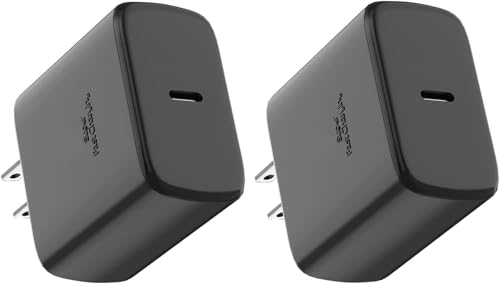
When a phone maker sells the charger its flagship was designed around, the sensible default is to start there. Samsung’s 45W adapter exists to deliver the Super Fast Charging 2.0 experience without detective work: the PPS profile is right, the behavior with Galaxy phones is the behavior the phone’s engineers tested, and the lock-screen notice confirms the tier the moment you plug in. For a Galaxy S-series or Ultra owner buying their first fast brick, this is the purchase with the fewest possible surprises, and there is real value in that certainty.
Beyond the Samsung ecosystem it behaves as a well-mannered 45W PD source for iPhones, Pixels and tablets, though nothing about it courts those buyers specifically. It is a single-port, single-device tool in a guide that also contains two-port and two-pack alternatives, so its case rests on correctness rather than versatility. Buy it for the Galaxy in your pocket; lend it to everything else without worry.
- Role: first-party 45W adapter for Galaxy flagships
- Profiles: USB PD with PPS, matched to Samsung’s faster tier
- Ports: one USB-C socket, one device at a time
- Cable: check the listing variant; the right 5A-class lead matters
- Fit: Galaxy S Ultra models and other PPS-aware phones
Strengths
- Guaranteed harmony with the Galaxy fast tier, no profile guessing.
- First-party accountability if a phone and charger ever disagree.
- A known quantity that resellers and support forums can advise on precisely.
Trade-offs
- One port means a second device waits its turn every single time.
- Samsung owners gain the most; other brands’ owners gain nothing special.
- The cable question still applies, so confirm what the box contains.
Best for: Galaxy flagship owners who want the faster tier with zero experimentation. Not suited for: a shared nightstand where two phones compete for the same single socket.

Anker 45W USB C Charger, 2-Pack with 5ft Cable — Best Household Bundle
Anker understands something about chargers that spec sheets miss: households do not need one perfect brick, they need enough good bricks that nobody unplugs anybody else’s. This bundle answers with two compact 45W units and a five-foot USB-C cable, which maps onto real geography — one charger claims the kitchen, the other claims the travel pouch or the bedside, and the cable is long enough to reach a pillow without turning the phone into a yo-yo. Each brick alone is an ordinary, competent 45W PD source for a phone or tablet; together they are a small domestic infrastructure.
The bundle logic also hedges the most common charger losses. Bricks die by being left in hotel rooms, borrowed by teenagers and absorbed into cars. A pair bought together softens every one of those events. What the bundle does not promise is Samsung’s top tier theatre: check the listing’s profile details if a Galaxy’s faster notice is your goal, and be ready to supply a suitably rated cable. As an all-round phone-and-tablet solution for a home, though, this is the entry we would hand to most families.
- Bundle: two 45W USB-C chargers in one purchase
- Cable: five-foot USB-C lead included in the box
- Ports: one per brick, two locations served
- Profiles: USB PD fast charging for phones and tablets
- Fit: iPhone, Galaxy and iPad households spreading out
Strengths
- Two rooms get fast charging on day one, ending charger custody disputes.
- The included five-foot cable reaches beds and couches honestly.
- Anker’s support stands behind a budget bundle, which is rarer than it should be.
Trade-offs
- Each brick serves one device; a couple sharing a room still shares.
- Galaxy owners chasing the top tier must verify profiles and cable rating.
- Two identical bricks invite mix-ups about whose is whose, a small domestic tax.
Best for: families seeding several rooms with fast phone charging in a single order. Not suited for: a buyer who needs two ports on one brick at one outlet tonight.

45W USB C Fast Charger, 2-Pack with 6Ft Cable — Budget Reach
This unbranded pair sells a simpler promise than the named brands: two 45W-class bricks and six-foot cables, aimed at Galaxy and iPhone owners who measure a charger by whether it reaches the couch. Six feet is the length at which a bedside phone stays usable while plugged in, and at which a living-room outlet behind furniture stops dictating where people sit. As spare and secondary chargers — the car, the guest room, the workshop — that reach is a legitimate feature, and the two-pack format matches how spares are actually consumed.
Our counsel with this class of listing is steady and unglamorous. Judge it as an accessory, not an heirloom. The listing claims compatibility across Galaxy generations and iPhones, and USB-C PD is a standard any competent unit can speak, but an unbranded brick has no reputation to lose, so let it earn trust in low-stakes posts first: the guest room before the flagship’s nightly charge, the older tablet before the new phone. If it behaves — cool, quiet, consistent — promote it. That is not snobbery; it is how careful households treat every unknown electrical accessory, and it costs nothing.
- Bundle: two unbranded 45W-class USB-C chargers
- Cables: six-foot leads included for each unit
- Ports: one USB-C socket per brick
- Claimed fit: Galaxy S series and iPhone models among others
- Role: spares and secondary posts around the home
Strengths
- Six-foot cables are genuinely useful and often cost nearly this much alone.
- A matched pair covers two rooms or a room and a car in one order.
- Standard PD behavior suits the older devices spares usually serve.
Trade-offs
- No brand accountability stands behind the internals or the claims.
- Samsung’s top tier depends on PPS and cable rating this listing may not guarantee.
- Longevity is a guess; treat the pair as consumable spares, not fixtures.
Best for: stocking guest rooms, cars and couches with long-reach spare charging. Not suited for: the one charger a new flagship depends on every night of its life.

Super Fast Charger USB C, 45W Dual Port, 2-Pack with 10FT Cable — Longest Cables
Ten feet of cable is this bundle’s entire personality, and it is more persuasive than it sounds. Ten feet crosses a room. It reaches from the only free outlet in a rental to the bed, from a garage socket to a workbench, from a lecture-hall wall to a middle seat. Each brick in the pair also carries two ports, so a phone and a tablet can share one distant outlet without a second expedition. Sold as a two-pack, the kit is really a small solution to bad outlet geography, and older buildings are full of exactly that problem.
The same cautions from the previous entry apply with interest, because the claims here are larger. Dual-port output is shared output: a brick feeding two devices divides its strength between them, so expect the headline pace only when one device drinks alone. The branding language borrows Samsung’s vocabulary, but the faster Galaxy tier still requires the right PPS behavior and cable, which a generic bundle cannot promise by adjective. Buy this for reach and redundancy — two bricks, two ports each, cables like rope — and let any top-tier charging it achieves be a pleasant surprise rather than the plan.
- Bundle: two dual-port 45W-class chargers per purchase
- Cables: ten-foot USB-C leads, the longest in this guide
- Ports: two per brick, output shared between them
- Claimed fit: Galaxy generations and Apple devices listed broadly
- Role: defeating distant outlets in older homes and rentals
Strengths
- Ten-foot leads end the tyranny of the one badly placed socket.
- Two ports per brick let a phone and tablet share that distant outlet.
- Four charging points across the pair cover a small home’s awkward corners.
Trade-offs
- Shared ports mean shared speed; solo charging is the fast case.
- Generic branding cannot guarantee the PPS behavior Galaxy owners want.
- Very long cables tangle enthusiastically and need a tie or a plan.
Best for: renters and older homes where the outlet is never where the bed is. Not suited for: a Galaxy owner whose whole goal is the certified top-tier notice.
Anker Nano Charger, 47W Max 2-Port GaN — Best Two-Device Pick
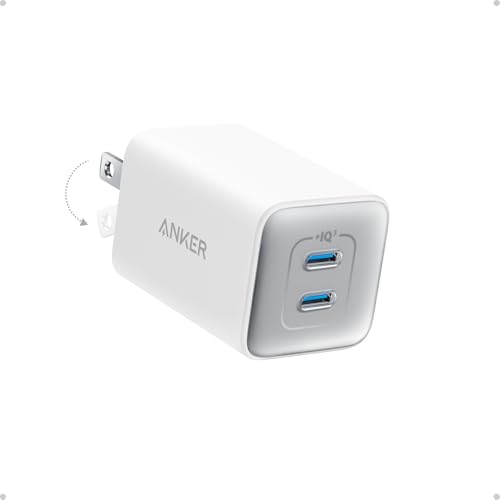
The Nano is the connoisseur’s entry in this guide: a folding GaN brick barely larger than the feeble chargers phones once shipped with, yet able to serve two USB-C devices from a 47W total budget. One port can drive a phone at a properly brisk pace; add a second device and the pair share, with the arrangement favoring the hungrier connection. For a traveler whose nightly load is a phone plus earbuds, or a phone plus a partner’s phone at modest expectations, it collapses two bricks into one object that vanishes into a pocket.
Note the number honestly: this is a 47W two-port unit appearing in a 45W guide because it lives in the same pocket and serves the same phones, not because it is a Samsung-tier specialist. Galaxy owners should again check profile details for the top notice. Everyone else — iPhone owners especially, plus Pixel and tablet users — gets Anker’s most refined small brick, the one that makes carrying a spare charger feel like no decision at all. It also anchors the two-port category elsewhere in our coverage, and its presence here is a reminder that port count sometimes beats raw wattage.
- Ports: two USB-C sockets in a folding Nano body
- Total output: 47W maximum, shared when both ports work
- Technology: GaN, compact enough for a coin pocket
- Profiles: fast charging for iPhone, Galaxy, Pixel and small tablets
- Role: the one-brick answer for phone-plus-one travel
Strengths
- Two devices charge together from a brick smaller than many single-port rivals.
- Folding prongs and tiny volume make it the best pure travel pick here.
- Anker’s fit and finish at this size remains the class benchmark.
Trade-offs
- Two hungry phones split the budget and both slow down noticeably.
- No cable is the headline here; bring a good one of your own.
- Samsung’s top tier is not this brick’s party trick, so verify before assuming.
Best for: travelers and minimalists charging a phone plus one companion device nightly. Not suited for: a desk where a laptop also expects to drink from the same brick.
Google 45W USB-C Charger — Pixel Owners’ Choice
Google’s own 45W charger is the quiet first-party answer for Pixel owners, designed to feed Google’s phones at the pace their charging curves request and to behave predictably with the rest of a USB-C household. It earns its place in this guide on relevance rather than linkability: we could not verify a listing for it in our pool, so it appears in prose, and readers should source it from Google’s store or a retailer they already trust rather than from any marketplace listing of uncertain origin.
Who should choose it over the linked names? A Pixel household that values the same first-party certainty Samsung owners get from the lead pick in this guide. Pixel fast charging has its own profile preferences, and the maker’s brick removes the guesswork in the same way. It will also charge other brands’ devices as a standard PD source, without special distinction. Consider it the symmetrical counterpart to Samsung’s adapter: the home-team charger for the other big Android camp, bought through channels where its authenticity is not in question.
- Role: first-party 45W adapter for Pixel phones
- Availability: prose-only here; buy through Google or trusted retail
- Ports: a single USB-C socket in the usual compact format
- Profiles: PD tuned for Pixel charging behavior
- Fit: Pixel owners first, general USB-C devices second
Strengths
- First-party matching removes profile doubt for Pixel owners entirely.
- Google’s retail channel guarantees the genuine article.
- It doubles as a standards-based spare for the rest of the drawer.
Trade-offs
- No verified listing in our pool means no link and no price guidance here.
- A single port keeps it a specialist in a guide full of sharers.
- Non-Pixel households gain little over the linked Anker options.
Best for: Pixel owners who want the maker’s own brick from a trustworthy source. Not suited for: bargain hunters, since first-party adapters rarely win on price.
Why Do Phones Slow Down as They Fill Up?
New owners of fast chargers often report a suspicious pattern: the first stretch of charging flies, then the pace visibly relaxes, and the last portion takes as long as everything before it. Nothing is wrong. Lithium batteries accept charge eagerly when empty and must be fed gently as they approach full, both to protect their chemistry and to manage heat, so every phone’s charging curve is a hill rather than a straight road. The practical meaning for shoppers is that headline wattage describes the eager phase. A 45W charger earns its keep in the first half of the battery, which is happily the half that matters in real life — the dead phone before a night out, the low tablet before a flight. Judging a charger by how fast it fills the final stretch is judging it by the phase no charger controls. When you test a new brick, test it from low, over the first half hour, and compare that window against your old adapter; that is the comparison the wattage on the box is actually about.
This curve also explains why overnight speed is a phantom benefit and why the adaptive overnight modes phones offer cost you nothing. A phone that reaches its gentle phase by 2 a.m. and its full point by dawn has lost nothing to a hypothetical faster brick, because the gentle phase was never the brick’s decision. Save your scrutiny for the daytime top-up, and let the night shift run at whatever pace the phone prefers.
How Do the Six 45W Options Compare?
| Charger | Ports | Units in box | Cable | Defining trait |
|---|---|---|---|---|
| Samsung 45W PD | 1 | 1 | Check variant | Galaxy top-tier reference |
| Anker 45W 2-Pack | 1 each | 2 | 5 ft included | Two-room household bundle |
| Generic 45W 2-Pack | 1 each | 2 | 6 ft included | Budget reach for spares |
| Generic 45W Dual-Port 2-Pack | 2 each | 2 | 10 ft included | Longest leads in the guide |
| Anker Nano 47W | 2 | 1 | Not the focus | Tiniest two-device brick |
| Google 45W (prose-only) | 1 | 1 | Sold via Google | Pixel first-party match |
The table exposes the category’s real axes: ports per brick, bricks per box, and cable length per dollar. Samsung and Google sell certainty to their own phone owners. Anker sells either multiplicity or miniaturization. The generic pairs sell distance. A buyer who knows which axis their household suffers on — too few rooms covered, too little reach, too much bulk, or a missing on-screen notice — can read their answer straight down the relevant column.
How Do You Get the Fastest Charge From a 45W Brick?
Start with the battery low and the phone idle; charging curves are steepest in the first half and a phone busy gaming or navigating will spend incoming power on itself rather than storing it. Use the cable the bundle provided or a lead you know is rated for higher current, and plug it into the charger’s primary port if the brick has several. Keep the phone out of direct sun and off warm surfaces, because a handset that grows hot will throttle its own intake to protect its battery, and no charger can argue with that decision. If your Galaxy still refuses to show the faster tier after those steps, change exactly one variable at a time — cable first, then port, then charger — and watch the lock screen after each change. Methodical swapping finds the weak link in minutes; random swapping finds it eventually, amid more frustration.
Overnight charging deserves a separate habit. Speed is wasted on a phone that has eight hours, and most modern phones offer an optimized or adaptive overnight mode that holds the battery at a gentler level until near your alarm. Turn that on, use whichever of these bricks lives by the bed, and save the full-speed sessions for the moments they matter: the hour before leaving, the layover, the quick turnaround between work and an evening out. Used that way, a 45W charger changes your relationship with the battery gauge — it becomes a tool for short windows rather than a nightly ritual you plan around.
How Does a 45W Brick Behave in a Car, a Café or a Library?
Public charging is where this size quietly shines. Café tables offer one outlet and an unspoken time limit; a 45W brick converts a coffee into a meaningful battery gain, which a weaker adapter cannot. Library carrels and airport counters reward the same arithmetic. In a car, the wall brick stays home, but the habit it teaches — carry the charger that matches the phone’s real appetite — transfers to choosing a proper car adapter rather than the feeble socket built into a dashboard. The deeper point is that 45W sits at the threshold where short opportunities become useful charges. Below it, a twenty-minute plug-in is a gesture. At it, twenty minutes is a plan. That threshold quality, more than any benchmark, is why this wattage became the default upgrade recommendation for phone owners who still use the adapter their phone came with years ago, or the one a carrier handed them in a paper bag.
What About Charging a Laptop From a 45W Brick in a Pinch?
It works more often than people expect, with conditions. A closed or sleeping ultrabook will refill from any pick here, slowly and completely. An open ultrabook doing light work will usually gain ground, because its draw during documents and browsing often sits below what the brick supplies. The same laptop rendering video or driving two external monitors may only hold its level, or slip gently, and that is the charger telling the truth about arithmetic rather than failing. MacBook Air-class machines are the happiest campers in this scenario; larger Pro-class machines treat 45W as a travel ration. The strategy frequent travelers adopt is deliberate: the 45W brick rides in the day bag for phones and emergency laptop sips, while the laptop’s proper adapter waits at the hotel for the evening refill. Judged as a ration, every pick in this guide succeeds. Judged as a replacement for a big adapter, all of them plead guilty to being 45W.
How Do You Read a 45W Charger Listing Without Being Fooled?
Listings in this category are written to be skimmed, so read them against the grain. Find the output specification, not the title: a title can say anything, but the specification block must state the profiles the charger offers, and PPS appears there by name when it exists. If the listing says only that a charger is fast, or borrows a phone maker’s marketing phrase as an adjective, treat the faster tier as unproven. Next, find the cable’s rating if a cable is included, and treat silence on that point as an answer. Then find the port arithmetic: a dual-port unit’s headline figure is its total, and the listing’s fine print usually confesses what each port receives when both are busy. Finally, look for the maker’s name attached to a warranty. A brand that prints its own name on the shell and stands behind it has given you a hostage; an unbranded listing has given you a price, which may still be the right trade for a spare, as long as you know which trade you made.
Photographs deserve the same skepticism. Renders of a charger beside a phone prove nothing about size; look for the stated dimensions or a shot of the brick in a hand or a socket, and remember that a unit photographed alone always looks smaller than it will beside your nightstand clock. Prongs tell a story too: folding prongs signal a maker thinking about travel, while fixed prongs on a compact brick signal a home post that will stab a bag’s lining if carried loose. None of these details is glamorous, and together they predict your satisfaction better than any headline wattage.
Which Devices Beyond Phones Love This Wattage?
Walk through a modern home with a 45W brick and a cable, and the sockets keep finding work. A handheld gaming console treats it as a full meal and can play while charging rather than merely surviving. A mirrorless camera’s USB charging port sips gratefully between shoots. A portable speaker, a rechargeable desk lamp, a heated travel mug’s base, a drone battery hub, a bike computer, an e-reader with a big appetite — the USB-C ecosystem has quietly standardized around exactly the appetite this class feeds. Even a power bank, that other reservoir, refills far faster from 45W than from the elderly 10W bricks still rattling around most drawers, which turns a power bank from an overnight commitment into a same-evening tool.
This breadth is the deeper reason the two-packs in this guide make sense. A single 45W brick is a phone accessory; several of them scattered through a home become the house’s low-voltage utility, as unremarkable and as essential as the hot water. Guests stop asking for chargers because the guest room has one. The car kit stops migrating back indoors. When a category reaches that level of domestic infrastructure, buying decisions should be made the way infrastructure decisions are made: coverage first, peak performance second, and a bias toward the boring reliability of makers who will still exist when a unit eventually fails.
What Changes When Two People Share One Bedroom Outlet?
Couples are the stress test of this category, and their evenings expose the difference between the bundle philosophies on offer. Two single-port bricks — the Anker pair, say — give each person a private fast charge and end all negotiation, at the cost of occupying both sockets of a duplex outlet or demanding a small strip. One dual-port brick — the Nano, or a generic dual-port unit — preserves the second socket for a lamp or a clock, at the cost of shared speed on the nights both phones arrive empty together. Neither answer is wrong; they are answers to different rooms. Rooms with plentiful outlets favor pairs of bricks. Rooms where the outlet count is the binding constraint favor the dual-port design, and their owners learn to stagger: the lower phone plugs in on arrival, the other after dinner, and by bedtime the sharing is invisible.
There is a third pattern worth naming, because so many households drift into it: the good charger migrates. One partner’s brick is faster, so both phones queue for it while the lesser brick sulks in a drawer. The fix is not a lecture but symmetry — buy the pair, buy identical units, and let there be nothing to migrate toward. Several entries in this guide are sold as matched pairs precisely because their makers have watched this domestic film before.
How Should You Pack a 45W Kit for a Week Away?
Decide what the laptop is doing on this trip before choosing the brick. If the laptop is a sometimes device — mail at the airport, a document in the evening — the 45W brick can be the only charger in the bag, feeding the phone properly and the laptop adequately, and the weight saved is real. If the laptop is the trip’s workhorse, pack its proper adapter too and let the 45W unit run the phone ecosystem from the second outlet; redundancy sounds like excess until a charger fails in a foreign city on a Sunday. Add the cable you trust most, not the longest you own, and add a second short cable for the power bank or the earbuds, because the one-cable kit always meets the evening when two devices are empty at once.
Hotel rooms reward a small ritual on arrival: find the outlet nearest the bed, claim it for the phone, and put the brick where you will see it during the departure sweep. Chargers are the most-forgotten item in hospitality precisely because they are small, silent and behind furniture. The bright side of the two-pack economy is that a forgotten spare hurts less than a forgotten flagship — one more reason the humble entries in this guide earn their shelf space in a traveler’s home.
Which Mistakes Send Buyers Back to the Returns Window?
Chasing the Galaxy top tier with a charger that lacks PPS is the signature disappointment of this category, followed closely by pairing a correct charger with an elderly cable and blaming the brick. Buying a two-pack of single-port units for a couple who share one nightstand is another: the pair covers two rooms, not two phones at one socket. The mirror error is buying the tiny two-port Nano for a household that will plug a laptop into it weekly and curse its manners. Generic bundles attract their own mistake — expecting flagship accountability from an unbranded box, then feeling betrayed by physics they were warned about. And a quiet final error: throwing away the cable a bundle included and substituting a prettier one of unknown rating, thereby downgrading a working system for aesthetics. Keep the chain intact, and most of these chargers will simply work for years.
What Does a Dorm Room Teach You About This Category?
A student room compresses every charging problem into twelve square meters: one or two reachable outlets, a phone that is also an alarm clock, a laptop that is also a television, and a roommate with the same inventory. The lessons generalize. First, cable length is a quality-of-life feature, because the bed is never near the socket and a phone that cannot reach the pillow is a phone that gets knocked off a desk at 3 a.m. The long-cabled bundles in this guide were practically designed by alumni. Second, a second brick is not a luxury but the difference between charging and queuing, which is why pairs outsell singles in September. Third, everything gets borrowed, so the charger that survives the year is the one with a name on it — literally, in marker, on the shell. Parents equipping a first dorm room could do worse than send the Anker pair, a marker, and the advice to keep one brick in the room and one in the bag, so a forgotten charger never becomes a dead phone on the walk home.
How Will You Know When It Is Time to Replace One?
Chargers rarely die dramatically; they fade. A phone that once announced its fast tier stops announcing it. A brick that ran warm begins running hot, or develops a faint whine under load, or charges only when the cable sits at a particular angle — that last symptom usually indicts the cable, which is why cables should always be swapped before bricks are condemned. Physical news is the clearest: a cracked shell, prongs that wobble, a port that grips loosely, any scorch mark or smell. Those are retirement papers, signed immediately, for any charger of any pedigree. The economics of this category are kind to the cautious: a replacement 45W brick from a maker in this guide costs less than the dinner you will eat while deciding, and no phone battery is worth nursing a suspect electrical accessory. Retire early, recycle the old unit where facilities exist, and let the spare from the two-pack you bought take the post — which is, in the end, the whole argument for buying them in pairs.
Final Recommendation
Let your phone choose first. Galaxy owners who want the notice their flagship promises should buy Samsung’s own adapter and a properly rated cable, and be done by dinner. Pixel owners should take Google’s brick through a channel they trust, accepting the prose-only detour as the price of authenticity. Everyone else is really buying logistics: Anker’s two-pack if rooms outnumber chargers, the Nano if a pocket must hold two devices’ worth of power, and the long-cabled generic pairs if your home’s outlets were placed by someone who hated furniture. Match the purchase to the geography of your evenings, keep the cable chain honest, and a 45W brick will quietly become the most-used object you own that you never think about.
Can a 45W Charger Hurt an Older Phone With a Small Battery?
No, and the reason is worth understanding because it governs every pick in this guide. The negotiation runs the relationship: an older phone asks for the modest profile it was built around, and the charger supplies that profile rather than its maximum. Small devices — earbuds cases, elderly handsets, e-readers with tiny cells — are protected by the same conversation, which is why one capable brick can serve a whole drawer without a casualty list. A charger’s size describes what it can offer, never what it insists on delivering. The devices genuinely at risk in a home are not the ones on strong chargers; they are the ones on damaged cables and cracked bargain bricks, which is why this guide keeps returning to the unglamorous virtues of sound cables and accountable makers.
The same logic explains why bundles of two modest chargers so often beat one superior charger in real homes. Households run out of locations before they run out of wattage. Two adequate bricks in two rooms outperform one excellent brick that is always in the wrong room, and makers have learned that the second unit is the one buyers actually thank them for. If your life happens mostly in one room, a single better brick wins. If it happens across a home, a car and a workplace, coverage wins, and the pairs in this guide exist to sell exactly that.
Frequently Asked Questions
Why does my Galaxy not show Super Fast Charging 2.0 on a 45W charger?
Either the charger lacks the PPS profile the tier requires, or the cable cannot carry the current the phone requests. Swap in a cable rated for higher current first, since that is the cheaper and more common culprit. If the notice still refuses to appear, the charger’s profile list is the limit, and a PPS-equipped model such as Samsung’s own adapter is the fix.
Is a 47W two-port charger better than a 45W one-port charger?
They solve different evenings. The two-port Nano serves a phone and a companion together, sharing its budget between them. A single-port 45W brick gives one device its full attention. If your second device is earbuds or a watch, sharing costs nothing you will notice; if it is a second phone in a hurry, both of you will notice.
Can I use a 45W charger for an iPhone?
Yes, comfortably. Recent iPhones negotiate standard Power Delivery and draw what their own curves allow, which sits within what these bricks offer. The charger will not force anything; the phone conducts. A 45W unit is a fine one-brick answer for an iPhone plus the rest of a small kit.
Are the unbranded two-packs safe to leave plugged in?
Any charger should be inspected on arrival, used first in attended, low-stakes spots, and retired if it runs excessively hot, buzzes or behaves inconsistently. That discipline matters more for unbranded units because no reputation polices them. Many serve for years as spares; the point is to let them earn trust rather than assume it.
Does a longer cable slow charging down?
A well-made long cable loses very little, and the ten-foot leads in this guide are useful precisely because length usually matters less than rating. A cable’s current rating and build quality decide far more than its length. Problems arise when a long cable is also a cheap one of unknown rating, which is a quality issue wearing a length costume.
Should I buy the charger from my phone’s maker or a specialist brand?
Buy the maker’s charger when your phone has a special fast tier with strict requirements, as Galaxy and Pixel owners do. Buy the specialist brand when your needs are about ports, bundles or size, where Anker’s range is broader. Mixed households can do both: the home-team brick by the bed, the versatile brick in the bag.
Related Guides
Readers whose laptops outgrow this class should step up to our survey of full-strength 100W chargers for laptop-first kits, while anyone whose real problem is too many devices at one outlet will prefer multi-port charging stations for shared desks. If your questions keep circling back to Samsung’s faster tier and the cables it demands, our explainer on PPS and what your phone actually asks a charger for goes deeper.
Related guides
- Best 400 FPS High Speed Cameras: The Honest Truth About Burst Slow Motion
- Best Kids Smartwatches for Texting and Calling: Six Watch-Phones Under Parent Control
- Best Fast Charge Qi Wireless Chargers: Qi2 at 15W and Qi2.2 at 25W
- Best 3rd Party MacBook Chargers: 96W-Class Alternatives, the 100W Cable Rule, and the Apple Benchmark



[…] and desk setup. Readers comparing smaller bricks for phone-only kits should see our roundup of compact USB-C chargers for everyday carry, while anyone building a permanent multi-device station may prefer the models in desktop charging […]