What's inside
- Key Takeaways
- Quick Picks
- How Did We Judge Replacements for Something Deliberately Simple?
- What Exactly Are You Giving Up When You Leave Disposables Behind?
- How Do the Six Alternatives Compare Honestly?
- What Does a Year of Events Actually Cost Each Way?
- Which Mistakes Do Disposable Converts Keep Making?
- How Do You Run a Reusable Camera as a Wedding Guest Camera?
- How Does the Environmental Argument Actually Stack Up?
- What Should You Buy Alongside the Camera?
- How Do Children and Grandparents Fare With Each Option?
- What About Travel — the Disposable’s Other Homeland?
- How Do You Keep the Habit Alive After the First Roll?
- A Word About Gifting These Cameras Well
- What If You Only Photograph One Big Event a Year?
- The Sentimental Case, Stated Plainly
- A Practical First Month With Your Chosen Alternative
- What This Guide Deliberately Did Not Recommend
- A Note on Secondhand Reusables and Handing Them On
- One Small Decision Tree for the Truly Torn
- Final Recommendation
- Frequently Asked Questions
- Related Guides
As an Amazon Associate I earn from qualifying purchases. This post may contain affiliate links at no extra cost to you.
gizmoverdict.com is reader-supported. When you buy through links on our site, we may earn an affiliate commission.
Where to buy: every pick below links to its Amazon listing, covering reusable film bodies and one instant camera for the impatient. The hunt for the best alternative to disposable cameras usually begins at a wedding, a festival, or the morning after one, when someone counts the plastic shells in a bin and does the uncomfortable arithmetic. A disposable camera delivers its charm honestly — zero settings, real film, a week of anticipation — then becomes landfill with a battery inside. Repeating that purchase at every event multiplies both the cost and the waste, which is why a small reusable camera that mimics the disposable experience, minus the throwing away, has become the thinking host’s and traveler’s answer.
The alternatives split into two philosophies. Reusable thirty-five millimeter cameras keep everything people love about disposables — the grain, the flash-lit candor, the delayed envelope of results — while opening at the back to accept another roll, forever. The instant camera at the end of this guide abandons the lab entirely, printing its small photographs on the spot at a higher per-frame cost, for people whose joy depends on holding the picture before the song ends. Both philosophies beat the disposable on economics within a handful of events; they differ in texture, patience, and what your guests carry home.
Cost per photograph is the honest yardstick here, so this guide keeps returning to it. A disposable bundles its film, body, and processing into one purchase and one bin. A reusable body spreads its price across years of rolls, after which each frame costs only film and developing. Half-frame models stretch those rolls twice as far again. Run your own event calendar through that arithmetic — two weddings, a holiday, a birthday season — and the crossover point where reusable wins usually arrives embarrassingly early.
Key Takeaways
- Reusable film cameras reproduce the disposable look faithfully because they use the same film stocks and flash-first simplicity.
- Half-frame Kodak and Pentax models halve per-frame costs, reaching seventy-two exposures from a single standard roll.
- The Pentax 17 is the upgrade path for anyone who suspects the disposable habit is becoming a real photography hobby.
- Instax Mini 12 trades the lab wait for instant prints, at a per-photo cost that suits parties better than archives.
- Every reusable pick here eliminates a stream of discarded plastic bodies and stranded batteries from your events.
Quick Picks
| Pick | Badge | Why it earns a slot |
|---|---|---|
| Kodak Ektar H35 | Closest disposable spirit | A featherweight half-frame box with fixed focus and party flash, doubling every roll to seventy-two frames. |
| Kodak EC35 | Protected pocket regular | Its sliding lens cover survives handbags and glove boxes that would scar an unprotected disposable-style lens. |
| Ilford Sprite 35-II | Monochrome romantic | A reloadable full-frame body from a film maker, born to give black-and-white stock an inexpensive permanent home. |
| Kodak Snapic A1 | Near-subject improver | Switchable focus zones rescue the table-distance portraits that fixed-focus disposable clones habitually soften. |
| Pentax 17 | The keeper upgrade | A properly engineered half-frame camera with a real lens for converts ready to outgrow toy-grade bodies. |
| Fujifilm Instax Mini 12 | Instant gratification branch | Prints credit-card-sized photos in the moment, skipping labs, envelopes, and anticipation entirely. |
How Did We Judge Replacements for Something Deliberately Simple?
A disposable camera sets a strange brief: be thoughtless, be tough, be charming, and cost little enough to abandon. Replacements were judged first on how completely they preserve the thoughtlessness — load, point, flash, wind — because a reusable camera demanding settings has answered a question nobody at a wedding asked. Second came the per-frame economics across a realistic year of events, including film and developing, since a replacement that costs more forever is a philosophy, not an alternative.
Durability separated the plausible from the pretend. A guest camera will be dropped, sat on, left in a hot car, and operated by someone who has never loaded film, possibly after champagne. Bodies earning places here tolerate that biography or cost little enough that their loss is a shrug. Image character mattered in the specific disposable direction: forgiving lenses, eager flash, colors that flatter a crowd. A clinically sharp reusable camera would actually fail this brief, because the disposable look — soft edges, glowing highlights, honest grain — is the product people are trying to keep.
The instant entry was judged on a parallel track: print cost, print size, and the social physics of a photograph that exists immediately. It does not replace the film picks so much as secede from their timeline, and the guide treats it as a neighboring country rather than a competitor, with its own customs. Readers should decide which timeline their events live on before comparing anything else, because that single preference reorganizes the entire ranking.
What Exactly Are You Giving Up When You Leave Disposables Behind?
Less than nostalgia suggests. The disposable’s magic was never its plastic; it was the constraint and the delay. Twenty-seven frames made people choose. A week of waiting made the results feel like archaeology rather than content. Every reusable film camera in this guide preserves both constraints almost exactly, because the film inside is the same emulsion and the lab takes the same week. What disappears is only the waste stream and the per-event repurchase, neither of which ever made a photograph better.
Two genuine losses deserve naming. A disposable can be handed to a stranger, a child, or a tipsy uncle with literally zero financial anxiety, and a fleet of them scattered across wedding tables creates a democratic archive no single reusable camera replicates. Hosts solving that specific problem sometimes buy two or three of the cheapest reusables here and accept the small risk collectively — still cheaper than a season of disposables, and the cameras come home afterward. The second loss is the disposable’s total weatherproof indifference; you do not care if it rains on a camera destined for the bin. Reusables ask for a plastic bag’s worth of care, which most adults can manage.
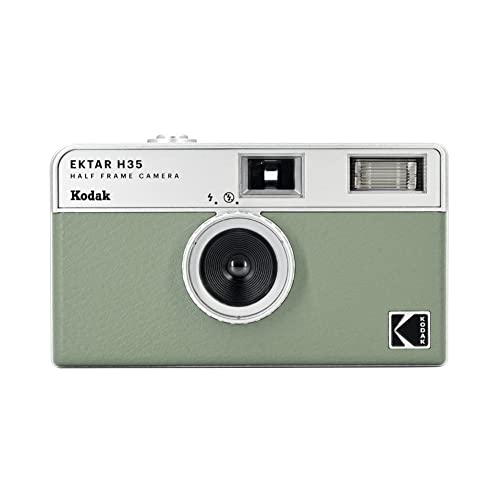
Kodak Ektar H35 — Closest disposable spirit
If a disposable camera reincarnated with a conscience, it would look like the Ektar H35. The ritual is identical — no focus to set, a flash for the indoors, a shutter button and a winder — except the back opens when the roll ends and another seventy-two-frame adventure begins. That half-frame economy is the headline for event hosts: a single roll covers an entire reception’s worth of guest photography, and the per-frame cost falls to a level where handing the camera around a table stops feeling like lending money.
The Sage finish in this listing suits the wedding-and-party habitat aesthetically, and the body weighs so little that guests forget they are carrying it, which is when candid photography happens. Output carries the full disposable signature — direct-flash faces, softened corners, grain that reads as atmosphere — because the optical recipe is a close cousin. One AAA battery runs the flash, and neither film nor battery is bundled, so hosts should stage the camera loaded and ready rather than presenting guests with an unboxing exercise.
As a personal camera it serves the same carefree brief for travel and festivals, with the standing caveats of its class: arm’s-length subjects soften, single-speed exposure guesses at extremes, and the plastic shell expects kindness. None of that distinguishes it from the disposables it replaces, which is precisely the point. Among all the alternatives gathered here, this is the one a disposable loyalist can adopt without learning a single new behavior — the same joy, the same look, and a bin that stays empty.
- Format: reusable half-frame body, up to seventy-two frames per roll
- Operation: focus-free lens, built-in flash, single AAA battery
- Finish on this listing: Sage
- Not included: film and battery, so buy both alongside
Strengths
- Disposable-identical handling removes any learning curve for guests.
- Seventy-two frames per roll undercuts disposable economics decisively.
- Negligible weight keeps it circulating at events instead of table-bound.
Trade-offs
- Close-range softness is inherited faithfully from the disposable formula.
- Plastic construction will not survive genuine abuse for years.
- Half-frame scans need a lab comfortable with the format’s pairs.
Best for: wedding hosts, party people, and disposable loyalists wanting the same ritual sustainably. Not suited for: anyone secretly hoping the replacement will take sharper, more serious photographs.

Kodak EC35 — Protected pocket regular
The EC35’s argument begins where most cheap cameras die: in the bag. Its sliding cover closes over the lens like an eyelid, so the months of keys, coins, and grit that sandblast an unprotected lens simply never arrive. For a camera whose destiny is to live in a tote as someone’s everyday alternative to buying disposables for every occasion, that small shutter of plastic is the difference between a tool that ages gracefully and one whose images fog a little more each season.
Photographically it is the full-frame member of Kodak’s beginner family: thirty-six standard frames per roll, a focus-free lens aimed at the middle distances of social life, and a flash powered by a single AA cell — the battery size every corner shop on the planet stocks, which matters on the third day of a trip when the flash dies. Results please crowds rather than critics, with bright color and gentle edges that flatter the disposable aesthetic while coming from a body you keep.
Against its half-frame sibling it trades economy for negative size: fewer frames per roll, each one larger and more print-friendly. Hosts counting pennies per frame should choose the H35. Owners who print enlargements of favorite frames, or who simply prefer the classic thirty-six-frame rhythm their parents knew, will feel at home here. Either way, the EC35’s cover makes it the most survivable of the inexpensive reusables, and survivability is the entire premise of replacing a throwaway object with a kept one.
- Format: reusable full-frame body, standard thirty-six-frame rolls
- Protection: sliding cover guards the lens between uses
- Power: one AA battery for the flash, sold separately with film
- Temperament: beginner-proof operation with nothing to misconfigure
Strengths
- Lens cover defeats the pocket wear that quietly ruins rival bodies.
- Full-frame negatives print more generously than half-frame alternatives.
- Universal AA power is replaceable anywhere on Earth within minutes.
Trade-offs
- Per-frame running cost doubles the half-frame sibling’s.
- No focus control at any distance, near or far.
- Flash-dependent indoors, with the direct look that implies.
Best for: everyday carriers wanting one kept camera instead of a drawer of disposables. Not suited for: event hosts optimizing cost per frame across many guests.
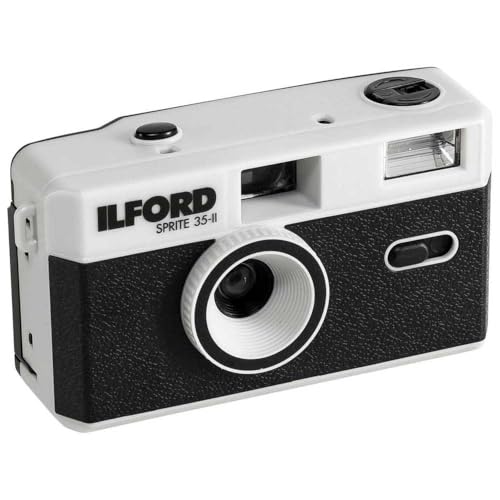
Ilford Sprite 35-II — Monochrome romantic
Every disposable ever sold shot color, so the Sprite’s presence here introduces an alternative the disposable world never offered: what if the kept camera spoke black-and-white? Ilford has manufactured monochrome film for generations, and this reloadable body exists as its emissary — a simple full-frame camera with a 31mm fixed-focus lens, a single shutter speed, and a flash, designed to be loaded with the company’s own emulsions and carried like the disposable it replaces, except it comes home with you afterward.
Monochrome transforms the disposable brief in a flattering direction. The mixed, ugly lighting of halls and kitchens — the light that makes color snapshots look jaundiced — becomes mere brightness and shadow, and suddenly the cheap lens’s softness reads as period atmosphere. Grandparents at a wedding photographed on black-and-white film look like ancestors already, in the best sense. For hosts and travelers tired of the disposable’s color postcard look, the Sprite offers the same simplicity wearing a more poetic coat.
Its discipline is real: the slow lens and single speed demand a versatile film stock and flash indoors, and color loyalists will miss their palette entirely — though nothing stops an owner loading color film instead, since the body accepts any thirty-five millimeter roll. Reloadability pays the body back against disposables within a few cycles, after which every frame is just film and developing. As the traditionalist’s alternative — same ritual, deeper roots, no waste — the Sprite holds a corner of this guide that no Kodak occupies.
- Format: reusable full-frame body accepting any standard film stock
- Lens: 31mm fixed-focus optic with a single shutter speed
- Heritage: made by a historic black-and-white film manufacturer
- Flash: built-in unit for interiors and evening events
Strengths
- Black-and-white results flatter the ugly lighting of real venues.
- Reloadable economics defeat disposables within a handful of rolls.
- Wide lens favors the group scenes event photography lives on.
Trade-offs
- Slow optics struggle in dim rooms without the flash’s help.
- Monochrome is a taste not every gift recipient shares.
- Single shutter speed punishes film-speed choices made carelessly.
Best for: romantics wanting the disposable ritual with a timeless monochrome voice. Not suited for: color devotees or low-light venues where flash is unwelcome.

Kodak Snapic A1 — Near-subject improver
Ask disposable cameras’ owners for their saddest frames and a pattern emerges: the close ones. The birthday honoree across the table, the ring held toward the lens, the dog’s nose investigating — all softened by a lens that cannot focus nearer than a room away. The Snapic A1 is the alternative built from that complaint. Its two-zone focus switch adds exactly one decision to the disposable ritual — near or far — and in exchange rescues the conversational distances where social photography actually lives.
The rest of the proposition stays disposable-faithful: a light ivory-white body, flash for interiors, AAA power, full-frame rolls. Guests can operate it after a ten-second briefing, and the zone pictograms make the single decision nearly foolproof, though a roll’s first frames may include one landscape accidentally shot on the near setting while the habit forms. That tuition is cheap, and the payoff — sharp faces across café tables, readable details on cakes and gifts — addresses the disposable experience’s most consistent disappointment.
Position it honestly among its siblings. It costs its owner one extra thought per photograph, which purists of the thoughtless school may resent. It returns that thought as keeper rate, the metric that decides whether an album delights or merely documents. For personal use — a kept camera for someone’s social life rather than a fleet for strangers — that trade favors the Snapic strongly, and it is the inexpensive alternative this guide would hand to a friend whose subjects are usually within arm’s reach plus a step.
- Format: reusable full-frame body with standard roll capacity
- Focus: two selectable zones for near subjects and general scenes
- Power: AAA battery, with film and battery both sold separately
- Finish on this listing: Ivory White
Strengths
- Near zone fixes the disposable formula’s weakest distance.
- One-switch simplicity keeps guest operation realistic.
- Full-frame negatives suit keepsake printing of favorite frames.
Trade-offs
- The extra setting introduces a rare but real user-error mode.
- Two zones remain crude beside any genuinely focusing camera.
- Shell durability matches its price rather than its ambitions.
Best for: social photographers whose world happens at table distance. Not suited for: hosts wanting absolutely zero decisions for their guests.

Pentax 17 — The keeper upgrade
Some disposable converts finish their first reusable roll, stare at the scans, and feel an unfamiliar itch: what if the camera were actually good? The Pentax 17 is where that itch leads. Built by a genuine camera manufacturer as a modern half-frame instrument, it keeps the disposable’s economy — up to seventy-two frames per roll — while replacing every toy component with engineered ones: a sharp coated 25mm lens, zone focusing with several distance bands, program exposure with a compensation dial for the moments you disagree with it.
The photographs announce the difference immediately. Edges hold, contrast breathes, and the grain sits on detail instead of replacing it. Yet the camera remains recognizably a descendant of the disposable idea — compact, quick, film-first, fun — rather than a shrunken professional tool demanding reverence. That balance is its genius and its market: it is the alternative for people who came for the disposable’s charm and stayed for photography itself, and it will keep serving long after the toy bodies have been outgrown, gifted onward, or retired to a shelf of good intentions.
The price, several multiples of the plastic picks, is the honest barrier, and this guide will not pretend the upgrade is necessary. Disposable joy survives perfectly well at the H35’s level. Buy the Pentax when the hobby has proven itself across a few rolls and the itch persists, and it becomes the rare upgrade that ends upgrading — a camera bought once, kept for decades, and associated with a whole era of someone’s life. As an alternative to disposable cameras, it is less a replacement than a graduation.
- Format: half-frame, up to seventy-two exposures per roll
- Lens: 25mm f/3.5 with multi-band zone focusing
- Exposure: program automation plus compensation control
- Build character: engineered construction intended for long ownership
Strengths
- Image quality leaps beyond anything the disposable formula produces.
- Half-frame economy keeps the running-cost advantage intact.
- Controls reward growing skill instead of capping it.
Trade-offs
- Cost demands evidence the film habit will actually persist.
- Too precious to hand around a party like a disposable.
- Half-frame grain shows sooner in very large enlargements.
Best for: proven converts ready for one serious, lasting film camera. Not suited for: guest fleets, first experiments, or careless environments.

Fujifilm Instax Mini 12 — Instant gratification branch
The Instax Mini 12 secedes from everything above by abolishing the lab. Load its proprietary instant film, point at a friend, and a small print develops in your hand while the moment is still warm. Automatic exposure handles the thinking, a selfie mirror and close-up mode handle the framing, and the pastel-blue body in this listing announces its intentions honestly: this is a social object, closer to a party game than to the archival instruments sharing this page.
Its role as a disposable alternative is real but differently shaped. At weddings it powers guest books that fill with actual photographs before dessert. At birthdays it gives children a print to take home, which no envelope of scans next week can rival emotionally. The per-print cost runs higher than any film frame in this guide, and the small prints will not enlarge or archive like negatives — the trade is immediacy itself, purchased openly. Hosts should also note the film packs are the ongoing budget line, and a popular Instax at a big party consumes them with joyful speed.
Choose it when the photograph’s social life matters more than its afterlife. Choose the film picks when you want negatives, enlargements, and the week’s delicious delay. Many households end up owning both species for different rooms of the same celebration, which this guide considers not indecision but wisdom. The disposable camera, notably, offers neither immediacy nor an archive worth the name — which is why, from either direction, it is the option this entire page exists to retire.
- Format: instant film camera producing Mini prints on the spot
- Exposure: fully automatic, with selfie mirror and close-up mode
- Finish on this listing: Pastel Blue
- Running cost note: proprietary film packs are the ongoing expense
Strengths
- Photographs exist physically within moments of the shutter.
- Guest books and party favors gain real images the same night.
- Automatic everything keeps operation genuinely universal.
Trade-offs
- Per-print cost exceeds every film alternative gathered here.
- Small prints cannot enlarge or archive like film negatives.
- Popular parties burn through film packs at surprising speed.
Best for: parties, guest books, and anyone whose joy needs the print now. Not suited for: archivists, enlargers, or cost-per-frame accountants.
How Do the Six Alternatives Compare Honestly?
| Pick | What it replaces best | Principal caution |
|---|---|---|
| Kodak Ektar H35 | The disposable ritual itself, at half-frame economy | Close subjects soften; plastic longevity |
| Kodak EC35 | The everyday carry disposable habit | Full-frame running costs; no focus control |
| Ilford Sprite 35-II | The ritual, translated into black-and-white | Slow lens; monochrome is a taste |
| Kodak Snapic A1 | Disposable parties where subjects sit close | One setting for guests to get wrong |
| Pentax 17 | The whole category, upgraded permanently | Price; too valuable for guest duty |
| Instax Mini 12 | The wait itself — prints immediately | Highest per-photo cost; tiny prints |
Two axes organize the table: patience and permanence. Film picks ask for a week’s patience and repay it with negatives that outlive everyone at the party. The instant pick asks for none and repays with a print whose charm is inseparable from its fragility. Cost runs opposite to instinct — the cheapest body to buy, the disposable, is the most expensive way to photograph a year — and every entry above exists to correct that inversion at a different level of commitment.
What Does a Year of Events Actually Cost Each Way?
Imagine a household’s ordinary year: two weddings attended, one hosted party, a summer holiday, and a birthday season. Photographed with disposables, that year consumes a small fleet of single-use bodies, each bundled with its film and processing, and leaves a drawer of guilt. Photographed with an H35, the same year costs the body once — a price comparable to a couple of disposables — plus a handful of rolls and their developing, with the half-frame economy stretching every roll across two events. The crossover arrives so early that the reusable’s second event is effectively photographed at film-and-lab cost alone.
The Instax year costs differently: the camera once, then packs of instant film whose per-print price exceeds the film route’s per-frame cost several times over. That premium buys the guest-book magic and the children’s take-home prints, and households that value those artifacts pay it gladly with open eyes. The Pentax year costs the most upfront and the least per frame among the quality options, amortizing toward the cheapest serious photography imaginable across a decade. None of these calculations requires a spreadsheet; all of them punish the disposable’s apparently simple price tag, which is a subscription disguised as a purchase.
Which Mistakes Do Disposable Converts Keep Making?
Buying the reusable and forgetting the ecosystem tops the list: film, batteries, and a chosen lab are part of the product, and a camera that arrives without its consumables sits idle through the event it was bought for. Stage it loaded. Second comes choosing a first film stock by romance rather than versatility; a forgiving four-hundred-speed roll covers the light these simple cameras meet, while exotic slow films punish their fixed exposures. Third is neglecting to tell guests how a guest camera works — one sentence about advancing the film prevents the double-exposure confusion and the unshot roll alike.
Fourth, converts sometimes abandon the ritual’s spirit by chimping expectations onto film: demanding to know immediately whether the shot worked, then shooting timidly when they cannot. The delay is the delight, and households that brief themselves on that — results next week, surprises included — enjoy the format as designed. Finally, Instax owners under-buy film packs for popular events, and film owners under-order rolls before holidays when labs slow down. Consumables are this category’s fuel; running dry mid-celebration is the one failure entirely within the buyer’s control.
How Do You Run a Reusable Camera as a Wedding Guest Camera?
Load it before the day, with fresh batteries and a versatile color stock, and tape a three-line instruction card to its back: wind after each shot, flash on indoors, hand it to someone new after five frames. Place it where circulation happens — the bar, the guest-book table — rather than assigning it to one shy volunteer. If the budget stretches, deploy two of the inexpensive bodies so no queue forms and no single loss ends the experiment; even a pair costs less than the disposable fleet it replaces, and both come home at the night’s end.
Brief the couple on the timeline so nobody expects a gallery by Monday. When the scans return, share them as an event of their own — the delayed second wedding album has become a small tradition in households that do this, often treasured precisely because its frames are unposed, unreviewed, and occasionally unflattering in the way real memory is. Print a handful for the couple physically. A framed five-by-seven from a guest camera carries a warmth no photographer’s preview gallery quite reproduces, and it cost a frame of film.
How Does the Environmental Argument Actually Stack Up?
Each disposable camera embodies a plastic shell, a circuit board, a flash capacitor, and a battery, all manufactured to be used for twenty-seven frames and discarded — sometimes into recycling streams that accept them, often into general waste. Multiply by the millions sold for weddings and holidays and the category becomes a small but perfectly formed monument to single-use electronics. A reusable body inverts the ratio: one shell serving thousands of frames across years, with its battery replaced a handful of times and its film’s cardboard-and-metal packaging as the main recurring footprint.
Honesty cuts both ways, so the caveats belong here too. Film itself is a chemical product, developing uses chemistry that reputable labs handle responsibly, and instant film’s per-print plastic cartridge is its own waste stream — smaller than a whole camera per roll, larger than a film canister. The greenest ranking in this guide therefore runs roughly with the economics: half-frame reusables first, full-frame reusables next, instant after that, and the disposable last by a distance no recycling logo closes. Buying one kept camera and using it for years beats every finer calculation, because the most sustainable photograph is the one taken on equipment already owned.
What Should You Buy Alongside the Camera?
Two rolls of the same versatile film, so the first event never ends mid-roll with no spare in the drawer. Spare batteries in the size your camera drinks, because a flash battery dies at the exact midpoint of every celebration by some law of the genre. A small pouch that makes the camera findable in a bag and protects it between outings. And a relationship with a lab — chosen before the first roll finishes, based on sample scans and turnaround that suits your patience — because the envelope moment deserves a competent partner.
For the Instax branch, the bundle is simpler and more perishable: film packs in genuine quantity, since a beloved instant camera at a party consumes prints the way a dance floor consumes songs, and a small album or guest book ready to receive them while the adhesive enthusiasm lasts. For the Pentax graduate, add nothing but film for the first season; the camera’s whole point is that it needs no entourage. In every branch, resist accessorizing beyond the consumables. These cameras replaced a throwaway object in order to simplify a habit, and a shelf of gadgets around them re-complicates what was beautifully plain.
How Do Children and Grandparents Fare With Each Option?
Children are the disposable’s natural constituency — zero instruction, instant bravery — and the inexpensive reusables inherit that constituency honestly, with the H35’s one-button ritual at the front of the class. Give a child a loaded reusable and a single rule about the winder, and you have also given them a first lesson in stewardship: this object comes back, so we look after it. The Instax, meanwhile, is the only camera here whose result a six-year-old can watch developing in her own hands, a small miracle that has started more photographic lives than any specification ever printed.
Grandparents split by history. Those who shot film for decades often handle the Sprite or EC35 with a fluency that embarrasses their grandchildren, and the ritual’s return can be genuinely moving at family events. Those who never did may prefer the Instax’s total automation and immediate confirmation that the photograph worked. Either way, the large-hearted point stands: these simple cameras are among the last photographic tools genuinely operable by every generation at the table simultaneously, with no accounts, no updates, and no grandchildren conscripted as technical support.
What About Travel — the Disposable’s Other Homeland?
Disposables built their second career on travel: the camera you could lose, soak, or have stolen without ruining the trip’s budget or its mood. Reusables contest that homeland on favorable terms. The inexpensive Kodaks cost little enough that their loss is a bad afternoon rather than a ruined holiday, they weigh nothing in a daypack, and they spare the traveler the disposable’s nastiest surprise — discovering at the lab, weeks later, that the sealed camera’s film was fogged by an airport scanner or a hot dashboard before the trip even began. A kept camera’s film can be hand-checked, refrigerated, and chosen fresh for the journey.
The Instax travels differently, as a social passport. Its prints become gifts for hosts, fellow travelers, and children met along the way — a currency no digital file quite matches in places where sharing a photograph means showing a phone screen and taking it away again. Seasoned travel photographers sometimes carry both species: film for the archive, instant for the diplomacy. What neither needs is the disposable’s bargain of indifference, because a camera cheap enough to keep is also, it turns out, cheap enough to risk.
How Do You Keep the Habit Alive After the First Roll?
The valley of this hobby is the fortnight after the first scans return, when novelty fades and the camera must earn its place in ordinary weeks. Households that survive it share a trick: they give the camera a standing assignment. Photograph the dog’s year. Document every family meal’s cook holding the finished dish. Keep the camera by the door for the walk it joins daily. A standing assignment converts an object into a project, and projects survive the novelty valley that objects do not.
Printing accelerates the conversion. One framed frame from each roll, hung where the household passes daily, turns the camera’s output into the home’s decoration and the next roll into an anticipated sequel. Share scans sparingly and deliberately rather than dumping seventy-two frames on a group chat; scarcity was the disposable’s secret sauce, and the reusable inherits it only if its owner respects the edit. Do these things and the alternative stops being an alternative — it simply becomes how your household photographs, and the disposable becomes a story you tell about how you used to do it.
A Word About Gifting These Cameras Well
A reusable film camera is a gift with a tail: it obliges its recipient to buy film and find a lab, which is either a delightful project or an errand, depending entirely on how the gift is assembled. The complete version includes the camera loaded with its first roll, a second roll beside it, spare batteries, and a note naming a good lab or a prepaid developing voucher. Presented that way, the gift is an experience with its first chapter already begun. Presented as a bare box, it risks becoming the most photogenic paperweight in the recipient’s drawer.
Match the model to the person with the same care as the packaging. The aesthetically minded friend who will carry it visibly deserves the H35’s pretty finish or the Snapic’s ivory calm. The nostalgic parent deserves the Sprite’s traditional ritual. The teenager whose parties are the point deserves the Instax and a heroic quantity of its film. And the friend who has been disposable-curious for a year, talking about grain at dinner, may deserve the Pentax outright — some gifts are meant to start a decade, not a season, and this is the rare category where that ambition is affordable.
What If You Only Photograph One Big Event a Year?
Then the arithmetic narrows but still favors keeping. A single annual event photographed disposably costs a body or two every year, forever, with nothing accumulated. The same event photographed with the least expensive reusable here costs the body once and then only film, which means the second year’s event is already cheaper and the fifth year’s is dramatically so — while the camera, unlike the annual disposable, also exists for the fifty weeks between events, available for the unplanned moments that never justified buying a disposable at all. Ownership’s quiet dividend is availability, and availability is where most beloved photographs actually come from.
The honest exception is the truly one-off event with no sequel imagined: a single festival abroad where even a cheap body’s return journey is doubtful, or a mud-run where destruction is the itinerary. There, a disposable remains a rational tool, and this guide blesses it without irony. Alternatives earn their name across repetition; judge them across your real calendar, not a hypothetical one, and the right answer for your household will usually be obvious by the second event you list.
The Sentimental Case, Stated Plainly
Strip away economics and ecology and one argument remains, the one that actually moves people at kitchen tables. A kept camera accumulates a biography. The same small body attends the wedding, the christening, the graduation, and the holiday where everyone is suddenly older, and its scratches become a diary no one wrote deliberately. A disposable, by design, attends once and is executed. Families who switch often report an unexpected attachment to the object that witnessed everything — an attachment no specification sheet predicts and no disposable can ever earn, because permanence is the precondition of sentiment. If your household photographs to remember, give the remembering a vessel that survives to be remembered with.
A Practical First Month With Your Chosen Alternative
Week one: load the camera, shoot a dozen frames around the house in mixed light, and resist the urge to save the roll for something worthy — worthiness is a trap that leaves cameras untested until the event where failure would actually hurt. Week two: finish the roll deliberately, including a few frames you expect to fail, because mapping the camera’s limits on an unimportant roll is the cheapest education in photography. Send it to your chosen lab the day it ends.
When the scans return, perform the honest audit. Which distances stayed sharp, where did the flash reach, how did the colors treat skin in your kitchen’s light? Write three lines of answers on the envelope and file the negatives like they matter, because they do. Then load the second roll and attend your next real event with a camera whose behavior you already know. That small, unglamorous preparation is the entire difference between an alternative that delights and one that merely substitutes — the disposable never asked it of you, and the reusable quietly rewards it for years.
What This Guide Deliberately Did Not Recommend
Two tempting paths were left off the picks list on purpose. The first is the vintage autofocus compact — optically superior, mechanically elderly, and a poor ambassador for a habit whose entire appeal is thoughtless reliability; it has its own guide elsewhere for readers who want that adventure knowingly. The second is the phone app that imitates film with filters, which costs nothing and wastes nothing but also keeps nothing: no negative, no print, no delay, no object. Readers whose attachment is purely to the color palette may be happy there. Readers who recognize that the disposable’s soul was physical — a thing held, a week waited, an envelope opened — will find their alternatives on this page and nowhere else.
A Note on Secondhand Reusables and Handing Them On
Because these bodies are simple and durable, they circulate: bought for one wedding, lent for a holiday, handed to a teenager whose parties then fill its rolls. That circulation is a feature the disposable never had, and it multiplies the value of every purchase in this guide beyond its first owner. If your own habit fades, pass the camera on loaded with a fresh roll rather than drawer-exiling it; somewhere down that chain is a person whose entire photographic life is about to start with your castoff, and the chain itself is the strongest argument this page can make for buying objects that last.
One Small Decision Tree for the Truly Torn
If you photograph mostly other people’s celebrations, take the H35. If you photograph mostly your own daily life, take the EC35 or the Snapic, choosing between them by how close your subjects stand. If you photograph mostly in your imagination’s monochrome, take the Sprite. If you photograph constantly and carefully, take the Pentax. If you photograph rarely but celebrate loudly, take the Instax. Five sentences, six cameras, and not one of them ends in a landfill — which was, after all, the entire original point of asking the question in the first place.
Final Recommendation
Start where your habit actually is. Disposable loyalists who want the identical ritual without the bin should take the Ektar H35 and its seventy-two-frame economy, or the EC35 if the camera will live in a bag daily. Traditionalists curious about monochrome belong with the Sprite, and social photographers frustrated by soft close-ups should claim the Snapic’s little focus switch. Converts certain the hobby has them for good should graduate directly to the Pentax 17 and never buy another body in this category. And hosts whose parties run on immediate joy should add the Instax, knowingly paying its per-print premium for photographs that exist before the music stops. Every route on this page beats buying another disposable — for your wallet across a year, for the drawer that will not fill with shells, and for the photographs, which lose nothing at all.
Frequently Asked Questions
Can one reusable camera really cover a whole wedding?
For guest photography, comfortably — especially a half-frame body whose seventy-two frames outlast most receptions’ candid energy by hours. Assign it a home base where guests circulate, keep a spare roll beside it, and collect it before the last dance. Couples wanting denser coverage deploy two inexpensive bodies, still spending less than the disposable fleet they replace and keeping both cameras for the next family event.
Do reusable film cameras really look like disposables in results?
Yes, unmistakably, because the ingredients match: the same film stocks, direct flash, forgiving fixed lenses, and lab processing. Side by side, frames from the Kodak picks and a disposable are siblings, with the reusables occasionally cleaner thanks to fresher lenses. The Pentax deliberately exceeds that look in sharpness, which is either its virtue or its deviation, depending on how faithfully you want the aesthetic preserved.
What if my lab returns scans I find disappointing?
Before blaming the camera, compare a frame’s negative against its scan under good light, because inexpensive scanning crushes shadows and invents color casts that the film never recorded. A better scan of the same roll can look like a different camera entirely. Choose labs by sample work, keep your negatives always, and remember that rescanning years later with better technology is one of film’s quiet superpowers — an option no disposable’s discarded original ever offered its owner.
How many events before a reusable camera pays for itself?
Typically by the second or third event, depending on the model chosen and your lab’s prices. The body costs roughly what a small number of disposables cost, and thereafter each frame is only film plus developing — with half-frame models halving that again. Hosts running guest cameras at a single large wedding can cross over within the one event.
What film should a beginner load first?
A versatile four-hundred-speed color stock, because it forgives the exposure guesses these simple cameras make across daylight, shade, and flash-lit rooms throughout a long day. Standardize on it for several rolls to learn your camera’s character, then experiment with black-and-white in the Sprite or a faster stock for dim venues. Avoid expired bargains while learning, since their quirks impersonate your mistakes.
Is instant film better than reusable film for a wedding?
They do genuinely different jobs. Instant prints fill a guest book the same night and thrill guests who take them home, at a higher per-photo cost and with no negatives. Reusable film costs less per frame and yields an archivable, printable record a week later. Many couples deploy both — an Instax at the guest book, film cameras circulating — and report the combination covers the celebration completely.
Can I develop the film from these cameras anywhere?
Essentially yes, almost anywhere on Earth. Standard thirty-five millimeter film is the most widely supported format in the medium’s long history, and mail-order labs plus surviving local processors handle it routinely, including half-frame with a note at drop-off. Ask for your negatives back and for scans large enough to print from, and the results will serve albums and frames alike. The Instax needs no lab at all, which remains its founding argument.
Are reusable film cameras allowed at concerts and festivals?
Rules vary by venue, but simple film cameras without interchangeable lenses are commonly permitted where professional gear is barred, and their small, unthreatening size helps at the gate. Check the event’s camera policy in advance, carry the camera unloaded through security if asked to prove what it is, and remember that flash etiquette in a crowd is a courtesy your fellow audience members will appreciate more than any policy document.
How long will a cheap reusable body actually last?
With ordinary kindness — a pouch, no drops onto concrete, batteries removed during long storage — years of regular service is a fair expectation, and many owners report bodies outliving their initial enthusiasm by a very wide margin indeed. These are simple mechanisms with little to wear out beyond the shutter and winder. Treat the purchase as a multi-year tool rather than a novelty, and it will usually reward the assumption.
What happens to the batteries inside disposable cameras?
They usually go to landfill with the body, along with its circuit board and flash electronics, which is part of the waste problem this guide exists to solve. Reusable cameras use a single replaceable or rechargeable cell across years of service, and instant cameras likewise keep their power source out of the waste stream per photograph. It is a modest environmental line item that becomes significant across millions of party cameras a year, and one more reason the kept camera wins arguments its image quality alone might leave unresolved for some households.
Related Guides
One final encouragement belongs here rather than in any product section: whichever alternative you choose, use it at the very next gathering, however small, rather than saving it for a grand occasion that justifies it. These cameras were born from an object designed to be spent without ceremony, and their reusable descendants keep that spirit best when they are spent just as freely — carried daily, lent casually, and loaded again the moment a roll ends. The bin stays empty, the album fills, and the habit quietly becomes the household’s way of remembering. New film shooters ready to go deeper should read our affordable point-and-shoot film camera roundup, party planners weighing the instant route can browse the analog instant camera comparison, and anyone pricing the full hobby honestly may appreciate our beginner’s guide to film and developing costs before the first big event.
Related guides
- Best 400 FPS High Speed Cameras: The Honest Truth About Burst Slow Motion
- Best Kids Smartwatches for Texting and Calling: Six Watch-Phones Under Parent Control
- Best Fast Charge Qi Wireless Chargers: Qi2 at 15W and Qi2.2 at 25W
- Best Airbnb Security Cameras: Compliant Outdoor Cameras and Noise Sensors for Hosts


