Our Top Picks
 Bulova Men's Classic Rectangle 2-Hand Quartz Watch Style:4.5 x 4.1 x 0.5 inches0.6 poundsCheck on Amazon

What's inside
- Why a square case wears differently from a round one
- Start with lug to lug, not the headline width
- Thickness, cuffs, and the shirt test
- Reading the dial: legibility inside four corners
- Quartz and automatic movements, discussed honestly
- Case materials and what they do to weight
- Water resistance in plain terms
- Straps, bracelets, and the mood they create
- Dress, business casual, and weekend registers
- Complications that earn their space
- Finishing details that separate price tiers
- Sizing for younger buyers and smaller wrists
- How to compare listings without being misled
- Wrist shape matters as much as wrist size
- Colour, dial texture, and light
- Heritage shapes and why they keep returning
- Travel, work, and daily scenarios
- Care, storage, and keeping a square case looking sharp
- Budget allocation inside a single purchase
- Common mistakes and how to sidestep them
- A short decision sequence that works
- What to check during the first week of ownership
- Check prices on Amazon
- Why this shape rewards a slower purchase
As an Amazon Associate I earn from qualifying purchases. This post may contain affiliate links at no extra cost to you.
Disclosure: This guide contains affiliate links. If you buy through links on this page, we may earn a commission from major retailers at no extra cost to you, which helps fund our research and the comparisons we publish.
Why a square case wears differently from a round one
A round watch hides its size inside a curve. A square or tonneau case puts that size on display, corner to corner, and the corners are exactly where fit succeeds or fails. Take a nominal 38 millimetre square case: measured straight across it sounds modest, yet the diagonal stretches close to 54 millimetres, so the visual footprint resembles a considerably larger circular model. That geometry explains why two watches sharing an identical width figure can feel unrelated once strapped on. One spreads weight toward the edges of the wrist, the other concentrates it in the middle, and your cuff, sleeve, and daily movements notice the difference long before a specification sheet explains it.
Tonneau shapes soften the argument without abandoning it. The barrel outline, wider through the centre and pinched at both ends, follows the natural taper running from wrist toward elbow. A 39 millimetre tonneau with curved flanks often settles more comfortably than a slab-sided square of equal width, because those arcs leave small gaps where bone and tendon move during typing or driving. Shoppers who tried a sharp-cornered design and disliked it should not dismiss the whole family; switching silhouette, rather than shrinking diameter, frequently solves the complaint.
Proportion also governs how formal the piece reads. Long, fine hands sweeping a slim rectangular dial evoke railway clocks and early twentieth-century dress watches, whereas a chunky square diver with a rotating bezel leans unmistakably sporty despite sharing the same basic outline. Case finish matters here as well: polished flanks catch light and shrink perceived bulk, brushed surfaces absorb it and look more utilitarian, and a two-tone treatment can make a 40 millimetre case appear dressier than a smaller all-steel alternative worn beside it.
Start with lug to lug, not the headline width
Lug to lug distance, the span from tip of one lug pair to the opposite pair, decides whether a case overhangs your wrist. A useful working method is simple: measure the flat top surface of your wrist with a ruler, avoiding the curved sides, then compare that figure against published lug spans. Someone with a 17 centimetre wrist circumference commonly has roughly 52 to 55 millimetres of usable flat area, although bone structure shifts that estimate in either direction. A watch whose lugs end inside that zone sits centred; one extending past it lifts at the edges, catches on pockets, and slides toward the hand whenever the strap loosens slightly.
Consider three concrete pairings drawn from typical size bands in this category. A 36 millimetre square case with a 44 millimetre lug span suits wrists near 15.5 centimetres, leaving a small margin at each end so the strap drops almost vertically toward the buckle. Moving up, a 38 millimetre case spanning 47 millimetres fits the broad middle ground around 16.5 to 17.5 centimetres, which is why so many heritage reissues cluster near those numbers. At the larger end, a 41 millimetre case with lugs reaching 51 millimetres needs a wrist approaching 19 centimetres to avoid overhang, and even then the wearer should check how far the crown protrudes sideways during wrist flexion.
Curved lugs change the arithmetic in your favour. When lug tips bend downward by several degrees, the effective span shortens because the strap leaves the case closer to the skin. Spring bar placement produces a similar effect: bars set low and close to the case body pull the strap into a steeper descent, hugging smaller wrists, while bars positioned high create a visible gap that makes the same case feel top-heavy. Product listings sometimes publish lug curvature or show a side profile photograph; that profile image tells you more about real fit than another glamour shot taken from directly above.
Width at the strap is a separate decision
Strap width, usually 20 or 22 millimetres on models in this class, influences both comfort and appearance. A 22 millimetre strap spreads pressure across more skin and steadies a heavier automatic case during movement, but on a narrow wrist its edges can extend beyond the lugs visually, producing a paddle effect. Narrower 18 millimetre fittings suit slim rectangular dress pieces, though very thin straps under a thick case let the head wobble when you shake your wrist. Checking that the strap tapers, perhaps from 22 millimetres at the lugs down to 18 at the buckle, often resolves the tension: support near the case, flexibility near the clasp.
Thickness, cuffs, and the shirt test
Case thickness decides whether a watch lives comfortably under clothing. A quartz dress model at 7 to 9 millimetres slides beneath a buttoned shirt cuff without resistance, because the cuff needs only a few millimetres of clearance beyond your wrist itself. Automatic versions commonly run 10 to 13 millimetres once the movement, rotor, and a domed crystal are stacked together, and that extra height changes behaviour: the case catches the cuff edge when you reach across a desk, and the cuff in turn pushes the watch down toward your hand throughout the day.
Crystal shape deserves attention alongside raw height. A flat sapphire sits lower and reflects light in a single sharp plane, giving a crisp, modern read. A domed crystal, whether mineral, acrylic, or sapphire, adds perhaps a millimetre at the centre yet feels slimmer in practice because its sloping edge slips under fabric instead of presenting a vertical wall. Box crystals, raised with nearly vertical sides before flattening on top, create vintage character but demand the most cuff clearance of all, a trade worth making only when the retro styling is the entire point of the purchase.
The shirt test itself takes ten seconds in a fitting room or at home with a favourite shirt. Fasten the cuff normally, then slide the watch underneath from the hand side; if you need to unbutton anything, the combination will annoy you within a week. French cuffs forgive more height, knitwear forgives almost everything, and the stiff fused cuffs on many budget dress shirts forgive least. Matching thickness to the shirts actually hanging in your wardrobe beats any generic dress-watch rule, because a watch bought for an imaginary formal life tends to stay in its box.
Reading the dial: legibility inside four corners
Corners give dial designers room that circles deny them, and the better models use it deliberately. Subdials migrate toward the middle, date windows settle into a corner at 4:30 or occupy the 6 o’clock position symmetrically, and applied indices can run longer because the dial’s usable area extends further from the centre pinion. A rectangular dial measuring roughly 30 by 26 millimetres carries about the same readable surface as a 33 millimetre round dial, which surprises shoppers who assumed the smaller width figure meant squinting at the time.
Hands need enough contrast against whatever sits behind them. Polished silver hands over a silver dial vanish under office lighting at certain angles, a flaw that photographs beautifully and functions poorly. Blued steel, blackened hands, or a matte dial finish each solve the problem differently. Luminous material appears less often on dress-leaning squares than on sports models; when present, check whether it fills the hands themselves or merely dots the hour markers, since the former supports quick night-time reads and the latter mostly decorates. For readers past forty, a high-contrast white dial with black printed numerals frequently outperforms an elegant tone-on-tone arrangement, regardless of how refined that arrangement looks in studio images.
Seconds displays reveal design priorities. A small seconds subdial at 6 o’clock suits the measured character of a formal piece and keeps the main dial uncluttered, while a long central seconds hand sweeping the full rectangle feels busier and more technical. Neither is objectively superior; the choice signals whether the watch wants to disappear under a cuff or start conversations across a table. Buyers replacing a round everyday watch often prefer central seconds because the glance pattern they already own transfers without adjustment.
Quartz and automatic movements, discussed honestly
Movement choice shapes ownership more than dial styling ever will. A quartz calibre runs from a small cell for roughly two to three years, keeps time within seconds per month, and allows those slim 7 millimetre cases because no rotor or mainspring barrel competes for vertical space. An automatic calibre winds itself from wrist motion, stores typically 38 to 80 hours of power reserve depending on the calibre family, and drifts by seconds per day rather than per month. Neither figure set makes one technology better; they answer different questions about how you intend to live with the object.
Daily wearers who rotate several watches feel the distinction sharply. A quartz piece picked up after a fortnight in a drawer shows the correct time immediately. An automatic stopped after its reserve expired needs winding, setting, and possibly a date correction, a small ritual enthusiasts enjoy and busy commuters resent at 7 a.m. Conversely, a watch worn every single day suits automatic power beautifully, since ordinary arm movement keeps the mainspring near full wind and accuracy settles into its most stable range.
Service intervals belong in the budget conversation. Quartz ownership costs centre on battery swaps every few years plus gasket checks to preserve water resistance. Automatic ownership adds periodic mechanical servicing, commonly suggested at five to seven year intervals by manufacturers, during which the movement is stripped, cleaned, lubricated, and regulated. Prices for that work vary widely by brand and region, so checking the maker’s published service menu before purchase prevents an unpleasant surprise later. A hand-wound calibre removes the rotor, trimming thickness by a millimetre or two, but demands a daily winding habit through the crown.
What the seconds hand tells you at a glance
Quartz seconds hands usually tick once per second; high-frequency quartz variants smooth that motion somewhat, and a few calibres sweep almost continuously. Automatic seconds hands advance in small steps, five to ten per second depending on beat rate, producing the gliding impression many buyers associate with mechanical watchmaking. On a rectangular dial the effect is magnified because the hand travels unequal distances toward corners versus edges. If a ticking hand landing between printed markers bothers you, look for models whose hand length and marker spacing were designed together, since misalignment shows most on sparse dress dials with nothing else to distract the eye.
Case materials and what they do to weight
Stainless steel dominates this segment for sound reasons: it resists corrosion from sweat and rain, takes both polished and brushed finishes, and can be refinished during servicing. A steel square case on a leather strap typically lands between 60 and 90 grams, while the same head on a full steel bracelet can push past 140 grams, a difference your wrist notices by mid-afternoon. Titanium cuts that burden by roughly forty percent and feels warm to the touch in winter, though its softer surface shows scuffs sooner and its grey tone reads more casual beside a suit.
Gold-toned and rose-toned cases in this price territory are usually plated or PVD-coated steel rather than solid precious metal. Coating quality determines whether edges stay coloured after a year of cuff friction or wear through to bright steel at the corners, and corners are precisely where square cases rub fabric most. Solid gold exists at far higher price tiers and adds unmistakable heft; a coated alternative delivers the visual effect for daily wear provided the wearer accepts eventual edge wear as part of the bargain. Black coatings lean contemporary, pair well with dark straps, and hide small scratches better than bright finishes, at the cost of looking out of place with traditional tailoring.
Resin and aluminium appear on fashion-led squares. Resin keeps cost and weight down and shrugs off knocks, but its matte texture rarely convinces beside formal clothing. Aluminium sits between resin and steel in both mass and durability, anodised colours included, yet dents more readily when a corner strikes a door frame. Because square geometry exposes corners to impacts that round cases deflect, material toughness matters more here than in the equivalent round purchase; a corner chip cannot be polished away as discreetly as a scuff on a curve.
Water resistance in plain terms
Ratings printed on dials describe static laboratory pressure, not real-world swimming forces, and square cases add a complication: their gaskets run around a rectangle, with four corners where sealing depends on precise machining. A 30 metre rating covers splashes and hand washing. Fifty metres tolerates brief immersion such as a shower or shallow swim for most manufacturers, though guidance differs by brand and should be checked in the manual. One hundred metres, usually paired with a screw-down crown, supports regular swimming with far more confidence.
Crown design influences that confidence. Push-pull crowns on dress squares are the weak point, since an accidental tug while reaching into a bag can break the seal unnoticed. Leather straps settle the question anyway, because repeated soaking stiffens and cracks leather regardless of what the case itself survives. Anyone planning poolside wear should choose a metal bracelet or rubber strap version and have gaskets pressure-checked after any battery change or case opening, a quick service most watch repairers offer. Steam deserves a special warning: hot showers drive moisture past seals more aggressively than cold water at equal depth, which is why manufacturers routinely advise keeping even rated watches out of saunas.
Straps, bracelets, and the mood they create
Leather remains the default partner for rectangular dress pieces because its taper and stitching echo the dial’s formality. Smooth calf suits offices, suede shifts the same watch toward weekend sweaters, and alligator-pattern embossed leather raises formality without the cost of genuine exotic hide. Strap thickness near 3 millimetres keeps the profile low; heavily padded straps lifting the case another 4 millimetres can undo the slimness you paid for in a quartz model. Quick-release spring bars, increasingly common, let owners swap between black and brown leather in seconds, effectively doubling the wardrobe range of a single watch.
Mesh bracelets, often called Milanese, deserve more attention in this category than they receive. Their fine weave drapes like fabric, adjusts in tiny increments without tools, and adds no visual bulk at the lug line, so a 39 millimetre case keeps its intended proportions. Solid link bracelets create the sportiest impression and the most weight, while a beads-of-rice pattern bridges the gap, offering metal durability with a vintage softness that flatters tonneau outlines. Whatever the material, check end-link fit: a gap between bracelet end and case shows the pairing was generic, and rattling end links cheapen an otherwise careful design.
Rubber and fabric straps pull a square case firmly into casual territory. A fitted rubber strap on a tonneau sports model handles summer humidity better than any leather, and a woven nylon band lightens a large case for travel. The watch head does not change, yet colleagues will read the combination entirely differently, which is precisely the versatility that makes owning two or three straps more rewarding than owning a second inexpensive watch. Readers comparing wearable technology alongside traditional pieces may also enjoy our guide to best activity smartwatches, where strap logic meets sensor hardware.
Buckles and deployant clasps
A simple pin buckle is light, thin, and easy to replace. A deployant clasp folds the strap without creasing it at a single hole, extending leather life, and keeps the watch captive on the wrist while fastening, which matters over hard floors. Butterfly clasps hide their mechanism for the cleanest line but offer less micro-adjustment than a single-fold deployant with multiple positions. On metal bracelets, look for a milled clasp rather than stamped sheet, plus at least three micro-adjust holes in the clasp body, because wrist circumference swells measurably between a cool morning and a warm evening commute.
Dress, business casual, and weekend registers
Formal dressing rewards restraint. A slim rectangular watch in a precious-metal tone, white or cream dial, minimal indices, and a black leather strap sits quietly beneath a cuff and never competes with cufflinks or a wedding band. The same case at 13 millimetres thick with a chunky bezel would break the spell, which shows how thickness and decoration, not outline alone, assign a watch to the dress category. Traditional guidance suggests matching leather colour to shoes and belt, and metal tone to other jewellery; following it loosely produces coherence without costume-like precision.
Business casual tolerates far more personality. Here a 38 to 40 millimetre square on a brown strap or mesh bracelet pairs naturally with an unstructured blazer, chinos, and loafers. Blue, green, and burgundy dials thrive in this register because daylight in offices and cafés reveals their depth, whereas those colours can look almost black under evening restaurant lighting. If your workplace wardrobe leans toward knit polos and overshirts, a tonneau case softens the whole outfit in a way an angular square cannot, echoing curves instead of adding another hard edge.
Weekend wear invites the largest sizes and boldest materials. A 41 millimetre black-coated square on rubber reads as deliberate streetwear beside a hoodie, and nobody expects it to hide under a cuff. Chronograph subdials, tachymeter scales, and luminous hands all belong here, where function displays openly. The trap is buying only for this register when your week is mostly office hours; the watch that thrills on Saturday but embarrasses on Tuesday ends up unworn, so honest buyers weight their decision toward the five days, not the two.
Complications that earn their space
Rectangular dials host certain complications gracefully. A date window gains room to print a larger numeral, helping quick reads. A moonphase aperture fits the wide lower half of a tonneau dial with unusual elegance. Power reserve indicators stretch along one flank, turning the asymmetry into a feature. By contrast, a rotating bezel on a square case, though feasible, sacrifices the clean geometry that attracted most buyers initially, and chronograph pushers widen the case silhouette beyond what the width figure promised.
Dual-time functions suit travellers who dislike digital displays. A second hour hand or a small subdial tracking home time lets a rectangular dress watch stay on the wrist through a business trip instead of yielding to a sports model. Calendar complications demand patience from owners of mechanical versions, since months with thirty days require manual correction, and setting mechanisms often forbid adjustment during late evening hours when the date change is engaged. Quartz perpetual calendars remove that chore entirely, at the price of a battery dependency and a more involved setting procedure through the crown.
Alarm functions, once common on mechanical watches, survive mainly in quartz lines now. For most men the phone handles alarms better, so paying extra for the complication rarely makes sense unless the tactile charm of a mechanical buzz on the wrist genuinely appeals. Simplicity ages well: a three-hand watch with a date covers the overwhelming majority of real needs, photographs cleanly, and leaves budget for better finishing, a superior strap, or the servicing reserve discussed earlier. Those weighing feature-rich wearables against classic three-handers can cross-check priorities in best adventure fit smartwatches, which approaches durability from the electronic side.
Finishing details that separate price tiers
Look first at the hands and indices under magnification in product photographs. Applied indices, individually placed metal pieces, cast tiny shadows and signal dial work done by hand-guided machinery; printed indices lie flat and cost less, though fine printing can still look superb on minimalist designs. Hand edges should appear clean, without burrs, and the centre stack where hands meet should sit tidy rather than wobbling above the dial. On better pieces the seconds hand reaches exactly to the minute track, a proportion detail that costs nothing in materials yet reveals whether a designer measured anything at all.
Case finishing shows in transitions. A polished bevel running along a brushed flank, called a chamfer, catches light in a continuous ribbon when executed well and breaks into wobbles when rushed. Brushing should run in one direction per surface, meeting polish at a crisp boundary rather than bleeding across it. Between the lugs, an area hidden by the strap, cheaper cases sometimes leave rough casting marks; discovering them during a strap change tells you where the budget went. Crown knurling offers another clue, since deeply cut, even grooves grip wet fingers properly, while shallow decorative ridges slip uselessly.
Crystal quality completes the picture. Sapphire resists scratching from everything except diamond and a few industrial abrasives, so it suits watches worn daily around tools, desks, and seatbelt buckles. Mineral glass sits a tier below, vulnerable to deeper scratches but cheaper to replace. Acrylic scratches easily yet polishes back with a cloth and compound, and its warm distortion at oblique angles charms vintage enthusiasts. Anti-reflective coating on the underside of sapphire reduces glare without the blue smearing that heavy external coatings can produce, a refinement worth seeking on dark dials intended for bright environments.
Sizing for younger buyers and smaller wrists
Men with wrists under 16 centimetres face a market that photographs everything on average arms and publishes width without context. Your strongest filters are lug span below 46 millimetres and thickness below 11 millimetres, which together guarantee the watch reads as intentional rather than borrowed. Vintage-inspired reissues frequently meet both numbers because they copy eras when 34 to 36 millimetre cases were standard menswear. Trying a tonneau before a true square also helps, since the pinched ends visually shrink the footprint even when the tape measure disagrees.
Gift buyers face the same problem in reverse, choosing for a wrist they cannot measure directly. A shirt cuff size offers a rough proxy, and a partner’s existing watch provides the perfect template: photograph it beside a ruler, note the strap hole in use, and match lug span rather than headline width. Adjustable mesh bracelets and straps with many holes forgive estimation errors, while fitted bracelets with few removable links punish them. Keeping the receipt and sizing the bracelet at a jeweller after gifting avoids the snapped links and scratched lugs that kitchen-table adjustments often cause. Families shopping across generations sometimes browse best 4g kids smartwatches for younger wearers before returning to adult sizing questions here.
How to compare listings without being misled
Specification tables reward sceptical reading. Some sellers quote width excluding the crown, others include it, producing a 3 millimetre discrepancy between listings for the identical watch. Case depth sometimes excludes a domed crystal. Strap length figures may count the buckle or ignore it. The defence is consistency: choose one measurement convention, convert every candidate to it using manufacturer documentation where possible, and distrust any listing that omits lug span entirely, because that omission usually means the number flatters nobody.
Photographs need the same scepticism. Wide-angle lenses stretch corners and exaggerate size, while wrist shots on large forearms shrink a 41 millimetre case into apparent modesty. Seek images showing the watch beside a coin or ruler, side profiles revealing lug curvature, and clasp details. Colour accuracy varies too; sunburst dials shift hue dramatically between studio and daylight shots, so a video walkthrough under ordinary room lighting predicts your daily experience better than a polished hero image. Specifications indicate a great deal, but the side profile and the clasp underside indicate the rest.
Return policies form the final safety net. A watch is a fit purchase as much as a style purchase, closer to shoes than to a phone, and reputable sellers accept returns on unworn pieces with protective film intact. Wear a candidate around the house on carpet for an evening, checking cuff clearance, desk comfort, and legibility under your own lamps, before removing stickers or sizing a bracelet. That single evening answers questions no review, including this one, can settle for your particular wrist bones and wardrobe.
Wrist shape matters as much as wrist size
Circumference alone misleads because wrists come in cross-sections, not just sizes. A flat, wide wrist distributes a square case beautifully even at modest circumference, since the case back meets a broad stable platform. A round, narrow wrist of identical measurement lets the same watch rock sideways, pivoting on the central ridge of bone and tendon, until the wearer tightens the strap enough to leave marks. If your wrist profile is rounded, prioritise curved case backs and flexible lugs; if it is flat, even a slab-sided design will feel planted and secure through a full day of movement.
Bone placement adds another variable. The ulna head, that prominent knob on the pinky side, sits close to where a watch settles for some men and further up the forearm for others. A square corner digging toward that knob during wrist extension, as happens when pushing up from a chair or gripping handlebars, produces a specific ache owners often blame on size generally. Sliding the watch slightly higher, choosing a tonneau whose end curves away from the bone, or reversing the strap so the buckle side changes the tilt can each relieve it. Diagnose the contact point before condemning a whole size class.
Dominant-hand habits influence comfort too. Most men wear a watch on the non-dominant wrist, where it endures less flexing and fewer impacts, yet left-handed writers who wear on the right may find crowns pressing into the back of the hand during longhand notes. Crown guards, recessed crowns, or a crown positioned at 4 o’clock reduce that pressure. Square cases with crowns centred on a flat side concentrate the contact; tonneau crowns nestled into a curve spread it. Small ergonomic details like these decide whether a watch survives the first month or becomes a drawer resident.
Colour, dial texture, and light
Sunburst dials, brushed radially so they flare under moving light, flatter rectangular geometry because the brushing can radiate from the centre pinion toward four corners in long uninterrupted strokes. Matte dials absorb light and maximise legibility, suiting tool-leaning squares. Guilloché patterns, engraved mechanically or stamped to imitate that work, add depth that rewards close inspection during meetings and commutes, though busy patterns fight with small subdials and date windows for visual calm. Choose one decorative idea per dial; a watch combining sunburst, guilloché, applied numerals, and three subdials rarely gives the eye anywhere to rest.
Dial colour interacts with strap colour in predictable ways worth rehearsing before purchase. A navy dial on black leather looks almost monochrome indoors, gaining contrast only in sunlight. The same navy on tan leather separates clearly in all lighting and reads younger. Silver dials brighten dark suits but can wash out against pale skin in summer short sleeves, where a champagne or light blue dial holds definition better. Green dials, fashionable recently, pair surprisingly well with brown leather and gold-toned cases, yet clash with some olive clothing; wardrobe auditing again beats trend following.
Evening legibility deserves its own check. Under warm restaurant lighting around 2700 kelvin, red and burgundy dials darken considerably, gold hands lose contrast against cream dials, and printed numerals outperform polished indices because polish reflects the dim environment rather than the light source. If a watch is intended primarily for dinners, weddings, and theatre evenings, judge candidate photographs taken under warm light, not the cool daylight-balanced images most product listings favour. A quick phone photograph of a friend’s similar watch at a dinner table teaches more than an hour of studio gallery browsing.
Heritage shapes and why they keep returning
Rectangular watches carry a century of design history that round models cannot claim in quite the same way. Early wristwatches adapted pocket movements into angular cases during the first decades of the twentieth century, and the Art Deco period turned those necessities into ornament, with stepped cases, fluted sides, and contrasting dial sectors. Mid-century tonneau designs softened the formula for a broader market. Modern reissues borrow these cues because the silhouettes photograph distinctively in a feed full of circular divers, and because the shapes genuinely suit formal clothing that round sports watches serve poorly.
Heritage borrowing succeeds when proportions stay faithful. Reissues that inflate a 1930s design from 33 millimetres to 42 without adjusting hand length, numeral size, or case depth look like enlargements rather than descendants. The balanced ones scale every element together, sometimes keeping the original size outright and trusting modern buyers to appreciate period correctness. If vintage character is your goal, scrutinise whether the dial printing, handset style, and crystal shape agree with each other; a domed acrylic-style crystal above a starkly modern printed dial sends mixed signals that register as cheapness even when individual parts are well made.
Original vintage pieces remain an alternative with distinct responsibilities. A forty-year-old rectangular watch may need movement parts that are no longer manufactured, seals that have hardened beyond usefulness, and a case that should never meet water despite any original rating. Buying vintage rewards patience and a relationship with a competent watchmaker who can inspect before purchase. For most readers, a modern reissue capturing the look with current gaskets, sapphire, and a warranty delivers the pleasure without the archaeology, and the savings can fund the strap wardrobe that completes the effect.
Travel, work, and daily scenarios
Consider a consultant flying twice a month, presenting in boardrooms, and exercising in hotel gyms. One slim tonneau on a mesh bracelet covers the presentations and dinners, adjusts instantly when cabin pressure and heat swell the wrist, and rinses clean after a treadmill session if its rating reaches 50 metres and the mesh is steel. A second rubber strap in the wash bag extends the range further. That single-watch travel kit weighs under 120 grams total and removes the anxiety of leaving an expensive round alternative in a hotel safe.
Now consider a secondary school teacher on his feet all day, writing on whiteboards, supervising sports, and wearing short sleeves through summer. Legibility at arm’s length, a strap that wipes clean, and a case that shrugs off door-frame knocks matter more than cuff clearance. A 39 millimetre square with luminous hands, mineral or sapphire crystal, and a fabric strap fits the brief, and its corners will collect small marks that a brushed finish disguises. The dressiest model in this guide would fail him by Friday, not through any defect, but because the brief was wrong from the start.
A software developer working from home, by contrast, may wear a watch chiefly for video calls, walks, and the pleasure of the object itself. Here the camera becomes a sizing tool: on a typical laptop call, the wrist occupies a small frame area, and an oversized square reads as a costume piece while a mid-size tonneau looks composed. Desk-diving marks on the clasp accumulate from keyboard trays and desk edges, so a brushed clasp or a leather strap avoids the scratched bright stripe that polished bracelets develop. Matching the watch to the actual camera, desk, and sleeve environment of your routine is the opposite of generic advice, and it works.
Readers whose daily carry already includes connected devices sometimes split duties: a traditional square for social hours and a capable wearable for training, a division explored from the budget side in best affordable android smartwatches. The pairing succeeds when each object does its own job well instead of both attempting everything and achieving mediocrity twice.
Care, storage, and keeping a square case looking sharp
Corners concentrate wear, so storage habits matter. A watch tossed loose into a drawer will meet keys and belt buckles corner-first; a simple pouch or a compartment in a watch roll prevents the bright nicks that polished square edges display so honestly. Wiping the case with a dry microfibre cloth after wear removes sweat salts before they dull polished flanks, and a soft toothbrush with lukewarm water cleans the crevice where strap meets case, an area that accumulates surprising grime on daily wearers. Leather straps rest best unbuckled and flat, away from radiators that dry the hide and crack its surface within a season.
Magnetic fields from laptop speakers, tablet covers, and bag clasps can magnetise a mechanical movement’s hairspring, causing sudden gains of minutes per day. The symptom appears overnight and frightens owners into imagining major failure, yet a watchmaker’s demagnetiser resolves it in moments, and many makers now fit anti-magnetic components that reduce the risk. Quartz models shrug off ordinary magnetism almost entirely, another practical point in their favour for men whose desks are crowded with electronics. Keeping any mechanical watch a few centimetres from strong magnets during storage costs nothing and prevents the most common accuracy complaint entirely.
Long-term storage raises a quartz-specific question: leave the battery in or remove it? A cell left for years beyond exhaustion can leak and damage the movement, so a watch entering storage for more than a year should have its battery removed by someone equipped to reseal the case, or be worn and checked periodically instead. Mechanical pieces stored long-term benefit from an occasional wind to redistribute lubricants, though modern synthetic oils resist migration far better than the organic oils of vintage calibres. Either way, a dark, dry drawer at room temperature beats a bathroom cabinet, where humidity cycles attack gaskets and dial lacquer alike.
Budget allocation inside a single purchase
Without naming prices, the allocation logic still holds: within any fixed budget, money spent on case finishing, crystal quality, and strap construction remains visible and tangible for a decade, while money spent on obscure complications fades from attention within months. A well-finished three-hand watch on an excellent strap gives daily pleasure; a poorly finished chronograph gives a drawer full of functions its owner never operates. Retailers’ listings sort poorly by finishing quality, so use the magnification checks described earlier rather than feature counts when two candidates compete for the same money.
Reserve something for the unglamorous essentials: a spring bar tool if you plan strap changes, a spare strap for summer, and the first service or battery change. Owners who spend their entire budget at the till often defer a needed gasket replacement, turning a small maintenance cost into water damage later. Buying the previous season’s colourway, when a maker refreshes dial options, can fund that reserve without sacrificing the watch itself, since case and movement usually carry over unchanged. Patience around model refresh cycles is the quietest saving strategy in watch buying.
Second-hand purchasing multiplies choice at any budget but demands verification discipline. Ask for photographs of the case back, clasp code, and movement if the seller opens cases professionally; check that the serial era matches the claimed production period; and confirm the strap or bracelet is original or honestly described as a replacement. Meet at a watchmaker for authentication on significant purchases. A legitimate seller welcomes scrutiny, while pressure to decide immediately is itself information about the deal. The square and tonneau market is smaller than the round sports market, which cuts both ways: fewer fakes target these shapes, yet fewer comparable sales exist to anchor a fair valuation.
Common mistakes and how to sidestep them
The first mistake is buying by width alone, already covered, but worth restating because listings encourage it. The second is choosing a strap colour in isolation; a strap that looks rich on a white product background may fight with your skin tone and your most-worn jacket simultaneously. The third is ignoring crown size: a tiny crown on a hand-wound watch makes daily winding fiddly, and an oversized crown on a dress square snags cuffs and presses the hand. The fourth is assuming water resistance survives a battery change at an untrained kiosk; only a pressure check afterwards proves the seal.
A subtler mistake involves matching formality across an outfit while ignoring scale. A delicate 34 millimetre rectangle beneath the cuff of a heavy tweed jacket on a large-framed man reads as lost, however correct its style, while the same watch graces a slim wrist under a fine merino crew neck perfectly. Scale harmony runs from clothing weight through wrist size to case size as one chain. Breaking any link weakens the whole impression, and fixing it usually means adjusting the watch choice, since the man and his wardrobe are not about to change for an accessory.
Finally, avoid buying a near-duplicate of a watch you already own unless duplication is the point. A second square differing only in dial colour adds little range; the same budget spent on a contrasting strap set, or saved toward a genuinely different silhouette, expands what your collection can do. Collections grow best by difference, not accumulation, and the discipline of asking what new situation a purchase covers will prevent most regretted acquisitions before the return window even matters.
A short decision sequence that works
Begin by measuring your wrist’s flat span and circumference, then filter candidates by lug distance and thickness before looking at a single dial photograph. Decide the register, dress, business casual, or weekend, that will claim most wearing hours, and let it veto anything too thick, too delicate, or too loud for that setting. Choose movement by rotation habit: daily wear favours automatic or hand-wound charm, intermittent wear favours quartz readiness. Then allocate budget toward finishing and strap quality, verify water resistance against your real exposure to water, and confirm the return route in case your wrist bones vote against the paper decision.
Handled in that order, the purchase stops being a gamble on photographs and becomes a series of small, checkable judgements, each grounded in a measurement or a habit you can state out loud. The square or tonneau watch that survives this sequence will not merely look right on arrival day; it will keep fitting your shirts, your desk, your travel, and your evenings years later, which is the only definition of a good watch purchase that has ever really mattered.
What to check during the first week of ownership
The first week teaches lessons no fitting-room minute can. Wear the watch through one full workday that includes commuting, typing, carrying bags, and washing hands, then note exactly where attention went: a crown that pressed during push-ups, a clasp that clicked against a laptop palm rest, a corner that caught a coat lining twice. Each observation points to a specific remedy, from moving one bracelet link to swapping strap sides, and most remedies cost nothing once the problem is named precisely. Vague dissatisfaction, by contrast, tends to harden into regret without ever identifying its cause.
Accuracy logging sounds obsessive yet takes seconds. Note the time against a phone clock on Monday morning, then compare again on Friday without resetting in between. A quartz piece should show no visible drift at all over that span. A mechanical piece gaining or losing a handful of seconds daily sits within normal behaviour for most calibres in this class, and its pattern matters more than its size: consistent gain in every position suggests simple regulation could improve it, while erratic swings between days hint at magnetism, low power reserve, or a knock you may not remember delivering against a door frame on Tuesday.
Comfort also changes as straps break in. New leather arrives stiff, holding the case slightly proud of the wrist, then softens across ten to fourteen days until the whole assembly settles lower and quieter. Judging leather fit on day one therefore misleads; give it a fortnight unless the case itself, not the strap, causes the discomfort. Bracelets behave oppositely, feeling best immediately and revealing any sizing error only after a warm afternoon swells the wrist, which is why that extra micro-adjust hole in the clasp earns its keep in the first summer rather than the first hour.
Skin response deserves a mention for men with nickel sensitivity. Most stainless steels release trace nickel, and a reaction shows as itching or redness precisely under the case back after several days of continuous wear. Loosening the strap rarely solves a true sensitivity, because contact continues regardless of pressure. Titanium and certain nickel-free steel grades exist specifically for this problem, and a clear barrier coating on the case back offers a temporary test before committing to a different watch. Raising the issue early with a retailer keeps exchange options open while the piece remains unworn enough to return.
Check prices on Amazon
Live listings for the shortlist in this guide are pulled from Amazon below, so prices and availability are always current at the moment you look.

HOLSTOUR Watches for Men Business Simple Model Rectangle Roman Numerals Silver Case Water Resistant with Black Leather Strap
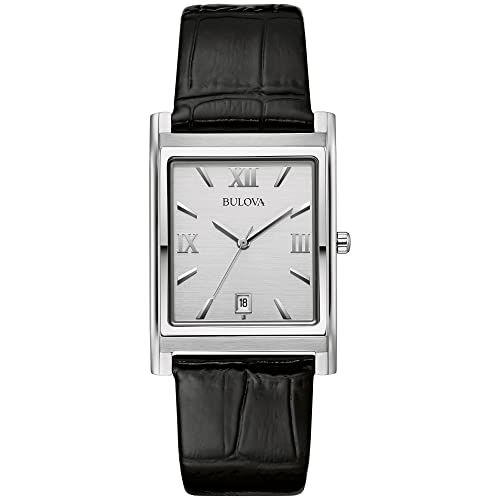
Bulova Men's Stainless Steel 3-Hand Calendar Date Quartz Watch with Black Leather Strap, Rectangle Dial Style: 96B107


Why this shape rewards a slower purchase
Round watches forgive haste. Their conventions are so familiar that a rushed buyer still lands near a wearable result, guided by thousands of similar wrists in every advertisement. Square and tonneau pieces punish haste and reward attention in equal measure, because every variable discussed here, lug span, corner geometry, thickness against cuffs, strap taper, dial contrast under warm light, interacts with the next. That interdependence is not a flaw in the category; it is the category. A shape with corners asks its owner to think in straight lines and honest measurements.
So take the slower route deliberately. Measure twice, literally, with a ruler on skin rather than estimates from memory. Read side profiles before dial photographs. Interrogate listings for the numbers they omit. Picture the watch under your own cuff, on your own desk, reflected in your own laptop camera during a call, rather than on a model’s wrist beside a sports car. The men who love their square watches years later almost always describe this kind of unglamorous homework, while the men who sell theirs within a season describe falling for a single photograph.
When the homework is done and the right case settles onto the wrist, edges aligned, strap dropping cleanly, dial legible at a glance, the result feels less like an accessory chosen from a catalogue and more like a piece of architecture scaled for one person’s arm, and that quiet rightness, repeated every morning at the clasp, is worth every measurement it took to earn.
A final note on proportions and confidence
Confidence completes what measurement begins. A man who understands why his watch fits, who can point to the lug span clearing his wrist bones and the case height clearing his cuff, wears the piece without adjusting it twenty times a day or glancing at it with doubt during conversations. That settled quality registers with other people more strongly than brand names or dial colours ever do. They may not identify the tonneau outline or the chamfered flank, yet they perceive an object in correct proportion to its owner, and the impression reads as care rather than expense.
Keep the ruler, the strap tool, and the return paperwork until the first fortnight ends happily. After that, the watch stops being a purchase under evaluation and becomes simply yours, its corners softening almost imperceptibly where your sleeves brush them, its strap moulding toward the exact curve of your wrist, until one ordinary morning you realise you have stopped thinking about fit at all, which is precisely the moment the fit has succeeded completely.
One last practical habit ties the whole approach together: photograph the watch on your own wrist, in ordinary daylight, beside the shirts and jackets you wear most, then live with those images for a day before deciding. Photographs flatten flattery and reveal proportion honestly, showing whether a corner overhangs, whether a dial colour survives your wardrobe, and whether the piece looks like it belongs to your life rather than to a catalogue, which is the final test every measurement in this guide has been quietly serving all along.