Our Top Picks
 Monoprice 1x12 Guitar Speaker Cabinet With Celestion Vintage22.7 x 14.2 x 21.5 inches36.54 poundsCheck on Amazon
 CELESTION T5891 G12H-75 Creamback 12 inch 75-watt Replacement12"12 x 12 x 5.4 inches10.4 poundsCheck on Amazon


What's inside
- Why the 12-inch format dominates guitar cabinets
- The reference models and their published specifications
- Sensitivity arithmetic: what 3 decibels really means
- Power handling versus amplifier output
- Magnet families: ceramic, alnico and neodymium
- A voicing map: midrange, breakup and chime
- Impedance: versions, wiring and total loads
- Cabinet interaction: open backs, closed backs and cabinet size
- Break-in: what changes during the first hours
- Mixing two models in one cabinet
- Check prices on Amazon
- Buying checks: used speakers, condition and reconing
As an Amazon Associate I earn from qualifying purchases. This post may contain affiliate links at no extra cost to you.
A guitar speaker is not a playback device in the hi-fi sense. It is the final, deliberately imperfect stage of the instrument itself, a paper cone in a stamped or cast frame that rolls off the top octave, emphasises parts of the midrange, compresses when pushed, and eventually distorts in ways players describe with affection. Celestion’s 12-inch catalogue is the reference library for that behaviour. Its models share a mounting pattern and a diameter, yet differ in magnet material, voice-coil construction, cone treatment and power handling to a degree that swapping one for another can change an amplifier’s apparent loudness, its breakup point and its genre allegiances all at once.
Certain links on this page are affiliate links, and following one to a purchase may earn the publisher a commission at no additional cost to the reader. The specifications discussed below come from Celestion’s published product data, the company’s application notes and long-running owner communities, and any figure that decides a purchase should be confirmed against the current datasheet for the exact variant, since impedance and production details differ between versions of the same model name.
Choosing among these speakers rewards the same discipline as choosing any transducer: start with the published numbers, understand what each number predicts, and only then talk about character. Sensitivity predicts loudness per watt and therefore how hard an amplifier must work. Power handling predicts survival and, less obviously, how much speaker breakup joins the amplifier’s own distortion. Resonant frequency and cone construction hint at low-end behaviour. Magnet type governs weight and a portion of the dynamic feel. This guide takes those topics in order, then turns to impedance and wiring, cabinet interaction, break-in, mixing models in one cabinet, and the inspection checks that matter when buying used.
Why the 12-inch format dominates guitar cabinets
The 12-inch cone sits at a physical sweet spot for the guitar’s frequency range. A nominal 12-inch driver has an effective cone area of roughly 500 square centimetres, several times that of an 8-inch speaker, so it moves enough air to reproduce the guitar’s low fundamentals — the low E string sounds at about 82 hertz — with authority at stage volume. At the same time its cone remains small and light enough to respond quickly through the midrange and to reach the presence region before its output collapses. A 15-inch driver goes deeper but grows sluggish and beamy for guitar, while a 10-inch driver stays articulate but surrenders low-end weight, which is why the history of guitar amplification, from early British combos to modern high-gain cabinets, keeps returning to the twelve.
Dispersion explains part of that loyalty. Any piston radiates sound in an ever narrower beam as frequency rises and the wavelength shrinks relative to the cone diameter. For a 12-inch cone, beaming becomes pronounced above roughly 1.5 to 2 kilohertz, so the speaker sounds bright and aggressive on axis and markedly darker a step to the side. Players exploit this constantly, whether they know the physics or not: the engineer places the microphone where the beam sounds right, the guitarist stands off axis to hear a softer version, and cabinet designers tilt or recess baffles to aim the beam at ears rather than knees. The 10-inch format beams later and spreads its treble wider; the 12-inch trades some of that spread for punch.
Low-end extension follows from cone area, suspension and cabinet volume together. A guitar 12 in a typical cabinet delivers useful output down to about 75 to 100 hertz depending on the model’s resonant frequency, which covers the guitar’s fundamentals without venturing into bass-guitar territory where a guitar speaker would waste excursion and blur. Published resonant frequencies for the models below cluster between about 70 and 85 hertz in free air, and the cabinet raises the system’s effective low-end behaviour from there. Nothing in this class is asked to reproduce 40 hertz, and that freedom from deep-bass duty is exactly what allows their cones to be light, their suspensions tuned for midrange life, and their voices distinct.
Standardisation sealed the format’s dominance. The mounting bolt pattern and cutout diameter for guitar twelves are effectively universal across makers, so a cabinet built for one brand accepts another with hand tools, and a player can re-voice an amplifier in an afternoon. That interchangeability created the culture this guide serves: speakers are treated as swappable tone components, cabinets as long-term furniture, and published specifications as the map for predicting what a swap will do before a single screw turns.
The format’s installed base also guarantees a permanent experiment culture: rehearsal rooms, studios and shops keep spare drivers on shelves, loan them between players, and document the swaps, so a prospective buyer can usually find owner reports for the exact amplifier-and-speaker combination under consideration rather than extrapolating from a neighbouring rig.
The reference models and their published specifications
The Vintage 30 is the catalogue’s modern reference point. Despite a name suggesting an earlier era, it is a design of the 1980s, rated at 60 watts with a sensitivity of 100 dB, a ceramic magnet, and a weight of about 4.7 kilograms. Its published frequency range runs from about 70 hertz to 5 kilohertz, its resonant frequency sits near 75 hertz, and its voicing emphasises the upper midrange, which is why it cuts through dense mixes and why some players find it strident at low volume in a small room. It ships in 8- and 16-ohm versions and anchors countless 2×12 and 4×12 cabinets built for rock and metal.
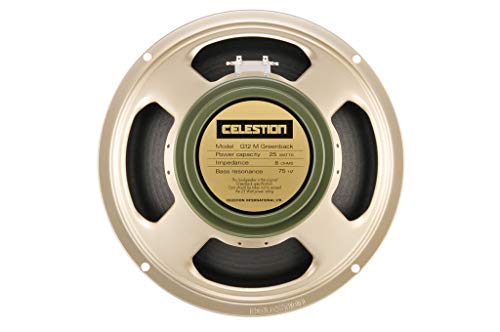
The G12M Greenback occupies the opposite historical pole. Rated at only 25 watts with a sensitivity of 98 dB, a ceramic magnet and a weight near 3.6 kilograms, it reproduces the specification of the 1960s speakers that defined early British rock. Its cone and suspension allow audible, musical breakup as the driver approaches its limits, so the speaker itself becomes part of the distortion recipe at volumes a modern high-power driver would reproduce cleanly. A single Greenback behind a 50-watt amplifier is a mismatch the arithmetic forbids, which is why Greenbacks live in pairs and fours, sharing power, or behind small amplifiers whose output they can survive alone.
The Creamback family answers the Greenback’s power problem from two directions. The G12M-65 Creamback keeps the M-series medium magnet character at a 65-watt rating and 97 dB sensitivity, letting a single speaker handle amplifiers that would endanger a Greenback. The G12H-75 Creamback uses the heavier H magnet, carries a 75-watt rating and a 100 dB sensitivity, and voices the result with a firmer low end and more top-end definition, suiting players who want vintage manners with modern headroom. Both use ceramic magnets; the H version weighs about 4.7 kilograms against the M version’s roughly 3.6 kilograms, a difference a gigging back notices across a full cabinet.
The G12T-75, rated at 75 watts and 97 dB with a ceramic magnet, spent decades as the stock speaker in widely sold 4×12 cabinets, and its published character — strong low end, comparatively recessed midrange, extended top — became the default sound of 1980s and 1990s high-gain rigs. The Seventy 80, an 80-watt, 98 dB ceramic design fitted as original equipment in many mid-priced amplifiers, offers a flatter, more neutral balance that shows the amplifier’s own voicing plainly. The V-Type, rated at 70 watts and 98 dB, was voiced to sit between the Greenback’s warmth and the Vintage 30’s cut, and owner reports consistently describe it as the catalogue’s all-rounder. The Neo Creamback applies the M Creamback recipe with a neodymium magnet, holding 60 watts and 97 dB while cutting weight to about 1.9 kilograms, less than half its ceramic counterpart.
The alnico models crown the range. The Alnico Blue is rated at just 15 watts yet posts a sensitivity of 100 dB, pairing a light cone with an alnico magnet assembly weighing about 4.2 kilograms; its published behaviour — early, graceful compression and a chime in the top end — made it the voice of early British combos. The Alnico Gold extends the same recipe to a 50-watt rating at 100 dB for players who need that character behind larger amplifiers, and the Alnico Cream raises power handling further still for high-power use. Alnico’s cost reflects the magnet material, and its devotees argue the compression curve justifies it; the sensitivity figures at least are unambiguous, since the Blue produces Vintage 30 loudness on a fraction of the amplifier power its wattage rating might suggest. Readers surveying the wider diameter landscape can compare the neighbouring class in best 10 guitar speakers and the general format field in best 12 inch speakers.
Two further models round out the working catalogue and clarify its structure. The G12H Anniversary revives the heavy-magnet formula of the late 1960s at a 30-watt rating and 100 dB sensitivity, voicing it with the broad low end and articulate top that made the original H-magnet speakers favourites for players who found the M-magnet Greenback too soft in the bass. Its low power rating places it in the same handling discipline as the Greenback: singles behind small amplifiers, pairs and fours behind larger ones. The Alnico Cream, by contrast, applies alnico construction to a high-power brief, carrying a rating in the region of 90 watts at 100 dB sensitivity, so a single driver can absorb the output of amplifiers that would require a full cabinet of Blues, while keeping the compression behaviour described in the magnet section. Between those two poles — a fragile vintage recreation and an alnico built for modern wattage — the catalogue’s logic becomes visible: every combination of magnet, power rating and voicing that players have historically asked for exists somewhere in the range, and the datasheet grid, read across rather than down, is the fastest way to locate the intersection a particular rig needs.
Reading a datasheet properly means knowing which figures are comparable and which are decorative. The frequency range endpoints, quoted at wide tolerances, say little beyond the class of driver involved. The figures that carry predictive weight are sensitivity, nominal impedance, resonant frequency, magnet type and the power rating, in roughly that order for tone and survival. Voice-coil diameter, listed for most models, hints at thermal capacity: larger coils dissipate more heat and generally accompany higher ratings. The chassis material, pressed steel on most models and cast alloy on some premium variants, affects rigidity and weight marginally rather than tone directly. A buyer who ranks models by those five load-bearing figures, and treats the rest of the sheet as context, will predict the outcome of a speaker swap correctly far more often than one who shops by reputation alone.
Sensitivity arithmetic: what 3 decibels really means
Sensitivity figures for guitar speakers follow the same convention as the hi-fi world: decibels produced at 1 metre with 1 watt of input, although the test signal and conditions are the manufacturer’s. The numbers in this catalogue span 97 to 100 dB, a range that looks trivial and is not. Three decibels is a doubling of power. A speaker of 100 dB sensitivity driven by a 20-watt amplifier produces the same level as a 97 dB speaker driven by 40 watts, and the same level as that quieter speaker driven by a 50-watt amplifier turned to about 80 percent of its clean capability. Sensitivity is therefore an amplifier multiplier that costs no headroom, generates no heat and never clips.
The arithmetic runs through every practical decision. A 100-watt amplifier into a 97 dB speaker and a 50-watt amplifier into a 100 dB speaker reach the same maximum level, but they arrive with different distortion recipes, because the smaller amplifier works nearer its limits and contributes more of its own breakup while the speaker stays composed. A player seeking power-amp distortion at club volume may deliberately choose the lower-sensitivity speaker to let the amplifier work harder at a given loudness, accepting the weight and heat that follow. A player with a small amplifier and a loud band does the reverse, choosing the 100 dB models to extract stage volume from limited watts.
Perceived loudness adds a final calibration. A 3 dB change is clearly audible but modest — roughly a notch or two on a volume control — while a 10 dB change is heard as about twice as loud. The full 3 dB spread of this catalogue therefore separates models by a useful but not dramatic margin, and voicing differences will usually dominate a buying decision once sensitivity is within a decibel or two. Where sensitivity becomes decisive is at the edges: the drummer who plays hard, the outdoor stage without monitors, the 15-watt amplifier that must survive both. In those cases the 100 dB models — Vintage 30, G12H-75 Creamback, Alnico Blue and Gold — are not preferences but solutions.
One caution belongs with every sensitivity comparison: the figure is measured at a reference condition, and a guitar speaker’s response is anything but flat, so two models with identical ratings can distribute that loudness very differently across the spectrum. A speaker whose energy concentrates in the upper midrange, where hearing is most sensitive, will seem louder in a band than its rating suggests, which is part of the Vintage 30’s reputation. Ratings compare honestly within a maker’s own published methods, and Celestion’s consistency across its catalogue makes its internal comparisons more trustworthy than cross-brand ones, but the ear remains the final arbiter of how loud a given voicing feels.
Worked examples fix the scale of the effect. A 15-watt amplifier driving an Alnico Blue at its 100 dB sensitivity produces about 112 dB at 1 metre at full clean output, since 15 watts adds roughly 12 dB to the 1-watt figure. The same amplifier driving a 97 dB G12M-65 Creamback produces about 109 dB, and recovering those 3 dB from the amplifier side would require a 30-watt model. Move the listener to 4 metres, a realistic stage-to-front-row distance, and free-field losses of about 12 dB bring both figures down near the threshold where a loud drummer competes, which is why small amplifiers on big stages live close to microphones and rely on the public-address system for the room. The sensitivity figure also explains a recurring puzzle in owner reports, where a nominally more powerful amplifier sounds quieter than a smaller one: a 50-watt head into a 97 dB speaker and a 30-watt head into a 100 dB speaker differ by less than a decibel at full output, well inside the variation that voicing and cabinet make.
Power handling versus amplifier output
A speaker’s wattage rating states the continuous power it can absorb without thermal or mechanical failure under the maker’s test conditions, and matching it to an amplifier begins with a simple observation: an amplifier’s rated output is its clean output, and a driven valve amplifier in particular can deliver substantially more than its rating once its output stage distorts, with peaks approaching twice the nominal figure in some designs. The working rule is therefore to give the speaker system a combined rating comfortably above the amplifier’s clean rating — a total at or above the amplifier’s output for sane use, and roughly one and a half times it where the amplifier will be run hard into distortion for long sets.
Sharing makes the arithmetic friendly. Two speakers wired together split the amplifier’s power equally when their impedances match, so a pair of 25-watt Greenbacks presents a 50-watt system and a quartet presents 100 watts, which is how a 100-watt head of the classic era could survive above cabinets full of individually fragile speakers. A single Greenback behind that head would receive four times its rating at full output and fail, predictably and audibly, first compressing and roughening, then distorting mechanically as the cone reaches its excursion limits, and eventually overheating its voice coil. Power handling is thus a property of the cabinet as a system, not only of the driver on the workbench.
Speaker breakup complicates the survival story in a productive direction. Long before a speaker fails, its cone, suspension and magnet assembly depart from linear behaviour: the suspension stiffens at excursion extremes, the motor’s force factor falls as the coil leaves the magnet’s strongest field, and the result is compression and harmonic distortion that players prize as part of the classic rock vocabulary. Low-rated speakers reach that zone at civilised volumes, which is precisely the Greenback’s and the Alnico Blue’s appeal. High-rated speakers stay clean and let the amplifier supply all the distortion, which suits high-gain styles where the preamp’s clipped waveform is already dense and additional cone chaos would blur it. Choosing a rating is therefore choosing where in the chain the distortion lives.
The under-powering myth deserves a direct answer. A persistent claim holds that too small an amplifier damages speakers by clipping, sending supposedly destructive square waves into them. The physics is narrower: a clipped amplifier delivers more average power than its rating implies, because a squared waveform carries up to twice the power of a sine wave at the same peak voltage, and it delivers that power disproportionately at high frequencies through a crossover — a real concern for tweeters in hi-fi systems. A full-range guitar speaker has no tweeter to protect, and in practice guitar speakers die from too much total power, whether that power arrived as clean sine waves from a large amplifier or as clipped output from a smaller one pushed past reason. The rating on the datasheet, respected with the sharing arithmetic above, is the protection; the amplifier’s size alone is not the threat.
Thermal behaviour explains why ratings are stated for programme rather than for laboratory tones. A voice coil converts the overwhelming majority of the electrical power it receives into heat rather than sound — a guitar speaker’s efficiency is only a few percent — so a driver absorbing 50 watts is a 50-watt heater with a coil wound on a former that must shed that heat into the magnet assembly and the surrounding air. Musical signals help: notes decay, rests intervene, and the average power across a song may be a fifth of its peaks, letting the coil cool between demands. Sustained, heavily compressed material removes that mercy, holding average power near the peaks for minutes at a time, which is why the same speaker survives an evening of dynamic rock playing at an amplifier setting that would endanger it under continuous high-gain compression at the same indicated level. Ratings assume the kinder duty, and players whose music is the harsher kind should hold a larger margin in reserve.
Magnet families: ceramic, alnico and neodymium
The magnet is the motor’s foundation, and the three families in this catalogue differ in material, weight and dynamic behaviour. Ceramic magnets — ferrite, technically — are the industry default: inexpensive, stable, heavy, and capable of strong fields in a large assembly. Most of the speakers discussed here use ceramic, in two broad sizes that Celestion’s naming encodes: the medium M magnet of about 35 ounces, found in the Greenback, G12M-65 Creamback and V-Type class designs, and the heavy H magnet of about 50 ounces in the Vintage 30, G12H-75 Creamback and G12T-75. The heavier magnet generally brings tighter low-end control and a point or two of sensitivity, at the cost of roughly a kilogram per driver.
Alnico, an alloy of aluminium, nickel and cobalt, powered the earliest guitar speakers and retains a devoted following for a measurable reason: its magnetic circuit behaves differently under drive. As the voice coil’s own field opposes the magnet’s at high signal levels, an alnico assembly’s flux modulates slightly, producing a gentle compression that softens transients and rounds the onset of distortion. Players describe the result as sweetness or chime, and while the vocabulary is poetic, the underlying compression is a documented characteristic of the material’s lower resistance to demagnetisation compared with ceramic. Alnico is also costly and was historically subject to supply shocks, which is why it survives mainly in premium models such as the Blue, Gold and Cream.
Neodymium rewrites the weight equation. Its magnetic strength per unit mass far exceeds ferrite’s, so the Neo Creamback reproduces the M-magnet recipe at about 1.9 kilograms against roughly 3.6 kilograms for its ceramic sibling. Across a 4×12 cabinet that saving approaches 7 kilograms, and across a 2×12 it exceeds 3 kilograms, which for a player carrying a cabinet up venue stairs is not a marginal benefit but the deciding one. The published sensitivity of the Neo Creamback, 97 dB, matches its ceramic counterpart, and owner reports describe the dynamic feel as close to the ceramic original, with any differences subtle beside the weight saving.
Weight arithmetic should be done at cabinet level before a purchase, because per-driver figures hide the total. Four Vintage 30s contribute about 18.8 kilograms of driver alone; four Greenbacks about 14.4 kilograms; four Neo Creambacks about 7.6 kilograms. Add a birch-plywood cabinet shell of 12 to 18 kilograms and the totals explain both the legendary heft of the classic 4×12 and the speed with which neodymium models have been adopted by working players whose backs keep their own accounts.
A voicing map: midrange, breakup and chime
Voicing is where the catalogue stops being a spreadsheet. The Vintage 30’s defining trait is a pronounced upper-midrange emphasis centred roughly in the 2 to 3.5 kilohertz region, sitting on a tight, controlled low end. In a band mix that emphasis places the guitar in the gap between the bass guitar’s top and the cymbals’ wash, which is why the model became the default for modern rock and metal rhythm work, where definition under high gain is the entire problem. The same emphasis, heard alone in a quiet room at low volume, can sound insistent to the point of harshness, and owner communities are full of players who judged the speaker in a bedroom and reversed their verdict on a stage. Context is part of this speaker’s specification in everything but print.
The Greenback’s voice is its breakup. Its low end is modest and slightly loose by modern standards, its midrange is warm and vocal, and as drive rises the cone contributes a crunch that fuses with the amplifier’s distortion into the sound of 1970s British rock. It flatters medium-gain playing — pushed clean tones, classic rock rhythm, blues leads that live on the edge of breakup — because the speaker completes the distortion recipe at volumes where a modern driver would still be reporting the amplifier neutrally. Its 25-watt rating is not a limitation imposed on that recipe; it is an ingredient of it.
The alnico models voice the top end differently from everything ceramic in the range. The Blue’s treble has an extended, bell-like quality that players call chime, paired with the compression described earlier, so single-note lines bloom and chords shimmer without the upper-midrange spike of the Vintage 30. That combination defined the sound of early British invasion combos and remains the reference for jangle, roots and Americana playing, and for clean and edge-of-breakup styles generally. The Gold carries the same signature into higher power brackets, trading a little of the Blue’s immediacy, in owner reports, for composure behind 30- to 50-watt amplifiers.
The remaining models fill the map’s middle. The G12T-75’s recessed midrange and strong extremes suit scooped high-gain tones and leave space for a vocalist in a dense arrangement. The G12H-75 Creamback offers a balanced, articulate voice with firmer bass than the Greenback and a smoother top than the Vintage 30, which makes it a frequent choice for players who cross genres in one set. The G12M-65 Creamback keeps the Greenback’s warmth with more low-end composure and far more power headroom. The Seventy 80’s neutrality serves modelling and multi-channel amplifiers that generate their voices electronically and need a speaker that reports rather than interprets. The V-Type sits deliberately between poles, warm but defined, and earns its all-rounder label by offending no genre. Even the impedance question that organises the next section has a hi-fi cousin, since readers rewiring a stereo pair will recognise the same series and parallel logic behind guides such as best 8 ohm bookshelf speakers.
Genre mapping follows from the voicing descriptions with reasonable reliability. Classic rock and blues, built on medium gain and dynamic touch, map to the Greenback and its Creamback descendants, whose breakup rewards players who control distortion from the guitar’s volume knob. Hard rock and metal, built on preamp gain and tight rhythm definition, map to the Vintage 30 and the G12T-75, the first for midrange-forward modern tones and the second for scooped, extended extremes. Roots, country and jangle map to the alnico models, whose chime and compression flatter clean and lightly driven playing. Fusion and multi-genre stage work, where one rig must cover clean funk, driven leads and ambient textures in a single set, maps to the balanced middle: the G12H-75 Creamback, the V-Type, or a mixed cabinet that borrows one voice from each pole. These mappings are starting points distilled from decades of owner reports, not laws, and the player whose ears disagree with the map should trust the ears — but the map exists because the underlying response differences are consistent enough for thousands of independent listeners to have drawn it in the same place.
A short synthesis may help before the wiring details. For a low-powered combo played at home and in small venues, the alnico models and the Greenback convert modest wattage into character earliest, and their low ratings are features rather than warnings. For a general-purpose 2×12 that must cover several styles behind a medium-powered head, the Creambacks and the V-Type hold the middle ground, with sensitivity near 97 to 100 dB and ratings that forgive an enthusiastic volume control. For high-gain work at stage volume, the Vintage 30 and G12T-75 remain the reference pair, one mid-forward and one mid-recessed, and the choice between them is the choice between standing in front of the vocal or behind it. Every other consideration in this guide — impedance, cabinet, mixing, condition — refines one of those three starting positions rather than replacing them.
Impedance: versions, wiring and total loads
Most models in this catalogue are sold in 8-ohm and 16-ohm versions, identical in voice and differing only in voice-coil winding, and the choice between them is made by the cabinet arithmetic, not by tone. A single speaker presents its own impedance to the amplifier, so a lone driver should match the amplifier’s output tap or combo rating directly. Multiple speakers combine by the familiar rules: identical impedances in parallel divide — two 8-ohm speakers give 4 ohms, two 16-ohm give 8, four 16-ohm give 4 — while identical impedances in series add, so two 8-ohm speakers in series give 16 ohms.
The classic 4×12 wiring exploits series-parallel combination to land back where it started. Four 16-ohm speakers are wired as two series pairs of 32 ohms each, with the pairs paralleled to give 16 ohms overall; alternatively four 4-ohm speakers would reach the same point, which is why 16-ohm drivers dominate the 4×12 world. A 2×12 cabinet usually parallels two 16-ohm speakers for an 8-ohm total, or two 8-ohm speakers for a 4-ohm total, and the choice should be made against the amplifier’s available taps, since many valve amplifiers offer 4, 8 and 16 ohm outputs and reward an exact match with full power transfer and the intended damping.
Mixed impedances break the equal-sharing assumption that makes the simple rules safe. A 16-ohm and an 8-ohm speaker in parallel present about 5.3 ohms in total, and the 8-ohm unit draws twice the power of the 16-ohm unit, so the pair’s power handling is set by the overloaded driver, not by the sum of the ratings. Series wiring of unequal impedances reverses the injustice, sending more power to the higher-impedance unit. Either way the combination wastes capability and complicates prediction, and the disciplined answer is to build cabinets from matched-impedance drivers and to verify each driver’s impedance with a meter before wiring — remembering that a meter reads the coil’s direct-current resistance, typically about 75 to 85 percent of the nominal impedance, so an 8-ohm speaker measuring near 6.5 ohms at rest is healthy, not mislabelled.
Amplifier matching closes the loop. Running a valve amplifier into a higher impedance than its tap expects raises the voltages reflected back into the output stage and stresses it; running into a lower impedance draws excess current and runs the output valves hot. Solid-state amplifiers tolerate low-side mismatches more gracefully but lose power into higher loads. The speaker cabinet’s total, computed before the first rehearsal and labelled on the back panel, is the cheapest insurance in the entire rig, and the arithmetic above is all it requires. The same discipline governs home audio loads, where the stand-mount class surveyed in best 5 25 bookshelf speakers follows identical parallel rules.
Cabinet interaction: open backs, closed backs and cabinet size
The same driver becomes two different speakers in open-back and closed-back enclosures, because the cabinet decides what happens to the cone’s rear radiation. A closed back traps that energy inside a sealed box whose air acts as a spring, stiffening the cone’s low-frequency behaviour, tightening the bass, and projecting all the output forward. The result suits high-gain and high-volume styles: focused, punchy, and directional, with the beaming described earlier in full effect. An open back lets the rear radiation escape into the room, where it reflects from walls and rejoins the direct sound slightly delayed, producing a spacious, ambient quality and a less tightly controlled low end. The rear wave also cancels part of the front wave at low frequencies, because the two are out of phase, which is why open-back cabinets sound leaner despite their airiness.
Model choice interacts with the cabinet type. The Alnico Blue’s classic home is the open-back combo, where its chime can bloom into the room. The Vintage 30 was voiced with closed-back cabinets in mind and delivers its intended tightness there, although it also serves in open-back 2×12 cabinets for players who want its cut with more air. Greenbacks thrive in both, with the closed 4×12 delivering the focused classic-rock thump and the open combo a looser, more vintage sprawl. Published frequency ranges assume a cabinet context, and a buyer comparing datasheets should remember that the cabinet will move the low-end figures by more than the differences between neighbouring models.
Cabinet size scales the experience. A 1×12 offers portability and a point-source directness that records beautifully, since a single driver has one acoustic centre for the microphone to interrogate. A 2×12 spreads the sound across a wider baffle, couples the drivers so their combined low end gains authority, and presents a fuller stage image while remaining a one-person carry in its neodymium forms. A 4×12 adds the visceral pressure and the sheer area that outdoor and large-stage work rewards, plus the comb interactions between four sources that engineers manage with a single close microphone. None of these is a hierarchy of quality; they are different radiation patterns for different rooms, and the sensitivity arithmetic from earlier decides how much amplifier each configuration needs to fill its room.
Construction materials add a second layer of cabinet influence. Baltic birch plywood, the traditional material for quality guitar cabinets, is stiff, void-free and consistent, and it contributes a controlled resonance that makers treat as part of the design. Cheaper fibreboard cabinets flex more, absorbing energy unevenly and adding a boxy colouration that no driver choice can fully remove, which is why the same speaker transplanted from a fibreboard combo into a birch cabinet is so often reported as improved beyond what the driver swap alone predicts. Baffle thickness and mounting method matter at the same scale: a driver bolted firmly to a rigid baffle transfers its reaction forces into a structure that barely moves, while a loosely mounted driver on a thin baffle wastes energy moving the panel. When a speaker upgrade disappoints, the cabinet deserves a share of the suspicion before the driver is condemned.
Break-in: what changes during the first hours
A new guitar speaker is mechanically at its stiffest on the day it is installed. The cone’s surround and the spider — the corrugated suspension that centres the voice coil — leave the factory with fibres and resins that have never flexed at full excursion, and published guidance from speaker makers acknowledges that these components loosen measurably over the first hours of energetic playing. As compliance rises, the resonant frequency falls slightly, low-end output fills in, and the treble loses an initial edge as the cone’s own behaviour settles. The change is real, gradual and modest, typically unfolding across the first ten to twenty hours of playing at honest volume rather than across a single evening.
The practical method is simply to play, at the volumes the speaker was bought for, across material with genuine low-frequency content, since excursion is what flexes the suspension. Low-volume playing still contributes, only more slowly, because the suspension’s movement is smaller. Owners sometimes accelerate the process with looped programme or signal generators run for extended periods; that approach works mechanically but demands respect for the power rating, because a speaker absorbing continuous programme at high level heats its voice coil in ways that intermittent guitar playing does not, and the rating assumes musical duty rather than a day-long sine wave. Neighbours and household goodwill impose their own, usually stricter, limits on the schedule.
Judgement should wait for the process to finish. A speaker condemned in its first hour for thin bass or a hard top end may be guilty of nothing but newness, and the models with the stiffest initial presentation — the Vintage 30 is the catalogue’s usual example in owner reports — are often the ones whose owners revise their opinion most completely after a month of playing. The reverse discipline also applies: break-in will not rescue a genuinely wrong voicing choice, because its effects are measured in small fractions of the differences between models. It refines a correct choice; it does not overturn an incorrect one.
Combo amplifiers impose constraints that separate cabinets do not, and they should shape model choice from the start. A combo’s speaker shares an enclosure with a chassis full of valves that vibrate with every note, sits in a cabinet whose dimensions the amplifier maker fixed, and often faces a strict depth and weight budget set by the product’s designer. The stock speaker in a respected combo is therefore rarely an accident; it was chosen against those constraints, and replacing it changes the amplifier’s balance in the room and, if the replacement is heavier, the practicality of carrying the amp at all. A neodymium model that saves nearly two kilograms while keeping a similar voice is frequently the most defensible combo upgrade, while a heavy H-magnet ceramic driver in a small grab-and-go combo can solve a tonal question and create a transport problem in the same afternoon. Clearance matters too: large magnet assemblies sit close to valve cages and reverb tanks in tight combos, and published dimensions, including the driver’s overall depth, should be checked against the available space before ordering.
Microphone practice, finally, is part of how these speakers earn their reputations, because most listeners meet them on recordings rather than in rooms. A dynamic microphone placed close to the grille hears a blend of cone regions depending on its position: near the centre cap the response is bright and detailed, near the cone’s edge it is warmer and smoother, and the few centimetres between those positions span much of the tonal range that players attribute to the speaker itself. The Vintage 30’s recording dominance owes something to this geography, since its aggressive zone sits where engineers habitually place the microphone, while a Greenback rewards a slightly off-centre placement that keeps its breakup and softens its top. None of this changes the buying arithmetic, but it explains why the same speaker can sound different on a record, through a stage monitor and from the player’s own position behind the cabinet, and why judgements formed from a single one of those vantage points should be held lightly.
Mixing two models in one cabinet
Pairing different models in a 2×12 or 4×12 cabinet is the catalogue’s favourite experiment, because two voices can complement each other the way two guitarists do: one supplying cut, the other body; one staying clean, the other breaking up early. The classic combinations follow that logic. A Vintage 30 beside a G12H-75 Creamback pairs upper-midrange definition with firmer, broader low end. A Greenback beside a Vintage 30 marries vintage breakup to modern projection. An alnico beside a ceramic model layers chime over punch. In each case the microphone hears a blend at any position, and the room hears a composite neither driver makes alone.
Sensitivity matching governs whether the experiment succeeds. Two speakers in a cabinet share the amplifier’s voltage, so the more sensitive unit plays louder by exactly the sensitivity gap: pair a 100 dB model with a 97 dB model and the louder unit leads by 3 dB, which in a blend is the difference between a partner and a soloist with accompaniment. Successful published pairings therefore stay within about 2 dB of each other — the Vintage 30 with the G12H-75 Creamback at matched 100 dB is the textbook case — while wider gaps need a deliberate reason, such as wanting the quieter driver’s breakup to season a dominant modern voice without challenging it. Impedance must match exactly between partners for the equal power sharing the wiring section described, and combined power handling follows the sharing rule: the pair survives what the weaker driver survives at its half of the total load, so a 25-watt Greenback beside a 60-watt Vintage 30 still caps the cabinet near 50 watts of honest use.
Placement inside the cabinet offers a final refinement. In a 2×12, side-by-side drivers blend evenly for a centred listener, while a diagonal arrangement in a 4×12 — alternating models in an X pattern — spreads both voices across the cabinet’s face so that no microphone position or audience seat hears only one driver. The X pattern is the standard recommendation in owner communities for mixed 4×12 cabinets for exactly that reason, and it costs nothing beyond wiring care to implement.
Recording practice refines mixing decisions further, because a blend that sounds even in the room may not be even at the microphone. A close microphone hears mostly the driver it points at, so a mixed cabinet gives the engineer two distinct voices to choose between or combine, and many engineers mic both drivers of a mixed 2×12 and balance them at the desk, effectively re-voicing the cabinet per song. That flexibility is a genuine studio argument for mixing even where a live player might prefer matched drivers for predictability. Conversely, a single-driver 1×12 chosen for recording should be the exact voice the track needs, since no partner exists to soften its edges, which is why studios keep individual cabinets loaded with single reference models rather than a fleet of blends.
Replacement logistics deserve a place in the decision, because a speaker is a mechanical component with a service life and an installation ritual of its own. Mounting bolts should be tightened evenly in a cross pattern, snug rather than forced, since overtightening can warp a pressed-steel chassis enough to misalign the voice coil it is meant to centre — a self-inflicted rub created at the workbench. Gaskets matter: a driver sealed unevenly against the baffle leaks air in a closed cabinet and buzzes in any cabinet, and reusing a crushed gasket invites both faults. Polarity must be consistent across every driver in a cabinet, because one reversed speaker cancels its partner’s low end in a way that owners routinely misdiagnose as a thin-sounding model; the simple check is a brief low-voltage battery touch that should move every cone in the same direction. Finally, a newly installed speaker should be played first at modest level while the owner listens for the rubs, rattles and loose hardware that installation can introduce, since faults caught in the first ten minutes are adjustments, while the same faults discovered on a stage are failures. None of this requires specialist tools — a screwdriver, a meter, a battery and patience cover the whole procedure — and an hour spent on it protects the investment better than any extended warranty.
Check prices on Amazon
Live listings for the shortlist in this guide are pulled from Amazon below, so prices and availability are always current at the moment you look.


Buying checks: used speakers, condition and reconing
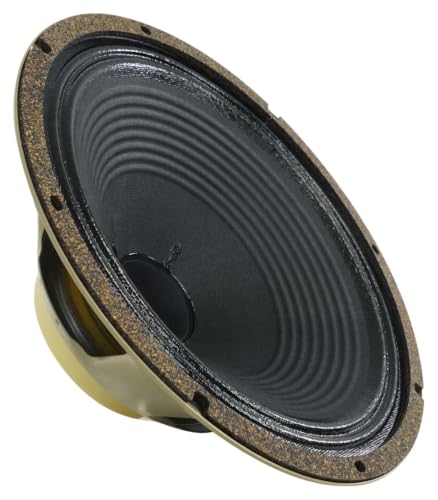
The used market for these speakers is deep, because cabinets change hands, amplifiers are parted out, and the drivers themselves are durable. Inspection begins with the cone. Hold the speaker to the light and look for creases, tears, repairs and the white or grey residue of water damage; then press the cone gently and evenly with several fingers and move it through its excursion, feeling for the gritty scraping of a voice coil rubbing in its gap, which indicates a warped coil or shifted magnet and ends the negotiation. A healthy cone moves silently and returns to rest centred. Listen, where facilities allow, at moderate volume across a sweep of notes: buzzes that follow particular frequencies suggest a loose dust cap, a separated surround or debris in the gap, each repairable in principle and each a reason to discount in practice.
Two subtler faults deserve names. Cone cry is a ghost note — a spurious tone, often around the upper midrange, generated when a cone flexes into unwanted modes at high excursion; it appears on particular notes at volume and cannot be diagnosed at conversation level, which is why a used purchase should ideally be played loudly before money settles. Voice-coil rub, described above, announces itself mechanically even unpowered. Doping — the damping compound applied to cone edges at the factory — should appear as an even, intact ring; flaking or missing sections change the cone’s edge behaviour and hint at age or heat exposure.
Date and origin codes help price a find honestly. Celestion speakers carry stamped codes on the frame or cone that identify production date and, on older units, the cone supplier, and owner communities maintain the decoding tables. A vintage Greenback with its original cone commands its premium because the cone is the voice; a reconed example, however skilled the work, is a different instrument and should be priced as one. Modern recone kits from the maker restore a damaged current-production driver to something very close to its datasheet behaviour, which makes reconing a rational repair for a Vintage 30 or Creamback and a value-destroying one for a collectible alnico or early Greenback. The buyer’s rule is symmetrical with the rest of this guide: identify exactly which specification the individual speaker in front of you still meets, and pay for that specification rather than for the legend printed on its label.
Choose the cone whose published numbers serve the amplifier’s watts, the room’s size and the band’s volume before letting its legend anywhere near the decision, and a Celestion twelve stops being a gamble and becomes what its datasheet always promised: the one component in the rig whose behaviour you predicted correctly before you ever plugged in.

