What's inside
- Where to buy
- Key Takeaways
- Quick Picks
- How did we judge equipment that trades in subtleties?
- Why did the sound card leave the computer case?
- What do balanced outputs and DAC chips really buy you?
- How should you assemble the rest of the chain?
- How should you actually listen when comparing two of these?
- What does ownership look like after the first month?
- Six ways to feed a serious pair of headphones
- Where do speakers fit in a guide about headphone gear?
- How do the six compare side by side?
- How should you set up a DAC/amp for critical listening?
- What mistakes do audiophile sound card buyers keep making?
- Final Recommendation
- Frequently Asked Questions
- Related Guides
As an Amazon Associate I earn from qualifying purchases. This post may contain affiliate links at no extra cost to you.
gizmoverdict.com is reader-supported. When you buy through links on our site, we may earn an affiliate commission.
Where to buy
Start with the honest sentence this whole guide hangs on: when people go shopping for the best sound cards audiophile listeners would approve of, the product they usually come home with is no longer a card at all. Five of the six picks below are desktop DAC and headphone-amplifier units that sit beside the computer rather than inside it, because that is where serious headphone listening migrated — out of the noisy case, onto the desk, within reach of a volume knob. One genuine flagship internal card survives in the list, and it earns its place. All six carry live Amazon listings linked throughout.
The migration happened for practical reasons, not fashion. A desktop unit can be carried from an old PC to a new one in a minute, can serve a laptop and a games console on the same afternoon, and puts its controls under your fingers instead of inside a driver panel. What did not change is the underlying job: convert digital audio cleanly, then amplify it with enough authority for the headphones you actually own. Judge every pick below by those two duties and the connectivity wrapped around them, and the category becomes refreshingly legible.
A word about vocabulary before the products. Listings in this corner of audio speak in DAC chips, output power in milliwatts, and sample-rate ceilings — and this guide quotes those figures only where the maker’s own listing states them, treating everything else as behaviour to describe rather than numbers to invent. A chip name is a starting point for a conversation about implementation, not a verdict, and the reviews below keep returning to that distinction.
Key Takeaways
- The audiophile “sound card” of today is mostly a desktop DAC/amp; only Creative’s AE-X in this set still lives inside the PC.
- FiiO’s K11 is the clean starting point — balanced output, generous stated power and every common input at the sensible end of the market.
- Fosi’s ZH3 is the feature flagship: balanced architecture, XLR outputs, a remote and a trigger for waking a whole system.
- Creative’s X5 brings dual-DAC balanced design from a gaming-audio house that decided to court purists.
- Fosi’s K7 and K5 Pro bend the formula toward gamers, adding microphone inputs and, on the K5 Pro, physical tone controls.
- Output power and balanced 4.4mm sockets matter only insofar as your headphones need them — buy for the cans on your head today.
Quick Picks
| Pick | Badge | Why it earns its place |
|---|---|---|
| FiiO K11 | Best starting point | Balanced and single-ended outputs, 1400mW of stated drive and USB, optical and coaxial inputs in a compact, unfussy box. |
| Fosi Audio ZH3 | Best full-featured DAC/amp | Fully balanced design around the AK4493SEQ, PCM up to 768kHz per the listing, XLR and RCA outputs, remote and 12V trigger. |
| Creative Sound Blaster X5 | Best dual-DAC purist route | Dual DACs, a fully balanced path and Creative’s discrete Xamp headphone bi-amplification in an external hi-res unit. |
| Creative Sound Blaster AE-X | Best true internal card | The flagship PCIe answer at 32-bit/384kHz for listeners who want their audio built into the machine itself. |
| Fosi Audio K7 | Best for gamer-audiophiles | 2100mW of stated power, a microphone input and Bluetooth aptX HD and LL alongside the usual digital inputs. |
| Fosi Audio K5 Pro | Best hands-on budget route | Physical bass and treble knobs, a mic input and 1000mW of drive for listeners who like adjusting sound by hand. |
How did we judge equipment that trades in subtleties?
Carefully, and with the listings kept open beside us. Every specification quoted in the reviews — a DAC chip, an output figure, a sample-rate ceiling — appears in the maker’s own product title or listing, and where a listing stays quiet, the review describes connectivity and behaviour instead of filling the silence with borrowed numbers. Audiophile marketing rewards invented precision; this guide declines the reward.
Beyond the paper, the judging ran on chain logic. A DAC/amp is a middle component: source before it, headphones or powered speakers after it, and its value is set by how gracefully it joins the two. Inputs were counted against real sources — computers, consoles, streamers, the occasional CD transport still in service. Outputs were matched against real headphones: efficient portable cans that need almost nothing, high-impedance studio veterans that need voltage, planar designs that need current. A unit that serves one of those loads brilliantly and the others adequately is described in exactly those terms.
Controls mattered more than audiophile folklore admits. A knob you can find blind, a gain switch that matches your headphones’ appetite, a remote for the listener across the room — these decide whether a theoretically superior box gets used daily or admired monthly. The ZH3’s remote and trigger, the K5 Pro’s tone knobs and the K11’s restraint are all, in their different ways, arguments about hands.
Finally, we discounted the two great exaggerations of the category: that DAC chips are destiny, and that sample-rate ceilings audible in practice separate these products. Implementation — power supply, output stage, board layout — is where designs diverge audibly, and it is precisely what a listing cannot fully tell you. The reviews therefore lean on architecture and stated figures, and they say “we cannot verify” by omission wherever the paper runs out.
Why did the sound card leave the computer case?
Because the case became a worse neighbourhood while the desk became a better one. Modern graphics cards switch enormous currents inches from where an internal card must sip its power, and coil whine that tracks frame rates is a familiar soundtrack to anyone who has plugged sensitive headphones into a gaming PC. An external unit fed by USB still drinks from the computer, but it converts and amplifies outside the worst of the interference, in a chassis designed for one job.
Portability sealed the argument. The listener of today rarely owns one audio source: a work laptop in the morning, a personal desktop at night, a console on weekends, perhaps a phone or tablet between them. An internal card serves exactly one of those masters. A desktop DAC/amp with USB, optical and coaxial inputs — the connection set the K11 and ZH3 both carry — serves whichever machine is awake, and it survives every PC rebuild untouched. Longevity is an audiophile virtue with a price attached, and external boxes simply last longer in a listener’s life.
History deserves a footnote here, because the internal card was not always the underdog. For two decades the sound card was a marquee PC component — the upgrade that turned beeps into orchestras — and its decline owed less to quality than to motherboards absorbing “good enough” audio and laptops abolishing the slot altogether. The products in this guide are the survivors of that extinction event, and they survived by specialising: conversion and drive done to a standard a motherboard cannot justify, for listeners who can hear why it matters. The AE-X carries the old flag; the five desktop units are what the species evolved into.
There is an ergonomic coda. Reaching a volume knob without looking, swapping headphones without crawling under a desk, watching a sample-rate indicator confirm what your streamer is sending — these small dignities accumulate into the feeling that hi-fi people call “a proper setup”. The AE-X below proves an internal card can still deliver the conversion half of that experience superbly. It cannot deliver the knob. That is the whole migration in one sentence.
What do balanced outputs and DAC chips really buy you?
Balanced headphone outputs — the 4.4mm socket that appears on the K11, ZH3 and K7 — run the headphone cable with separate conductors for each channel’s return path instead of a shared ground. In practical terms that usually means more available power, better channel separation on paper, and compatibility with the balanced cables many headphone enthusiasts already own. It does not automatically mean better sound from every headphone, and a well-implemented single-ended output beats a careless balanced one. Treat the 4.4mm socket as a capability to match against your cable collection, not a ranking.
DAC chips deserve the same demystification. The listings below name their silicon where the maker is proud of it: Fosi builds the ZH3 around the AK4493SEQ with an XMOS XU316 handling USB, and the K7 around the AK4493S. Those are respected modern converter chips, and naming them tells you the design’s generation and its format ceilings — the ZH3’s stated PCM 768kHz, the K7’s 384kHz/32-bit. What the chip cannot tell you is how the analogue stage after it behaves, which is where two products sharing a chip diverge. Buy the architecture and the implementation’s reputation; let the chip be a footnote that confirms the era.
Output power, quoted in milliwatts, is the most misread figure of all. The K11’s stated 1400mW, the K7’s 2100mW and the K5 Pro’s 1000mW are not loudness scores — your ears would surrender long before any of them reached their ceiling into easy headphones. Power is headroom: the reserve that keeps bass controlled and peaks clean into demanding loads. A listener with efficient headphones uses a sliver of any of these figures and should choose on features instead. A listener with planar or high-impedance headphones should read the figures as the shortlist’s first filter.
How should you assemble the rest of the chain?
Feed the DAC the cleanest convenient signal. USB from a computer is the modern default and the only path that reaches the highest stated sample rates on these units; optical from a console or TV brings isolation from ground noise as its bonus; coaxial keeps older transports and streamers in service. None of these choices needs to be agonised over — what matters is that the source hands over an unprocessed digital stream, with the operating system’s own “enhancements” and sample-rate conversions set aside so the DAC you paid for does the converting.
After the DAC, respect the gain staging. Set the source to a healthy fixed level, choose the amplifier’s gain for your headphones’ sensitivity, and let the knob live in the middle of its travel where channel balance is happiest. If you run powered speakers or a power amplifier from the RCA or XLR outputs — the ZH3 explicitly courts that role with its preamp outputs and trigger — decide whether the DAC or the amplifier owns the volume, and make the other one a fixed, forgotten setting.
Cables can stay boring. Any competently made USB, optical or interconnect cable does its job inaudibly; the chain’s weak links are almost always mismatched gain, a noisy source output, or headphones asked to perform beyond their design. Spend the cable budget on a balanced lead only if your headphones and your chosen amp both speak 4.4mm — that is a compatibility purchase, not a sonic one.
How should you actually listen when comparing two of these?
Level-match or go home. The single most reliable illusion in audio is that the slightly louder option sounds clearer, wider and more alive, and it has sold more unnecessary upgrades than every advertisement combined. When you compare two outputs — balanced against single-ended, the new DAC against the old motherboard — set them to the same volume with a phone app or a test tone, switch quickly, and listen to the same thirty seconds of a recording you know embarrassingly well. Differences that survive level-matching are real. Differences that evaporate were volume wearing a costume.
Choose your test material for information, not flattery. A sparse recording with a single voice and one instrument exposes noise, tonal balance and the space around notes; a dense orchestral or electronic passage exposes control under load, when amplifiers either hold the architecture together or let it smear. Add one deliberately mediocre recording, because a chain that only forgives masterpieces will make half your library unlistenable, and honesty about that trade belongs in the audition, not in month three.
Finally, give the decision a night. First auditions overweight sparkle — the treble lift that reads as “detail” at minute five and as fatigue at hour two. The chain you want is the one still inviting you at the end of a long evening, at ordinary volumes, with ordinary recordings. Every product in this guide can impress for thirty seconds; the reviews above were written for the listener who stays for the album.
What does ownership look like after the first month?
External DAC/amps are among the calmest products in a modern setup: no batteries to manage, no subscriptions, and firmware that — on the sensible end of this guide — exists to fix things rather than to rearrange your life. The ownership tasks that do exist are small and worth naming. Keep the maker’s driver or control software current on Windows where the unit uses one for its highest-rate modes, dust the volume knob’s surroundings before grit becomes a scratchy rotation, and give the unit air — a DAC/amp sealed under a pile of papers runs hotter than its designer intended.
The second year is where form-factor choices collect their debts or pay their dividends. The desktop units migrate to the next computer in minutes and shrug off operating-system reinstalls; the internal AE-X asks for its driver to be re-established with each major rebuild, a five-minute task that nonetheless belongs in the honest ledger. None of this is burdensome. All of it rewards the buyer who chose the shape of product that matches the shape of their computing life, which is why this guide returns to that match so insistently.
Resale and hand-me-down value follow the same logic. A recognised desktop DAC/amp with balanced outputs remains desirable to the next listener because it fits any desk; an internal card’s audience narrows to builders of compatible machines. Buying the external route is, among its other virtues, buying the option to change your mind — and in a hobby built on curiosity, that option is worth real money.
Six ways to feed a serious pair of headphones

FiiO K11 — Best starting point
The K11 is where this guide sends the listener who asks the simplest question: what is the least complicated box that does the audiophile job properly? Its listing reads like the category’s checklist executed without garnish — a DAC and headphone amplifier for home audio or PC, with 6.35mm and balanced 4.4mm headphone outputs, RCA line output, and coaxial and optical inputs beside USB, delivering a stated 1400mW and handling 384kHz/24-bit and DSD256. Nothing on that list is exotic. All of it together, in one compact enclosure, is the point.
FiiO’s restraint shows in what the K11 refuses to be. It is not a streamer, not a Bluetooth hub, not a gaming processor; it converts and amplifies, and its small display and single knob keep the interaction honest. For a listener whose sources are a computer and perhaps a console or CD player through the digital inputs, that focus translates into a setup that disappears — music arrives, volume responds, and the box asks for no further attention or firmware diplomacy.
The balanced output deserves its practical framing. Owners of headphones with 4.4mm cables — a growing tribe, thanks to portable audio — can plug straight in and use the K11’s full output stage; everyone else loses nothing, since the 6.35mm socket serves single-ended headphones with the same stated drive behind it. The RCA output meanwhile lets the K11 moonlight as the DAC in front of powered speakers, which is how many first hi-fi desks actually evolve: headphones first, speakers creeping in later, one box presiding over both.
Who should skip it? Listeners who need a microphone path for gaming should look at Fosi’s K7 further down; listeners building a speaker-first system around a remote control should meet the ZH3. The K11’s kingdom is the headphone desk, and within that kingdom it is difficult to argue with — a fact the rest of this guide keeps having to concede while praising fancier rivals.
Desk reality suits it, too: the K11’s footprint is small enough to live beside a keyboard without negotiating, and its finish shrugs off the daily choreography of mugs, notebooks and headphone stands. Products at this station succeed by being present and unremarkable for years, and everything about the K11’s design — few buttons, clear display, no app dependency for its core job — points at that long, quiet tenure.
- Role: desktop DAC and headphone amplifier
- Outputs: 6.35mm and balanced 4.4mm headphone, RCA line
- Inputs: USB, optical and coaxial digital
- Stated drive: 1400mW, per the listing
- Formats: up to 384kHz/24-bit and DSD256, per the listing
Strengths
- The complete core feature set with no decorative extras inflating it.
- Balanced and single-ended headphone outputs cover both cable tribes.
- Digital inputs beyond USB let consoles and transports share the box.
Trade-offs
- No microphone input, so gaming headsets look elsewhere in this guide.
- No remote — volume is a hand’s job, across the desk.
- Its plainness is the appeal; feature collectors will feel undersupplied.
Best for: headphone listeners building their first serious desktop chain. Not suited for: gamers needing a mic path or lounge listeners wanting a remote.
First-time chain builders can read through the K11’s Amazon listing and tick its inputs against the sources already sitting on their desk.
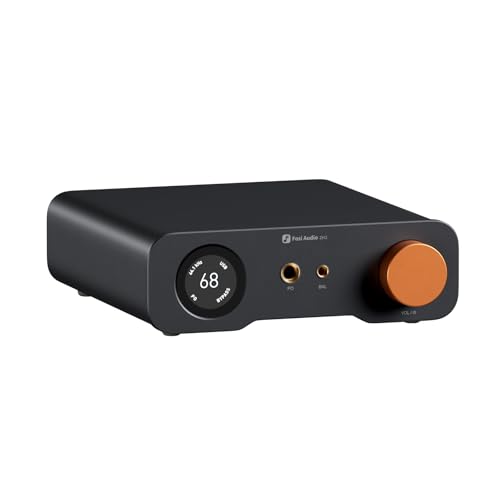
Fosi Audio ZH3 — Best full-featured DAC/amp
If the K11 is the checklist executed plainly, the ZH3 is the checklist executed completely. Fosi describes a fully balanced desktop DAC preamp built on the AK4493SEQ converter with an XMOS XU316 USB stage, PCM handling up to 768kHz, and a connection panel that reads like a small system’s front door: USB, optical and coaxial in; XLR, RCA, 4.4mm and 6.35mm out. Add the 12V trigger and the remote control from its listing, and the ZH3 stops being merely a headphone accessory — it is a control centre for a desk or a compact speaker system.
The balanced architecture is more than a socket count here. Running balanced from conversion through to the XLR outputs gives powered monitors and power amplifiers the noise-rejecting connection professionals default to, which makes the ZH3 the one pick in this guide a speaker-first listener can choose without apology. Headphone owners get both balanced and single-ended sockets, so the unit does not force a cable philosophy on anyone.
The remote and trigger deserve emphasis because they change the product’s habitat. A DAC on a desk needs neither; a DAC across the room, feeding speakers from a listening chair, needs both — the remote for volume, the trigger so the power amplifier wakes and sleeps with the system instead of glowing through the night. Fosi including both signals that the ZH3 was designed by people who pictured it in a room, not only beside a keyboard.
Its cautions are the usual flagship cautions. The feature set costs more of everything — money, desk depth, setup attention — and listeners who will only ever plug one USB cable and one headphone into it are paying for a parliament of unused sockets. The ZH3 rewards the system builder and gently taxes the minimalist, and knowing which of those you are is the entire decision.
There is a future-proofing argument that belongs to the ZH3 alone in this set. Sources change — a streamer arrives, a transport retires, a console joins — and systems die by a thousand small incompatibilities. A control centre with this breadth of inputs and outputs absorbs those changes without a replacement cycle, which is why, despite its flagship station, the ZH3 can be the frugal choice for a listener who keeps equipment for a decade and hates re-buying the middle of the chain.
- Role: fully balanced desktop DAC, preamp and headphone amplifier
- Converter: AK4493SEQ with XMOS XU316 USB, per the listing
- Formats: PCM up to 768kHz, per the listing
- Outputs: XLR and RCA line, 4.4mm balanced and 6.35mm headphone
- Extras: remote control and 12V trigger output
Strengths
- Balanced from end to end, serving serious speakers and headphones alike.
- Remote and trigger make it a genuine system controller, not a desk ornament.
- Input and output coverage that leaves almost no source homeless.
Trade-offs
- Minimalists subsidise sockets and features they will never touch.
- Its ambitions want a permanent installation, not a laptop bag.
- No microphone input — gaming headsets are not its congregation.
Best for: system builders splitting time between headphones and powered speakers. Not suited for: single-headphone minimalists or headset gamers.
System builders can examine the ZH3’s listing on Amazon to map its XLR and trigger connections onto the amplifier already in their room.

Creative Sound Blaster X5 — Best dual-DAC purist route
The X5 is Creative’s interesting heresy: a company raised on gaming processing deciding to build an external unit for the listener who wants none of it. Its listing leads with the architecture — a hi-res dual DAC design, fully balanced, with the company’s Xamp discrete headphone bi-amplifier — and the emphasis is telling. Where its G-series siblings sell surround and game modes, the X5 sells the purity of the path itself: two converters, a balanced topology, and amplification built as separate channels rather than a shared afterthought.
Bi-amplification, in the Xamp sense, means each side of the headphone gets its own dedicated amplifier rather than splitting one stage’s attention. The claimed virtue is control — particularly with demanding headphones whose impedance swings across the frequency range — and it places the X5 in conversation with specialist hi-fi brands rather than with gaming peripherals. Creative arriving in that conversation with decades of production scale behind it is precisely why purists who would never open a gaming catalogue should still read this entry.
The X5 also functions as a bridge product in a listener’s biography. Many audiophiles began as gamers, and their desks still hold a console beside the turntable-era aspirations. An external hi-res DAC that speaks USB fluently, feeds balanced headphones properly and carries a name their gaming years trust lowers the psychological price of entering serious listening — no new religion required, just a better box.
Its honest limitation is focus. The X5 is a listening instrument; the microphone-centred, processing-rich talents of Creative’s gaming line are deliberately not its story, and buyers wanting one box for ranked play and reference listening must decide which self gets the flagship. Within this guide, that tension is resolved by the K7’s existence — but for the listener whose gaming is casual and whose music is not, the X5 is the most persuasive conversion-and-drive package Creative makes.
Listeners assembling a first balanced setup will appreciate a subtle mercy: the X5 does not demand the whole ecosystem at once. Start single-ended with the headphones you own, add a balanced cable when curiosity or a new headphone justifies it, and the same box serves both chapters. Equipment that tolerates gradualism respects how people actually build systems — one considered piece at a time — and the X5’s dual nature is gradualism engineered in.
- Role: external hi-res USB DAC and headphone bi-amplifier
- Architecture: dual DAC, fully balanced design, per the listing
- Amplification: Xamp discrete headphone bi-amp
- Audience: audiophile listeners, per the listing’s own positioning
- Form: desktop unit for PC-centred listening desks
Strengths
- Dual-DAC balanced architecture aimed squarely at purity of path.
- Dedicated per-channel amplification for demanding headphones.
- Creative’s scale and support behind a specialist-style design.
Trade-offs
- Listening-first brief — gaming processing lives in the G-series instead.
- Balanced headphones benefit most; single-ended owners use part of the design.
- No speaker-system ambitions of the ZH3’s XLR-and-trigger kind.
Best for: music-first listeners who want balanced drive without leaving a familiar brand. Not suited for: competitive gamers or speaker-system builders.
Purists curious about Creative’s serious side can visit the X5’s Amazon page and compare its balanced architecture against their headphone collection.

Creative Sound Blaster AE-X — Best true internal card
And then there is the card. The AE-X is Creative’s flagship PCIe sound card, listed with hi-res audio at 32-bit/384kHz and desktop app support, and it represents the road the rest of this guide’s products left behind — defended here on its merits, because for a certain listener those merits are real. An internal card is part of the machine: no desk footprint, no extra cable, no box to knock behind the monitor, and a build that treats audio with the same permanence as the graphics card beside it.
The modern case against internal cards is interference, and the flagship answer is engineering: careful board layout, shielding and conversion that keeps its composure in a hostile electrical neighbourhood. Buyers should still be honest about their specific build — a compact case with a flagship GPU’s power stages pressed against the audio card is a sterner test than a roomy tower — but the AE-X exists precisely because Creative believes the test can be passed, and its hi-res specification states the ambition plainly.
Where the AE-X genuinely wins is integration with a single, stationary, serious PC. Everything routes through one device with one control application; there is no input-switching ritual when the machine wakes, no second power supply, no competition for desk territory. For the listener whose entire audio life — music, films, games — already happens in one chair in front of one tower, the internal flagship removes friction the external boxes cannot, because it removes the box.
Its boundaries are the migration’s boundaries. The AE-X cannot follow you to a laptop, cannot serve the console across the room, and will one day be retired with the motherboard generation that hosts it. Listeners who change machines like seasons should read this entry as a beautifully engineered answer to a question they are not asking. Listeners who build a PC to keep for six years are its intended audience, and for them it may be the most satisfying pick in this entire guide.
One more constituency should hear its name: the listener whose desk is also a battleground of space — small room, shared surface, a partner with strong opinions about blinking boxes. For them the AE-X’s invisibility is not a convenience but a diplomatic settlement, flagship audio with zero territorial claim. Peace treaties have been signed over less, and a sound card that keeps both the music and the household happy has earned its slot twice over.
- Role: internal PCIe sound card for desktop PCs
- Conversion: hi-res audio at 32-bit/384kHz, per the listing
- Control: desktop app support, per the listing
- Installation: PCIe slot inside the PC — no desk footprint
- Audience: single-PC listeners who build to keep
Strengths
- Flagship conversion integrated invisibly into the machine itself.
- No cables, no extra box, no desk space surrendered.
- One device and one app own the PC’s entire audio life.
Trade-offs
- Serves one PC only — laptops and consoles need external answers.
- Lives and retires with the host build’s slot and drivers.
- Volume stays in software unless your keyboard or headset provides a knob.
Best for: keep-for-years desktop builds and tidy-desk absolutists. Not suited for: multi-device listeners or anyone whose main machine is a laptop.
Desktop loyalists can check the AE-X’s Amazon listing and confirm their case has a free PCIe slot worthy of it.

Fosi Audio K7 — Best for gamer-audiophiles
The K7 starts from an observation the purist boxes ignore: a large share of serious headphone listeners also game, and they are tired of choosing between a microphone and fidelity. Fosi’s answer carries a stated 2100mW of output power — the largest figure in this guide — built around the AK4493S converter at 384kHz/32-bit, with a 4.4mm balanced output, and then adds the gamer’s contraband: a microphone input and Bluetooth with aptX HD and aptX Low Latency, per its listing, alongside USB-C, optical and coaxial connections and stated compatibility with PC, PS5 and Switch.
That combination redraws the one-box map. A listener can run a high-end headphone — balanced cable and all — for music, plug a headset or separate microphone in for play, and take a phone’s Bluetooth feed without touching a cable. The console compatibility matters just as much: a PS5 beside the PC stops being a second-class audio citizen, fed through the same conversion and drive as everything else on the desk.
Power is the K7’s headline and it should be read correctly. The 2100mW figure is not about volume — it is about never meeting a headphone the amp cannot govern, including the planar designs that make lesser outputs sound apologetic. Combined with the balanced socket, it makes the K7 the natural home for listeners whose headphone collection is more ambitious than their patience for multiple specialised boxes.
The compromises are of emphasis rather than quality. Bluetooth, however good its codecs, remains a convenience input that wired USB outranks for critical listening, and the K7’s gaming-friendly breadth means the absolute minimalist will find the K11’s silence-by-omission restful by comparison. But as a single answer to “music seriously, games socially, everything on my desk”, nothing else in this guide covers as much ground.
Households with one good desk and several competing schedules will recognise the K7’s social value. It is the box that lets the same chair serve a morning of focused listening, an afternoon of calls-adjacent gaming and an evening console session without a re-cabling ceremony between tenants. Shared equipment survives on exactly this kind of diplomatic breadth, and the K7 is the most diplomatic product in the guide.
- Role: desktop DAC headphone amp with gaming inputs
- Converter: AK4493S, 384kHz/32-bit per the listing
- Stated drive: 2100mW, with 4.4mm balanced output
- Extras: microphone input, Bluetooth aptX HD and LL
- Platforms: PC, PS5 and Switch named in the listing
Strengths
- The guide’s strongest stated drive, ready for demanding headphones.
- A microphone input that ends the two-box gaming compromise.
- Console compatibility and Bluetooth widen its parish considerably.
Trade-offs
- Breadth over purity — the X5 and ZH3 are narrower, deeper designs.
- Bluetooth is a convenience tier below its own wired performance.
- No XLR or trigger for speaker-system control duties.
Best for: gamer-audiophiles who refuse to own two boxes. Not suited for: purist minimalists or XLR-based speaker systems.
Hybrid listeners can look at the K7 on Amazon and check its console and Bluetooth promises against the devices on their own desk.
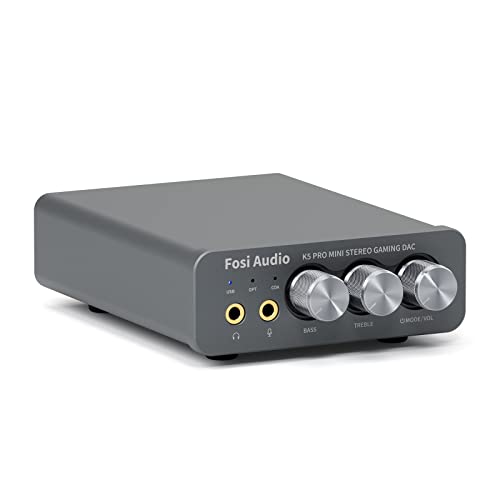
Fosi Audio K5 Pro — Best hands-on budget route
The K5 Pro is the guide’s populist: a gaming-leaning DAC and headphone amp with a stated 1000mW of drive, 24-bit/192kHz handling, a microphone input — and, gloriously, physical bass and treble knobs on its face. In a category that increasingly hides adjustment inside apps and menus, Fosi put two small dials within fingertip reach and trusted the listener’s hands. For a certain kind of owner, that single decision outsells every specification in this article.
Tone controls carry an unfair reputation in purist circles, as if adjusting a recording’s balance were a confession of weak equipment. The K5 Pro’s owner knows better: recordings vary, games vary, ageing ears vary, and a two-second twist that warms a thin soundtrack or tames a shrill one is worth more at 11 p.m. than a lecture on neutrality. The knobs are defeatable in spirit — set them flat and the unit is a straight DAC/amp — which makes their presence pure option, never obligation.
Connectivity keeps the populism going: USB-C, optical and coaxial inputs feeding RCA and 3.5mm outputs, with stated service across PS5, PC and Mac. The 3.5mm headphone output rather than a 6.35mm socket announces the intended headphones — headsets and portable-style cans rather than studio veterans — and the microphone input completes a package aimed at the desk where gaming and listening genuinely share hours.
Set expectations by its station and the K5 Pro delights; inflate them and it cannot. It will not drive the most stubborn planar headphones with the K7’s authority, offers no balanced output for the 4.4mm tribe, and its conversion ceiling is the most modest in this guide. What it offers instead is the highest ratio of daily usefulness to fuss in the set — the box a pragmatic listener buys, enjoys immediately, and upgrades from only when a specific limitation, honestly felt, asks them to.
It is also, quietly, the easiest recommendation in this article to lend. A friend curious about external audio can borrow the K5 Pro, twist its knobs, hear their own headset transformed, and return it with an educated opinion — no software accounts, no balanced-cable prerequisites, no vocabulary lesson required first. Gateways matter in a hobby that can sound like a gated community, and this little box holds the gate open.
- Role: gaming DAC and headphone amp with tone controls
- Stated drive: 1000mW, per the listing
- Formats: 24-bit/192kHz, per the listing
- Controls: physical bass and treble knobs, microphone input
- Inputs: USB-C, optical and coaxial; RCA and 3.5mm outputs
Strengths
- Bass and treble knobs answer in two seconds what menus answer in twenty.
- Microphone input makes it a complete gaming-and-listening station.
- Three digital inputs cover PC, console and legacy sources alike.
Trade-offs
- No balanced output and a 3.5mm headphone socket — portable cans, not studio flags.
- Modest conversion ceiling beside the K11 and K7.
- Stubborn planar headphones will find its limits before the K7’s.
Best for: hands-on listeners and gamers who like their sound adjustable by touch. Not suited for: balanced-cable collectors or the hardest-to-drive headphones.
Pragmatists can browse the K5 Pro’s Amazon listing to confirm its socket sizes match the headset they already own.
Where do speakers fit in a guide about headphone gear?
More centrally than the category’s name suggests. Many listeners who begin with headphones discover, usually around the second year, that they want music in the room as well as in the ears — and the DAC they bought becomes the seed of a speaker system. That is why the line outputs in this guide were reviewed as seriously as the headphone sockets. The K11’s RCA feed can drive powered speakers directly. The ZH3 was practically designed for the transition, with balanced XLR outputs for studio monitors, a remote for the listening chair and a trigger to wake the amplification. Even the K5 Pro’s humble RCA pair can hand a powered speaker a clean signal while its owner saves for the next chapter.
The discipline is to keep the two systems’ needs separate in your head. Headphones ask the DAC/amp for drive; powered speakers ask it for a clean, preferably variable, line-level feed and nothing more. A unit that excels at the first and merely offers the second is a headphone product with a bonus. A unit like the ZH3, which treats the preamp role as a headline feature, is a system component that also drives headphones superbly. Neither is superior in the abstract — but buying the wrong emphasis means the second chapter of your setup starts with replacing the first chapter’s hero.
Room reality gets the final word. Speakers interact with walls, desks and neighbours in ways headphones never do, and no converter, however balanced its architecture, can negotiate with a landlord. Listeners in thin-walled buildings often find their endgame is exactly where this guide lives: one excellent headphone chain, honestly built. There is no consolation prize in that outcome — for many recordings, it is the most revealing seat in the house.
How do the six compare side by side?
| Pick | Form | Balanced out | Signature strength | Watch out for |
|---|---|---|---|---|
| FiiO K11 | Desktop DAC/amp | 4.4mm | Complete, unfussy core set | No mic input or remote |
| Fosi ZH3 | Desktop DAC/preamp | 4.4mm + XLR | System control with remote and trigger | Feature tax on minimalists |
| Creative X5 | Desktop DAC/amp | Fully balanced design | Dual-DAC purity, Xamp drive | Listening-first, not gaming kit |
| Creative AE-X | Internal PCIe card | Internal design | Invisible integration, 32-bit/384kHz | One PC only |
| Fosi K7 | Desktop DAC/amp | 4.4mm | 2100mW drive plus mic and Bluetooth | Breadth over narrow purity |
| Fosi K5 Pro | Desktop DAC/amp | None | Physical tone knobs, mic input | Modest conversion ceiling |
How should you set up a DAC/amp for critical listening?
Give the unit a clean digital feed first: USB from the computer for music, with the operating system set to hand audio over without its own resampling or enhancement layers, and the player application — where it offers exclusive or bit-perfect modes — allowed to speak to the DAC directly. The goal is a chain of custody where the file you chose is the file the converter meets.
Set gain with intention. Low gain for sensitive headphones keeps the knob in its happiest range and the noise floor at its lowest; high gain exists for the demanding loads and should be visited only when low gain cannot reach your listening level with room to spare. If the unit offers both balanced and single-ended outputs for your headphone, try both at matched volume before declaring a winner — louder is the oldest trick in audio, and it fools everyone who skips the matching.
Headphone cables deserve thirty seconds of the setup ritual too. Route them clear of chair casters and foot traffic, give the plug a strain-free path to the socket, and if your headphones offer detachable cables, treat the balanced lead and the single-ended lead as tools for different days rather than rivals. More good headphones die by cable and caster than by any electronic failure, and the finest amplifier in this guide cannot play through a severed conductor.
Then arrange the physical desk like you mean it. The DAC belongs within arm’s reach, its cable runs separated from power bricks and monitor feeds, its ventilation unobstructed by the stack of books it will inevitably be asked to hold. Leave the setup alone for a fortnight before judging it. Ears calibrate slowly, first impressions overweight brightness, and the chain that sounds “dull” on day one is frequently the honest one you keep for a decade.
What mistakes do audiophile sound card buyers keep making?
The founding mistake is shopping by chip. Two products can share a converter and sound nothing alike, because the analogue stage, power supply and output design do the audible heavy lifting — yet buyers routinely rank products by silicon as if reading a league table. Use the chip to date the design and confirm its format support, then judge the architecture around it.
Second is buying power for headphones you do not own and will not buy. A flagship’s 2100mW is glorious insurance for planar owners and pure waste for the listener whose efficient headphones sip milliwatts; the money difference buys a great deal of music. Third, listeners feed a fine DAC from a mangled source — a browser tab through three enhancement layers — and blame the converter for the result. The chain is only as honest as its first link.
Fourth comes the balanced misunderstanding: purchasing 4.4mm cables as a sonic upgrade rather than a compatibility choice, then attributing the balanced output’s extra loudness to extra quality. And fifth, the quietest mistake of all — buying an internal card for a machine already scheduled for replacement, or a desktop box for a listener whose life is laptops and travel. Form factor is destiny in this category; choose the shape that matches your next three years, not your last three.
Final Recommendation
Beginners should begin with the K11 and feel no inadequacy about it: a complete, balanced, well-driven chain is not a compromise but a destination many listeners never need to leave. System builders graduate to the ZH3 when speakers and remotes enter the picture, while the X5 serves the purist who wants dual-DAC architecture from a name with scale. The AE-X remains the connoisseur’s internal answer — one PC, built to keep, audio as part of its skeleton. Gamers with standards split their vote: the K7 when drive and consoles matter, the K5 Pro when hands-on tone control and value lead. Whichever you choose, let the headphones on your head — not the chip in the box or the fashion of the season — cast the deciding vote, because the chain exists to serve them and everything else is commentary.
Frequently Asked Questions
Is a DAC/amp really different from a gaming sound card?
In purpose, yes. A gaming card spends its budget on surround processing, microphone tools and game profiles; a DAC/amp spends the same money on conversion quality, output drive and balanced architecture for music. Products like the K7 deliberately blur the line, but the centre of gravity differs, and buyers should decide which activity — playing or listening — gets to be the priority their hardware serves first.
Do I need balanced headphones to enjoy these units?
No. Every balanced model here also offers a single-ended output that serves ordinary headphones fully, and many listeners live happily on that socket forever. Balanced becomes relevant when your headphones already wear a 4.4mm cable, when a design reserves its fullest drive for the balanced path, or when you are building a system whose other components — like the ZH3’s XLR outputs — speak balanced natively.
Will a better DAC fix harsh or badly recorded music?
It will reveal it more faithfully, which is not the same mercy. A clean chain removes the equipment’s own grit so that what remains is the recording’s character — glorious for good masters, unsparing for bad ones. Listeners who prefer a gentler presentation should look at headphones with a warmer tuning, or at honest tools like the K5 Pro’s tone knobs, rather than asking a converter to editorialize.
How high a sample rate do I actually need?
Far lower than the ceilings in this guide suggest. The stated figures — 384kHz on the K11 and K7, 768kHz PCM on the ZH3 — are headroom and future-proofing, not requirements; the overwhelming majority of music libraries live at rates every unit here handles trivially. Buy ceiling as insurance if it costs nothing, but never let it outrank drive, outputs or controls in your decision.
Can one of these replace my AV receiver for speakers?
For a stereo pair of powered speakers, the ZH3 makes a genuine case — balanced preamp outputs, a remote and a trigger are a receiver’s core courtesies in miniature. For passive speakers you still need power amplification, and for multi-channel home cinema you need a receiver outright. These are headphone-and-stereo instruments; asking them to run a cinema is how good products get unfair reviews.
Why does the internal AE-X cost a place in an external world?
Because integration is a real value. A listener with one permanent desktop gains invisibility, a single control point and flagship conversion without surrendering desk space or adding cables. The card’s exile from laptops and consoles is the price, stated openly in its review — and for the build-to-keep audience, it is a price rationally paid.
One last encouragement for the hesitant: the distance between a motherboard’s headphone jack and any product in this guide is larger than the distance between the cheapest and dearest products within it. The first step into a dedicated chain is the one your ears will remember; the refinements after it are a hobby, pursued at leisure, with the music already sounding better every single day you postpone them. Buy the step, enjoy the plateau, and let upgrade fever arrive — if it ever does — as a guest rather than a landlord.
Related Guides
Gamers who want processing alongside their fidelity should compare Best External Sound Cards, builders weighing the internal route in full should read Best Desktop Sound Cards, and producers curious where PCIe still fits a working studio can continue to Best PCI Sound Cards for Music Production.


