Our Top Picks
 Howardly Ni-MH AA 1.2v 600mAh Rechargeable Battery forAA1.97 x 0.55 x 0.55 inches0.4 poundsCheck on Amazon
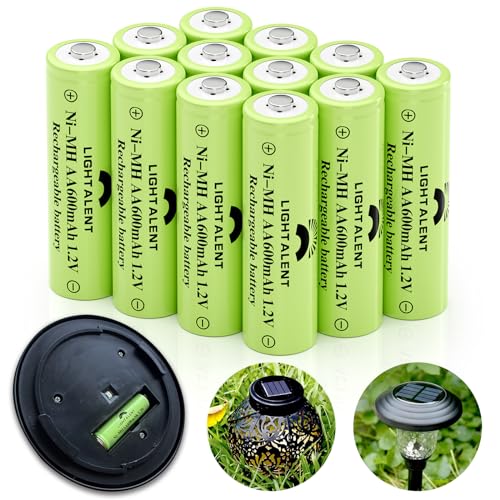 Lightalent Rechargeable Solar AA 600mAh Batteries for OutdoorAA 600mAh 12Pack1.97 x 0.55 x 0.55 inchesCheck on Amazon


What's inside
- What a solar lamp battery actually is
- Check the old cell before you buy anything
- Why capacity matching matters more than capacity chasing
- The 600mAh lamp-original class
- The 1000 to 1300mAh mid range
- The 1600 to 2000mAh high range
- NiMH versus NiCd: dealing with legacy cells
- Seasonal care and sensible storage
- When the lamp itself is the real failure
- Check prices on Amazon
- A short buying checklist
As an Amazon Associate I earn from qualifying purchases. This post may contain affiliate links at no extra cost to you.
When a solar lamp fades an hour after sunset, the instinct is often to replace the whole light. In many cases, though, the lamp itself is fine and only its small rechargeable cell has worn out. Most outdoor solar lights and solar lamps do not contain a large battery pack at all. They contain a single removable AA-size cell, tucked under a cap on the underside of the lamp head or inside the battery compartment near the panel. That cell charges slowly from a tiny solar panel during the day and then powers a small LED after dark. Replacing that one cell, with the right type, is one of the simplest and most satisfying repairs in the garden.
This guide is honestly framed as a replacement-parts guide, because that is what these products are. The eight packs covered here are solar-light-specific AA NiMH cells. They are not solar power-station batteries, not the large lithium packs used to store energy for a home or a camper, and not generic AA rechargeables chosen at random from a drawer. They are lower-capacity cells tuned for the daily shallow charge cycles a solar lamp actually delivers: a modest trickle of energy in daylight, a partial discharge overnight, and then the same gentle pattern again the next day. Understanding that distinction is the key to buying the right pack the first time, so our research for this guide starts with matching, not with capacity bragging rights.
Throughout this guide, we checked each product against the details in its own listing title: chemistry, voltage where stated, capacity, pack size, and any stated cycle or design notes such as pre-charged delivery, low self-discharge, anti-leak construction, or mercury-free composition. Where a title does not state a figure, we do not invent one. The advice below leans on generic category truths that apply to solar lamps as a class, flagged as general guidance rather than product claims.
What a solar lamp battery actually is
A typical solar path light, stake light, string light control box, or decorative solar lamp runs on one AA NiMH cell rated at 1.2 volts. NiMH stands for nickel-metal hydride, a rechargeable chemistry that tolerates being charged slowly, discharged partially, and charged again the following day, over and over, without needing careful electronic management inside the lamp. The lamp’s own circuitry is deliberately simple. The panel produces a small current when light falls on it, a sensor switches the LED on at dusk, and the cell does the quiet work in between.
That simplicity explains why these cells look modest on paper. A solar lamp panel is small, often no larger than a drink coaster, and it can only push a limited amount of energy into the cell during a day, less in winter or in shade. The cell therefore does not need to be huge. It needs to accept a slow charge gracefully, hold enough of that charge to run a low-power LED through the evening, and survive hundreds of these shallow cycles while living outdoors through heat, cold, and damp. Solar-specific AA cells are built and marketed around exactly that job, which is why their capacities often look lower than the capacities advertised for general-purpose rechargeable AA batteries used in camera flashes or game controllers.
It also explains what these cells are not. They are not a way to upgrade a lamp into something brighter than its LED and panel were designed to deliver. They are not interchangeable with the sealed battery banks inside solar generators. And they should not be confused with primary, single-use AA batteries, which cannot be recharged by the lamp at all and should never be left in a lamp that will try to charge them. The correct replacement is a rechargeable NiMH AA, matched as closely as you can to the cell the lamp came with.
Check the old cell before you buy anything
The single most useful step in this entire guide takes about a minute and costs nothing: remove the lamp’s existing cell and read it. Twist or unclip the battery cover, usually on the underside of the lamp head, and slide the cell out. Printed on its wrapper you should find three pieces of information that decide your purchase: the physical size, the chemistry and voltage, and the capacity in milliamp-hours, written as mAh.
Size first. Most solar lamps use AA, but some smaller decorative lights use AAA, and a few older or larger lanterns use a different format entirely. AA and AAA look similar at a glance and are easy to confuse in a dim garage, so compare the old cell directly with the description of anything you plan to order. Every product in this guide is an AA cell, sometimes described as Double A in the listing, which is simply another name for the same size. If your lamp’s original cell is AAA, none of these packs will fit correctly, and forcing a larger cell into a smaller compartment can damage the contacts.
Chemistry and voltage second. The wrapper should say NiMH, or occasionally NiCd on older lamps, alongside 1.2V. That 1.2-volt figure is normal and correct for a rechargeable AA; it is lower than the 1.5 volts printed on a disposable alkaline AA, and the lamp was designed around it. If your old cell says NiMH 1.2V, you are shopping in exactly the right category here.
Capacity third. The mAh number on a solar lamp’s original cell is often surprisingly small. Many lamps ship with a 600mAh cell, and some ship with even less. That number is your anchor. A replacement with the same capacity, or one step up, is usually the sensible match. A replacement with several times the capacity is not automatically an upgrade, for reasons we explain in the capacity section below. Write the number down, or photograph the wrapper with your phone, before you recycle the old cell. If the wrapper is faded or torn, check the lamp’s instruction leaflet or the printing inside the battery compartment, which sometimes repeats the specification.
While the compartment is open, look at the contacts. White or green crust, rust spots, or a spring that has lost its tension can all imitate a dead battery. Clean light corrosion gently with a dry cloth or a pencil eraser, make sure the new cell will sit snugly, and check that the compartment seal or cover is intact, because water creeping in past a cracked cover will shorten the life of any replacement cell you fit. If a previous cell has leaked, wear gloves, bag the old cell, and take it to a battery recycling point rather than putting it in household waste.
Why capacity matching matters more than capacity chasing
Capacity, the mAh figure, describes how much charge a cell can hold when full. It is tempting to treat it like a score and simply buy the biggest number. Solar lamps punish that logic, because the limiting factor in the system is rarely the cell. It is the panel, and the number of usable daylight hours your garden actually gets.
Think of it as a small jug under a slow tap. If the tap only delivers a modest amount each day, a bigger jug does not fill any faster; it just sits partly filled. A high-capacity cell in a lamp with a small panel may spend its whole life in a partially charged state, because one day of sunlight cannot replenish what a long night draws from it, and the shortfall accumulates. The lamp then behaves much like it did with a worn-out cell, even though the new cell is technically larger. Meanwhile, a cell matched to the panel reaches a healthy full charge on a good day, delivers its rated evening of light, and repeats that balanced cycle, which is the pattern these products are tuned for.
There are still good reasons to choose a higher-capacity tier. Lamps with larger panels, lamps in reliably sunny positions, and lamps that group several cells or drive a brighter fitting can genuinely use more storage. A higher-capacity cell can also carry a lamp through a run of dull days a little better once it has been properly charged. Some households prefer to pre-charge cells in a mains charger before fitting them, which sidesteps the slow first charge from the panel; if that is your routine, a charger that handles AA cells sensibly is worth having, and our guide to best aa and aaa battery chargers covers that side of the setup. The point is not that high capacity is bad. The point is that the original cell’s rating is evidence about what the lamp’s panel can support, and evidence should beat guesswork.
For organising the eight packs in this guide, we grouped them into three tiers that mirror how lamps are actually supplied. The 600mAh tier is the lamp-original class, the closest match for the many lights that shipped with a cell of exactly that size. The 1000 to 1300mAh tier is the mid range, a step up for lamps with decent panels or originals in that neighbourhood. The 1600 to 2000mAh tier is the high range, best reserved for lamps whose original cell, panel size, or sunny placement justifies it. Pack size cuts across all three tiers: a small pack suits a couple of lamps, while a large pack suits a whole path or garden set and gives you spares for the next failure.
The 600mAh lamp-original class
If the cell you pulled from your lamp says 600mAh, start here. This tier exists because a huge number of garden lights were manufactured around a cell of this size, and a like-for-like swap is the lowest-risk repair you can make. The lamp’s panel was sized to fill a 600mAh cell on a reasonable day, its LED draw was chosen to run from that store of energy, and a fresh cell of the same class restores the balance the designer intended. Three of the eight packs in this guide sit in this tier, and the differences between them are mostly about pack size and the small print in their listings.
Howardly Ni-MH AA 600mAh
The Howardly pack is the most plainly described option in this tier. Its listing states the essentials without decoration: Ni-MH chemistry, AA size, 1.2 volts, and 600mAh capacity, pre-charged and with low self-discharge, made for solar lights and described as a Double A solar battery for outdoor solar lights. Low self-discharge matters more than it might sound. It describes a cell’s ability to keep its charge while it is sitting unused, which is useful if you buy a pack, fit some cells now, and keep the rest in a drawer for the next lamp that fades. A spare that has quietly emptied itself by the time you need it is not much of a spare.
Choose the Howardly cells when your original cell is a 600mAh NiMH AA and you want the closest straightforward match. Because the listing leads with a single-cell description, read the pack quantity on the product page carefully before ordering so the number that arrives matches the number of lamps you plan to revive. Fitting is the same as with any cell in this guide: observe the polarity markings, seat the cell firmly, refit the cover so its seal sits evenly, and give the lamp a full day in position before judging the result at night.
Lightalent Rechargeable Solar AA 600mAh, 12-Pack
Lightalent offers the same 600mAh lamp-original capacity in a 12-pack, which changes who it suits. Twelve cells is a garden-set quantity: enough for a run of path lights in one pass, with the consistency benefit that every lamp in the set starts its new life on the same day with cells of the same age. Mixed-age cells across a set are a common reason one or two lights in a row look dimmer than their neighbours, and a single larger pack is the easiest way to avoid that patchwork.
The listing adds two useful details: the cells are Ni-MH at 1.2 volts and pre-charged, and they are rated for 1000 cycles. A cycle figure is a manufacturer’s statement about how many charge-and-discharge rounds the cell is designed to handle, and in a solar lamp, which cycles daily, it is a more relevant durability clue than almost anything else on the page. Treat all such figures as the maker’s own rating rather than a promise about your particular garden, since shade, season, and lamp condition all move the real number. Even so, a stated cycle rating at this capacity tier is a welcome sign that the product is aimed at daily solar duty rather than occasional use. Choose Lightalent when you have many 600mAh lamps to refresh at once and want one uniform batch to do it with.
JiajaX Ni-MH AA 600mAh, 4-Pack
JiajaX covers the opposite end of the quantity question: a 4-pack of 600mAh Ni-MH AA cells at 1.2 volts, pre-charged, with low self-discharge, for outdoor solar lights. Four is the right number for a household with a small cluster of lamps, a pair of decorative lanterns plus spares, or for a first repair when you are not yet sure whether the battery is the whole problem. Buying small first is a legitimate strategy. If a fresh, correctly matched cell brings a lamp back to life, you have confirmed the diagnosis cheaply and can order a larger pack for the rest of the set with confidence.
If the fresh cell does not fix the lamp, you have spent the least possible amount while learning something important, namely that the fault probably lies with the panel, the LED, or the lamp’s switch and sensor, a possibility we return to later in this guide. The JiajaX pack’s low self-discharge note also makes its leftover cells sensible drawer spares. For small jobs, small packs are not a compromise; they are the proportionate choice, and this tier is really about matching both the capacity and the quantity to the lamps in front of you.
Across all three 600mAh options, set expectations correctly. These cells restore a lamp to the evening runtime its panel and LED were designed for; they will not make a shaded lamp behave like a sunny one. Give any newly fitted cell two or three decent days in position before deciding the repair has failed.
The 1000 to 1300mAh mid range
The mid tier is for lamps that arrived with a cell somewhere around this range, lamps with noticeably larger panels, and lamps in strong sun where the original 600mAh cell filled early in the day and the extra storage can genuinely be used. It is also the tier to consider if your lamps light a space you actually rely on, such as steps or a gate, and you want more headroom for dull weather, provided the panel can support it. Two packs sit here, and they approach the tier from slightly different angles.
Tenergy Solla Rechargeable NiMH AA, 1000mAh
The Tenergy Solla is a 1000mAh NiMH AA cell made for solar garden lights, and its listing emphasises durability rather than headline capacity. It describes anti-leak construction, outdoor durability, and performance of five or more years. Those emphases suit the real conditions of solar lighting better than a raw capacity contest does. A solar lamp cell lives outside, in a small compartment that heats up in afternoon sun and cools hard at night, and it does so for years. Resistance to leaking protects the lamp’s contacts and compartment, which are often the parts that actually end a lamp’s life.
Read the longevity wording as the manufacturer’s own positioning, and weigh it alongside fit. At 1000mAh, the Solla is a measured step up from the lamp-original class rather than a leap: large enough to add useful headroom for lamps with a decent panel, small enough that a modest panel still stands a chance of filling it on a good day. It is a particularly sensible choice for lamps you cannot easily reach, such as lights mounted along a fence or set into a border you do not want to disturb every season, where a durability-focused cell reduces how often you climb back in. Check the pack quantity on the product page when ordering, since the listing title describes the cell itself rather than leading with a pack count.
EBL Solar AA Rechargeable, 1300mAh, 12-Pack
EBL’s entry pairs 1300mAh with a 12-pack, pre-charged NiMH cells at 1.2 volts, a mercury-free description, and a stated 1200 cycles, aimed at outdoor solar lights. The cycle figure is the highest stated among the mid-tier options in this guide, and the mercury-free note will matter to buyers who are replacing very old cells and want a modern chemistry without that particular toxic ingredient. Twelve cells at this capacity suits a larger set of mid-range lamps, or a mixed garden where several fittings share the same battery compartment size.
The honest caution for this tier applies to the EBL pack as much as to any other: 1300mAh only earns its keep if the panel can deliver it. In a small lamp that shipped with a 600mAh cell and a thumbnail-sized panel, a 1300mAh replacement may spend its life underfilled, and the lamp’s runtime may improve little, or occasionally not at all, compared with a like-for-like swap. In a lamp with a generous panel in open sun, by contrast, the extra capacity is real storage the system can use, and the step up makes sense. Let the old cell and the panel size arbitrate. If your original was 1000mAh or more, this pack is squarely in your territory. If your original was 600mAh, treat this tier as a considered experiment for your sunniest lamps rather than a blanket upgrade for the whole garden.
One practical tip for the mid tier: when you step capacity up in some lamps but not others, mark which is which. A small note in the battery compartment saves confusion next season and turns guesswork into a pattern you can act on.
The 1600 to 2000mAh high range
The high tier holds the three largest-capacity packs in this guide. These are still solar-light AA NiMH cells, still 1.2 volts where stated, and still intended for the same daily cycle as everything else here. What changes is the amount of storage on offer and the size of the packs, which makes this tier the natural home for big lamp sets, lamps with substantial panels, and households that would rather hold spares than reorder. It is also the tier where the matching warning matters most, so read these three options with your original cell’s rating in mind rather than treating the largest number as the default winner.
Kruta Rechargeable AA Solar Batteries, 1600mAh, 20-Pack
Kruta offers 1600mAh NiMH AA cells at 1.2 volts in a 20-pack for outdoor solar lights, the largest pack in this guide. Twenty cells is a whole-property quantity. It suits a long driveway run, a full set of path and border lights, or a household maintaining lamps at more than one property. There is a real consistency argument for buying at this scale: when every lamp in a display gets a fresh cell from the same pack on the same weekend, the set ages together, and the lamps that fade early in future seasons stand out as individual faults rather than blending into general decline.
The counterweight is commitment. Twenty high-capacity cells are only a good buy if 1600mAh is genuinely your lamps’ tier. If most of your lamps shipped with small cells and small panels, a smaller like-for-like pack serves you better and leaves less money sitting in a drawer. Kruta’s pack makes most sense where the original cells were already in the higher range, or where the lamps are larger fittings, such as lantern-style lights with panels big enough to justify the storage. If that describes your setup, the pack size turns a tedious annual chore into a single afternoon’s work, and the spares cover the stragglers that fail mid-season.
WENJOOP AA Rechargeable Batteries for Solar Lights, 1600mAh, 16-Pack
WENJOOP matches Kruta’s 1600mAh capacity in a 16-pack of 1.2-volt NiMH cells, described as precharged and low self-discharge, and reusable for garden lights. The precharged and low self-discharge pairing is worth pausing on, because it speaks to how these packs are actually used. Few households fit an entire pack the day it arrives. More often, a batch of lamps gets repaired, and the remaining cells wait weeks or months for their turn. Cells that arrive precharged and lose their charge slowly while stored are ready for that second and third round of repairs, rather than needing attention before they can be used.
Sixteen sits in a useful middle ground between the dozen-sized packs and Kruta’s twenty. It covers a substantial set with spares left over, without asking you to be quite as certain about your whole garden as the largest pack does. As with every high-tier option, the deciding question is upstream of the brand: does your lamp’s panel and original specification support 1600mAh? If yes, WENJOOP’s combination of capacity, pack size, and storage-friendly description makes it an easy pack to live with. If your lamps are small 600mAh fittings, the honest answer is to buy from the first tier and spend the difference on a spare set for next year.
Brightown NiMH Rechargeable AA, 2000mAh, 12-Pack
Brightown tops this guide’s capacity range at 2000mAh, in a 12-pack of NiMH rechargeable AA cells for solar lights, described as long lasting and suitable for solar lights and home devices. That dual description is interesting. It positions the pack not only for lamps but also for household gadgets, which can be convenient if you like holding one type of AA rechargeable for several jobs. For the purposes of this guide, though, judge it as a solar lamp cell first, because that is the job with the strictest matching requirements.
At 2000mAh, this is the pack most likely to be underfilled by a small lamp panel, and the one where expectations need the firmest handling. In a lamp designed around it, or a lamp with a large panel in strong sun, the capacity is there to be used and the long-lasting description has the conditions it needs. In a compact path light that shipped with a fraction of this capacity, the panel becomes the ceiling, and the lamp’s behaviour will be governed by daylight and shade rather than by the number on the wrapper. There is also a housekeeping point: if you use cells from this pack in home devices as well as lamps, keep the two sets separate and labelled, so each set ages in its own role.
Stepping back, the high tier rewards buyers who did the one-minute check and found a high number on the old wrapper, or who own larger fittings with panels to match. It punishes impulse buying more than the other tiers, because the gap between a big cell and a small panel is widest here. None of that makes these packs poor products. It makes them specialised ones, and specialisation is the theme of this entire category.
NiMH versus NiCd: dealing with legacy cells
If your lamp is old enough, the cell you remove may say NiCd rather than NiMH. NiCd, nickel-cadmium, was the standard chemistry in earlier generations of solar lights, and millions of those lamps are still in gardens. The good news is that NiMH is the modern replacement chemistry for this job, and the packs in this guide are NiMH cells intended for exactly these lamps. The two chemistries share the same nominal 1.2-volt rating and the same AA format, and solar lamp charging circuitry is simple enough that NiMH replacements are the normal, expected route when an NiCd original wears out.
There are two practical differences to know. First, disposal: cadmium is a particularly nasty heavy metal, so an old NiCd cell should always go to a battery recycling point and never into household waste. The same recycling route is right for worn NiMH cells too, but with NiCd it is non-negotiable. Second, behaviour: NiCd was famous for tolerating abuse and for the so-called memory effect in some usage patterns, while NiMH generally offers more capacity in the same size and suits the shallow daily cycling of a solar lamp well. You do not need to hunt down like-for-like NiCd replacements to keep an old lamp alive. A NiMH cell matched on size and roughly on capacity is the standard modern answer, and the mercury-free note on the EBL pack in this guide reflects how far the category has moved from the toxic ingredients of earlier cells.
One related warning deserves its own emphasis. Do not substitute a lithium AA cell that advertises 1.5 volts. Those products exist for devices that need a higher, steadier voltage, and some are excellent in their intended role, but a solar lamp is not that role. The lamp expects a 1.2-volt rechargeable cell and will attempt to charge whatever is in its compartment using circuitry designed for NiMH behaviour. A 1.5-volt lithium AA is built differently inside, is not designed to be charged by a solar lamp’s simple circuit, and forcing that pairing risks damage to the cell, the lamp, or both. Voltage is not a dial where more is better. Match the 1.2 volts on the original wrapper, every time.
For the same reason, be wary of advice that any rechargeable AA will do. Cells designed for high-drain devices, cells with unusual voltage, and cells salvaged from other equipment all introduce variables a simple lamp circuit cannot manage. The solar-specific packs in this guide remove those variables.
Seasonal care and sensible storage
Solar lamps live a seasonal life, and a little care at the turning points of the year stretches the life of every cell in this guide. In autumn, as days shorten, lamps receive less charge and run for less time; that is physics, not failure. It is, however, a good moment to clean each panel with a soft damp cloth, because a film of dust, pollen, and traffic grime quietly steals charge all year and matters most when light is scarce. Check that shrubs and climbing plants have not crept over panels during the growing season, and trim back anything casting new shade.
In winter, decide honestly which lamps earn their place. Lights in deep shade may barely charge for weeks, and cells left sitting deeply discharged for long periods age faster than cells kept in gentle use. For lamps you do not need in midwinter, switch them off, or bring the cells indoors, charge them in a mains charger if you have one, and store them in a cool, dry place until spring. Low self-discharge cells, a description carried by the Howardly, JiajaX, and WENJOOP packs in this guide, are the most forgiving of this pattern. Whatever the brand, store cells in a dry box away from heat, and never store a cell that is swollen, leaking, or damaged; recycle that one instead.
Households maintaining a lot of lamps sometimes pre-charge a whole batch of cells before the spring refit, so every lamp starts the season full rather than waiting for the panel to do the first fill. If that is your scale, our guide to best 16 bay battery chargers covers chargers built for many cells at once. The same logic applies at the other end of the solar world, where larger 12-volt batteries for sheds, boats, and off-grid setups need a different kind of maintenance charging entirely; our guide to best 12v solar trickle chargers deals with that separate category, and it is worth stressing that those products and these AA cells solve different problems and are not substitutes for each other.
In spring, refit cells, clean panels again, and give the set a few bright days before judging it. In summer, check that compartment covers still seal after winter frosts, and avoid leaving spare cells in a hot car or sun-baked shed. An hour twice a year is enough, and it is the difference between replacing cells on a natural cycle of years and wondering why a set faded within a single season.
When the lamp itself is the real failure
Not every dim lamp has a tired battery, and part of honest replacement advice is knowing when to stop buying cells. Fit a fresh, correctly matched cell, give the lamp several days in a decent position, and then read the symptoms.
If the lamp never lights at all with a known-good cell, suspect the lamp. The light sensor may have failed, the switch may be corroded or stuck in the off position, or a wire between panel, cell, and LED may have broken. If the lamp lights but the panel face is cloudy, cracked, or peeling, the panel may no longer generate enough to charge any cell properly; a milky, degraded panel is one of the clearest signs that the fitting, not the battery, is at end of life. If the LED itself is dim even at the start of the night with a freshly charged cell, or flickers and cuts out when the lamp head is moved, the LED or its connections are the likely culprits. Water inside the lamp head, visible as condensation that never clears, points the same way: the electronics have been living wet, and a new cell will inherit the same conditions.
There is a simple cross-check that separates battery faults from lamp faults. Move the suspect cell into a lamp that works, and move a known-good cell into the suspect lamp. If the problem follows the cell, replace the cell. If the problem stays with the lamp, retire or repair the lamp. This swap takes minutes and prevents the most common waste in this category, which is a second and third pack bought to feed a lamp whose panel died two seasons ago.
Also keep formats straight when you do retire or diversify your outdoor lighting. Some larger solar lanterns and many torches use cylindrical lithium cells in the 18650 format instead of AA NiMH, and those cells need their own dedicated chargers and handling; if you own lights like that alongside your AA lamps, our guide to best 18650 chargers covers that separate drawer of the toolbox. The lesson generalises: outdoor lights look interchangeable from the outside and are anything but inside, so the wrapper on the original cell is always the authority.
Check prices on Amazon
Live listings for the shortlist in this guide are pulled from Amazon below, so prices and availability are always current at the moment you look.


A short buying checklist
- Remove the old cell and note its size, chemistry, voltage, and capacity before ordering anything.
- Buy AA NiMH at 1.2 volts, in the capacity tier closest to the original cell: 600mAh for lamp-original fittings, 1000 to 1300mAh for mid-range lamps with panels to support them, and 1600 to 2000mAh only where the original specification or panel size justifies it.
- Choose pack size by lamp count: the JiajaX 4-pack for a small cluster or a first diagnostic repair, the 12-packs from Lightalent, EBL, and Brightown for full sets, WENJOOP’s 16-pack for a large set with spares, and Kruta’s 20-pack for a whole property.
- Value the quiet specifications: pre-charged delivery and low self-discharge for spares that wait in a drawer, a stated cycle rating such as Lightalent’s 1000 cycles or EBL’s 1200 cycles for daily-duty reassurance, and durability notes such as Tenergy Solla’s anti-leak, outdoor-focused description for hard-to-reach lamps.
- Never substitute disposable alkaline cells, 1.5-volt lithium AA cells, or random cells from other equipment, and recycle every retired cell, especially legacy NiCd cells, at a proper battery recycling point.
- After fitting, allow several days of normal daylight before judging the result, and use the cell-swap check before blaming a second lamp on its battery.
Followed in order, that checklist turns a vague purchase into a matched repair. The eight packs here cover the realistic spread of what solar lamps actually need: three honest 600mAh options for the largest class of fittings, two mid-range packs for lamps with more panel and more appetite, and three high-capacity packs for the minority of lamps built to use them. The best solar battery for your lamp is rarely the biggest one on the page. It is the one whose size, chemistry, voltage, and capacity mirror the cell your lamp was born with, bought in the quantity your garden actually needs, and then given clean panels, sound seals, and a few sunny days to prove itself.
Disclosure: This guide is based on our research of product listings and general knowledge of how solar lamps and NiMH cells work, and it is intended to help you choose replacement parts with confidence. Product details and availability can change, so check the listing before you buy. As an Amazon Associate we earn from qualifying purchases.


