What's inside
- Key Takeaways
- Quick Picks
- How were these executive picks chosen?
- Executive phones compared
- How should an executive actually choose between these phones?
- Working weeks we pictured while ranking these handsets
- Common mistakes executives make when buying a work phone
- Security, enrolment and the unglamorous back office of an executive handset
- Final recommendation
- Frequently asked questions
As an Amazon Associate I earn from qualifying purchases. This post may contain affiliate links at no extra cost to you.
gizmoverdict.com is reader-supported. When you buy through links on our site, we may earn an affiliate commission.
Where to buy: Executive-class handsets on Amazon split into two very different shelves — current unlocked flagships sold through brand storefronts, and carrier-specific or renewed listings that arrive through third-party sellers — so before ordering, confirm on the product page whether the unit in front of you is the unlocked US model, a Verizon build, or, in the case of the iPhone covered below, a renewed device rather than a new one.
The best smartphones for business executives are not really chosen the way personal phones are chosen. A personal phone can survive a mediocre battery because a charger lives on the kitchen counter; an executive phone dies at the worst possible moment, which is usually during the call that decides whether a contract gets signed. The buyer behind this search runs a company, or a division of one, and treats the handset as infrastructure: it carries the email thread that cannot wait, the two-factor prompts that gate the bank account, the boarding pass, the hotspot for a laptop in a taxi, and the camera that photographs a whiteboard before the cleaner wipes it. Downtime is not an inconvenience at this level. It is lost revenue with a glass screen.
That framing changes what matters. Storage stops being a vanity number and becomes a question of how many years of mail, attachments, recorded calls and offline documents the device can hold before it starts nagging about space. Battery claims stop being about weekend photography and become about whether the phone reaches the hotel at midnight with enough charge to handle the morning. Warranty language, usually ignored, suddenly deserves a close read, because a handset that anchors a working week needs a repair path that does not involve a forum thread. And the question of who sells the phone — the brand, a carrier, or a marketplace seller offering a renewed unit — matters more here than in almost any other phone category, because the support experience after purchase is part of what an executive is actually buying.
The six phones below were picked to cover the real shapes of executive life rather than to repeat one flagship six times. Two Google Pixels argue that the smartest assistant wins the working day. Samsung’s big Ultra argues that screen privacy and sheer storage win it. A VERTU handset argues, at considerable expense, that the phone is also a signal sent across a boardroom table. A Kyocera built for field conditions argues that some executives spend their days on construction sites and loading docks rather than in corner offices. And an iPhone appears in prose only, for a reason stated plainly wherever it is named: Amazon’s listings for it are renewed, this one Renewed Premium, so it is discussed honestly as a renewed route into Apple’s ecosystem rather than linked as though it were new stock.
Executives who also travel constantly may want to compare this list with our guide to the best factory unlocked smartphones for international travel, where dual-SIM flexibility and regional variants take priority over boardroom polish. The two briefs overlap less than people expect: a phone can be a superb domestic workhorse and a mediocre travel companion, and the reverse is equally true.
Our Top Picks
Key Takeaways
- Storage is the executive spec that ages worst: the Samsung and the VERTU both offer very large internal capacity, while the smaller Pixel 10 Pro configuration suits executives whose files live almost entirely in cloud accounts.
- Battery language differs sharply across this shelf — Google quantifies its claims in hours, Samsung describes durability without a figure in the title, and the VERTU prints an exact milliamp-hour capacity plus a 65W charging figure.
- The Kyocera DuraForce PRO 3 is tied to Verizon in its listing title, which makes it a deliberate carrier decision rather than a casual unlocked purchase.
- The iPhone 17 Pro in this guide is a renewed listing — Renewed Premium, in Amazon’s wording — and is covered without a purchase link for exactly that reason.
- A US warranty is stated outright in the Samsung title; where a title stays silent on warranty, that silence is flagged in the spec boxes rather than smoothed over.
- Executives who take notes by hand in meetings may find the separate stylus category more relevant than anything here; handwriting support is not a titled feature of any pick in this guide.
Quick Picks
| Pick | Model | Badge |
|---|---|---|
| 1 | Samsung Galaxy S26 Ultra | Best overall |
| 2 | Google Pixel 10 Pro | Best for assistant-led days |
| 3 | Google Pixel 11 Pro | Best for camera-driven reporting |
| 4 | VERTU Agent Q | Best boardroom statement |
| 5 | KYOCERA DuraForce PRO 3 | Best for site-based leadership |
| 6 | Apple iPhone 17 Pro | Best renewed route into iOS |
Read the badges as descriptions of working styles, not rankings of worth. The Kyocera would be a strange choice for a mergers lawyer and a perfect one for the operations director of a logistics firm; the VERTU reverses that verdict completely. Executive buying is mostly the discipline of matching a handset to the calendar it has to survive.
How were these executive picks chosen?
Selection started from the listing titles themselves, because the title is the one document every buyer can verify before money moves. A phone earned its place here by stating, in its own title, at least two of the attributes that dominate executive use: generous storage, a quantified or clearly described battery position, fast charging, an explicit unlocked or carrier status, a warranty statement, or a durability claim. Phones whose titles offered nothing beyond a brand name and a colour were set aside, however famous the brand.
Carrier honesty formed the second filter. An executive phone bought on the wrong network assumption becomes an expensive paperweight with a nice camera, so each pick below states its network position exactly as titled: unlocked Android for the Samsung and both Pixels, Verizon for the Kyocera, and eSIM with an unlocked status for the renewed iPhone. Where a title does not name a carrier or a network technology, the review says so instead of filling the gap with plausible-sounding generalities.
The third filter was role coverage. Six near-identical glass slabs would have made a tidier table and a useless guide. Instead the list deliberately spans the assistant-first Pixel approach, Samsung’s privacy-display flagship, a luxury outlier whose value is partly ceremonial, a rugged handset for executives whose office has a loading bay, and a renewed Apple option for leaders whose organisations run on iMessage and FaceTime. If your working week resembles one of those shapes more than the others, the corresponding review is where to spend your reading time.
Finally, renewed stock was quarantined rather than quietly blended in. The iPhone 17 Pro appears because executives genuinely cross-shop it, but Amazon’s listings for it are renewed, and this one carries the Renewed Premium label. It therefore receives a prose-only review: no link, no image marker tied to a listing, and a plain statement of its renewed status each time it is named. Anything less would misrepresent what the money buys.
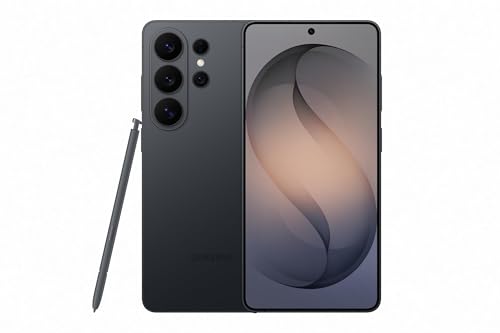
1. Samsung Galaxy S26 Ultra — Best overall
The Galaxy S26 Ultra’s title reads like a checklist written by someone who has sat through an executive’s complaints. It is an unlocked Android smartphone with 512GB of storage, finished in black, and its headline features aim squarely at working life: a Privacy Display, Galaxy AI, an AI Camera, Super Fast Charging 3.0, and a battery the title describes as durable. It is a 2026 model carrying a US 1 Year Warranty, and that warranty line — mundane as it looks — is one of the most executive-relevant phrases in this entire guide, because it converts a support question into a contractual one.
The Privacy Display deserves the first deep look. Executive work happens in public: seat-back trays, lounge chairs, the window seat of a regional jet. Financial models, unreleased headcount plans and negotiation positions all get reviewed in those seats, inches from a stranger’s peripheral vision. A display engineered to limit off-angle readability addresses a real exposure, not a hypothetical one. It will not stop a determined observer standing directly behind you, and no screen technology replaces the discipline of turning the phone face-down during sensitive conversations, but as a passive layer of protection that requires no behaviour change, it is the single most boardroom-specific feature any pick here can claim.
Storage at 512GB changes daily habits in ways smaller capacities do not. Entire mail archives stay searchable offline. Presentation decks, site photography, recorded briefings and a season of podcasts coexist without the monthly purge ritual. For an executive who delegates everything except the final decision, the phone becomes the archive of record for those decisions, and archives should not live under permanent space pressure. Paired with the AI Camera branding, the large capacity also suits the whiteboard-and-document scanning habit: photograph everything, file it later, never delete in haste.
Charging and battery language in the title is suggestive rather than numerical. Super Fast Charging 3.0 promises rapid top-ups — the airport-lounge twenty minutes that has to carry an evening — while the battery is described with the word durable and no hour figure. Compare that with Google’s hour-quantified claims below and decide which style of promise you trust. The honest reading is that Samsung is emphasising charging speed and battery longevity as qualities, and readers who plan around a guaranteed hour count should treat that absence as information, not oversight.
Galaxy AI is the wildcard. AI features on a work phone earn their keep in summarisation — long threads compressed before a meeting, call notes tidied afterward — and those are precisely the chores that eat an executive assistant’s morning. Whether the suite justifies flagship money depends on how much of your day is text. For the executive whose work is mostly spoken negotiation, it is garnish; for the one drowning in written channels, it may be the feature that matters most after the battery.
- Strengths: Privacy Display directly addresses shoulder-surfing risk in public workspaces.
- Strengths: 512GB of storage holds years of mail, decks and document scans without purge cycles.
- Strengths: US 1 Year Warranty is stated in the title, giving a clear support path.
- Trade-offs: Battery endurance is described qualitatively; the title gives no hour figure to plan around.
- Trade-offs: The title does not state a display size, so one-handed use cannot be judged from the listing.
- Trade-offs: A black-only listing finish offers no discreet alternative colourway in this configuration.
- Storage: 512GB
- Display: Privacy Display (size not stated in the listing title)
- Charging: Super Fast Charging 3.0
- Battery: Described as durable; capacity not stated in the listing title
- Network status: Unlocked Android
- Warranty: US 1 Year Warranty
Best for: a chief executive whose working day unfolds in public seats and shared spaces, where screen privacy and a deep local archive matter daily. Not suited for: a carry-on strategy built around a phone narrower than a large-format Ultra handset, since the title’s silence on dimensions leaves pocket fit unverified.
Of the six phones here, this is the one that asks the fewest compromises of a conventional executive routine, which is why it leads the list; readers ready to act on that judgement can check price on Amazon and confirm the 512GB black configuration is the unit in the basket before paying.

2. Google Pixel 10 Pro — Best for assistant-led days
Google’s pitch to the executive class is not hardware theatre; it is delegation. The Pixel 10 Pro arrives unlocked, in Obsidian, with 128 GB of storage, and its title leads with Gemini — the assistant is the headline, ahead of the triple rear pro camera system, ahead of the fast-charging battery rated beyond a full day, ahead of the bright 6.3-inch Super Actua Display. That ordering tells you who this phone is for: the executive whose scarcest resource is attention, and who would happily trade raw storage for a machine that drafts, summarises and transcribes without being asked twice.
The 128 GB figure is the honest tension in this listing. It is the smallest capacity in this guide, half the Pixel 11 Pro’s allocation and a quarter of the Samsung’s. For an executive whose documents live in Google Workspace or Microsoft 365 and whose photo library syncs automatically, it may never pinch. For one who keeps project archives, offline video briefings or years of recorded calls on the device itself, it will pinch within the first year. Neither answer is wrong; the mistake is buying the smaller configuration out of habit and discovering the constraint mid-quarter. Audit your current phone’s storage screen before choosing — the number there is the truth about your habits, whatever you believe them to be.
The display size, by contrast, is a quiet executive virtue. At 6.3 inches the Pixel 10 Pro remains a phone that can be worked one-handed in a corridor, thumbed through security, and slipped into a jacket pocket without rearranging the jacket. Brightness is claimed through the Super Actua name, which matters for the parking-lot glance and the sunlit site walk. Senior staff who spend their days moving between rooms rather than sitting at desks often underrate this: the phone that is comfortable to check forty times a day gets checked; the cumbersome one gets left on the desk, and messages wait.
Battery wording here is quantified where Samsung’s was not: a fast-charging battery described as lasting more than a day. Treat the figure as the manufacturer’s framing rather than a guarantee — heavy hotspot use, roaming and back-to-back video calls compress any phone’s endurance — but a stated threshold at least gives a planning baseline. Fast charging complements it for the executive pattern of short, opportunistic top-ups rather than overnight discipline.
The triple rear pro camera system earns its place in a work context less through artistry than through documentation: photographing prototypes, scanning signed pages in poor light, capturing the exact wording of a contract clause for counsel. Executives rarely need cinematic video; they need legible evidence, quickly, and a pro-labelled triple system is aimed at exactly that reliability.
- Strengths: Gemini is the headline feature, suiting executives who delegate drafting and summarising.
- Strengths: The 6.3-inch display keeps the phone manageable for one-handed corridor use.
- Strengths: Battery endurance is quantified in the title as beyond a full day, with fast charging alongside.
- Trade-offs: 128 GB is the tightest storage allocation among these six picks.
- Trade-offs: The title states no warranty term, leaving support terms to be confirmed on the product page.
- Trade-offs: No durability or water-resistance rating is claimed in the listing title.
- Storage: 128 GB
- Display: 6.3″ Super Actua Display
- Camera: Triple rear pro camera system
- Battery: Fast-charging, rated 24+ hours in the title
- Assistant: Gemini
- Colour: Obsidian
Best for: a managing director whose files live in cloud suites and whose day is a stream of drafts, summaries and transcriptions handled by an assistant. Not suited for: an offline archive habit larger than 128 GB of total internal storage.
If your organisation already runs on Google accounts and your current handset’s storage screen shows comfortable headroom, this Pixel is the low-friction choice; you can check price on Amazon for the Obsidian configuration described in the listing title.

3. Google Pixel 11 Pro — Best for camera-driven reporting
The Pixel 11 Pro reads as Google’s answer to the executive who reports visually. Also unlocked, also Obsidian, it doubles the storage to 256 GB, extends the titled battery claim to beyond thirty hours, keeps the 6.3-inch Super Actua Display, and then adds the camera vocabulary its sibling lacks: Pixel HiLight and a zoom figure reaching 120x. Durability is addressed directly this time through IP68 protection. The phrase Gemini Intelligence replaces the plain Gemini branding, suggesting the assistant layer remains central while the imaging hardware takes the headline.
Consider the regional director who walks retail sites, warehouses or clinics and reports upward with photographs. For that reader, the camera is not a leisure feature; it is the reporting channel. A long zoom range, whatever its practical limits at the extreme end, serves the unglamorous work of reading a distant shelf label, a serial plate, a hairline crack in a façade, without climbing anything. HiLight branding points at low-light competence, and low light is the natural condition of stockrooms and plant floors. The 256 GB capacity then holds the resulting image archive locally, which matters on sites where connectivity is a rumour.
The IP68 line deserves attention from any executive whose work leaves the carpeted world. Ingress protection at that level reframes the phone from a fragile object to be sheltered into a tool that tolerates rain on a site walk and dust in a loading bay. It is not a licence to submerge the device deliberately, and seals age, but as a stated rating in the title it outranks the vague toughness language used elsewhere in this guide.
Battery framing again uses hours — thirty-plus — which reads as a deliberate contrast with the 10 Pro’s day-plus phrasing. Whether the difference reflects hardware or simply a new generation’s confidence, the planning implication is the same: this is the Pixel for the executive whose day regularly outlasts the office, the one taking the last flight home after a full site schedule. Paired with the same manageable 6.3-inch footprint, it avoids the two-handed bulk of the largest flagships while outlasting them on paper.
Choosing between the two Pixels is therefore mostly a question of evidence. If your camera roll is a work product and your sites are wet, dusty or dim, the 11 Pro’s titled advantages are concrete rather than cosmetic. If your phone is a messaging and documents terminal, the premium buys capability you will admire in the listing and rarely invoke in the field.
- Strengths: 120x Zoom and Pixel HiLight target documentation photography in difficult spaces.
- Strengths: IP68 protection is stated outright, rare candour in this guide’s titles.
- Strengths: 256 GB doubles the sibling model’s room for local image archives.
- Trade-offs: The title gives no charging-speed figure to set against the battery claim.
- Trade-offs: Warranty terms are not stated in the listing title.
- Trade-offs: Obsidian is the only finish named for this configuration.
- Storage: 256 GB
- Display: 6.3″ Super Actua Display
- Camera: Pixel HiLight, 120x Zoom
- Battery: Rated 30+ hours in the title
- Protection: IP68
- Assistant: Gemini Intelligence
Best for: a regional director whose upward reporting is photographic and whose sites punish delicate hardware. Not suited for: a charging routine built around a titled wattage figure, because the listing states battery hours without naming charge speed.
Field-reporting executives comparing the two Google options will find the differences concentrated exactly where their work is; the listing can be reviewed directly — check price on Amazon — before committing the team’s budget.

4. VERTU Agent Q — Best boardroom statement
Every category has one product whose price is partly a message, and in executive phones that product is the VERTU Agent Q. Its title is unexpectedly concrete for a luxury object: a 6.02-inch AMOLED display refreshing at 120Hz, 16GB of RAM paired with a full terabyte of storage, a 5565mAh battery, and 65W fast charging, in a Black-Silver Plate finish. The AI Agent branding sits in the name itself. Strip away the badge and the specification sheet would still command respect; keep the badge, and the phone additionally functions as jewellery that happens to run software.
It is worth being honest about who should buy this. The executive for whom the VERTU makes sense is not purchasing performance per dollar — the Samsung above matches the storage and adds a stated warranty. This purchase is about the semiotics of the object placed on the table during a negotiation, in industries where counterparties read signals: private banking, luxury retail, certain corners of real estate and hospitality. In those rooms, a recognisably exclusive handset is equipment in the same way a mechanical watch is equipment. Pretending otherwise, in either direction, produces bad buying advice.
Judged purely as a tool, the titled hardware is genuinely strong. A terabyte of storage swallows a decade of everything. The battery capacity is the largest explicit figure in this guide, and 65W charging is the only wattage any pick here commits to print. The 120Hz AMOLED panel at just over six inches keeps the device closer to the manageable Pixels in size than to the biggest flagships, which suits a phone that will be handled constantly and displayed occasionally. The 16GB RAM figure, the highest stated here, supports the heavy multitasking pattern of a principal who never closes anything.
The cautions are structural rather than technical. The title names no carrier status and no warranty, and for a device at this level the after-sales conversation matters as much as the specification sheet; a prospective buyer should establish the support route in writing before purchase. Software longevity is likewise unstated — the title does not describe an update policy — and an executive phone is a three-to-four-year commitment in most organisations. None of this disqualifies the Agent Q; it simply means the purchase should be made with the same diligence applied to any other conspicuous asset.
- Strengths: 1TB storage with 16GB RAM is the roomiest memory pairing in this guide.
- Strengths: The 5565mAh battery and 65W charging figures are stated numerically, not implied.
- Strengths: The 6.02-inch 120Hz AMOLED keeps a luxury device pocketable rather than theatrical.
- Trade-offs: Carrier status is not stated in the listing title and must be established before ordering.
- Trade-offs: No warranty term appears in the title despite the device’s premium positioning.
- Trade-offs: Camera hardware is not described in the title at all.
- Storage: 1TB ROM
- Memory: 16GB RAM
- Display: 6.02″ AMOLED, 120Hz
- Battery: 5565mAh
- Charging: 65W Fast Charging
- Finish: Black-Silver Plate
Best for: a principal in a signal-sensitive industry whose handset is part of the presentation, backed by hardware that needs no apology. Not suited for: a procurement policy that requires a warranty term printed in the product title before approval.
Readers for whom the signalling value is real rather than embarrassing will find the hardware underneath it surprisingly earnest; the listing is available to check price on Amazon, where the support terms should be confirmed in the same visit.

5. KYOCERA DuraForce PRO 3 — Best for site-based leadership
The shortest title in this guide belongs to the phone aimed at the executives who get rained on. The KYOCERA DuraForce PRO 3 E7200 is listed as a Verizon handset with 128GB of storage in black, running on 5G. That is nearly everything the title says, and the review below respects that brevity: Kyocera’s DuraForce line is the rugged-business pick of this list by design, a device family built for gloved hands, wet yards and dropped-on-concrete afternoons, but any specific toughness certification belongs to the product page rather than to this title, and none is invented here.
The Verizon tie is the first and largest consideration. This is not an unlocked phone to be carried between carriers on a whim; it is a commitment to one network, which in organisational terms can be a virtue — fleet purchasing, unified billing, a single support relationship — or a disqualifier, depending on the coverage map where your sites actually sit. An operations executive should make this decision from drive-test data and site addresses, not from brand affection. If the depots, plants and routes are well served by that carrier, the tie is administrative trivia. If they are not, no amount of ruggedness rescues a phone that cannot connect.
Storage at 128GB matches the smaller Pixel and suits a usage pattern dominated by messaging, forms, photographs of equipment and dispatch applications rather than local media archives. The 5G designation matters more here than in the flagship reviews: site-based leadership increasingly runs on live data — inventory lookups, telematics dashboards, video calls from the yard — and a current-generation network radio keeps those tools responsive at the fence line, not just at the office.
What the title leaves unsaid shapes the buying conversation. No battery figure, no display size, no camera description and no explicit durability rating appear in the listing text provided. For a mainstream flagship that silence would be a flaw in the listing; for a business-rugged handset sold into fleets, it mostly means the evaluation must happen on the product page and, ideally, through a trial unit in the hands of the supervisors who will carry it. Rugged phones succeed or fail on grip, glove response and speaker clarity in noise — qualities no title can convey and no review should fake.
Positioned honestly, the DuraForce PRO 3 is the pick for the executive whose authority is exercised outdoors: the construction VP walking a pour, the logistics director on the dock at dawn, the utilities manager in weather that cancels everyone else’s meetings. For those readers, the polished flagships above are the fragile option, whatever their specifications say.
- Strengths: A rugged-business handset from a line built for site and fleet conditions.
- Strengths: 5G connectivity supports live operational data at the fence line.
- Strengths: 128GB covers forms, dispatch tools and equipment photography comfortably.
- Trade-offs: Verizon-only positioning removes carrier flexibility entirely.
- Trade-offs: The title states no battery, display or camera figures for planning.
- Trade-offs: No durability certification is named in the listing title itself.
- Storage: 128GB
- Network: Verizon, 5G
- Model: E7200
- Display size: Not stated in the listing title
- Battery: Not stated in the listing title
- Colour: Black
Best for: an operations leader whose inspections happen on concrete, gravel and dock plates in all weather. Not suited for: a bring-your-own-device policy spanning several carriers, because this handset is built for Verizon service only.
Fleet buyers already standardised on that carrier can move straight to the listing and check price on Amazon; everyone else should settle the network question first, since it decides this phone’s fate before any other attribute gets a hearing.
6. Apple iPhone 17 Pro — Best renewed route into iOS
This pick carries a disclosure that shapes everything about its coverage: the iPhone 17 Pro is available through Amazon as a renewed device — the listing behind this review is labelled Renewed Premium — so it is presented here in prose only, with no purchase link and no listing image. Wherever it is named in this guide, that renewed status applies. An executive considering it is not buying new stock from a shelf; they are buying a previously owned handset that Amazon’s renewed programme has inspected and graded, with the Renewed Premium tier representing the top of that programme’s condition scale as the listing presents it.
The titled facts are still substantial. This is the US Version with 512GB of storage — matching the Samsung’s generous allocation — in Deep Blue, unlocked, and built around eSIM rather than a physical card tray. For an organisation standardised on Apple’s ecosystem, where the group threads run on iMessage, the approvals happen over FaceTime, and the device management tooling assumes iOS, those facts describe the path of least resistance back into the fold: flagship-class Apple hardware, ample storage, carrier freedom through the unlocked status, at whatever discount the renewed market applies on the day — a figure this guide deliberately does not print, because renewed pricing moves with available stock.
The eSIM detail deserves a paragraph of its own. An executive who carries a personal number and a work number, or who adds a local data plan on arrival in another country, will find eSIM provisioning either liberating or maddening depending on the carriers involved. Transfers between devices are software operations rather than tray-and-pin rituals, which suits frequent upgraders. But the absence of a physical slot removes the oldest troubleshooting trick in travel — borrowing a local card at the airport kiosk — and some corporate carriers still handle eSIM swaps slowly. Know your carrier’s process before the trip, not during it.
Why would an executive accept renewed stock at all? Three honest reasons recur. First, value: renewed flagship hardware typically undercuts new pricing meaningfully, and a finance-minded buyer may prefer that arithmetic. Second, availability: when a specific configuration is scarce through new channels, the renewed shelf may be the only shelf. Third, sustainability reporting: several organisations now count refurbished device purchases favourably in their procurement disclosures. Against those stand the renewed realities — condition grading is a programme’s judgement rather than a factory seal, battery history is a previous owner’s habit, and the exact contents of the box follow the renewed listing’s terms rather than Apple’s retail standard. The Renewed Premium label mitigates the condition question; it does not erase the category.
Our advice is procedural. If the Apple ecosystem is non-negotiable and the renewed route is attractive, buy through the programme’s own guarantees, read the grading description on the listing page carefully, and plan the first week with a return window in mind. Executives whose tolerance for uncertainty is low — and whose calendar cannot absorb a device swap in week two — should read this pick as context and choose from the new-stock options above instead.
- Strengths: 512GB of storage matches the roomiest new Android configuration in this guide.
- Strengths: Unlocked US Version status preserves carrier choice despite the renewed channel.
- Strengths: Renewed Premium grading represents the top condition tier of the programme as listed.
- Trade-offs: The device is renewed, not new — a previous owner’s handset by definition.
- Trade-offs: eSIM-only provisioning removes the physical SIM fallback for travel and swaps.
- Trade-offs: Battery history reflects prior use rather than a factory-fresh cell.
- Storage: 512GB
- Condition: Renewed (Renewed Premium)
- SIM: eSIM
- Network status: Unlocked, US Version
- Colour: Deep Blue
- Display size: Not stated in the listing title
Best for: a finance-conscious executive committed to Apple’s ecosystem who accepts programme-graded renewed hardware in exchange for flagship storage. Not suited for: a deployment calendar with zero slack for a device exchange during the first fortnight.
Because this iPhone 17 Pro is a renewed listing, this guide deliberately carries no purchase link for it; readers who want it should search Amazon’s renewed storefront directly and read the grading terms on the listing page before ordering.
Executive phones compared
| Model | Storage | Network position | Battery position as titled | Defining trait |
|---|---|---|---|---|
| Samsung Galaxy S26 Ultra | 512GB | Unlocked | Durable battery, Super Fast Charging 3.0 | Privacy Display |
| Google Pixel 10 Pro | 128 GB | Unlocked | Fast-charging, 24+ hours | Gemini assistant |
| Google Pixel 11 Pro | 256 GB | Unlocked | 30+ hours | IP68 with 120x Zoom |
| VERTU Agent Q | 1TB | Not stated in the listing title | 5565mAh, 65W charging | Luxury positioning |
| KYOCERA DuraForce PRO 3 | 128GB | Verizon | Not stated in the listing title | Rugged business build |
| Apple iPhone 17 Pro | 512GB | Unlocked, eSIM | Not stated in the listing title | Renewed Premium status |
Read the network column before the storage column. More executive purchases fail on carrier assumptions than on any hardware attribute, and the table makes the spread obvious: four unlocked devices, one carrier-locked workhorse, and one luxury handset whose network position must be established with the seller.
How should an executive actually choose between these phones?
Start with the ecosystem question, because it quietly eliminates half the shelf. If your organisation’s approvals, messaging and device management already run through Apple, the renewed iPhone is your only on-list route and the real decision becomes renewed-versus-waiting. If the organisation is platform-agnostic or Android-based, the iPhone’s pull weakens and the contest becomes about working style.
Next, audit your storage honestly. Open your current phone’s settings and read the consumed figure, then double it if your role is expanding. Executives chronically underestimate because mail archives and message attachments grow silently. The audit takes ninety seconds and prevents the most common regret in this category, which is saving a small sum at purchase and paying for it monthly in deletion rituals and cloud overage.
Then map your geography. A leader whose week is carpeted and climate-controlled can weight display privacy, assistant quality and camera evidence. A leader whose week includes yards, sites and weather should start from the Kyocera and the IP68-rated Pixel and work backward. Geography also decides the carrier question: the Verizon tie on the Kyocera is either a non-event or a veto, and only your site addresses can say which.
Consider the assistant layer as a staffing decision. Gemini, in two different generations here, and Galaxy AI on the Samsung both promise to compress written work. If your inbox is your factory floor, prioritise the phone whose assistant integrates with the accounts you actually use, and discount headline features your workflow cannot reach. Leaders who travel with a human assistant may find this layer nearly irrelevant, which frees budget for storage or durability instead.
Finally, price the support path, not just the handset. The Samsung states a US warranty in its title; the others require a trip to the product page to establish terms. For a device that anchors revenue-generating work, the cost of a week without it dwarfs any purchase saving, so confirm repair routes, turnaround expectations and accidental-damage options before ordering — particularly for the renewed iPhone, where programme terms replace the standard retail script, and for the VERTU, where the support conversation is part of the luxury proposition and should be tested before money moves.
Executives who split their year between headquarters and foreign sites should also weigh the dual-number question early; our overview of the best dual sim smartphones under 100 dollars sits at the opposite end of the price spectrum, yet its explanation of two-line habits translates directly to flagship buying decisions.
Working weeks we pictured while ranking these handsets
Our evaluation scenarios began in the airport, because that is where executive phones are truly audited. We pictured the 6 a.m. lounge session: laptop tethered to the phone, a deck downloading, a boarding pass one tap away, and a stranger settling into the adjacent seat with a clear view of the screen. That scenario is why the Samsung’s Privacy Display leads this guide rather than trailing as a curiosity, and why battery claims were read as flight-survival figures rather than laboratory numbers.
A second scenario ran through a regional site tour — the Pixel 11 Pro’s home ground. Photograph the shelf set, zoom to the label you cannot reach, dictate the note, move on. In that rhythm, the IP68 rating stops being a spec-sheet trophy and becomes permission to stop sheltering the device, and the thirty-hour battery claim becomes the difference between documenting the last site and rationing the phone through it. The 10 Pro handled the same day in our imagining with more charm and less evidence: lighter in the pocket, quicker to summarise the morning’s dictation, but its smaller storage filled with site photography by the third stop.
The VERTU we pictured in a different room entirely: a negotiation dinner, the phone face-down beside the plate, noticed exactly as intended. Judging it by site-tour standards would be a category error, and judging the Kyocera by dinner standards equally so — the Kyocera’s scenario was a dawn dock in sleet, gloves on, dispatch app open, where the only specification that mattered was that the phone still worked at the end of the shift. The renewed iPhone’s scenario was quieter: a finance director unboxing a programme-graded handset, checking it against the grading description, and feeling either vindicated or cautious by Friday. Each phone won its own scene; the ranking reflects how many executive calendars each scene actually occupies.
Common mistakes executives make when buying a work phone
The most expensive mistake is buying the keynote instead of the calendar. Launch presentations sell camera theatre and AI demonstrations; calendars need battery honesty, storage headroom and a repair path. A phone chosen for its announcement video will be resented by November.
Second is ignoring the carrier line in the title. The Kyocera’s Verizon positioning is printed plainly, yet every year capable buyers order carrier-specific hardware for the wrong network because the brand name carried the decision. Read the network words first; they are the only words in a title that can render the rest irrelevant.
Third is treating renewed as a synonym for new-with-a-discount. The iPhone in this guide is a Renewed Premium unit — a graded, previously owned device. Bought knowingly, it can be excellent value. Bought carelessly, by a reader who skimmed past the renewed label, it becomes a trust-destroying surprise. The label is in the title; honour it.
Fourth is under-buying storage to hit a budget line. The saving is visible once; the constraint is visible daily. Fifth is forgetting the second line: executives who carry personal and work numbers on separate devices out of habit should test whether an eSIM or dual-line arrangement collapses that into one handset before buying another slab of glass. Sixth is skipping the support rehearsal — not knowing, until the screen cracks in another time zone, what the replacement process actually involves.
Security, enrolment and the unglamorous back office of an executive handset
Somewhere between choosing the phone and using it sits a layer of decisions that never appears in launch coverage and determines whether the device is an asset or an incident. The first is enrolment. An executive handset should join the organisation’s device management from day one, so that a loss in a taxi becomes a remote wipe and a replacement order rather than a breach notification. Every unlocked Android in this guide can be enrolled by an IT function that supports Android fleets; the renewed iPhone enrols into Apple-focused management just as a new one would, because management cares about the operating system and the device’s integrity, not about whether the box was sealed. Ask the question before purchase anyway — a five-minute conversation with whoever runs your systems prevents the particular misery of a flagship that the company network refuses to trust.
The second layer is authentication hygiene. The executive phone is the second factor for the bank, the board portal, the payroll system and the domain registrar; it is, in effect, a key safe that also makes calls. That argues for a biometric unlock that works without theatre, a lock timeout measured in seconds rather than minutes, and a strict personal rule that the work handset does not accumulate children’s games or sideloaded novelties. None of the listing titles in this guide dwell on biometrics, which is normal for the category, but the discipline costs nothing and should be set up in the first hour of ownership, while the intention is fresh.
Third comes the update question. A phone retained for three or four years — the normal executive cycle — will be defended, or exposed, by its maker’s update policy. The titles here are largely silent on update commitments, and that silence should push a careful buyer to the manufacturers’ own policy pages before ordering, particularly at the two ends of this list: the luxury VERTU, whose support model is part of its price, and the carrier Kyocera, whose update cadence follows a fleet rhythm rather than a consumer one. Longevity of software support is the closest thing this category has to a warranty on relevance.
Finally, plan the exit on the day of entry. Executive handsets accumulate the most sensitive residue of any device class — negotiation threads, personnel matters, early financials. When the phone is replaced, its data should migrate under supervision and its storage should be wiped and verified, a step that matters doubly for the renewed iPhone’s next chapter: the renewed programme exists because handsets have second lives, and your organisation’s discipline determines whether your data takes part in yours. Treating purchase, enrolment, authentication, updates and retirement as one continuous decision will get more security from a mid-priced pick on this list than careless buying gets from the most expensive one.
Final recommendation
For the broadest definition of executive work
— public spaces, heavy written load, long retention — the Samsung Galaxy S26 Ultra is this guide’s default answer, on the combined evidence of its privacy display, 512GB of storage and a warranty stated where everyone can read it. Leaders whose organisations live inside Google’s orbit should choose between the Pixels by camera need: the 11 Pro for evidence-gathering roles, the 10 Pro for assistant-led desk work in a smaller frame. The VERTU Agent Q is a deliberate, defensible purchase for the narrow set of rooms where the object itself negotiates. The Kyocera owns the outdoor brief outright, carrier permitting. And the iPhone 17 Pro, renewed as it is, remains the pragmatic re-entry point for Apple-committed organisations that accept programme grading with open eyes.
Frequently asked questions
Is a renewed iPhone a sensible purchase for a company phone?
It can be, when bought knowingly. The iPhone 17 Pro covered here is a Renewed Premium listing — previously owned, inspected and graded under Amazon’s renewed programme. The sensible corporate route is to order through the programme’s own terms, verify the handset against the grading description on arrival, and keep the return window in mind during the first week. Organisations that cannot tolerate any condition uncertainty should buy new stock instead and treat the renewed shelf as context.
Which of these phones states its warranty in the listing?
The Samsung Galaxy S26 Ultra’s title states a US 1 Year Warranty outright. The other titles in this guide do not print a warranty term, which does not mean none applies — it means the term must be confirmed on the product page before purchase, a step we recommend treating as mandatory for any phone that anchors revenue work.
Does the Kyocera work on carriers other than Verizon?
Its listing title positions it as a Verizon handset, full stop. Buyers on other networks should treat that as the answer rather than hoping for flexibility the title does not promise, and should choose from the unlocked models in this guide instead.
How much storage does an executive phone really need?
Read your current phone’s consumed storage, then consider your trajectory. Mail archives, message attachments and document scans grow silently; a leader at 100GB today with an expanding remit will outgrow a 128GB device. The 256GB and 512GB configurations in this guide exist precisely because the audit so often surprises.
What does the Privacy Display on the Samsung actually protect against?
It limits how readable the screen is from side angles, which addresses the everyday exposure of working in lounges, aircraft seats and shared offices. It is a passive layer, not a guarantee: a viewer directly behind you is a different problem, solved by behaviour rather than hardware.
Should an executive carry two phones for two numbers?
Usually not anymore. Between eSIM provisioning — the route the renewed iPhone takes — and dual-line arrangements elsewhere, most two-number lives fit in one handset. Readers exploring that consolidation may also find our guide to the best smartphones with stylus relevant if handwritten meeting notes are part of the same upgrade decision.
The executive phone market rewards the habit of reading titles the way contracts are read — every clause, especially the unglamorous ones about carriers, warranties and condition — and the handset chosen that way tends to disappear into the working week, which is the highest compliment infrastructure can earn.
Related guides
- Best Balancing Stabilizers for Mirrorless Cameras: Payload, Balancing and Native Vertical Shooting
- Best Canon Point and Shoot Digital Cameras: PowerShot Picks From Pocket Compacts to Travel Zooms
- Best Basic Phones Camera Buyers Can Trust: Flip Phones and Simple Handsets That Still Take a Photograph
- Best Sony Full Frame Cameras for Astrophotography: Sensitivity vs Resolution


