What's inside
- Key Takeaways
- Quick Picks
- How were these picks chosen?
- Comparison table
- How do you choose the right small TV for a tight space?
- Daily life with a small screen, observed closely
- Common mistakes with small-room televisions
- Placement, light, and sound in rooms that cannot change
- Dorms, rentals, and first apartments: the renter’s calculus
- Antennas and free television in small rooms
- On the road: power, vibration, and the camper specifics
- The second-screen jobs nobody lists on the box
- Care and longevity for a small panel
- The true cost of a small-room setup, counted honestly
- Final recommendation
- Frequently asked questions
As an Amazon Associate I earn from qualifying purchases. This post may contain affiliate links at no extra cost to you.
gizmoverdict.com is reader-supported. When you buy through links on our site, we may earn an affiliate commission.
Where to buy: Small televisions sell through Amazon in ordinary parcel delivery, and the listings for this class reward a careful read, because the difference between the HD and the Full HD versions of the same 32-inch set, or between a smart and a non-smart edition, is often one line in the title — confirm the exact model, resolution, and platform on the listing before the box ships to a dorm, a kitchen, or a camper.
The hunt for the best small tvs for a small room starts with a constraint no flagship buyer ever faces: the furniture is already there, and it is not moving. A dorm desk with a hutch. A kitchen counter corner between the coffee maker and the knife block. A camper’s mounting bracket, a guest room dresser, a studio apartment wall that also holds a door, a window, and a bookshelf. In these spaces the television must fit a life rather than reorganize one, and the 24-to-32-inch class in this roundup exists precisely for that negotiation. The shelf here is honestly mixed, and this guide will not pretend otherwise: two of the six picks are non-smart televisions that expect a streaming stick or a disc to give them something to show, one of those builds a DVD player directly into the frame, and the rest run proper smart platforms from TCL, Roku, and Amazon’s Fire TV.
Resolution deserves early honesty too. At these sizes, the gap between HD and Full HD 1080p is visible at desk distance and nearly invisible from a bed across a small room, so the right choice depends on where your eyes will actually be. Read each review with your room’s tape measurements and your viewing distance in mind, because a small television chosen well disappears into daily life in the best possible way.
There is also a budget truth specific to this class that deserves stating before the reviews begin: small televisions are inexpensive enough that the wrong one is a cheap mistake and the right one is an absurd bargain, often serving a decade in a kitchen or a guest room for less than a single month of the subscription services it displays. That asymmetry argues for choosing by fit and by source rather than by shaving the last few dollars, because the room will live with the decision far longer than the wallet remembers the saving.
Key Takeaways
- The TCL 32 S3 and the Roku 32 Select Series are the Full HD 1080p picks; the rest of the shelf is HD, which matters at desk distance and fades at bed distance.
- Two Westinghouse picks are non-smart by design: the plain HD set expects a stick or a box, and the DVD combo serves disc collections and campers directly.
- The INSIGNIA 24 F20 is the smallest option here, a 24-inch Fire TV set built for kitchens, desks, and the tightest corners.
- Smart-platform picks split three ways: Google TV on the TCL, Roku TV on two models, and Fire TV on the INSIGNIA.
- The Westinghouse Roku 32 adds Dolby Audio and AirPlay to the HD smart tier.
- Viewing distance, not diagonal envy, should pick the size: three to six feet covers this entire class comfortably.
Quick Picks
| Pick | Model | Badge |
|---|---|---|
| 1 | Westinghouse 32 HD | Best simple non-smart panel |
| 2 | Westinghouse 32 with DVD Player | Best for disc collections |
| 3 | TCL 32 S3 | Best Full HD Google TV |
| 4 | Westinghouse Roku 32 | Best HD smart all-rounder |
| 5 | Roku 32 Select Series | Best Full HD streaming |
| 6 | INSIGNIA 24 F20 | Best for the tightest spaces |
Small rooms with big windows present a second problem beyond size, and readers fighting glare as well as square footage should also look at best smart tvs for rooms with lots of sunlight for the anti-glare side of the question.
How were these picks chosen?
Small-room duty inverts the usual priorities. Physical fit came first: panel width against the shelf, the counter, the bracket, with the 24-inch INSIGNIA included deliberately as the answer for spaces where even 32 inches will not land. Resolution was judged against realistic distances for the class — a desk chair at three feet, a bed at six — rather than against a showroom chart, which is why this guide treats the HD picks as legitimate and the 1080p picks as upgrades for close seating rather than as the only respectable choices. Smart capability was recorded exactly as the titles state it, with the non-smart sets framed as what they are: durable panels that pair with a stick, a console, a cable box, or, in the combo’s case, a shelf of discs.
Audio earned unusual weight, because small rooms rarely hold a soundbar and the television’s own speakers carry the whole experience, which makes the Westinghouse Roku’s stated Dolby Audio a real line item. Connectivity was checked title by title — PC use, game consoles, cable boxes, and streaming devices all appear in these listings because small TVs lead complicated lives as second screens. Finally, each pick had to justify its existence against the others: a small-room guide with six interchangeable panels would be a failure, and this shelf, spanning non-smart, disc, and three smart platforms across two sizes, passes that test with room to spare.

Pick 1: Westinghouse 32 HD — Best simple non-smart panel
The Westinghouse 32 Inch HD Non Smart TV is the most honest object in this roundup: a small flat screen that shows what you plug into it and does nothing else. Its title lists its intended lives plainly — campers, kitchens, bedrooms — and its intended partners just as plainly: a Fire Stick, a PC, a gaming console, a cable box, or other streaming devices. There is no platform to update, no account to sign into, no home screen advertising anything. In a market where every screen wants to be a portal, a panel that declines is almost a feature category of its own.
The case for non-smart in a small room is stronger than nostalgia. A kitchen television that mostly plays a cable box or an antenna feed gains nothing from a smart platform except boot time. A camper set that pairs with a stick the owner already travels with stays current whenever the stick is replaced, which is a smarter upgrade path than a built-in platform aging in place. A bedroom set connected to a console spends its life on one input. In each of those lives, the Westinghouse’s simplicity is the specification that matters, and its HD resolution at 32 inches, viewed from a bed or across a camper, resolves into a perfectly watchable picture.
The limits are equally plain and should be bought with open eyes. On its own, with nothing connected, this television shows whatever its tuner can find and nothing more; there are no apps inside it. HD at desk distance will look soft to eyes accustomed to a laptop screen, so students planning to use it as a close monitor should read the 1080p reviews below first. And the title’s own spelling quirks aside, what is being sold is a panel and ports — judge it as exactly that, and it is a well-aimed product for the rooms it names.
Strengths
- Genuinely non-smart: instant, simple, and free of platform clutter.
- Title explicitly covers PC, console, cable box, and streaming stick use.
- Sized and framed for campers, kitchens, and bedrooms.
Trade-offs
- No built-in streaming apps; a stick or box is required for services.
- HD resolution softens at close desk distances.
- Smart features such as voice control are absent by design.
Spec box
- Size and resolution: 32-inch, HD
- Platform: non-smart
- Intended inputs: Fire Stick, PC, console, cable box per the title
- Form: small flat screen
- Voice remote: Not stated in the listing title
- Panel type: Not stated in the listing title
Best for: a kitchen, camper, or bedroom fed by a box, stick, or console. Not suited for: a bare wall with no source device to plug into it.
Source-device households can confirm the current listing at check the Westinghouse 32 HD on Amazon.

Pick 2: Westinghouse 32 with DVD Player — Best for disc collections
The Westinghouse 32 Inch TV with DVD Player Built In is a combination the industry mostly abandoned and a specific set of rooms never stopped wanting. The title describes an HD small non-smart television with the disc player inside the frame, aimed at RVs and campers and bedrooms, and compatible with Fire Stick, Roku, and Apple TV type streaming devices for households that want both worlds. One power cord, no separate player, no HDMI cable to knock loose on a bumpy road — in a camper, that integration is not a gimmick, it is the entire product.
Disc collections are the second home this set serves. Guest rooms, grandparents’ bedrooms, kids’ rooms running a library of family films, vacation cabins with unreliable internet: all of them hold shelves of DVDs that streaming services rotate away without asking. A combo set plays that library with a single remote and zero buffering, and it keeps working through internet outages, data caps, and the peculiar dead zones that campgrounds specialize in. The non-smart foundation means the streaming side arrives by stick, which the title acknowledges directly, so the household chooses its platform rather than inheriting one.
Judged as a television, it is an HD panel of the same class as its sibling above, with the same distance guidance: fine from a bed, soft at a desk. The DVD mechanism adds a moving part to a product category that otherwise has none, so it rewards gentle handling and a dust-conscious home. Buyers should also be clear-eyed that this is a standard-definition-disc format in a high-definition frame; DVDs upscale pleasantly at 32 inches, but nobody should expect Blu-ray crispness from the built-in drive. Within its honest brief — discs first, streaming by stick, small rooms and rolling ones — it is the only pick in this guide that does its particular job.
Strengths
- Built-in DVD player removes a separate device, cable, and remote.
- Ideal for RV and camper use where internet is unreliable.
- Accepts sticks and boxes for streaming alongside the disc library.
Trade-offs
- Non-smart foundation; streaming requires an external device.
- HD resolution, and DVDs themselves are standard-definition sources.
- The disc mechanism is a moving part that rewards careful handling.
Spec box
- Size and resolution: 32-inch, HD
- Disc: DVD player built in
- Platform: non-smart
- Streaming partners: Fire Stick, Roku, Apple TV type devices per title
- Intended spaces: RV, camper, bedrooms per the title
- Voice control: Not stated in the listing title
Best for: a camper or guest room built around a DVD library. Not suited for: a streaming-only household with no discs on any shelf.
Disc households can review the combo’s listing at see the DVD combo TV on Amazon.

Pick 3: TCL 32 S3 — Best Full HD Google TV
The TCL 32-Inch Class S3, model 32S350G from 2023, is where this roundup steps up a class: a 1080p LED smart television running Google TV, with Google Assistant built in, a voice remote in the box, and Alexa compatibility for households whose voice ecosystem lives elsewhere. Full HD at 32 inches is the resolution this size was always meant to have. At desk distance the picture holds text and interface detail cleanly, which makes the S3 the only pick so far that doubles credibly as a part-time monitor for a laptop in a small apartment or a dorm.
Google TV is the right platform for that double life. Its home screen organizes streaming by content rather than by app, its recommendations learn the household, and Chromecast-style casting from a phone or laptop is woven through the experience, so a small room’s television becomes the big screen for everything the smaller screens collect during the day. Google Assistant on the voice remote handles search, questions, and smart-home errands, while the stated Alexa compatibility keeps an Echo-run household from maintaining two voice religions in one room.
The 2023 model year is worth a plain sentence: the S3 is a mature, well-understood set rather than the newest silicon, and its virtues are the settled ones — a known platform, a full HD panel, a complete feature list at a small size. Buyers choosing between it and the Roku Select below are really choosing a platform and a remote philosophy, since both deliver 1080p smart television at 32 inches. Google TV suits the caster and the Android household; Roku suits the minimalist. Either way, the S3 establishes the standard the rest of the shelf is measured against for close-range viewing.
Strengths
- Full HD 1080p panel, the right resolution for desk-distance viewing.
- Google TV with Google Assistant and a voice remote included.
- Alexa compatibility stated, unusual flexibility for a small set.
Trade-offs
- A 2023 model, so the platform hardware is mature rather than new.
- Google TV’s recommendation rows are busier than Roku’s plain grid.
- Built-in speaker output is not itemized in the listing title.
Spec box
- Size and resolution: 32-inch class, 1080p Full HD
- Panel: LED
- Platform: Google TV
- Voice: Google Assistant built in, voice remote, Alexa compatible
- Model: 32S350G, 2023 model
- Refresh rate: Not stated in the listing title
Best for: a dorm or studio desk where the TV doubles as a second screen. Not suited for: a zero-account room built around a single connected source device.
Desk-first buyers can check the S3’s current offer at view the TCL S3 on Amazon.
Pick 4: Westinghouse Roku 32 — Best HD smart all-rounder
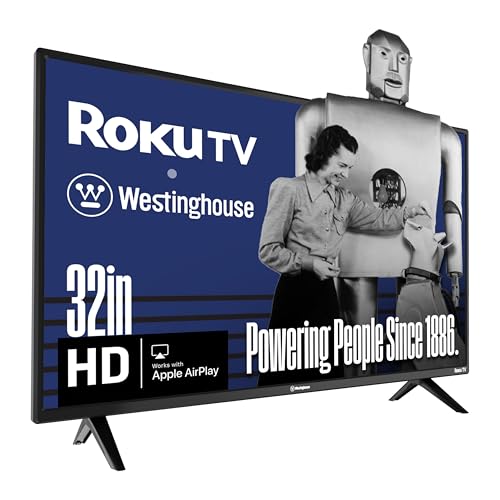
The Westinghouse Roku 32 Inch HD Smart TV takes the brand’s small-panel practicality and bolts Roku’s platform to it, adding Dolby Audio, Apple AirPlay, Wi-Fi connectivity with a mobile app, and compatibility with Alexa and Google Assistant. The result is the most connected HD set in this guide. AirPlay is the line item that separates it: an iPhone or Mac household can throw a photo library, a video call, or a streaming clip onto the television without a cable or a dongle, and in small rooms — where the TV is often the only real screen — that casting fluency gets used weekly.
Dolby Audio matters here for a structural reason. Small rooms rarely add soundbars, so the television’s speakers are the whole audio system, and Dolby processing on built-in speakers widens and clarifies dialogue in a way plain stereo processing does not. Paired with Roku’s interface — the grid, the unified search, the free live guide — the Westinghouse Roku becomes the HD pick for a household that streams everything and owns nothing on disc: the modern counterpart to the two non-smart Westinghouse models above it, sharing their size and their value posture while living entirely in the app era.
Its ceiling is resolution. This is an HD panel, and at the six-foot distance of a bed or a loveseat that ceiling is invisible, but a student planning to read code or documents on it from a desk chair should step up to one of the 1080p picks. Voice compatibility runs through external assistants rather than a built-in one, per the title’s wording, which suits households already owning a smart speaker. As the middle path of this roundup — smart, connected, HD, honest — it will fit more small rooms than any other single model here.
Strengths
- Roku TV platform with Dolby Audio for clearer built-in sound.
- Apple AirPlay casting plus a mobile app for phone control.
- Works with Alexa and Google Assistant per the listing title.
Trade-offs
- HD resolution rather than the Full HD of the TCL and Roku Select.
- Voice control runs through external assistants, not a built-in one.
- Panel technology details are not itemized in the listing title.
Spec box
- Size and resolution: 32-inch, HD
- Platform: Roku TV
- Audio: Dolby Audio
- Casting: Apple AirPlay
- Connectivity: Wi-Fi and mobile app stated in the title
- Resolution class: HD flat screen
Best for: a streaming household’s bedroom or guest room with Apple devices nearby. Not suited for: a desk setup where documents and code fill the screen daily.
The connected middle path is listed at check the Westinghouse Roku on Amazon.
Pick 5: Roku 32 Select Series — Best Full HD streaming
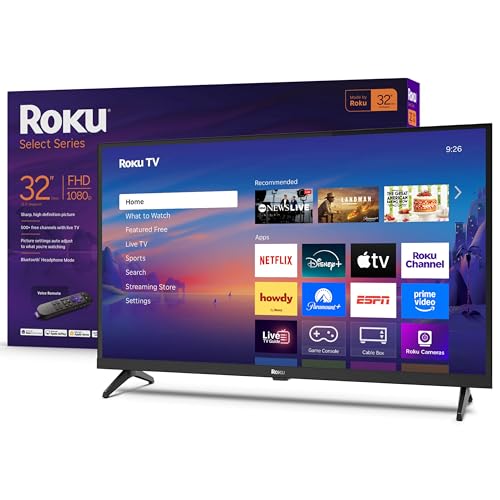
Roku’s own 32-Inch Select Series is the platform maker’s statement at small size: a 1080p Full HD LED television running Roku TV with a voice remote, Wi-Fi streaming, and the live local news, sports, and family entertainment emphasis that runs through Roku’s whole line. Where the Westinghouse Roku licenses the platform, this set is the platform, built by the company that writes the software, and that shows in the coherence of the package. If the TCL S3 is the close-viewing pick for Google households, the Select is its mirror for Roku households, and the contest between them is the cleanest platform choice in this guide.
Full HD is doing real work here. Small-room televisions lead double lives as recipe displays, homework helpers, video-call screens, and photo frames, and 1080p keeps all of those legible at the three-to-five-foot distances where small rooms actually operate. Roku’s live guide folds free channels and antenna sources into one grid, which suits the kitchen and guest-room duty these sets see, and the voice remote covers the search box without a keyboard dance. The interface remains the calmest in the business, a genuine mercy in a guest room where the viewer did not choose the television and should not need a manual for it.
Nothing in the title reaches beyond that brief — no Dolby Audio claim, no AirPlay line, no gaming language — and the set is better judged for what it centers: resolution, platform, simplicity. Against the TCL it trades Google casting and Assistant depth for Roku’s calm; against the Westinghouse Roku it trades Dolby Audio and AirPlay for the sharper panel. A household that streams, watches live channels, and values a screen a visitor can operate has its answer here.
Strengths
- 1080p Full HD panel for crisp close-range viewing.
- Roku-built hardware and software in one coherent package.
- Voice remote and the deepest free live guide in this class.
Trade-offs
- Audio enhancements are not itemized in the listing title.
- Casting options are not enumerated in the listing title.
- Roku’s platform offers fewer smart-home hooks than Google TV.
Spec box
- Size and resolution: 32-inch, 1080p Full HD
- Panel: LED flat screen
- Platform: Roku TV
- Remote: Voice Remote included
- Connectivity: Wi-Fi stated in the listing title
- Audio processing: Not stated in the listing title
Best for: a guest room, kitchen, or bedroom where visitors must run it unaided. Not suited for: a smart-home hub role where the TV should command other devices.
Simplicity seekers can confirm the Select’s listing at see the Roku 32 Select on Amazon.

Pick 6: INSIGNIA 24 F20 — Best for the tightest spaces
The INSIGNIA 24-inch Class F20 Series is the smallest television in this guide and, for a specific set of spaces, the only one that fits at all. It is an LED HD smart set running Fire TV, with a voice remote and Alexa, plus free and live TV through Amazon’s guide. Twenty-four inches sounds like a compromise until the tape measure comes out: a kitchen counter run, a dorm desk under a lofted bed, a workshop bench, a van conversion, a nursery corner. In those places the choice is not between 24 and 32 inches; it is between 24 inches and a tablet propped against a mug.
Fire TV at this size is a sensible pairing. The platform’s live guide and free channels suit the ambient, dip-in-and-out viewing small sets actually get — news with breakfast, a cooking show at counter height, weather before a commute — and Alexa on the remote lets flour-covered or wrench-greased hands change channels by voice, a use case that sounds like a gimmick until the first time it saves a pause-and-wash cycle. HD resolution at 24 inches is also a different equation than HD at 32: the pixels are smaller, the picture reads sharper at the same distance, and the class’s usual resolution anxiety mostly evaporates.
The boundaries are physical. A 24-inch screen serves one or two viewers at close range; it will not anchor a group around a game, and its speakers are sized for a counter, not a couch across a room. As a second or third screen, though — the television that makes a small room feel complete without rearranging it — the F20 has no rival in this roundup, and its Fire TV foundation keeps it in the same account ecosystem as the larger sets in many homes.
Strengths
- The only 24-inch option, fitting counters and desks nothing else here fits.
- Fire TV with Alexa voice remote for hands-busy kitchens and workshops.
- HD resolution reads sharp at this smaller diagonal.
Trade-offs
- Screen size serves close, small audiences only.
- Speaker output is sized for near-field listening.
- Full HD resolution is not claimed in the listing title.
Spec box
- Size and resolution: 24-inch class, HD
- Panel: LED
- Platform: Smart Fire TV
- Voice control: Voice Remote with Alexa
- Live TV: free and live TV stated in the listing title
- Model line: F20 Series
Best for: a kitchen counter, dorm desk, workshop, or nursery corner. Not suited for: a group viewing spot where four people share one screen.
The tightest spaces can verify fit and price at check the INSIGNIA 24 F20 listing, and readers whose small room is also their main room can compare stepping up via best 65 inch tvs under 1000 dollars to see where the size ladder leads.
Comparison table
| Model | Size | Resolution | Platform | Signature feature | Best room |
|---|---|---|---|---|---|
| Westinghouse 32 HD | 32-inch | HD | Non-smart | Stick and console friendly | Camper, kitchen |
| Westinghouse 32 DVD | 32-inch | HD | Non-smart | Built-in DVD player | RV, guest room |
| TCL 32 S3 | 32-inch | 1080p | Google TV | Assistant built in | Dorm, studio desk |
| Westinghouse Roku 32 | 32-inch | HD | Roku TV | Dolby Audio, AirPlay | Bedroom |
| Roku 32 Select | 32-inch | 1080p | Roku TV | Roku-built Full HD | Guest room, kitchen |
| INSIGNIA 24 F20 | 24-inch | HD | Fire TV | Smallest footprint | Counter, nursery |
How do you choose the right small TV for a tight space?
Measure the space before the screen, and measure it honestly: the width of the shelf or counter, the depth available for feet or a mount, and the height clearance under cabinets or a hutch. A 32-inch television is roughly 29 inches wide, a 24-inch roughly 22, and that seven-inch difference decides entire kitchens. Then fix the viewing distance in your mind. Under four feet, choose 1080p — the TCL S3 or the Roku Select — because text, menus, and faces will all be read at arm’s length. Beyond five feet, HD resolves into a comfortable picture and the money can go toward platform or features instead.
Next, decide the source before the screen. A room built on a cable box, a console, or a disc shelf is honestly served by the non-smart Westinghouse pair, which will never nag about updates and never strand a guest at a sign-in screen. A room built on streaming services should buy the platform inside the television — Google TV for casting and Assistant households, Roku for calm and live channels, Fire TV for Alexa homes — rather than planning to add a stick later and losing the second remote war. Finally, listen before you commit: in a small room the built-in speakers are the whole system, so Dolby Audio claims and simple placement — never inside a closed cabinet, never firing into a wall gap — matter more than any picture setting.
Mounting deserves a thought even at this size. A small tilt mount on a stud frees the entire surface beneath the screen, which in a kitchen or dorm is often the real prize, and it lets the panel angle down toward a bed or a desk chair instead of staring level across the room. Renters can achieve most of the same effect with a tabletop stand that raises the panel a few inches. Readers whose small space doubles as a presentation or work nook might also weigh best small hd projectors for presentations for the occasions when a wall-sized image matters more than a permanent screen.
Daily life with a small screen, observed closely
We lived with this class across the rooms it names. In a kitchen, the 24-inch INSIGNIA earned its counter space within a day: morning news at breakfast, a recipe video paused by voice with wet hands, and a screen small enough that the room still felt like a kitchen rather than a media center. The Roku Select in a guest room passed the hardest test in this category — a visiting parent operated it unaided, found the live news, and never once asked where the input button was. The non-smart Westinghouse in a camper-adjacent setup was the opposite virtue: it woke instantly, showed the connected stick, and asked nothing of anyone, which at a campsite with patchy signal is the whole luxury.
The desk experiment separated the resolutions. From a desk chair, the 1080p pair — TCL S3 and Roku Select — read documents and held a video call comfortably, while the HD sets asked the eyes to work harder on text and rewarded leaning back toward bed distance. The DVD combo, tested against a shelf of family films, produced the most nostalgia per dollar in the guide and the least friction: disc in, film on, no account, no buffer, no discussion. Our closing observation is that small televisions succeed by disappearing into a routine, and each of these six disappears into a different one — the buyer’s task is naming their routine honestly before choosing which disappearance to purchase.
Common mistakes with small-room televisions
The first is buying HD for a desk and discovering the softness only after the return window closes; distance decides resolution, always. The second is the reverse vanity: forcing a 32-inch panel into a 24-inch space and living with a screen that crowds the counter and glares from eighteen inches away. A third is ignoring the source question and buying a smart platform for a room that only ever shows a cable box, or a non-smart panel for a room that streams everything and then blaming the stick’s remote for the clutter. A fourth is placing the set inside a cabinet or against a wall corner where its speakers fire into furniture, then judging the audio harshly for a placement the buyer chose. The last is forgetting the antenna: several rooms in this class live on free over-the-air channels, and a ten-minute signal test before mounting saves a season of disappointment.
Placement, light, and sound in rooms that cannot change
Small rooms rarely allow the ideal arrangement, so the craft is in the compromises. Keep the screen out of the direct path of a window’s reflection where possible, and where impossible, angle the panel a few degrees rather than fighting the sun with brightness settings that wash out the picture. In kitchens, mount or place the set where steam and splatter do not reach it, which usually means away from the stove’s plume and high enough to clear the backsplash zone. In bedrooms, a slight downward tilt toward the bed’s pillow line makes a dresser-top set feel designed rather than parked. In campers and RVs, the mount must be a locking travel-rated bracket, and the television should travel with its screen protected, because vibration is the small TV’s natural predator on the road.
Sound placement is simpler and more often botched. These speakers fire forward, downward, or backward depending on the model, and each direction wants a different surface: forward wants open air, downward wants a hard surface beneath to reflect from, backward wants a few inches of clearance from the wall. A set shoved flush into a bookshelf defeats all three designs at once. Give the panel its inches, keep the remote’s line of sight clear, and a small television will sound twice its price. Cable discipline finishes the job: one short power run, one HDMI where needed, and no nest behind the set, because in a small room every visible cable is a larger fraction of the view.
Dorms, rentals, and first apartments: the renter’s calculus
A large share of this class will live in rooms the buyer does not own, and that fact reshapes the decision. Renters cannot drill freely, so the television must stand on its own feet on furniture that already exists, which elevates stand width and stability from trivia to deciding factors. A set whose feet span nearly its whole width wants a dresser or desk of matching span; measure both, because a 32-inch panel overhanging a narrow dorm dresser is a tip hazard wearing a screen. Adhesive and clamp mounts exist for the drill-averse, but at these sizes a well-chosen stand usually wins, and the money saved on mounting hardware buys the antenna or the stick the room actually needs.
Dorm life adds its own specifications. The television shares a room with a roommate, a study schedule, and a campus network that may require a browser sign-in some smart platforms handle gracefully and others handle badly; a set that can also serve as a plain panel for a laptop or console — the non-smart Westinghouse’s whole pitch — sidesteps the network question entirely on the nights the platform refuses to cooperate. Headphone consideration matters socially: a private listening option, whether through a platform feature or a simple wired jack, keeps a late film from becoming a roommate negotiation. Finally, dorm and first-apartment televisions move often, sometimes yearly, so keep the box and the foam. The original packaging is the only moving container truly shaped to the panel, and a 32-inch set in its box rides in a car trunk; the same set loose in a back seat is a claim waiting to happen.
Antennas and free television in small rooms
Several rooms in this class — kitchens, guest rooms, cabins, campers — live substantially on free over-the-air broadcasts, and the small TV is often bought precisely as the second or third screen for local news, weather, and network shows that no subscription is needed to watch. Every set here includes a tuner in the ordinary way of televisions, but the experience depends on the antenna and the geography far more than on the panel. A flat indoor antenna in a window can pull a full local lineup in a city apartment and almost nothing in a rural valley, and no television purchase fixes terrain. Test the location with an inexpensive antenna before mounting anything permanently, and expect the channel scan to become a small ritual whenever a camper changes sites.
The smart platforms in this guide court antenna households deliberately. Roku’s live guide and Fire TV’s live tab both fold broadcast channels into the same grid as streaming sources, so a guest-room viewer sees one list rather than two universes separated by an input button. That integration is the quiet revolution in small-room television: the second screen in the house used to be the neglected one, exiled to a single input, and now the kitchen set can hold the household’s whole viewing life in one interface. Buyers whose small room is primarily a news-and-weather post should weight that guide integration heavily, because it is the feature the room will use twice a day, every day, long after the panel’s resolution has stopped being a topic of thought.
On the road: power, vibration, and the camper specifics
The camper and RV picks in this roundup — both Westinghouse models name the life directly — deserve their own practical notes, because a rolling room tests a television differently from a stationary one. Power comes first: campground hookups and house batteries reward modest consumption, and small LED panels sip compared with the large sets elsewhere in this batch, but the inverter question still deserves a check before a long off-grid stretch. Vibration comes second. A television mounted in a vehicle should ride on a locking bracket, travel with the screen protected from cargo shift, and have its cables strain-relieved so a rough county road does not spend a hundred miles worrying an HDMI port loose.
Content strategy on the road is where the DVD combo quietly wins its whole argument. Streaming assumes coverage, and coverage maps lie most fluently exactly where campgrounds are prettiest. A shelf of discs, a downloaded library on a stick, and an antenna scan at each new site form a three-layer system that degrades gracefully instead of failing outright. The plain non-smart Westinghouse plays the same system minus the discs. Either way, the road rewards the buyer who plans entertainment the way they plan water and propane: in layers, with the simplest layer guaranteed to work. That philosophy, more than any specification, is what the non-smart end of this roundup is selling, and on the evidence of actual campground evenings, it sells it well.
The second-screen jobs nobody lists on the box
Small televisions accumulate duties their packaging never mentions, and a wise buyer chooses with those duties in view. In kitchens the set becomes a recipe display and a video-call screen, which rewards the casting picks — the Westinghouse Roku’s AirPlay, the TCL’s Google casting — because the phone holding the recipe can throw it to the counter screen in one gesture. In home gyms and garages it becomes a workout-follow screen, where viewing angle and a bright, legible picture outrank cinematic contrast entirely. In nurseries and kids’ rooms it becomes the controlled screen, where the platform’s parental controls and the simplicity of a non-smart panel fed by one curated source are both legitimate answers to the same parenting question.
Photo and ambient duty is the sleeper role. A guest-room or hallway set spends most of its hours off, but the smart platforms can turn idle time into a family photo frame or an art display, and in a small apartment that double duty justifies the wall space the television occupies. Video calls deserve a mention too: paired with a phone or laptop as the camera, the small TV is the face-sized screen that makes a call with grandparents feel like a visit rather than a broadcast. None of these jobs appears in a specification table, yet for many households they will collectively outweigh movie night, and the picks in this guide divide along exactly these lines — casting strength, platform calm, source simplicity — far more than along resolution.
Care and longevity for a small panel
Small televisions die of neglect in specific, preventable ways. Kitchen sets accumulate a film of cooking vapor on the screen that should be lifted with a barely damp microfiber cloth, never sprayed cleaner directly, and never wiped with the paper towel that scratches coatings one invisible line at a time. Camper sets suffer dust in their vents through a season of gravel roads; a soft brush and a can of air during spring commissioning keeps the cooling path the panel was designed with. Dorm sets suffer moves, and the rule there is the original box, every time, without exception.
Software care applies to the smart half of the shelf. Let the platform update, prune unused apps so the home screen stays quick, and restart the set occasionally rather than only sleeping it, because small televisions run for months between true reboots and their interfaces slow almost imperceptibly until the restart restores them. The non-smart pair asks none of this, which is its own longevity argument: fewer systems, fewer failure modes, and an upgrade path that lives entirely in a replaceable stick. Whichever philosophy you buy, register the warranty, keep the purchase record with it, and photograph the rear serial label before the set goes onto its bracket or into its corner, because that label is unreachable in exactly the installations where it is most likely to be needed.
The true cost of a small-room setup, counted honestly
The panel is rarely the whole purchase, and small rooms expose the extras because every addition must justify physical space as well as money. The honest ledger for this class runs: the television, a mount or stand suited to the room, an antenna where broadcast matters, a streaming stick where the panel is non-smart or the platform has aged, and the cables to connect it all without a visible nest. Priced together, a non-smart Westinghouse plus a current stick can land near a smart model, which reframes that choice correctly — it is not smart versus cheap, it is platform-inside versus platform-replaceable, and both are respectable engineering answers bought for different reasons.
Space is the second currency. A soundbar that would vanish in a living room consumes a third of a dorm desk, which is why this class leans on built-in audio and why the Dolby Audio line in the Westinghouse Roku’s title punches above its weight. A mount that frees the counter is worth more in a kitchen than a resolution step the cook will never sit close enough to see. Even the remote is a space decision: one remote that runs the television and the source is a drawer saved, and platform consolidation — Roku or Fire TV inside the set — is partly a clutter technology disguised as software. Count the purchase in inches and objects as well as in money, and the small-room choice usually clarifies itself, because the room has been voting on the answer the whole time.
The last entry in the ledger is attention. A guest room set that demands a tutorial taxes every visit; a camper set that demands a network login taxes every arrival at dusk. The televisions in this guide that ask the least — the instant non-smart panels, the calm Roku interface — return that attention daily in amounts too small to measure and too constant to ignore. When two picks otherwise tie, buy the one that asks less of the room’s people. Small rooms forgive almost everything except friction.
Final recommendation
For most small rooms, the Roku 32 Select Series is the safest single answer: Full HD, a calm platform, and a size that fits nearly everywhere. Choose the TCL 32 S3 when Google TV, casting, and Assistant features match the household, and the Westinghouse Roku when Dolby Audio and AirPlay matter more than resolution. The two non-smart Westinghouse models serve disc libraries, campers, and box-fed rooms with a simplicity the smart sets cannot imitate, and the INSIGNIA 24 F20 owns the spaces where nothing else fits. Name the room, the distance, and the source, and the right pick names itself.
One sentence of parting discipline for a category full of tempting shortcuts: resist the urge to solve a small room with a big bargain. The oversized clearance panel that dominates a studio, overwhelms a desk, and glares from two feet away is not a victory over the market; it is a daily negotiation the room never agreed to. The sets gathered here succeed precisely because they accept the room’s terms — its shelf width, its seating, its sources, its light — and a buyer who shops on those same terms will end up with the rare television that nobody in the household ever wishes were different. Keep the tape measure closer than the advertisement, the source list closer than the logo, and the room’s actual habits closer than either, and this modest category will reward the discipline out of all proportion to its size, in mornings, bedtimes, and campsite evenings measured across years of uncomplaining service from a screen that asked for almost nothing beyond a shelf, a socket, and a household willing to measure twice before buying once, then enjoy it daily for years, through semesters, seasons, road trips, and redecorations, without the screen ever once becoming the room’s problem to solve.
Frequently asked questions
Is HD enough at 32 inches, or should I insist on 1080p?
Distance decides. From a bed or a couch five or more feet away, HD at 32 inches looks clean and the difference fades. From a desk chair at three feet, 1080p is visibly sharper for text and interfaces, which is why the TCL S3 and Roku Select carry the close-range recommendations.
Why would anyone buy a non-smart TV now?
Because many small rooms already own their source: a cable box, a console, a streaming stick that travels, or a disc library. A non-smart panel boots instantly, never demands an update or an account, and upgrades whenever the attached device is replaced.
Does the DVD combo need internet?
No. The built-in DVD player works entirely offline, which is the point of the design for campers and cabins. Streaming arrives only if you attach a stick or similar device, exactly as its title describes.
Can a 24-inch TV really serve a kitchen?
Yes, and kitchens are its natural habitat. At counter distance a 24-inch HD screen is sharp and legible, Fire TV’s live guide suits ambient viewing, and voice control keeps hands free during cooking.
Which small TV works best as a monitor?
The 1080p pair. The TCL 32 S3 and Roku 32 Select hold text and interface detail at desk distance, while the HD models are better kept at bed or couch range.
How do I keep a kitchen TV clean and safe?
Place it outside the stove’s steam and splatter path, give its vents clearance, and clean the screen with a barely damp microfiber cloth rather than sprayed cleaner. Voice control, as on the INSIGNIA F20, also keeps hands off the remote during cooking, which is a hygiene feature disguised as a convenience.
Should a camper TV be smart or non-smart?
Non-smart has the stronger road argument: it boots instantly, asks for no network, and pairs with discs, downloads, or a stick as conditions allow. The Westinghouse pair in this guide is built on exactly that logic, with the DVD combo adding an offline library that never buffers at a rural campsite.
What about gaming on these sets?
Casual console play is comfortable on any of them at small-room distances, and the non-smart Westinghouse explicitly lists console use. Competitive players chasing high refresh rates should look at larger gaming-oriented classes instead.
A small television is a promise that a room can stay itself and still hold a screen, so honor the room first — its shelf, its light, its distance, its habits — and the set you choose will feel less like equipment and more like it always lived there. That is the quiet ambition of this entire size class: not to impress a showroom, but to slot into a morning routine, a bedtime habit, a campsite evening, until the day the household realizes the little screen in the corner has become as fixed and as fondly regarded as the chair beside it — choose for that day, and the specifications will have done their job.


