Our Top Picks
 SanDisk 128GB Ultra SDXC UHS-I Memory Card128GB (1-Pack)1.26 x 0.94 x 0.1 inches0 poundsCheck on Amazon


What's inside
- SD cards for Pentax DSLRs: full-size cards, matched to real bodies
- Why the card matters as much as the camera
- Understanding bus speed: UHS-I and what it means for Pentax bodies
- The shortlist in detail
- SanDisk 128GB Extreme PRO UHS-I — the strongest all-round Pentax pick here
- SanDisk 128GB Ultra UHS-I — the simple, familiar everyday card
- SanDisk 64GB Extreme PRO UHS-I — Extreme PRO performance in a mid-size card
- MMOMENT 64GB SDXC MM13 — a full-size card that states both figures plainly
- SanDisk 32GB Extreme PRO UHS-I — a small SDHC card with grown-up classes
- GIGASTONE 256GB Camera Pro — the largest capacity in this Pentax shortlist
- Transcend 32GB SDC300S — a modest, widely compatible 32GB option
- INDMEM 8GB SLC SDHC — a small legacy card for older equipment, honestly framed
- Speed classes, video classes, and what the markings guarantee
- How to choose capacity without overbuying or running short
- Care, formatting, and backup habits that protect your images
- Who should buy which kind of card
- Final thoughts
- Check prices on Amazon
- Disclosure
As an Amazon Associate I earn from qualifying purchases. This post may contain affiliate links at no extra cost to you.
SD cards for Pentax DSLRs: full-size cards, matched to real bodies
Pentax DSLRs use full-size SD cards, and that single fact simplifies shopping more than most buyers expect. There is no adapter question, no miniature format to lose in a bag, and no second card format hiding in a second slot to budget for. What remains is the real decision: which bus your body supports, which speed and video classes your shooting needs, and how much capacity fits the way you work. This guide answers those three questions around eight full-size UHS-I cards, from a small legacy card for older bodies to a 256GB card for long trips.
A word about bodies, stated carefully. The Pentax DSLR range covers many years of production. Many bodies work on the UHS-I interface, and some higher-tier bodies offer a faster slot, but this guide does not attach specifications to individual models that it has not cited. Your body’s manual is the authority on its own slot. What can be said generally, and is said throughout this guide, is that every card listed here is a UHS-I card, and a UHS-I card works in a UHS-I slot at full intended behaviour, which covers the great majority of Pentax DSLR owners.
Method matters here for the same reason it matters in any honest buying guide. Every speed, class and capacity figure in the product sections comes from the published product title for that card. Industry background — what UHS-I means, what a video class is for, how SDHC differs from SDXC — is explained in general terms that apply across the SD standard. Nothing has been borrowed from a different card, a different capacity in the same family, or a review of a product that is not on this list.
The shortlist is deliberately uneven in capacity, because Pentax owners are uneven in their needs. A landscape photographer on a current body, a parent using a decade-old body that still works beautifully, and a traveller shooting video as well as stills do not need the same card, and pretending otherwise would make this guide shorter but worse. Read the sections for the roles that resemble your own shooting, and let the background sections explain the markings you will meet on every packet.
Why the card matters as much as the camera
A memory card looks like a simple accessory, but for a Pentax DSLR it is part of the image pipeline. Every frame the sensor captures has to be written somewhere, quickly and reliably, before the next frame can clear the buffer. When the card cannot keep up, bursts slow down, video can stop, and offloading a full card at the end of a day takes far longer than it should. Choosing well is therefore not about chasing the largest number printed on a label. It is about matching the bus, the speed class, and the capacity to the way the body actually writes data.
Our research for this guide started with the product titles published by the manufacturers and sellers, because those titles state the bus, the class ratings, and the headline read and write figures in a consistent way. Where a title does not state a figure, this guide does not invent one. That restraint matters. A card can be excellent for stills and ordinary for long video takes, or fast to read on a computer and only moderate to write in camera, and those differences only become clear when the published figures are read carefully and in context.
There is also a reliability side that rarely appears in marketing copy. Cards are handled, swapped in cold weather, carried in pockets, and written and erased thousands of times. Good habits help any card last longer: format in the camera you will use, avoid filling a card completely during an important shoot, keep a spare in a case rather than loose in a bag, and copy files to two places before you format and reuse the card. No brand name removes the need for those habits.
Understanding bus speed: UHS-I and what it means for Pentax bodies
The letters and numbers on an SD card describe two different things that are easy to confuse. The bus describes the electrical interface between card and host. UHS-I is the long-established single-row interface found in most cameras and readers, and every card in this shortlist is a UHS-I card. UHS-II adds a second row of contacts and can move data much faster, but only when both the card and the device support that second row. A UHS-II card used in a UHS-I slot still works, simply at UHS-I behaviour.
For most Pentax DSLR owners, that means UHS-I is not a limitation to apologise for; it is the interface the body was designed around, and a good UHS-I card exploits it fully. Spending more on a faster bus only makes sense when a body or a reader in your chain can actually use it. The smarter Pentax upgrade path is usually a better UHS-I card, a second card for rotation, or a faster reader for the computer, in whichever order your own bottleneck suggests.
Read speed and write speed also need to be separated. Read speed governs how quickly files leave the card, most visibly during offload and review. Write speed governs how quickly the camera can push new data onto the card, which affects burst depth and video stability. Product titles in this guide state both figures for many cards, and the honest way to compare them is like for like: write against write, read against read, and never assume a high read figure implies an equally high write figure.
The shortlist in detail
Each card below has its own section, written around the figures and markings in its published product title. Read the sections for the roles that match your shooting, and use the background sections around them to interpret the numbers rather than simply ranking cards by the largest figure on the front of the pack.
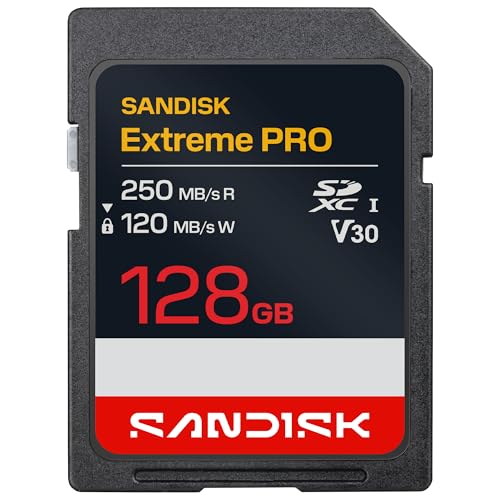
SanDisk 128GB Extreme PRO UHS-I — the strongest all-round Pentax pick here
This SanDisk Extreme PRO card offers 128GB of capacity on the UHS-I bus. For a Pentax DSLR, the appeal starts with fit and role: it is the card in this list for Pentax owners who want one full-size card that covers stills, bursts and 4K video without qualification. The published title is the source for every figure in this section, so the discussion stays grounded in what the maker actually claims for this exact card rather than in assumptions borrowed from a different capacity or a different product line.
On speed, the title states up to 250MB/s read speeds and up to 120MB/s write speeds. Read those figures the right way round. The read figure shapes how the card feels after the shoot, when folders are copying and thumbnails are rendering. The write figure, where stated, shapes how the card feels during the shoot, when bursts need somewhere to go and video needs a steady destination. A card whose two figures are balanced suits mixed work; a card tilted toward reading suits photographers whose bottleneck is the evening offload rather than the moment of capture.
The class markings in the title, V30, U3 and C10, with 4K UHD and Full HD named in the title, tell you about sustained behaviour rather than momentary peaks. That distinction is easy to overlook and important in practice, because a long video clip or a long burst is a sustained event. When you compare this card with the others in this guide, compare class with class first and headline speed second, and you will reach a more honest ranking for the kind of shooting you actually do.
Because every card in this guide is UHS-I, this one competes on its published figures and classes rather than on a faster bus, and on those terms it leads the list. The stated write figure is the one burst shooters should notice first, while the V30 class gives video shooters a clear sustained-writing reference. At 128GB it also sits at the capacity most Pentax owners will find easiest to live with: large enough for a serious day, small enough to encourage a proper nightly offload.
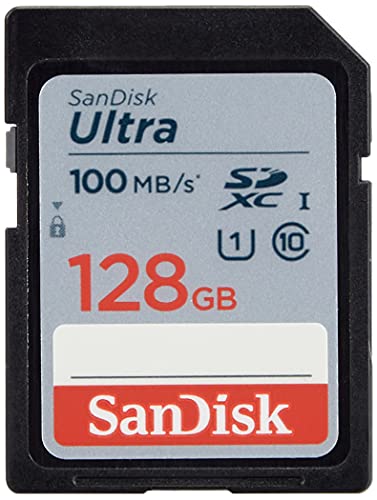
SanDisk 128GB Ultra UHS-I — the simple, familiar everyday card
This SanDisk Ultra card is a 128GB SDXC model from SanDisk’s long-running Ultra line. For a Pentax DSLR, the appeal starts with fit and role: it suits Pentax owners whose work is stills-led, with Full HD video rather than 4K as the moving-image requirement. The published title is the source for every figure in this section, so the discussion stays grounded in what the maker actually claims for this exact card rather than in assumptions borrowed from a different capacity or a different product line.
On speed, the title states 100MB/s, as stated in the title; the title presents this as the card’s speed figure without separating a write figure, so none is claimed here. Read those figures the right way round. The read figure shapes how the card feels after the shoot, when folders are copying and thumbnails are rendering. The write figure, where stated, shapes how the card feels during the shoot, when bursts need somewhere to go and video needs a steady destination. A card whose two figures are balanced suits mixed work; a card tilted toward reading suits photographers whose bottleneck is the evening offload rather than the moment of capture.
The class markings in the title, C10 and U1, with Full HD named in the title, tell you about sustained behaviour rather than momentary peaks. That distinction is easy to overlook and important in practice, because a long video clip or a long burst is a sustained event. When you compare this card with the others in this guide, compare class with class first and headline speed second, and you will reach a more honest ranking for the kind of shooting you actually do.
The honest way to place this card is by its classes. U1 and C10 describe a card intended for dependable everyday recording rather than for the most demanding bursts or 4K workflows, and many Pentax photographers genuinely work at exactly that level: family events, travel, landscapes, and portraits in single frames or short sequences. For that reader, this card’s simplicity is the point. Readers comparing 128GB options across this site may also find our dedicated overview best 128 gb sd cards a useful companion to this section.
SanDisk 64GB Extreme PRO UHS-I — Extreme PRO performance in a mid-size card
This SanDisk Extreme PRO card brings the family’s stronger classes to a 64GB capacity. For a Pentax DSLR, the appeal starts with fit and role: it fits Pentax owners who want V30 video capability and U3 performance but prefer a smaller card that gets offloaded and rotated more often. The published title is the source for every figure in this section, so the discussion stays grounded in what the maker actually claims for this exact card rather than in assumptions borrowed from a different capacity or a different product line.
On speed, the title states up to 200MB/s read speeds and up to 90MB/s write speeds. Read those figures the right way round. The read figure shapes how the card feels after the shoot, when folders are copying and thumbnails are rendering. The write figure, where stated, shapes how the card feels during the shoot, when bursts need somewhere to go and video needs a steady destination. A card whose two figures are balanced suits mixed work; a card tilted toward reading suits photographers whose bottleneck is the evening offload rather than the moment of capture.
The class markings in the title, V30, U3 and C10, with 4K UHD named in the title, tell you about sustained behaviour rather than momentary peaks. That distinction is easy to overlook and important in practice, because a long video clip or a long burst is a sustained event. When you compare this card with the others in this guide, compare class with class first and headline speed second, and you will reach a more honest ranking for the kind of shooting you actually do.
Mid-size cards have a quiet advantage: they enforce good habits. A 64GB card fills sooner, gets copied sooner, and carries less of a day with it if anything goes wrong. Paired as a two-card rotation, cards of this size suit event and travel photographers who copy at lunch and again in the evening. The published figures here are strong for the capacity, so the smaller size is a workflow choice rather than a performance compromise.
MMOMENT 64GB SDXC MM13 — a full-size card that states both figures plainly
This MMOMENT card is a 64GB full-size SDXC card in the maker’s MM13 line, and the title is explicit that it is a full-size SD card, not a microSD card. For a Pentax DSLR, the appeal starts with fit and role: it is aimed at DSLR, mirrorless and camcorder users, which makes a Pentax DSLR exactly the kind of host the maker describes. The published title is the source for every figure in this section, so the discussion stays grounded in what the maker actually claims for this exact card rather than in assumptions borrowed from a different capacity or a different product line.
On speed, the title states up to 90MB/s read and 50MB/s write, with 4K UHD named in the title. Read those figures the right way round. The read figure shapes how the card feels after the shoot, when folders are copying and thumbnails are rendering. The write figure, where stated, shapes how the card feels during the shoot, when bursts need somewhere to go and video needs a steady destination. A card whose two figures are balanced suits mixed work; a card tilted toward reading suits photographers whose bottleneck is the evening offload rather than the moment of capture.
The class markings in the title, UHS-I, U3 and V30, tell you about sustained behaviour rather than momentary peaks. That distinction is easy to overlook and important in practice, because a long video clip or a long burst is a sustained event. When you compare this card with the others in this guide, compare class with class first and headline speed second, and you will reach a more honest ranking for the kind of shooting you actually do.
There is something refreshing about a title that states a modest read figure and a separate, lower write figure without decoration. It lets a buyer judge the card for sustained work with clear eyes. The U3 and V30 markings carry the video argument, while the stated write figure sets realistic expectations for bursts. For a Pentax owner building an affordable rotation of several cards rather than relying on one, that transparency is genuinely useful.
SanDisk 32GB Extreme PRO UHS-I — a small SDHC card with grown-up classes
This SanDisk Extreme PRO card is a 32GB SDHC model, the larger of the two 32GB cards in this guide. For a Pentax DSLR, the appeal starts with fit and role: it suits Pentax owners who shoot shorter sessions, teach with the camera, or want a high-class spare that lives permanently in the bag. The published title is the source for every figure in this section, so the discussion stays grounded in what the maker actually claims for this exact card rather than in assumptions borrowed from a different capacity or a different product line.
On speed, the title states up to 100MB/s read speeds and up to 90MB/s write speeds, with compatibility with cameras and camcorders stated in the title. Read those figures the right way round. The read figure shapes how the card feels after the shoot, when folders are copying and thumbnails are rendering. The write figure, where stated, shapes how the card feels during the shoot, when bursts need somewhere to go and video needs a steady destination. A card whose two figures are balanced suits mixed work; a card tilted toward reading suits photographers whose bottleneck is the evening offload rather than the moment of capture.
The class markings in the title, V30, U3 and C10, with 4K UHD named in the title, tell you about sustained behaviour rather than momentary peaks. That distinction is easy to overlook and important in practice, because a long video clip or a long burst is a sustained event. When you compare this card with the others in this guide, compare class with class first and headline speed second, and you will reach a more honest ranking for the kind of shooting you actually do.
Capacity is this card’s defining trade. At 32GB it will not carry a long raw-heavy day, and it is not presented as though it could. What it offers instead is the Extreme PRO class set — V30 and U3 — in a size that suits workshops, second bodies, and deliberate short sessions. As a spare, it is the kind of card that saves a day when the main card is left in the reader at home, which happens to every photographer eventually.
GIGASTONE 256GB Camera Pro — the largest capacity in this Pentax shortlist
This Gigastone card is a 256GB SDXC model in the maker’s Camera Pro line, supplied with one mini case and a stated five-year free data recovery offer in the title. For a Pentax DSLR, the appeal starts with fit and role: it is the long-session option here, for Pentax owners who shoot travel, events or video over days where swapping and offloading are not always practical. The published title is the source for every figure in this section, so the discussion stays grounded in what the maker actually claims for this exact card rather than in assumptions borrowed from a different capacity or a different product line.
On speed, the title states up to 170MB/s, as stated in the title for its 4K UHD video speed figure. Read those figures the right way round. The read figure shapes how the card feels after the shoot, when folders are copying and thumbnails are rendering. The write figure, where stated, shapes how the card feels during the shoot, when bursts need somewhere to go and video needs a steady destination. A card whose two figures are balanced suits mixed work; a card tilted toward reading suits photographers whose bottleneck is the evening offload rather than the moment of capture.
The class markings in the title, UHS-I, A1 and V30, with 4K Camera Pro and 4K UHD named in the title and compatibility with digital cameras stated by the maker, tell you about sustained behaviour rather than momentary peaks. That distinction is easy to overlook and important in practice, because a long video clip or a long burst is a sustained event. When you compare this card with the others in this guide, compare class with class first and headline speed second, and you will reach a more honest ranking for the kind of shooting you actually do.
Two details in the title deserve attention beyond speed. The included mini case is a small thing that encourages the storage habits the background sections of this guide keep recommending, and the data recovery offer named in the title will matter to some buyers, though its terms should be checked on the product page rather than assumed. Readers who find even this capacity tight for very long trips may want to look at best 512 gb sd cards as the next step up in size. The A1 marking, meanwhile, is an application-performance class more often discussed for other devices; on a camera card, the V30 marking is the one that speaks to recording.
Transcend 32GB SDC300S — a modest, widely compatible 32GB option
This Transcend card is a 32GB SDHC model in the maker’s 300S line. For a Pentax DSLR, the appeal starts with fit and role: it fits Pentax owners who need a straightforward card for a second body, a family camera, or lighter stills work. The published title is the source for every figure in this section, so the discussion stays grounded in what the maker actually claims for this exact card rather than in assumptions borrowed from a different capacity or a different product line.
On speed, the title states 100MB/s, as stated in the title; the title does not separate a write figure, so this section does not invent one. Read those figures the right way round. The read figure shapes how the card feels after the shoot, when folders are copying and thumbnails are rendering. The write figure, where stated, shapes how the card feels during the shoot, when bursts need somewhere to go and video needs a steady destination. A card whose two figures are balanced suits mixed work; a card tilted toward reading suits photographers whose bottleneck is the evening offload rather than the moment of capture.
The class markings in the title, UHS-I, U1 and C10, with compatibility with DSLRs, digital cameras, trail cameras and camcorders stated in the title, tell you about sustained behaviour rather than momentary peaks. That distinction is easy to overlook and important in practice, because a long video clip or a long burst is a sustained event. When you compare this card with the others in this guide, compare class with class first and headline speed second, and you will reach a more honest ranking for the kind of shooting you actually do.
Placed beside the other 32GB card in this guide, this Transcend shows how the same capacity can serve two different readers. Its U1 and C10 classes describe dependable everyday performance rather than 4K-led work, and the maker’s stated compatibility list, which names DSLRs directly, matches the Pentax use case in plain language. For a body that mostly shoots JPEGs or moderate raw sets, that is a rational place to spend less and keep a second card in reserve.
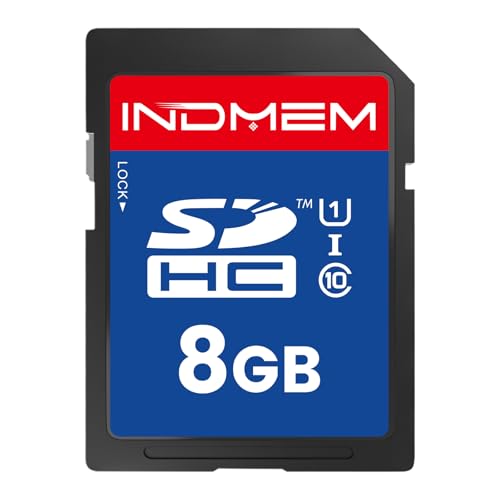
INDMEM 8GB SLC SDHC — a small legacy card for older equipment, honestly framed
This INDMEM card is an 8GB SDHC card using SLC flash, sold as a single pack and described by the maker as compatible with digital cameras, DSLRs, trail cameras and legacy devices. For a Pentax DSLR, the appeal starts with fit and role: it is a niche choice for older Pentax bodies and other legacy devices that are limited to SDHC capacities, where a modern large SDXC card may not be recognised at all. The published title is the source for every figure in this section, so the discussion stays grounded in what the maker actually claims for this exact card rather than in assumptions borrowed from a different capacity or a different product line.
On speed, the title states no headline speed figure is stated in the title supplied for this guide, so none is claimed here; the card’s story is its format, capacity and flash type, not speed. Read those figures the right way round. The read figure shapes how the card feels after the shoot, when folders are copying and thumbnails are rendering. The write figure, where stated, shapes how the card feels during the shoot, when bursts need somewhere to go and video needs a steady destination. A card whose two figures are balanced suits mixed work; a card tilted toward reading suits photographers whose bottleneck is the evening offload rather than the moment of capture.
The class markings in the title, UHS-I, U1 and Class 10, tell you about sustained behaviour rather than momentary peaks. That distinction is easy to overlook and important in practice, because a long video clip or a long burst is a sustained event. When you compare this card with the others in this guide, compare class with class first and headline speed second, and you will reach a more honest ranking for the kind of shooting you actually do.
This card must be framed truthfully: 8GB is tiny by current standards, and for a modern Pentax body shooting raw files it would fill almost immediately. Its value lies elsewhere. Older bodies with SDHC limits, older point-and-shoot cameras kept in service, and trail cameras are exactly the legacy devices the maker names, and for those hosts a small, current-production SDHC card solves a real problem. The SLC flash designation in the title refers to the flash memory type, a durability-oriented design choice that suits devices expected to write modest amounts over a long service life. Buy it for an old body, not for a new one.
Speed classes, video classes, and what the markings guarantee
Alongside bus speed, SD cards carry class markings that describe minimum sustained performance rather than peak bursts of speed. Class 10, written as C10 in several titles here, has long been the baseline for full HD recording. The UHS Speed Class, shown as U1 or U3, raises that floor, with U3 intended for more demanding recording. The Video Speed Class, shown as V30 in several titles here, speaks directly to sustained video writing, with the number indicating the class level in the naming scheme used by the SD Association.
For a stills photographer, these markings are a useful safety net rather than the whole story. A card can carry a strong video class and still differ from another card with the same class in burst behaviour, because cameras write in patterns that differ from a steady video stream. For a videographer, the video class is often the first marking to check, because a dropped recording is far worse than a slower offload. In both cases, buying a card whose class comfortably covers your recording format is wiser than buying exactly at the minimum and hoping conditions stay ideal.
Capacity interacts with class in a practical way. A larger card invites longer sessions and fewer swaps, which reduces the chance of losing a small card in the field, but it also concentrates more images on one piece of media. Many photographers prefer two medium cards to one very large card for important work, rotating them so that a single failure cannot take the whole day. Others prefer the simplicity of one large card for travel. Neither approach is wrong; the right choice depends on how you back up and how you work.
File system naming follows capacity. Cards up to 32GB are generally SDHC, while larger cards are SDXC, a distinction you will see in some product titles in this guide. Modern bodies handle SDXC without difficulty, but very old devices may not, which is why the smallest card in this guide is discussed honestly as a legacy option for older, SDHC-limited equipment rather than as a general recommendation for everyone.
How to choose capacity without overbuying or running short
Capacity planning starts with your file sizes, not with a marketing chart. Raw stills, high-resolution JPEGs, and video clips consume space at very different rates, and a card that feels generous for a weekend of JPEG stills can disappear in an afternoon of video. Think in sessions: how much do you normally shoot between offloads, how often can you realistically copy files, and what happens if a session runs long. Buying for the long session, with a spare in the bag, is the calm approach.
There is a cost angle too, expressed without quoting any figures here because prices move constantly and this guide does not print static prices. Larger and faster cards generally cost more than smaller and slower ones from the same family, so the saving from stepping down a size can fund a second card, a better reader, or a protective case. A balanced kit often matters more than a single flagship card. Two good cards beat one excellent card and no backup at all.
Consider also how you archive. If you offload nightly to a laptop and a portable drive, medium capacities rotate comfortably.
For a Pentax DSLR, the shortlist in this guide deliberately spans a wide capacity range, from a small legacy card suited to older equipment through to a large card intended for long days and travel. That spread is intentional. Readers do not all shoot the same subjects, and a guide that only listed the largest cards would fail the many photographers whose needs are simpler and whose budgets are better spent elsewhere in their kit.
Care, formatting, and backup habits that protect your images
Format every new card in the camera that will use it before its first real session. Formatting in camera aligns the file system with that body’s expectations and gives you a clean starting point, and it is also the moment to confirm the card is recognised at its full capacity. If a card reports an unexpected capacity or produces an error at this stage, set it aside and do not trust it with work that matters.
During a shoot, avoid swapping cards with wet or dirty hands, keep contacts clean and dry, and store removed cards in a hard case. Heat matters as well: a card left on a hot dashboard ages faster than one kept in a shaded bag. None of this is glamorous advice, but card failures in the field are far more often about handling and age than about the logo on the front.
Back up as if the card will fail, because one day a card will. Copy to a computer, then to a second location, and only format after you have opened a sample of files from the copy and confirmed they are intact. Cloud storage can be that second location for JPEGs on the road, while raw archives usually wait for a proper drive at home. The exact system matters less than having one and following it when you are tired at the end of a long day.
Who should buy which kind of card
If you shoot short bursts, single frames, and mostly JPEG files with a Pentax DSLR, a well-regarded UHS-I card with a solid class rating will feel entirely adequate, and your money may work harder spent on a second card for rotation. If you shoot longer bursts, raw files, or sustained video, write performance and video class move to the front of the decision, and stepping up within this shortlist is justified by the work itself rather than by specification envy.
If offload time is your main frustration, look first at read performance and at your reader. A fast card copied through a slow reader or an old hub will disappoint, while the same card in a modern reader can transform an evening of copying into a short break. Diagnose the whole chain before replacing a card that may not be the bottleneck.
If you run an older Pentax body alongside a newer one, keep compatibility in mind and label cards by intended use. A modest SDHC card that suits the older body perfectly can live with it permanently, while your larger SDXC cards stay with the body that supports them. That separation helps.
Final thoughts
There is no single best card for every owner of a Pentax DSLR, and this guide has deliberately avoided pretending otherwise. What there is, instead, is a set of well-documented options that divide cleanly by class, by capacity, and by role, from an everyday 128GB card down to a small legacy card for older equipment. Match those things to your subjects, your sessions, and your backup habits, and any card on this shortlist can serve you well in the role described for it.
Re-read the product sections with your own shooting in mind, note which published figures actually matter for that shooting, and ignore the rest. Specifications are tools for decision-making, not a scoreboard. The photographer who understands why they chose a card will always work more calmly than the one who simply bought the largest number they could find.
Card habits transfer between devices more than most people expect, and Pentax owners who also run a vehicle camera may find it useful to compare the endurance thinking in best dash camera sd cards with the camera-focused advice above before standardising on one brand for everything.
Finally, a note for readers who own both full-size and smaller devices: the cards in this guide are full-size SD cards for Pentax bodies, and our separate coverage of best micro sd cards 4k is the right starting point for the smaller format rather than anything in the sections above.
Check prices on Amazon
Live listings for the shortlist in this guide are pulled from Amazon below, so prices and availability are always current at the moment you look.

Disclosure
This page contains affiliate links to the products discussed. If you purchase through one of those links, this site may receive a commission, and that commission helps support the work of maintaining guides like this one. All product information here is drawn from published manufacturer and seller material, including the product titles cited for each card, and from general published information about the SD standard. This site does not carry out direct testing of the products it covers, and nothing in this guide should be read as a claim of first-hand use. Please confirm specifications, compatibility with your specific Pentax body, and current details on the product page before ordering.