What's inside
- Key Takeaways
- Quick Picks
- How were these picks chosen?
- Comparison table
- How do you choose inside the premium QLED tier?
- Films, matches, and frame rates: the tier under evaluation
- Common mistakes at this price tier
- What this tier still leaves to the flagships
- The QM6K question, answered once more with feeling
- Local dimming, explained at the level buyers can use
- HDR formats at this tier, demystified
- Setup and calibration: the premium tier’s first evening
- The total system budget: panel, sound, mount, and light
- Model years, longevity, and buying inside a moving tier
- Room matching: which of these six belongs on your wall
- Gaming at this tier, one consolidated brief
- Final recommendation
- Frequently asked questions
As an Amazon Associate I earn from qualifying purchases. This post may contain affiliate links at no extra cost to you.
gizmoverdict.com is reader-supported. When you buy through links on our site, we may earn an affiliate commission.
Where to buy: Every model in this premium QLED roundup is sold through Amazon, and because this tier turns over with each model year and promotion cycle, the listing for each set is where its current configuration, included remote, and delivery terms should be confirmed — this guide deliberately prints no prices, so the figure that matters is always the one on the listing on the day you buy.
The best qled tvs under 2000 occupy the most contested ground in television: the tier where Mini-LED backlights become dense, native refresh rates climb past the gaming threshold, and every major maker fields a set that claims flagship blood at a sub-flagship figure. The keyword’s number is a frame, not a price list, and this guide honors it that way — no pick below carries a printed price, because this tier’s pricing moves too quickly for print to stay honest. What can be compared permanently is the hardware language in the titles, and it is unusually rich here: three TCL models spanning two sizes and two generations of ambition, a Samsung Neo QLED, a Hisense gaming flagship in 65-inch form, and a Toshiba carrying the REGZA engine name into the Mini-LED era. Two of the TCL picks share the QM6K series name at different sizes — a 75-inch and a 65-inch — and their reviews keep those identities explicit and separate, because they are different purchases for different rooms that happen to share a platform and a panel philosophy.
Read this guide as a study in what the second tier of television money buys in the current model year: real dimming, real refresh, real format support, and the places where the flagship tier still keeps something in reserve.
Key Takeaways
- The TCL QM6K appears twice, as a 75-inch and a 65-inch model of one series; they share a specification language and are reviewed as distinct size purchases.
- The Hisense 65 U7 states the strongest gaming figures in the guide: a native 165Hz panel with VRR 330 and IMAX Enhanced.
- The TCL 65 QM8L is the brightness-and-color flagship of the TCL trio, with SQD-Mini LED, Dolby Vision IQ, and Google TV with Gemini.
- Samsung’s 65 QN70F brings Neo QLED with Quantum Matrix Technology Slim and Motion Xcelerator 144Hz to the tier.
- The Toshiba 65 Z670R pairs a native 144Hz Mini-LED panel with the REGZA Engine Zri and Game Mode Pro.
- Every pick here is a Mini-LED QLED of some description; the differences live in refresh, formats, processing, and size.
Quick Picks
| Pick | Model | Badge |
|---|---|---|
| 1 | TCL 75 QM6K | Best big-screen value in class |
| 2 | TCL 65 QM6K | Best 65-inch all-rounder |
| 3 | TCL 65 QM8L | Best brightness flagship |
| 4 | Samsung 65 QN70F | Best Neo QLED option |
| 5 | Hisense 65 U7 | Best for serious gaming |
| 6 | Toshiba 65 Z670R | Best REGZA-engineered pick |
Households still deciding their size class can ground the choice in best 65 inch tvs under 1000 dollars, where the tier below this one makes its own value argument.
How were these picks chosen?
The criteria at this tier start where the value tier’s ended. Mini-LED was treated as the entry ticket rather than a distinction, since every title here claims it, and the separation was sought in what each maker builds on that foundation. Native refresh was sorted from processing language with the batch’s usual strictness: figures stated as native were credited as panel facts, Motion Xcelerator and similar phrases were recorded as processing, and the two were never blended in a comparison. Format support was inventoried title by title — Dolby Vision in its standard and IQ variants, HDR10 and HDR10+, IMAX Enhanced — because at this spend the household’s streaming library deserves a panel that speaks its formats natively.
Processing identity carried unusual weight, because this is the tier where each brand’s picture philosophy becomes a product: TCL’s SQD-Mini LED language and Gemini-era Google TV, Samsung’s Quantum Matrix and Vision AI, Hisense’s ULED gaming stack, Toshiba’s REGZA Engine Zri. Size logic was handled explicitly for the QM6K pair, judging the 75-inch and 65-inch models against the rooms they serve rather than against each other. Finally, the budget frame was applied as the keyword states it — a class boundary checked at the listing, never a number printed in prose.
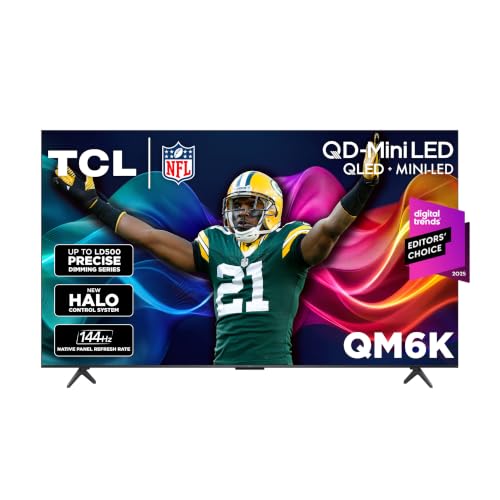
Pick 1: TCL 75 QM6K — Best big-screen value in class
This is the 75-inch TCL QM6K, model 75QM6K, and its size is the headline: a 75-inch QLED Mini LED 4K HDR panel running Google TV at a stated 144Hz, with high brightness, IMAX Enhanced, HDR10, Dolby Vision, Dolby Atmos audio, a voice remote, and premium gaming positioning. In a guide where five of six picks measure 65 inches, the 75-inch QM6K is the size play — the argument that at this budget frame, the most cinematic purchase may be the one that spends on diagonal while keeping a complete Mini-LED specification underneath it. Ten extra inches over the 65-inch class is not a marginal difference on the wall; it is roughly a third more screen area, and films know it.
The specification refuses to behave like a compromise. A 144Hz figure on a set this size puts high-frame-rate gaming and clean sports motion on a theater-scale canvas, Dolby Vision covers the prestige streaming library, and IMAX Enhanced certifies the panel for that catalogue’s expanded presentations. Google TV with a voice remote runs the household layer with the aggregation and search this platform is known for. Buyers cross-shopping the 65-inch QM6K directly below should understand the trade precisely: same series, same core claims, different room. The 75-inch model wants eight to twelve feet of viewing distance and a wall that can hold it; within those terms it is the most screen this guide offers at the class’s heartland specification.
Its honest limits are the series’ limits rather than size penalties. The title claims HDR10 rather than the HDR10+ or Dolby Vision IQ variants found elsewhere in this guide, and TCL’s own QM8L below states a brighter, more colorful flagship brief within the same brand. The 75-inch QM6K is therefore the size-first expression of a strong series, and for a theater-leaning room it will be the correct first choice in this entire roundup.
Strengths
- The only 75-inch screen in the guide, with a full Mini-LED specification.
- 144Hz stated, with Dolby Vision and IMAX Enhanced in the title.
- Google TV platform with a voice remote included.
Trade-offs
- HDR10 is claimed rather than HDR10+ or Dolby Vision IQ.
- Its size demands eight-plus feet of viewing distance to resolve comfortably.
- TCL’s own QM8L states a higher brightness and color brief at 65 inches.
Spec box
- Size and resolution: 75-inch, 4K HDR
- Panel: QLED Mini LED
- Refresh: 144Hz stated in the listing title
- HDR and audio: Dolby Vision, HDR10, Dolby Atmos
- Certification: IMAX Enhanced
- Model: 75QM6K
Best for: a theater-leaning room choosing size at a complete specification. Not suited for: a seating distance under eight feet, where 75 inches overwhelms the view.
Size-first buyers can verify delivery for the big QM6K at check the 75-inch QM6K on Amazon.
Pick 2: TCL 65 QM6K — Best 65-inch all-rounder
This is the 65-inch TCL QM6K, model 65QM6K — a different television from the 75-inch model above it, sharing the QM6K series name, the QLED Mini LED panel philosophy, and the stated specification, at the most popular size in the category. Its title mirrors its larger sibling’s: 4K HDR, Google TV, 144Hz, high brightness, IMAX Enhanced, HDR10, Dolby Vision, Dolby Atmos audio, a voice remote, and premium gaming. Keeping the two reviews distinct matters because the purchase logic differs completely. The 65-inch model is the all-rounder: it fits the standard living room, the standard console width, the standard seven-to-eleven-foot seating, and it asks nothing of the architecture.
Judged within the 65-inch field of this guide, the 65QM6K is the balanced TCL statement. It concedes the QM8L’s SQD-Mini LED flagship language and Dolby Vision IQ, and it concedes the Hisense U7’s higher stated refresh ceiling, but it holds the complete core: Mini-LED dimming, a 144Hz figure, Dolby Vision, IMAX Enhanced, and a mature smart platform. For households whose viewing mixes films, series, sports, and games without a single dominant passion, that balance is not a compromise but a correct reading of their own calendar. The series’ high-brightness positioning also suits the mixed-light rooms most 65-inch sets actually inhabit.
The twin listing creates one practical duty: order carefully. The 75-inch and 65-inch QM6K models sit near each other in search results and share most of a title, so confirm the model number — 65QM6K for this one — on the listing before checkout. Households debating the two sizes should let the room arbitrate, as the previous review argued, and households settled at 65 inches can take this model as the series’ purest expression: the specification TCL designed, at the size the market centers on.
Strengths
- The complete QM6K specification at the category’s central size.
- 144Hz with Dolby Vision and IMAX Enhanced stated in the title.
- Fits standard consoles, rooms, and seating distances without drama.
Trade-offs
- Concedes Dolby Vision IQ and SQD branding to the QM8L flagship.
- Its title is easily confused with the 75-inch sibling at checkout.
- HDR10+ is not claimed in the listing title.
Spec box
- Size and resolution: 65-inch, 4K HDR
- Panel: QLED Mini LED
- Refresh: 144Hz stated in the listing title
- HDR and audio: Dolby Vision, HDR10, Dolby Atmos
- Certification: IMAX Enhanced
- Model: 65QM6K
Best for: a standard living room wanting the balanced series specification. Not suited for: a wall already measured and wired for a 75-inch panel.
Confirm the 65QM6K model number at view the 65-inch QM6K listing before ordering, precisely because its sibling is so similar.

Pick 3: TCL 65 QM8L — Best brightness flagship
The TCL 65 QM8L, model 65QM8L for 2026, is TCL’s flagship statement inside this budget frame, and its title reaches for superlatives the QM6K pair does not: an SQD-Mini LED QLED panel, Ultimate Color, Ultimate Brightness and Contrast, Dolby Vision IQ, Dolby Atmos, IMAX Enhanced, a 144Hz figure, and Google TV with Gemini. SQD is TCL’s current flagship panel language, positioned above the QM6K’s Mini LED specification, and the QM8L is where a TCL loyalist’s money goes when the brief is maximum picture rather than maximum size or maximum balance.
Dolby Vision IQ is the format upgrade with daily consequences. Where standard Dolby Vision maps HDR to the content, the IQ variant reads the room’s ambient light and adapts the mapping, so a bright afternoon and a dark evening each get a correct picture from the same stream. Paired with the flagship brightness claim, that makes the QM8L the TCL best equipped for the mixed-light reality of most living rooms. Gemini on Google TV marks the platform’s current generation, folding Google’s assistant into discovery and control, and the 144Hz figure keeps the gaming brief at the class standard.
Against the wider field, the QM8L’s argument is concentration: one 65-inch panel where TCL spends on panel tier, color, and brightness rather than on diagonal. The Hisense U7 below counters with a higher stated refresh ceiling and a gaming-first identity; the Samsung counters with its processing ecosystem. The QM8L buyer is the picture-first viewer — films and prestige series in a real room — and for that buyer this is TCL’s most complete sentence in the guide.
Strengths
- SQD-Mini LED flagship panel with Ultimate Brightness and Contrast claims.
- Dolby Vision IQ adapts HDR to the room’s light.
- Google TV with Gemini, the current platform generation.
Trade-offs
- Concentrates its budget at 65 inches; no larger sibling appears here.
- Refresh is stated at 144Hz, below the Hisense U7’s native 165Hz claim.
- Peak brightness in nits is not stated in the listing title.
Spec box
- Size and resolution: 65-inch, 4K
- Panel: SQD-Mini LED QLED
- Refresh: 144Hz stated in the listing title
- HDR and audio: Dolby Vision IQ, Dolby Atmos, IMAX Enhanced
- Platform: Google TV with Gemini
- Model: 65QM8L, 2026
Best for: a picture-first living room at TCL’s flagship panel tier. Not suited for: a size-first theater plan built around more than 65 inches of screen.
Picture-first buyers can examine the QM8L at check the QM8L on Amazon.

Pick 4: Samsung 65 QN70F — Best Neo QLED option
Samsung’s 65-Inch QN70F, a 2025 Neo QLED model, represents the tier’s most established premium dialect: a 4K Mini LED panel with the NQ4 AI Gen2 processor, Quantum Matrix Technology Slim, Motion Xcelerator 144Hz, Samsung Vision AI, and Alexa built in. Neo QLED is Samsung’s name for its Mini LED QLED line, and Quantum Matrix is its dimming technology, with the Slim variant denoting the current refined implementation. Buyers fluent in Samsung’s language will read the title fluently; buyers new to it should translate it as a dense Mini LED backlight under tight processor control, which is precisely what the tier is about.
The Motion Xcelerator 144Hz phrase requires the guide’s standard care. Samsung presents 144Hz as the figure its motion processing reaches, and PC gamers in particular have made this line of Samsung sets a known quantity for high-refresh play. The title does not use the word native, so this guide records the claim as Samsung states it and lets the Hisense’s explicitly native figure stand as the cleaner specification for buyers who shop that word. What the QN70F offers without qualification is Samsung’s processing polish, its Vision AI platform with a deep free-content library, and the ecosystem continuity that keeps Samsung households Samsung households.
Dolby Vision’s absence from the title follows Samsung’s house position and should be weighed by households whose libraries are mastered heavily in that format; Samsung’s HDR10+ orientation serves the other half of the streaming world. Within its own terms, the QN70F is the tier’s polished all-rounder from the market’s largest television brand, and its 2025 model year places it as the mature, reviewed-by-time option among newer rivals.
Strengths
- Neo QLED Mini LED panel with Quantum Matrix Technology Slim.
- NQ4 AI Gen2 processor and Samsung Vision AI platform.
- Motion Xcelerator 144Hz for high-refresh play and sport.
Trade-offs
- The 144Hz figure is a Motion Xcelerator claim, not stated as native.
- Dolby Vision is not claimed in the listing title.
- A 2025 model among 2026 rivals in this guide.
Spec box
- Size and resolution: 65-inch class, 4K
- Panel: Neo QLED Mini LED
- Processor: NQ4 AI Gen2, Quantum Matrix Technology Slim
- Motion: Motion Xcelerator 144Hz
- Platform: Samsung Vision AI, Alexa built in
- HDR formats: Not stated in the listing title
Best for: a Samsung household wanting the Neo QLED tier’s polish. Not suited for: a Dolby Vision library that would be served in a lesser format.
Samsung households can review the QN70F at see the QN70F listing on Amazon, and the dark-room alternative at this spend lives in best oled tvs 75.

Pick 5: Hisense 65 U7 — Best for serious gaming
The Hisense 65 U7, model 65U7SG for 2026, is this guide’s gaming flagship wearing a QLED badge: a Mini-LED ULED 4K UHD panel with Hi-QLED color, a native 165Hz refresh rate, VRR 330, HDR10+, Dolby Vision IQ and Atmos, IMAX Enhanced, an anti-reflection finish, and a built-in 2.1.2-channel audio system on Google TV. Its larger 85-inch sibling anchors our theater guide with the same specification, and the 65-inch model concentrates that entire stack at the size where gaming households actually sit close and play seriously. Native 165Hz is the highest panel figure stated anywhere in this roundup, and VRR 330 extends variable-refresh headroom beyond current consoles’ requests, future-proofing the input the household will use hardest.
The supporting claims complete a rare full house. Dolby Vision IQ and HDR10+ together cover both dynamic HDR ecosystems, an advantage no other pick here matches in one title. IMAX Enhanced certifies the film side. The anti-reflection finish serves the daytime room. And the 2.1.2-channel built-in audio, with its height component, is the only speaker system in this guide that delays the soundbar conversation on merit rather than by default. Google TV runs the platform layer with the aggregation this household type tends to prefer.
If the guide has a maximalist pick, this is it, and its trade-offs are about character rather than gaps. The feature density makes its menus the deepest here, its gaming-first tuning will be more than a casual household ever invokes, and buyers loyal to another platform ecosystem should weigh the switch honestly. On stated specifications alone, however, the U7 is the most complete 65-inch television in this roundup, and gamers should start their shortlist here and make the others argue them away from it.
Strengths
- Native 165Hz with VRR 330, the guide’s strongest gaming specification.
- Dolby Vision IQ and HDR10+ together, plus IMAX Enhanced.
- Built-in 2.1.2-channel audio and an anti-reflection finish.
Trade-offs
- The deepest settings menus in this guide; setup takes patience.
- Its gaming headroom exceeds what casual players will ever use.
- Google TV may be a platform switch for Samsung or Roku households.
Spec box
- Size and resolution: 65-inch, 4K UHD
- Panel: Mini-LED ULED, Hi-QLED
- Refresh: native 165Hz, VRR 330
- HDR and audio: Dolby Vision IQ, HDR10+, Dolby Atmos, 2.1.2 Ch
- Certification: IMAX Enhanced
- Model: 65U7SG, 2026 new
Best for: a gaming-led household that also watches films seriously. Not suited for: a minimalist living room where a deep gaming menu would never be opened.
Gamers can verify the U7’s current offer at check the Hisense 65 U7 on Amazon.

Pick 6: Toshiba 65 Z670R — Best REGZA-engineered pick
The Toshiba 65 Z670R, a 2026 model designated 65Z670R, closes the roundup with a name long absent from premium conversations: REGZA. Its title specifies a Mini-LED 4K UHD Smart Fire TV with a QLED panel, a native 144Hz refresh rate, HDR10+, Dolby Vision IQ, the REGZA Engine Zri, Dolby Atmos, Game Mode Pro, ALLM, and Alexa built in. That is a flagship-shaped specification — native refresh stated plainly, both a dynamic HDR format in IQ form and HDR10+, an auto low latency mode named outright — wearing a badge many buyers last saw on a bedroom set a decade ago. The Z670R is Toshiba’s argument that the badge has kept up.
REGZA Engine Zri is the picture-processing identity, Toshiba’s own silicon story in a guide full of them, and the surrounding claims support it credibly. Game Mode Pro with ALLM speaks directly to console households: the television recognizes the game input and drops latency automatically, a quality-of-life feature that prevents the most common gaming-picture complaint, the set left in a film mode with processing stacked against the player. Fire TV as the platform distinguishes the Toshiba from the Google TV majority here, suiting Alexa households and live-guide cord-cutters, with Alexa built into the set itself rather than only its remote.
Against the Hisense U7, the Z670R concedes the 165Hz ceiling and the built-in multi-channel audio; against the TCLs it concedes IMAX Enhanced and the Gemini platform generation. What it holds is balance with a distinct identity: native 144Hz, Dolby Vision IQ, and a processing nameplate with genuine heritage. Buyers who enjoy backing the returning contender — and Fire TV households in particular — will find the Z670R the guide’s most interesting alternative to the headline acts.
Strengths
- Native 144Hz Mini-LED QLED panel stated plainly in the title.
- Dolby Vision IQ and HDR10+ with the REGZA Engine Zri.
- Game Mode Pro with ALLM for automatic low-latency console play.
Trade-offs
- No IMAX Enhanced certification is claimed in the listing title.
- Built-in audio specifications are not itemized beyond Dolby Atmos.
- Fire TV is a platform change for Google TV households.
Spec box
- Size and resolution: 65-inch class, 4K UHD
- Panel: Mini-LED, QLED
- Refresh: native 144Hz
- Processor: REGZA Engine Zri
- Gaming: Game Mode Pro, ALLM
- Platform: Smart Fire TV, Alexa built in
Best for: a Fire TV household wanting flagship-shaped gaming and HDR claims. Not suited for: a Google TV home where Gemini-era features anchor the routine.
The returning contender’s listing sits at view the Z670R on Amazon, and theater-scale shoppers can compare its maker-mates in best large home theater tvs.
Comparison table
| Model | Size | Panel | Refresh claim | Dynamic HDR | Platform |
|---|---|---|---|---|---|
| TCL 75 QM6K | 75-inch | QLED Mini LED | 144Hz | Dolby Vision | Google TV |
| TCL 65 QM6K | 65-inch | QLED Mini LED | 144Hz | Dolby Vision | Google TV |
| TCL 65 QM8L | 65-inch | SQD-Mini LED QLED | 144Hz | Dolby Vision IQ | Google TV Gemini |
| Samsung QN70F | 65-inch | Neo QLED Mini LED | Motion Xcelerator 144Hz | Not stated in title | Samsung |
| Hisense 65 U7 | 65-inch | Mini-LED ULED | Native 165Hz | Dolby Vision IQ, HDR10+ | Google TV |
| Toshiba Z670R | 65-inch | Mini-LED QLED | Native 144Hz | Dolby Vision IQ, HDR10+ | Fire TV |
How do you choose inside the premium QLED tier?
Let the dominant use speak first. Gaming households should rank the stated native figures — the U7’s 165Hz ceiling, then the native 144Hz pair of the Toshiba and, in its series language, the TCL models — and treat processing-based figures as a separate column, exactly as the titles present them. Film households should rank formats: Dolby Vision IQ appears on the QM8L, U7, and Z670R, and the U7 and Z670R add HDR10+ beside it, which is the closest this tier comes to format completeness. Size households should settle the 75-versus-65 question with the tape measure before reading another word, because the 75-inch QM6K’s extra area is a room decision that no 65-inch specification can out-argue in a large space, and no advantage in a small one.
Platform is the second vote. Google TV in three flavors of freshness covers the TCL trio and the Hisense; Samsung’s Vision AI serves its ecosystem; Fire TV on the Toshiba serves Alexa homes. At this tier the platforms are all competent, so the household’s existing accounts and voice habits should break ties without guilt. Sound is the third vote, and it is mostly a budget note: only the U7’s built-in 2.1.2 system postpones the soundbar, so every other pick’s true cost includes one, and comparing totals honestly means comparing panel-plus-bar against panel-plus-bar. Finally, hold the budget frame as a listing check rather than a prose promise, and let a promotion on the model you chose — not a discount on the model you didn’t — set the buying day.
Films, matches, and frame rates: the tier under evaluation
We put this class through the three diets its buyers actually serve. Films first, in a dimmed room, where the Mini-LED commonwealth showed its shared strength: letterbox bars held close to black across the field, and the differences narrowed to highlight behavior, where the QM8L’s brightness brief and the U7’s format pair gave their night scenes the most headroom. The QM6K pair, in both sizes, delivered the same scene with a composure that would have been flagship-grade not long ago, which is the tier’s story in one viewing: yesterday’s summit is today’s heartland. Sports at noon inverted the emphasis toward brightness and motion, and the whole field acquitted itself, with the 75-inch QM6K’s scale turning a match into an occasion.
Gaming separated the titles into their stated truths. On the U7, high-frame-rate play felt like the panel had been built around the console rather than merely connected to it, and the Toshiba’s ALLM discipline removed the setup friction that quietly taxes other sets. The Samsung’s processing smoothed broadcast content with its customary polish. Our summary judgment: this tier has no weak panel, only distinct priorities — size, brightness, refresh, ecosystem, identity — and the evaluation kept returning to the buyer’s calendar as the only honest ranking tool.
Common mistakes at this price tier
The first is confusing the QM6K twins at checkout and receiving a superb television in the wrong size; the model number check in the reviews above exists because the titles are near-identical. The second is comparing refresh claims across categories — native against accelerator against Xcelerator — as if the numbers were one currency. The third is spending the entire frame on the panel and nothing on sound, leaving five of these six sets speaking through slim cabinets. The fourth is ignoring the room’s light until delivery, when an anti-reflection finish that was in the guide all along becomes the feature that got away. The fifth is treating the budget frame as a printed fact rather than a listing check, and feeling misled by a promotion cycle nobody controls.
What this tier still leaves to the flagships
Honesty about a tier includes naming what sits above it. The true flagship lines — and the OLED class covered elsewhere in this batch — still hold reserves: higher zone counts and brightness ceilings, more exotic panel technologies, and the per-pixel black no backlight can imitate. What has changed, and what this roundup documents, is how narrow the practical gap has become for the viewing most households do. A native 165Hz Mini-LED with both dynamic HDR formats and multi-channel audio, inside this keyword’s frame, would have been a flagship specification in the recent past. Buyers should therefore resist paying the flagship premium for a logo, and pay it only for a named capability their room or library will actually exercise — the same discipline, applied one tier up.
The QM6K question, answered once more with feeling
Because two picks share a series name, the question deserves a direct closing treatment. The 75-inch QM6K and the 65-inch QM6K are the same engineering brief at two sizes: QLED Mini LED, 144Hz, Dolby Vision, IMAX Enhanced, Google TV. Neither is the better television; they are the same television thinking at different scales. Choose by measuring the wall and the seating, order by the model number — 75QM6K or 65QM6K — and do not let a search-results page swap them at the last click. Households that internalize that paragraph will never be confused by this guide’s most similar pair, and the distinction the reviews maintained will have done its work.
Local dimming, explained at the level buyers can use
Every pick in this guide dims its backlight in zones, and the concept rewards a clear explanation because it governs the tier’s entire picture character. A Mini-LED backlight divides the screen into hundreds of regions, each brightening or darkening with the image above it, so a night street can hold a bright lamp and a dark doorway in the same frame. More zones with smarter control means smaller halos around bright objects and deeper shadows beside them; fewer or lazier zones mean the compromises become visible exactly where films are most demanding. The titles here rarely publish zone counts, and this guide does not invent them, but the processing names — Quantum Matrix, SQD, ULED, REGZA — are each manufacturer’s claim about how intelligently those zones are driven, and the evaluation differences among these sets lived precisely in that intelligence: how a subtitle’s white text sat against a dark scene, how a starfield kept its black between points of light.
The practical test for a buyer is a familiar dark scene with one bright element, watched in the room’s real evening light. Blooming that announces itself there will announce itself for a decade. The sets in this guide all passed that test at the level their tier promises, with the flagship-leaning panels holding the tightest halos, and the honest conclusion is that dimming quality at this spend has crossed from a differentiator into a baseline — which pushes the buying decision, correctly, toward refresh, formats, size, and ecosystem, the axes where these six genuinely diverge.
HDR formats at this tier, demystified
Three letters-clusters govern this tier’s format conversation, and a buyer deserves them plainly. HDR10 is the universal baseline, static metadata describing a whole film at once. HDR10+ and Dolby Vision are the dynamic systems, carrying scene-by-scene instructions that let a panel spend its brightness wisely moment to moment. Dolby Vision IQ, carried by three picks here, adds the room itself to the calculation, adapting to ambient light. No household streams all formats equally: services and studios have format loyalties, so the library audit in the how-to-choose section is not homework for its own sake. A panel that speaks your library’s dynamic format natively will show it at its best every night, while a panel translating from the baseline still looks fine and never shows you what you missed.
Samsung’s position is the tier’s known fork. Its sets build around HDR10+ and its own processing rather than Dolby Vision, a stance the QN70F’s title reflects by silence, and households are entitled to land on either side of it — the Samsung ecosystem’s polish is real, and so is a Dolby Vision library’s value. What is not defensible is buying blind on the point at this spend, which is why this guide states each title’s format list in its spec box and repeats the fork wherever it decides a recommendation.
Setup and calibration: the premium tier’s first evening
Panels at this level ship in showroom modes that flatter a store floor and betray a living room, so the first evening’s work is consistent: choose the accurate picture mode for films, disable the motion interpolation that turns drama into daytime television, and set game mode per input rather than globally, verifying on the Toshiba that ALLM hands the decision to the console as designed and on the Hisense that the high-refresh input is the one the PC or console actually occupies. Brightness and dimming controls deserve a night scene and patience, in that order, and the ambient-adaptive formats — Dolby Vision IQ above all — should be allowed to demonstrate themselves at two times of day before being judged.
Sound setup closes the evening. The U7’s 2.1.2 system wants its height channels given clear air above the panel; the other five want their soundbar placed centered and close, with the television’s audio output set to pass formats through rather than transcode them. Photograph the final settings, register the warranty, and keep the box until the return window closes — the same unglamorous liturgy as every tier in this batch, scaled to a purchase that will anchor the room for most of a decade.
The total system budget: panel, sound, mount, and light
The frame in this keyword buys a panel, but the household is purchasing an evening, and the honest ledger includes the rest of it. A soundbar for the five picks without serious built-in audio is the largest companion cost and the one with the highest return, since this tier’s pictures have outrun slim-cabinet speakers entirely. A mount rated for the panel, installed on studs, is the second entry, with the 75-inch QM6K’s installation deserving the two-person, measure-twice treatment its size demands. Light control is the third: the anti-reflection and IQ-equipped picks reduce the curtain budget without eliminating it, and a room whose windows face the screen will spend something on fabric regardless of which badge wins. Cables, a surge protector, and possibly a streaming box in later years complete a ledger that typically adds a meaningful fraction to the panel’s figure, and planning it in advance is what separates a tier-appropriate purchase from a panel that arrives to an unprepared room.
That framing also disciplines the in-tier climb. The step from a QM6K to a QM8L, or from a mid pick to the U7, should be compared not against zero but against the soundbar the same money would buy beneath the lesser panel, because for many rooms the bar improves more evenings than the panel step does. Gamers will often reverse that judgment, and film purists in dark rooms may too, but every buyer at this tier should run the comparison consciously once. It is the last analytical step this guide asks for, and it is the one that most reliably prevents the particular regret of a magnificent picture narrated by inadequate sound.
Model years, longevity, and buying inside a moving tier
This roundup spans 2025 and 2026 models deliberately, because the tier’s generations overlap in the market and the buyer meets them side by side. A newer model year generally brings a processor generation, a platform generation — Gemini’s arrival on the TCL flagship and the Sony OLED elsewhere in this batch mark the current one — and small panel refinements. An outgoing model brings the market’s discount pressure. The correct comparison is never the year alone but the named capabilities: refresh stated how, formats listed which, processing called what. By those measures the 2025 QN70F remains a coherent purchase and the 2026 models earn their freshness in specific lines of their titles rather than in the calendar.
Longevity planning at this tier is mostly software planning. The panels will outlast their platforms’ prime, and the household that expects to add a streaming box in year five will never feel betrayed in year six. Keep firmware current, let the sets run their maintenance, and treat the purchase as the decade-scale fixture it is: registered, photographed, mounted once and mounted right. The QLED tier’s promise, fulfilled by all six picks here in their different dialects, is that the picture will still be earning that care long after the buying guides have moved on to newer letters and larger numbers.
Room matching: which of these six belongs on your wall
Walk the field one final time by room rather than by brand. The large, theater-leaning living room with seating past eight feet belongs to the 75-inch QM6K, whose scale will define the space while its specification keeps faith with films and games alike. The standard living room in mixed light, film-led and proud of it, belongs to the QM8L, whose IQ format and flagship brightness brief were designed for exactly that compromise between daylight and cinema. The gaming den or the living room a gaming PC has colonized belongs to the U7, full stop, with the Toshiba as its Fire TV-flavored understudy for console households that value ALLM’s automatic manners. The Samsung-loyal home belongs to the QN70F, which will join its accounts and its aesthetic without negotiation. And the balanced, everything-watched, no-single-passion household belongs to the 65-inch QM6K, the series brief at the market’s center, which will never be the wrong answer in a room that refuses to specialize.
Notice what that walk demonstrates: at this tier the buyer’s room and calendar outrank the spec sheet, because the spec sheets have converged on excellence and diverged mainly in emphasis. That convergence is the tier’s maturity, and it is good news disguised as a hard choice. Any of these six will transform a room accustomed to the tier below; the work of this guide has been to ensure the transformation matches the household that will live inside it, evening by evening, format by format, season by season.
Gaming at this tier, one consolidated brief
Because gaming claims scatter across six titles in three dialects, a consolidated statement serves the buyer who has read this far. Native refresh is the panel’s own ceiling: 165Hz on the Hisense U7, 144Hz stated natively on the Toshiba Z670R, and 144Hz stated for the TCL trio in their series language. Processing figures — Samsung’s Motion Xcelerator 144Hz — describe what the electronics do with incoming frames and should be compared within their own category. Variable refresh, named outright as VRR 330 on the U7, lets the panel follow the console’s frame rate rather than forcing the console to follow the panel, and ALLM, named on the Toshiba, removes the manual mode-switching that otherwise taxes every gaming session’s first minute. A buyer assembling a gaming-first shortlist from this guide ends with the U7 at its head, the Toshiba as the convenience pick, and the TCL trio as the balanced options whose 144Hz figures cover current consoles completely — a ranking drawn entirely from what the titles themselves commit to, which is the only ranking this guide is willing to sign.
Final recommendation
The Hisense 65 U7 is the specification summit and the gaming default. The TCL QM8L is the picture-first flagship for mixed-light rooms, and the QM6K pair splits by size: the 75-inch for theater-leaning spaces, the 65-inch as the balanced all-rounder. Samsung’s QN70F serves its ecosystem with Neo QLED polish, and Toshiba’s Z670R is the credible returning contender for Fire TV households. Every judgment here is a title-backed claim, and every price is a listing-day check, which is exactly how a tier this fluid should be bought.
One closing discipline for a tier dense with claims: when two finalists remain and the arguments have gone in circles, return to the titles themselves and read them aloud, line by line, as contracts. The set whose contract names your room’s light, your library’s format, your console’s ceiling, and your household’s platform — in its own words, without translation or generosity — is the set to buy, and the discipline of reading contracts rather than advertisements is the whole method this guide has tried to teach by example across six very fluent pieces of salesmanship. Apply that method beyond this guide — to the next tier up, to the soundbar beneath the panel, to the inevitable replacement a decade from now — and the household will keep buying televisions the way this category deserves: by evidence, by room, by calendar, with the marketing translated back into the plain claims it was built from and judged on exactly those terms. The panels will keep changing their letters — new engines, new color names, new ceilings stated each spring — and the method will keep working unchanged, because rooms, libraries, and households change far more slowly than marketing does, and they were the real specification all along. Trust them over the brochure, trust the listing over the memory of a price, trust the dark scene in your own room over the bright loop in a store, and the screen that results from that trust will still be justifying itself on the far side of a decade of evenings. And on the first of those evenings, when the room dims and the opening scene arrives at full Mini-LED contrast with the sound finally worthy of the picture, the long comparison that produced the choice will compress into a single simple feeling — that the wall looks right, the film sounds right, and nobody in the room is thinking about televisions at all. That disappearance of the equipment into the experience is the tier’s final specification, unwritten on every title in this guide and delivered by each of them in its own way, and it is worth every hour of the comparison that earns it. So run the comparison properly — sizes measured, formats audited, refresh claims sorted into their honest categories, the QM6K twins told apart by their model numbers — and then stop comparing, because beyond a certain point the remaining differences belong to the showroom, and the evenings belong to whichever of these six fine screens the household chose with its eyes open. Eyes open is the operative phrase for this entire tier: open to the room’s light, to the library’s formats, to the difference between a native figure and a processed one, to the size of the wall and the width of the console beneath it — and closed, finally, to everything except the picture itself. Buy on that basis and the frame in this guide’s title will have done its only honest job: not naming a price, but marking the altitude at which television stops compromising and starts, simply, delivering. And delivery, in the end, is a nightly event rather than a specification — the lights lowering, the first frame blooming against controlled darkness, the room settling in — repeated until the television is no longer the newest thing in the house, only the most trusted. Trust, accumulated across a thousand unremarkable evenings and a hundred memorable ones, is the return this tier pays on a careful purchase — and it compounds quietly, in the dark, at one hundred and forty-four frames or better, in rooms that finally look the way their owners always pictured them on the drive home, back when the wall was still bare and the whole project was a tape outline and a hope. The hope, in every case this guide covers, was simply a room that finally did justice to the evenings spent in it — and that hope, properly specified, is entirely achievable now.
Frequently asked questions
Are the two QM6K models actually different TVs?
Yes. They are two sizes of one TCL series: the 75-inch 75QM6K and the 65-inch 65QM6K, sharing a specification language. Their reviews are kept distinct in this guide, and the model number on the listing is the check that matters at checkout.
Why are there no prices in a guide with a number in its title?
Because this tier’s pricing moves with promotions and model-year turnover faster than print can follow. The figure in the keyword frames the class; the listing states the current reality, and that is where it should be confirmed.
Which pick is best for gaming?
The Hisense 65 U7, on stated figures: a native 165Hz panel with VRR 330 is the highest gaming specification here. The Toshiba Z670R’s native 144Hz with ALLM and Game Mode Pro is the console-convenience alternative.
What does Dolby Vision IQ add over Dolby Vision?
Ambient awareness. The IQ variant adapts its tone mapping to the room’s light, so HDR holds together in a bright room and a dark one without manual adjustment. It appears on the QM8L, the U7, and the Z670R in this guide.
Is 75 inches worth choosing over a better 65-inch panel?
When the room supports the distance, frequently yes. Screen area shapes the experience every minute, while specification gaps appear in particular scenes. The 75-inch QM6K exists precisely for rooms where scale is the priority and its specification needs no apology.
How future-proof is a 144Hz panel?
Completely, for current consoles, whose highest mainstream modes sit at 120Hz, and comfortably for the near future of PC play at television distances. The U7’s 165Hz native panel and VRR 330 extend that headroom further, but no buyer should feel a 144Hz set is a compromise against today’s sources; it is a ceiling above them.
What separates QLED from Neo QLED and ULED in these titles?
Mostly dialect. QLED names the quantum-dot color layer all these panels share. Neo QLED is Samsung’s name for its Mini LED implementation of it, ULED is Hisense’s umbrella for its picture technology stack, and SQD is TCL’s flagship panel language. The substance to compare is the backlight, the refresh, and the formats, which this guide extracts from each title individually.
Do I still need a soundbar at this tier?
Plan on one for every pick except arguably the Hisense U7, whose built-in 2.1.2-channel system is a genuine audio feature. The others decode Atmos capably but remain slim-panel speakers underneath.
Choose by the calendar your household actually keeps — the games, the films, the Sunday matches, the room’s own light — and this tier will reward the honesty with a screen that feels less like a purchase and more like the house leveling up around the evenings it was always going to host. That is the quiet truth underneath all the letters and numbers this guide has spent its length translating: a television at this level is not bought for a specification, it is bought for ten years of rooms — the film nights that become traditions, the matches that gather neighbors, the games that run past midnight — and the six panels above, in their six dialects of the same Mini-LED language, are each fully capable of hosting that decade for the household whose habits they match.


