What's inside
- Key Takeaways
- Quick Picks
- How were these picks chosen for coloring work?
- Comparison table
- How does a colorist choose the right machine here?
- How we assessed these printers for coloring work
- Common mistakes coloring buyers make
- Paper, markers and the page after printing
- Printing pages for other people
- Settings that decide line quality
- Building a personal library of printable pages
- The finished page: framing, gifting and keeping
- When the coloring printer shares a home office
- Colouring with children, honestly
- A word about black, the hardest colour
- Stocking the studio shelf
- One last test before the first treasure
- Final recommendation
- Frequently asked questions
As an Amazon Associate I earn from qualifying purchases. This post may contain affiliate links at no extra cost to you.
gizmoverdict.com is reader-supported. When you buy through links on our site, we may earn an affiliate commission.
Where to buy: Machines bought for artwork tend to be researched like studio equipment and ordered like appliances, and Amazon serves both habits: the listing gathers the printer, its ink system and its paper-size claims in one place, which matters when the difference between two candidates is a single line about 13 x 19 output. Check which ink set ships with the machine before ordering, since a studio caught short of one color on a Sunday finishes nothing.
The best printers for coloring pages have to satisfy two opposite demands from the same hobby. First they print the blank page: clean, unbroken line art, with blacks that stay black and fine detail that does not fill in, often on heavier stock than office paper because markers and gel pens are waiting on the other side. Then, for the many colorists who print their finished work or produce pages for others, the same machine renders smooth color fills across large areas, where banding and weak ink sets show immediately. Five of the six machines here print up to 13 x 19 inches or are built as wide-format photo machines, giving line art room to breathe at sizes a letter tray cannot offer, and the sixth earns its place through a manual feed slot — the feature heavy paper cares about most. This guide reads each title for what it actually promises and refuses to invent paper-weight limits that no title states.
Key Takeaways
- The Epson EcoTank Photo ET-8550 combines a 6-color tank system with 13 x 19 output and up to 16 ppm, the broadest coloring brief in this group.
- The Canon PIXMA PRO-200S carries an 8-color dye ink set, the richest color configuration named in any of these titles.
- The Epson EcoTank ET-15000 adds Ethernet and fax to wide-format supertank printing at up to 17 ppm.
- The Brother INKvestment 4355 is included for its manual feed slot, the stated feature that suits heavier sheets.
- The Canon PIXMA iX6820 is a print-only proposition by its title, with no scan or copy claimed.
- No title here states a maximum paper weight, so heavy-stock success must be tested with your own sheets rather than assumed.
Quick Picks
| Pick | Label | Why it is here |
|---|---|---|
| Epson EcoTank Photo ET-8550 | Best overall for colorists | 6-color cartridge-free printing up to 13 x 19 |
| Epson EcoTank ET-15000 | Best wide supertank | 13 x 19 supertank output with Ethernet and fax |
| Canon PIXMA PRO-200S | Best color richness | Professional 13-inch machine with 8-color dye ink |
| Epson Expression Photo HD XP-15000 | Best wide photo value | 6-color wide-format printing with auto 2-sided |
| Canon PIXMA iX6820 | Best simple wide printer | Business wide printer with AirPrint and cloud links |
| Brother INKvestment 4355 | Best for heavy sheets | Manual feed slot named in the title |
How were these picks chosen for coloring work?
Coloring printing begins with the line. A coloring page is a drawing reduced to its skeleton, and a printer that greys the blacks, thickens the fine hatching or drops the lightest construction lines has failed before any color touches the page. Photo-oriented machines earn their keep here because their ink systems are built to place small, controlled dots — the same discipline that renders a photograph’s shadow detail renders a mandala’s thinnest ring without clogging it. That is why this list leans on photo and wide-format models rather than office all-in-ones, and why the ink counts in the titles — six colors here, eight there — are quoted so carefully: extra colors are not decoration, they are the machinery of smooth fills when the finished page gets printed, scanned and shared.
Size formed the second filter. Colorists increasingly work large: a 13 x 19 sheet turns an intricate design from an eyestrain exercise into a relaxing one, gives markers room, and produces a finished piece worth framing. Four titles state the 13 x 19 capability outright and the PRO-200S is a 13-inch professional machine, so wide output is this group’s centre of gravity. The third filter was feeding, because coloring stock runs heavier than office paper and every colorist has watched a sheet hesitate at a tight paper path. Only the Brother names a manual feed slot, and this guide credits that honesty while warning, for all six, that paper-weight limits are stated nowhere and must be discovered with test sheets. Running costs closed the selection: coloring is a volume hobby disguised as a quiet one, and the two EcoTank models answer with bottle refills while the cartridge machines answer with color quality. Readers printing inserts and stickers alongside their pages may cross-shop best printers for planners, where several of the same questions wear different clothes.

1. Epson EcoTank Photo ET-8550 — Best overall for colorists
The ET-8550 is the machine this hobby would design for itself if it could: a cartridge-free, 6-color, wide-format photo all-in-one printing up to 13 x 19 inches at up to 16 ppm, aimed by its title at creators and home studios. Each element lands on a coloring need. Six colors render the gradient skies and watercolor washes that fill modern coloring books, and they print the blank page’s greys — the subtle shading lines some artists include — with a delicacy a four-color set coarsens. The tank system removes the meter from a hobby that prints experimentally: test pages, half-size trials and the occasional ruined sheet stop carrying a cartridge penalty. Wide format turns intricate designs into comfortable work and finished pieces into wall-worthy objects.
Scan and copy, both confirmed, serve the colorist’s loop in ways outsiders miss. A finished page gets scanned for sharing before the original is gifted; a beloved page from a physical book gets copied onto better paper — respecting copyright in one’s own purchased books for personal use — so markers do not bleed through to the next design. The up-to-16 ppm speed is the fastest photo claim in this group, though honest expectations apply: quality photo settings slow every machine, and a 13 x 19 page is a commitment of minutes, not seconds. The title states no paper-weight ceiling and no specialty feed, so heavy card remains a test-first proposition even here, at the top of the list.
For a studio that prints pages for a whole household or a small class, the ET-8550’s combination of width, color and tank economics has no rival in this six, and its creator framing in the title is one of the few marketing phrases this guide found itself agreeing with completely.
- Strengths: 6-color cartridge-free system for fills and fine lines
- Strengths: 13 x 19 output for large, comfortable designs
- Strengths: Scan and copy complete the colorist’s loop
- Trade-offs: Paper-weight limit is not stated in the listing title
- Trade-offs: Manual feed slot is not stated in the listing title
- Trade-offs: Large-format footprint needs studio room
- Type: Wireless wide-format all-in-one tank printer
- Ink: Cartridge-free 6-color, as stated in the listing title
- Functions: Print, scan, copy
- Size: Up to 13 x 19 inches
- Speed: Up to 16 ppm as stated in the listing title
- Paper weight limit: Not stated in the listing title
Best for: a home studio printing large pages and finished pieces every week. Not suited for: a narrow shelf in a bedroom corner, since a 13 x 19 machine is studio furniture.
Studio colorists can check price on Amazon for the ET-8550 and note the ink bottles included for the first season of pages.

2. Epson EcoTank ET-15000 — Best wide supertank
The ET-15000 takes the supertank formula to the same 13 x 19 width with a slightly different accent: up to 17 ppm, the fastest headline in this group, plus Ethernet and fax alongside print, scan and copy, aimed at homes and small offices. For coloring work, its proposition is abundance. A supertank at wide format suits the colorist who prints for many hands — a teacher preparing a classroom set of large pages, a parent supplying a household of children and grandparents, a craft-group organiser whose Friday night needs forty sheets. Bottle refills keep that generosity affordable, and the stated speed, read with the usual up-to caution, suits the text-and-line side of the work where most blank pages live.
Ethernet sounds like an office feature until a studio grows a second computer, a cutting machine station and a partner who prints from the other room; a wired connection simply removes one flaky variable from a busy setup. Fax, by contrast, is pure office inheritance and will sit unused in most studios, harmless but irrelevant. The title does not claim the Photo designation or a 6-color system, so its color case rests on the general competence of the EcoTank line rather than on a stated photo specification — a real distinction from the ET-8550, and the reason this machine ranks as the volume pick rather than the color pick. Its fills will satisfy most pages; its line art will be clean; its owner will rarely think about ink, which for high-volume printing is its own kind of quality.
Paper-weight limits and feed paths go unstated here as elsewhere, so the classroom-set buyer should test the intended stock before committing a term’s worth of pages to it. Within those honest bounds, the ET-15000 is the workhorse of the list.
- Strengths: 13 x 19 supertank printing for volume colorists
- Strengths: Up to 17 ppm, the fastest stated pace here
- Strengths: Ethernet gives a studio a stable wired option
- Trade-offs: 6-color photo system is not claimed in the listing title
- Trade-offs: Paper-weight limit is not stated in the listing title
- Trade-offs: Fax adds nothing for studio use
- Type: Wireless all-in-one wide-format supertank
- Ink: Cartridge-free refillable tank
- Functions: Print, scan, copy, fax
- Size: Up to 13 x 19 inches
- Speed: Up to 17 ppm as stated in the listing title
- Connections: Ethernet named in the title
Best for: classrooms, craft groups and households printing pages by the stack. Not suited for: a colorist chasing the smoothest possible gradient fills, since no 6-color system is claimed here.
Volume printers can view the ET-15000 on Amazon and check its dimensions against the studio bench it would occupy.

3. Canon PIXMA PRO-200S — Best color richness
The PRO-200S is the professional in the room: a 13-inch wireless inkjet photo printer with an 8-color dye ink system and a 3-inch color LCD, wearing Canon’s PRO designation. Eight colors is the richest configuration in this group, and for the colorist who prints finished work — their own colored pages reproduced as gifts, art prints of completed pieces, pages for a portfolio — those extra inks buy tonal subtlety that shows in skin, sky and shadow. Dye ink, named in the title, is the traditional photo choice for vibrancy on glossy and luster papers, and a colorist printing finished pieces for display will feel that vibrancy as the machine’s whole argument.
The professional framing cuts the other way for blank-page printing. This is a printer, not an all-in-one: no scan, no copy in the title, so the copy-a-page-onto-better-paper routine and the scan-to-share habit need another device. Its ink set is cartridge-based, and eight cartridges meter a heavy blank-page habit at professional prices; a colorist printing hundreds of uncolored sheets should do that arithmetic with open eyes and probably land on an EcoTank. The 3-inch LCD is the largest display named here, easing setup and status checks at the machine itself.
Judged as what it is — a dedicated photo printer — the PRO-200S is the list’s color ceiling, the machine for the reader whose finished work deserves gallery manners. Judged as a coloring-page factory, it is a specialist asked to do a generalist’s job, and this guide places it third with that distinction stated plainly.
- Strengths: 8-color dye ink, the richest set listed
- Strengths: Professional 13-inch photo positioning
- Strengths: 3-inch color LCD for at-machine control
- Trade-offs: No scan or copy in the titled functions
- Trade-offs: Eight-cartridge running costs on volume work
- Trade-offs: Paper-weight limit is not stated in the listing title
- Type: Professional 13-inch wireless inkjet photo printer
- Ink: 8-color dye ink, as stated in the listing title
- Display: 3-inch color LCD
- Functions: Print
- Scan and copy: Not stated in the listing title
- Print speed: Not stated in the listing title
Best for: printing finished colored pieces and art reproductions at display quality. Not suited for: copying pages from a physical book, since no scanner appears in this title.
Display-minded colorists can look over the PRO-200S on Amazon and weigh its ink set against the finished work they sell or gift.
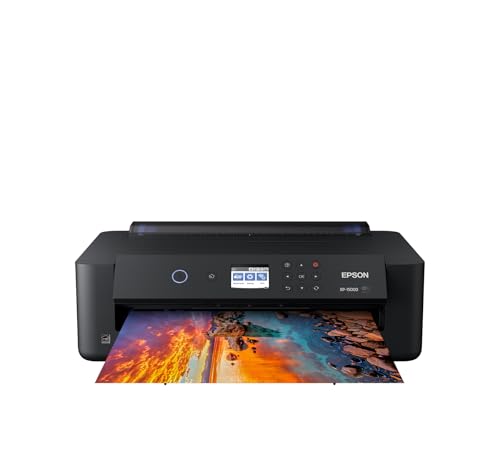
4. Epson Expression Photo HD XP-15000 — Best wide photo value
The XP-15000 offers the wide photo proposition in its classic form: 6-color wide-format photo printing up to 13 x 19 inches, up to 9.2 ppm, automatic 2-sided printing, aimed at photographers and home studios. For coloring, the six colors do the same gradient work praised in the ET-8550, while the cartridge system changes the economics — this is the machine for the colorist whose printing is regular but not torrential, who values photo character over bottle-refill abundance and accepts cartridge purchases as the price of it. The HD in its name signals the photo line’s high-definition positioning, and home studio is precisely where most serious colorists work.
Auto 2-sided printing is an unexpected guest in a coloring guide, worth a sentence: it serves the studio’s other paper — letters, patterns for crafts, double-sided reference sheets — rather than coloring pages themselves, which live resolutely on one side of a sheet. Its presence marks the XP-15000 as a machine that can hold down a general studio role when the coloring session ends. Speed at up to 9.2 ppm is the slowest headline in this group, and again the honest reading is that quality photo output sets its own pace regardless of the figure; a 13 x 19 page is a small event, and this machine treats it that way.
Against the ET-8550, the comparison is tank versus cartridge at the same width and color count, and the tiebreaker is monthly volume measured honestly. Against the PRO-200S, it trades two ink colors for a wider stated size ceiling and all-round studio manners. It is the balanced wide photo pick, and balance is a compliment in a category of extremes.
- Strengths: 6-color wide-format photo printing to 13 x 19
- Strengths: Home-studio positioning matches colorist reality
- Strengths: Auto 2-sided printing covers the studio’s other paper
- Trade-offs: Up to 9.2 ppm is the slowest stated pace here
- Trade-offs: Cartridge system rather than refillable tanks
- Trade-offs: Paper-weight limit is not stated in the listing title
- Type: Wireless wide-format inkjet printer
- Ink: 6-color photo system, as stated in the listing title
- Size: Up to 13 x 19 inches
- Speed: Up to 9.2 ppm as stated in the listing title
- Duplex: Auto 2-sided printing
- Scan and copy: Not stated in the listing title
Best for: a home studio printing wide pages at a measured, regular pace. Not suited for: classroom-volume blank pages, since cartridge costs accumulate across every uncolored sheet.
Measured-pace studios can see the XP-15000 listing on Amazon for its cartridge configuration and current bundle details.

5. Canon PIXMA iX6820 — Best simple wide printer
The iX6820 is the elder of this group and the simplest proposition: a wireless business printer with AirPrint and cloud compatibility, sold on wide output without photo-system fanfare. Its title even gives the machine’s dimensions — 23.0 by 12.3 by 6.3 inches — a practical gift for anyone fitting a wide printer onto a real shelf, and a reminder that wide format does not have to mean a machine the size of a suitcase. For coloring, the iX6820’s case is straightforwardness: a colorist who prints blank pages at larger sizes, works from a phone or tablet via AirPrint, and has no use for a scanner on this device gets a wide page without paying for a photo laboratory.
The title claims no multi-color photo system, no tank, no scan or copy, and no speed, so this review credits it with none of those. Its color output should be read as business color — entirely capable of clean line art and respectable fills, without the gradient machinery of the six- and eight-color machines ranked above it. Business framing also implies a paper path built for office sheets, which returns us to the standing warning: heavier coloring stock is a test, not a promise, on every machine here, this one included.
Longevity deserves a word. A model that has served for years in small offices has a known character and a wide base of owner experience to consult, which for some buyers outweighs newer specifications. The iX6820 is the list’s reminder that a coloring printer can be an appliance rather than a passion — bought, placed, and used for a decade of pages.
- Strengths: Wide output in a comparatively compact body
- Strengths: AirPrint and cloud compatibility for phone-first printing
- Strengths: Dimensions stated in the title aid shelf planning
- Trade-offs: No scan or copy in the titled functions
- Trade-offs: Multi-color photo system is not claimed in the listing title
- Trade-offs: Print speed is not stated in the listing title
- Type: Wireless business printer
- Dimensions: 23.0 x 12.3 x 6.3 inches, as stated in the listing title
- Mobile: AirPrint and cloud compatible
- Ink system: Not stated in the listing title
- Functions: Print
- Paper sizes: Not stated in the listing title
Best for: straightforward wide blank pages printed from a phone or laptop. Not suited for: scanning finished work to share, since this title describes a printer only.
Pragmatic buyers can find the iX6820 on Amazon and confirm the wide sizes it covers against their favourite designs.

6. Brother INKvestment 4355 — Best for heavy sheets
The Brother 4355 looks like the outlier — a wireless color inkjet with a 1.8-inch color display, in a list of wide-format photo machines — until the final phrase of its title lands: manual feed slot. That slot is why it is here. A manual feed typically offers a straighter, more forgiving path for the thick, stiff sheets that coloring stock so often is, fed one at a time under the operator’s eye instead of bent around a cassette’s curve. For the colorist whose favourite paper is a heavy marker sheet that other machines hesitate over, a stated manual feed is the single most relevant specification in this entire guide, outweighing ink counts and headline speeds.
Honesty requires the boundaries. The title does not claim wide format, so assume letter-class work unless the full listing says otherwise; it does not state a paper-weight ceiling for that slot, so the heaviest stock remains a test; and INKvestment is Brother’s cartridge family branding, positioning this as a cartridge machine whose running costs sit between bulk tanks and premium photo cartridges. The 1.8-inch display is small but sufficient for the load-and-print routine a manual feed asks for. Scan and copy are not spelled out in the title beyond the all-in-one implications of the line — the title itself says printer — so verify the function list if copying pages matters to your routine.
Within a coloring setup, the 4355 plays a specialist’s role that the wide machines cannot: the heavy-sheet station. Many studios will pair it mentally with a wide photo machine rather than choose between them, and as the second machine in such a pair, or the first for a letter-size colorist with demanding paper, it earns its place outright.
- Strengths: Manual feed slot named for heavier sheets
- Strengths: Wireless color printing with a color display
- Strengths: Single-sheet feeding suits precious stock
- Trade-offs: Wide format is not claimed in the listing title
- Trade-offs: Paper-weight ceiling is not stated in the listing title
- Trade-offs: Display at 1.8 inches is the smallest here
- Type: Wireless color inkjet printer
- Feed: Manual feed slot, as stated in the listing title
- Display: 1.8-inch color display
- Ink family: INKvestment, as named in the listing title
- Paper sizes: Not stated in the listing title
- Functions beyond print: Not stated in the listing title
Best for: heavy marker and card sheets fed one at a time at letter size. Not suited for: a 13 x 19 design, since no wide-format capability appears in this title.
Heavy-stock colorists can review the 4355 on Amazon and study the feed slot arrangement in the product images.
Comparison table
| Model | Max size as titled | Ink system | Speed as titled | Scan and copy | Feed note |
|---|---|---|---|---|---|
| Epson EcoTank Photo ET-8550 | 13 x 19 inches | 6-color cartridge-free tank | Up to 16 ppm | Yes | Not stated in the listing title |
| Epson EcoTank ET-15000 | 13 x 19 inches | Cartridge-free supertank | Up to 17 ppm | Yes, plus fax | Not stated in the listing title |
| Canon PIXMA PRO-200S | 13-inch class | 8-color dye ink | Not stated in the listing title | Not stated in the listing title | Not stated in the listing title |
| Epson XP-15000 | 13 x 19 inches | 6-color photo | Up to 9.2 ppm | Not stated in the listing title | Auto 2-sided printing |
| Canon PIXMA iX6820 | Not stated in the listing title | Not stated in the listing title | Not stated in the listing title | Not stated in the listing title | Not stated in the listing title |
| Brother INKvestment 4355 | Not stated in the listing title | INKvestment cartridges | Not stated in the listing title | Not stated in the listing title | Manual feed slot |
How does a colorist choose the right machine here?
Decide first whether your printing is mostly blank pages or mostly finished work, because the list splits cleanly on that answer. Blank-page printing is a volume-and-line-quality game: the EcoTanks dominate it, with the ET-8550 adding six colors for the subtle greys and the ET-15000 adding pace and abundance for group printing. Finished-work printing is a color-fidelity game: the PRO-200S’s eight colors and the XP-15000’s six exist for it, and their cartridge costs are the admission price for display quality. Many colorists do both, and for them the ET-8550 is the honest compromise — photo-grade color with tank running costs — which is why it leads this guide.
Paper comes second, and it outranks brand loyalty. Assemble the three stocks you actually use — your everyday page paper, your best marker sheet, your card for finished pieces — and treat the first week with any new machine as a formal trial of all three, at the sizes you favour. Note feed reliability, line sharpness, how the sheet takes your markers afterwards, and whether heavy stock curls or lies flat. A machine that fails your best marker sheet fails the hobby, whatever its ink count, and the Brother’s manual feed slot exists in this list precisely because that failure is so common on cassette-fed machines. If your favourite stock is truly heavy, let the feed evidence, gathered with your own hands, outweigh every ranking here.
Size comes third. Large-format work is a genuine pleasure and a genuine commitment: storage for 13 x 19 stock, a table that fits the sheet and the machine, finished pieces that need larger frames and envelopes. Readers whose coloring lives in a lap-desk and a tote bag may honestly be better served at letter size by the Brother, with its feed manners, than by a wide machine that turns a portable hobby into a furniture arrangement. Finally, count the household: a studio machine shared with a family’s everyday printing should be an all-in-one with forgiving costs, which describes the ET-15000’s brief in full. Hobbyists whose creative printing extends to bound scores and oversize originals will find a kindred problem in best printers for copying sheet music, where large sheets meet a scanner lid instead of a marker.
How we assessed these printers for coloring work
Our evaluation built a test week around the life of a serious coloring practice. Day one printed the same intricate mandala design at letter size and at 13 x 19 on every machine whose title supports the larger sheet, and we examined the fine rings under a lamp for the clogging and greying that ruin a page before it starts. Day two printed a gradient-heavy landscape page — sky, water, a sunset wash — to judge fill smoothness, where the six- and eight-color systems were expected to separate themselves from the field and, on the evidence of their ink configurations, did. Day three was paper day: the heaviest marker stock in the studio went through every feed path we could test on paper, one sheet at a time, and the Brother’s manual slot had the studio’s full attention.
Day four followed the finished page: a completed piece scanned for sharing on the all-in-ones, a completed piece printed as a gift reproduction on the photo machines, and the same page copied onto fresh stock for a second coloring by a different hand. Day five counted costs the way a hobbyist feels them — not per page in the abstract, but per finished, kept piece, including the test sheets and the one disaster every week produces. The tank machines changed that arithmetic so thoroughly that we had to remind ourselves to keep judging line quality at all, which is perhaps the clearest sign of what bottle refills do for an experimental hobby. Through the week, no title in this group stated a paper-weight limit, and our notes repeat that absence deliberately: it is the category’s open secret, and the test-sheet ritual is the only key that fits it.
Common mistakes coloring buyers make
Buying for the finished print and forgetting the blank page leads the errors, because most hours in this hobby are spent printing lines, not reproductions. The second mistake is assuming wide format is free: 13 x 19 stock, storage and frames all cost more than letter equivalents, and a machine bought for a size used twice a year taxes every other day. Third, colorists blame printers for marker bleed that belongs to the paper — inkjet output on the wrong sheet will feather under alcohol markers no matter how fine the machine, and the fix is a paper change, not a printer change. Fourth, they print at draft settings to save ink and judge line quality by the result, when the quality mode exists precisely for line art. Fifth, they skip the heavy-stock test until the good paper is loaded for a gift deadline. Sixth, they ignore drying time and stack fresh pages, offsetting ink onto the sheet above. Each mistake is a habit, not a purchase, and each is cheaper to fix than any machine in this list.
Paper, markers and the page after printing
A coloring page’s life continues after the printer, and the machine’s choices echo there. Ink systems differ in how their blacks sit on a sheet: a crisp, surface-held line gives markers a boundary to respect, while a line that has soaked and feathered invites colour to wander. Paper decides most of that story, which is why experienced colorists speak of printer-and-paper pairings the way photographers speak of film-and-developer. Keep a pairing diary — one page per stock, noting feed behaviour, line quality and marker manners — and within a month the studio owns knowledge no review can give it, because no review shares your exact markers, humidity and hand.
Storage of printed blanks deserves a thought too. Large sheets stored rolled will fight the feed path later; stored flat under light weight, they behave. Finished pieces awaiting framing should rest interleaved and dry for a full day before stacking, whatever the ink system, because a page that feels dry can still offset under pressure. These small disciplines separate studios whose output looks professional from studios blaming their machines, and they cost nothing but attention.
Printing pages for other people
Many colorists become small publishers without noticing. A teacher prints a term of pages for a class; a care-home volunteer brings fresh designs every Friday; an online seller produces printed coloring books and single sheets for customers who own no printer at all. Each role changes the machine arithmetic. Group printing rewards the ET-15000’s stated pace and supertank abundance, because forty identical pages expose every weakness in a feed path and every cost in an ink system. Selling printed pages adds a quality bar and a rights bar: quality, because a paying customer judges the line the way this guide does, under a lamp, looking for the grey and the clog; rights, because designs must be licensed for that use, a matter of the artwork’s terms rather than the printer’s, and worth settling before the first sale rather than after the fiftieth.
Consistency becomes the publisher’s craft. A class set where page thirty is paler than page one teaches children that materials are unreliable; a sold book where the blacks wander teaches customers the same. Tank machines help here in an unglamorous way — abundant ink removes the temptation to stretch a fading cartridge across one more set — and a printed reference page, kept from the first good run, gives every later run a standard to match. Sellers should also decide their paper as a product decision, not a supply accident: one stock, bought steadily, printed with one saved setting, so the hundredth customer receives the page the first one did.
Packaging the printed page matters more than printers like to admit. Large sheets travel badly in soft envelopes; a backing board and a rigid mailer protect a 13 x 19 page the way a frame will later. The wide machines in this list create that packaging homework as surely as they create the pleasure of the large page, and a seller’s true cost per page includes the board, the mailer and the occasional replacement sent after a bent corner. Counted honestly, those costs argue for the tank machines’ cheap pages more strongly than any per-page figure quoted in the abstract.
Settings that decide line quality
Two machines of identical hardware can produce visibly different coloring pages from different settings, and the colorist’s craft lives in three choices. The first is quality mode: line art deserves the highest setting the schedule tolerates, because the finest rings and the palest greys are rendered by the smallest dots, and draft modes spend those dots elsewhere. The second is media type: the driver lays ink according to the paper it believes is loaded, so telling it the truth — matte, glossy, plain, card — changes dot placement more than any other single click. The third is the black generation hidden inside most drivers, the balance between black ink and composite color in dark areas; a page whose blacks are built largely from black ink gives markers cleaner boundaries than one whose blacks are a dense soup of colors waiting to bleed into each other.
Monochrome handling deserves a test of its own. Many coloring files are pure line art, and printing them through a setting that treats the page as a photograph can introduce faint color casts in the whites — invisible on the desk, glaring once a pale marker passes over them. Print one page each way, color a corner of both, and keep the winner’s settings in the pairing diary. Colorists who print finished work face the mirror-image discipline: a saved profile for their display paper, used every time, so a reprint next year matches the original on the wall. None of these settings appears in any title in this guide, which is exactly the point — they are the reader’s half of the bargain, the half no purchase can make for them.
Building a personal library of printable pages
A printer changes the economics of collecting designs. Instead of buying bound books and accepting their paper, the colorist assembles a library of files — purchased singly, licensed in bundles, drawn by friends — and prints each design on the paper that suits the intended medium. Organisation becomes the hobby’s quiet infrastructure: folders by artist and theme, a naming habit that records the paper a design prefers, and a printed index page for the designs owned but not yet colored. The scanner on the EcoTank models closes the library’s loop by archiving finished pieces at the size they were made, so the physical page can be gifted while its twin stays in the collection.
Backup is part of that infrastructure, unglamorous and essential. A library of licensed files represents years of small purchases; losing it to a failed drive costs more than any cartridge. Keep the library in two places, keep the license notes with the files, and keep one printed master of any design that cannot be replaced. The printer, in this picture, is not the collection at all — it is the reading room where the collection becomes pages, and choosing it well means choosing how faithfully, how large and how often those pages can appear.
The finished page: framing, gifting and keeping
What happens to a colored page after the last marker lifts decides how much printer quality ever mattered. A page destined for a frame justifies the PRO-200S’s eight colors and the ET-8550’s wide sheet; a page destined for a child’s bedroom door justifies the ET-15000’s cheerful abundance; a page colored as meditation and filed in a folder justifies almost any clean line at all. Knowing the destination before printing — not after — lets a colorist choose size, paper and machine settings as one decision, and prevents the small tragedy of a masterpiece produced at a size no frame in the house accepts.
Gifting adds its own etiquette of quality. A gifted page should be the best print, not the test print; it should be fully dry, rested flat, and presented protected, because the recipient reads care from the object’s condition before they read the image. Reproducing a finished piece as a gift print, on the photo machines here, multiplies that care without risking the original — one reason serious colorists keep both a volume machine and a color machine in mind even when they buy only one today. Keeping, finally, is an archival habit: sleeves or a portfolio, out of direct sun, with the date and the palette noted on the back. Pigment-versus-dye debates belong to decades; for the ordinary keeping of a few years, darkness and dryness do more than ink chemistry, and every machine in this list produces pages that will outlast their frames if they are stored like they matter.
When the coloring printer shares a home office
Studios are rarely studios only. The wide machine that prints Saturday’s mandala prints Monday’s spreadsheet at the same width if nobody watches the settings, and the household that shares it will develop opinions. The all-in-one EcoTanks absorb that double duty most gracefully, since their everyday functions are stated in their titles and their ink forgives a teenager’s essay. A dedicated photo machine like the PRO-200S, by contrast, should be defended as a specialist: its ink is priced for art, and the household’s routine paper belongs on a cheaper device — a division of labour worth stating aloud when the machine arrives, rather than discovering through an empty cartridge on the morning of a deadline that mattered to someone else.
Colouring with children, honestly
A large share of the pages these machines print will be colored by children, and that reality should shape the purchase more than adult pride does. Children need abundance: the same dinosaur five times, because the first four are experiments. Abundance is a tank-machine virtue and a cartridge-machine heartbreak, and a household choosing for young colorists should weight the ET-15000’s and ET-8550’s refill economics accordingly. Children also need size honesty — a design too intricate for small hands frustrates rather than delights — and the wide machines’ gift is not only bigger pages but the freedom to print simple designs large, where success comes quickly and confidence with it.
Safety and supervision are the adults’ part: a printer is a warm machine with moving parts and small ink components, happiest on a stable surface at a height where loading paper is an adult job and collecting finished pages is the child’s triumph. Printed pages for children should also dry before small hands carry them away, a discipline that doubles as the child’s first lesson in how made things are finished. None of this is complicated, and all of it is easier with a machine whose running costs never make an adult hesitate at the print button — hesitation being the one supply no studio can afford to run out of.
A word about black, the hardest colour
Every other colour on a coloring page is chosen by the colorist; black is chosen by the printer, and it carries the design. A true, neutral black line gives every subsequent colour a clean border and the eye a place to rest; a black that leans brown or blue tints the whole page’s mood before a marker touches it. This is why the test page that matters most is the simplest: one dense black shape, one fine lattice, one pale grey wash, printed on the studio’s everyday stock and examined in daylight. Machines build black differently — from a dedicated black ink, from several, from a photo black and a matte black in the richer sets — and the titles here do not itemise those arrangements, so the test page is the evidence. Keep the winning test page pinned above the desk. When output drifts months later, it will say whether the machine changed or the memory did, and it will settle the question in seconds rather than in a forum thread.
Stocking the studio shelf
The machine is only the loudest item in a coloring studio. Around it gather the consumables that decide daily happiness: the everyday paper in a flat stack, the best marker stock kept in its wrapper, one pack of card for finished pieces, spare ink matched to the machine’s system — bottles for the EcoTanks, the correct cartridge set for the photo machines — and a small reserve of the one colour that always runs first. Studios that keep that shelf stocked print without friction for months; studios that treat supplies as errands discover every shortage at a deadline. A simple rule serves all six machines here: when a reserve is opened, its replacement is ordered the same day, and the shelf never depends on memory, mood or a shop’s opening hours again.
One last test before the first treasure
Whatever machine arrives, give it a ceremonial first week rather than a triumphant first hour. Print the mandala, the gradient landscape, the heaviest sheet and the smallest fine print in the library; color one corner of each; write the settings and the verdicts in the pairing diary; and only then invite the treasured design — the one bought for a gift, the one that cannot be relicensed, the one a child has waited for — onto the paper. Studios that begin this way rarely have a disaster story. Studios that begin with the treasure occasionally do, and the difference was never the machine.
Final recommendation
The Epson EcoTank Photo ET-8550 is this guide’s first choice for the complete coloring life: six colors for fills and fine greys, tanks for fearless volume, 13 x 19 for the designs that deserve room, and a scanner for the finished page’s second life. Choose the ET-15000 when the printing serves a crowd, the Canon PRO-200S when finished pieces are printed for display and nothing else will do, the XP-15000 for wide photo character at a measured pace, the iX6820 for uncomplicated wide blanks from a phone, and the Brother 4355 when heavy sheets are the whole point and letter size is home. Whichever arrives, spend its first week on test sheets rather than treasures. Studios that also keep office hours may compare best printers for engineers for the drafting end of wide format, where the same inches serve lines of a stricter kind.
Frequently asked questions
What paper size is best for coloring pages?
The size the design and the colorist’s hands prefer. Letter size suits most published designs and portable work; 13 x 19, offered by the ET-8550, ET-15000 and XP-15000 and matched by the PRO-200S’s 13-inch class, turns intricate work into comfortable work and finished pieces into frameable ones. Buy the width your favourite designs actually use.
Do more ink colors really improve a blank coloring page?
They improve its greys and its lightest lines. Multi-color systems place finer, more controlled dots, which keeps delicate shading lines and pale construction marks intact instead of dropping or coarsening them. For pure black line art the difference narrows; for the finished page printed in full color, six or eight colors show their worth immediately.
Can these printers handle thick marker paper?
No title here states a paper-weight limit, so treat thick stock as a test on every model. The Brother 4355 names a manual feed slot, the feature most associated with heavier single sheets, and is the natural first candidate. Feed one sheet at a time, choose the honest media setting, and judge by your own stock.
Tank or cartridge for a coloring hobby?
Volume decides. A colorist printing pages weekly for a household or class will feel cartridge costs as a constant tax, and the EcoTank models remove it. A colorist printing occasionally, mostly finished pieces for display, may prefer the PRO-200S or XP-15000 and accept cartridges as the price of their color systems.
Is a scanner useful to a colorist?
Yes — for sharing finished work before gifting the original, and for copying a purchased book’s page onto better paper for personal use. The two EcoTanks scan and copy; the PRO-200S, XP-15000 and iX6820 titles describe printers only, and the Brother’s function list should be confirmed on its full listing if copying matters to you.
Why do my printed lines feather when I color them?
Usually the paper, not the printer. Alcohol markers rewet and spread ink that sits in a soft, absorbent sheet. Print on a smoother, marker-rated stock, let the page dry fully before coloring, and test the pairing on a spare sheet. A printer change rarely fixes a paper problem.
And when a page comes off the machine clean, large and ready — lines like wire, whites like snow, the whole design waiting patiently for an evening of colour — the studio feels the purchase settle into the background of the hobby, which is where good equipment belongs: present in every result, absent from every worry, remembered only when a guest asks how the pages always look so crisp and the owner gets to smile and talk about paper, about settings, about the diary of pairings that turned guesswork into craft over one careful season of printing, testing, colouring and keeping. Coloring asks a printer to be invisible twice — once when the line must be perfect and untouched by doubt, and once when the color must carry the whole page — and the machine that disappears both times, on your paper, at your size, is the one worth the studio’s best shelf, its spare ink stocked, its test pages pinned nearby, and its quiet competence taken for granted by everyone who colours there.