What's inside
As an Amazon Associate I earn from qualifying purchases. This post may contain affiliate links at no extra cost to you.
gizmoverdict.com is reader-supported. When you buy through links on our site, we may earn an affiliate commission.
Where to buy: All six headsets gathered here are listed on Amazon, and Switch accessories frequently appear in character editions and colour variants that share a model name, so check the product page carefully to confirm the edition, the console generation named and the wired or wireless design before ordering.
Before any product names, an honesty obligation. The best headsets to use for nintendo switch online voice chat operate inside an unusual system, because Nintendo routes voice chat for many Switch games through the Nintendo Switch Online smartphone app rather than through the console itself. In those games, your headset conversation happens on your phone, in the app, while game audio comes from the Switch; no headset plugged into the console can change that architecture. Other games handle chat natively or through their own systems, and there a 3.5mm headset at the console does carry your voice directly. So the truthful promise of this guide is twofold: these headsets serve wired chat wherever a game supports it at the console, and they deliver game audio everywhere, on every game, app-routed or not. A headset also remains useful with the app itself, since a wired or Bluetooth set connected to your phone keeps the app conversation in your ears instead of on speaker. Buy with that map in mind and nothing here will disappoint you; buy expecting every game to chat through the console jack and even the finest headset will seem broken.
That split explains the shape of the roundup. Most picks are light, inexpensive wired designs built around the Switch’s headphone jack and the handheld way the console gets played: on sofas, in passenger seats, at kitchen tables. One pick goes wireless with Bluetooth and a stated forty-hour battery for players tired of a cable crossing the screen in handheld mode. Character editions appear because Switch culture embraces them, and we treat a Zelda or Mario colourway as a legitimate preference rather than a lesser reason to buy.
Key Takeaways
- Many Switch games send voice chat through the Nintendo Switch Online phone app, not the console; headsets serve console chat only where a game supports it directly.
- Every pick here still delivers game audio on every title, which is half the reason to own one.
- The two PDP models are distinct products: the Airlite in a Zelda Hyrule Blue edition, and the LVL40 Airlite in Mario Neon colours.
- Turtle Beach Stealth 500 is the wireless outlier, stating Bluetooth, 40mm drivers and a 40-hour battery.
- Flip-to-mute and flip-to-mute-style booms appear on both Turtle Beach wired and wireless picks, a kindness in family rooms.
- All five wired picks use the console’s 3.5mm connection, so none of them needs charging before a journey.
Quick Picks
| Pick | Badge | Headline fact |
|---|---|---|
| Turtle Beach Airlite Fit | Best overall for Switch players | Flip-to-mute mic, 40mm speakers, Switch 2 ready |
| PDP Airlite | Best for Zelda households | Flexible noise-cancelling mic, Hyrule Blue edition |
| PDP LVL40 Airlite | Best for Mario fans | Stereo headset, Mario Neon Red and Blue |
| Turtle Beach Stealth 500 | Best wireless freedom | Bluetooth, 40-hour battery, memory foam |
| AOC Wired Headset for Switch 2 | Best red-and-blue all-rounder | 3.5mm stereo, also named for PS5, PC, Fortnite |
| Turtle Beach Recon 50 | Best multiplatform veteran | Removable mic, 40mm speakers, in-line controls |
Readers whose households also run an Xbox will find the chat-first thinking in our guide to best gaming headsets for xbox one fortnite a useful contrast, since that platform keeps its voice chat inside the console experience.
Picture the buying moment this guide is really for. A family has a new console or a newly online child, a birthday or a holiday is approaching, and the headset aisle offers forty near-identical boxes, half of them implying that voice chat on this console works like it does everywhere else. It does not, and the gap between that implication and Nintendo’s app-based reality is where returns and disappointment breed. Everything below is organised to close that gap first and rank products second. If you finish this guide understanding the system and merely liking a headset, it has done its main job; the six reviews then help you pick the likeable one whose stated facts fit your rooms, your players and your other consoles.
How were these Switch chat headsets selected?
The first selection rule was allegiance to the console’s real audio architecture, as described above: no pick was allowed to pretend the app does not exist. Beyond that honesty filter, we looked for handheld practicality. The Switch spends much of its life undocked, so stated lightweight designs and comfortable cushions mattered more than home-theatre scale. Microphone muting behaviour came next, because Switch gaming happens in shared spaces, living rooms, trains, the backs of cars, where a flip-to-mute boom or an in-line control protects both the conversation and the people around it. Compatibility wording was recorded literally: several titles now name the Switch 2 alongside the original Switch, Lite and OLED models, and that forward compatibility protects a purchase across a console upgrade. One wireless model was included for the substantial minority of players who game docked or who simply refuse cables in handheld mode, and its stated battery figure was weighed against the wired picks’ freedom from charging. Character editions were neither rewarded nor punished; they were noted, because for many Switch households the edition is the point.
We also kept the two PDP headsets carefully separate throughout. They share a surname and a design language, but they are different models with different microphones, different editions and different listings, and merging them would mislead exactly the buyers most likely to care about the distinction.
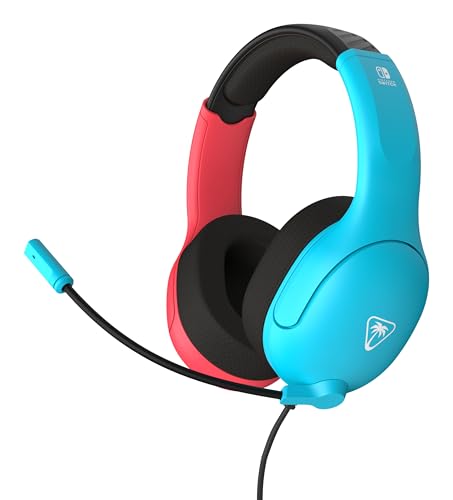
1. Turtle Beach Airlite Fit — Best overall for Switch players
Turtle Beach’s Airlite Fit leads because its title reads like a checklist written by somebody who actually plays a Switch in company. It is a wired gaming headset for the Nintendo Switch 2 and Lite, also working with the Switch OLED, carrying a flip-to-mute mic, comfortable ear cushions and 40mm speakers in a lightweight frame finished in Neon Blue and Red, the console’s signature colours. The flip-to-mute gesture suits Switch life particularly well: a parent looks up from a handheld session to answer a question, flips the boom, and the party hears nothing of the domestic exchange. In app-routed games, remember, the conversation lives on the phone, yet the headset still earns its place piping game audio privately while the phone handles voices nearby.
The 40mm speakers match the stated size across most of this roundup, so the Fit’s case rests on integration rather than scale: the right colours, the right consoles named, the right muting gesture, cushions described as comfortable for the handheld sessions that define this platform. Lightweight is claimed without a gram figure, a small frustration we record rather than resolve. Nothing in the title claims noise cancelling for the microphone, so in a loud room your party may hear more of your surroundings than the PDP models below promise to suppress; in exchange, the Fit’s simplicity is total, with no battery, no pairing and no modes to misunderstand.
For families buying a first headset alongside a Switch 2, this is the least surprising option in the six, and in family technology, lack of surprise is a compliment. It also travels well between siblings because the design reads as the console’s own accessory language. Players ready to match their headset to their Joy-Con colours can check price on Amazon for the Airlite Fit.
Durability thinking suits this pick as well. A wired headset with a flipping boom has exactly one moving joint to wear, no battery quietly ageing, and no firmware to fall behind the console’s updates. For a household handing a headset between siblings of different ages, that mechanical simplicity predicts a long, boring service life, and boring is the highest praise family technology can earn. The Neon finish will eventually scuff, the cushions will eventually compress, yet the essential arrangement, plug in, flip up to hush, flip down to talk, will still make sense to a visiting cousin within ten seconds of picking it up. Teaching-free design is a feature parents feel in their bones even when a specification sheet has no row for it.
Strengths
- Flip-to-mute mic handles family-room interruptions with one silent gesture.
- Switch 2, Lite and OLED compatibility is stated across the console family.
- Neon Blue and Red finish matches the console’s own signature colours.
Trade-offs
- No microphone noise cancelling is claimed in the title text.
- Weight is described as lightweight with no gram figure published.
- Wired design keeps a cable crossing the handheld screen area.
- Speakers: 40mm
- Microphone: Flip-to-Mute Mic
- Consoles named: Switch 2, Lite, OLED
- Weight figure: Not stated in the listing title
Best for: handheld players in shared rooms where muting must be instant and silent.
Not suited for: a docked setup across the room where a cable cannot reach the chair.
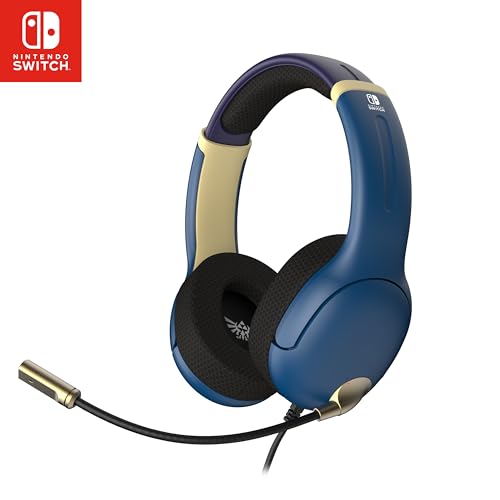
2. PDP Airlite — Best for Zelda households
The PDP Airlite in its Zelda Hyrule Blue Edition is the pick for the household where the console’s library leans toward Hyrule and the headset might as well admit it. Beneath the edition colours sits a sensibly specified wired headset for Switch 2, Switch Lite and OLED: a flexible noise-cancelling mic, a lightweight design, soft ear cushions and on-ear volume controls. The flexible boom matters more than its modest wording suggests. A boom that bends stays where a younger or smaller player positions it, instead of springing back to a factory angle designed for an adult jaw, and that positional honesty improves every conversation the headset carries.
On-ear volume controls deserve their sentence too. In handheld play, reaching a cable control means releasing a grip mid-game; a control on the earcup keeps both hands on the console. The noise-cancelling microphone claim is the strongest chat wording among the wired PDP and Turtle Beach picks here, valuable in the kitchens and living rooms where Switch sessions actually happen, and in console-supported chat games it will carry your voice while in app-routed titles the same headset serves the phone conversation or the game audio. Soft cushions and a lightweight frame address the session-length reality of a console whose games famously consume entire afternoons.
What the title withholds is driver size, so the Airlite’s audio scale cannot be ranked against the 40mm models from the title alone. Buyers choosing between this and the LVL40 below should notice they are different headsets, not trim levels: this one brings the flexible noise-cancelling boom and the Zelda edition, while its sibling brings its own microphone wording and Mario colours. Fandom is a fine tiebreaker once the functional boxes are ticked, and here the functional boxes genuinely differ. Hyrule households can see the Hyrule Blue Airlite on Amazon.
The flexible boom deserves one more paragraph, because it quietly solves the most common family chat complaint: the headset microphone that points at a cheek, a chin or the ceiling. Younger players rarely adjust a stiff boom correctly, and a boom that bends and holds its bend lets a parent set it once during the first session and trust it for the month. Voice clarity in console-supported chat improves more from that single act of positioning than from any processing claim printed on a box. Add the on-ear volume control, which a small hand can find without looking, and the Airlite reads as a headset designed by people who have watched children actually use one, rather than by people who have only measured adult heads.
Strengths
- Flexible noise-cancelling mic bends to the wearer and stays positioned.
- On-ear volume controls keep both hands on the console in handheld play.
- Zelda Hyrule Blue edition gives the headset a genuine identity.
Trade-offs
- Driver size is not published in the title, leaving audio scale unranked.
- The themed edition will not suit every player’s taste or every gift.
- Wired connection only, with no wireless mode mentioned.
- Microphone: Flexible Noise-Cancelling Mic
- Controls: On-Ear Volume Controls
- Cushions: Soft Ear Cushions
- Driver size: Not stated in the listing title
Best for: Zelda households whose players adjust their boom once and expect it to stay.
Not suited for: a gift purchase where the recipient’s taste in game franchises is unknown.
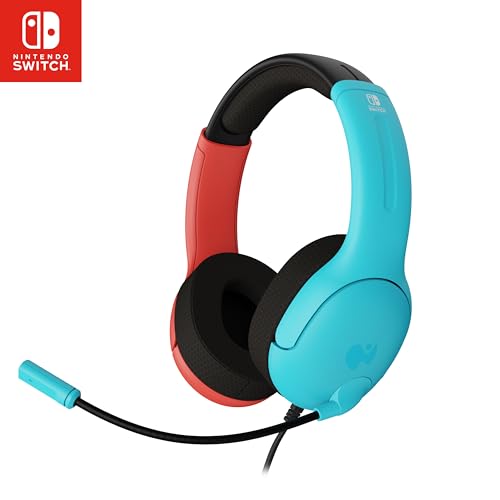
3. PDP LVL40 Airlite — Best for Mario fans
The LVL40 Airlite is PDP’s other Switch headset in this roundup, and it is not the model above wearing different paint. Its full title describes a stereo headset for Switch, Lite and OLED with a wired power noise cancelling microphone, a lightweight soft comfort on-ear design, and the Mario Neon Red and Blue colourway. Note the on-ear form: where its sibling reads as an over-ear style with soft cushions, the LVL40 sits on the ear, a distinction smaller heads and glasses wearers often feel immediately. On-ear designs trade some isolation for a lighter touch and easier awareness of the room, which in family Switch sessions is frequently the right trade.
The microphone wording, wired power noise cancelling, is the manufacturer’s own phrasing and we report it as written rather than translating it into promises. Practically, this is a chat headset for the games that carry chat at the console, and a game-audio headset for everything else, with the app caveat applying exactly as it does to every pick here. The Mario Neon colours make it the most immediately giftable object in the six for younger players, and the LVL40 name has circulated in Switch accessory aisles long enough that replacement and advice are easy to find, a quiet virtue the title cannot state but the market demonstrates.
Specification silence appears here too: no driver dimension is published in the title, and no weight figure either, despite the lightweight description. We place it third because its on-ear comfort case and character appeal are strong for its audience while its published evidence is thinner than the two picks above it. For a Mario household buying a child’s or a smaller player’s headset, that ordering may reasonably invert, and the guide’s honesty about the app applies with special force to gifts: explain to the recipient how chat works on this console before the first session, not during it. The LVL40 Airlite listing on Amazon shows the Mario edition in full.
On-ear comfort has a social dimension on this console that spec sheets never capture. A child wearing on-ear headphones still hears a parent call dinner, still catches a sibling’s joke from the next cushion, and stays inside the family’s shared afternoon instead of sealing away from it. Many parents actively prefer that permeability for younger players, reserving full isolation for older ones. The LVL40’s design honours that preference while still giving the player a private channel for game audio and a microphone for the games that chat at the console. Judged as family equipment rather than as isolated hardware, its choices look less like omissions and more like manners.
Strengths
- On-ear design keeps the wearer aware of the room during family sessions.
- Mario Neon colourway makes it an immediately giftable Switch accessory.
- Noise cancelling microphone wording aimed at chat clarity.
Trade-offs
- On-ear fit isolates less game audio than over-ear cushions would.
- No driver size or weight figure appears in the title text.
- The character colourway narrows its appeal to Mario households.
- Format: On Ear Headphones
- Microphone: Wired Power Noise Cancelling Microphone
- Sound: Stereo
- Driver size: Not stated in the listing title
Best for: Mario households and smaller players who prefer an on-ear touch.
Not suited for: a noisy room where over-ear isolation must carry the game audio.

4. Turtle Beach Stealth 500 — Best wireless freedom
The Stealth 500 breaks the wired pattern of this roundup, and its title says so proudly: a wireless gaming headset licensed for Switch 2, with Bluetooth, 40mm drivers, a 40-hour battery, a flip-to-mute mic, memory foam and a lightweight build in Charcoal Black. The licensing phrase matters on a Nintendo platform, where accessory ecosystems are curated more tightly than on PC. The battery figure matters even more in daily life. Forty stated hours covers a week of ordinary play between charges, which converts wireless from a nightly chore into a weekly one, and that conversion is the difference between a feature and a burden.
Bluetooth is the connection named in the title, and buyers should hold two thoughts about it simultaneously. It frees handheld play from the cable that crosses the screen and catches on sleeves, and it lets the same headset serve the phone running the Nintendo Switch Online app, which for app-routed games is a genuinely elegant arrangement: game audio from the console through the speakers or a wired fallback, voices through the headset at the phone. The title does not detail simultaneous connections or a low-latency mode, so we claim neither; read the full listing if dual-device behaviour decides your purchase. Memory foam cushions and the flip-to-mute boom carry over the comfort and courtesy themes of the wired Turtle Beach above it.
Why fourth, then, in a list it might headline elsewhere? Because the Switch’s chat architecture reduces wireless’s usual advantage: with so much conversation routed through a phone anyway, the console-end cable bothers fewer players than it would on other platforms, and the wired picks ask nothing of a charger before a holiday journey. For docked players across a room, though, and for handheld players who hate cables on principle, this is the pick that respects the preference with real numbers attached. The Stealth 500 page on Amazon carries the full wireless details.
Consider the travel case for this model, since Switch headsets live in backpacks. A forty-hour battery spans a whole holiday of handheld sessions without hunting for a charger in a rented apartment, and Bluetooth means the same headset serves films on a phone during the flight home. The Charcoal Black finish, sober beside its neon siblings in this roundup, suits the adult player who shares trains and offices with the console. Memory foam, meanwhile, is the cushion material frequent travellers tend to request by name, because it seals gently around glasses and recovers its shape after being compressed in a bag. The Stealth 500 is the grown-up traveller’s entry in a family-flavoured list, and it knows it.
Strengths
- Stated 40-hour battery turns charging into a weekly rather than nightly task.
- Bluetooth freedom removes the cable from handheld play entirely.
- Licensed for Switch 2, with memory foam and flip-to-mute carried over.
Trade-offs
- Simultaneous connection behaviour is not described in the title.
- A battery can still be flat on the one morning a journey begins.
- Charcoal seriousness lacks the character editions some households want.
- Battery: 40-Hr Battery
- Drivers: 40mm
- Connection: Bluetooth
- Cushions: Memory Foam
Best for: docked players across a room and handheld players who refuse cables.
Not suited for: a long trip starting with an uncharged battery and no cable backup.

5. AOC Wired Headset for Switch 2 — Best red-and-blue all-rounder
AOC’s wired headset enters with a title aimed squarely at the new console generation: a wired gaming headset for Nintendo Switch 2, OLED and Lite with a mic, offering 3.5mm stereo and a noise cancelling microphone for PS5, PC and Fortnite, finished in Red and Blue. The Fortnite mention is doing quiet work in that sentence; it signals that AOC pitches this as a general gaming headset that happens to wear Switch colours, rather than a single-console accessory. For households where the same child plays Fortnite on a PS5 in the evening and Switch games on a Saturday train, that breadth is the entire value proposition.
The stated facts are functional: stereo sound, a noise cancelling microphone whose pattern is not further described, and the universal 3.5mm connection. No driver size, cushion material or weight appears in the title, so the AOC’s comfort and audio scale rest on the listing’s fuller description rather than on anything we can verify here. We note that silence plainly and rank accordingly. What can be said is that wired stereo through the console jack is the native, zero-configuration Switch experience, and a headset that also names PS5 and PC covers the three chairs a young gamer is most likely to rotate among.
The Red and Blue finish keeps it visually at home beside the console, which matters to the players this headset is evidently for. In the app-versus-console chat split, the AOC behaves like every wired pick here: voice at the console where games support it, game audio always, and a useful partner for the phone app when chat routes that way. Buyers should confirm the fuller specifications on the listing before expecting memory foam or a particular driver, since the title promises neither. Households wanting one coloured, wired, works-everywhere headset can check the AOC headset on Amazon.
There is a fairness point to make about this headset’s thin title. AOC is a display company with a long history in monitors, and its gaming accessories often carry their detailed specifications in the listing body rather than the headline. The correct response to that pattern is the one this guide applies everywhere: report what the title states, decline to invent the rest, and direct the buyer to the full listing for cushion, driver and weight details before money moves. A reader who follows that discipline will never be misled by this roundup, and may find the complete AOC specification entirely satisfactory. What we can certify from the title alone is the shape of the offer: Switch colours, stereo wired sound, a cancelling microphone claim, and two extra platforms named.
Strengths
- Switch 2, OLED and Lite named alongside PS5 and PC in one title.
- Noise cancelling microphone claim aimed at chat in shared spaces.
- Red and Blue finish matches the console’s visual identity.
Trade-offs
- Driver size and cushion material are both absent from the title.
- Microphone pattern is not described beyond the cancelling claim.
- No muting mechanism is mentioned in the stated text.
- Connection: 3.5mm Stereo
- Microphone: Noise Cancelling Microphone
- Consoles named: Switch 2/OLED/Lite, PS5, PC
- Driver size: Not stated in the listing title
Best for: young players rotating between a Switch and a PS5 with one headset.
Not suited for: a comfort-led purchase requiring published cushion materials first.

6. Turtle Beach Recon 50 — Best multiplatform veteran
The Recon 50 is the elder of this roundup, a wired multiplatform gaming headset whose title lists PS5, Xbox, PC, PlayStation, PS4, Xbox Series X|S, Xbox One and Mobile alongside the Switch role that earns it a place here. Its stated kit is the classic Turtle Beach formula: a removable mic, 40mm speakers, in-line controls and a lightweight build in Black Blue. In a Switch context its virtue is universality. This is the headset a family buys once and points at every screen in the house, and its presence in a Switch chat guide is justified by exactly that household logic rather than by any Nintendo-specific tailoring.
The removable microphone distinguishes it from the flip-to-mute designs above: the boom comes away entirely for film watching, music or a solo handheld session, then returns for chat. In-line controls keep volume and mute on the cable, the established pattern for this class. For Switch chat specifically, the same architecture rules apply: console chat where a game supports it, the phone app where Nintendo routes it there, game audio always. The Recon 50’s long market life means its foibles are well documented by owners, and a cautious buyer can read that history in a way newer models do not yet allow.
It closes the list because nothing in its title is Switch-shaped: no console colours, no Switch 2 licensing language, no themed edition. Buyers who want the headset to feel like part of the Nintendo setup should look at the five picks above. Buyers who want one proven wired headset to cover a decade of assorted consoles will understand why this model refuses to leave roundups like this one. The Recon 50 listing on Amazon shows its current form.
Longevity evidence is the Recon 50’s hidden specification. A headset design that remains on sale across console generations has survived years of returns, reviews and redesign pressure, and that survival says something no launch-day title can. Spare parts knowledge, setup videos and troubleshooting threads accumulate around such models until almost any problem a family encounters has a documented answer. For a risk-averse household, that public track record can outweigh a newer model’s fresher colours. The Recon 50 will not make a Switch setup feel Nintendo-flavoured, yet it will very likely still be working, and still be understood, when the next console arrives in the house.
Strengths
- Widest platform list in the roundup, spanning consoles, PC and mobile.
- Removable mic converts the headset cleanly for solo and media use.
- In-line controls keep volume and muting reachable on the cable.
Trade-offs
- No Switch-specific colours, editions or licensing language in the title.
- A removed boom can be left behind when chat time arrives.
- Cushion material is not described in the stated text.
- Speakers: 40mm
- Microphone: Removable Mic
- Controls: In-Line Controls
- Cushion material: Not stated in the listing title
Best for: one-headset households covering many consoles across many years.
Not suited for: a themed Nintendo setup where the headset should match the console.
Household logistics deserve a paragraph of their own, because Switch headsets are shared objects in a way PC headsets rarely are. Decide where the headset lives: a hook by the dock, a drawer in the television stand, a named place in a child’s school bag for the commute. Headsets without a home migrate, tangle and vanish, and the wired picks here at least cannot vanish into a pairing menu on somebody else’s device. Labelling helps in multi-child homes, and the character editions perform that job accidentally, since nobody confuses the Mario headset with the Zelda one. When a headset serves three players across a week, choose the model whose controls a stranger can operate without instruction; that test quietly favours simple flips, dials and on-ear buttons over clever combinations.
The six Switch headsets at a glance
| Headset | Microphone fact | Connection | Fit style | Defining trait |
|---|---|---|---|---|
| Turtle Beach Airlite Fit | Flip-to-Mute Mic | Wired | Comfortable Ear Cushions | Neon colours, Switch 2 named |
| PDP Airlite | Flexible Noise-Cancelling Mic | Wired, on-ear volume controls | Soft Ear Cushions | Zelda Hyrule Blue edition |
| PDP LVL40 Airlite | Wired Power Noise Cancelling Microphone | Wired | On Ear | Mario Neon edition |
| Turtle Beach Stealth 500 | Flip-to-Mute Mic | Bluetooth wireless | Memory Foam | 40-Hr Battery, licensed for Switch 2 |
| AOC Wired | Noise Cancelling Microphone | 3.5mm Stereo | Not stated in the listing title | PS5 and PC also named |
| Turtle Beach Recon 50 | Removable Mic | Wired, in-line controls | Lightweight build | Eight platforms named |
How do you choose a headset for Switch voice chat?
First, learn how your favourite games handle chat, because that single fact rearranges everything else. Check whether the titles you actually play carry voice at the console or route it through the phone app, then decide where your headset will spend its life: plugged into the Switch for game audio and console chat, connected to the phone for app conversations, or, for the Bluetooth pick, moving between those roles. Second, match the headset to your dominant play posture. Handheld players should prize light weight, on-ear or softly cushioned fits and controls reachable without releasing the console; docked players across a room should look hard at the wireless model. Third, consider the room’s other people. Flip-to-mute booms and in-line mutes are social features in family spaces, and on-ear designs that leak a little awareness are kinder in shared rooms than total isolation.
Fourth, settle the edition question honestly. A Zelda or Mario colourway brings daily pleasure to the right household and daily embarrassment to the wrong one, and neither reaction is irrational. Fifth, think about the second console. Several titles here name PS5, PC or a wall of other platforms, and a headset that follows a player across machines gets used enough to justify itself. Finally, rehearse the chat path before a planned session with friends: open the app if your game needs it, confirm the headset’s role in that arrangement, and let the first Mario Kart night be about the racing.
Sixth, plan the phone’s place in the room. App-routed chat turns your phone into gaming equipment, with a battery to keep alive and a screen that lights up at every notification. Players who stream or record their Switch sessions face an even more layered arrangement, and the microphone discipline in our guide to best headsets for ps4 streaming translates surprisingly well to keeping an app conversation clean. Decide in advance whether the phone sits on the armrest, charges beside the dock, or connects to the headset itself, because improvising that geography with friends already in a lobby is how headsets get blamed for an architecture they never designed.
Our evenings with Switch headsets, app and all
We structured our evaluation around the Switch’s split personality rather than pretending it away. Sessions began docked, with a wired headset at the console and a chat-capable game, the simplest arrangement this platform offers. We then moved the same headsets into handheld mode on a sofa, where cable routing, on-ear versus over-ear pressure and the reach of volume controls stopped being abstractions. The app-routed games got their own evening: phone on the armrest running the Nintendo Switch Online app, headset serving game audio at the console, and the small choreography of two devices that every Switch family learns. That evening, more than any specification, explained why this guide refuses to promise what the platform does not.
We also handed the headsets to the people they are evidently designed for. Younger players gravitated instantly to the character editions and, more usefully, told us which booms stayed where they were put; the flexible PDP boom earned genuine praise there. A glasses-wearing player compared on-ear and over-ear pressure across a long session and had a clear preference by the second hour. The wireless model was tested on a docked setup with the chair deliberately far from the television, the one geometry where its case becomes undeniable. None of these evenings produced a single winner, which is the honest result: they produced a map from households to headsets, and that map is what the rankings above try to draw.
A second round of evenings tested endurance rather than features. We played a long role-playing session in handheld mode, the kind of game this console’s library is famous for, and tracked when each headset announced itself: the on-ear model stayed socially open but let the room in during a thunderstorm scene, the foam-cushioned wireless set disappeared from attention for hours, and the lightest wired frames were forgotten until a cable brushed the screen. We also tested the passenger-seat scenario, game audio private in the ears while the car’s own conversation continued around the player, which is where modest isolation and a quick mute proved their worth more convincingly than any driver measurement could.
Common mistakes when buying a Switch chat headset
The defining mistake is buying any headset while believing all Switch voice chat flows through the console. It does not, it often flows through a phone app, and the disappointment that follows that discovery gets blamed on innocent hardware. The second mistake is confusing the two PDP models, ordering the LVL40 while expecting the flexible boom and on-ear volume controls of its sibling, or the reverse; read the full model name at checkout. Third, buyers overlook posture: a headset that delights at a desk can annoy in handheld mode, where its cable crosses the screen and its weight pulls differently. Fourth, wireless buyers forget that Bluetooth behaviour varies and skip the full listing’s connection details. Fifth, gift buyers choose a character edition for a player whose allegiance lies with a different franchise entirely. Our roundup of best headsets for people with small heads is worth a detour when the Switch player in question is a child, since fit governs whether any of these microphones ends up near a mouth at all.
A further mistake hides in plain sight: assuming the newest console generation invalidates the old headsets. The titles in this very roundup name Switch 2, Lite and OLED side by side, because the 3.5mm arrangement carried across the family. Before replacing a working headset during a console upgrade, check its title’s named models; the answer may save a purchase entirely. The reverse error also occurs, buying a themed headset for a console the household is about to sell. Headsets outlive consoles in many homes, and the multiplatform picks here exist for households honest about that arithmetic.
Sound expectations deserve calibrating before the verdict, because Switch games vary enormously in what they ask of a headset. A kart racer wants punchy effects and a clear voice over engine noise; a sprawling role-playing game wants hours of gentle, unfatiguing presentation; a rhythm title wants timing honesty above all. No single specification in these titles guarantees any of those experiences, which is why this guide keeps steering readers back to fit, muting and the chat architecture. A headset that stays comfortable and keeps its boom correctly placed will serve all three genres decently, while a spectacular-sounding model abandoned after forty minutes serves none of them. Buy for the whole library, not for the one game in the console this week.
There is also a resale and hand-me-down angle that family buyers quietly understand. Themed headsets in good condition pass down to younger siblings with their desirability intact, sometimes increasing as the franchise ages into nostalgia. Plain multiplatform models pass sideways, to a parent’s desk or a spare room’s console. Either path extends the value of a careful first purchase, and both paths reward choosing a headset whose design intent you understood at buying time. The family that reads the app explanation in this guide’s opening will simply never have the argument that starts with a child announcing that the new headset must be broken because the game will not talk through it.
Final recommendation
Start with the Turtle Beach Airlite Fit if you want the Switch-shaped default: flip-to-mute courtesy, the console family’s colours, and compatibility stated across Switch 2, Lite and OLED. Choose the PDP Airlite for its flexible noise-cancelling boom and Zelda identity, or the LVL40 Airlite when an on-ear Mario edition fits a smaller player better. Take the Stealth 500 when cables genuinely spoil your play and its stated forty hours will be kept charged, the AOC when one wired headset must also serve a PS5 and PC, and the Recon 50 when a proven multiplatform veteran appeals more than Nintendo tailoring. Whichever you choose, set it up alongside the phone app before your friends are waiting, because on this console the preparation is part of the product.
One more consideration belongs to parents setting up a child’s first online sessions. Agree the chat rules before the headset arrives: which games, which friends, when the boom stays down and when it flips up. The hardware in this guide supports those rules with physical gestures a child can actually perform, muting by flipping, pausing by lifting an on-ear cup, and that physicality is easier to teach than any menu setting. Keep the phone running the app within adult sight during early sessions, not as surveillance theatre but because the two-device arrangement confuses even grown players the first time. A calm first evening sets the pattern for years of uncomplicated ones.
Volume courtesy in shared spaces is the last practical theme. Handheld gaming at full volume in a quiet carriage or a sleeping household is a social act, and a headset is partly a courtesy device: it privatises the game’s sound while keeping the player’s voice at conversation level rather than at speakerphone level. Several picks here, through isolation or on-ear openness, let a player judge their own loudness honestly, which is harder inside sealed cushions than most people expect. Families setting a new headset up should agree a household volume norm in the first week, while habits are forming, instead of negotiating it during a midnight session months later.
Finally, a word about expectations for chat quality itself. Even in games that carry voice at the console, a Switch conversation will sound like a games console conversation, not like a podcast recording, and that is fine for coordinating a kart race or a raid. Players who also record or stream should treat the headset as the social layer and plan a separate microphone path for published audio, rather than asking a forty-dollar class of accessory to be both. The headsets in this guide were judged as social equipment for a social console. Within that honest frame, the differences between them, boom flexibility, muting gesture, fit style, wireless freedom, are exactly the differences that decide whether a family’s Friday game night runs smoothly.
Gift buyers get one final checklist, since so many of these headsets will change hands wrapped. Confirm the console generation in the recipient’s home and match it against the title’s named models. Confirm the franchise before choosing a character edition, and keep the receipt either way. Include, kindly and without a lecture, the one fact from this guide’s opening: many games chat through the phone app, so the headset and the app are partners rather than rivals. A gift that arrives with that single sentence of explanation will be understood and enjoyed on the first evening, instead of being quietly returned by the second weekend.
And if the whole arrangement still feels convoluted, take comfort in the routine’s short learning curve. Families report, and our own evenings confirmed, that the two-device dance becomes invisible by the third session: phone propped, app open, headset on, race started. The technology fades and the conversation remains, which was the point of buying a headset in the first place. Choose the model whose fit and gestures suit your players, set it up once with patience, and the system will stop feeling like a system at all.
One small habit separates satisfied Switch households from frustrated ones: somebody in the house becomes the person who knows how chat works on each favourite game, and that knowledge gets shared at the start of a session rather than discovered mid-race. Be that person once, and every headset in this guide will perform exactly as its title promises, on every console generation it names, in every room your family actually plays in together, from the dock-side sofa to the back seat on the longest holiday drive of the year, without a single argument about whose turn the conversation is.
Two household topics remain that questions cannot hold. The first is arrival day. Test the whole chain before friends are waiting: game audio in both ears, the mute gesture, the boom position, and, if your game uses it, the phone app conversation, with the phone charged and propped where it will live during play. Five quiet minutes of rehearsal converts the first real session from a technical support call into a game night, and it teaches younger players the two-device rhythm while nobody is impatient. The second topic is storage. Give the headset one fixed home near the dock or inside the console’s travel case, its cable loosely coiled rather than wound tight around the frame, its boom resting in a neutral position instead of flipped against a cushion for a week. A headset with a home survives childhood, travel and siblings far longer than a technically superior one that lives wherever it was last dropped.
Generations and gifts complete the picture. The titles in this roundup already span Switch 2, Lite and OLED side by side, so a console upgrade rarely forces a headset replacement, and a household keeping two generations will lean naturally on the wired picks that serve every machine identically. Character editions, meanwhile, cost a place in a serious guide because enjoyment is a legitimate specification in family technology: a child who loves the Mario or Zelda colours wears the headset willingly, positions its microphone properly and looks after it, while a technically identical plain model might live in a drawer. Function ranks first in these reviews, and delight is still never counted as worthless.
One more arrangement is worth stating plainly for households juggling both roles: a separate spare headset is not required for the phone app and the console. One headset can serve both across an evening, moved between phone and console as the game’s chat path demands, though some families keep an inexpensive wired spare at the dock to avoid swapping mid-session. Either rhythm works once it becomes routine.
Frequently asked questions
Why does my Switch game want me to chat through a phone app?
Because Nintendo designed voice chat for many of its online games to run through the Nintendo Switch Online smartphone app rather than the console. The headset cannot override that design; it can serve your phone conversation, your game audio, and console chat in games that support it directly.
Does a wired headset still help in app-routed games?
Yes, in two ways. It delivers private game audio at the console, and a wired or Bluetooth headset connected to the phone keeps the app conversation off speaker. Many families settle into exactly that two-device rhythm.
Are the two PDP headsets in this guide the same model?
No. The PDP Airlite here is the Zelda Hyrule Blue edition with a flexible noise-cancelling mic and on-ear volume controls, while the LVL40 Airlite is a distinct on-ear stereo model in Mario Neon colours with its own microphone description.
Is wireless worth it for Switch chat?
For docked players and cable-averse handheld players, yes, and the Stealth 500 states a forty-hour battery to support the habit. For travel-heavy players, the wired picks’ freedom from charging may matter more.
What does licensed for Switch 2 mean on the Stealth 500?
It states the headset is licensed for the newer console, a compatibility assurance from within Nintendo’s accessory programme. It does not change how any game’s voice chat is routed.
Can these headsets be shared with a PS5 or PC?
Some state exactly that: the AOC names PS5 and PC, and the Recon 50 names a long platform list. Check each title’s named platforms rather than assuming, since the themed PDP models are Switch-focused.
Switch voice chat rewards the player who understands the system before judging the equipment, and a headset chosen with the app honestly in view will feel less like a compromise and more like the missing half of a two-device conversation.


