What's inside
- Key Takeaways
- Quick Picks
- How Did We Verify Fitments and Designations for This Guide?
- The Six Picks in Detail
- Comparison Table
- Why Do the Best 5×7 Car Speakers Share a Pattern With 6×8?
- How Do You Verify the Fit in Your Specific Vehicle?
- Which Vehicles Actually Use This Fitment?
- What Mistakes Do Buyers in This Fitment Make?
- How Should Front and Rear Choices Differ in This Size?
- What About Power, Sensitivity and the Working-Vehicle Reality?
- How Does the Oval Shape Change the Sound?
- What Should Truck Owners Specifically Consider?
- How Do You Handle a Vehicle With Mismatched Front and Rear Labels?
- What Is the Sensible Fitting Order for This Fitment?
- How Long Do Speakers in This Fitment Last?
- Why Does Accurate Labelling Matter More in This Fitment Than Any Other?
- How Should You Choose Between the Three 6×8 Temperaments?
- What Does the Second-Hand Market Look Like in This Size?
- How Do You Set Up the System Once the Speakers Are In?
- What Accessories Earn Their Place in This Fitment?
- How Does This Fitment Serve Electric and Hybrid Conversions?
- What Should You Tell Your Installer — or Your Future Self?
- How Do You Know the Job Is Finished?
- What Genres and Duties Suit This Fitment Best?
- How Should You Budget Across a Whole Vehicle in This Size?
- A Note on Orientation: Which Way Should the Oval Point?
- Final Recommendation
- Frequently Asked Questions
- Related Guides
As an Amazon Associate I earn from qualifying purchases. This post may contain affiliate links at no extra cost to you.
gizmoverdict.com is reader-supported. When you buy through links on our site, we may earn an affiliate commission.
Where to buy: Five of the six picks carry links into the site’s verified pool; the sixth is a prose-only class recommendation. Every pick’s true size — 5×7 or 6×8 — is stated in its name, its badge and its verdict, because in this fitment the two sizes share one market and confusing them helps no one, least of all the person holding a screwdriver on a Saturday morning. No prices and no star ratings are printed in this guide, and no model is recommended under a designation its maker has quietly retired.
The first thing to understand about the best 5×7 car speakers is that the category is secretly two categories wearing one coat. The 5×7 and 6×8 sizes are near-twins — the same mounting pattern family, interchangeable in the overwhelming majority of the vehicles that use them, which are above all the Ford-built cars and trucks whose doors and rear quarters made this odd oval a North American institution. Manufacturers know it: Kicker does not even make a separate 5×7 model, folding both sizes into a single speaker designed to fit either hole. So this guide treats 5×7 and 6×8 as what they are in the real market — one shared fitment with two labels — and says so on every pick, rather than pretending a wall exists between them that your door has never heard of and your mounting holes have never respected in all the decades this fleet has been on the road.
That honesty cuts both ways, and the guide keeps both edges sharp. It is worth pausing on why the pretence would be harmful rather than merely untidy: a buyer who believes the two sizes are sealed worlds will either overlook half the shelf — including, possibly, the speaker that suits them best — or, worse, buy a 6×8 product under the impression that someone has certified it as a 5×7, and meet the difference for the first time with a door panel off and a Saturday draining away. The shared market is a gift; the labels are how you unwrap it without tearing anything. A pick that is natively 6×8 is labelled 6×8 wherever it appears, even though it will very likely fit your 5×7 opening; a pick that is natively 5×7 is labelled 5×7. The shared mounting pattern makes the cross-fit routine, but “routine” is not “universal” — a minority of installations, with tight trim or shallow depth, care about the difference — so the fit-check discipline in these pages is not decoration. Measure your opening, confirm the pattern, and then shop the whole shared shelf with confidence: one true 5×7 Kenwood under its current designation, Kicker’s dual-fit CSC68, and three 6×8 natives from Pioneer, Infinity and JBL, each verified, each labelled, plus a prose-only look at the component class for front-door perfectionists.
Why does this fitment endure? Because the vehicles endure — and because the size itself, once the shared pattern is understood, turns out to be one of car audio’s most practical shapes: generous cone area in a shallow, door-friendly outline, served by every major brand’s mainstream line, at prices set by a fleet so large that no maker can afford to gouge it and no retailer can afford to ignore it. Ford’s long love affair with the size filled millions of doors across decades of cars, trucks and SUVs, and those vehicles remain on the road in enormous numbers, their factory speakers ageing out year by year. The aftermarket that serves them is mature and sensibly priced, and the oval’s generous cone area — closer to a 6.5-inch round’s than its name suggests — means even modest replacements transform these cabins. This is a working vehicle’s speaker size, and the guide treats it with working respect: verified models, current names, true labels. It also treats its readers as working people, which is why every section returns to the same practical triad — measure the opening, order by the current designation, balance from the driver’s seat — because in this fitment those three habits prevent essentially every disappointment the category can produce, and they cost nothing but the minutes a careful owner was going to spend anyway.
Key Takeaways
- 5×7 and 6×8 form one shared market: the same mounting family fits both holes in most vehicles, especially the Ford fleet that made the size standard.
- Kicker’s CSC68 is a dual-fit design covering both 5×7 and 6×8 openings — Kicker makes no separate 5×7-only model.
- Kenwood’s KFC-C5798RS is the true 5×7 native here, and the current designation — its predecessor KFC-C5796PS no longer has a listing.
- The Pioneer TS-A6880F, Infinity REF-8632CFX and JBL Club 864F are 6×8 natives, labelled as such everywhere, fitting the shared pattern in most vehicles.
- Infinity’s code is REF-8632CFX — read it digit by digit — and JBL’s current Club model in this size is the 864F, successor to the discontinued 8622F.
Quick Picks
| Pick | Badge | Why it earns its place |
|---|---|---|
| Kicker CSC68 CS Series Speakers | Dual-fit 5×7/6×8 — the shared-pattern anchor | One Kicker design that mounts in either opening, with CS-series control for the doors this size usually serves. |
| Kenwood KFC-C5798RS 5×7 Speakers | True 5×7 native — the current designation | Kenwood’s present-day 5×7 model for buyers whose opening is the smaller label and who want a native fit. |
| Pioneer TS-A6880F 6×8 Speakers | 6×8 native — labelled, fits the shared pattern | Pioneer’s 4-way A-series oval, the lively all-rounder of the 6×8 side of the family. |
| Infinity REF-8632CFX 6×8 Speakers | 6×8 native — the clarity pick | Reference-series efficiency and definition for factory-radio Fords that will never see an amplifier. |
| JBL Club 864F 6×8 Speakers | 6×8 native — the current Club model | JBL’s present-day Club entry in this size, successor to the 8622F, with the brand’s energetic signature. |
| 5×7/6×8 component class (prose-only) | Component class — no verified listing | Separate-tweeter sets for front-door listeners in this fitment, described as a class with shopping criteria. |
How Did We Verify Fitments and Designations for This Guide?
Three checks ran on every candidate. First, the listing had to be live and verified in this site’s pool — no ghosts. Second, the designation had to be the current one: the Kenwood had to be the KFC-C5798RS that replaced the unlisted KFC-C5796PS, the JBL the Club 864F that succeeded the 8622F, and the Infinity’s code had to read 8632CFX exactly, because a transposed digit in this family points at a different or non-existent product. Third, each pick’s native size had to be established from its listing and carried through the guide untouched — dual-fit where the maker designs dual-fit, 5×7 where native, 6×8 where native — so that the shared market never becomes an excuse for sloppy labelling.
The Kicker case deserves its sentence: searches for a dedicated Kicker 5×7 — under both its DS and CS lines — confirmed none exists, because the CSC68 was designed from the start to serve both openings. A guide that listed a “Kicker 5×7” as a distinct model would be inventing a product; this one lists the dual-fit truth instead. The same verification habit quietly retired the fitment’s other ghosts — predecessor designations still sold from stale stock photographs, codes transposed by careless copying, and at least one famous brand’s entire supposed presence in a size it never made — and what survived the habit is the shelf you can actually buy from, which is the only shelf a buying guide is entitled to describe.
The Six Picks in Detail

Kicker CSC68 CS Series Speakers — Dual-fit 5×7/6×8: the shared-pattern anchor
The CSC68 is the shared market made metal and cone: a CS-series coaxial engineered to mount in either the 5×7 or the 6×8 opening, because Kicker looked at the fitment data and declined to build the same speaker twice. For the buyer this is pure convenience — one verified product answers both labels — delivered with the CS line’s characteristic discipline: a controlled cone, composure at working volumes, and a warmth-tinged balance that flatters the radios in the trucks and family cars this size serves. In front doors it is a genuine front-stage speaker; in rear quarters it is the dependable fill that makes a cabin feel finished.
Its dual-fit nature deserves one practical footnote: “fits both” describes the mounting pattern, and the installer should still confirm depth and trim clearance in the specific vehicle, as with any pick here. Subject to that ordinary diligence, the CSC68 is the closest thing this category has to a default recommendation — the speaker to buy when the opening could be either label, the vehicle is a keeper, and the goal is one purchase that ends the research. Owners of both a 5×7 car and a 6×8 truck have been known to standardise on it across the household fleet, which tells you most of what you need to know.
- Format: coaxial pair designed to fit BOTH 5×7 and 6×8 openings
- Series character: CS — Kicker’s controlled, composed mainstream line
- Model note: Kicker makes no separate DSC57/CSC57 — this dual-fit model is the Kicker answer for the whole fitment
- Power character: content on factory power, rewarding under amplification
- Best habitat: Ford-pattern front doors and rear quarters of every description
Strengths
- One verified product honestly covering the whole shared fitment
- CS-series control that suits front-door duty, not just fill
- Household standardisation — the same pick serves both labels in a mixed fleet
Trade-offs
- Dual-fit still requires the ordinary depth and trim check in your specific vehicle
- Warmth-led voicing will not satisfy clarity absolutists — see the Infinity
- A coaxial’s fixed tweeter position caps imaging, as always
Best for: the majority of this fitment’s owners, whatever their door’s label says. Not suited for: native-fit purists with a true 5×7 opening who prefer a speaker designed for that label alone — the Kenwood follows.

Kenwood KFC-C5798RS 5×7 Speakers — True 5×7 native: the current designation
Buy this speaker by its full current name: KFC-C5798RS. The designation matters because its predecessor, the KFC-C5796PS, no longer has a verified listing, and older guides will happily send you hunting for it. The C5798RS is Kenwood’s present-day answer in the true 5×7 size — a native of the smaller label for owners whose openings, trim or preferences say 5×7 exactly. Its character is Kenwood’s familiar even-handedness in oval form: balanced across the range, composed when pushed, and untiring over the long drives these vehicles do.
In the shared market’s terms, the Kenwood is the precision instrument — the pick for the minority of installations where the difference between the labels is real: a tight trim ring, a shallow pocket, a factory grille shaped for the smaller oval. It is also the pick for buyers who simply like their speaker to be the thing their door says it is. Neither motivation needs defending. What the Kenwood asks in return is the ordinary one: order by the current designation, verify the fit against your opening as you would any pick, and let a balanced speaker get on with its balanced work.
- Format: true 5×7-inch two-way coaxial pair
- Model note: current designation KFC-C5798RS — successor to the unlisted KFC-C5796PS; order by the new name
- Power character: manufacturer peak figures are generous; the speaker is designed for real head-unit and modest amplifier life
- Series character: Kenwood’s even, composed mainstream tuning
- Best habitat: true 5×7 openings, tight trims, native-fit preferences
Strengths
- A native 5×7 design for the installations where the label difference is real
- The current, buyable designation — verified for this guide
- Balanced, untiring character for long-distance vehicles
Trade-offs
- In most vehicles the dual-fit Kicker serves equally — native fit is a preference, not a necessity
- Even-handed tuning excites specialists less than the field’s extroverts
- Shoppers must resist older guides’ predecessor designation at checkout
Best for: true 5×7 openings and native-fit purists buying under the current name. Not suited for: buyers indifferent to the label, for whom the CSC68’s one-product simplicity is the easier life.

Pioneer TS-A6880F 6×8 Speakers — 6×8 native: the lively all-rounder
Size first, in this guide’s standing rule: the TS-A6880F is a 6×8 speaker. It belongs in a 5×7 guide because the shared mounting pattern puts it within reach of most 5×7 openings — a fit to verify in your vehicle, not to assume blindly — and because Pioneer’s A-series oval is too good a citizen of this market to omit. As a 4-way design it covers the range broadly, and Pioneer’s tuning gives it a liveliness that suits the size’s working vehicles: present vocals for the commute, enough low-end body from the oval cone for the deck and door locations, and a general air of competence at everything.
The 4-way count deserves the guide’s standard footnote — in a coaxial, the woofer does the heavy work and the extra drivers subdivide the top; judge this speaker by its balance and build, which are genuinely good, rather than by its census. Owners cross-shopping the Kicker will find the Pioneer a touch brighter and more forward, the Kicker a touch warmer and more controlled; both are honest mainstream answers, and the shared fitment means the choice can be made purely on taste. That is the shared market working as it should.
- Format: 6×8-inch 4-way coaxial pair — a 6×8 NATIVE, labelled as such
- Fitment: mounts on the shared 5×7/6×8 pattern in most vehicles — verify in yours
- Series character: A-series — Pioneer’s lively mainstream tuning
- Power character: friendly to factory head units
- Best habitat: 6×8 doors and decks; 5×7 openings verified for the shared pattern
Strengths
- Broad, lively coverage that flatters everyday listening
- A-series build and consistency at a mainstream tier
- Shared-pattern fit opens it to most of the 5×7 fleet as well
Trade-offs
- It is not a native 5×7 — the fit in a 5×7 opening must be confirmed, not presumed
- The 4-way count is coverage breadth, not a quality multiplier
- Brighter lean than the Kicker pair for warmth-first ears
Best for: 6×8 owners wanting Pioneer’s all-round game, and verified-fit 5×7 owners who share the taste. Not suited for: unmeasured 5×7 installs or warmth absolutists.
Infinity REF-8632CFX 6×8 Speakers — 6×8 native: the clarity pick
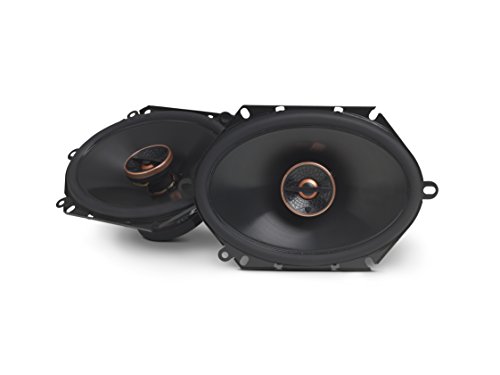
The code is the first specification: REF-8632CFX, with the 86 in front — transposed versions of this model number circulate in sloppy content and point nowhere useful, so copy it exactly. The speaker behind the code is the clarity pole of the shared market: a 6×8 native from Infinity’s Reference line, bringing the family’s efficiency and resolution to the Ford-pattern fitment. On a factory radio — the power source in most of these vehicles, forever — it produces the familiar Infinity effect of an apparent amplifier appearing from nowhere: voices step forward, details surface, and the cabin sounds like a newer truck than the odometer admits.
As a 6×8 native it carries the guide’s standing fitment note for 5×7 readers: the shared pattern makes it a candidate in most 5×7 openings, subject to your measurement, and a certainty in 6×8 ones. Tonally it is the anti-Kicker — leaner, quicker, brighter — which makes the pair of them the shared market’s great taste fork. Trucks and cars that live on talk radio, podcasts and acoustic playlists will find this the most articulate verified option in the fitment; listeners who measure a speaker by warmth should take the fork’s other branch without regret.
- Format: 6×8-inch two-way coaxial pair — a 6×8 NATIVE, labelled as such
- Model code: REF-8632CFX — the “86” leads; verify digit by digit at checkout
- Series character: Reference — the family that puts efficiency and fine detail first
- Power character: the fitment’s best on factory head-unit power
- Best habitat: 6×8 openings; shared-pattern 5×7 openings verified by measurement
Strengths
- Reference clarity and efficiency that transform factory-radio vehicles
- Vocal intelligibility that serves talk-heavy driving beautifully
- A genuinely different flavour from the Kicker anchor — taste can decide
Trade-offs
- Not a native 5×7 — cross-fitting must be measured, not assumed
- Lean, bright balance will read as thin to warmth seekers
- Revealing of poor-quality compressed audio at volume
Best for: clarity-first owners of the shared fitment on factory power. Not suited for: warmth-led listeners, or 5×7 owners unwilling to verify the shared-pattern fit.

JBL Club 864F 6×8 Speakers — 6×8 native: the current Club model
Another designation to buy precisely: Club 864F, the current JBL model in this size, successor to the Club 8622F that no longer lists. The 864F is a 6×8 native — labelled so here as everywhere in this guide — carrying JBL’s Club-line signature into the shared fitment: an energetic, forward presentation with real rhythmic punch and a treble that sparkles, powered happily by the factory units these vehicles run. Where the Infinity is the fitment’s analyst, the JBL is its entertainer, and in the noisy, working cabins this size serves, entertainment is a serious engineering brief.
The verified listing states its power figures in both continuous and peak terms, a small honesty this guide appreciates and repeats only qualitatively: this is a speaker designed for real head-unit life with headroom to spare, not a numbers-display piece. For 5×7 readers it stands with the other 6×8 natives under the shared-pattern rule — measure, confirm, then enjoy the widest shelf in the category. For 6×8 natives it is the extrovert alternative to Pioneer’s all-round game and Infinity’s clarity, completing a trio of big-brand temperaments that the dual-fit Kicker and native Kenwood frame from either side.
- Format: 6×8-inch (152x203mm) two-way coaxial pair — a 6×8 NATIVE, labelled as such
- Model note: Club 864F is the current designation — successor to the discontinued Club 8622F
- Power character: rated for honest head-unit life with headroom, per the verified listing
- Series character: Club — JBL’s energetic mainstream line
- Best habitat: 6×8 openings and verified shared-pattern 5×7 fits, in lively cabins
Strengths
- JBL energy and punch for cabins that compete with road and work noise
- The current Club designation, verified — no discontinued-model hunting
- Completes a genuine range of temperaments in the shared fitment
Trade-offs
- Not a native 5×7 — the shared-pattern fit needs your tape measure’s blessing
- Forward treble can fatigue on long, bright drives
- Energy-first tuning is wasted on near-silent, talk-only cabins
Best for: 6×8 owners and verified 5×7 cross-fitters who want the extrovert option. Not suited for: mellow listeners, or any buyer ordering by the old 8622F name.
5×7/6×8 Component Class (Prose-Only) — For front-door perfectionists in this fitment
The final pick is a class rather than a listing: component sets in the shared 5×7/6×8 fitment — separate oval woofers, separate tweeters for the A-pillars or mirror triangles, and outboard crossovers — exist in the wider market for the front-door listeners this size occasionally produces. The pool verifies no example of the class, so it is presented in prose, offered with the criteria that govern safe shopping in the class: confirm the set is genuinely component (separate tweeters in the box contents, not in the headline), confirm its native size label exactly as this guide has modelled, and budget the half-day installation the format always demands.
Who should bother? The driver of a keeper Ford-pattern car whose front doors are their concert hall, and who has already decided the coaxial ceiling — a soundstage at ankle height — is the one thing they cannot un-hear. For that listener, the class delivers the format’s usual transformation inside this fitment’s oval geometry. For everyone else, the five verified coaxials above cover the territory with less money and far less Saturday. The class is included so the map is complete, and labelled so the map stays honest: a direction to explore, not a product this page can hand you.
- Format: component class — separate woofers, tweeters and crossovers in the shared fitment
- Listing status: a class sketch in prose — the pool links no example of it
- Shopping tests: true component contents; exact native size label; installer time budgeted
- Install commitment: the full component project, tweeter placement included
- Best habitat: front doors of keeper vehicles with committed listeners
Strengths
- The lifted soundstage no coaxial in this fitment can offer
- Oval cone area with component refinement — the fitment’s ceiling
- A complete map of the category includes its summit, honestly labelled
Trade-offs
- Nothing verified to link — the hunting and checking fall to the buyer
- The full component installation, in doors never designed for it
- Wasted entirely in rear locations, where the class’s virtue cannot be heard
Best for: front-stage perfectionists in Ford-pattern keepers. Not suited for: everyone else — the verified coaxials above are this fitment’s working heartland.
Comparison Table
| Pick | TRUE native size | Format | Character | Choose it when |
|---|---|---|---|---|
| Kicker CSC68 | DUAL-FIT 5×7 + 6×8 | Coaxial, verified link | Warm, controlled | You want one pick for the whole shared fitment |
| Kenwood KFC-C5798RS | 5×7 native | Coaxial, verified link | Even, composed | Your opening is truly 5×7 and you want a native fit |
| Pioneer TS-A6880F | 6×8 native | Coaxial 4-way, verified link | Lively, broad | You run 6×8, or a verified shared fit |
| Infinity REF-8632CFX | 6×8 native | Coaxial, verified link | Clear, efficient | Factory power and vocal clarity lead |
| JBL Club 864F | 6×8 native | Coaxial, verified link | Energetic, punchy | You want the current Club temperament |
| Component class | Shared fitment class | Component, prose-only | Spacious, refined | Front doors justify the full install |
Why Do the Best 5×7 Car Speakers Share a Pattern With 6×8?
The kinship is a manufacturing inheritance. When Ford standardised on the smaller oval across its range, the aftermarket answered with speakers whose frames and hole patterns served that opening; the slightly larger 6×8 variant grew from the same pattern family, close enough in its mounting geometry that the two sizes became interchangeable in most of the vehicles concerned. Makers then designed for the overlap deliberately — Kicker’s dual-fit CSC68 is the philosophy cast in plastic — because one product serving two labels halves the inventory a retailer must stock for the same fleet of doors. The beneficiary is you: a shelf effectively twice as wide as either label alone, provided the labels themselves are never blurred. Hence this guide’s double discipline — shop the whole shelf, read every label literally.
How Do You Verify the Fit in Your Specific Vehicle?
Three measurements and one trial settle it. Measure the opening’s length and width with the old speaker out, and the depth behind it to the nearest obstruction — window glass at full drop is the classic surprise. Compare all three against the candidate’s published dimensions, not its size name. Check the mounting-hole pattern against the new speaker’s frame or adapter. Then, before committing the second side, trial-fit the first speaker fully — mounted, connected, window cycled, trim offered up — because the first door is the experiment and the second is the production run. Vehicles in this fitment are old enough to have histories; a previous owner’s improvisation behind a panel is common, and the trial fit is how you meet it on your terms.
Which Vehicles Actually Use This Fitment?
Ford’s catalogue is the heartland — generations of its cars, trucks and SUVs carried the size in doors and rear quarters — with the wider Ford family brands and a scattering of other makers’ models joining over the decades. The practical consequence is a fitment with unusually good support: adapter harnesses, mounting information and accumulated installer knowledge exist for nearly every vehicle that uses it, because the fleet is so large. If your vehicle is in that fleet, you are shopping one of car audio’s best-documented sizes. If it is not — if your 5×7-labelled opening belongs to an outlier — the measurement discipline matters doubly, since outlier openings are where shared-pattern assumptions go to be humbled.
What Mistakes Do Buyers in This Fitment Make?
Ordering by a dead designation leads the list — the KFC-C5796PS and Club 8622F patterns, both cured by this guide’s current names. Transposing a model code comes next, with the REF-8632CFX’s digits the standing example. Third is assuming the shared pattern without measuring, a usually-safe bet that punishes the minority of tight installations all the harder for being usually safe. Fourth is buying a “Kicker 5×7” from a listing that invented the product — the CSC68 is the whole Kicker story in this fitment. And fifth is forgetting that rear quarters in trucks often run shallow, so depth, not diameter, is the dimension that bites. Each mistake is a five-minute check declined; the guide has now made all five checks for you once, and the habit is yours to keep.
How Should Front and Rear Choices Differ in This Size?
The shared fitment often appears at both ends of the same vehicle, and the two ends want different things. Front doors serve the driver’s ears and justify the controlled or clarity-led picks — CSC68, Infinity, or the component class for the committed. Rear quarters and decks serve fullness and passengers, where the Kenwood’s evenness or a second pair of CSC68s keep the voicing family intact. Mixing families across the cabin is the error to avoid: a brilliant front with a boomy rear, or the reverse, makes the fader a referee rather than a control. One family, two roles, balanced from the driver’s seat — that is the shared fitment’s reference system, and every pick here was chosen to be able to play its half of it.
What About Power, Sensitivity and the Working-Vehicle Reality?
These speakers live in working vehicles — trucks that idle at sites, family SUVs on school runs — powered almost always by factory head units of modest output. Sensitivity is therefore the specification with a job: the efficient Infinity makes a stock radio sound upgraded, while the rest trade a little of that thrift for warmth or energy. All five verified picks are designed for exactly this power reality, which is why none of them needs an amplifier to justify itself and why peak wattage theatre matters even less here than elsewhere. If amplification ever arrives, the CSC68 and the Kenwood have the composure to use it; if it never does, nothing on this page feels unfinished. Buy for the truck you have, not the build thread you admire.
How Does the Oval Shape Change the Sound?
An oval cone is a compromise drawn in geometry, and knowing its terms helps you judge the picks. The long axis gives the 5×7/6×8 a radiating area in the 6.5-inch round’s neighbourhood — hence the size’s surprising fullness and midbass ease — while the uneven dimensions spread cone resonances across a wider band rather than concentrating them at one frequency, which many listeners experience as smoothness. The costs are dispersion quirks: an oval beams differently along its two axes, so orientation matters, and most of these speakers can be mounted in either orientation to suit the door’s shape and the listener’s position. None of this makes the oval better or worse than a round speaker; it makes it different in ways a thoughtful installer can use, and it explains why this odd shape has survived fifty years of round rivals — in the doors it fits, it earns its keep.
What Should Truck Owners Specifically Consider?
Trucks dominate this fitment’s fleet and impose their own conditions. Cab noise floors are higher, so composure at volume — CSC68, Kenwood — outranks delicacy. Door depth behind big truck panels is usually generous, which relaxes the fitment question and makes the shared-pattern cross-fits safer bets than in tight cars. Rear quarters in extended and crew cabs sit close to passengers’ ears, arguing for the warmer, less fatiguing picks behind and reserving brightness for the front. And trucks work for a living: dust, door slams and temperature extremes are the daily round, which favours the synthetic-coned, simply built designs that fill this page over anything exotic. Specify for the vehicle’s actual life and the shared shelf narrows itself kindly.
How Do You Handle a Vehicle With Mismatched Front and Rear Labels?
Plenty of vehicles in this family carry one label in front and the other behind — a 5×7 door with 6×8 quarters, or the reverse — which is precisely the situation the shared market was born for. The CSC68’s dual-fit makes it the natural single answer across such a car, one voicing family in every hole. Where taste or budget splits the purchase, keep the family discipline the earlier section described: choose the front pair for the driver’s ears, the rear for fullness, and let the fader reconcile them. Photograph each opening before ordering anything, because mismatched-label cars are also the ones where a previous owner may have standardised, trimmed or improvised — the tape measure outranks the badge on the door card, every time.
What Is the Sensible Fitting Order for This Fitment?
Sequence the job the way installers do. Research your exact vehicle’s panel removal before touching it — this fleet’s clips and fasteners vary by generation, and the knowledge is all documented thanks to the fleet’s size. Assemble adapters and harness connectors in advance so no factory wire is cut. Do the driver’s door first and completely, including a polarity check and a window cycle, while your patience is fresh. Then replicate. Test the whole system before the last trim piece returns, with the fader and balance walked through their ranges. The shared fitment’s one unique trap — assuming the second side mirrors the first in a mismatched-label car — is defeated by treating each opening as its own measurement exercise. An afternoon, done in that order, ends with a finished vehicle rather than a collection of intentions.
How Long Do Speakers in This Fitment Last?
Longer than their owners usually expect, because the size’s vehicles and speakers age together gracefully. The wear items are the familiar ones — surrounds under sun in rear quarters, terminals in damp doors — and the picks here use synthetic materials chosen for door life. A decade of service from a verified pick in ordinary use is unremarkable; the factory speakers these replace typically died of their paper cones and foam, not of the fitment. You can extend any pick’s tenure with the standard kindnesses: replicate factory water shields, keep connections clean, and avoid the boosted-distortion habit that cooks voice coils in any size. When a speaker in this fitment eventually fades, its replacement will still be on this shelf — the fleet’s size guarantees the aftermarket’s attention for years to come.
Why Does Accurate Labelling Matter More in This Fitment Than Any Other?
Because this is the one size class where the industry’s own behaviour tempts everyone to blur. When makers design dual-fit products, retailers list one speaker under two size keywords, and vehicles accept either label, the path of least resistance is to call everything both things and let the buyer sort it out. The cost of that blur lands in the usual places: the tight installation where the half-inch was real, the order placed under a transposed code, the discontinued designation bought in good faith. This guide’s labelling — native sizes stated, dual-fit stated, current designations stated — is not pedantry about an oval; it is the recognition that in a shared market, the label is the only thing distinguishing one honest shelf from a pile of maybes. Shop with sellers who label as carefully, and the fitment’s famous flexibility stays a gift instead of becoming a gamble.
How Should You Choose Between the Three 6×8 Temperaments?
Once measurement has admitted the 6×8 natives to a 5×7 car’s shortlist — or if your car is 6×8 from birth — the decision among Pioneer, Infinity and JBL is a pure taste fork, and it deserves a clean framework. Choose the Pioneer if your listening is everything-at-once and your priority is a speaker that never puts a foot wrong: broad, lively, forgiving. Choose the Infinity if your hours are talk and detail, your radio is staying, and your cabin is quiet enough to let resolution speak. Choose the JBL if your cabin competes with the world — open windows, work noise, energetic playlists — and you want the speaker that competes back. None of the three is the fitment’s secret best; each is the best answer to a different description of a driving life, and describing yours honestly is the entire method.
What Does the Second-Hand Market Look Like in This Size?
Deep, cheap and treacherous in the usual proportions. The fleet’s size means used examples of every pick here circulate constantly, including the discontinued designations this guide warned against, sometimes honestly described and sometimes wearing their successors’ names. The format’s checks apply with full force: a used oval’s surround has spent years in a stranger’s sun, its history of distorted volume is unwritten, and the saving over new is often small because the new prices in this fitment are already working-vehicle prices. The legitimate used purchase is the verified current model, demonstrated working, for a vehicle whose remaining life is short. Everything else is a lottery ticket priced like a saving. New, verified and current is this fitment’s natural state — the shelf is wide enough that nobody needs the lottery.
How Do You Set Up the System Once the Speakers Are In?
The shared fitment’s vehicles reward the standard routine with unusual generosity, because their factory baselines are usually so tired. Start flat — tone centred, loudness off — and set balance and fader from the driver’s seat with a familiar voice recording, which should sit centred and solid. Walk the volume to your honest cruising level and listen for the door or quarter that rattles; cure it with foam, not with the dial. Give the new surrounds their week before judging bass, and resist the lowest equaliser band entirely — the ovals’ area gives them honest midbass, and boosting under it buys distortion in any size. If the vehicle carries both labels front and rear, recheck the fader after a few days of mixed driving; the rear quarters in trucks sit closer to ears than intuition suggests, and a click of fader is often the difference between a stage and a surround-sound accident.
What Accessories Earn Their Place in This Fitment?
The fleet’s popularity means the accessory shelf is deep, and most of it is optional. Vehicle-specific harness adapters earn their money almost always, preserving factory wiring in vehicles that may outlive two more owners. Mounting adapters earn theirs where a shared-pattern fit needs the pattern translated for a particular door. Foam gasket tape earns its pennies everywhere. Beyond that shelf, spend only against a named fault: a measured depth problem, a located rattle, a water path that needs a shield. The picks themselves need nothing exotic, and in working vehicles the discipline of a short accessory list is what keeps a speaker upgrade from becoming a project with a parts cannon. Fit the speakers, cure the rattles, keep the change.
How Does This Fitment Serve Electric and Hybrid Conversions?
A growing corner of this fleet is being electrified or hybridised by enthusiasts, and quiet drivetrains change the speaker brief in the ways earlier guides on this site have noted: listening drops to lower volumes, where efficiency and low-level manners matter more than maximum output, and cabin silence exposes every rattle the old engine used to cover. The Infinity’s thrift and the Kenwood’s composure gain ground in such vehicles; the JBL’s extroversion, built for competing with noise, spends its talent where there is less noise to fight. The fitment itself is indifferent to the drivetrain — the doors do not care what turns the wheels — but the choice among its picks should hear the new quiet and answer it.
What Should You Tell Your Installer — or Your Future Self?
Whether the hands are a professional’s or yours next spring, leave the vehicle a note. Record which picks went where, under which designations they were ordered, what adapters were used, and how the fader and tone were finally set. This fleet’s vehicles pass through owners and workshops for decades, and the note converts the next person’s archaeology into a lookup. It also protects your own work: when a quarter speaker fades in year six, the note says whether it was the CSC68 or the Kenwood, and the replacement order takes a minute instead of a door panel. Small disciplines like this are the unglamorous difference between a fleet that stays musical for thirty years and one that dissolves into mismatched singles — and this fitment, above all others, is a thirty-year fleet.
How Do You Know the Job Is Finished?
When the truck or car simply sounds like itself on its best day — voices clear at cruising speed, the cabin full without effort, no rattle auditioning on the bass notes, and your hand leaving the volume control alone for whole journeys. Every verified pick here can deliver that finish line in its assigned role; the component class exists for the owners who want one more rung, and the guide has labelled it as honestly as the rest. Recognising “finished” matters in a working vehicle’s life, because the vehicle has other claims on your weekends. Fit the right oval well, set it once with care, and let this odd, shared, enduring size go back to doing what it has done for fifty years — making ordinary journeys sound better than they have any right to.
What Genres and Duties Suit This Fitment Best?
The size’s working life has a soundtrack: talk radio and sport across long counties, classic rock and country — the genres its fleet grew up with — podcasts through the commute, and the occasional full-volume Friday drive home. The picks divide that soundtrack naturally. Talk belongs to the Infinity’s clarity and the Kenwood’s evenness. The rock-and-country heartland belongs to the CSC68’s warmth and control, with the Pioneer’s breadth a step behind. Energetic modern playlists in noisy cabs are the JBL’s home fixture. None of this is a rule — ears outrank genres — but a buyer who recognises their own soundtrack in one of those descriptions has effectively made the choice, and the rest of the guide becomes confirmation rather than research.
How Should You Budget Across a Whole Vehicle in This Size?
A four-speaker vehicle in this fitment tempts two budgets: uniform, or weighted. Uniform — the same pick in every hole — is simple, tonally seamless, and well served by the CSC68’s dual-fit design. Weighted — the better pair in front, the honest pair behind — spends where the driver sits and is the connoisseur’s answer on the same money. What the budget should never do is invert: premium rears behind factory fronts, a pattern seen whenever a deck is easier to reach than a door. Add the fitting accessories and, where the vehicle is a keeper, a little door treatment to the same ledger, and hold a small reserve for the clip or connector that will inevitably break on a twenty-year-old panel. Planned this way, the whole vehicle is one purchase with four addresses, and it will sound like it.
A Note on Orientation: Which Way Should the Oval Point?
Because an oval radiates differently along its axes, some installers in this fitment experiment with rotating the speaker in its opening where the pattern allows — long axis vertical in a door, horizontal in a quarter — and report small differences in how the sound spreads across the cabin. Treat this as the finishing school of the install, not its foundation: get polarity, sealing and balance right first, live with the maker’s intended orientation for a week, and only then, if curiosity persists, try the rotation on one side and compare honestly from the driver’s seat. Many owners hear nothing worth keeping; some find a spread they prefer. Either result is a success, because the experiment costs an hour and teaches you your own cabin — which is the real subject of every section in this guide.
Final Recommendation
Start with the CSC68 unless your case argues otherwise — one dual-fit Kicker covering the whole shared market is the closest this category comes to a universal answer. Argue for the Kenwood KFC-C5798RS, under its current name, when your opening is truly 5×7 and native fit matters. Cross to the 6×8 natives by temperament once your measurement blesses the shared pattern: Pioneer for lively breadth, Infinity REF-8632CFX — digits exact — for clarity on factory power, JBL Club 864F for current-model energy. And keep the component class in mind if your front doors ever demand the summit. Two labels, one market, six honest ways through it — that is the whole story of this odd, enduring size.
Frequently Asked Questions
Will a 6×8 speaker fit my 5×7 opening?
In most vehicles using this fitment, yes — the two sizes share a mounting pattern family, which is why this guide treats them as one market. “Most” is not “all”: measure your opening and depth, compare the candidate’s dimensions, and trial-fit one side before committing. The 6×8 picks here are labelled as 6×8 natives wherever they appear.
Does Kicker make a dedicated 5×7 speaker?
No. Searches for DS- and CS-series 5×7 models confirm none exists; Kicker covers the whole fitment with the dual-fit CSC68, which mounts in both 5×7 and 6×8 openings. A listing selling a distinct “Kicker 5×7” model should be read with suspicion.
What is the current Kenwood model in this size?
The KFC-C5798RS, the verified successor in this guide. Its predecessor, the KFC-C5796PS, no longer has a listing, so order by the C5798RS designation to receive the speaker reviewed here.
Is the Infinity code 8632CFX or 6832CFX?
It is REF-8632CFX — the 86 leads. The transposed version circulates in careless content and does not identify this speaker. Copy the code digit by digit when ordering, as with the JBL Club 864F, whose predecessor 8622F is discontinued.
Which pick is best for a truck’s front doors?
The CSC68 for most owners — controlled, warm-leaning, and happy on factory power. Talk-heavy drivers may prefer the Infinity’s clarity if their fit is verified, and the prose-only component class is the ceiling for keepers whose owners will do the full install.
My vehicle has 5×7 in front and 6×8 in the rear. What should I buy?
The shared market was made for your car. The simplest answer is the dual-fit CSC68 in all four holes — one voicing family, one order, no fitment arithmetic. The weighted answer is a front pair chosen for your ears (CSC68, or the Infinity if its fit verifies and clarity leads) with CSC68s or the Kenwood behind. Either way, balance the finished system from the driver’s seat and keep the family voicing consistent across the cabin.
How long does fitting a pair take in this size?
For the coaxial picks, plan an hour for the first door of an unfamiliar vehicle and half that per side once your hands know its clips — this fleet’s panel procedures are well documented, which helps. Rear quarters in trucks can be quicker or more stubborn depending on trim. The prose-only component class is the exception: set aside half a day, and audition tweeter positions with temporary mounts before drilling anything.
Do these speakers need an amplifier?
No. Every verified pick is designed for factory head-unit life, which is the power reality of this fitment’s fleet. Amplification adds composure for the CSC68 and Kenwood in particular, but it is an optional refinement, never an entry requirement.
Should I replace all four speakers at once in an older Ford?
Not necessarily, and doing the front pair first is usually the smarter sequence. The front speakers carry the voices, the melody and most of what you actually listen to, while the rear pair mostly fills the cabin behind you, so a tired front set replaced with any pick in this guide transforms the system for roughly half the effort. Replace the rears later with the same model line if you want the tonal match, or leave them entirely if the budget is tight — the shared 5×7/6×8 fitment means the same shortlist applies when you come back for the second pair, and nothing about the first installation has to be undone to add them.
Related Guides
Continue with the best 5.25-inch speakers for the smaller Ford-adjacent fitments, the budget treatment in the best budget 6×9 speakers for rear-deck value, and the format-deep dive in the best 5.25-inch component speakers.


