What's inside
- Key Takeaways
- Quick Picks
- How Did These Six Systems Earn Their Places?
- What Is the Real Difference Between a Component System, a Powered System, and a Soundbar?
- Why Does 5.1 Keep Winning the Affordable Argument?
- How Do You Budget the Whole Installation, Format by Format?
- Six Affordable Systems, Reviewed One by One
- How Should You Choose Between the Two Monoprice Sets?
- Reading the Six Systems Side by Side
- How Does an Affordable System Grow — or Refuse to — Over Five Years?
- What Should Gamers and Sports Viewers Weight Differently?
- How Should a First Surround System Be Set Up on Day One?
- What About the Room Itself — Can a Cheap System Sound Expensive in the Right Space?
- Can a Second-Hand Receiver Make a Passive Package the Cheapest Route of All?
- Which Mistakes Do Affordable Surround Buyers Keep Making?
- Final Recommendation
- Frequently Asked Questions
- Related Guides
As an Amazon Associate I earn from qualifying purchases. This post may contain affiliate links at no extra cost to you.
gizmoverdict.com is reader-supported. When you buy through links on our site, we may earn an affiliate commission.
Where to buy: The six systems below each link to the listing verified for this guide. Read the format line in every review before the sound line — in this category, what a system leaves out of the box matters as much as what it puts in.
The hunt for the best affordable surround sound speakers runs into a vocabulary problem before it reaches a sound problem. The word system hides three entirely different purchases. One is a powered set with its amplification and decoding built in, ready the day it arrives. One is a box of passive speakers that presumes a receiver — an excellent box, and an incomplete purchase. And one is a soundbar, which surrounds you by processing and reflection rather than by speakers placed behind your head. All three can be the right answer. All three are represented below. But a guide that ranked them as though they were interchangeable would be lying with a straight face, so this one keeps the formats separate in every review and every total.
Affordable, as the word is used here, describes a system’s whole cost of arrival: the box, plus the receiver if it needs one, plus cable, plus the stands or mounts its surrounds require. Measured that way, the rankings shuffle. The passive package with the friendliest ticket can finish as the expensive option; the powered system with the higher ticket can finish as the bargain, because it asks for nothing else, ever. The soundbar sits between, complete on day one and closed forever after. None of those shapes is a trap — they are simply different financial geometries for the same Friday night, and the reviews below keep each system’s geometry visible from its first paragraph.
What affordable may not mean, in any format, is the sacrifice of the two elements that make surround sound worth having. The first is a centre channel that keeps dialogue anchored and intelligible at the volumes real households use after nine in the evening. The second is a subwoofer under control — one that underlines a door slam instead of auditioning for its own solo. Every system below protects both. Where each one economises instead — cabinet scale, amplifier flexibility, connectivity, the last degree of output — is written into its review, because in this category the location of the compromise is the most useful fact a buyer can own.
Key Takeaways
- The Logitech Z906 is the only fully self-contained component-style set here: amplification and Dolby Digital and DTS decoding live inside the system, per its title, so no receiver joins the bill.
- The Fluance Elite 5.1 is the traditionalist’s value: genuine three-way tower fronts and a DB10 subwoofer, with a five-channel receiver as the necessary second purchase.
- Monoprice fields two different answers — the Premium 5.1.4 adds four height channels for Atmos, the Premium 5.1 keeps the same idea simpler and cheaper to feed.
- The Energy Take Classic remains the small-room reference: five compact satellites voiced to hand over seamlessly to their subwoofer.
- The JBL Bar 500 is the soundbar route — a 5.1-channel bar with MultiBeam and Dolby Atmos that simulates the rear field instead of placing speakers in it.
- Count every candidate as a finished installation, not a box: receiver, cable, and stands are part of some of these prices and none of others.
Quick Picks
| Pick | Badge | Why it is here |
|---|---|---|
| Logitech Z906 | The self-powered 5.1 | THX-certified, decoding and amplification built in — surround for desks and small lounges with no receiver anywhere. |
| Fluance Elite 5.1 System | The tower-fronted package | Three-way floorstanding fronts, centre, surrounds and a DB10 subwoofer in walnut, awaiting your receiver. |
| Monoprice Premium 5.1.4 | The Atmos doorway | Four height channels join a 5.1 base in one matched package, the affordable route into overhead sound. |
| Monoprice Premium 5.1 | The honest starter set | Plainly specified five speakers and a subwoofer — the component path’s lowest first step. |
| Energy Take Classic 5.1 | The small-room classic | Five discreet satellites and a governed subwoofer, engineered as one instrument for flats and bedrooms. |
| JBL Bar 500 | The one-bar answer | A 5.1-channel soundbar with MultiBeam width and Atmos decoding for rooms that refuse a speaker project. |
How Did These Six Systems Earn Their Places?
Selection began with format coverage, because the category’s central confusion is format confusion. A shortlist of six passive packages would have ignored the households — renters, desk gamers, minimalists — for whom the powered system and the soundbar are not compromises but the correct engineering. So the six divide deliberately: one powered set, three passive packages at three different ambitions, one satellite classic, and one bar. Within each format, the filter was the protection of the essentials described above: a real centre voice, a subwoofer with manners, and surrounds that are actual loudspeakers rather than tokens. Systems that saved money by hollowing out the centre channel were excluded regardless of their other charms.
The second filter was documentary honesty. Each pick’s title had to state its configuration plainly enough that a buyer could plan around it — channel count, subwoofer specification, decoding where the format includes it. That is why the Monoprice sets, whose titles read almost like specification sheets, sit comfortably here, and why the soundbar’s title matters too: the Bar 500 calls itself a 5.1-channel soundbar, and this guide holds it to exactly that claim — a bar that renders a 5.1 presentation from the front of the room, not a bar that places sound behind you. Where a title is silent, the reviews say what the format implies and no more.
What Is the Real Difference Between a Component System, a Powered System, and a Soundbar?
Strip the marketing away and the three formats differ in two things: where the amplification lives, and whether any part can ever be replaced. In a component system — the Fluance, both Monoprice sets, and the Energy — the speakers are passive and the amplification lives in a separate receiver you supply. That separation is the format’s genius and its cost. Genius, because any element can be upgraded, repaired, or replaced independently across decades; cost, because the receiver is a second purchase with its own learning curve, and the system’s true price is never the number on the speaker box. A component system is not a product. It is the first instalment of an architecture.
In a powered system — here, the Z906 alone — amplification and decoding are built into the speaker set itself, historically into the subwoofer’s cabinet, and the architecture collapses into an appliance. You gain completeness and simplicity; you surrender the upgrade path entire. When a powered system’s electronics age out, the speakers retire with them, however sound their drivers remain. In a soundbar, the collapse goes further: the front three channels merge into one cabinet, the surrounds become processing, and only the subwoofer stays separate, usually wireless. You gain the simplest installation in home audio and a room with no cable runs; you surrender physical rear sound and, again, all upgrade paths. Neither surrender is foolish. Households that move every few years, or that value a room’s appearance over a system’s ceiling, rationally choose the appliance over the architecture every time.
Why Does 5.1 Keep Winning the Affordable Argument?
Because 5.1 is where surround sound’s geometry becomes complete and its returns start diminishing. Left and right carry the scene and the score. The centre — the channel this guide refused to compromise — carries the voices. Two surrounds open the world beside and behind the seat. The subwoofer carries the weight that small cabinets cannot. That is the whole grammar of cinematic sound, and the overwhelming majority of films, series, broadcasts, and games are mixed with exactly that grammar as their reference. Everything added beyond it is refinement: rear surrounds widen the back field, height channels open the ceiling. Refinement is lovely. It is also precisely where an affordable system should economise, and five of these six picks do.
The exception proves the rule by pricing it. The Monoprice 5.1.4 exists so a buyer can see exactly what the first refinement costs: four height channels, a receiver with four more channels of amplification to feed them, and a ceiling suitable for the up-firing method the package uses. For the household streaming Atmos mixes nightly under a flat ceiling, that bill can be worth paying. For everyone else, the same money parked in a better 5.1 base — or simply kept — buys more audible improvement. Affordable is not a synonym for minimal. It is a synonym for spending where the geometry is founded rather than where it is decorated.
How Do You Budget the Whole Installation, Format by Format?
Work the arithmetic in the open, because each format hides its extras in a different place. A passive package’s second invoice contains the receiver, and the receiver’s tier is set by the package’s ambitions: five channels of mainstream amplification for the 5.1 sets, nine for the 5.1.4, with the price gap between those receiver tiers being one of the largest single numbers in this entire category. Add speaker cable measured along walls rather than across floors, a subwoofer lead, and stands or wall mounts for the surrounds if the room offers them no furniture. A household that prices only the speaker box will under-budget a passive system by a wide and entirely predictable margin.
The powered system and the soundbar hide nothing, and that is their budgetary elegance: the ticket is the total, plus perhaps a longer HDMI cable. Their costs arrive later and differently — as the absence of options. When a powered system’s amplifier section eventually fails, the repair bill is a replacement system; when a soundbar owner’s room changes, the bar’s width effect changes with it and cannot be re-aimed. None of this makes the closed formats bad value. Over a five-year horizon in a stable room, a complete powered system can be the cheapest surround sound per evening of use in this guide. It makes them finite value, which a buyer should choose knowingly rather than discover.
The practical method is a two-column list per candidate: what the box costs, and what the first playing evening costs. For the passive sets, the second column is the honest one and the one to compare against the closed formats’ single figures. Buyers are often surprised to find the Fluance package plus a receiver landing near a premium soundbar’s territory — and equally surprised to realise the comparison still favours the package for a settled household, because the receiver and towers will outlast two generations of the bar. Affordable is a horizon, not a number, and the horizon you are buying for is a legitimate thing to decide before the models are.
Six Affordable Systems, Reviewed One by One
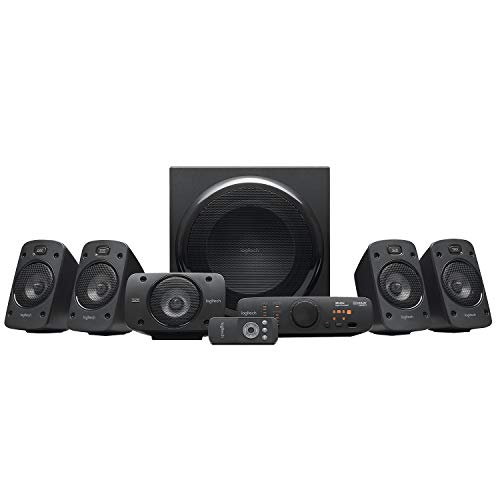
Logitech Z906 — The self-powered 5.1
The Z906 began life in the personal-computer world and never lost that world’s best habit: everything in one box, working by the weekend. Its title carries the full claim — a 5.1 surround system, THX certified, with Dolby Digital and DTS decoding handled inside the system and power quoted in both peak and RMS terms, of which the RMS figure is the one a planner should respect. Five satellites, a substantial subwoofer that houses the amplification, and a desktop control console complete a package that needs no receiver, no speaker cable shopping, and no configuration weekend. For a desk setup, a gaming room, or a small lounge, it remains the shortest honest distance between a television’s speakers and genuine surround sound in this entire guide.
There is a social detail worth recording about the console: because the Z906’s controls live on a desktop unit rather than inside a receiver’s menus, guests, partners, and children can operate it without a induction ceremony. Volume, input, and effect are physical and immediate. Systems that live on desks and in shared rooms get used more when they are operable by everyone in the household, and a surround system that gets used nightly at moderate volume delivers more actual value than a grander one reserved for occasions. The Z906’s longevity in the market owes as much to that operability as to any figure in its title.
Its performance follows its design centre. In the near field of a desk or across a small room, the Z906 plays with a punch and a clarity that embarrass grander systems loafing below their potential, and its console makes input-switching between a computer, a console, and a television genuinely painless. The boundaries are equally clear. The satellites are small, so a large room will find the system’s ceiling; the amplification is fixed, so there is nothing to upgrade into; and the whole set ages as a unit, electronics and drivers together. None of that matters to the buyer it suits. Purchased as a finished appliance for a room of the right size, the Z906 is among the most satisfying objects in this category — and purchased as the seed of a future theatre, it is simply the wrong format wearing a friendly face.
- Configuration as titled: 5.1 surround, THX certified
- Decoding as titled: Dolby Digital and DTS, performed inside the system
- Power as titled: quoted in peak and RMS terms — plan around the RMS figure
- Amplification: built in; no receiver required, and none can be added
- Home ground: desks, gaming rooms, small lounges
Strengths
- Nothing else to buy — the only component-style set here that is complete in its box
- Decoding and certification credentials stated plainly in its own title
- Console control suits multi-source desks better than any receiver remote
Trade-offs
- Closed appliance: when the electronics age, the system retires whole
- Satellite scale caps large-room volume and stereo spread
- No path to height channels or a bigger front stage later
Best for: a desk, gaming room, or small lounge wanting real surround with zero receiver involvement. Not suited for: a growing theatre, a large room, or an upgrader’s first instalment.
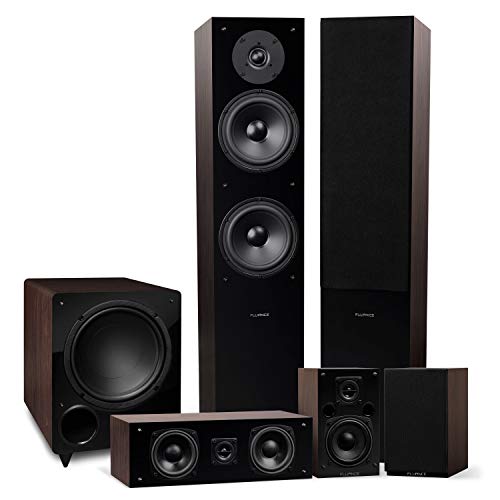
Fluance Elite 5.1 System — The tower-fronted package
Most affordable packages shrink the front speakers to satellites and ask the subwoofer to cover the gap. The Elite 5.1 refuses that economy, and its title describes the refusal: a 5.1 system built on three-way floorstanding towers, with a centre channel, rear surrounds, and Fluance’s DB10 subwoofer, finished in walnut. Towers at the front change the system’s character in ways no specification captures. Stereo music becomes a hi-fi experience instead of a theatre idling between films; film scores acquire bodies; and the centre channel works against a front stage with genuine scale behind it, so voices sit inside the scene rather than floating in front of a miniature one.
A word about the walnut finish, since it is in the title and in the room: at this tier, finishes are usually black ash and an apology, and a warm wood tone that lets towers sit beside real furniture without reading as equipment is a genuine quality-of-life feature. The Elite package is the only system in this guide a household might choose partly for how it looks standing still, and in a living room — as opposed to a dedicated theatre — that is not a frivolous consideration.
The condition is printed on the format, and this guide will keep printing it: these are passive speakers, and a five-channel AV receiver is a separate, necessary purchase, along with the cable to wire five speakers and a subwoofer lead. Counted honestly as a total — package plus a sensible mainstream receiver — the Elite 5.1 still lands in the affordable tier of component audio, and it buys the architecture’s full promise: every element upgradeable, the towers good enough to anchor the next two receivers you own. For a settled household building its first real theatre in a room that can place towers, this is the strongest long-term value in the guide, and the review’s enthusiasm should be read with its condition attached, the way the price should be.
- Configuration as titled: 5.1 — three-way floorstanding fronts, centre, rear surrounds, DB10 subwoofer
- Finish as titled: walnut
- Amplification: none in the box; a five-channel AV receiver is required
- Series: Elite, the value tier of Fluance’s three speaker families
- Room ask: floor space for towers, side or rear positions for surrounds
Strengths
- Tower fronts give music a full-size stereo stage no satellite set matches
- The centre and DB10 protect dialogue and bass, the two essentials
- Enters the component architecture at a friendly finished total
Trade-offs
- The receiver and cable sit outside the box price — the real total is higher
- Towers demand a room that can place them with clearance
- Setup is a project measured in an afternoon, not an unboxing
Best for: a settled living room building a first component theatre meant to be kept and grown. Not suited for: renters, small rooms, or anyone whose budget ends at the box.
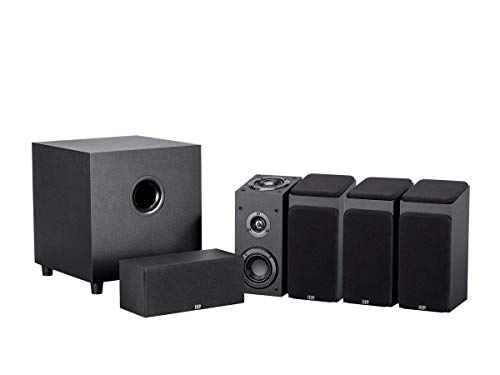
Monoprice Premium 5.1.4 — The Atmos doorway
Every affordable-system shopper eventually asks what the height dimension costs, and this package is the category’s most direct answer. Its title lays the architecture out flat: a premium immersive home theatre system in a 5.1.4 configuration, Dolby Atmos compatible, with an 8-inch, 200-watt subwoofer. Translated from the numerals, that is the full 5.1 grammar — fronts, centre, surrounds, subwoofer — plus four height channels, delivered by up-firing drivers that bounce the overhead layer off the ceiling. Rain that actually falls, aircraft that actually pass over, a cathedral’s sense of vertical air: the 5.1.4 is the only system in this guide that can even attempt those effects, and it attempts them at a package price the flagship world would consider a rounding error.
One underappreciated pleasure of the package is what it does to ordinary 5.1 content while the owner waits for Atmos evenings to accumulate. A nine-channel receiver driving a matched nine-speaker set gives the surrounds and the front stage a coherence that mixed-and-matched systems assemble only by luck, and the height speakers, idle on paper, sit ready for the growing share of streamed mixes that use them. The purchase is a bet on a catalogue direction, certainly — but it is a bet whose stake also pays out on tonight’s ordinary film.
The conditions deserve the same prominence as the promise, and there are three. First, the ceiling: up-firing height channels need a flat, reasonably reflective ceiling at a conventional height, and they fail gracefully but completely under vaults, beams, and heavy texture. Second, the receiver: nine channels of amplification are required, which steps the second purchase up a tier from the five-channel units the other passive sets need. Third, the scale: these are satellite-class speakers, tidier and smaller-voiced than the Fluance’s towers, so the system’s front stage trades muscle for dimension. A flat-ceilinged room that streams and games in Atmos nightly will call those fair trades. A vaulted room should save its money and take the plainer sibling below — the honest sequencing this guide exists to provide.
- Layout, in the title’s own terms: 5.1.4 immersive system — five ear-level channels, one subwoofer, four height channels
- Subwoofer, as the title specifies it: 8-inch, 200 watts
- Height method: up-firing drivers reflecting off the ceiling — architecture-dependent
- Amplification: none in the box; a nine-channel Atmos receiver is required
- Finish as titled: black
Strengths
- The overhead dimension at an affordable-tier package price
- A matched nine-speaker set removes all speaker-matching guesswork
- Subwoofer and configuration stated in the title without adjectives
Trade-offs
- Height effect collapses under vaulted or absorbent ceilings
- The nine-channel receiver requirement raises the finished total sharply
- Satellite scale trails the Fluance towers for music and front-stage weight
Best for: a flat-ceilinged room committed to Atmos streaming and gaming, wanting height now rather than eventually. Not suited for: vaulted ceilings, music-first listeners, or a receiver budget capped at five channels.

Monoprice Premium 5.1 — The honest starter set
If the 5.1.4 is Monoprice reaching upward, the Premium 5.1 is the same company keeping its feet on the ground: five speakers and a subwoofer, described in its title with a plainness the whole category could study — 100-watt speakers, a 200-watt subwoofer, black finish, no adjectives doing unpaid work. This is the set for the buyer who has absorbed the geometry argument, decided that completeness at 5.1 beats ambition at 5.1.4 in their room, and would rather the difference in money improve the receiver, fund the cable, or stay in the bank. There is no narrative trick in it, and that is its charm.
Judge it by coherence rather than scale. The five speakers are compact and matched, and a matched five disappears into a film in a way a scavenged five never does: dialogue anchored, the rear field continuous, the subwoofer handing over without a audible seam at the volumes small and medium rooms use. Its second identity matters as much — this is the component architecture’s lowest first step, and every speaker in it can be upgraded individually as taste and budget mature, fronts first, in the classic sequence. Households that suspect they are becoming enthusiasts should start exactly here, where the first purchase is cheap, complete in geometry, and entirely reusable as the system grows around and eventually past it.
- Layout, per the title: 5.1 channel home theatre system with subwoofer
- Power figures, per the title: speakers and subwoofer specified separately and plainly
- Amplification: not included; any mainstream five-channel receiver suits it
- Finish as titled: black
- Role in a system’s life: the entry instalment of the component path
Strengths
- Complete, matched 5.1 geometry at the friendliest component entry total
- Specification honesty makes receiver planning trivially easy
- Every speaker individually replaceable as the system grows
Trade-offs
- Compact cabinets cap large-room scale and stereo music presence
- No height channels, and none addable within the set
- The receiver remains a second purchase, as with every passive set here
Best for: a first component system in a small or medium room, bought deliberately as a foundation. Not suited for: a large room, or a buyer who wants Atmos inside the first purchase.

Energy Take Classic 5.1 — The small-room classic
Some products earn the word classic by surviving, and the Take Classic has survived longer than most of this category’s catalogues. Its formula sounds simple — five genuinely compact satellites and a 200-watt subwoofer, per its title — and conceals the hardest trick in small-system design: the handover. Satellites this small cannot reach down to meet a subwoofer on their own, so the system must be voiced as a single instrument, each satellite’s bottom and the subwoofer’s top shaped to dovetail. Energy voiced it that way, and the result is a set that sounds larger and more continuous than any of its cabinets, which is why it kept being recommended while newer packages with bigger numbers came and went around it.
One more virtue deserves its own sentence, because small-room buyers feel it nightly: restraint at low volume. Satellite systems with a well-judged handover keep dialogue and effects in proportion when the level drops for a sleeping household, where lesser sets lose their bass foundation entirely and turn thin and televisual. The Take Classic’s balance holds together at those neighbourly levels, which is a large part of why flat-dwellers who bought it years ago have not replaced it.
Its virtues are domestic in the best sense. The satellites mount on walls or perch on shelves without colonising them, the subwoofer has authority enough for flats and bedrooms without the boom that starts neighbour disputes, and the balance flatters the dialogue-and-television diet most small rooms actually consume. Its limits are the honest counterparts: scale, in a large room, and the passive format’s standing condition of a receiver purchased separately. Within the rooms it was designed for — the flat, the bedroom, the modest lounge where speakers must be heard more than seen — the Take Classic remains the answer its name claims, neither embarrassed by its age nor in need of apology for it.
- Layout, per the title: complete 5.1 speaker system with a 200-watt subwoofer
- Form: five compact satellites, wall- and shelf-friendly
- Amplification: not included; a five-channel receiver is required
- Design signature: satellites and subwoofer voiced as one instrument around the handover
- Home ground: flats, bedrooms, small lounges
Strengths
- The satellite-to-subwoofer blend is the smoothest in this guide
- Cabinets discreet enough for rooms that reject visible equipment
- A long production life means a deep well of owner experience to draw on
Trade-offs
- Satellite scale finds its ceiling quickly in large or open-plan rooms
- Receiver cost is additional, as with all the passive sets here
- Stereo music is pleasant rather than commanding
Best for: a flat, bedroom, or small lounge where surround must be heard more than seen. Not suited for: open-plan rooms that swallow small speakers, or listeners building around stereo music.

JBL Bar 500 — The one-bar answer
The Bar 500 is what happens when a company that builds loudspeakers for actual cinemas is asked to solve the living room that refuses a speaker project. Its title states its configuration with unusual candour for the format: a 5.1-channel soundbar, with MultiBeam and Dolby Atmos. MultiBeam is JBL’s method of driving the bar’s array so the room’s side walls become collaborators, reflecting a widened sound field back to the sofa — a rendered surround impression rather than a physical rear field — while a wireless subwoofer supplies the foundation from wherever in the room it sounds best. The installation is the simplest in this guide by an enormous margin: one bar beneath the television, one subwoofer in a corner, one cable, done.
There is a second, quieter audience for the bar worth naming: households with a genuinely good stereo system elsewhere, who want the television — a separate room, a separate habit — improved without a second hobby. For them the Bar 500 is not a compromise at all but a boundary, the point where television sound stops expanding. Equipment that knows its job and stays inside it has a honourable place in this guide.
Its buyer has looked at the five systems above and declined their terms — no receiver, no five cable runs, no stands — while still wanting television sound with genuine width, confident dialogue, and bass a television cannot produce unaided. The Bar 500 delivers that brief with particular strength in the midrange, where voices live and where JBL’s cinema heritage shows. What it cannot do, and does not claim to do, is place a sound physically behind you: the helicopter’s exit over your shoulder is suggested from the front, skilfully and unmistakably. Households that accept that trade — and in small and medium rooms, with the walls cooperating, many find the suggestion surprisingly complete — get the most painless major upgrade in this guide.
- Layout, in the title’s words: 5.1-channel soundbar with MultiBeam and Dolby Atmos
- Form: single bar plus wireless subwoofer
- Amplification: built in; no receiver required or possible
- Surround method: processed width reflected from the room’s walls, not rear speakers
- Finish as titled: black
Strengths
- The fastest installation here — an evening’s television transformed within the hour
- Dialogue confidence and front width that shame television speakers utterly
- Wireless subwoofer placement frees the bass from the television wall
Trade-offs
- No physical rear field; surround is an impression, however skilful
- A closed system — no element can be upgraded or replaced alone
- The width effect needs side walls at sensible distances to reflect from
Best for: a living room wanting a major television upgrade with no installation project whatsoever. Not suited for: a listener for whom real speakers behind the sofa are the entire point.
How Should You Choose Between the Two Monoprice Sets?
Because they share a brand, a design language, and most of a name, the two Monoprice packages are the pair buyers most often freeze between — so decide it on the three questions that actually separate them. The first is your ceiling, asked literally: flat, smooth, and at a conventional height, or anything else? Up-firing height channels are a reflection technology, and a ceiling that cannot return the reflection turns the 5.1.4’s defining feature into four speakers performing for nobody. The second question is your content, asked honestly: how many evenings a month will carry an Atmos mix — streamed films, recent series, current games — rather than the 5.1 and stereo material that fills most catalogues? Height channels earn their keep only on the first list.
The third question is your receiver budget, and it is the one that settles most real purchases. The 5.1.4’s nine channels step the receiver up a full tier, and that step costs more than the difference between the two speaker packages themselves. A household that answers ceiling yes, content often, and receiver willingly should buy the 5.1.4 without a backward glance — it is a genuinely remarkable amount of architecture for the tier. Any other pattern of answers points to the plain 5.1, with the savings redirected to the five-channel receiver’s quality, where they will be audible every single evening rather than on Atmos nights only. Freezing between them is unnecessary once the questions are asked in that order.
Reading the Six Systems Side by Side
| Pick | Format | Configuration | Receiver needed? | Defining strength |
|---|---|---|---|---|
| Logitech Z906 | Powered system | 5.1 with decoding inside | No | Completeness in one box |
| Fluance Elite 5.1 System | Passive package | 5.1 with tower fronts | Yes — five channels | Full-size front stage |
| Monoprice Premium 5.1.4 | Passive package | 5.1.4 with height channels | Yes — nine channels | Overhead Atmos effects |
| Monoprice Premium 5.1 | Passive package | 5.1 satellite set | Yes — five channels | Lowest component entry |
| Energy Take Classic 5.1 | Passive package | 5.1 compact satellites | Yes — five channels | Seamless small-room blend |
| JBL Bar 500 | Soundbar | 5.1-channel bar, processed surround | No | Zero-project installation |
How Does an Affordable System Grow — or Refuse to — Over Five Years?
Picture each purchase five years on, because the formats diverge most over time. The passive packages age like houses: a receiver is replaced when its video standards date, the front speakers are upgraded when a birthday justifies it, the original surrounds migrate to a bedroom system, and the first purchase is still visible inside the fifth year’s system. Owners of the Monoprice 5.1 routinely describe exactly that archaeology, and the Fluance’s towers are good enough to survive several such cycles untouched. This is the component architecture’s deepest argument, and it compounds quietly: money spent inside it is rarely spent twice.
The closed formats age like appliances, which is a different and equally respectable biography. The Z906 on a desk in five years is the Z906, unchanged, still decoding, still punching above its size — and if its electronics fail in year six, the whole biography ends at once. The Bar 500’s five-year story is similar, with one addition: televisions will have changed around it, and the bar’s single-cable connection makes those changes painless in a way a receiver rack never is. Households that move house, redecorate, or simply prefer finished purchases to ongoing projects will find the appliance biography the happier one. The only genuine error is buying one biography while wanting the other, and it is an error of self-knowledge, not of product selection.
What Should Gamers and Sports Viewers Weight Differently?
Gaming stresses a surround system in a direction films do not: positional information is gameplay, not decoration. A component or powered 5.1 set with physical surrounds tells a player where a sound lives with an honesty no processing matches, which is why the Z906’s desk-scale geometry — five real speakers arranged around one seated player — has such a devoted following in gaming rooms, and why the passive sets reward the player willing to place surrounds properly. Soundbar width, by contrast, serves the spectator better than the participant: the Bar 500’s wide front stage flatters a broadcast’s crowd and commentary beautifully, while a competitive player will miss the true rear cues. Neither is a defect. They are different sports.
Sports viewing itself is the most forgiving duty in this guide and secretly one of the most valuable, because it is measured in hundreds of evenings rather than dozens of film nights. Commentary clarity is its whole requirement, and every system here delivers it through a real or rendered centre that television speakers cannot approach. If your household’s screen time is mostly matches, series, and news with occasional films, weight your choice toward dialogue and away from scale: the Energy’s blend, the Sony-free clarity of the Z906, or the Bar 500’s midrange all serve that diet better than raw output does. Buy for the evenings you actually have, counted honestly, and affordable stops being a compromise word at all.
How Should a First Surround System Be Set Up on Day One?
Start with the centre channel, because it does the most work and forgives the least. Place it as close to the television’s centreline as furniture allows, at or near the seated ear height, and angled slightly toward the listeners if it must sit low in a media unit. Then set the front pair equidistant from the main seat, far enough apart that the soundstage is wider than the screen, and place the subwoofer by experiment rather than by symmetry: corners load it with extra weight, positions along the front wall are usually calmer, and the right answer is the one where bass notes sound even in pitch rather than loud at one note and absent at the next. Surrounds belong at or just above ear height, to the sides of the seat or slightly behind it — not on the ceiling, not on the floor behind the sofa, and not in the room’s far corners because the cable reached that far.
With a receiver in the system, run its automatic calibration after the speakers are placed, with the microphone at the main seat’s head position, and then check its decisions like a suspicious auditor. Calibration routines regularly misjudge speaker sizes and crossover points on small satellites; set compact speakers to the small setting so their bass routes to the subwoofer built to carry it, and confirm the centre channel’s level by ear against dialogue you know well. Powered-system and soundbar owners have the shorter version of the same evening: place, connect, run any supplied calibration, and resist the demonstration urge to judge the system at maximum volume. Judge it at the volume of a Tuesday night, because that is where it will spend its life.
What About the Room Itself — Can a Cheap System Sound Expensive in the Right Space?
Within limits that surprise most first-time buyers, yes. Surround sound is unusually sensitive to the room because its speakers address the listener from five directions, and every direction interacts with a wall, a floor, or a ceiling on the way. A rug between the front speakers and the sofa, curtains on a bare side wall, and a bookcase breaking up the rear wall will do more for a satellite system’s clarity than the next price tier of satellites would. Conversely, the most common affordable-system disappointment — a boomy subwoofer and surrounds that seem to shout from their corners — is usually a placement and furnishing story wearing a product story’s clothes.
Two room rules cover most situations. Keep the listening seat off the back wall if the room allows it, because a seat against a wall sits in a pressure zone where bass piles up and surround imaging collapses; even a modest gap improves both. And keep the front three speakers on a shared plane facing the seat, rather than letting one live in a bookcase cubby and another on a mantel, because the front stage’s coherence is the illusion everything else hangs from. None of this costs money. It costs an afternoon of small experiments with familiar scenes — which is, not coincidentally, the most enjoyable research a new owner can do.
Can a Second-Hand Receiver Make a Passive Package the Cheapest Route of All?
Often, yes — and it is the affordable category’s best-kept open secret. Receivers depreciate faster than speakers because their video and streaming features date, while their amplification, the part a speaker package actually needs, barely ages at all. A five-channel receiver from a few model years ago, bought used with its remote and calibration microphone present, can drive the Fluance, the Energy, or the plain Monoprice set beautifully for a fraction of its original price, and the savings can exceed the difference between the passive and powered routes entirely. The checks are mundane: every channel working, no protection-mode history, the microphone included, and HDMI ports new enough for your television’s connection habits.
The exception is the 5.1.4, whose nine channels and current Atmos decoding keep its receiver requirements in the recent, pricier tiers even second-hand — one more entry in that package’s honest ledger. And the soundbar and powered routes have no equivalent trick, because there is nothing to pair them with. For the three five-channel passive sets, though, the used-receiver path is worth an evening’s browsing before any totals are declared final. It is the one move in this category that can make the architecture cheaper than the appliance.
Which Mistakes Do Affordable Surround Buyers Keep Making?
The first is comparing box prices across formats, the error this guide opened with: a passive package’s ticket excludes its receiver, a powered system’s includes everything, and a soundbar’s includes its own ceiling of possibility. Convert every candidate to a finished, playing installation before ranking it, or the ranking is fiction. The second mistake is buying channels instead of quality — choosing a compromised 7.1 or a stretched 5.1.4 over a solid 5.1 because the numerals look like progress. Geometry first, decoration later; the 5.1.4 in this guide earns its place on a specific room’s merits, not on the arithmetic of its name.
The third mistake is neglecting the centre channel’s placement and level, then blaming the speakers for mumbled dialogue that a raised centre and an afternoon’s calibration would have fixed. The fourth is subwoofer placement by furniture symmetry — centred under the television because it looks right — rather than by how bass actually behaves along the room’s walls. The fifth is forgetting that surrounds need a home: stands, mounts, or shelves at ear height belong in the first budget, not in a later apology. And the sixth, quietest mistake is buying a closed format while privately intending to upgrade it. The Z906 and the Bar 500 are excellent finished purchases and impossible first instalments; the passive sets are the reverse. Decide which purchase you are making, and the category becomes simple.
Final Recommendation
Choose by format first and by model second, and this category stops being confusing. If the room is a desk, a gaming corner, or a small lounge and the system must simply work, the Logitech Z906 is the complete answer in a single box. If the household declines every part of the project except the improvement, the JBL Bar 500 transforms a television within the hour and asks nothing ever again. The passive packages serve the builders: the Monoprice Premium 5.1 as the honest first step, the Energy Take Classic where the room is small and the speakers must disappear, the Fluance Elite 5.1 where towers fit and music matters, and the Monoprice Premium 5.1.4 where a flat ceiling and an Atmos habit justify the height channels and the bigger receiver they demand. Every one of the six protects clear dialogue and governed bass; they differ in what they ask of your room, your receiver shelf, and your future intentions — so answer those three questions honestly, and the right system in this guide will be the one still making you grin at a rainy Sunday matinee years after the box it came in has been recycled.
Frequently Asked Questions
Is a soundbar really surround sound?
It is a surround presentation rather than a surround layout. The Bar 500 renders a 5.1-channel mix from the front of the room, using processing and wall reflections to widen the field, and in cooperative rooms the effect is convincing. What it cannot do is place a speaker behind you, so effects that a component system locates over your shoulder are suggested instead. Whether that distinction matters is a question about your room and your standards, not about the bar’s honesty — its title claims a 5.1-channel soundbar, and that is what it is.
Do the passive packages include everything I need?
No, and planning for that fact is the difference between an affordable system and a frustrating one. The Fluance, both Monoprice sets, and the Energy Take Classic are speakers only: add a receiver with the right channel count — five for the 5.1 sets, nine for the 5.1.4 — plus speaker cable for every channel and a subwoofer lead. The Z906 and the Bar 500, by contrast, are complete in their boxes.
What makes the Monoprice 5.1.4 different from the 5.1?
Four height channels. The 5.1.4 adds an overhead layer for Dolby Atmos content, delivered by up-firing drivers that reflect sound off the ceiling, on top of the same 5.1 foundation the plainer set provides. The additions it demands are a flat, reflective ceiling and a nine-channel receiver; without either, the plain 5.1 is the better purchase, which is why both are in this guide.
Can I start with two speakers and build up to one of these systems?
With the passive packages, that is precisely the intended life: buy the set or begin with its front speakers, add the centre, then the surrounds and subwoofer, in the order your budget allows. The powered Z906 and the Bar 500 do not work that way — they are complete, closed purchases. Knowing which of those two philosophies you are buying is the single most valuable decision in this category.
How loud does an affordable system need to play?
Loud enough for your room at your seat, which is quieter than showroom demonstrations suggest. Small and medium rooms reach satisfying film levels well within every system here; the strain appears when satellite sets are asked to fill large, open spaces. If your room is big, the Fluance’s towers are the affordable answer to that specific problem — scale is the one thing processing cannot synthesise.
Is THX certification on the Z906 a meaningful distinction?
It is a meaningful floor rather than a magic ingredient. Certification means the system was verified against a published set of performance requirements for its class — output, distortion, and consistency among them — which removes a layer of guesswork that uncertified specifications leave behind. It does not make the Z906 sound like a component theatre, and this guide does not ask it to. Read it as audited honesty about what the system does, which in the affordable tier is worth having.
Where should the subwoofer go in a small room?
Start along the front wall, offset from the corner, and move it in small steps while playing a scene with varied bass — a walking sequence or a score with low strings serves well. Corners maximise output and boom together; a position partway along a wall usually trades a little volume for much better evenness. In small rooms, evenness is worth more than output every time.
Related Guides
Surround systems grow in stages, and these companion guides cover the neighbouring decisions: our 7.1 home theatre speaker systems for the next step up in channels, our guide to the floorstanding towers that front a serious component system, and bookshelf speakers with the bass response to serve as surrounds and stereo pairs.


