What's inside
- Where to buy
- Key Takeaways
- Quick Picks
- How Did We Choose These Picks?
- What Does Macro Actually Mean on a Compact Camera?
- How Do You Photograph Coins, Stamps and Small Products on a Table?
- What Is Focus Stacking, and Can These Compacts Do It?
- How Do You Choose Between the TG-7 and a Bridge Camera?
- What About Using a Phone for Macro?
- How Do the Six Compare Side by Side?
- How Do You Light and Steady a Macro Shot?
- How Do You Photograph Living Subjects Without Ruining Their Day?
- How Do the Seasons Change Your Macro Subjects?
- What Should You Verify in the Manufacturer’s Specifications Before Buying?
- What Are the Common Mistakes When Buying a Macro Camera?
- Final Recommendation
- Frequently Asked Questions
- Related Guides
As an Amazon Associate I earn from qualifying purchases. This post may contain affiliate links at no extra cost to you.
gizmoverdict.com is reader-supported. When you buy through links on our site, we may earn an affiliate commission.
Where to buy
The six cameras below are sold through Amazon’s US store under the listings we verified, and each linked pick points at the exact listing whose title we checked. Compact cameras attract lookalike listings and inflated headline figures more than most categories, so match the model name in the listing title to the product section here before ordering, and read the macro sections with the scepticism this guide itself models.
The best digital cameras macro shoppers can buy without joining an interchangeable-lens system live under an honesty cloud, and this guide begins by dispersing it. Macro is a word sellers stretch until it means any photograph taken nearer than arm’s length, yet true macro has a meaning: the subject rendered large, at or near life size, with detail that survives enlargement. Among compacts, exactly one camera in this pool is a genuine macro specialist, the OM System Tough TG-7, whose close-focus design is its reason for existing. The other five offer close-up modes of varying usefulness, from a serious bridge camera’s near-focus to budget compacts whose macro claims rest on add-on lenses and headline numbers we decline to repeat as fact. All six are fixed-lens compacts; no interchangeable-lens macro system appears here, because that is a different purchase with a different budget, and pretending otherwise would serve nobody.
So this guide grades on a curve it explains. Each pick is judged on how close it can honestly focus, what evidence its listing offers for that claim, and which close-up jobs it can genuinely do: the beetle on the leaf, the coin in the collection, the ring on the sales listing, the texture of a leaf’s vein. Where a listing title does not state a minimum focus distance, the spec box says so in plain words and sends you to the manufacturer’s specifications, because in macro photography the distance figure is the whole ballgame and an invented one would be a small fraud.
Key Takeaways
- The OM System Tough TG-7 is the one true macro specialist here, a rugged compact whose microscope-style close focus is its class signature.
- Panasonic’s FZ80D appears twice, as a bundle listing and as the 4K 60X listing; it is the serious bridge-camera route to close-up work at a distance.
- Kodak’s PIXPRO FZ55 is the simple, honest compact for casual close-ups of flowers, food and finds.
- The two unbranded dual-lens compacts sell macro as an accessory-lens idea; their headline resolution figures are seller claims, not measurements.
- Minimum focus distance decides macro ability, and where a title omits it, verify the figure in the manufacturer’s specifications before buying.
- Light and steadiness matter more than megapixels at close range, where depth of field shrinks to millimetres.
Quick Picks
| Pick | Badge | Why it is here |
|---|---|---|
| OM SYSTEM Tough TG-7 | Best True Macro | A waterproof, freeze-proof compact built around microscope-style close focusing that no other pick here attempts. |
| Panasonic LUMIX FZ80D Bundle | Best Bridge Bundle | The FZ80D bridge camera kitted with a shoulder bag, a 32GB card and a cleaning cloth for field close-ups. |
| KODAK PIXPRO FZ55 | Best Simple Compact | A friendly 5X zoom compact with a 28mm wide lens for garden and tabletop close-ups without a learning curve. |
| Panasonic 4K Point and Shoot 60X | Best Reach for Close-Ups | The FZ80D in its 4K, 60X optical zoom listing, for photographing shy subjects from a respectful distance. |
| Dual-Lens Digital Camera with Macro Lens | Best Novelty Dual Lens | An unbranded compact pairing macro and wide-angle lenses with WiFi, sold on versatility for beginners and teens. |
| Dual-Lens Digital Camera with Lens Kit | Best Kit-in-a-Box | An unbranded vlogging compact arriving with a wide and macro lens kit, tripod and two batteries in the box. |
How Did We Choose These Picks?
We started from the subjects readers actually photograph closely: insects and flowers in the field, coins, stamps and jewellery on the table, textures and small products for selling, and the underwater world a few inches from a mask. A pick had to offer a plausible route to at least one of those jobs, and its listing had to survive a plain reading. That reading applied two tests. First, what does the title actually claim about closeness: a stated focus distance, a named macro mode, an accessory lens, or merely the word macro floating in marketing fog. Second, what class of camera is this really, because a rugged specialist, a bridge camera and a novelty compact should be praised in different currencies.
The megapixel discipline in this article is deliberate and worth stating once, clearly. Headline resolution figures on the unbranded compacts are seller figures; this guide never repeats them as tested resolution, because compact sensors behind accessory lenses do not deliver what such numbers imply, and a buyer misled on resolution will be misled on everything. The brand-name picks’ figures are used only where their titles state them and only as identifications. Readers whose close-up work is specifically small valuables will find a kindred discipline in our guide to the best cameras jewelry photography, where honest detail matters for the same reasons.
What Does Macro Actually Mean on a Compact Camera?
Photographers define macro by reproduction ratio: at 1:1, a subject one centimetre long occupies one centimetre of sensor, and its detail is limited by optics rather than by cropping. Compact cameras rarely quote ratios, so buyers navigate by the practical proxy, minimum focus distance, and by the working distance it creates. A camera that focuses a few centimetres from the subject can fill its frame with a butterfly; one whose close focus is half a metre away is taking a portrait of the bush the butterfly sits on, however the listing decorates the fact.
Working distance carries consequences that specifications never mention. Very close focus means the camera and its shadow fall on the subject, light is blocked by the tool meant to capture it, and living subjects vote with their wings. That is why macro practice splits into two styles represented in this pool: the true close-focus style of the TG-7, which embraces centimetre distances and manages light with diffusers and patience, and the standoff style of the long-zoom bridge cameras, which use reach to photograph close detail from far enough away that the subject never knows. Neither style is the real macro and the other a pretender; they are different crafts sharing a subject.
Depth of field is the third teacher. At close distances it contracts to a sliver, so a beetle’s head can be sharp while its body dissolves, whatever the camera. Compact sensors, being small, are quietly merciful here, granting more depth at a given framing than large-sensor systems do, which is one honest reason compacts remain beloved by field naturalists. The other mercies are size and price: a camera that fits a coat pocket goes on the walk where the beetle is, and the finest macro system ever made photographs nothing from the shelf at home.

OM SYSTEM Tough TG-7 — Best True Macro
The TG-7 is the camera this category exists because of. OM System’s listing describes a red underwater compact that is waterproof and freeze proof, with a bright high-resolution sensor philosophy, 4K video and macro shooting headlined at 44x. Strip away the toughness for a moment and the TG-7’s fame rests on its microscope-style macro mode, the class signature that lets this camera focus at distances where other compacts have long since given up, rendering a grain of sand’s neighbourhood as a landscape. That mode is a class fact to verify in OM System’s own documentation, since the listing title emphasises toughness over focus distances, but it is the reason naturalists, divers and field scientists carry this camera when every other compact stays home.
The toughness is not decoration on a macro tool; it is an enabler. Macro subjects live in tide pools, under leaves after rain, on frosty mornings and in the splash zone of streams, and a camera that is waterproof and freeze proof goes to all of them without a housing, a prayer or a plastic bag. Underwater macro is this camera’s home water in the most literal sense: a reef’s small citizens, nudibranchs, shrimps and gobies, are macro subjects that never come to a studio, and the TG-7 photographs them on their own terms. On land, the same sealing shrugs off the dew that soaks a dawn flower shoot. No other pick in this pool can follow its subjects into those places, and the guide’s verdict is correspondingly simple: if close-up photography is the purpose rather than a feature, this is the camera the other five are alternatives to.
- Class: rugged compact, waterproof and freeze proof per the listing title
- Macro: microscope-style close focus is the model’s class signature — verify the exact focus range in OM System documentation
- Capture: stills with 4K video included in the title
- Body colour in this listing: red
- Natural habitat: tide pools, reefs, wet meadows and frosty fieldwork
- Audience: naturalists, divers and close-up specialists
Strengths
- Genuine close-focus design rather than a marketing macro mode.
- Sealing that follows macro subjects into water, frost and dew.
- A specialist reputation earned across generations of this camera line.
Trade-offs
- Its fixed lens offers none of a bridge camera’s distant reach.
- Extreme close work demands light management the camera cannot do alone.
- You pay for toughness and macro together, even if you only need one.
Best for: serious close-up photography in real weather and real water. Not suited for: photographing distant wildlife or casual snapshots where macro is an afterthought.

Panasonic LUMIX FZ80D Bundle — Best Bridge Bundle
This listing sells Panasonic’s FZ80D bridge camera as a working kit: the camera, identified in the title as an 18.1MP point and shoot, bundled with a Slinger shoulder bag, a 32GB SD card and a cleaning cloth. Bridge cameras occupy the thoughtful middle of close-up photography. Their long lenses and close-focus modes let a photographer work a flower bed or a butterfly bush from standing height, and the FZ80D family is a long-serving example of the breed, the kind of camera nature reserves’ gift shops and birding clubs have recommended for years.
The bundle framing suits the field naturalist this camera serves. A shoulder bag matters when the camera’s home is a trail rather than a shelf; the included card means the first walk happens the day the box opens; the cloth is the accessory macro photographers actually use hourly, since dew and fingerprints find front elements with uncanny aim. Judge the macro offer honestly: the title does not state a minimum focus distance, so the close-up ability here should be verified against Panasonic’s specifications and understood as the bridge class’s usual arrangement, respectable close focus at the wide end of the zoom rather than the TG-7’s microscope territory. What the FZ80D returns for that concession is versatility, one camera for the heron across the pond and the beetle on the railing, which for many naturalists is the entire point of owning a camera at all.
- Class: bridge camera, 18.1MP per the listing title
- Bundle: Slinger shoulder bag, 32GB SD card and cleaning cloth included
- Minimum focus distance: Not stated in the listing title — verify the macro focus range in the manufacturer specifications
- Zoom: long-zoom bridge lens; the exact range is stated in the sibling 60X listing of this model
- Natural habitat: trails, gardens and nature reserves
- Audience: field naturalists who want one camera for near and far
Strengths
- The kit is genuinely field-ready the day it arrives.
- Bridge versatility covers wildlife and close-ups in one body.
- A long-serving model family with known behaviour and support.
Trade-offs
- Macro focus distance must be verified in Panasonic’s specifications.
- It cannot match the TG-7’s extreme close-focus specialisation.
- The bundle’s bag and card may duplicate what you already own.
Best for: walkers and naturalists who photograph everything a trail offers. Not suited for: microscope-style macro of subjects measured in millimetres.
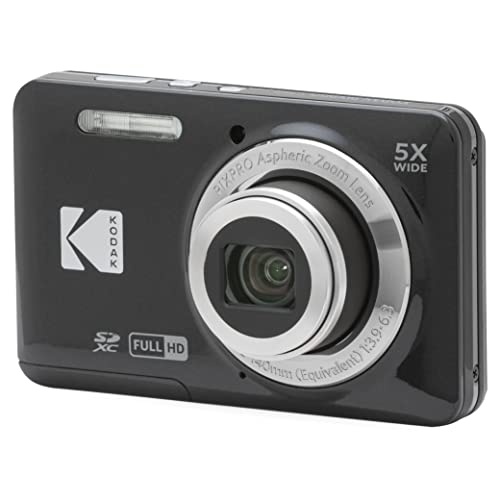
KODAK PIXPRO FZ55 — Best Simple Compact
Kodak’s PIXPRO FZ55 makes no grand claims, and in this category that restraint reads as integrity. The listing describes a 16MP compact with a 5X optical zoom, a 28mm wide-angle lens, 1080p full HD video, a 2.7-inch LCD and a lithium-ion battery, pitched as a point and shoot and vlogging camera. This is the camera for close-ups of opportunity: the mushroom after rain, the interesting shell, the flower a gardener is proud of, the coin a grandparent wants identified by a distant grandchild. It will not resolve a beetle’s eye facets, and it does not pretend otherwise in any language its title speaks.
The 28mm wide end is the relevant detail for casual close work, because compact cameras generally focus closest at their widest setting, letting the FZ55 frame a subject generously from a short distance while keeping its surroundings in view, which suits the storytelling close-up better than the specimen photograph. Simplicity is the deeper feature. A camera with a short menu and a forgiving automatic mode gets carried, and carried cameras take the close-ups that happen in real life, at markets, on hikes and across kitchen tables. The title does not state a minimum focus distance, so treat its macro ability as the compact class’s everyday close mode and verify the figure in Kodak’s specifications if a particular subject size matters to you. Within those honest borders, the FZ55 is the pool’s easiest recommendation to hand to a beginner without a briefing.
- Class: compact point and shoot, 16MP per the listing title
- Lens: 5X optical zoom with a 28mm wide-angle end
- Minimum focus distance: Not stated in the listing title — verify the macro focus range in the manufacturer specifications
- Video: 1080p full HD
- Screen: 2.7-inch LCD
- Power: rechargeable lithium-ion battery
Strengths
- Approachable operation that encourages everyday carrying.
- Wide lens end suits contextual close-ups of found subjects.
- An established brand’s support behind a simple tool.
Trade-offs
- Close focus is a convenience mode, not a macro specialisation.
- The modest zoom limits standoff work on shy subjects.
- Focus distance must be confirmed in the manufacturer’s specifications.
Best for: beginners and casual photographers whose close-ups are found, not staged. Not suited for: specimen photography, stacking, or resale-grade product detail.

Panasonic 4K Point and Shoot 60X — Best Reach for Close-Ups
This listing presents the same FZ80D bridge camera under its capabilities rather than its bundle: a 4K point and shoot with a 60X optical zoom and image stabilisation, model DC-FZ80D in the title. Sixty times zoom changes the macro conversation entirely, because it enables the standoff style at full strength. A dragonfly that would flee a camera at twenty centimetres can be photographed in frame-filling detail from two metres, lit by unobstructed daylight, with the background melted by the long lens’s natural shallowness. For living subjects, that distance is not a compromise; it is the difference between a photograph and a disturbance.
The 4K capture adds a second route to closeness: cropping. A frame recorded at 4K can be trimmed hard in editing and still yield a usable image, which lets a photographer shoot a cautious composition in the field and find the tighter macro framing at leisure, a workflow that suits beginners learning what a good close-up looks like. Stabilisation is the enabling technology for both routes, since long zooms magnify hand movement as faithfully as they magnify dragonflies, and much standoff macro is shot handheld between gusts of wind. As with its bundle sibling, the title states no minimum focus distance, so verify the macro focus range in Panasonic’s specifications, and understand this camera’s close-up power as reach plus resolution rather than microscope focus. Two listings of one camera in a single guide is unusual, and it is deliberate: the bundle serves the field kit buyer, this listing serves the buyer comparing headline capabilities, and the camera underneath is the same honest bridge.
- Model: DC-FZ80D per the listing title
- Zoom: 60X optical with image stabilisation
- Capture: 4K point and shoot photography and video
- Minimum focus distance: Not stated in the listing title — verify the macro focus range in the manufacturer specifications
- Style: standoff close-ups of shy subjects at long range
- Audience: nature photographers who value reach over proximity
Strengths
- Enormous optical reach photographs wary subjects undisturbed.
- 4K resolution funds aggressive cropping in the edit.
- Stabilisation keeps long-zoom close-ups usable handheld.
Trade-offs
- Reach is not close focus; tiny subjects still need proximity.
- Long zooms demand light, and dim woods will test it.
- Duplicates the bundle pick’s camera under a different listing.
Best for: insect, bird and garden photography from a respectful distance. Not suited for: true macro of minute subjects on a tabletop.

Dual-Lens Digital Camera with Macro Lens — Best Novelty Dual Lens
This unbranded compact takes a different route to the word macro: two cameras in one body philosophy, pairing macro and wide-angle dual lenses for selfies and close work, with WiFi, autofocus, a 3-inch screen and a vlogging pitch aimed at beginners and teens. Its listing leads with resolution figures of the kind this guide declines to repeat as tested fact, because headline numbers on unbranded compacts describe marketing ambition rather than measured output, and a buyer who understands that single sentence is already shopping more wisely than the listing expects.
Judged on what it plausibly is, the camera offers a playful introduction to close-up framing. A dedicated macro lens position, even a simple one, teaches the essential macro lesson better than any article: that closeness is a place you put the camera, with its own light and depth consequences, not a filter you apply afterwards. WiFi transfer suits its social purpose, moving a close-up of a nail design, a sketchbook detail or a LEGO build straight to a phone for sharing. The honest limits are equally clear. Accessory-class macro optics soften edges, autofocus at close range will hunt, and no focus distance is stated in the title, so the macro focus range belongs on your verify-in-the-specifications list, assuming specifications can be found at all. Buy it as a toy in the honourable sense, an inexpensive instrument for curiosity, and it can delight; buy it as a tool for selling jewellery or documenting a collection, and it will spend your patience instead.
- Class: unbranded dual-lens compact for beginners
- Lenses: macro and wide-angle dual cameras per the listing title
- Minimum focus distance: Not stated in the listing title — verify the macro focus range in the manufacturer specifications
- Connectivity: WiFi with autofocus
- Screen: 3-inch display
- Resolution claims: headline figures in the title are seller claims, not tested measurements
Strengths
- A dedicated macro lens position makes close framing tangible for beginners.
- WiFi suits quick sharing of casual close-ups.
- Low commitment as a first experiment in macro curiosity.
Trade-offs
- Headline resolution figures should not be believed as measurements.
- Documentation and specifications may be thin or hard to find.
- Not a tool for commercial or archival close-up work.
Best for: teens and beginners exploring close-up photography for fun. Not suited for: product listings, collections documentation or print work.

Dual-Lens Digital Camera with Lens Kit — Best Kit-in-a-Box
The second unbranded compact arrives as an event rather than a camera: a dual-lens vlogging body with a flip screen, WiFi, a microphone, a tripod, two batteries, a memory card, colour filters and, central to this guide, a wide and macro lens kit in the box. The kit philosophy deserves a fair hearing. A beginner does not yet know which accessories macro photography will demand of them, and a box that includes a tripod, the single most valuable macro accessory at any price, plus screw-on close-up lenses to experiment with, is a discovery set as much as a camera.
Screw-on macro lenses are the oldest trick in close-up photography, and their behaviour is well understood: they let a lens focus closer by adding optical power, at the cost of softness toward the edges and a working distance that shrinks as the effect grows. On a camera like this, that trade produces dreamy, centre-sharp close-ups of flowers and crafts that social audiences genuinely enjoy, while falling short of the crisp, edge-to-edge evidence that specimen and product work require. The same honesty applies to this listing’s headline figures, which are seller claims of the now-familiar kind. The tripod, the spare battery and the flip screen will still be useful if its owner graduates to a TG-7 later, which is perhaps the most generous and most accurate thing to say: this is a starter kit whose accessories outlast its optics, bought to learn what kind of close-up photographer you are.
- Class: unbranded dual-lens vlogging compact
- Kit: wide and macro lens kit, tripod, two batteries and card included per the title
- Minimum focus distance: Not stated in the listing title — verify the macro focus range in the manufacturer specifications
- Screen: flip screen for self-framing
- Filters: three colour filters included
- Resolution claims: headline figures in the title are seller claims, not tested measurements
Strengths
- The included tripod is a genuine macro tool, not filler.
- Accessory lenses let a beginner experiment with closeness cheaply.
- A complete box removes every excuse to postpone starting.
Trade-offs
- Screw-on macro optics soften edges and shrink working distance.
- Seller resolution figures are not measurements of anything.
- Build and support sit at the novelty end of the market.
Best for: gift buyers and experimenters who want the whole hobby in one box. Not suited for: anyone whose close-ups must persuade a buyer or a scientist.
How Do You Photograph Coins, Stamps and Small Products on a Table?
Tabletop macro is a discipline of stillness and parallelism. The subject does not flee, so the camera’s job narrows to rendering detail honestly, and the photographer’s job becomes carpentry: a support that holds the camera directly above or squarely in front of the subject, at a fixed distance, with the subject’s face parallel to the sensor. A tripod with a tilting column, a copy stand, or the humble tower of books all serve, and the kit pick’s included tripod earns its praise a second time here. Once the geometry is square, focus on the detail that carries the object’s identity, the date on the coin, the perforation line on the stamp, the hallmark inside the ring’s band, and let the rest fall where it may.
Light on a table is a design problem you can actually solve, unlike weather. Two small lamps at opposing angles, softened through tracing paper or a shower curtain’s worth of diffusion, reveal relief without the glare that a bare bulb throws off metal and gloss. Coins reward a single raking light that drags shadows across the relief and makes a worn portrait legible; stamps want flat, even light that shows colour truthfully; jewellery wants a tent of diffusion with one deliberate bright edge to give stones their life. The camera matters less than this patience, which is why the honest compacts in this pool can produce saleable tabletop work while a careless specialist camera produces expensive mush.
Colour honesty closes the tabletop lesson. Set white balance from a grey card or a sheet of known white paper under your actual lamps, because mixed household lighting will tint a silver coin blue and a gold ring green in the same frame. Sellers live or die by this: a buyer who receives goods that match their photographs leaves the review that builds a shop, and macro’s merciless detail makes colour the first place a mismatch shows. Shoot a test frame of a familiar object whenever the lighting changes, and keep the setup’s recipe written down, lamp positions, camera distance, settings, so that next month’s listings match this month’s and your shopfront looks like one careful person’s work.
What Is Focus Stacking, and Can These Compacts Do It?
Focus stacking is macro’s answer to its cruellest limit. When depth of field shrinks to millimetres, no single frame can hold a beetle sharp from horn to tail, so the photographer takes a series of frames, each focused a hair deeper than the last, and software merges the sharp slices into one impossible photograph with depth throughout. The technique transforms specimen and product macro, and it explains many of the eerily complete close-ups that make beginners despair of their own first attempts, which were never competing on level ground.
Compact cameras approach stacking from two directions. Some specialists in the TG-7’s class are known for focus bracketing and even in-camera stacking modes, a capability to verify in OM System’s documentation for the exact model, since the listing title does not discuss it. Other compacts can be stacked manually: lock the camera down, nudge focus in small steps between frames, and let desktop software do the merging, which demands a tripod, a still subject and a temperament for methodical work. Living subjects in the field mostly refuse to sit for a stack, so stacking belongs to the tabletop, the specimen tray and the very patient dawn insect, while field macro remains the art of placing one thin plane of focus exactly where the story is.
Beginners should treat stacking as a second-year skill with a first-year teaser. Learn single-frame macro until placing the focal plane is instinct, then stack a coin, a shell and a watch movement at the table where failure is free. The cameras in this pool will not stop you; the honest ones will simply refuse to pretend, in their listings or in this guide, that the software’s magic was ever the lens’s.
How Do You Choose Between the TG-7 and a Bridge Camera?
This is the pool’s real fork, and it is decided by working distance, not by budget. Ask where your subjects live. If they are small, still or aquatic, and you can place a camera centimetres away without harm, the TG-7’s close focus is the only tool here that truly fits, and its sealing widens the map to tide pools, frost and rain. If your subjects are alive, wary and lit by open sky, the bridge camera’s reach is the ethical and practical instrument, photographing from metres away with the subject’s behaviour intact. Many naturalists eventually own both shapes across a lifetime, starting with whichever matches the subjects that made them want a macro camera in the first place.
The secondary questions refine rather than overturn that answer. Travel weight favours the TG-7, which vanishes into a pocket the bridge cannot enter. Versatility across a whole day out, landscapes, birds, family, favours the bridge. Video ambitions are served by both at 4K, though neither is a cinema tool. Support ecosystems matter at the margins: the TG-7’s class carries dedicated macro lighting accessories worth investigating in the manufacturer’s documentation, while the bridge’s support is its own universality. What should never decide it is a headline number, neither the bridge’s zoom multiple nor any compact’s megapixel banner, because macro is a game of distances and light, and those are the terms on which this guide has graded every pick.
What About Using a Phone for Macro?
Fairness requires the question, because modern phones carry macro modes of their own and live in the pocket a compact must be remembered into. A phone’s close mode is genuinely good for the casual record: the menu photographed for a friend, the rash shown to a pharmacist, the flower identified by an app. Phones focus close, process aggressively and share instantly, and for the close-up as a note to self, nothing in this guide competes with the device already in your hand.
The phone’s limits arrive with intent. Its macro mode typically switches to a lesser ultra-wide camera, its working distance is fixed by software decisions you cannot overrule, its light is its own torch, and its processing sharpens and smooths according to tastes set for social photographs rather than evidence. The photographer who wants to choose the focal plane, control the light, work in water or cold, or print the result at size will feel each of those walls in turn. That is the honest border: phones own the casual close-up, and the cameras in this pool exist for everyone who has bumped into the border and wants to work beyond it, with the TG-7 standing farthest beyond it of all.
How Do the Six Compare Side by Side?
| Camera | Macro route | Focus distance stated | Zoom | Defining trait |
|---|---|---|---|---|
| OM System Tough TG-7 | Microscope-style close focus, class signature | Verify in OM System documentation | Compact fixed lens | True specialist that is also waterproof and freeze proof |
| Panasonic FZ80D Bundle | Bridge close-focus modes | Not stated in the listing title | Long-zoom bridge lens | Field kit with bag, card and cloth included |
| Kodak PIXPRO FZ55 | Everyday compact close mode | Not stated in the listing title | 5X optical, 28mm wide | Simplicity that gets carried and used |
| Panasonic FZ80D 60X | Standoff close-ups by reach and cropping | Not stated in the listing title | 60X optical | Frame-filling detail from metres away |
| Dual-Lens Macro Compact | Dedicated macro lens position | Not stated in the listing title | Dual-lens design | Playful WiFi compact for beginners |
| Dual-Lens Lens-Kit Compact | Screw-on accessory macro lenses | Not stated in the listing title | Kit-based versatility | Tripod and lens kit included in the box |
One row describes a specialist, two describe the same bridge camera wearing different listings, one describes an honest simple compact, and two describe novelty routes whose value is experimentation. The focus-distance column is the guide’s conscience: only the TG-7’s close focus is famous enough to discuss as a class fact, and even there the exact range belongs to the manufacturer’s documentation.
How Do You Light and Steady a Macro Shot?
At macro distances, technique outranks equipment so completely that a modest camera in disciplined hands will embarrass a fine one in careless hands. Steadiness comes first. Depth of field is measured in millimetres, so the plane of focus must be placed, not hoped for: rest the camera on a beanbag, a fence or the tripod one of our kit picks includes, focus on the subject’s eye or the coin’s date, and let a self-timer or remote release fire the shot so your hand’s departure does not become the photograph’s subject. In the field, your own body is a windbreak and a light modifier; kneel, brace your elbows, and wait out the gusts, because macro subjects on stems are pendulums and patience is a shutter speed.
Light is the second discipline. The camera at close range shadows its own subject, so the classic solutions are to bring light around the lens, with a diffuser softening a flash or an LED panel, or to choose light that is already soft, the open shade of a porch or an overcast morning that field macro photographers quietly prefer to sunshine. The TG-7’s class is famous for accessory diffusers that wrap light around its lens for exactly this reason, a detail worth confirming in OM System’s documentation when you shop its ecosystem. Bright, direct sun is the beginner’s false friend: it promises easy exposures and delivers black shadows, blown petals and a photographer-shaped eclipse across the subject.
Finally, compose for the sliver. With depth of field so thin, the subject’s important plane, an insect’s eyes, a stamp’s perforations, a ring’s setting, must lie parallel to the sensor, which means moving your body rather than angling the camera and hoping. Sellers of small goods learn this as the flat-lay discipline, and our guide to the best cameras jewelry photography treats that tabletop geometry in the depth it deserves. Take more frames than feels dignified, shifting focus a breath at a time; macro’s contact sheet has always been a haystack with a needle in it, and the needle is worth the hay.
How Do You Photograph Living Subjects Without Ruining Their Day?
Field macro has an ethics and a craft that overlap. The craft says approach slowly, from the subject’s blind side where one exists, in the cool of morning when insects are sluggish and dew does half your lighting design for you. Long-zoom standoff photography, the FZ80D 60X’s whole argument, exists because many subjects should not be approached at all: a butterfly feeding, a bee working a flower, a frog at a pond’s edge will each tolerate a distant lens indefinitely and a close one for seconds. Choosing reach over proximity is frequently the mark of the better naturalist, not the lazier one.
The ethics say the photograph is never the most important thing at the scene. Do not chill, trap, glue or relocate a creature for a picture; do not strip the leaf a subject is sheltering under; leave a tide pool’s citizens where the tide left them, which the TG-7’s underwater ability makes gloriously possible by photographing them in place. Gardens offer the honourable shortcut: plant what pollinators love, place a comfortable perch near the flowers, and let the subjects book their own sittings across a whole summer. A macro portfolio built on patience and hospitality will outlast, in quality and in conscience, one built on pursuit.
Tabletop subjects have their own gentler version of the same care. Coins, stamps and jewellery photograph best clean, lit softly and handled by their edges, and a copy stand or a steady stack of books beats a wobbling hand for the flat, parallel framing that shows detail honestly. Sellers should remember that macro honesty is commercial honesty: a photograph that reveals a coin’s wear or a ring’s hallmark builds the trust that closes sales, while a soft, flattering blur invites returns. The cameras in this pool span that range of intent from the TG-7’s evidence-grade close focus to the novelty compacts’ impressions, and matching the tool to the trust you need is the buyer’s real decision.
How Do the Seasons Change Your Macro Subjects?
Macro photography is a calendar disguised as a hobby, and the camera you buy in one season will meet a different cast in the next. Spring is emergence: seedlings uncurling, the first bees working early blossom, frogspawn becoming tadpoles in the pond that the TG-7 can visit at the surface. It is the season of close focus at ground level, of kneeling on wet earth, and of dew that turns every grass stem into a chandelier before breakfast. Summer brings abundance and difficulty together, insects at their most numerous and most energetic, flowers at full stretch, and hard midday light that sends the wise photographer out at dawn and dusk and into the shade at noon.
Autumn is the specimen season: fungi after rain, seeds and husks engineered like sculpture, spiders at their largest and most patient, leaves whose decay writes patterns no spring leaf attempts. The bridge cameras earn their keep here, reaching fungi on the far side of a ditch and wary insects in the last warm hedgerows. Winter, finally, is macro’s secret masterpiece: frost feathers on a window, ice crystals on a fence wire, the architecture of a snowflake on dark wool. It is also the season that justifies freeze proofing in a listing title, because a camera that works at the temperatures where frost forms will bring home photographs that fair-weather tools never attempt. Buy any camera in this pool and you have bought four different hobbies a year; the photographers who thrive are the ones who learn the calendar and let it assign their subjects.
What Should You Verify in the Manufacturer’s Specifications Before Buying?
Since this guide has repeatedly sent you to the manufacturer’s specifications, it owes you the shopping list for the visit. First and above all, the minimum focus distance, and the zoom setting at which it applies, because many compacts focus closest only at their widest angle, a fact that changes how a subject can be framed. Second, the magnification or reproduction ratio if the maker publishes one, the truest single number in macro. Third, the macro mode’s restrictions: some modes lock the zoom, disable the flash or cap the resolution, and a mode that quietly reduces image size is a fact a buyer deserves before the first field trip rather than after it.
Then the supporting cast. Check which lighting accessories the maker offers for close work, diffusers and ring lights in the TG-7’s ecosystem being the famous example, because macro light is a system purchase disguised as an afterthought. Check the tripod socket’s position relative to the battery door, a homely detail that decides whether cards and batteries can be swapped without dismantling your tabletop rig. Check the sealing claims behind words like waterproof, including the depth and the conditions, where the subject is water. And check the manual’s macro chapter itself: a manufacturer that writes three thoughtful pages about close focusing has built a camera that does it, while a manual that mentions macro once, in a list of scene modes, has told you the truth in its own way.
What Are the Common Mistakes When Buying a Macro Camera?
The first mistake is shopping by the word macro itself, which listings apply to everything from the TG-7’s microscope mode to a screw-on lens in a gift box. The antidote is the question this guide has repeated until it became a rhythm: what is the minimum focus distance, stated where, by whom. A seller who cannot answer has told you something important. The second mistake is its cousin, shopping by headline megapixels, especially on unbranded compacts whose figures describe the box’s ambitions. Resolution you can use is made by lenses and light, and a modest sensor behind honest optics will out-photograph a fantasy figure behind a plastic accessory every day of the week.
The third mistake is buying reach when you needed closeness, or closeness when you needed reach. A tabletop photographer with a 60X bridge will spend their life backing away from coins; a butterfly photographer with a close-focus compact will spend theirs crawling toward subjects that leave. Name your subject and its working distance before you name a camera, and the pool sorts itself. The fourth is neglecting the accessories that make macro real: a tripod or beanbag, a diffuser, a spare battery for long field sessions, each cheaper than any camera here and each worth more than a specification upgrade.
Finally, beginners mistake their first soft results for the camera’s verdict. Macro punishes haste more than any branch of photography, and the same camera that disappoints in week one, handheld at noon with the subject backlit, will astonish in week six at dawn with a beanbag and a diffuser. Buy the honest tool your subjects require, then invest the season in the technique sections above before blaming the instrument; in macro, the learning curve is the product, and the cameras are merely how you pay for it.
Final Recommendation
If macro is the mission, buy the OM System Tough TG-7 and do not look back; it is the only camera in this pool designed from the sensor outward for close focus, and its sealing carries that focus into the wet, cold, salty places where close subjects live. If your photography ranges wider, the Panasonic FZ80D in either listing is the naturalist’s compromise, the bundle for the field-ready kit, the 60X listing for the standoff artist, with the Kodak FZ55 waiting for anyone who wants close-ups to stay as simple as noticing them. The two unbranded dual-lens compacts are invitations to experiment rather than instruments of record, and bought in that spirit they can start a hobby honestly. Whichever you choose, take it outside on the first still morning, kneel beside something small that you have walked past a hundred times, and discover the crowded, glittering, previously invisible country that begins exactly where your shoe ends.
Frequently Asked Questions
What is the difference between macro and a close-up mode?
A close-up mode simply lets a camera focus nearer than usual, filling more of the frame with a subject. True macro renders the subject at or near life size on the sensor, which demands focus distances of a few centimetres and optics designed for that range. The TG-7’s microscope-style mode is this pool’s genuine macro; the other picks offer close-up modes or accessory routes of varying usefulness, which their sections grade individually.
Why do several spec boxes here say the focus distance is not stated?
Because the listing titles genuinely do not state it, and minimum focus distance is the single most decisive macro specification. Rather than borrow figures from reviews or sibling models, the guide marks the gap and directs you to the manufacturer’s specifications, where the figure for the exact model can be confirmed before money changes hands.
Can a long zoom really substitute for macro focus?
For living subjects, often yes: a 60X lens photographs a dragonfly at frame-filling size from a distance that leaves it undisturbed, lit and behaving naturally. What reach cannot do is magnify a motionless tiny subject beyond the lens’s own close-focus limits, so tabletop specimens, coins and stamps still belong to true close-focus cameras. The two styles complement rather than replace each other.
Are the high megapixel figures on budget compacts real?
Treat them as seller claims. Unbranded compacts advertise headline numbers that their small sensors and simple lenses cannot deliver as resolved detail, which is why this guide never repeats those figures as tested resolution. Judge a budget compact by its lens, its focus behaviour and sample images you can inspect, not by the largest number on its box.
Do I need a tripod for macro photography?
Need is strong, but at macro distances the case is close to it: depth of field is millimetres thin, shutter speeds fall as light is diffused, and the plane of focus must be placed with a precision hands rarely hold. A tripod, a beanbag or even a steady stack of books transforms results, which is why the included tripod in one kit pick is praised as a real tool rather than packaging.
Is the TG-7 only for underwater use?
No; the water and frost proofing are freedoms, not assignments. The same sealing that photographs a reef also shrugs off dew, rain and cold on land, and its macro design serves gardens, workshops and collections. Divers made it famous, but field naturalists and close-up specialists of every dry-land kind are its natural owners, a point our coverage of the best point and shoot waterproof cameras echoes from the durability side.
Related Guides
Close-up work borders several neighbouring specialisms. Bridge cameras with larger sensors reward a look in best bridge cameras with 1 inch sensor. Extreme telephoto compacts are compared in best 50x superzoom digital cameras. For pocketable zoom cameras judged on travel rather than macro, see best 20x optical zoom compact cameras.
Patience at the other timescale is rewarded in best cameras to do timelapse.
When a compact stops being enough for video work, best dslr cameras for live streaming explains what replaced the DSLR.
Related guides
- Best 3D Art Tablets
- Best Balancing Stabilizers for Mirrorless Cameras: Payload, Balancing and Native Vertical Shooting
- Best Canon Point and Shoot Digital Cameras: PowerShot Picks From Pocket Compacts to Travel Zooms
- Best Basic Phones Camera Buyers Can Trust: Flip Phones and Simple Handsets That Still Take a Photograph


